正在加载视频...

视频加载失败

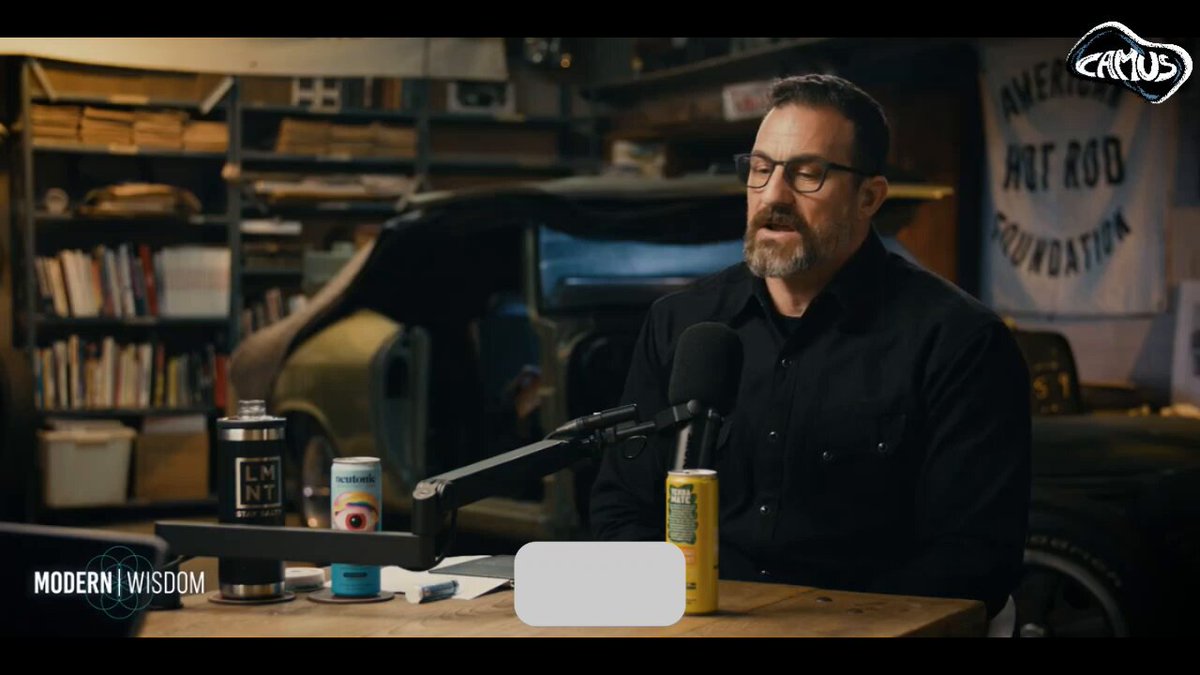
Andrew Huberman drops a mind-blowing sleep science fact: Your face after a bad night’s sleep is literally swollen with lymph buildup — and it’s the same system clearing waste from your brain, spinal cord, and even your eyes. Key takeaways from the clip: - Glymphatic clearance (brain’s nightly detox)...

913,489 次观看 • 8 个月前 •via X (Twitter)

35 条评论

Camus 的头像
Camus8 个月前

Full podcast:

Rick 的头像
Rick8 个月前

Sounds dramatic, but getting my sleep in order has been an absolute game changer for me. This book is an excellent resource to start with.

Pale Stag Mythos 的头像
Pale Stag Mythos8 个月前

So… a pillow

James N Hansen 的头像
James N Hansen8 个月前

I’m convinced that nasal cycle optimization is the key to lymphatic clearance. Now that I exclusively breathe through only one nostril and I’m congested continuously on the other side I only need about four hours of sleep and I feel fantastic and I’m 70.

The Sword Path 的头像
The Sword Path8 个月前

True. Sleep clears waste. Puffy face is a receipt. But men don’t need more sleep trivia. They need a life that makes them tired for the right reasons. The face reflects the spine. Disorder upstream shows up under the eyes.

Michael Stan 的头像
Michael Stan8 个月前

I wish I understood this in 2016 when I was running my business into the ground. I was sleeping 4 hours a night thinking I was being productive, but I was just making terrible decisions with a foggy brain. My cash flow spreadsheets were riddled with errors because I couldn't think straight. Sleep isn't a luxury for entrepreneurs, it's a competitive advantage. If you can't see clearly, you can't plan accurately. And if you can't plan accurately, you lose money. It's that simple.

Mark 🌄 的头像
Mark 🌄8 个月前

Wild how visible sleep deprivation really is. It’s not just “feeling tired”—your body literally can’t clear waste properly. Good sleep posture might be the most underrated health and appearance upgrade there is.

Lindén 🇸🇪 的头像
Lindén 🇸🇪8 个月前

Thanks! However, as usual with Huberman’s claims, we need to fact-check then very thoroughly since about 40% are true.

Paul Brassey 的头像
Paul Brassey8 个月前

@hubermanlab I’ve been sleeping that way for years. Front of the bed is 3 inches higher. Helps avoid gastric reflux.

Osama Saamba 的头像
Osama Saamba8 个月前

So the real glow-up isn’t skincare… it’s lymph drainage while you sleep.

Rob Rene | Faith & AI 🙏 的头像
Rob Rene | Faith & AI 🙏8 个月前

Spot on! As a cancer warrior, optimizing sleep has been a game-changer in my healing—glymphatic clearance detoxes my brain and body from chemo toxins, slashing inflammation and boosting energy. Slight head elevation + side sleeping? Pure gold for lymphatic flow and that refreshed glow! Pro tip: Add breathwork before bed to amp oxygen levels and pair with molecular hydrogen water for deeper cellular detox. God's design for rest is unbeatable. Who's hacking their sleep routine tonight? 💤🙏💪 #SleepBiohack #GlymphaticSystem #CancerWarrior #FaithOverFear #NaturalHealing

Makai Elías Calles 的头像
Makai Elías Calles8 个月前

@ChrisWillx

I 的头像
I8 个月前

Doubling my pillows for leverage

Aesthetic Villain 的头像
Aesthetic Villain8 个月前

Sleep really clears waste

Ex mental health nurse 🦘🐨 的头像
Ex mental health nurse 🦘🐨8 个月前

@hubermanlab People don’t talk about the lymph/glymph systems enough. If they’re not functioning properly the entire body (including the brain) suffers. 👍@hubermanlab for putting this in the spotlight.

Nico 的头像
Nico8 个月前

Your face is literally a sleep quality dashboard that everyone can read except you The biological flex of "I only need 4 hours" is writing itself on your face in real time

Josh Whiton 的头像
Josh Whiton8 个月前

@lifeext but hair loss is being correlated with reduced blood flow to the scalp. I think i’ll just keep sleeping flat, or maybe rotate strategies.

Robert Kopacz 的头像
Robert Kopacz8 个月前

@hubermanlab I started doing this not too long ago and saw the results almost immediately.

EJ Aguado 的头像
EJ Aguado8 个月前

best pillow for this?

Mary 的头像
Mary8 个月前

Really anything can happen, not how you guys feel about it.

Dallas 的头像
Dallas8 个月前

Just your head? I wouldn't think that would be good for the neck, are you saying the entire bed should be slighted elevated at the top?

Something Clever for anonymity 的头像
Something Clever for anonymity6 个月前

Bats. Cows.

Rejuve.AI 的头像
Rejuve.AI8 个月前

Sleep is cosmetic, cognitive, and metabolic.

Paolo Moneti 的头像
Paolo Moneti8 个月前

40 Hz photic and acoustic stimulation increases glymphatic flow.

Jen 的头像
Jen8 个月前

I think you will be interested in this article published in the Journal of Alzheimer’s Disease.

Brian Baumann 的头像
Brian Baumann8 个月前

@ChrisWillx @freckleyed

datjuicy 的头像
datjuicy8 个月前

@grok given what he is saying in a picture show me how i should sleep

Geoffrey Allott 的头像
Geoffrey Allott8 个月前

@hubermanlab Kipp Ludwig- look him up- University of Wisconsin

Pr Chapi Chapo 的头像
Pr Chapi Chapo8 个月前

Well, just take a look at Matt Walker and how sleep made him look beautiful now than ever 😂

ILMVOMan 的头像
ILMVOMan8 个月前

Great if you want to worry about things that are only important in a wealthy society where most of your “problems” (food,shelter, sustenance, safety from predators) are taken care of. Relax. Lighten up. You’re fine. 🤦‍♂️

4F Hepcat 的头像
4F Hepcat8 个月前

It’s important too to avoid plaque build up i.e. dementia risk in the brain.

Vin 的头像
Vin8 个月前

@hubermanlab “ sleeping better with your head slightly raised? ” Would be nice to see an example

James N Hansen 的头像
James N Hansen7 个月前

Hmm, after racking up 7,000 views on my last repost, here's another dive into sleep hacks inspired by that Camus clip on Huberman's glymphatic insights. My sleep needs dropped to just 4.5 hours/night after adopting one-nostril breathing and swapping sides ~10x/day. Here's how: I side-sleep with my head on the pillow, nose close to the mattress—this keeps the lower nostril fully open while the upper one congests naturally. When congestion flips (1-2x/night), I roll over and repeat. Building on Dr. David Newell's transcranial Doppler observations of slow B-waves (~every 1-2 minutes) during deep sleep, which pump glymphatic fluid to clear brain waste: One key drain route? Along nerves to the nose. My theory: Forcing full patency in the lower nostril (with upper congested) supercharges glymphatic clearance in 3 ways: 1. **Boosted Flow Dynamics**: Higher air velocity through one nostril amps up the Bernoulli effect at sinus openings, creating negative pressure that ramps nitric oxide (NO) production *and* speeds its delivery to lungs/blood. More NO during sleep likely amplifies Newell's B-waves for stronger pumping. 2. **Healthier Sinuses**: Those 10 daily congestion/decongestion cycles keep my nose ultra-clear—no dust, pollen, or bacteria buildup. Lifelong allergies, apnea, and snoring? Gone. 3. **Gravity + Vibrant Drainage**: With the drain at the bottom, gravity pulls "brain sewage" down. My nasal tissues stay lively, with cilia beating in sync (~7 Hz), sweeping fluid throatward (keeping it moist for even more NO, looping back to #1). Bonus speculation: This might flush microplastics straight to the toilet—zero in my brain? I sleep like crap without this method, but even "doomscrolling" in position gives ~80% of the deep-sleep vibe. Sleep lab volunteers? Easy tests: Measure my NO levels, breathing/BP/HR, or use tracers to track brain clearance. Let's science this! What do you think, @hubermanlab? Ties right into your glymphatic talks.

Wellness.Amethos 的头像
Wellness.Amethos8 个月前

Sleep isn’t just restorative for the brain—it literally affects lymphatic and glymphatic clearance. Side or slightly elevated sleeping positions help your brain and face drain optimally.

Diminutive Richard 的头像
Diminutive Richard8 个月前

What's he trying to sell you in this clip?

相关视频

with consistent buccal massage treatment, you unlock — decreased inflammation via stimulated lymph flow — improved facial symmetry through muscle relaxation — reduced TMJ dysfunction and jaw tension — increased ATP production and cellular detoxification — smoother fascia = fewer wrinkles and sagging — enhanced collagen synthesis from boosted circulation — normalized cortisol via parasympathetic activation — and long-term reeducation of facial muscle memory the buccal region (aka: the cheeks, lower face, and inside of your mouth) holds major lymphatic vessels, fascia, and muscle tension hotspots, especially the masseter and buccinator. these are two of the most overused muscles in the body. you clench them in your sleep. when you scroll. when you’re anxious. when you speak. and when they’re tight, they restrict blood flow, lymph flow, and literally pull your face downward. buccal facial massage — externally, it manually stimulates lymphatic drainage pathways along the jaw, cheek, and neck, reducing stagnant fluid, increasing microcirculation, and oxygenating the skin. — intraorally, fingers go inside the mouth to reach the inner surface of the buccinator and deep fascia. this releases chronic tension, improves neuromuscular function, and restores balance to the facial structure. translation? your face becomes tighter, lifted, sculpted—not because it’s frozen, but because it’s healthy. — sharper jawline — de-puffed under eyes — higher cheekbones — smoother nasolabial folds — brighter skin tone — actual nerve relaxation — and for some: less grinding, better sleep, even improved digestion (via vagus nerve stimulation) so if your face feels heavy, puffy, asymmetrical, or tired—it’s not “just genetics.” it’s stagnation. and lymphatic buccal massage is the antidote. get the tension out. let the lymph drain. and watch your real face reappear

raw milky

339,802 次观看 • 1 年前

Around 80% of the world is now struggling with sleep, but what if we’ve been trying to fix the wrong problem? For years, we’ve been told that poor sleep comes down to our habits, routines and discipline... But Stasha Gominak believes there is a much deeper conversation we need to have about what is happening inside our bodies. Stasha is a Harvard-trained neurologist who spent more than a decade researching sleep after noticing patterns in thousands of patients. She left traditional medicine because she wanted more time to understand the experiences people were having and the questions that weren’t being answered. During our conversation, she shared why she believes listening to patients changed the way she understood sleep, health and the human body. We discussed things like: - Millions of people sleeping enough hours but still feeling exhausted. - The hidden role REM sleep plays in how we think, feel and function. - A surprising link between vitamin D, gut health and sleep. - The relationship between sleep, memory and emotional health. The relationship between sleep, memory and emotional health. - Mistakes people make when trying to fix their sleep. Stasha's whole point is that sleep isn't about hours in bed - it's about what's actually happening in your brain and body while you're asleep. If you’ve been doing "everything right" and you’re still waking up exhausted you will take a lot from this conversation. Out now on all platforms. Let me know what you think of this one in the comments ❤️👊🏾

Steven Bartlett

34,915 次观看 • 2 个月前

The only thing worse than Homeopathy? Scientists on the internet without any knowledge on clinical medical practice, selling supplements that they endorse, using misinformation masquerading as "solid peer reviewed science." Check this video out, when Huberman bullshits everyone in just half a minute on the Joe Rogan Experience Podcast. Before I go on, please remember this The Bullshit Asymmetry Principle, also known as Brandolini’s Law, states that the amount of energy needed to refute bullshit is an order of magnitude bigger than that needed to produce it. Which means, I have to put extra effort just to debunk the 36 seconds of that podcast. First, a little about sleep disorders Sleep disorders are of different types and due to different causes. The diagnosis is simply not "I can't sleep" and so here, take this sleep cocktail. Many patients come with sleep disorders that are associated with other conditions. For example, cirrhosis patients have sleep disorders that require management with ammonia lowering therapies and severe cases can only be reversed with a liver transplant. Patients with alcohol use disorders have sleep disorders that require management with de-addiction therapies along with sedatives. Sleep disorders in the ICU set up has different causes. People with mental health disorders have associated sleep disorders. Certain sleep disorders have no identifiable causes and are called "idiopathic." Which means, coming on a podcast and blindly giving out a "sleep cocktail" to millions of viewers, who may be suffering from a sleep disorder which has an as yet unidentified cause, is one of the most foolish things one can do. And Huberman, not being an actual clinical doctor, makes that exact mistake. Huberman claims (very generally and casually), melatonin helps you to go to sleep, but does not maintain sleep. But "solid peer reviewed" studies have much more to say about melatonin. Melatonin improved sleep onset latency and total sleep time in children/adolescents with neurodevelopmental disorders. Melatonin also improved and sleep onset latency and total sleep time in adults with delayed sleep phase disorder. Treatment with melatonin has positive effects on sleep quality in adults with respiratory diseases, metabolic disorders, primary sleep disorders, not with mental disorders, neurodegenerative diseases and other diseases. This meta-analysis demonstrated that melatonin decreases sleep onset latency, increases total sleep time and improves overall sleep quality. Another large meta-analysis showed that melatonin dosing and timing matters: for circadian phase advancement, an earlier time and smaller dose, but for sleep quality/consolidation a larger and later dose seemed appropriate. See here: So melatonin does increase total sleep time, total sleep quality and reduces time to sleep and has beneficial effects in specific groups of patients. Now the "solid peer reviewed studies" on the cocktail - which Huberman claims on three supplements - magnesium threonate, apigenin and L-theanine. Unfortunately, such "solid peer-reviewed papers" DO NOT EXIST. Lets see. Magnesium supplements: First of all, there is no conclusive evidence that magnesium, dietary or supplemented has any actual effect on sleep. Randomized clinical trials showed an uncertain association between magnesium supplementation and sleep disorders. See here: Forget sleep, magnesium has absolutely no evidence for involvement even in mood disorders. See here: This review confirms that the quality of literature is substandard for physicians to make well-informed recommendations on usage of oral magnesium for older adults with insomnia. See here: Apigenin (from Chamomille): The possible sleep inducing effects of apigenin is still speculative. There are absolutely no solid peer reviewed studies or evidence for benefits of apigenin in sleep as Huberman claims. See here: A randomized, double-blind, placebo-controlled pilot trial showed that chamomille DID NOT have conclusive effects on sleep. See here: Even better, a systematic review and meta-analysis of randomized trials and quasi-randomized trials showed that there was very little evidence to show effect of chamomille on insomnia. See here: L-theanine supplements: There is absolutely NO study or data to suggest that L-theanine is useful for sleep induction, improving sleep quality or increasing total sleep time. The only studies that are of "better quality" shows that L-theanine "maybe" useful in reducing anxiety/ stress levels due to caffeine at night. See here and here The only other "study" on L-theanine which was done on mice and not humans showed effects only on brain related biomarkers and were not applicable in the clinical sense to humans - And coming to SOLID EVIDENCE on the "Huberman cocktail" - there is absolutely nothing in published literature to confirm that it works and there is no convincing mode of action of this cocktail in humans. A large systematic review and meta-analysis showed that Cognitive-Behavior Therapy for Insomnia was the best and not some random supplements proclaimed on a podcast by half-baked scientists who are full time supplement sellers. See here: There are basic scientists, with no or half-baked clinical practice knowledge, trying to sell you a bunch of useless supplements that they endorse for a paid-commission, using "science-sounding" words without any practical, rational or logical meaning; and push untested and unregulated therapies that are NEVER recommended, approved or promoted by any active, medical, scientific clinical societies worldwide. They are worse than pseudoscience peddlers. Be aware of where you find your health information. There is pseudoscience, but then there is also another terrible type of misinformation: BAD SCIENCE.

TheLiverDoc™

475,648 次观看 • 3 年前

New mattress unboxing and I have THOUGHTS. My old mattress had full Shelli-shaped dents in it. I am talking body impressions. I was waking up every single morning with sore hips and sore shoulders because I am a side sleeper and my mattress had basically molded itself around my old body and never updated. I knew I needed a new one. I found a memory foam mattress for about $150 and yes I financed it and yes it was worth every penny. Shout out to whoever recommended this one, I cannot remember who you are but I owe you one❤️ Four nights in. Here is the honest report: Night 1: Rough. Different feel, different position, brain would not settle. Normal. Night 2: Woke up with ZERO hip pain. Zero shoulder pain. I just laid there for a second because I could not believe it. Night 3: Slept like an absolute log. Night 4: Same. No hips. No shoulders. No back pain. Four nights. Now let me tell you why this matters beyond just comfort. Sleep is not optional on a healing journey. It is not a bonus. It is the foundation that everything else is built on. While you sleep your body: Regulates cortisol, and high cortisol is one of the biggest stall factors nobody talks about. Repairs tissue and reduces inflammation, the very inflammation we are trying to heal with what we eat. Balances hunger hormones, poor sleep spikes ghrelin (the hunger hormone) and crashes leptin (the fullness hormone), which means you wake up ravenous and nothing satisfies you. Processes and consolidates memory and emotional regulation, this is why sleep deprivation makes anxiety and depression so much worse. Supports insulin sensitivity, bad sleep alone can cause blood sugar dysregulation even if you are eating perfectly. You can be eating the cleanest carnivore on the planet and sleeping on a mattress that is destroying your sleep quality and wonder why you are stalled, inflamed, anxious, and exhausted. I was that woman. I am not saying go buy a mattress. I am saying your sleep environment matters as much as what is on your plate. If you are waking up in pain every day that is inflammation before you even start your morning. Fix the sleep. Everything else works better. $150. Financed. No regrets. I’ll drop the 🔗 below if you want to check it out.🛌🥱

Queen of Carni

16,907 次观看 • 6 个月前

jihoon’s sleep paralysis is so bad that he went in and out of it more than 10 times during his massage today :( he couldnt even sleep and get some rest even if he had the time to :( i feel so bad :( 🐶 right after I got back to Korea, I went to get a massage. while I was getting the massage, I ended up getting sleep paralysis. 🐶 u know how it is, right? when you get sleep paralysis, you wake up - fall asleep - get sleep paralysis - wake up - fall asleep - boom sleep paralysis. over and over. u know you’re trapped in that cycle, but you can’t escape it because you’re so tired that you keep falling back asleep 🐶 im like “ah im probably gonna get sleep paralysis again” but at the same time you think, “maybe this round will be different” 🐶 but no, I got sleep paralysis so many times. I seriously got stuck in an endless loop. I was trying so hard to snap out of it, like moving around and struggling, and then when I finally woke up, the massage therapist was like 👩🏻 oh? are you okay? is this position uncomfortable for you? 🐶 so I pretended it was that and went “ah yeah im okimokimok” 🐶 then I fell asleep again, and it happened again. I’d move around, wake up, and they’d ask me if im okay. i say yes. this happened like three or four times. 🐶 then later they put something warm on me. but when they did, I suddenly got kind of scared because I was already in that weird state, so I asked, “how long does this stay on for?” and they said about 7 minutes. by then I’d already had sleep paralysis like four times in a row. every time it happened, i’d wake up - sleep paralysis - wake up - sleep paralysis just over and over. 🐶 anyway, after it was all done 👩🏻 does your body feel okay now? 🐶 oh yeah yeah my body feels great. yes yes I think I feel really good 🐶 my manager said he could give me a ride, but since the other hyungs had just gotten back to Korea too, I was like, “no everyone go home and rest. its Sunday anyway, I’ll go by myself.” 🐶 so I was dragging myself home thinking, “should I just lie down and sleep right here on the street?” but it was so hot today, and the back of my neck was burning from the heat. I pulled myself together and got home. 🐶 honestly, I was planning to sleep. I thought I’d sleep for like three hours after getting home, but I just couldn’t fall asleep. And seriously, this is torture. the suffering of insomnia is real. people who can actually sleep when they want to sleep are seriously amazing. 🐶 I really tried today. I turned on the styler, lay there with my eyes closed for like forty minutes, but in the end I couldn’t sleep. so I was like, “okay if it’s gonna be like this, i’ll just start a livestream! okay”

shan

58,747 次观看 • 4 个月前

WHY YOU WAKE UP IN THE MIDDLE OF THE NIGHT Your brain has 20,000 neurons clustered in the hypothalamus. They form the suprachiasmatic nucleus. This is your master clock. It's been running since before birth. At 25, this clock kept you unconscious until morning. At 65, the same clock runs on less melatonin, weaker signals, and a rhythm that physically shifted 2-3 hours earlier. It fires a wake signal between 2-4 a.m. Four systems inside your body shifted with age. They converge at the same hour every night. The thoughts that arrive at 3 a.m. feel different from the same thoughts at 3 p.m. because your brain runs a different program in the dark. The part that would normally tell you those thoughts aren't emergencies is still asleep. THE CLOCK MOVED FORWARD The suprachiasmatic nucleus generates a near 24-hour rhythm controlling when you feel alert and when you feel sleepy. In young adults, peak sleepiness arrives around 11 p.m. Peak alertness arrives around 9-10 a.m. Blue light at 480 nanometers activates melanopsin cells in the retina. These cells send signals directly to the suprachiasmatic nucleus, synchronizing your clock to the day-night cycle. With age, the clock shifts earlier. This is circadian phase advance. The sleepiness signal arrives at 7-8 p.m. instead of 11 p.m. The wake signal arrives at 3-4 a.m. instead of 6-7 a.m. The entire sleep-wake window moves forward 2-3 hours. The suprachiasmatic nucleus itself degrades. Neurons deteriorate. The amplitude of the circadian signal weakens. Peaks become shallower. Troughs become less deep. The radio station loses transmitter power until the signal becomes fuzzy and inconsistent. The clock's sensitivity to light cues diminishes through two mechanisms. The aging lens yellows and thickens, filtering more blue light before it reaches the melanopsin cells. The suprachiasmatic neurons themselves respond less robustly to whatever signal does arrive. Weaker input through a cloudier window. Less responsive neurons processing that input. The clock drifts. When the circadian clock drifts without strong light cues, it drifts earlier. Phase advance is the default direction of an unanchored aging clock. MELATONIN COLLAPSED The pineal gland releases melatonin at night to initiate and maintain sleep. This hormone declines with age. The pineal gland calcifies gradually over decades, reducing functional tissue and capacity to produce melatonin. By 65, nighttime melatonin levels can be one-third to one-quarter of what they were at 30. Sometimes less. Melatonin doesn't just initiate sleep. It maintains depth and continuity across the full night. When melatonin is low, sleep is shallower, more fragmented, more vulnerable to interruption. Even if you fall asleep at a reasonable hour, low melatonin cannot hold you through to morning. Your body tries to put you to sleep at 8 p.m. and wake you at 3 a.m. That's a 7-hour sleep window. It might be enough sleep for your shifted clock. But you fight the 8 o'clock drowsiness. Social life, television, family, habit. You stay up until 10 or 11. The clock doesn't adjust to your social schedule. It fires the wake signal at 3 regardless. The clock runs on light and biology, not preferences. You lost 2-3 hours from the front of your sleep window by staying up late. The alarm still goes off on the original schedule. The 3 a.m. waking isn't a malfunction. It's your shifted clock doing exactly what it was programmed to do. This is social jet lag. The gap between your biological clock time and your social clock time creates the same physiological mismatch as flying across two or three time zones. Your body is in one time zone. Your social life is in another. The drowsiness you fight at 8 p.m. is your body's genuine sleep onset signal. The waking at 3 a.m. is your body's genuine wake signal. The problem isn't the signals. The problem is overriding one without being able to override the other. There's a compounding factor. The shifted clock means your body wants to sleep earlier. The reduced melatonin means it cannot hold sleep as deeply or as long. You're caught between two problems: a clock that fires the wake signal too early and a chemical supply that cannot maintain the sleep signal through the full night. Even if you went to bed at 8, the reduced melatonin might still fail to hold you past 3 or 4. The clock shifted the window. The melatonin shrank it. DEEP SLEEP DISAPPEARED Sleep cycles through stages roughly every 90 minutes. Light sleep, deeper sleep, deeper sleep, then REM. The stage that matters most for feeling rested is slow-wave sleep, stage N3, the deepest phase. Brainwaves drop to large, slow delta oscillations at 0.5-4 hertz. During slow-wave sleep, the glymphatic system activates. Cerebrospinal fluid flushes through brain tissue along channels that open when neurons shrink slightly during deep sleep. This clears metabolic waste: adenosine, the molecule that builds sleep pressure during the day, and amyloid beta proteins, the plaques associated with Alzheimer's disease. Growth hormone pulses during N3. Tissue repair peaks. Memory consolidation occurs. The hippocampus replays the day's experiences and transfers them to long-term cortical storage. This is the sleep that makes you feel like you actually slept. At 25, roughly 20% of the night is spent in slow-wave sleep. By 65, that drops to 10-15%. By 75, some people get almost none. My sleep tracker tells me that I almost never get less than 30%... and I'm 60. It is possible to have restorative deep sleep no matter what your age is. In my case even at lower sleep duration. High energy availability alsp plays a big role. The slow wave generating circuits in the medial prefrontal cortex usually deteriorate with age, producing weaker and less frequent delta oscillations. The deep sleep itself becomes shallower. The waves are smaller. The duration shorter. The restorative process is less complete. If deep sleep is the period when the brain clears amyloid beta, then reduced deep sleep means reduced clearance. Less deep sleep leads to more amyloid, which leads to less deep sleep, which leads to more amyloid. The relationship is bidirectional and self-reinforcing. If you never feel fully rested no matter how many hours you spend in bed, if 8 hours produces the recovery that 6 hours used to produce, if you wake in the morning with the sense that something was missing from the night, the missing component may be slow wave sleep. The hours were there. The depth was not. Slow-wave sleep that remains concentrates in the first half of the night, the first two to three sleep cycles. By 2-3 a.m., most of the deep sleep budget has been spent. What remains for the second half of the night is lighter stage one and stage two sleep, interspersed with REM. Light sleep has a dramatically lower arousal threshold. Stimuli that would not have registered during slow-wave sleep can push you above the waking threshold in light sleep. A slight temperature change in the room. A bathroom urge from a bladder that fills faster with age. A noise from outside. Even the natural shift in body position. You wake at 3 a.m. partly because the sleep you're in at 3 a.m. is physiologically different from the sleep you're in at midnight. The fortress walls got thinner as the night progressed. By 3 o'clock, you're sleeping behind a screen door instead of a vault. You could sleep through thunderstorms at 30. Now you wake at the sound of a refrigerator cycling on. The physics isn't about the noise. It's about the stage of sleep you're in when the noise arrives. At midnight, during slow-wave sleep, your arousal threshold is high. The brain runs delta waves that suppress responsiveness to external stimuli. At 3 a.m. in stage 1 or stage 2, the threshold has dropped to a fraction of its midnight level. The same sound that the sleeping brain would have filtered at midnight wakes you at 3 because the brain is no longer running the program that filters it. CORTISOL ARRIVED EARLY Your body runs a cortisol rhythm called the cortisol awakening response. In the final hours of sleep, the adrenal glands begin increasing cortisol output, preparing the body for waking. Mobilizing glucose into the bloodstream. Priming the immune system for the day's pathogens. Raising blood pressure and heart rate toward daytime operating levels. In a young adult, this cortisol rise begins around 4-5 a.m. and peaks roughly 30-45 minutes after waking. With age, the rise begins earlier. 2-3 a.m. in many older adults. Low-carb diets can also trigger a relatively strong cortisol release, waking you up early.. The same circadian phase advance that shifted the sleep-wake window also shifted the cortisol curve. Every rhythm the suprachiasmatic nucleus controls moves in the same direction. Cortisol alone doesn't wake you. But combined with already light sleep and a shifted circadian clock, the cortisol rise adds a third signal, pushing you toward wakefulness at precisely the hour when the other two systems have already weakened your defenses. Three systems converging on the same window. The clock says wake up. The sleep stage says the walls are thin. The cortisol says the body is preparing for morning. All three signals arrive at 3 a.m. Not by coincidence. All three are governed by the same shifted circadian master clock. If the waking comes at almost exactly the same time every night, not randomly scattered across the early morning hours but clustered within the same 30-minute window, that precision is the signature of a circadian event. Cortisol is antagonistic to melatonin. The two hormones suppress each other. Cortisol inhibits melatonin production. Melatonin suppresses cortisol. In a young person with high melatonin and correctly timed cortisol, the two hormones hand off smoothly. Melatonin dominates the night. Cortisol rises toward morning. The transition is seamless. In an aging body with depleted melatonin and early-arriving cortisol, the handoff happens too soon. When cortisol starts rising at 2-3 a.m. and melatonin is already low, the biochemical conditions for staying asleep collapse. The melatonin that should be holding you under is insufficient. The cortisol that should not be arriving for another two hours is already here. Two hormones that are supposed to hand off like relay runners, one finishing as the other begins, instead collide in the same hour because both shifted on the same aging clock. The balance tips toward waking. THE WORST THOUGHTS ARRIVE When you wake at 6-7 a.m., cortisol is high, light enters your eyes, and your prefrontal cortex comes online in its task-oriented mode. You think about what to do, what to eat, where to go. Executive function engages. The thinking is directed, practical, forward-looking. Problems that exist at 7 a.m. feel like problems to be solved. Manageable, bounded, addressable. When you wake at 3 a.m. in the dark with no tasks to perform and no light to signal daytime, a different network activates. The default mode network. The brain's self-referential processing system fires in the absence of external input and directed task. This is the rumination network. It runs replays of conversations you had years ago. It generates worry scenarios about events that may never happen. It revisits regrets from decades past with a vividness that feels more real than memory should. It rehearses confrontations that will never take place. It asks questions that have no answers at any hour, let alone at 3 a.m. At 3 a.m., the default mode network has nothing competing with it. No light. No task. No external stimulation. No social interaction. And the executive prefrontal cortex that would normally evaluate, contextualize, and override the rumination is still partially offline. The prefrontal cortex is the last brain region to fully activate upon waking. It requires light exposure and time to reach full operating capacity. This is the region that says this thought is not an emergency. This worry is not proportionate to reality. This problem can wait until morning and will look different then. At 3 a.m., that region is sleeping while the default mode network runs at full power. You're awake enough to think. But the thinking is the uncontrolled, self-referential, catastrophizing kind. The system that controls and contextualizes thought has not caught up with the system that generates it. The worry loop feels more intense at 3 a.m. than the same thoughts would feel at 3 p.m. because the brain regions that regulate emotional response and assign proportionality are not yet operational. You're running the worry software without the control software. The thoughts feel urgent and catastrophic because the part of your brain that would tell you they are neither is still asleep. The thoughts are not true in the way they feel true. They're running on hardware that cannot evaluate them yet. The 3 a.m. thoughts have a specific quality that daytime worry doesn't. A sense of certainty. Of inevitability. Of problems being larger and solutions being fewer than they actually are. The distortion isn't emotional. It's architectural. The brain regions that generate worry are online. The brain regions that evaluate worry are not. By 7 a.m., when the prefrontal cortex has fully activated and light has entered the eyes and cortisol has reached its appropriate peak, the same problems that felt catastrophic at 3 a.m. feel manageable. Nothing changed about the problems. Everything changed about which brain regions are processing them. If you've lain in the dark at 3 a.m. and felt that your problems were larger, your regrets sharper, your fears more certain than they would be by breakfast, that wasn't weakness. It wasn't anxiety disorder. It was the default mode network running without prefrontal supervision, amplified by cortisol that arrived early, in a brain that had already run through its deep sleep budget and could not pull you back under. Four systems, all doing what the physics of aging programmed them to do, all converging on the same hour. Subscribers have access to detailed practical applications of remedies in a second attached post.

Metabolic Uncle

12,138 次观看 • 5 个月前

Your body runs a nightly deuterium depletion cycle during sleep. Most people are switching it off without knowing it. During sleep, your body shifts toward fat oxidation, activates peroxisomes, and produces deuterium-depleted metabolic water. Sleep is the one time your body is forced to fast. Dr. Laszlo Boros — Hungarian medical biochemist, retired professor at UCLA School of Medicine, author of 100+ peer-reviewed papers, and one of the world's leading deuterium researchers — puts it simply on the Sleep Is A Skill podcast: "When you sleep, you can do this simply because you don't walk through the freezer — unless you do sleepwalking. What you do is leave your body in a fasting state, where you don't eat for 6 or 8 hours, and you get into a metabolic state called burning fat or metabolic ketosis. After 2 or 3 hours, glucose and carbohydrates are limited — and then you have to burn fat to produce energy and heat during sleep." That's when the real work begins. REM activity and muscle movement burn through glucose and glycogen reserves. Once glucose availability falls, metabolism shifts toward fat oxidation. Breathing slows to 6-8 inhalations per minute — roughly half the daytime rate. Hemoglobin-delivered oxygen falls. The body increasingly relies on dissolved oxygen circulating in the blood — a small but sufficient supply that doesn't require active breathing to access. But something prepares the body for this transition before sleep even begins. Yawning. According to Boros, yawning is a biological preparation mechanism. A yawn is a held inhalation — it pressurizes the chest cavity, squeezing more dissolved oxygen into the blood like pressurizing a soda bottle. This dissolved oxygen is what peroxisomes need to burn fat. But peroxisomes only activate once glucose is gone. Yawning prepares the oxygen supply. Fat must be the available fuel. Boros: "Sleep starts with yawning." Peroxisomes are small organelles that can only burn fat. They cannot utilize carbohydrates. They cannot utilize amino acids. They use dissolved O₂ directly. They produce hydrogen peroxide (H₂O₂) from fat. This hydrogen peroxide is inherently low in deuterium because it comes from fat. Catalase — the fastest enzymatic reaction in biological systems — then converts that hydrogen peroxide into metabolic water while recycling oxygen in the process. The result is fresh deuterium-depleted metabolic water. Boros calls sleep a metabolic miracle. Every night your body activates pathways that burn fat, deplete deuterium, and preserve the integrity of the mitochondrial nanomotors — all without requiring food intake. But here is the twist: If you eat too close to bed — or wake up and eat during the night — glucose remains available for longer. The transition into fat oxidation is delayed. The peroxisomal cycle starts later. Every hour of delayed ketosis is an hour of missed nocturnal deuterium depletion. This is not theoretical. Boros works with military personnel and emergency crews in Europe and the United States on exactly this problem. Emergency workers return from a call, eat under stress, then try to sleep. Glucose reloads. The peroxisomal cycle never fully activates. Deuterium accumulates. Sleep quality degrades. This is one of the reasons emergency workers retire early. Their disrupted sleep and stress-eating patterns create chronic metabolic confusion — the body never gets the nightly deuterium cleanup it evolved to run. The opposite is also true. According to Boros, people following ketogenic diets often report needing one to two fewer hours of sleep while waking up more rested. Boros explains why: Less deuterium accumulates during the day. The nocturnal depletion cycle runs more efficiently during the night. The metabolic cleanup process finishes faster. The required sleep duration is shorter. This is one reason I stop eating at least 3 hours before bed. And it is one reason I treat sleep consistency as a non-negotiable. I am in bed before 10pm. Usually closer to 9:30pm. When I yawn 3 times in a row, I know it’s time.

no.mind

27,616 次观看 • 3 个月前

Chris Williamson just shared his "nuclear" sleep stack that's quietly changing his life—and Andrew Huberman breaks down exactly why it works: If you're lying in bed at 2 a.m. scrolling or staring at the ceiling, this 4-minute protocol combo might be the fastest way to shut your brain off without pills. The two killer techniques Williamson swears by: 1. The Mind Walk (visualization on steroids) - Imagine walking a route you know perfectly (your house → front door → street) - Do it with insane detail: feel the shoehorn, hear the key turn, feel the door handle, pressure of the pavement - It's like reading fiction for your nervous system—engages the brain just enough to stop problem-solving loops, but not enough to keep you awake 2. Resonance breathing with the Ohm stone lamp - Bedside lamp with induction-charging stone that has a built-in FDA-cleared HRV sensor - Hold the stone → 3/6/9/12-minute guided sessions with silent tactile vibration (no sound, no light, partner-safe) - Guides you into true resonance frequency (max vagal tone) → the stone knows when you hit it - Williamson calls it “the sickest” sleep tool he’s ever used—currently in stealth (ohmhealth, not widely available yet) Huberman adds the neuroscience: Looking down + eyelids lowering activates parasympathetic circuits and deactivates wakefulness-promoting brainstem nuclei. It’s literally pedaling the sleep pedal while shutting off the alertness arm. Williamson: “Some days you need the adventure story (mind walk), some days you need the physiological hammer (resonance breathing). Stack them and I’m cross-eyed into sleep.” Already trying one of these? Or is your nighttime routine still a war zone?

Camus

3,045,598 次观看 • 7 个月前