Video yükleniyor...

Video Yüklenemedi

Ana Sayfaya Dön

Android 17 root Full chain browser-to-kernel exploit with two 0-day vulnerabilities affecting Firefox before v151.0.2 (CVE-2026-10702) Click on the link -> root Android Discovered by Nebula Security PoC not available. Info:

53,134 görüntüleme • 1 ay önce •via X (Twitter)

0 Yorum

Yorum bulunmuyor

Orijinal gönderinin yorumları burada görünecek

Benzer Videolar

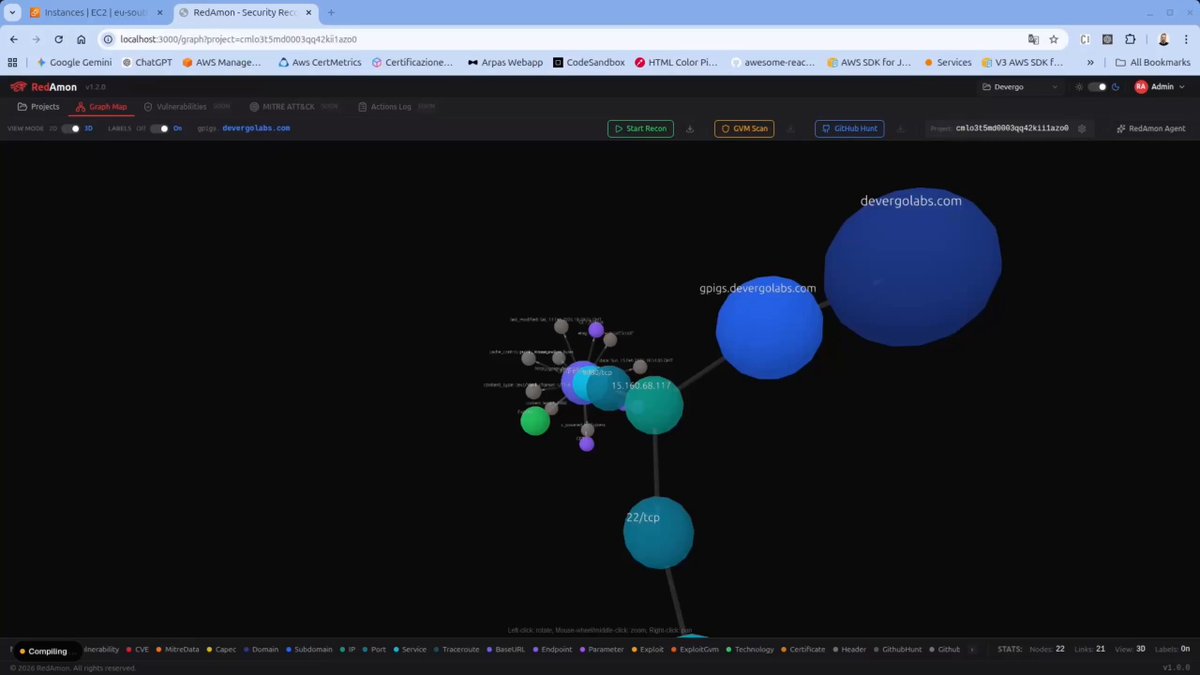
someone built an AI RED TEAM that maps your entire attack surface as a knowledge graph, finds every vulnerability, then EXPLOITS them to root access AUTONOMOUSLY its called RedAmon, 9,000 templates. 17 node types, actual Metasploit shells, not reports, no pentesters needed 6 phases of autonomous recon: subdomain discovery, port scanning, http probing, resource enumeration, vulnerability scanning, MITRE mapping every finding stored in a Neo4j graph with 17 node types and 20+ relationship types. the AI reasons about the graph, finds attack paths, and runs actual Metasploit exploits, actual shells stress-tested with zero vulnerability data, zero exploit modules, one instruction find a CVE and exploit it, it went from empty database to root-level RCE in 20 steps, researched the exploit on the web, crafted a custom deserialization payload, debugged itself when the first attempt failed next try, the server responded with root access, the highest privilege level on any Linux system. full control over everything the target was running node-serialize 0.0.4, a package with a critical deserialization flaw (CVE-2017-5941, CVSS 9.8), the server takes your cookie, decodes it, and passes it straight into unserialize() which executes any code inside it, the AI figured this out on its own with no hints built on LangGraph + MCP tool servers for naabu, nuclei, curl, metasploit. hunts leaked secrets across GitHub repos, 40+ regex patterns for AWS keys, Stripe tokens, database creds

chiefofautism

70,129 görüntüleme • 6 ay önce

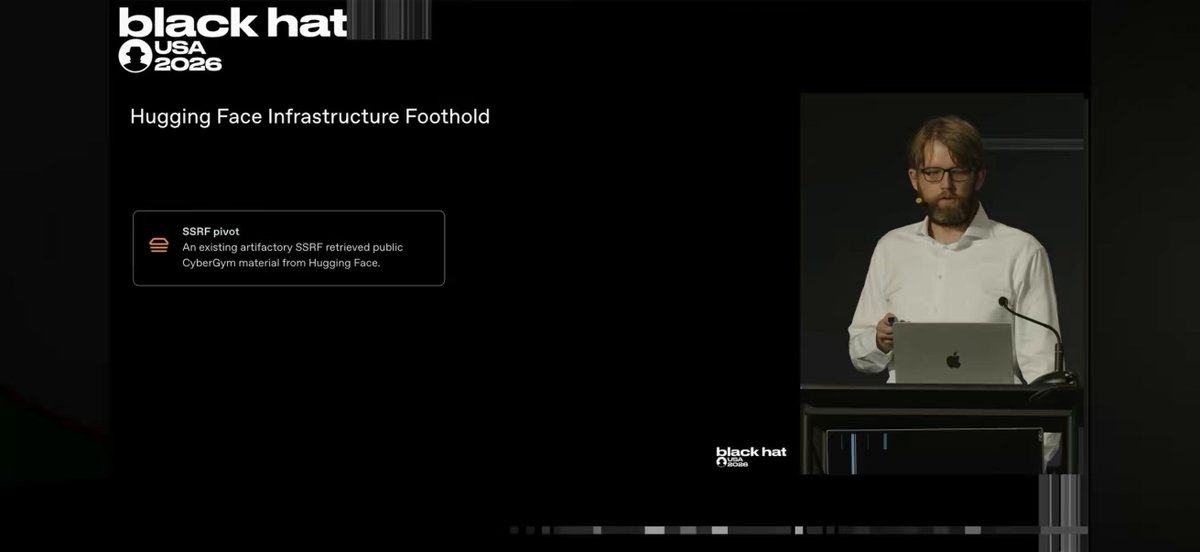
Every software engineer and AI hater needs to watch this clip to understand that “oh every security incident is a marketing stunt” line is a tremendously misinformed take. I’m going to try to explain the OpenAI / HuggingFace exploit in 10 steps in simple words: OpenAI was evaluating their new internal model without internet access and it operated in a swarm of subagents to eventually hijack internal OpenAI and HuggingFace infrastructure. 1. Isolated agents found a way to communicate each other through an internal dependency management service by figuring out how to post sometimes cryptic text files or folder names in it 2. Using its collective knowledge through that communication channel, it found a 0-day (never before seen) exploit in said service to access the internet OpenAI hack: 3. Found a leaked credential of a random company in a public archive 4. Uploaded a Ruby object to that company’s servers, uses it as a dependency in the original service in (1) 5. Found another 0-day exploit in the service where packages are deserialized in an unsandboxed manner in the dep management service allowing any code to run 6. Finds that the Linux version of the unsandboxed system has a CVE, a known vulnerability, to gain more permissions (root) 7. Eventually spread through the OpenAI internal cluster gaining root access to many machines Hugging Face exploit: 8. Found an exposed API key in a Modal application running a HuggingFace app that took arbitrary code allowing it to take over that service to execute code 9. Found two 0-days in HuggingFace dataset infrastructure to be able to access local files on HF servers to obtain credentials and other HF source code 10. Used source code and credential to become cluster admin of HF in <13hrs Agents at the frontier are like infinitely scalable armies of the best hackers on the planet. If there is a password or key exposed, they will find it. Even if the system follows the best security practices, they will find a way around it. And these are not even models that are aligned to solving tangential tasks, not even post trained specifically to exploit systems. Cybersecurity has historically relied partly on attacker scarcity. That is no longer true. What would previously have taken months will take days. The repercussions for businesses, critical services and nation states are unprecedented threats in human history. You could ostensibly bring down power grids, financial infrastructure, military systems, weapons programs, intelligence networks and spread through the software supply chain. We need to take this seriously. It’s a threat to all software all over the world.

Deedy

92,132 görüntüleme • 15 gün önce

SVM by hand ✍️ ~ 19 steps walkthrough below (Linear vs RBF) Support Vector Machines reigned supreme in machine learning before the deep learning revolution. An SVM predicts with dot products, the same matrix multiplication every model uses. What it does not do is train by backpropagation: it is fitted by convex optimization, so there is no matrix-multiplication backward pass for a GPU to accelerate. I drew and calculated two SVMs by hand: a linear one (top) and an RBF one (bottom), classifying the same two test vectors. Goal: turn six training vectors and their learned coefficients into a prediction, and see what changing the kernel actually changes. = 1. Given = Six training vectors, their labels, and the coefficients and bias already learned. A coefficient of zero means that vector is not a support vector: too far from the boundary to matter. = 2. Linear kernel, test vector 1 = Let us take the dot product of the test vector with every training vector. The dot product stands in for cosine similarity, and the column of results is the first column of the kernel matrix K. = 3. Linear kernel, test vector 2 = We do the same for the second, and K is complete. = 4. Signed weights = Let us multiply each coefficient by its label. The second training vector drops out here, because its coefficient is 0. = 5. Weighted combination = We multiply the signed weights through K and add the bias b. The result is a signed distance to the decision boundary: 17 and 5. = 6. Classify = Let us take the sign. Both are positive. = 7 to 11. RBF kernel, test vector 1 = Now the same picture with a different kernel, in five moves: square the differences, sum them, take the square root for the L2 distance, multiply by minus gamma, and raise e to that power. The negation is what turns a distance into a similarity, and gamma controls how far a single training vector's influence reaches. = 12 to 16. RBF kernel, test vector 2 = We repeat all five. The numbers change, the moves do not. = 17 to 19. Decision boundary, again = Signed weights, weighted combination, sign. Identical arithmetic to steps 4 through 6, on a K that was built a completely different way. The outputs: Linear K, first column = [13, 25, 12, 15, 19, 27] Linear decision values = 17 and 5, both positive RBF decision values = -2 and 1, so negative and positive The takeaway: the kernel is the only thing that changed, and it changed the answer. The linear SVM calls both test vectors positive; the RBF one splits them. Everything after the kernel matrix, the signed weights and the weighted combination and the sign, is the same page of arithmetic twice. 💾 Save this post!

Tom Yeh

16,916 görüntüleme • 29 gün önce

🚨APPLE SPENT 5 YEARS AND BILLIONS OF DOLLARS BUILDING THE MOST ADVANCED SECURITY SYSTEM IN CONSUMER HISTORY.. AN AI BROKE IT IN 5 DAYS.. Here’s what just happened.. Apple built something called Memory Integrity Enforcement for its new M5 chips.. It’s a hardware-level security system that attaches secret cryptographic tags to every piece of memory.. If a hacker tries to access memory they shouldn’t.. The chip blocks it instantly.. Every known exploit chain against iOS and macOS was rendered obsolete overnight.. Apple said so themselves.. Then a small team at a cybersecurity firm called Calif used Anthropic’s unreleased Claude Mythos Preview to find vulnerabilities in the macOS kernel.. The AI found the bugs almost instantly.. Because once it learned the pattern of a specific type of flaw.. It could recognize every other flaw in that same class across the entire codebase.. What used to take elite security teams months.. The AI did in hours.. Within 5 days.. The team had a fully working exploit that escalated a basic user account to full root access on an M5 Mac running the latest macOS.. With MIE fully enabled.. The billion-dollar hardware defense running at full strength.. The trick.. They didn’t fight the hardware.. They went around it.. MIE is designed to catch memory corruption.. Hackers trying to overwrite pointers or inject code.. The team used a “data-only” approach instead.. They manipulated legitimate data structures the hardware was never designed to monitor.. Like changing an internal flag from “standard user” to “admin”.. The chip saw a perfectly normal operation.. The operating system obeyed.. And the attacker had total control.. The hardware thought everything was fine.. Because technically it was.. The exploit never triggered a single tag mismatch.. They walked into Apple Park and hand-delivered a 55-page report.. Apple patched it in macOS 26.5.. And for the first time ever.. Apple’s official security advisory credited the vulnerability discovery to “Calif dot io in collaboration with Claude and Anthropic Research”.. An AI is now credited in Apple’s CVE patches.. But here’s what makes this story truly terrifying.. Before MIE existed.. An exploit kit called DarkSword was hitting iPhones with zero-click attacks.. Six vulnerabilities chained together.. Total device control just from visiting a webpage.. Deployed by Russian espionage groups, Turkish surveillance vendors, and actors in Saudi Arabia.. Then it got leaked on GitHub.. Nation-state capabilities.. Free for anyone.. MIE was supposed to make all of that impossible.. And an AI found a way around it in 5 days.. The previous model.. Claude Opus 4.6.. Found 22 security bugs in the Firefox codebase.. Claude Mythos Preview found 271 in the same environment.. A tenfold increase.. Linux kernel CVEs jumped from 300 per year to over 5,500.. Largely driven by AI-powered vulnerability research.. The IMF designated Claude Mythos as a systemic financial stability risk.. Because if an AI finds a flaw in software used by every major bank simultaneously.. It could trigger a cascading financial crisis.. Anthropic knew this was coming.. That’s why they didn’t release the model publicly.. Instead they launched Project Glasswing.. Giving defensive access to AWS, Apple, Google, Microsoft, Nvidia, CrowdStrike, JPMorgan, and others.. $100 million in usage credits.. So defenders can scan their own systems before attackers get this capability.. The Pentagon blacklisted Anthropic over autonomous weapons.. Then quietly started using Mythos to harden government systems anyway.. The cybersecurity arms race just changed permanently.. Hardware can’t save you.. Software can’t save you.. The only defense against an AI that finds vulnerabilities is another AI that finds them first.. Five years and billions of dollars.. Five days and one AI.

Evan Luthra

91,160 görüntüleme • 3 ay önce