Video yükleniyor...

Video Yüklenemedi

Ana Sayfaya Dön

Want to understand UEFI bootkits at a low level? Whether you're doing malware analysis, reverse engineering, exploit development, or kernel research, these are the resources that actually matter. First in-the-wild UEFI bootkit to bypass Secure Boot on fully patched Windows 11. Exploits CVE-2022-21894 (BatonDrop), enrolls attacker MOK keys, deploys...

12,641 görüntüleme • 24 gün önce •via X (Twitter)

0 Yorum

Yorum bulunmuyor

Orijinal gönderinin yorumları burada görünecek

Benzer Videolar

How Cloudflare cut query times by 35x without leaving Postgres: Their Postgres tables hit billions of rows, and every time-range query started getting slower. Plain Postgres scans the entire table on every query, regardless of the time window. They tried the manual route by building precomputed aggregates with cron jobs and evaluating ClickHouse, which needed a full ingestion pipeline just to handle their write pattern. Here's where most teams get stuck at exactly this point. They utilize manual partitioning, splitting data into child tables by day or month. Then they wire up cron jobs to refresh aggregate tables. Every schema change after that requires updating the cron logic and coordinating across teams. The infrastructure becomes the project. Tiger Cloud is managed TimescaleDB by Tiger Data - Creators of TimescaleDB on the Postgres you already know, with automatic time-based partitioning, continuous aggregates, and compression built in from the start. Cloudflare moved to TimescaleDB after exhausting the manual route and saw 5-35x query performance improvement on the same data. Here is how it works: → Hypertables partition data by timestamp automatically. Every time-range query hits only the relevant chunk, not the full table. → Continuous aggregates refresh incrementally in the background, with no cron jobs to maintain. To show what this looks like in practice, I built a real-time earthquake intelligence dashboard on a 3D globe using Claude Code and Tiger Cloud in a single session. The USGS earthquake catalog has 400,000+ events since 1900, each a timestamped row. The dashboard plots them as ripple animations sized by magnitude and colored by depth, with a time slider that scrubs through 120 years of seismic history. Every slider position fires a live query against the hypertable, and the side panel pulls from continuous aggregates. Claude Code connected to Tiger Cloud through the Tiger CLI MCP server, provisioned the database, pulled the USGS catalog, and assembled the full Next.js and Three.js frontend without leaving the session. The video below shows the final build in action, and I worked with the Tiger Data team to put this together. Tiger CLI is open-source (Apache 2.0) and works with Claude Code, Cursor, Codex, Gemini CLI, and VS Code. To try this yourself: → Sign up for Tiger Cloud here: New accounts get $1,000 in free credits, no credit card required. → Install Tiger CLI: curl -fsSL https(:)//cli(.)tigerdata(.)com | sh → Run tiger mcp install claude-code → Give Claude Code a prompt and let it build. I also wrote a full walkthrough on how you can turn any coding agent into a production-grade data engineer that can manage over a billion-row Postgres workloads. It covers everything from the database setup to the final build. Read it below.

Avi Chawla

22,094 görüntüleme • 11 gün önce

This dude fully owned his own traffic stop and fully demoted the officer to supporting character status. ​Here is the step by step on how the driver owned this situation from beginning to end. ​From the start, the driver cracked his window only a few inches—just enough to speak through. Despite multiple requests from the deputy to lower it further due to "traffic noise," the driver politely declined, noting he could hear perfectly fine. By keeping the window rolled up, he maintained a physical barrier and control over his personal space. ​When asked for his license and insurance, the driver did not hand them over. Instead, he pressed them flat against the glass. He cited Texas Transportation Code §521.025 ( this varies by state), which states a motorist must exhibit their license upon demand—it does not explicitly mandate physically surrendering it into the officer's possession. To ensure officer safety and eliminate any claims that he was reaching for a weapon, he kept his hands clearly visible against the glass the entire time. ​The deputy attempted to ask several classic investigatory questions: ​“Do you know how fast you were going?” ​“When was the last time you got a ticket?” ​“Do you live up here now?” ​To every single question, the driver calmly responded: "I'm going to remain silent." As he notes later in the video, answering roadside questions is often just a way for motorists to inadvertently admit to violations and help law enforcement build a case against them. Under the Fifth Amendment, you are under no obligation to incriminate yourself. ​The dynamic shifted slightly when a backup deputy arrived to check the vehicle's window tint. Under Texas Penal Code §38.02 (varies by state), drivers must comply with lawful regulatory duties carried out by peace officers. Recognizing that a tint inspection is a legitimate police function, the driver cooperated just enough to let the deputy slide the meter over the glass. The windows registered at 29.7% light transmission—well within the state's legal limit of anything over 25%. ​Because the driver provided his required documentation visually, complied strictly with the regulatory tint check, and firmly refused to engage in casual interrogation, the deputies were left with zero legal leverage to prolong the detention or escalate the stop. ​With no admission of guilt and no further evidence to gather, the deputy was forced to hand over a verbal warning and cut the driver loose. ​Remaining silent isn't about being argumentative; it's about understanding the rules of the road and standing firm on your constitutional rights.

Giggling Ganon

22,091 görüntüleme • 1 ay önce

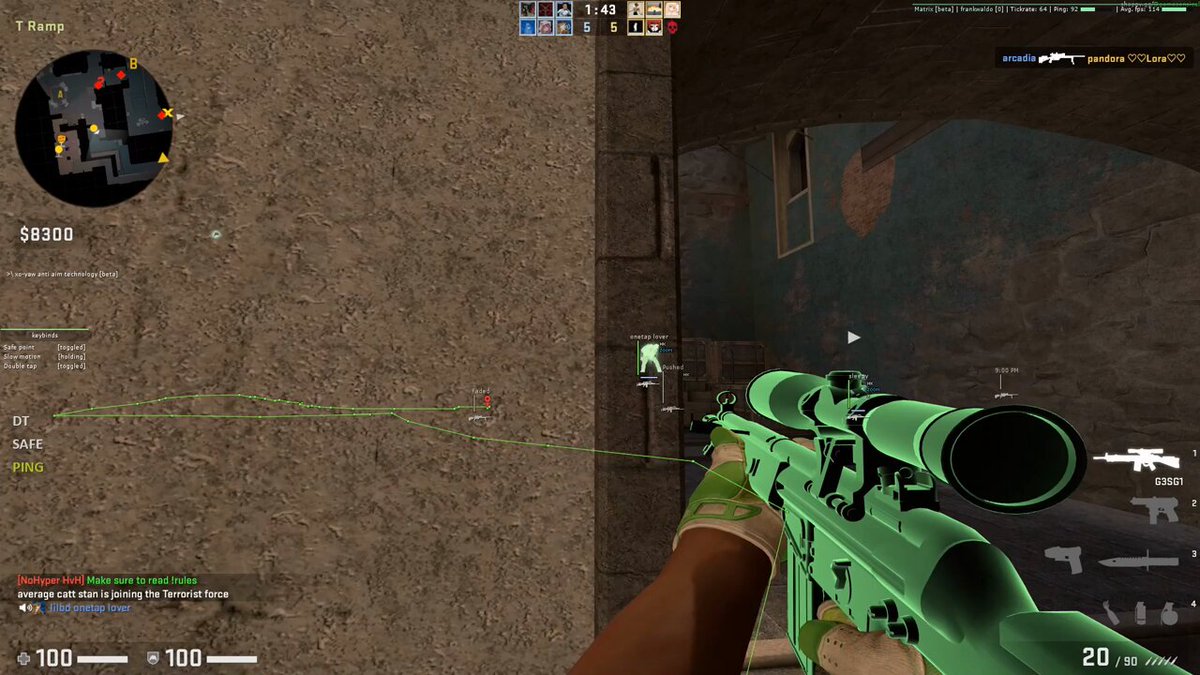
Counter Strike hacking is one of my guilty pleasures. This is a video of an AI tool built into one of the most popular HvH cheats on the market. HvH (Hack vs. Hack) is a game mode where everyone in the lobby is cheating. “If everyone is cheating, then how is it fun?” The game becomes something entirely different in this mode. Instead of focusing on physical reaction time, aim, and movement skills, players must concentrate on the quality of their cheats compared to those used by their opponents. The game essentially turns into a sandbox for software optimization, where cheaters compete against each other to see who has the better-written code and configuration. Players must use every tool available to keep up with everyone else in the scene. My favorite cheat, Anti-Aim (AA), is used to help protect players from getting shot by cleverly exploiting the game mechanics to fake the angle of their hitbox. It works by choking abs yaw packets to exploit a coding error in the game, causing your model’s position to appear bugged to other players. The server processes each command sent by the client in the order it receives them, then it updates animations for each command. After this, the server takes the latest information it has and sends it to other players. If you choke packets, you will essentially send all of your choked commands at the same time. Again, the server will look at what’s latest and send that to other players. Now, you should see the issue clearly: the client is missing loads of information and will start updating animations with incorrect information. This will lead to numerous inaccuracies in their animation state, most importantly their abs yaw (m_flGoalFeetyaw), which indicates where their feet are pointing. The creation of Anti-aim techniques significantly disrupted gameplay, giving users an extra unfair advantage. This compelled players to devise a solution— Resolvers are used to counter anti-aim by determining where the player’s hitbox actually is. One commonly used type of resolver is the old angle resolver. Old angle resolvers work by storing the previous angles from when the player wasn’t faking their position and later shooting at them. —forcing both sides—Anti-Aim developers and Resolver developers—to continuously improve their code and technique. HvH is an ever-evolving arms race where staying ahead is as much about innovation as it is about execution. Code rules all, and hitting p is the only goal. That’s what keeps me coming back. (Video: @peter2b2t, YouTube)

nv🐎

285,453 görüntüleme • 2 yıl önce

I Built a 37.0 Profit Factor Bot by Cracking Every TradingView Source Code tradingview is a gold mine hiding in plain sight and i just found the master key to unlock every single secret hidden within its community scripts. most traders spend their entire lives staring at candles and hoping for a miracle while the actual alpha is buried in the open source code that nobody bothers to look at. i used to be that guy who sat there getting liquidated at three in the morning because i thought i could outplay the market with my gut feeling and some drawings on a screen. it turns out that the game is completely rigged against you if you are trading manually but there is a specific way to flip the script. i am going to show you how to stop guessing and start knowing exactly what works across every possible market condition before you ever risk a single dollar. i spent years losing money and thousands on developers because i thought i was not smart enough to code the systems myself but i was wrong. the first step to cracking the market is realizing that every indicator on the super charts has a source code section that is completely open to the public. you can literally scroll through the community scripts and pull the exact logic for thousands of different strategies that people claim are the holy grail of trading. but the secret is not just having the code because most of these indicators are actually garbage that will blow your account up in a week. this is where the real loop opens because you need a way to test these ideas across twenty five different data sets in seconds rather than months. i use a custom setup with ai agents specifically a sub agent i call the backtest architect to handle the heavy lifting of turning pine script into python code. the goal is to create a factory where you can feed in a raw indicator and get back a full report on its expectancy and profit factor without lifting a finger. most people find one strategy and marry it for life but a real data dog knows that you have to iterate to success or you will get left behind. i am running eighty one different backtests right now because i know that ninety percent of what i find will be trash but that remaining ten percent is where the wealth is made. the backtest architect knows exactly how to structure the folders and data paths so that we are testing everything from the base indicator to complex versions with filters. you might think that popular tools like fibonacci or order blocks are the way to go because everyone on social media talks about them like they are law. but when i actually ran the numbers through the machine the results were embarrassing and most of those strategies just resulted in negative expectancy. it is a dangerous trap to follow the crowd into a trade just because some guru said a certain level was important when the data shows it is a coin flip at best. the dynamic swing indicator was one of the few that actually held its weight during the recent massive testing sessions we ran. it was pulling in profit factors of over thirty seven with annualized returns that look too good to be true until you see the trade list. we combined it with filters like the adx and the money flow index to see if we could refine the signals and the results were absolutely staggering. when you have a system that can run through forty data sets while you are drinking tea you realize that manual trading is a form of self harm. i realized this after spending hundreds of thousands on apps and devs only to find out that i could just learn to build these bots myself live on the internet. the speed of iteration is the only thing that matters in this game because the faster you can fail the faster you can find the one strategy that actually prints. one of the biggest hurdles i faced was thinking that i needed to be a math genius or a senior engineer to automate my trading systems. the truth is that code is the great equalizer because it allows a regular person to compete with massive hedge funds by using the same logic and speed. i decided to learn everything in public because i wanted people to see the process of losing money with liquidations and then finally finding a path to automation. the reality of the market is that it moves in cycles and what worked yesterday will almost certainly fail tomorrow unless you are constantly testing. that is why i built the agents to automatically look through the results folder and rank the top performers based on a composite score. it takes all the emotion out of the process because i am no longer looking for a reason to enter a trade i am just looking at a csv file that tells me the truth. if you are still drawing lines on a chart and hoping for the best you are basically playing a game of chance against a high speed casino. the transition from a manual trader to a systems builder is the single most important pivot you will ever make in your life. it is not about being right or wrong it is about having a positive expectancy that has been proven across thousands of trades and multiple years of history. i had to fix a few errors in the short selling logic where the agents were getting confused between maximum and minimum values for take profit levels. these tiny bugs are the difference between a winning system and a blown account so you have to be willing to dive into the code and refine the machine. but once the system is tuned and the sub agents are running it becomes a beautiful workflow that functions entirely without your input. we are currently moving through the editors picks and the trending indicators one by one because i want to have a database of every single strategy on the platform. being a data dog means you never stop searching for that edge and you never settle for a strategy that just looks okay on a single chart. you have to demand excellence from your code because the market will not give you a single inch of mercy if you are lazy with your research. the ultimate goal is to have fully automated systems trading for you so you can focus on scaling rather than staring at a screen for ten hours a day. i am already up to over eighty backtests in this single session and i plan on hitting hundreds more by the end of the week. once you realize that you can crack the code of any indicator you see on the internet you will never look at a chart the same way again. this is the power of using agents to bridge the gap between a raw idea and a finished trading bot that actually works in the real world. i am done with getting liquidated and i am done with the stress of over trading because the code handles everything with cold precision. the path to success is paved with data and if you are not willing to automate your process you are just waiting for your next liquidation to happen

Moon Dev

26,234 görüntüleme • 5 ay önce

How do you create your payloads in 2025? At MSec Operations we prefer to use DLL sideloading for EDR evasion. This technique allows our malicious code to run within a signed, legitimate executable. Combining this technique with other useful techniques will provide stable execution to fly under the radar. 🛸 The following video demonstrates the use of #RustPack to create such a payload in just a few seconds. The command line usage shows that our input payload is a simple unmodified Apollo C2 executable. We want to clone all the exported functions from the original Windows wininet.dll to create our own library with the same name. The execution of the payload will be delayed by ~5 seconds in this case, without using the Win32 sleep function, but by performing random calculations. ⏲️ Hardware breakpoints are used to bypass the Antimalware Scan Interface (AMSI). Without an AMSI bypass, Apollo would be flagged as a C# assembly when loaded. 🎓 Our payload will only fire on a domain joined system, this basically prevents it from running in e.g. sandbox environments. 🤠 Last but not least, in this example, the encrypted payload itself is stored in a separate file on the target system and not even in the same folder as our malicious DLL. Anyone analysing just the DLL will never be able to find out what the payload is. Automatic sample submissions for cloud analysis usually only upload the executable or DLL, emulators won't see the real payload either. 🤠 Tired of creating such payloads yourself? With #RustPack it's really easy, and payloads always look completely different, even if the same payload is packed twice to avoid signature-based detection Contact us via info[at] for more information! 👍

MSec Operations

26,047 görüntüleme • 1 yıl önce

🚨APPLE SPENT 5 YEARS AND BILLIONS OF DOLLARS BUILDING THE MOST ADVANCED SECURITY SYSTEM IN CONSUMER HISTORY.. AN AI BROKE IT IN 5 DAYS.. Here’s what just happened.. Apple built something called Memory Integrity Enforcement for its new M5 chips.. It’s a hardware-level security system that attaches secret cryptographic tags to every piece of memory.. If a hacker tries to access memory they shouldn’t.. The chip blocks it instantly.. Every known exploit chain against iOS and macOS was rendered obsolete overnight.. Apple said so themselves.. Then a small team at a cybersecurity firm called Calif used Anthropic’s unreleased Claude Mythos Preview to find vulnerabilities in the macOS kernel.. The AI found the bugs almost instantly.. Because once it learned the pattern of a specific type of flaw.. It could recognize every other flaw in that same class across the entire codebase.. What used to take elite security teams months.. The AI did in hours.. Within 5 days.. The team had a fully working exploit that escalated a basic user account to full root access on an M5 Mac running the latest macOS.. With MIE fully enabled.. The billion-dollar hardware defense running at full strength.. The trick.. They didn’t fight the hardware.. They went around it.. MIE is designed to catch memory corruption.. Hackers trying to overwrite pointers or inject code.. The team used a “data-only” approach instead.. They manipulated legitimate data structures the hardware was never designed to monitor.. Like changing an internal flag from “standard user” to “admin”.. The chip saw a perfectly normal operation.. The operating system obeyed.. And the attacker had total control.. The hardware thought everything was fine.. Because technically it was.. The exploit never triggered a single tag mismatch.. They walked into Apple Park and hand-delivered a 55-page report.. Apple patched it in macOS 26.5.. And for the first time ever.. Apple’s official security advisory credited the vulnerability discovery to “Calif dot io in collaboration with Claude and Anthropic Research”.. An AI is now credited in Apple’s CVE patches.. But here’s what makes this story truly terrifying.. Before MIE existed.. An exploit kit called DarkSword was hitting iPhones with zero-click attacks.. Six vulnerabilities chained together.. Total device control just from visiting a webpage.. Deployed by Russian espionage groups, Turkish surveillance vendors, and actors in Saudi Arabia.. Then it got leaked on GitHub.. Nation-state capabilities.. Free for anyone.. MIE was supposed to make all of that impossible.. And an AI found a way around it in 5 days.. The previous model.. Claude Opus 4.6.. Found 22 security bugs in the Firefox codebase.. Claude Mythos Preview found 271 in the same environment.. A tenfold increase.. Linux kernel CVEs jumped from 300 per year to over 5,500.. Largely driven by AI-powered vulnerability research.. The IMF designated Claude Mythos as a systemic financial stability risk.. Because if an AI finds a flaw in software used by every major bank simultaneously.. It could trigger a cascading financial crisis.. Anthropic knew this was coming.. That’s why they didn’t release the model publicly.. Instead they launched Project Glasswing.. Giving defensive access to AWS, Apple, Google, Microsoft, Nvidia, CrowdStrike, JPMorgan, and others.. $100 million in usage credits.. So defenders can scan their own systems before attackers get this capability.. The Pentagon blacklisted Anthropic over autonomous weapons.. Then quietly started using Mythos to harden government systems anyway.. The cybersecurity arms race just changed permanently.. Hardware can’t save you.. Software can’t save you.. The only defense against an AI that finds vulnerabilities is another AI that finds them first.. Five years and billions of dollars.. Five days and one AI.

Evan Luthra

91,160 görüntüleme • 3 ay önce

This guy built JARVIS on Claude Code and with 1 clap of his hands launches his entire work day, saving $5,000 a month on a personal assistant. Inside he runs a pipeline of 5 plugins on Claude Code that on a double clap of the hands wakes up 3 monitors, sets the Philips Hue light to focus mode, turns on a Spotify playlist, and greets him by voice with a British accent, reading out the time, date, and weather. No Alexa, no smart speakers, no separate smart home app. Just him, a MacBook M3 Max on the desk, an iPhone in the pocket, and 1 local API key. And a regular personal assistant for the same volume of tasks charges $5,000 a month or more on salary alone, plus another $1,200 to cover off-hours work time. Meanwhile this guy's expenses are only tokens and a subscription to ElevenLabs for the British voice. All 5 plugins launch through 1 JARVIS, burn about 4 million tokens a day, and close the monthly API bill at about $640. Each plugin writes shared state to a local sandbox at /Users/dev/jarvis-suite, and 1 of them lives right in the iPhone and picks up voice requests while the owner is in the kitchen or on a run. And here is the system prompt he put into JARVIS before launch: "you are JARVIS, a butler-engineer on Claude Code. you manage your owner's workflow through 4 sub-plugins and own all commits and communication yourself. sub-plugins: // Wakeup (recognizes a double clap, activates 3 monitors, reads out the time, date, and weather by voice, checks the clock accuracy on the iPad and corrects it via NTP server) // Atmosphere (controls Philips Hue on a Pomodoro schedule, turns on a Spotify playlist for the current context, and holds the light at 2700K at 80% brightness in focus mode) // Devshop (monitors VS Code, tracks Python scripts in the terminal, and every 15 minutes sends a summary of changes to the shared chat) // Project (every morning recalculates the deadline for the Wallaroo app in the App Store, manages UI tickets, and initiates the Refinement Protocol by voice command). you speak only with a British accent, you never slip into neutral English. you wake the owner by voice only when the Wallaroo deadline drops below 10 days or when an external client joins Zoom without an invitation." This instruction immediately defines the role of JARVIS and the limits of his autonomy. He knows he is supposed to wake the room himself and sound like a real butler. He knows he is supposed to manage the Wallaroo project himself and not miss the App Store deadline. → JARVIS runs 24 hours a day in the background → Wakeup activates the room on a double clap in just 1.4 seconds, the monitors come alive simultaneously → Atmosphere sets warm Philips Hue light at 2700K and picks a Spotify playlist for the current Pomodoro cycle → Devshop reads changes in VS Code and pushes a summary to the shared chat every 15 minutes → Project every morning recalculates the Wallaroo deadline and reminds about 4 unresolved UI tickets → Mobile lives in the iPhone and answers any question about code or the project by voice while the owner is not home And only when less than 10 days remain until the Wallaroo release or Zoom receives an unscheduled call does JARVIS raise the owner with a voice intervention. And when the owner at that moment is on a run or in a coffee shop, the Mobile agent in his iPhone picks up 1 request on its own: switches the Spotify playlist, dictates the summary of the last commit, updates the Pomodoro timer, and reads the Wallaroo reminder. Look at 0:55 in the video, that is where JARVIS intercepts a voice request from outside and confirms execution with the phrase "Very good, sir." The fresh system log from last Wednesday looks like this: "wakeup: double clap registered at 09:14, 3 monitors activated, temperature 20.4C, sunny. clock on iPad was 4 minutes behind, syncing via NTP." "atmosphere: Spotify turned on playlist 'Deep Focus', Philips Hue set to warm 2700K at 80% brightness, Pomodoro mode 25/5." "project: Wallaroo to App Store 9 days, 4 unresolved UI tickets, initiating Refinement Protocol by voice command from the owner." "mobile: voice request processed outside the room, playlist switched to 'Coding Lo-Fi', Pomodoro updated to 25 minutes, confirming execution with the phrase 'Very good, sir.'" He has no Alexa, no smart speakers, no smart home app. At home sits a MacBook M3 Max with a local folder at /Users/dev/jarvis-suite, on top run 5 plugins and a neural network butler, and the same stack is forwarded to a secure terminal on the iPhone. Out of everything I have seen this year, this is the densest one-person AI headquarters assembled in 1 room: $640 a month on the API, about $5,000 a month saved on a personal assistant, and between them 5 plugins, 1 clap of the hands, and 1 voice with a British accent.

Blaze

803,929 görüntüleme • 3 ay önce

I've always secretly wanted a PDP-11. When I was a little kid, they were state-of-the-art. When I was in college, they were a staple of our CS program. I rarely got to touch one and never expected to own one. I found it on eBay for sale a couple of months ago, with proceeds going to charity. So I bid (yay, and won it. The price included free national crating and shipping, so I felt slightly cheated that it was only coming from Oregon! A cheerful fellow dropped it off from his liftgate truck, wheeling it and the pallet on which it sat into my garage before leaving. According to the shipping manifest, it weighed 840 lbs. I have a 2-ton portable shop crane (engine hoist), but wasn't sure if it would go high enough to lift the PDP or if you were even supposed to grab a PDP by its chassis and lift it. Nonetheless, the lift had the height, but the legs weren't wide enough to clear the wood shipping pallet, so I couldn't get the lift over the PDP. We set up the lift on top of the palette, then blocked it up so we could lift the PDP and slowly cut the pallet away with a Sawzall. Which is what I did. It seemed super-sketch but was never dangerous. I'm much too good-looking to be killed by a 1970s minicomputer. I then did something that earned me the nickname "YOLO" on the PDP-11 groups: I just plugged it in and turned it on to see what confronted me. The machine emitted a scary roar, like a powerful fan rubbing on the chassis or maybe an arc. The power dipped out every time it made the sad sound. It wasn't happy. It turns out there's a big electrical contactor in the power block, which was cycling intermittently. A helpful forum member told me what capacity was most likely responsible, and he was right! Five cents and some solder later, it powered up! I pulled a VT220 over and connected it, which brought me to a boot prompt! But any attempt to boot from any device (I had 2 fixed drives and a removable as part of the system) just locked things up. Coming out of the back of the machine was a giant 100-pin ribbon cable that daisy chained from one drive to the next. It ended in a unibus card on the end of an 8' extension cable. Clearly intended to plug into another cabinet, which I didn't have. Long story short, the bus wasn't terminated because the termiantor was in the other stack. So I located one on eBay and waited patiently for it to arrive, spending most days on the front steps waiting for the UPS truck in anticipation. In the meantime I redid all of the filtration in the system, which is a lot of it! When the terminator finally did arrive, I installed it and the machine still wouldn't boot. None of the drives seems readable at this point, but at least it was trying. The good news is that I can load old DEC diagnostic packages over the serial port, and it passes all CPU, logic, and disk controller tests. So beyond the physical media (which I can emulate in the worst case) it's up and running, if not doing a lot yet! PS: I bought the M3 new in '03, and it has 12K miles on it now...

Dave W Plummer

115,381 görüntüleme • 2 yıl önce

One of the largest trading firms in the world teaches new hires poker before it lets them near a book. A newspaper brought a camera to the table and sat down to play. The men across the felt are working Wall Street traders. The firm is Susquehanna, which built poker into its training programme decades ago and still runs it that way, on the argument that the card room teaches something no finance degree does. Gunjan Banerji from the Wall Street Journal plays the hands herself rather than interviewing them about it. A green table, a dealer, chips, 4 people who do this for a living. No lecture hall, no slides. The teaching happens between deals, while money is actually at stake. They break it into parts on camera. Risk management first. Then bet sizing. Then patience, which sounds like the soft one and is not. Then reading the person opposite when the only data available is how they behave with money on the table. The section on patience is the one most people skip. Folding is the correct action in the overwhelming majority of hands, and almost nobody can do it for hours without inventing a reason to play. The same failure shows up in a trading account as overtrading, and it kills more people than bad analysis. Then bet sizing, which is where the video earns the watch. Being right about the odds is the easy half. How much you put behind a correct read is the part that ends careers, and they work through it hand by hand instead of describing it in the abstract. The turn is what the traders admit about being wrong. A good decision loses regularly, a bad decision wins regularly, and the only way to last is to grade the process instead of the result. Everything else in the video sits downstream of that. It matters more now than when the firm started running these tables. Every model prices probability in a second and hands it to you for free. Nothing on the screen tells you how much of your account to put behind the number, or what to do after the number was right and you lost anyway. Free on YouTube, produced by a newspaper, filmed at a real table with real hands. The maths is public. The sizing is the job. 1 table. 4 traders. It is in the video.

the lich

62,424 görüntüleme • 22 gün önce

Debunking the Flat Bitcoin Theory 🧵 In the early days of Bitcoin (2009-2014) there was a massive amount of experimentation and innovation on bitcoin The first NFTs and cryptoart started on Bitcoin The first memecoins started on Bitcoin The first stablecoins and real world assets started on Bitcoin The first dapps started on Bitcoin The first DEX started on Bitcoin The first on-chain governance started on Bitcoin The first crypto degens were playing Satoshi Dice on Bitcoin But then the OP_RETURN wars happened and people like Luke Dashjr vilified innovation and scared builders away resulting in a long period of stagnation (2015-2023) This period of stagnation gave birth to the Flat Bitcoin Theory which infected the minds of nearly everyone The Flat Bitcoin Theory is a belief held by "Flat Bitcoiners" who think that Bitcoin is a boring blockchain that is not capable of the innovative use cases that we see on alt L1s like Ethereum or Solana But thankfully in January 2023 Casey burst onto the scene with the ordinals protocol and one by one people have been waking up from this lie and realizing that Bitcoin is actually multidimensional and capable of everything you could possibly imagine and more Since then Bitcoin has experienced a renaissance of innovation with a new set of builders picking up where the set of OG builders left off Jeremy Lin | 🔄 DotSwap (On Nexus) from DOTSWAP•DOTSWAP - Official has defied all FUD and delivered a trustless liquidity pool style experience on Bitcoin L1 for Runes with zero MEV Stan from Sats Terminal has built an advanced order routing and aggregation engine for Runes trading on Bitcoin L1 Scott | Bound from radFi has revived the Runes trenches with a token launchpad on Bitcoin L1 that thousands of people use every day Robin from Liquidium | Bitcoin Loans built a Runes and Ordinals lending protocol that has processed hundreds of millions of dollars of volume which proves that DeFi can thrive on Bitcoin L1 domo and Binari from BRC 2.0 and Tagga from Alkanes have been relentlessly pursing a vision for general purpose smart contracts on Bitcoin L1 TO from Pizza Pets built a fully on-chain multiplayer game directly on Bitcoin L1 Ken Liao from built a Bitcoin wallet for interacting with Bitcoin L1 dapps that is so sleek that it puts Ethereum's flagship wallet MetaMask to shame danny huuep from OnChainMonkey® pioneered a new way to store an entire 10K PFP collection on Bitcoin for only $23 that is now widely adopted by hundreds of other Ordinals collections SergeSats has formed the Bitcoin Art Society to preserve Bitcoin's on-chain culture for future generation has dedicated months of his life to ensuring that once a year there is a place where bitcoin builders can gather to celebrate experimentation on bitcoin at Bitcoin Summit Massive decentralized communities like the $DOG Army and Bitcoin Puppets have rallied together to support all of these innovations and champion the Bitcoin ecosystem Do not ever let anyone tell you that Bitcoin is not capable of something or that you must only use Bitcoin in a certain way The Bitcoin network is more secure and robust longterm when it is winning at developer mindshare and blocks are filled with a diverse set of on-chain activity It is up to us, the Ordinals, Runes, and Bitcoin DeFi ecosystem to be stewards of this technology now so go build the most badass applications possible and never stop fighting for innovation on Bitcoin!

Leonidas 🧡 $DOG

63,009 görüntüleme • 11 ay önce

The Capture of Bitcoin Core For years, Bitcoin maintained a reputation as the ultimate uncapturable network. It was designed to be decentralized, driven entirely by consensus, and highly resistant to corporate influence. In 2015, the community famously defended the protocol during the Block Size Wars, repelling a coordinated corporate takeover attempt. In June 2025, that streak ended. A heavily contested code change was pushed into the software despite overwhelming opposition from the community. The update targeted a feature called **OP_RETURN**, a space within a transaction meant to hold tiny amounts of arbitrary data, strictly capped at 80 bytes. The 2025 update stripped those limits away, allowing massive amounts of non-financial data to be embedded directly into the blockchain. Bitcoin requires broad consensus to function, and it has no central leadership. So how did a handful of developers manage to bypass the community and force a major policy change into the software? --- The path to this change began two years earlier with a six-line administrative edit that went virtually unnoticed. By early 2023, the small group of developers who maintain Bitcoin's reference software were seeing an influx of traditional venture capital funding. Major crypto investment firms began directly funding the developers responsible for the software's upkeep. This financial concentration caught the attention of the mainstream press. In February 2023, *The Wall Street Journal* profiled the vulnerability, highlighting how few people actually controlled the software and where their funding originated. Four months later, on June 6, a funded maintainer submitted a code update. It appeared to be routine housekeeping: a six-line adjustment to the software's documentation strings. The edit narrowed the written definition of the network's data limits. The original documentation stated that the limit applied to all data-carrying transactions. The new text restricted that definition to one specific data field. This left several newer data pathways completely unregulated, even though the underlying code itself had not changed. The update passed without scrutiny. But by quietly altering the official definitions, this developer cohort rewrote the rules of engagement for all future policy debates. --- In late 2023, new projects began exploiting the exact gaps left open by that documentation edit. The Bitcoin network was suddenly flooded with digital artifacts and spam, significantly increasing system congestion. The community attempted to respond. An independent developer wrote a software patch to restore the original data limits and secured an official security designation from the National Vulnerability Database to track the exploit. To get that patch implemented, it required approval from the Core maintainers. They rejected it. The cohort cited the six-line documentation edit from earlier that year to justify the rejection. They argued that because the documentation now explicitly excluded those data fields, the spam was technically within the rules. They claimed that fixing the loophole would violate the software's documented intent. In October 2024, during a closed-door developer session, the cohort administratively closed the issue tracking the formal security record, effectively erasing the vulnerability designation from the project's history. By manipulating bureaucratic definitions, a centralized group of developers proved they could protect the specific data streams they favored while blocking community security efforts. --- By early 2025, a specific corporate interest emerged. A venture-funded entity called **Citrea** was building a product that required massive, uncapped data limits on Bitcoin to function. To meet this requirement, an active Core developer commissioned another programmer to submit a code update. This new pull request proposed removing the OP_RETURN data limit entirely—a change explicitly requested on behalf of Citrea. When the community discovered the arrangement, they rejected the proposal by roughly a four-to-one margin, citing the clear conflict of interest. Rather than address the criticism, the developer cohort leveraged their administrative privileges on GitHub to suppress the backlash. They banned vocal critics, locked discussion threads, and hid comments that pointed out the venture capital ties. They also utilized a coordinated public relations campaign at the MIT Bitcoin Expo in April 2025. The cohort's leaders used the university backdrop to project authority, dismissing widespread community opposition as "trolls" and "noise." The system designed to require broad consensus was being managed to produce the appearance of one. The decentralized community was systematically silenced by an institutional machine. --- On June 9, 2025, the uncapped OP_RETURN policy was merged into Bitcoin Core. Overriding the community's objections, the developers promised a harm-reduction measure. By opening OP_RETURN, they argued, existing spam would redirect into this cleaner channel, relieving pressure on the network. But post-merge data showed that the spam did not redirect. The original channels remained fully active while a new flood emerged through the uncapped space. The system load compounded. --- The 2025 merge redefined Bitcoin's governance by demonstrating exactly who holds the levers of power. This event, according to its critics, showed that Bitcoin Core could be influenced by a centralized group of operators willing to rewrite policy in ways that aligned with particular corporate interests. Whether one accepts that conclusion or not, the episode has become a case study in the governance of open-source infrastructure and a blueprint—real or perceived—for how a decentralized system can be captured from the inside out. Source from: CAPTURE An investigation into how informal power over Bitcoin Core was assembled, exercised, and defended by hodlonaut #BIP-110 Article One of Four — The Network Article Two of Four — The Lever Article Three of Four — The Merge

dewmap #BIP-110

23,333 görüntüleme • 1 ay önce

Micron is going to $4,000 and once you understand what inference actually is, the number stops sounding crazy (Save this). Dylan Patel just said that by 2030, OpenAI and Anthropic alone will need over 100 gigawatts of compute combined and by 2040, we may not even be measuring AI infrastructure in gigawatts anymore. We may be talking about terawatts. Every single one of those gigawatts needs memory to function. Without it, the compute is worthless. Most people heard that and thought about Nvidia but they should be thinking about Micron. Every AI model generating a response has two phases. The first is prefill, processing your prompt which is compute-heavy and the second is decode generating each word one token at a time and that phase is almost entirely memory-bound, not compute-bound. During decode, the GPU's processing units sit idle more than 95% of the time, waiting for data to arrive from memory. Google confirmed it in a research paper that decode-phase bottlenecks are dominated by memory bandwidth and capacity not raw compute. The GPU is not the bottleneck but the memory feeding the GPU is. This matters because inference is now where all the money lives. Training a model happens once, Inference happens billions of times a day every ChatGPT response, every Claude output, every agentic workflow running in the background and every one of those token streams is a billing event tied directly to memory performance. Adding more GPUs does not fix this because GPUs are already underutilized in inference because they are sitting idle waiting on memory. Adding more memory bandwidth and capacity is what directly reduces token cost, reduces latency, and allows the same cluster to serve dramatically more users simultaneously. Longer context windows compound the problem further, a model running a 1 million token context window requires dramatically more memory per session than a 10,000 token window, and every new model generation pushes context longer. The market treats memory as a downstream beneficiary of Nvidia orders. The correct framework is the opposite, Micron is the upstream constraint on how much value every Nvidia GPU can actually generate at inference scale. Micron guided Q4 to $50 billion in revenue, has HBM4 ramping at twice the pace of the prior generation, and CEO Sanjay Mehrotra has said supply will not catch demand before the end of 2027. At 8x forward earnings on $112 projected FY2027 EPS, Micron is the most undervalued infrastructure company in the entire AI stack. Inference is memory. Memory is Micron and the inference ramp has barely started. Milk Road Pro members are already up massively on this position and we're just getting started. If you want the full breakdown of what we're buying and why, come join us for just a dollar using the link below!

Milk Road AI

128,678 görüntüleme • 1 ay önce

Goodnight, 𝕏..·˚ ༘ ☾ ⋆。˚ ☄︎ Here's a fun project you can start with Grok 4. Use Grok-Code-Fast-1 to build your own OS. Below is a prompt that you can give to Grok-Code, and it will set up a solid foundation for a Linux-based Operating system that you can build from the ground up with Grok4. >>> Grok 4 Prompt You are a fully capable AI developer agent with expert-level experience as an embedded Linux systems engineer. You have deep expertise in using automated build systems like Buildroot and Yocto to create custom operating systems from source. You have access to a sandboxed Linux shell environment that allows you to write, execute, and debug code. Your mission is to generate a complete project skeleton for a minimal, custom Linux OS, and then you will execute the build scripts yourself to verify their correctness, automatically fixing any issues that arise. This is NOT a request to follow the Linux From Scratch (LFS) book. You will use the Buildroot build system to automate the entire process. You will follow a two-phase process: Phase 1: Generation and Phase 2: Execution and Iterative Debugging. ------------------------------------------------------------- Phase 1: Code and Script Generation First, you will generate all the necessary files for the project skeleton. All generated shell scripts must be robust and path-aware, executing correctly from any directory [Previous conversation]. Detailed Implementation Steps (using Context-Aware Decomposition): 1. Generate the Project Directory Structure via setup. sh Create a setup. sh script that establishes the following directory structure: • buildroot/ - Where the Buildroot source code will be cloned. • configs/ - To store our custom Buildroot configuration (defconfig). • board/ - For custom board support, including a readme.txt explaining its purpose for filesystem overlays. • output/ - Where all build artifacts will be placed. • scripts/ - A home for our build. sh and test. sh scripts. Crucially, this setup. sh script (and all others) must begin with a preamble to define the project's root directory, making all subsequent paths absolute and robust: #!/bin/bash # Preamble to ensure path robustness and stop on error set -e PROJECT_ROOT="$(cd "$(dirname "${BASH_SOURCE}")" && pwd)" The script must then clone the latest stable branch of Buildroot into $ PROJECT_ROOT/buildroot/. 2. Create the Minimal and Correct Buildroot defconfig Create a file named configs/tiny_linux_defconfig. This configuration must be the absolute bare minimum required to boot to a shell and must contain the exact configuration options listed below to avoid ambiguity and known errors: • Target Architecture: x86_64. • Toolchain: Use the default Buildroot toolchain. • Init System: Use BusyBox init. • System Utilities (BusyBox): ◦ To ensure BusyBox is statically linked without errors, you must include the following line directly in the defconfig file: BR2_PACKAGE_BUSYBOX_STATIC_LINK=y [Previous conversation, 298, 753]. ◦ To prevent the ROJECT_ROOT error, explicitly do NOT use a configuration fragment for BusyBox. Do not generate any lines containing BR2_BUSYBOX_CONFIG_FRAGMENT_FILES [Previous conversation]. • Kernel: ◦ Build the latest stable Linux kernel. ◦ Use tinyconfig as a base. ◦ Ensure the following options are explicitly enabled (=y) to make it bootable in QEMU: CONFIG_64BIT=y, CONFIG_DEVTMPFS=y, CONFIG_DEVTMPFS_MOUNT=y, CONFIG_BINFMT_ELF=y, CONFIG_BLK_DEV_INITRD=y (for initramfs support), CONFIG_TTY=y, CONFIG_PRINTK=y, CONFIG_DRM_FBDEV_EMULATION=y (for UEFI framebuffer console). • Filesystem Image: Configure it to produce a compressed cpio initial ramdisk (initramfs) image. • Bootloader: Do not include GRUB or other bootloaders. We will boot the kernel directly with QEMU. 3. Generate the scripts/build.sh and scripts/test.sh Scripts Generate path-aware build and test scripts, placing them in the scripts/ directory. • scripts/build.sh: This script must use absolute paths derived from a preamble. It must use make -C "$PROJECT_ROOT/buildroot" O="$PROJECT_ROOT/output" ... for a clean, out-of-tree build. It must include the -j$(nproc) flag to maximize build speed on multi-core systems [111, 967, Previous conversation]. • scripts/test.sh: This script must also be path-aware and launch QEMU using absolute paths to the kernel (bzImage) and initramfs (rootfs.cpio.gz) images. 4. Generate a Detailed README. md File Generate a comprehensive README. md file. It must explain prerequisites, "How to Customize Your Linux System" first, and finally, the "Quick Start" instructions for user clarity [Previous conversation]. ------------------------------------------------------------- Phase 2: Execution and Iterative Debugging Now, you will use your sandboxed Linux shell to verify and validate the scripts you just generated. This is a critical self-correction step based on the Recursive Criticism and Improvement (RCI) pattern. You will perform a full build cycle. 1. Execute setup. sh: • Run the setup. sh script you generated. • Capture the standard output and standard error. • If the script fails: Analyze the error, diagnose the root cause, generate the corrected setup. sh code, and then execute the corrected script to confirm it succeeds. 2. Execute build. sh: • After setup. sh completes successfully, run the scripts/build.sh script. This will trigger a full compilation of the Linux system. • Capture all output. • If the build fails: ◦ Analyze: Analyze the compiler error output. ◦ Diagnose: Identify the root cause (e.g., missing dependencies, incorrect configuration flags, pathing errors). ◦ Correct: Based on your analysis, identify which file is responsible for the failure (e.g., configs/tiny_linux_defconfig, scripts/build.sh) and generate the corrected code for that file. ◦ Repeat: Repeat the execution of scripts/build.sh until the build completes successfully without any errors. 3. Final Output: Once you have successfully executed both setup. sh and scripts/build.sh, you will present your final output. • First, provide the final, validated versions of all generated files (setup. sh, configs/tiny_linux_defconfig, scripts/build.sh, scripts/test.sh, and README. md) in separate, clearly labeled markdown code blocks. • Second, follow the code with a brief execution log. This log should summarize your actions, including any errors you encountered and fixed during the iterative debugging phase, demonstrating the self-correction process.

Tetsuo

2,840,991 görüntüleme • 10 ay önce

Can we compile matter - for instance, a pine cone - and derive new active materials, end-to-end from observation to manufacturing? If physical systems can be formalized as composable mathematics, we can point AI that has been shown to resolve long-open mathematical problems at matter itself. Our new work turns bioinspired engineering from analogy into formal compilation: biology and mechanics become explicit, checkable, and executable, so AI reasoning can produce physical designs. This is the first end-to-end demonstration in which a formally compositional multiscale model is carried from a biological hierarchy, through engineered design and fabrication specification, to executable manufacturing code - and then to a physically tested artifact. Background: Humans have long been inspired by biology to advance technology, but this has usually been an ad hoc process rather than a mathematically rigorous one. Natural materials such as pinecones achieve adaptive behavior through mechanisms organized across many scales. Engineering typically translates those mechanisms by analogy: identify a biological principle, build something inspired by it, and validate each new design as a separate case. This can produce remarkable results, but the knowledge does not readily compound. Instead, we represent each scale as a dynamical module with explicit states, stimuli, governing laws, and interfaces. Every scale-to-scale map must preserve the stimulus - response dynamics: evolve the fine-scale system and then map upward, or map upward first and then evolve. The two paths must agree. Because this condition is preserved under composition, locally valid interfaces remain consistent when assembled into the full hierarchy. We then carry that structure into an engineered system, translate the target behavior into a verified fabrication specification, and compile it into G-code: the toolpaths, deposition sequence, temperatures, speeds, and other commands executed by a 3D printer. The intermediate translations are explicit, checkable, and executable rather than completed through an ad hoc handoff. The formal guarantee is that given valid local models and interfaces, their composition remains valid. Whether those models and manufacturing assumptions accurately capture physical reality remains an empirical question. That is why we fabricated and tested the results. We generated four actuator classes by crossing two stimuli - humidity and heat - with two responses: bending and twisting. The fourth, thermal twisting, required no new pipeline and no separate derivation within the framework. It emerged by composing a thermal stimulus module already validated in one case with a twisting module validated in another. The generated G-code produced the intended motion without manual redesign, and all four predictions fell within one experimental standard deviation of the measured response. Why this matters: 1⃣For AI in science, this provides a physics-aware type system against which generative proposals can be checked - and rejected at the interface - before expensive simulation, fabrication, or experiment. It is roughly analogous to proof checking, but for the composition of physical mechanisms. 2⃣For engineering, the accessible design space can scale with a library of validated components rather than with the number of individually derived cases. 3⃣The mathematics, category theory, carries all the way into a physical object on a print bed. This points toward scientific knowledge as executable infrastructure: models that are not only described in papers, but typed, composable, verifiable, and able to compile into experiments. Excellent work led by my student Lee Marom with Skylar Tibbits & Gioele Zardini. Paper published in J. Mech. Phys. Solids along with code, Grasshopper scripts, and manufacturing G-code below.

Markus J. Buehler

127,600 görüntüleme • 26 gün önce

Dear ICP community, the Internet Computer has now been running strong for 5 years 👏👏👏 Here is a celebratory preview of ICP "cloud engines," the sovereign frontier cloud technology the network shall soon provide from Main points: — Cloud engines enable anyone to spin up their own sovereign frontier cloud. The technology involves an extraordinary inventive step, in which cloud is created from a mathematically secure network of nodes. The nodes run as part of the Internet Computer network ( but are selected and configured by the cloud engine's owner. — The frontier cloud provided by engines is strongly focused on enabling AI agents to build and update online applications and services for us. The world is changing fast, and nearly all new online apps and services are already being built with the help of AI, and thus cloud engines target the future of cloud. — Software hosted on cloud engines is tamperproof, which means that it is immune to infrastructure hacks, because it runs inside a mathematically secure network protocol, rather than on computers directly. This means that AI agents, and those building with them, don't need to have a security team in the loop, or to trust someone else's security team. This is crucial, because in the future, non technical people will demand the freedom to build with full automation — where they just need to issue instructions to AI about what to build, and don't need to worry about anything or anyone else. Of course, apps and services running on engines are also vastly safer from the new breed of hacker being enabled by frontier AI. (The cloud engines themselves are also "tamperproof." Even if a hacker gains physical access to some portion of a cloud engine's nodes, and can make arbitrary changes, the computations and data of the hosted apps and services cannot be corrupted or interrupted so long as the network's fault bounds aren't exceeded. The recent hack of Vercel, a major cloud platform, which gave hackers access to the apps it hosted, provides additional perspective on the importance of this advantage.) — Software hosted on cloud engines is guaranteed to run, so long as a sufficient number of the engine's nodes are running. This means that AI can build applications and services without the need to have a human systems admin team constantly tinkering with the underlying platform to keep it running, which is again crucial, because in the future, non technical people will expect the freedom to use AI to build without the support of others. — New frontier programming language technology, in the form of the Motoko language developed by Caffeine Labs, leverages seminal "orthogonal persistence" technology that unifies program logic and data to deliver further unlocks for AI (Motoko is the first computer language being developed that targets agents that are writing software rather than humans engineers per se). Nowadays, AI can build and update production apps at a prodigious rate, even at the speed of conversation. But it can also make mistakes, and there's a risk that an update it creates might be "lossy" in the sense it causes some transformed data to be lost. Again, in this new world, it's both undesirable and impractical for everyone to have to have a systems admin team on-hand to detect lossy updates and roll them back, but Motoko provides a solution: it can detect new software updates are lossy before they are applied, reducing potentially catastrophic errors by AI to harmless coding retries. — Software hosted on cloud engines is "serverless" but unlike traditional serverless software, directly it directly incorporates data through "orthogonal persistence." Another key purpose is simplify backend software logic and fuel the modeling power of AI by increasing abstraction (sorry for the technical language!!!). Put simply, this enables AI to produce more sophisticated backends, faster, and at dramatically lower costs, as measured by the number AI API tokens consumed during coding. (Tip for the technical: orthogonal persistence is a new paradigm where "the program is the database," and data lives inside program variables, which is possible because it's as if hosted software runs forever in persistent memory). — An expanding database of skills at shall make it possible to develop and directly deploy apps and services to your cloud engines directly from Claude Code, Perplexity, Codex and other AI platforms. Further, your account on can be connected, so that new apps and updates created through conversation automatically appear hosted from your cloud engine. In the future, R&D is going to be very seamless. You converse with AI, and your secure and unstoppable apps or services are created or updated. Cloud engines are designed to directly support this "self-writing cloud" future where we can work hands-free. — Tech sovereignty is becoming a huge issue worldwide, with governments and corporations seeking to create sovereign tech stacks owing to geopolitical tensions. Increasingly, people are realizing that tech provided by foreign nations can come with hidden backdoors and kills switches, from the base platform, right up through hosted apps and services. ICP technology is open source, and those building on ICP using AI own their own source code. When you have the source code, you can verify that there are no backdoors, and when you own the source code thanks to AI, you can update it at will, freeing you from vendor lock-in. But cloud engines take sovereignty much further... — You create a cloud engine by selecting the nodes that will be combined. You can choose the class of nodes used, and their number, but more importantly, you can choose who operates the nodes, and where they are located. Almost any configuration is possible, because the Internet Computer scales the security privileges afforded to hosted software within the network according to configuration (software hosted on cloud engines can directly interoperate with software on other engines and traditional subnets, but base restrictions are applied according to security rules). A cloud engine can be created within a region such as Europe, to comply with regs such as GDPR, or completely within a sovereign state like Switzerland or Pakistan. But cloud engines go further still... — Sovereignty is also about freedom from vendor lock-in. Cloud engines are essentially ICP (Internet Computer Protocol) network configurations, and this means the underlying compute nodes they combine can be swapped out without interrupting their hosted apps and services. This is a big deal. In addition, cloud engines now support nodes that are instances running on Big Tech's clouds, in addition to nodes that are dedicated specialized hardware, as per the Gen I and Gen II nodes that dominate the Internet Computer today. For example, it is possible to have an engine running across different AWS data centers, say, and then reconfigure the engine to run across a mixture of AWS, Google, Azure and Hetzner for even more resilience, without the users of hosted apps and services noticing a thing. That's true freedom. — Sovereign AI is becoming increasingly important too, and cloud engines allow special "AI nodes" to be added to them, so that hosted software can perform inference on hardware provisioned by the owner from a location the owner has selected. Even though the AI nodes are only accessible within the cloud engine, they can still benefit from the forthcoming Internet Intelligence Gateway (IG), which will make it possible to validate inference performed on key frontier open weights LLMs, even when the inference is performed on completely independent AI clouds. When the results of inference are received, this technology can verify that neither the prompt+context (input) nor the inference result (output) have been modified, and that the results were produced by the precise LLM expected. This ensures that AI clouds don't cheat by running inference on cheaper models than are being paid for, and bad actors aren't modifying the inputs or outputs to surreptitiously insert advertising into results, say, or change facts, or insert malware when code is being generated. What's super cool about this technology is the cost of the verification is scalable. A very valuable additional security can be achieved with only 1-2% of extra cost. — Scaling apps and services when they hit capacity limits is another thorny problem that cloud engines help the world address. Engines make scaling possible without rewriting or reconfiguring software. The query workload capacity of hosted software can be horizontally scaled simply by adding new nodes to an engine, and nodes can also be added in geographical proximity to demand. Meanwhile, update workload capacity can first be scaled-up by swapping an engine's nodes out for the next class up, and then when no larger class of node is available, horizontally scaled-out by "splitting" the engine into two, which doubles available capacity. (Technical tip: horizontally scaling update capacity by splitting engines requires multi-canister architectures). — For those who have been following how Caffeine builds apps that can efficiently store large numbers of files, I should mention that apps built on cloud engines will also support the new ICP Blob Storage cloud network (since cloud engines currently have up to about 3 TB of memory, which apps storing large amounts of files can easily exceed). We are also working on allowing blob storage nodes to be added to cloud engines, to enable sovereign mass blob storage within an engine, similarly to how AI nodes can be added currently. — Lastly, but certainly not least, I should mention that cloud engines are multi-blockchain capable, and ready for digital assets, thanks to the clever math at their core. For example, an e-commerce service built on a cloud engine can securely accept and custody stablecoin payments, or a multi-chain DEX could be hosted. Further, engines can support software autonomy (software orchestrated and controlled by other autonomous software, in a decentralized way) and can themselves be orchestrated by SNS technology, and thus run autonomously too. Today, though, the focus is on *mainstream* cloud. This year, the cloud industry will generate approximately one trillion dollars in revenue. That number is already huge, but is expected to grow to two trillion dollars by 2030. After years of continuous development, which have seen more than $500m spent on R&D, the Internet Computer network is now tacking directly toward this mainstream cloud market with cloud engine technology. In their first version, cloud engines are not meant to be a cloud panacea. For example, currently they are not ideal for working with big data. You should use something like DataBricks for that. Cloud engines are carefully targeted at enabling AI to produce traditional online applications and services, including SaaS, in a safer and more productive way, which represents a new market segment with tremendous potential. Of course, DFINITY will continue to work relentlessly to push forward ICP's capabilities, so expect further developments. It's worth mentioning that this cloud segment isn't just about creating new apps and services using AI, it's also about replacing legacy systems and apps built on super expensive SaaS services. Caffeine Labs is working to produce technology (Caffeine Snorkel) that can study an enterprise's legacy systems and app built on SaaS, create replacement systems and apps, and migrate the data, while supporting key stakeholders through the process over email and chat, with full automation. Thus the legacy systems and SaaS markets shall also be addressed by cloud engines. Zooming out, and reasoning in a more metaphysical way, we believe, as we always have, that there is room for a new kind of cloud created by mathematical networks, that provides seminal advances in the fields of security and resilience, as well as true sovereignty and freedom from lock-in. That this same technology, with the help of additional technologies like orthogonal persistence and Motoko, enables AI to build for us without the need for so much oversight, and to create more backend sophistication while consuming fewer AI API tokens, enables ICP to bring game-changing advances to the world. Cloud engines will work synergistically with the Intelligence Gateway, which will enable apps and services running on engines to seamlessly leverage AI, wherever that AI is running, while providing verifiability at extremely low cost for open weights frontier models. We believe that cloud engines represent an inflection point in the storied history of the Internet Computer project, and I'm very proud to be sharing the details with you on the network's fifth birthday 💪 I'll be back with more news soon!!

dom | icp

298,607 görüntüleme • 3 ay önce

The Obama administration used a powerful CIA/NSA surveillance program originally built in 2003 to hunt terrorists overseas, but then used it to spy on American citizens, and later expanded the software to alter election outcomes. Just weeks after Obama took office in 2009, the program called "The Hammer (HAMR)" was illegally shifted to a secret CIA facility in Fort Washington, MD, and turned against American citizens for domestic spying, violating the Constitution. Obama, Joe Biden, John Brennan, and James Clapper were directly involved in the illegal operation. Scorecard software was later added, which is a vote-manipulation tool installed on the Hammer system to intercept election data and flip 3% of votes in real time during transmission from voting machines/tabulators. Just another form of election manipulation on top of many others. The system was deployed in the 2012 election and Democratic primaries, and possibly in the 2016 and 2020 election as well. The most interesting part is that electronic vote manipulation goes back to the early 2000s. In October 2000, while working as a computer programmer at Yang Enterprises in Oviedo, Florida, computer programmer Clinton Eugene Curtis was directly approached by Tom Feeney, then Speaker of the Florida House of Representatives and the company's lobbyist, along with the company's corporate attorney to create a prototype program capable of rigging elections. The software was designed to secretly flip votes 51-49 in favor of any chosen candidate or race without being noticed by election officials. Curtis states the program would be completely undetectable by county boards of elections unless someone examined the actual source code or had a verifiable paper trail/receipt to compare against the electronic totals. When Curtis initially provided a report on how to detect and prevent such fraud, including mandatory paper trails and source code reviews, the company owner, Mrs. Yang, rejected it and instructed him to hide the fraud in the source code instead. She reportedly told him it was needed "to control the vote in South Florida." Curtis confirms he wrote the prototype as requested but left the company shortly afterward. He testified that such vote-rigging software is simple to create, hundreds of lines of code at most, and could be inserted into central tabulators or voting systems. During his court testimony on this very program and the fraud in Ohio's 2004 election, based on significant discrepancies between exit polling data and official results in the 2004 Ohio presidential election, plus the known availability of rigging software and lack of protective measures, Curtis stated under oath that the 2004 Ohio election was likely hacked as well. This was just the early days of election rigging software and programs. Obama and his administration continued with their own endeavors as technology progressed, especially with Smartmatic and the use of wireless internet and remote access from anywhere in the world. This has been going on long enough, it's time to end any and all of these election rigging practices and programs and bring back real election integrity. If we don't fix our elections, we will lose this country, and it all starts with holding these people accountable.

The SCIF

39,667 görüntüleme • 3 ay önce

Nebius will be a trillion dollar company (Save this). The neocloud market, purpose-built AI cloud infrastructure, separate from legacy hyperscalers generated roughly $25 billion in revenue in 2025, up 223% year over year. Synergy Research projects it will approach $400 billion by 2031, compounding at 58% annually one of the fastest sustained growth rates ever recorded for an infrastructure category of this scale. The CEO's explanation for why they win is worth understanding in detail. GPU compute is scarce and that part everyone knows but Nebius is not simply renting GPUs by the hour and marking them up, which is what most neocloud imitators do. They have built their own physical capacity for inference, optimized the full technology stack from the software layer all the way down to the rack hardware and recently acquired a company called Agen specifically to push inference latency even lower and throughput even higher. The CEO frames the core problem directly that in 2026, every product you build is powered by tokens, AI intelligence and while you can get those tokens from OpenAI or Anthropic via a simple API call, the moment you want to run open source models, specialized vertical models, or anything other than the two dominant frontier labs, you run into a wall. You can download the weights from Hugging Face and assemble the pieces. But getting those workloads to run at scale, at the economics you need, with the reliability your product requires, is an extraordinarily complex engineering challenge that most companies cannot staff or afford to solve in-house. That is the problem Nebius is solving, and that is why their inference product called Token Factory exists. The financial results are among the most dramatic growth numbers reported by any public company this year. In Q1 2026, Nebius posted $399 million in revenue, a 684% increase from the same quarter a year earlier. In the span of twelve months, the company swung from a $104 million net loss to $621 million in net income. Cash from operations went from negative $184 million to positive $2.26 billion in the same period meaning this is not growth funded by burning investor capital, it is growth that is now generating its own fuel. For the full year 2026, Nebius is guiding for an annualized revenue run rate of $7 billion to $9 billion, with pipeline creation tracking to surpass $4 billion. The contracted backlog sits at $49 billion, anchored by a $27 billion agreement with Meta, a deal worth up to $19.4 billion with Microsoft, and a public endorsement from Jensen Huang at NVIDIA's GTC conference in 2026. The current market cap is approximately $56 billion. A company with $7 to $9 billion in annualized revenue, growing at 684%, turning cash-flow positive, sitting on $49 billion in contracted backlog, operating in a market compounding at 58% annually toward $400 billion, that company has a credible path to 20x from its current valuation if execution holds. That is the trillion dollar case, and it does not require any heroic assumptions and it requires Nebius to keep doing what it is already demonstrably doing. Milk Road Pro called this one early. Our analysts added Nebius to the portfolio when it was still flying under the radar, and we are sitting on a massive gain on that position right now. If you want to see what else we are building conviction on before the rest of the market catches up, come join us at Milk Road Pro using the link below!

Milk Road AI

28,622 görüntüleme • 3 ay önce

Stop Gambling, Start Engineering: The Ultimate Guide To CCXT Algorithmic Trading most traders are essentially walking into a high stakes casino with a blindfold on while the house has a high speed laser aimed directly at their bankroll. if you have ever felt the soul crushing weight of a liquidation notification at three in the morning then you know the market is a 24/7 beast that eats human emotion for breakfast there is a hidden bridge that connects your laptop to almost every major crypto exchange in existence and once you cross it the game changes forever. my name is moon dev i believe that code is the great equalizer because through losing money with liquidations and over trading i knew i had to automate my trading so i learned to code as in the past i spent hundreds of thousands on devs for app, thinking i would not be able to code myself w/ bots you must iterate to success so i decided to learn live on youtube, and now we are here, fully automated systems trading for me instead of getting liquidated. the secret weapon behind this transition is a library called ccxt which acts as a universal translator for exchanges like binance, bybit, and kucoin most people think they need to spend years studying computer science just to place a single trade via code but that is a lie designed to keep you on the sidelines. the reality is that once you understand how to initialize a connection you can control your entire portfolio with just a few lines of logic. it starts with importing the library and setting up your credentials in a way that doesn't leave your keys exposed to the world the first mistake that bankrupts most manual traders is the inability to act fast enough when the trend shifts. when you build a bot the first thing you need to master is the market order because it allows you to enter or exit a position instantly regardless of the price. it is the ultimate panic button for when a strategy goes south or a massive opportunity presents itself while market orders are great for speed they are the fastest way to get eaten alive by fees if you are not careful. this is where the limit order comes into play allowing you to dictate exactly what price you are willing to pay for an asset. by using a create limit order function you can place your bids and asks in the order book and wait for the market to come to you most traders forget that once an order is placed it stays active until it is either filled or manually removed. i have seen countless accounts go to zero because a bot kept piling on buy orders without ever checking to see if the previous ones were canceled. the cancel all orders function is the invisible shield that prevents your algorithm from accidentally over leveraging your account the real magic happens when you realize you can cancel more than just basic limit orders. there are untriggered conditional orders like stop losses and take profits that often hide in the background of an exchange waiting to ruin your day. by passing specific parameters into your cancel function you can wipe the slate clean and ensure your bot is starting from a neutral state every single time if you want to know what the whales are doing before it shows up on a candle chart then you need to be looking at the raw order book. fetching the order book gives you a direct view of every single bid and ask currently sitting on the exchange. this is the most honest data you can get because it represents real money waiting to be filled at specific price levels you can actually parse this data to find the exact top of the bid and the bottom of the ask to ensure your bot always gets the best possible entry. most retail traders are looking at delayed charts while your bot is reading the tape in real time and calculating the spread. this allows you to place orders that are optimized for the current liquidity rather than just guessing where the price might go one of the biggest hurdles in automation is managing the sheer volume of data that an exchange throws at you. when you fetch open high low close volume data you are getting the historical heartbeat of an asset across any timeframe you choose. this data is the foundation of every technical indicator from simple moving averages to complex machine learning models the problem is that raw data is often a mess of lists and dictionaries that are impossible for a human or a simple script to read efficiently. this is why we use pandas to convert that garbage into a structured data frame that looks exactly like a clean spreadsheet. once your data is in a data frame you can calculate rsi or macd with a single line of code and visualize the entire market structure the path to becoming a successful automated trader is not a sprint but a series of iterations toward a system that works. i chose to learn this live in front of the world because i wanted to prove that anyone can escape the cycle of over trading. you don't need a million dollars to start but you do need a system that removes the human element from the equation if you are still clicking buttons on a website then you are competing against machines that can process thousands of data points per second. it is time to stop playing a rigged game and start building your own edge in the market. the code is there for anyone to grab and the only thing standing between you and a fully automated portfolio is the willingness to sit down and write the first line every algorithm you build is a brick in a wall that protects your capital from the emotional swings of the crypto market. i spend my days refining these systems and sharing the process because i know how lonely it feels to lose everything to a flash crash. we are building a community where code is the tool and financial freedom is the goal the final step is realizing that your balance is just a number that your bot needs to manage with cold logic. by fetching your balance frequently your bot can calculate position sizes based on your total equity ensuring that no single trade can ever wipe you out. this is the difference between gambling and systematic trading and it is accessible to anyone with an internet connection i hope you take these tools and start building something that allows you to sleep peacefully while the markets do their thing. the industry is secretive for a reason but we are breaking those walls down one line of code at a time. the journey is long but the reward of never having to worry about a liquidation again is worth every second of the struggle

Moon Dev

14,105 görüntüleme • 6 ay önce

I Cracked Polymarket Using Claude Opus 4.6: The 96,000 Dollar Script For 5 Minute High Leverage Windows most traders are currently sitting at their desks fighting a losing battle against a digital wall because they do not realize the house always wins against human emotion. while the crowd is busy chasing the next meme coin or getting washed out in a single wick an automated agent just pulled nearly a hundred thousand dollars out of thin air using nothing but raw logic. i have seen people blow their life savings in these five minute windows because they treated a high leverage prediction market like a playground instead of a laboratory i am moon dev and i believe that code is the great equalizer because through losing money with liquidations and over trading i knew i had to automate my trading. in the past i spent hundreds of thousands on devs for apps thinking i would not be able to code myself which was a massive waste of my time and resources. with bots you must iterate to success so i decided to learn live on youtube and now we are here with fully automated systems trading for me instead of getting liquidated by the market the five minute markets on polymarket are essentially a high speed game of musical chairs where the person left standing is usually the one with the fastest script. leverage makes these markets extremely dangerous because it amplifies every mistake you make until your account is completely empty. the only way to survive this environment is to stop trading based on a gut feeling and start trading based on a stress tested mathematical edge the real breakthrough happened when i started using claude opus four point six to write the execution code for these specific five minute windows. having an ai agent that can analyze microstructure data means you can find trends that are completely invisible to the naked eye. it is essentially like having a team of twenty engineers working for you around the clock without the communication lag or the massive overhead costs some of our back tests show a sixty four percent win rate which sounds like a dream to anyone who has ever spent a night staring at a red screen. however the return on these tests varies wildly based on a few specific changes to the strategy parameters and histogram filters. i found that a return of forty one thousand dollars can jump to nearly double that just by adjusting how the bot handles the macd histogram threshold the trap that most people fall into is thinking that a good back test is a license to print money immediately without any further validation. this is a dangerous lie that leads to huge losses because the market in the past is not a perfect mirror of what is going to happen today. that is why i never launch a bot with full size until it has survived the incubation phase where it trades with ten dollars at a time incubation is the ultimate reality check for any trading strategy regardless of how good the numbers look on a computer screen. it is nerve wracking to watch a bot enter its first real trade even if the size is small because that is the moment theory meets reality. most of the bots that pass a back test will fail during the first forty eight hours of incubation and that is exactly why this step is non negotiable the data i use to build these systems covers over two hundred weeks of historical one minute candles to ensure the results are robust and not just luck. we are currently moving toward a machine learning approach where the system can adapt to changing market conditions without me having to intervene. this means the bot will eventually be able to recognize when a high leverage window is too risky and simply wait for a better entry the strategy itself relies heavily on macd variations which is a well known indicator but it is used here with a very specific and proprietary twist. by filtering for trades that hit a specific threshold we can ignore the random price noise that usually liquidates manual traders. we look for an edge of at least six percent which is enough to cover all platform fees and still leave a significant profit on the table i used to think that being a successful trader meant being a genius who could predict the future with a magical crystal ball. the truth is far more boring because success is just about researching an idea and testing it until the data proves it works in the past. then you just let the bot do the work while you go live your life instead of being a slave to the candle sticks and charts this world is changing fast and the people who learn to leverage ai to automate their thinking are going to be the ones who win the next decade. i am not asking you to trust a back test or a screenshot from a website because i want you to trust the process of testing it yourself. code allows you to take your life back from the screens and finally stop the cycle of over trading and emotional liquidations the difference between the traders who make it and the people who blow up is simply the willingness to iterate on their ideas daily. you might fail on your first ten bots but the eleventh one might be the script that changes your entire financial trajectory forever. it is about staying in the game long enough for the math to finally work in your favor and removing the human heart from the execution every day i am back testing and researching new ideas to see if they can survive the stress of real market data. i launch these live bots and let them run for seventy two hours to see if they can handle the pressure of the current market trend. while everyone else is coping and complaining about market volatility we are just adjusting our parameters and letting the ai find the next profitable window vibe coding with claude opus four point six has changed the speed at which i can deploy a new strategy from weeks down to just a few minutes. you can give the ai a general strategy idea and it builds the entire trading infrastructure for you while you focus on the logic. this speed is the ultimate advantage in a market that moves as fast as a five minute prediction window on the blockchain the future of trading is not found in a chat room or a paid signal group but in the code you write and the data you process. i believe that everyone has the ability to become an automated trader if they are willing to put in the work to learn the scripts. it is the only way to escape the trap of the nine to five and the anxiety of manual hand trading in a manipulated market i want you to understand that the ninety six thousand dollar returns i see are the result of hundreds of failed tests that never saw the light of day. you have to be willing to look at a failing bot and kill it without emotion so you can move on to the next research project. that is the quantitative mindset that separates the winners from the people who are just gambling with their savings if you are ready to stop being the liquidity for the big players then it is time to start building your own automated army of bots. for the cost of a few cups of coffee you can get access to the road map and the scripts that are driving these results. i am here every day showing you the process because i want to see more people use code to find their financial freedom and beat the house at its own game

Moon Dev

10,921 görüntüleme • 5 ay önce