正在加载视频...

视频加载失败

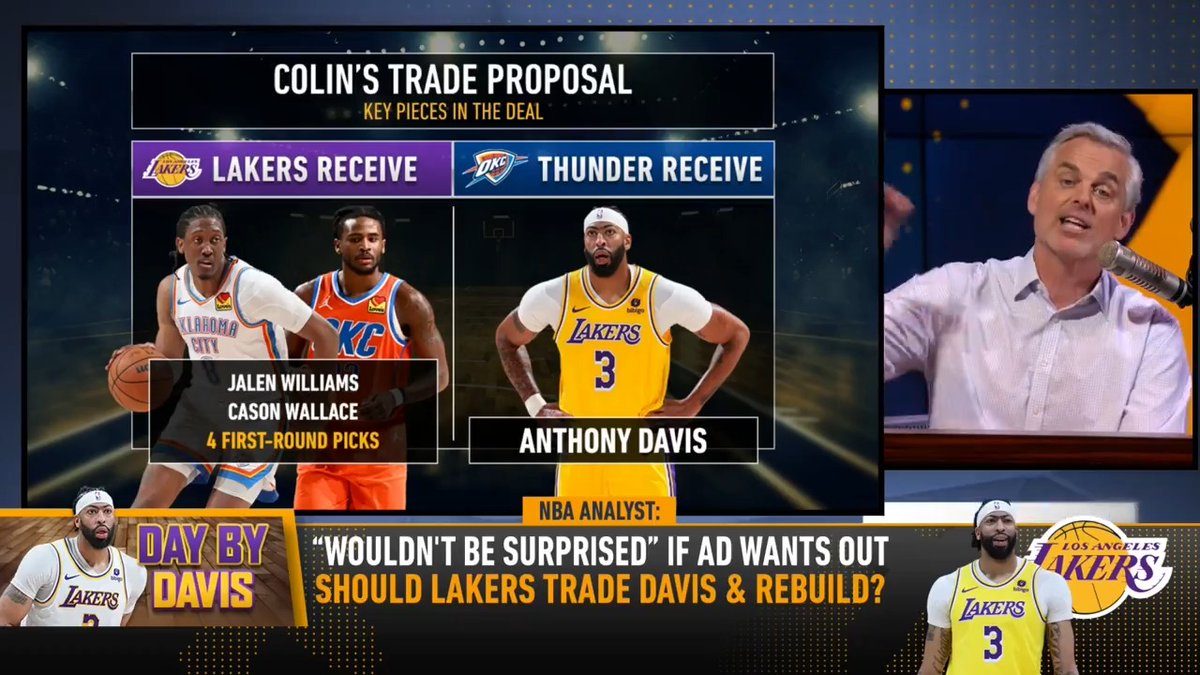
Anthony Davis trade idea per Zach Lowe: Bulls Receive: Anthony Davis Mavs Receive: Coby White, Nikola Vucevic, Portland 1st round pick, Bulls 1st round pick. “This would almost be like a free agency signing” Core: Giddey/Ayo/Okoro/Matas/AD

382,273 次观看 • 8 个月前 •via X (Twitter)

0 条评论

暂无评论

原始帖子的评论将显示在这里

相关视频

The Wolves salary dumped Mike Conley's $10.8M contract at the trade deadline. These were the functional salary cap-related values to the Wolves in making that trade... - The trade got them below the 1st apron, which gave them the ability to take back more money in a subsequent trade (because you can't be over the 1st apron and take back more money than you send out in a trade). Technically, they took back more money in the Ayo Dosunmu trade, because it included Julian Phillips and his contract. But if you remember, the Conley trade happened two days before the deadline. They made the move in advance to open up the possibility of taking back more money in a trade for an expensive star (potentially Giannis). That was the theoretical value there, much more than it was about the value of bringing in Phillips. - They saved a lot of money on the luxury tax bill after paying nearly $100M in luxury tax for being above the 2nd apron the season before. - They created a $10.8M trade exception that they can use to absorb up to $10.8M in salary without sending money back. But using a trade exception hard caps you at the 1st apron and only lasts for 12 months. - Got off Rob Dillingham's contract that is set to pay him $6.9M this coming season and $8.8M the following season. This creates some space beneath the aprons that they could need if they are to re-sign Ayo Dosunmu. Also created another $6.6M trade exception when doing the Dillingham-Dosunmu trade, because the Wolves absorbed Dosunmu into the Alexander-Walker trade exception from last summer ($7.6M NAW trade exception, and Dosunmu made $7.5M). Transacting this way hard-capped the Wolves at the 1st apron, but at that point in time the deadline was about to pass, they weren't trading for Giannis or anyone else, meaning there was no cost to being hard-capped at the 1st apron for the rest of the season. (Though that could impact a draft night trade, I believe -- because that's the same calendar year.) - The 21st picks salary this season ($3.9M) is $800k higher than the 28th picks salary this coming season ($3.1M). So while that player should be more valuable, that player would also carry a bigger cap hit. What it cost them was a pick swap with Detroit in this draft -- moving them back from pick 21 to pick 28 in the 1st round. So I asked Tyler Metcalf how much value the Wolves gave up in this draft by moving back from 21 to 28.

Dane Moore

59,064 次观看 • 1 个月前

Lots to unpack as Jake Fischer discusses the Domantas Sabonis/Toronto Raptors trade talks this season: -The Kings thought that Toronto and Washington were the two landing spots for Sabonis. -The Wizards were shopping around Khris Middleton’s $33M-expiring contract, and some draft capital to see what sort of center they could land (ultimately ended up acquiring AD). -Wizards inquired about players like Sabonis, KAT, potentially Zion as well. -“The second the Wizards went and got Anthony Davis, that kind of took a lot of Sacramento’s leverage with Toronto, trying to get first round draft capital for Domantas Sabonis, and the Raptors were just not willing to do so.” This lead to some friction between the two teams regarding negotiating draft capital. -“The only contract of significant consequence that Toronto was offering, that Sacramento was willing to take back, was RJ Barrett.” Kings GM (and former Knicks executive) Scott Perry was with the Knicks when they drafted RJ. -Jakob Pöltl’s contract was considered “onerous” around the league. -Jake says he has confirmed with various sources that Memphis was open to taking on Jakob Pöltl’s contract. -The Raptors had conversations on Daniel Gafford as well. Mavs were looking to land first round draft capital -Toronto simply just wasn’t going to give up any first round picks for any big men during this season’s trade deadline -The Kings will have another opportunity this summer to move on from Domantas Sabonis, if they want to. (Via. Bleacher Report)

Omer Osman

63,253 次观看 • 5 个月前

Thank you Saratoga County GOP for honoring me with the Free Speech Award! Edited speech transcript to save characters: My name is Lenny Roudik. I've had the privilege of knowing Anthony for nearly a decade. Back in 2015, I was a 15 years old and thought it would be cool to work for Sticker Mule. So, I sent the CEO a tweet asking if he would hire me. To my surprise, Anthony responded and gave me a job. When I first met Anthony, I had no idea he was a Trump supporter. What stood out was that he was a great boss who believed in loyalty, and giving people a chance. Our friendship was forged late one night in 2016 when Anthony was getting attacked by a Twitter mob over his support for President Trump. He wrote a few tweets in support of then candidate Trump and the mob went wild. 10,000+ emails came pouring into our inbox. Anthony spent years making Sticker Mule a much loved brand and, suddenly, it felt like everyone hated us. It was 2am and I saw Anthony was online. So I messaged him and said, “Ignore these crazy people. Sticker Mule is still awesome.” From that moment, Anthony became more than a boss. I told him I was the only vocal Trump supporter at my high school and we developed a close bond. Tonight I couldn’t be prouder to represent a person who truly loves our country. When the mob attacked, Anthony didn't back down in 2016 and he continues to refuse to back down. In 2024, he took a big risk to support President Trump and free speech. Many told him to stay quiet. “Anthony,” they said, “Just donate and move on.” But Anthony refused. He repeatedly said, “We all just saw President Trump almost die. If people like me stay on the sidelines forever, things will never get better.” So he sent an email to our 5+ million customers announcing that he supports President Trump and called for an end to Anti-Trump hate. In defending the President, Anthony took on the wrath of the entire Democrat Party. 100,000+ people sent hate emails and many more posted on social media. Democrats boycotted us, harassed customers not to buy anymore, banned us from Reddit, and more. Rather than cave to pressure, Anthony doubled down and erected the beautiful, artistically designed, “Vote for Trump” sign. What we didn’t know at the time was that this sign would turn into something much bigger - a fight for free speech. Not only did we receive hundreds of credible death threats over the sign, we faced a cowardly attack by our own Democrat mayor. At the very last minute, the Mayor rushed to court and filed a restraining order threatening Anthony with arrest if he dared to light up the sign. I’ll never forget it. We were in Anthony’s kitchen the night before the lighting while Anthony’s attorney was on speakerphone telling Anthony not to light the sign or he would end up in jail. Anthony made it clear. He was lighting that sign, no matter what. Luckily, moments before Anthony was about to light it, we got the call. Our attorney, Sal Ferlazzo, said: “Anthony, the judge overturned the restraining order. You’re free to light the sign.” We were ecstatic and the energy at the ‘Vote for Trump’ sign lighting was electric. People were coming up to Anthony, saying, “Thank you.” They came from all different walks in their life and some had tears in their eyes. Even some Democrats showed up and saw how much love was within the MAGA movement. And I’ll end with a powerful story. Amid the crowd, I noticed a retired pro-boxer who trained Anthony, standing near the front line, keeping an eye on things. I walked over to him and said, “You're doing a great job. Thank you.” He looked at me and said something I’ll never forget: “I’m ready to die for this man. I even brought a little something with me... just in case things go south.” That kind of loyalty shows you who Anthony Constantino is. I’m proud to call Anthony my boss, my mentor, my friend and if we are lucky, one day, our elected representative.

Anthony Constantino

301,975 次观看 • 1 年前

I asked Dallas Mavericks GM Nico Harrison four questions today at his end-of-season press conference: Me: “You said me and Coach Kidd are aligned, you know the player(s) that he likes. But when it comes to a trade of this magnitude, it’s the main player that led y’all to the finals last season, so I wanted to ask you, what did that conversation look like at the 11th hour when you told him that y’all would be trading Luka Doncic, and do you think it was fair to him to have y’all’s entire team to be built around Luka, and then in the middle of the season him having to pivot to a completely different player to try to make the title run again?” Harrison: “I think there’s some difficulties anytime when you do a trade that big during the middle of the season. We saw it when we traded for Kyrie a couple years ago. Sometimes trades take a little longer to really see how good a trade it was. But I also know his connectivity to Anthony Davis. He won a championship with him with the Lakers. I know his admiration for him as a defensive player, and so I wasn’t worried about that.” Me: “What did y’all’s conversation look like when you let him know?” Harrison: “It was really brief. I just told him the reasoning behind it and let him know, and he understood and he got geared up to start white boarding to get ready to see how we would play with Anthony Davis.” Me: “Do you feel like he agreed with those reasons?” Harrison: “I don’t think it’s about agreeing, but he aligns with how I think in terms of defense wins championships. That’s how he feels. He also aligns with the philosophy of versatile style of play. And so it really wasn’t about agreeing or disagreeing, it was about ‘I see the vision, let’s go.’” Me: “Defense is one thing that’s been talked about so many times when you’re referring to this trade. With you trading Luka, in a way you’re betting on Anthony Davis to help you guys but it’s also you thinking AD would help more than Doncic did. Outside of defense, why are you betting against Luka Doncic not being able to bring y’all a title when he was here?” Harrison: “It’s more about AD…I’m not going to bet against Luka or speak negatively towards him. He’s not here anymore. But it’s the belief that I have in the guys that are in this locker room.”

Noah Weber

199,034 次观看 • 1 年前

📊 Things I dislike and Like about Mikal Bridges — aka Mr. 5 First-Round Picks (Also a 2028 1st Pick Swap with BK) 🗒️ 5 firsts is the most ever for a non-All-Star and he makes the same $37M as Şengün — a homegrown All-Star. 🗒️ Mikal not the defender he once was. Last year he was last in On-Ball Screen Navigation. Here are his matchup results this season according to most points scored on him: 🍎 Josh Giddey — 21 PTS | 9:18 | 9-12 FG (75.0%) | 3-4 3PT (75.0%) | 0 To 🍎 Norman Powell — 18 PTS | 13:04 | 7-16 FG (43.8%) | 2-5 3PM | 0 To 🍎 Donovan Mitchell — 13 PTS | 5:25 | 5-9 FG (55.6%) | 0-2 3PM | 1 To 🍎 Matas Buzelis — 6 PTS | 6:24 | 2-4 FG (50.0%) | 2-2 3PT | 1 To 🍎 Anthony Edwards — 6 PTS | 4:39 | 2-4 FG (50.0%) | 2-3 3PT | 1 To 🍎 AJ Green — 6 PTS | 4:14 | 2-3 FG (66.7%) | 2-3 3PT | 1 To 📊 Defensive Profile: 🔵 D-FG%: 47.3% (bad for a perimeter defender — wings are expected to hold opponents closer to ~43–45%, anything near 47% means scorers are getting clean looks vs him) 🔵 Defensive Rating: 114.0 🔵 Usage Rate: 16% — 5 FRPs for a low-usage player is organizational malpractice (same usage tier as KCP 16.0%, Wendell Carter Jr 16.0%, rookie Egor Demin 16.4%, Hartenstein 16.5%, even Miles McBride has higher usage at 16.7%) 🧠 Shot Creation Issues: 🔵 3PM Assisted: 96.7% 🗑️ Unassisted 3s: 3.3% 🔵 FGM Assisted: 72.9% 🗑️ Unassisted FGM: 27.1% 🧠 3P% When He Dribbles: 📉 1 Dribble 33.3% 📉 2 Dribbles 0% 📉 3–6 Dribbles 33.3% 📉 7+ Dribbles 0% 📉 Pull-Up 3P% 28.6% 🪫 PPG: 16.2 (not worth 5 1st round picks) for context: 🍁 RJ Barrett 19.1 PPG 🔥 Jaime Jaquez JR. 17.1 PPG 🛎️ Quentin Grimes 16.8 PPG 🍀 Payton Pritchard 16.4 PPG ⚡️ Ajay Mitchell 16.3 PPG 📊 What I Do Like About Mikal: 🥷 2.0 STL 🧱 0.9 BLK 🥇 AST% 19.5% (career high) 🥇 AST/TO 5.36 (career high) 📈 FG% 48.6% 🎯 3P% 41.7% 📈 3P% on 0 Dribbles: 45.5% This isn’t enough production. He gives us almost no shot creation, and while he’s elite on corner 3s, we didn’t trade 5 firsts and a 2028 swap for a spot-up role player. The bare minimum expectation for Mikal Bridges should be All-Star production — not role-player numbers. #NewYorkForever #SNYK #NYKx #NYK #Knicks #NYC #MikalBridges

🇬🇭State🇬🇭

37,034 次观看 • 8 个月前

Malika Andrews: "…Last time…you said…Jalen Brunson's not a 1A…" Becky Hammon: "1st of all, we were talking in a championship culture…There's nothing more attractive than a bunch of guys with panties, like, up their…calm down, calm down, calm down! He's a tremendous player…I love watching him…love watching smaller guys play b/c they defy odds…Allen Iverson, Steve Nash, MVPs…they didn't win a championship. So yes he is your 1A––and alls I was saying is that I don't think you win a championship. It's not that he's not amazing. He's amazing. So calm down New York." Woj: "I texted Becky that night & said 'Don't let anyone make you apologize for this.' The Knicks agree with you. That's not a slight on Jalen Brunson. He has transformed that organization…But the reason the Knicks are hoarding assets…they want to (if he becomes available) get a 1st/2nd team All-NBA level player. You win with that––Jokic, Giannis, LeBron––and if we were doing a draft of available players, would Jalen Brunson be in the first 5? The first 10? The first 15? Maybe. But championships…you have to have one of those guys. That doesn't diminish what Brunson has meant…He is one of the great success stories in this league from a second-round pick." Zach Lowe: "Look I don't think any of these things are absolute…We've seen other small guys win…Isiah Thomas…Chris Paul could've…depends…Right now, look: The Knicks want a better player than Jalen Brunson…you just said that. I think the Knicks right now if they're healthy…without that player but with Jalen Brunson, is the biggest threat to the Celtics in the East, as is…I don't think they'd beat them & I think they would like another star. So I think nothing is quite absolute…Everyone wishes they were a little bit taller." Malika: "…What Jalen Brunson has done is turn the New York Knicks into an organization that people want to play for, that free agents around the league look at and say 'OK what about New York'…"

New York Basketball

1,581,878 次观看 • 2 年前

The 4.5 billion dollar-per-year National Indigenous Australians Agency has been quick to deny it’s been developing demands to be made by the voice to Parliament, revealed in a letter sent to my office last week. I’ll remind you what some of these demands were: •Aborigines paying only 50 per cent the rate of income tax; •Aboriginal groups owning beaches and national parks, and charging the rest of us to use them; •10 per cent of all judges, magistrates, police officers, ADF officers, vice chancellors and ambassadors to be Aboriginal; •no entry tests and no fees for Aborigines going to university; •50 per cent discounts for Aborigines going to sport and music events on public land; •Aborigines to have first claim on all public housing in Australia; •reduced age of eligibility for the aged pension for Aborigines; •rivers and streams to be owned by local Aborigines, who will charge the rest of us for water consumption; •the same for mining royalties; •all new liquor licences to be vetted by the voice; and •the voice office being the same size, and having the same budget, as the Department of Prime Minister and Cabinet. As I said, the NIAA has been quick to deny this ‘action list’ for the voice, and no wonder! If any these demands were met, 97 per cent of Australians would be made second-class citizens based solely on race. However, minutes of government organisations meetings with Aboriginal groups around the country obtained through a freedom of information request show these sort of demands are being discussed. These include: •exclusive sovereignty for Aboriginal and Torres Strait Islander people over land and waters; •creating a new Aboriginal state from land under native title, with its own constitution; •a treaty or treaties recognised in the Australian Constitution; •racially-exclusive designated seats in Parliament reserved only for Aborigines; •Aborigines to receive a fixed percentage of all Australian gross national product; •Aborigines to be exempted from paying land tax; •funding for the voice to Parliament to be generated from percentages of land and water taxes; •funding for Aboriginal bodies and programs to be linked to reparations for “theft of land”; •creation of a ‘black Parliament’; •a race-based rent tax from “an open cheque book”; •race-based “inherent” rights for Aboriginal people in the Australian Constitution; •renaming more towns and landmarks after Aboriginal and Torres Strait Islander people; •the creation of “sovereign wealth” exclusively for Aborigines; •Australian taxpayers to fund the preservation of Aboriginal languages; •changing the Australian flag because it “symbolises the injustices of colonisation”; •tearing down statues of explorers; •enshrining Aboriginal “traditional ways of life” in the Constitution; •changing the curriculum in all schools for non-indigenous Australians; •“de-colonising” Australia; and •fee-free access for Aborigines to sport and recreation, including free sporting equipment. Like the demands contained in the letter sent to me, many of these would also make most Australians second-class citizens in our own country. The 4.5 billion dollar NIAA has been actively discussing them with Aboriginal groups for years. These are the dangers of putting the voice to Parliament in the Constitution. For these and many other reasons, it’s why Australians must vote NO in Anthony Albanese’s racist referendum.

Pauline Hanson 🇦🇺

288,210 次观看 • 3 年前

$NVDA $GFS NVIDIA’s reported agreement to acquire Groq for $20B in cash (per CNBC, amplified via Reuters and other wire coverage) represents a materially different strategic posture than NVIDIA’s prior M&A pattern, given both the headline size (largest reported NVIDIA acquisition to date) and the unusual carve-out that Groq’s early-stage cloud business would not be included. Public reporting indicates the information originated from Alex Davis, CEO of Disruptive (lead investor in Groq’s latest financing), and that neither NVIDIA nor Groq had issued an immediate confirmation at the time of publication. The same reporting frames the transaction as coming together quickly, only months after Groq raised $750M at a ~$6.9B valuation, and highlights Groq’s positioning as a high-performance inference chip vendor founded by ex-Google TPU engineers. Groq is best understood as a vertically integrated inference acceleration company whose core asset is an application-specific processor optimized for deterministic, low-latency execution of transformer-style workloads, paired with a compiler-led software stack and a distribution layer (GroqCloud) designed to reduce developer friction via OpenAI-compatible APIs and integrations. Groq brands its architecture as a Language Processing Unit (LPU) and consistently emphasizes that the design target is inference, not training. The company’s own architecture description centers on 1-core execution, large on-chip SRAM used as primary storage (explicitly not cache), a custom compiler that statically schedules compute and communication, and direct chip-to-chip connectivity intended to coordinate multi-chip execution without relying on conventional caching hierarchies or dynamic runtime scheduling. The technical premise is a deliberate inversion of the conventional GPU approach. GPUs deliver throughput via massively parallel, multi-core execution with dynamic scheduling, complex memory hierarchies, and heavy reliance on off-chip HBM bandwidth and sophisticated runtime/kernel optimization. Groq instead argues that inference bottlenecks are driven by latency variance (tail latency), synchronization overhead, and memory access unpredictability inherent in dynamically scheduled, cache-heavy architectures, particularly when workloads are latency sensitive and batch sizes cannot be inflated. Groq’s solution is to move “control” into the compiler: the full execution graph and inter-chip communication schedule are computed ahead of time down to clock-cycle granularity, with deterministic execution designed to reduce run-to-run variance. In Groq’s framing, the removal of caches, reorder buffers, speculative execution overhead, and other sources of contention enables predictable latency and high utilization without per-model kernel engineering typical of GPU tuning cycles. A critical nuance is that Groq’s determinism is not merely a software claim; it is tightly coupled to architectural constraints and system design choices that trade flexibility for predictability. Third-party technical commentary indicates Groq’s chip uses a fully deterministic VLIW-style approach with minimal buffering, no external memory, and heavy dependence on sharding models across many chips because on-chip SRAM capacity is limited. SemiAnalysis describes a ~725 mm^2 die on GlobalFoundries 14nm with ~230MB of SRAM and notes that “no useful models” fit on a single chip, forcing multi-chip partitioning for modern LLMs and driving a system-level design where networking and compilation are first-class scheduling problems rather than ancillary infrastructure. This is consistent with Groq’s own messaging that tensor parallelism across chips is a primary design goal, enabled by large on-chip SRAM and compile-time coordination of compute plus interconnect. The on-chip SRAM emphasis is central to Groq’s latency story and also its most constraining trade-off. Groq claims on-chip SRAM bandwidth “upwards of 80 TB/s” and contrasts that with off-chip HBM bandwidth “about 8 TB/s,” asserting a potential 10x advantage from bandwidth plus reduced trips across chip-to-memory boundaries. While these comparisons are marketing-oriented and depend on workload specifics, the architectural implication is clear: Groq prioritizes ultra-fast local weight/activation access and then scales capacity by adding chips, not by attaching large off-chip memory pools. This design can reduce latency for sequential inference layers and minimize unpredictable stalls, but it pushes complexity into partitioning strategy, interconnect topology, and compiler scheduling, and it increases the number of chips needed for very large parameter counts and large KV-cache footprints. Groq also highlights numeric formats and compiler-driven precision management as a performance lever. In its 2025 technical blog, Groq describes “TruePoint numerics,” including 100-bit intermediate accumulation and selective quantization choices (FP32 for attention-sensitive operations, block floating point for MoE weights, FP8 storage in error-tolerant layers), and claims 2-4x speedups versus BF16 without measurable accuracy degradation on benchmarks such as MMLU and HumanEval. Even if the absolute uplift is workload dependent, the strategic point is that Groq is pursuing performance via end-to-end co-design: precision policy is not just hardware capability (FP8/BF16) but compiler-enforced mapping of precision to error sensitivity, which can matter materially for inference cost-per-token if it reduces memory traffic and boosts throughput without forcing aggressive, accuracy-damaging quantization. Independent performance datapoints indicate Groq has been credible on latency-oriented inference speed, at least for certain regimes. EE Times reported in 2023 that Groq demonstrated Llama-2 70B inference at ~240 tokens/s per user on a cloud-based dev system described as 10 racks and 64 chips, using the company’s 1st-gen silicon introduced several years earlier. Separate Groq commentary around independent benchmarking cites results showing ~241 tokens/s throughput and ~0.8s time to receive 100 output tokens for a Llama-2 70B API configuration, positioning the platform as a step-change in “available speed” for certain interactive use cases. These figures do not settle total cost-of-ownership versus GPUs or hyperscaler ASICs, but they establish that Groq’s system-level architecture can deliver strong single-user throughput and latency on large models when properly partitioned and scheduled. GroqCloud is the commercial wrapper that packages this hardware/software stack as “tokens-as-a-service,” aiming to make Groq adoption feel like switching API endpoints rather than adopting new silicon. Groq’s documentation states its API is designed to be “mostly compatible” with OpenAI client libraries, and its pricing page provides model-specific token rates, published speeds (tokens/s), prompt caching discounts, and batch processing discounts. For example, pricing lists inputs as low as $0.05 per 1M tokens and outputs as low as $0.08 per 1M tokens for certain smaller LLM configurations, with higher prices for larger models and long-context or MoE variants; it also advertises prompt caching with a 50% discount on cached input tokens for certain models and a batch API offering 50% lower cost for asynchronous processing windows. These mechanics are economically important because they demonstrate Groq’s go-to-market is not simply “sell chips,” but “sell predictable unit economics per token,” with tooling (batch, caching) that directly targets inference cost drivers (reused prompts, throughput smoothing, and asynchronous workloads). The cloud footprint and distribution partnerships indicate Groq has been building an inference-native “edge within the cloud” strategy rather than competing head-on with hyperscalers on breadth of services. A 2025 Groq newsroom release describes a European deployment in Helsinki with Equinix, positioned as latency reduction and data governance for European customers, and explicitly references Equinix Fabric enabling private connectivity to GroqCloud over public, private, or sovereign infrastructure. The same release enumerates additional capacity in the U.S. (Equinix, DataBank), Canada (Bell Canada), and Saudi Arabia (HUMAIN), and states these sites collectively served more than 20M tokens/s across Groq’s global network at that time. That supply-side metric matters because it provides a directional sense that Groq is scaling capacity as a network, not merely as a chip vendor. Customer disclosure is inherently limited because Groq is private and many enterprise deployments are not public, but Groq’s marketing materials and partnerships provide signals about demand vectors. The company’s public website displays logos of large consumer and enterprise brands (e.g., Dropbox, Vercel, Chevron, Volkswagen, Canva, Robinhood, Riot Games, Workday, Ramp) and includes a published customer quote claiming a 7.41x chat speed increase and an 89% cost reduction after moving to GroqCloud, followed by a tripling of token consumption. While marketing claims should be treated as case-specific and not generalized, they indicate that Groq is targeting both AI-native developers (who measure success by latency and cost-per-token) and enterprise buyers (who care about predictable performance and governance). Supplier and dependency mapping for Groq spans 3 layers: silicon production, system integration, and cloud infrastructure. On silicon, third-party analysis indicates GlobalFoundries 14nm for the 1st-gen Groq chip, implying a supply chain less constrained by the most capacity-tight leading-edge nodes and advanced packaging bottlenecks that dominate high-end GPU supply (HBM stacks, CoWoS-type packaging constraints). If accurate, this is strategically meaningful because it suggests Groq capacity expansion could be gated more by conventional wafer supply, board assembly, and data center power than by the same HBM/advanced packaging scarcity that has constrained top-tier GPU ramp cycles. On systems and cloud, Groq’s own releases identify colocation and connectivity partners (Equinix, DataBank, Bell Canada) and a Middle East partner (HUMAIN), implying dependencies on data center real estate, power availability, and network connectivity, alongside procurement of standard server components, NICs/switching, racks, and cooling infrastructure. The Groq design narrative also emphasizes air cooling and reduced need for complex power/cooling infrastructure, which—if realized in deployments—can widen the set of feasible hosting locations and lower deployment friction relative to liquid-cooled, very high power density GPU racks. Against that backdrop, the strategic rationale for NVIDIA acquiring Groq can be framed as a set of overlapping objectives: inference silicon optionality, architectural hedging, competitive defense, and supply chain diversification, with the carve-out of GroqCloud signaling a preference to avoid direct cloud competition and to focus on IP and product portfolio control rather than operating a capital-intensive token-serving business. The deal, if confirmed, would occur at a valuation step-up of ~190% versus Groq’s reported ~$6.9B private valuation in the September $750M round, reinforcing that any acquisition logic would be predominantly strategic rather than a conventional financial multiple arbitrage. The most compelling strategic driver is inference. Training has historically been the center of gravity for cutting-edge GPU demand, but inference volume is structurally larger and more distributed as deployments scale, with economics dominated by cost-per-token, latency guarantees, and utilization under spiky demand. Inference workloads also create a strategic vulnerability for NVIDIA: hyperscalers and large platforms can justify bespoke ASICs (TPU, Trainium/Inferentia, Maia-class efforts) because inference is stable, repeatable, and can amortize software investment at massive scale. Groq’s core proposition—deterministic, compiler-scheduled inference with predictable latency—aligns directly with the segment where GPU generality is least valued and where “good enough” programmability plus superior unit economics can win share. Acquiring Groq would allow NVIDIA to own a credible inference-native architecture rather than relying solely on GPUs and software optimization to defend that segment. Competitive defense logic is also plausible. Groq occupies a specific competitive wedge: low-latency, high-throughput interactive inference, delivered via a simple API abstraction that reduces switching cost. That wedge directly pressures GPU inference margins in the long run because it makes inference price/performance comparisons more transparent at the token level, and it targets a developer persona that historically defaulted to CUDA-first ecosystems. Even if NVIDIA’s current-generation systems can achieve very high tokens/s per user with extensive optimization, the strategic risk is that competing architectures normalize the idea that inference is best served by special-purpose silicon with a simpler programming model, weakening CUDA lock-in at the application layer. NVIDIA has actively demonstrated that Blackwell-era systems can exceed 1,000 tokens/s per user in benchmarked configurations, but that performance leadership does not automatically translate to lowest cost-per-token across the full range of batch sizes, latency targets, and deployment environments. Groq’s existence as a credible alternative architecture forces NVIDIA to keep defending inference economics rather than only raw performance leadership. The “technology acquisition” rationale is unusually strong in this specific case because Groq’s differentiator is not a single block of silicon IP but an end-to-end methodology: compiler-led static scheduling, deterministic networking, and a system architecture designed around tensor-parallel inference rather than throughput-maximizing batch inference. NVIDIA’s stack is already compiler-heavy (TensorRT, Triton, CUDA graphs, kernel fusion, speculative decoding techniques), but GPUs remain dynamically scheduled devices with complex memory hierarchies and stochastic latency behaviors under contention. Groq’s approach provides an alternate design point: treating the entire inference execution (compute plus communication) as a statically schedulable program. In principle, that IP could be valuable even if Groq silicon itself is not adopted at massive scale, because it can inform how NVIDIA builds future inference-optimized products, compilers, and networking fabrics, especially as distributed inference with large models makes communication a first-order performance determinant. Supply chain diversification is a non-obvious but potentially important driver. If Groq’s mainstream product generation is truly based on a mature process node and avoids HBM, then the scaling constraints look different than those of state-of-the-art GPUs. NVIDIA’s ability to meet incremental demand has been tightly coupled to advanced packaging and HBM supply, and those constraints can remain binding even when wafer supply is available. An inference ASIC architecture that relies primarily on on-chip SRAM and scales by adding chips—while not costless—could reduce dependence on HBM availability and advanced packaging capacity, enabling NVIDIA to ship “inference capacity” in higher absolute volumes or into geographies and customer segments where the highest-end GPUs are economically or logistically difficult to deploy. This could be particularly relevant for latency-sensitive inference deployed in regional colocation footprints rather than centralized hyperscale campuses. The carve-out of GroqCloud, if accurate, is itself a strategic signal about NVIDIA’s priorities. Operating a token-serving cloud at scale is capital intensive, structurally lower margin than silicon IP rents, and creates channel conflict with hyperscalers and CSP partners who are core NVIDIA customers. NVIDIA has generally positioned its cloud offerings through partnerships rather than as a direct hyperscale competitor. Excluding GroqCloud would preserve neutrality with CSPs and avoid inheriting multi-region data residency obligations and partner contracts, while still allowing NVIDIA to acquire Groq’s silicon, compiler technology, and engineering talent. At the same time, excluding GroqCloud would also mean NVIDIA would not automatically acquire the commercial proof-point of Groq’s unit economics or the customer contracts that validate product-market fit at scale, increasing the importance of diligence on whether Groq’s cloud pricing is structurally profitable or partially subsidized by fundraising. There is also a “preemptive acquisition” angle. The reporting identifies recent investors in Groq’s latest round including large financial institutions and strategic/industry players. In that context, Groq represents an asset that could plausibly have been acquired by a competitor (AMD/Intel) or by a hyperscaler seeking to accelerate inference independence. NVIDIA acquiring Groq could be a defensive move to prevent a credible inference-native architecture from being weaponized by a rival with deep distribution. Even if GroqCloud is carved out, controlling the silicon roadmap and compiler IP would meaningfully constrain Groq’s ability to evolve into a standalone competitor, unless the carved-out entity retains long-term rights to the hardware and software stack. However, the strategic case is not one-sided; there are meaningful risks and potential contradictions that would need to be reconciled for the transaction to be value-accretive on a multi-year horizon. 1st, Groq’s architecture appears to rely on scaling out chip count to achieve capacity, which introduces system cost, networking complexity, and physical footprint considerations. The absence of external memory and limited on-chip SRAM implies very large models require substantial chip parallelism, and the economics then depend heavily on chip cost, yield, power efficiency, and interconnect overhead. SemiAnalysis explicitly frames Groq as trading space for time and raises questions about token economics and whether publicly advertised pricing reflects fully loaded costs or market share capture. 2nd, integration risk is non-trivial. Groq’s compiler-led deterministic model is philosophically and practically different from CUDA’s dominant programming and execution model. A poorly executed integration could create internal product confusion, dilute engineering focus, or alienate developers if the combined stack fragments. 3rd, there is cannibalization risk. If Groq-class inference silicon undercuts GPU inference economics, NVIDIA could face internal margin trade-offs, even if the goal is to defend share against hyperscaler ASICs. Cannibalization can still be rational if it prevents larger share loss, but it would require crisp portfolio segmentation and go-to-market discipline. The presence of NVIDIA’s own rapidly improving inference performance complicates the “need” for Groq but does not eliminate the “option value.” NVIDIA has demonstrated benchmark-leading tokens/s per user on Blackwell-based systems, suggesting that raw interactive throughput is not necessarily the limiting factor for NVIDIA’s product line. The more enduring strategic question is unit economics and architectural control: whether future inference demand is better monetized through general-purpose GPUs plus software optimization, or whether a bifurcated product portfolio (training GPUs plus inference-native ASICs) becomes necessary to defend total AI compute wallet share as hyperscaler ASIC penetration increases. Acquiring Groq could be a decisive move to ensure NVIDIA participates in both regimes rather than betting exclusively on GPUs to win inference forever. What is “special” about Groq’s technology relative to a typical accelerator roadmap is the tight coupling of determinism, compilation, and networking into a single scheduling problem. The LPU narrative emphasizes deterministic compute and networking, static scheduling, and direct chip-to-chip coordination that allows “hundreds” (more precisely, 100s) of chips to behave like a single scheduled resource. The architecture also explicitly targets tensor-parallel, latency-optimized distribution rather than pure data-parallel throughput scaling, which matters for real-time applications where a single response must arrive quickly rather than many requests being processed in bulk. The implication is that Groq is optimized for the time-to-first-token and steady token streaming behavior that defines user experience in interactive LLMs, and it attempts to achieve that without relying on large batch sizes that can degrade latency. From a portfolio manager’s perspective, the most important interpretation is that an NVIDIA-Groq combination would likely be less about “NVIDIA needs more inference speed” and more about controlling the architectural trajectory of inference acceleration and removing a fast-improving, developer-friendly competitor from the market. The carve-out of GroqCloud would reinforce that the transaction is aimed at IP, talent, and product optionality, not acquiring a cloud revenue stream. The valuation step-up implied by $20B versus $6.9B would therefore be justified only if the acquired assets materially reduce long-term competitive risk (hyperscaler ASIC displacement, inference margin compression) or enable new monetization vectors (inference ASIC product line, supply chain de-bottlenecking, improved software determinism) that would be difficult to achieve on a comparable timeline via internal R&D.

TheValueist

102,145 次观看 • 7 个月前

Just in $AMD Anush "Speed is the moat"|ROCm🎙️ In the race to define the future of AI, what's the one advantage that truly lasts? It's not proprietary tech, argues Anush Elangovan Elangovan, VP of AI Software at AMD , but the sustainable speed of innovation. He explains why AMD is rejecting the "walled garden" model for its open source ROCm stack, betting that an open community flywheel is the key to victory. Listen to understand how this open strategy is designed to out-innovate closed systems by empowering developers to solve everything from frontier-model challenges to the mundane, everyday problems that define the "last mile" of AI. AMD ROCm Software: Part 1 Transcript [00:00:00] Andrew Zigler: Joining me is Anush Elangovan, VP of AI software at AMD. And when people talk about AI compute, the conversation often stops at hardware specs, but it's more than just physical chips that win the game. It's also the software ecosystems supporting them. [00:00:18] Andrew Zigler: The prevailing strategy in the industry has been to build something like a walled garden. You know, something closed, proprietary locks, developers in. But AMD is betting on an entirely different play, open source acceleration, and with rock, their open source AI software stack. AMD is building not just hardware parity, but an innovation flywheel that's powered by the community with interoperability and the freedom to scale without all of that pesky lockin. [00:00:48] Andrew Zigler: And in this world, speed is your moat and how fast you can innovate while your platform remains open, flexible, and standardize across all of its applications. That's what we're gonna explore [00:01:00] today. So Anush, I'm really excited to have you here. Welcome to Dev Interrupted. [00:01:04] Anush Elangovan: Thanks for having me. Uh, super excited to chat about it. [00:01:07] Andrew Zigler: Amazing. Well, let's go ahead and dive right in with kind of what I laid it out with in the beginning, the idea of the moat and it being about speed. I wanna unpack that a bit because that came from you when you and I first spoke. And I, and I want to know, you know, how do you define speed inside of AMD beyond just things like hardware, benchmarks. [00:01:27] Anush Elangovan: Yeah, that's a very good question. So when we typically talk about speed, everyone's like, Hey, hardware benchmark specs, right? Like, uh, memory bandwidth or, or flops. And that is one important part of it, uh, AMD does very well. With that, we do have, a, a very good history of executing on that axis. [00:01:47] Anush Elangovan: But when I say speed is the moat, it is about, uh, how we prepare, how we build the muscle to run the race for a long time and run it fast. And it is [00:02:00] not about a single point in time that you've, you've beat some you know, benchmark and, and you declare victory. It's about building the ability to consistently develop and deliver. [00:02:13] Anush Elangovan: Both hardware and software innovation at scale and do it fast, right? Like, you know, we we're increasingly getting to a point where models come out and they're, uh, you know, a year or two ago it was like, Hey, they work on AMD on day zero, which is great, but now they are performing on AMD the day it releases, right? [00:02:32] Anush Elangovan: So, what does it take to Prefetch where the industry is going? Be prepared to intercept. At that point is what you know, I, I refer to as you know, the, the speed factor in, in creating this mode, right? And the mode is just shed all things that hold you back and run as fast as you can. [00:02:53] Anush Elangovan: Uh, because the pace of innovation that is, uh, being seen in, in AI [00:03:00] industries is just. Amazing. Right? And it's like, it's transformational at at how you generate electricity. It's transformational as at how you build data centers. It's transformational at how you deploy compute, networking. It's transformational at what kind of use cases you, you know, uh, use AI for. [00:03:17] Anush Elangovan: Uh, and for that, you need to be prepared to, see what comes tomorrow and be prepared to run the race tomorrow. [00:03:23] Andrew Zigler: Yeah, it's a really great perspective because it highlights that it's not just like a checkpoint that you run through. I like how you called out, like it's not just hitting that benchmark or being the best in class at that moment, in that snapshot, it's about having a. The throughput and about having that dedication to the idea and continuing to deliver on it. [00:03:43] Andrew Zigler: It's not just crossing the threshold, but it's also being the engine. And that's what, that's what protects a business. That is the moat, because the moat is that innovation layer, the faster and more, uh, future forward. That you can work and think, [00:04:00] you know, the better. Uh, we, we talk a lot about like future forward work styles. [00:04:04] Andrew Zigler: Like what are the things I could be doing right now today that are gonna be like, way more useful tomorrow? Let, let's abandon those, workflows that are older and that kind of like, that translates into. An advantage when you work that way. You know, what kind of things have you learned working with, uh, like across all spectrums of people who would use ROCm, right? [00:04:23] Andrew Zigler: You have like the developers, but then you also have the enterprises and you have this large span of adoptees, right? So what is the, what does that look like that you learn? [00:04:32] Anush Elangovan: Yeah, so, so the way I look at it is there are gonna be pockets of different, uh, you know, cadences, right? Like, so people who are deploying in enterprises, for example, right? The validation and how long it takes for them to deploy an LLM that's secure. It's, with guardrails, et cetera, maybe longer. [00:04:52] Anush Elangovan: but you still have to go through the process and you have to be prepared to like, walk that walk to deploy an enterprises. That doesn't mean it's [00:05:00] not fast, that's as fast as you can do for that industry, right? And if you are deploying AI in healthcare, right, it's, it's got its own, uh, cycle. [00:05:07] Anush Elangovan: but in each one of these, you want to see how, like, go down to the essence of what is it that you actually have to do. And, you know, I, I, I like how you framed it. It's like it's, you shed your prior assumptions of how things are done, right. And, and you kind of build up from a, uh, first principles, uh, approach to say, this is how I could use AI to unlock, whatever I'm doing. [00:05:33] Anush Elangovan: And, and, some of it, you know, it's good to really step back and look at. Just question every part of it, right? Like right now you're getting chat GPT and, Gemini competing for like, math, olympiads and, and, uh, college, uh, reasoning, uh, tests. Right? And, and those are like that, that is amazing and increasingly like complex tasks that they're trying to do. [00:05:58] Anush Elangovan: But there may also be like. [00:06:00] More mundane things that AI could, could get applied to. Right? And, and so when we think about shedding old ways, you wanna shed it not just in like the tip of the spear. It's like, you know, I'm gonna see what's the frontier model. It's also, it could be something as simple as. [00:06:18] Anush Elangovan: How do you choose a, a movie, uh, you know, like a recommendation system, right? Or, or, uh, an automated, uh, flight, uh, rebooking system. So the moment, you know, your flight is late, uh, right now it's a notification, right? It's like, oh, you got a text message saying your flight's late. And I got that like three times this week. [00:06:38] Anush Elangovan: But anyway, uh, and, and, and, and, I was just like, okay, so if I were to rethink this. All this MCPs that we have that should be hooked up into an MCP that says, your flight's delayed. Here are your options. If you want, you know, these are the paid options. Yeah. Here are the free options. This will get you back into your you know, Toronto airport [00:07:00] tonight. [00:07:00] Anush Elangovan: Or if you stay, here's a hotel plus this, plus this, plus. It's just like, go ahead is all I should say. Versus now I'm like, okay, can someone, you know, can I call a travel agent? Can I do this? Can I go online and log into And you know, so we gotta fundamentally rethink even those like small, nuances of, things that we do that can be automated out and AI is really, really good at doing something like this, right? Maybe I just explained an AI startup idea right now. Somebody should just start that. [00:07:29] Andrew Zigler: I think you did. Yeah, you definitely did. Someone, one of our listeners is definitely going to lift that off of you. I, I, I, you know, I hate being on the receiving end of those. You feel a little helpless and then you have to like, follow the whole flow. So I know what you mean. Like I, I like how you called out that the build and this like. [00:07:45] Andrew Zigler: Where speed is your moat and the innovation layer is protecting you, is what makes you better than your competitors. How you scale that and you bring that to market. So by understanding the problems that you're solving, uh, throwing away those older assumptions, but also [00:08:00] recognizing that like. We're building every single day, new things and new ways of using stuff that we're still figuring out the implications of. [00:08:08] Andrew Zigler: And so when you have a lot of velocity and you're introducing a lot of new ideas, and maybe you have that workflow now that automatically rebook your flight off of your late flight text message, and uh, I know I would certainly use it, but you know, what kind of philosophies guide the way that y'all think about building this ecosystem to manage that stability while letting folks. [00:08:29] Andrew Zigler: Play with the speed and the assumptions and the airplane re bookings. [00:08:34] Anush Elangovan: so, so I think, you know, we need to peel one layer down, right? and the philosophy is, Hey, we, we just discovered electricity, right? And you know what we're gonna do? We are gonna make motors, uh, or dynamos, right? Like engines. Uh, sure. We don't know if it's gonna be a Ferrari that you're gonna make, or it's a a a a dump truck. [00:08:57] Anush Elangovan: That's good for doing this. But let's [00:09:00] let, which is also required, right? You need a dump truck. You need a garbage truck. And, [00:09:04] Andrew Zigler: Yeah. You need the [00:09:04] Anush Elangovan: course you need, uh, a Ferrari for a midlife crisis, right? So, [00:09:09] Andrew Zigler: precisely. [00:09:10] Anush Elangovan: But, but my, uh, point is what do we build next? And, uh, and this is what I meant by like, okay, let's, let's take those baby steps to build the. [00:09:20] Anush Elangovan: Infrastructure that's required that we know we'll have to use, right? So, so if I just discovered electricity, okay, great. Now one, how do I save this electricity and how do I use it? So there's battery technology, so you need to do something like that, right? Like so. But then you also want to make it into an actionable thing. [00:09:37] Anush Elangovan: You want to make it for like automobiles, or you wanna use it for, you know, powering, uh, entire cities. So it is that transformational. So, uh, AI is that transformational. So, if you distill down, it'll, it'll come down to how do we think about, what we can do with this this fundamental technology that, We may not be aware of what it [00:10:00] is gonna unlock next, but at least you know the next step is clear, right? It's like a dense fog, you know, it's gonna be like, it, it's the right path. You see the light, but it's kind of like out there and, and the steps you're taking are concrete and you're like, okay, this is good. [00:10:16] Anush Elangovan: I, this is better than where I was or where we were. So we are moving forward. So you can build with the. Intuition from what you see in the short term and a tactical view, but towards what you think the future is gonna be. [00:10:28] Andrew Zigler: Right. You almost like we're all in this like fog of war, right? And like you said, you're reaching out and you're trying to step through it. You could think of it too, as like you're in the dark and your hands are up in front of you and you know that. You're, you're not gonna run your face into a wall because your hands are out in front of you, but you're not gonna maybe do much better than that. [00:10:45] Andrew Zigler: So that's kind of like, I think the eco, the, the industry, the world that we find ourselves in, uh, and we all have to, then this becomes the power of an ecosystem, of a group of people working together to create that layer of, [00:11:00] uh, of establishing the [00:11:01] Anush Elangovan: exactly. And I, I, I just, instead of, you know, saying fog of war I describe it as like, you're in this. Beautiful valley with like a morning, uh, fog that's in. You can smell the flowers. You, you hear the birds. You are like, okay, it's, we are in like, uh, utopian paradise and yes, I just need to like, continue the walk, right? [00:11:24] Anush Elangovan: and then move forward with that, conviction that you're in the right spot. [00:11:27] Andrew Zigler: Yeah. So let's talk about that ecosystem world. This nice, I love how you describe it, this grassy side of a hill in the morning that's covered in some mist and maybe we can't see 30 feet in one direction, but it sure is a beautiful hill and it smells nice. And so we're all here. And why is, in that world, why is. [00:11:44] Andrew Zigler: You know, open source, their strategic advantage that y'all are going for in the AI hardware market. And, and then how does like ROCm turn that into wins for people within that ecosystem? [00:11:56] Anush Elangovan: you know, the, the way we look at it is this, is kind of like how I view [00:12:00] AI and the ecosystem, right? But, but it is for everyone to enjoy. Uh, and so we do want to make sure that. You know, it is, uh, beneficial for everyone. [00:12:09] Anush Elangovan: The ecosystem can come in and, and innovate. It's an open innovation engine. and uh, it is very different from, you know, having a walled garden with, Hey, only I know how to do this and I'm gonna do it and throw it over the fence and you can use it or keep walking, right? So we'd like to be good citizens that way, but also. [00:12:30] Anush Elangovan: Uh, it is self-fulfilling in a way, right? Like it, the, the pace at which we innovate with open source is unmatched. Like, you know, our serving engines are like VLLM and, and sg l. Those things, uh, those frameworks are like super, super aggressive in terms of how fast they come out with features and how fast they can you know, get performant models out. [00:12:52] Anush Elangovan: And that compared with what, uh, you'd get from, you know, the likes of like T-R-T-L-L-M or something is always lagging, right? Because you [00:13:00] just can't keep up with you know, 200 commits a week just on one particular model to get that model really performant [00:13:06] Andrew Zigler: And, and, and in that world where, you know, everyone can enjoy the winds of this, what kind of customer stories or innovation stories have really stood out to you and excite you about building and creating this place for developers? [00:13:19] Anush Elangovan: Yeah. So I think the parts that are super exciting for me are when when we get to see a customer that is first skeptical. Then they start a little like, okay, fine, we'll give you a chance. Uh, we do a simple, uh, POC and then they're like, huh, this seems to work. Yeah, we told you it works. [00:13:42] Anush Elangovan: You don't have to change one line of code. Really? Yes, no need to change one line of code. Okay, let's try a production workload. So then they try it. Oh, you're more performant than the competition. Yes. We're more performant than, than the competition. So how much does it cost? And we're like, oh, it's your TCO is better with, uh, [00:14:00] AMD. [00:14:00] Anush Elangovan: So again, they're like, wow, okay, good. So now how do we deploy at scale? And then we go deploy it at scale. And when they give a thumbs up on that and they say, this is good, right? That's when you know, you, you see it go full circle from like, oh, we, we've never heard about AMD to like actually deploy to tens of thousands of GPUs In the order of a few months, right? It, it, it really is fascinating to see and very exciting and invigorating to [00:14:28] Andrew Zigler: Yeah. At like a great exposure to a lot of interesting problems. And, and then people using the infrastructure, the, the technology available to solve those problems. Really specific problems by the way, that's often why they're bringing their data and AI to it, uh, is because it is really specific and important for them. [00:14:45] Andrew Zigler: And there's a, a lot I think that other engineering orgs can learn and even emulate from AMD's success and, and having this open source ecosystem and it causing this acceleration within. You [00:15:00] know, uh, customers and enterprises that use and adopt the tools and, and, and that creates an advantage. And that goes back to why we're talking and like the real thesis of our conversation today. [00:15:10] Andrew Zigler: So how do you think engineering leaders that are listening to this and obviously tapping into this great success AMD has from an open source flywheel, how do you think other, other folks building in the same space can foster that open, first, that open source oriented culture in order to, you know, accelerate their innovation goals? [00:15:29] Anush Elangovan: Yeah, that's a very good question. So the startup that um, was acquired by AMD we, we built, I mean, we started off doing iot stuff and you know, smart ring and all that, right? But in the, the end of like, uh, and not the end, the last six years of the company was building ML compilers. [00:15:47] Anush Elangovan: And ml, ML compilers are like super, uh, complicated, sophisticated, advanced algorithms, dah, dah, dah. but it was all open source, right? So our VCs were like, wait, what do you mean your core [00:16:00] IP is open source? And um, the speed is the moat applied even then, right? It was just like, yes, if you have an idea that. [00:16:08] Anush Elangovan: Because someone saw this idea that you are, they're gonna be able to catch up, then you probably have the wrong idea anyway. But if they are, you know, you execute and they're gonna catch up, that you should assume they're gonna catch up. Right? So you gotta move forward. So keeping it open source is super important. [00:16:25] Anush Elangovan: But also to your question on like, you know, the learnings from an AMD standpoint, right? If there are, hard problems, I'd say dig in and work through it, right? Like there's no way but through it, right? That should be the simple mentality. And more, uh, frequently than not. you'll see that you'll just make it through in a, in, in good form. [00:16:52] Anush Elangovan: But if you doubt it and you're like, oh, I don't know if I should commit, if I'm, I, you know, what should just commit to do the right thing [00:17:00] every step, right? Every step, and just keep taking one step in front of the other. And in no time you'll see that you'll be running. Right. And, and yes, the first few steps will be like, yeah, everyone's complaining about your software quality. [00:17:15] Anush Elangovan: Everyone's complaining about this and that, and it doesn't work. And, and a few steps in, you know, you get, you get the hang of all the complaints that are coming in. You get the feedback loop. You're like, okay, what, what are you prioritizing again? One step in front of the other, right? You just keep knocking that out and then you get to a point where you're, it just becomes second nature, right? To do the, to do the right thing. And, and then yes, if someone gives you two options, you'll be like, fine. This is, uh, you know, there's always the resource trade off. There's always a human capital trade off, but what's the right thing to do? of course, I, I'm pragmatic about what we choose, but, but if the right thing for your long-term success is dig in, go first, principles, make it [00:18:00] happen. [00:18:00] Anush Elangovan: Well. Then just go for that. There's, there is no shortcut to [00:18:04] Andrew Zigler: acknowledging, you know, how it aligns with your mission, your core company goals, and what you're looking to achieve. And, and I, I love how you rightfully called out that in the open source world and you know, you have your technology that you've built, what you think is your moat upon, right? [00:18:22] Andrew Zigler: It's your code and, and to open source that, or to just make it where anyone could peer in is, you know. Scary in one regard, but two, it just kind of feels like you're handing away your throne room in some kind of sense, a very direct feeling sense. But the ultimately, you were really right to call out, and this is something I think about all the time, that the real power there is still the speed This the speed. [00:18:42] Andrew Zigler: That was the moat at the beginning of our conversation. It's the speed in combination with your. Very specific domain understanding of what you're building and what you're creating, and your new role as the steward of that world and how people plug into it, which [00:19:00] has frankly, a lot more influence and power than lording over a closed. [00:19:04] Andrew Zigler: You know, repository or an ecosystem, and like you said, like throwing things over the wall. Sure. There, there might be people always on the other side of that wall, but you're not gonna have a great connection with them. You're not gonna be able to really clearly understand them. I, I like your metaphor of the side of the field of the mountain a lot more. [00:19:23] Andrew Zigler: But, but in the, in this world, you know, where. That speed is, is the power and, and open source is just one way that you can harness that speed to get really far ahead and to innovate. , There's other parts of this equation that you can be experimenting with too, and I'd love to pick your brain about them as a software leader and, and, and one of them is about looking forward and kind of understanding that future that we're all building towards and beyond today's models and hardware. [00:19:48] Andrew Zigler: You know, what do you see as the next major bottleneck or opportunity in the AI compute space? As, as you know, enterprises and folks start to get a little more mature about what's available to [00:20:00] them. [00:20:00] Anush Elangovan: Yeah, I think, the bottleneck and opportunity is, uh, what I'd call, call walking the last mile of ai. Right. Uh, and like I I, I gave you an example, uh, previously, but, but it's similar to that. It's like there are cases where Humans have so many, uh, things to do in your day. You know, like the, if we sit down and actually had a customer focus like, okay, these customers lives, I'm gonna save four hours of this customer's life. And if you actually sit down and look at all of that, it'll be. Easily automatable, easily you know, uh, applicable, uh, for ai, right? [00:20:39] Anush Elangovan: Like, but then making it happen is gonna take a little bit, right? It's like maybe it's, uh, paying your utility bill, right? Or something like that, right? Or, or, your healthcare explanation of benefits. Uh, like, I'm sure you get an explanation of benefits, and I'm like, I, I don't even know what that thing is. [00:20:55] Anush Elangovan: It's just like EOB and like. [00:20:57] Andrew Zigler: it's a big, a big old PDF. Yeah, [00:21:00] exactly. [00:21:01] Anush Elangovan: Like, like, I'm like great straight to the, uh, shredder, right? And but that could be, you know, automated with the ai, right? It, it, it'd be like, Hey, the summary of this thing is you went and visited this day. Everything is okay. Everything is paid for, so don't worry, it's not a bill. [00:21:17] Anush Elangovan: That again, the same, uh, thing, but the sense of what that information overload is could be. Digested by ai, uh, accumulated over time and retrieved when you need it. Like, I don't, I actually don't even need to know this EOB right now, unless of course, whenever I need to know it, that maybe, you know, like for some benefits I need to figure out what do, what did I do over the past year and how do I apply it? Source:

Mike

14,195 次观看 • 8 个月前

In trading, the common advice is to control two emotions - fear and greed. However, for nearly every trader I've encountered, including myself, anger and depression remain as constant undertones. They are the primary drivers of superperformance. Here's how: ✉️ I am usually a calm and happy person, and very rarely lose my temper. Despite the many years spent honing the craft of trading, I've never truly felt the overt confidence or exuberance that many fintwits often exhibit. Even though the primal errors have been eliminated and my game has transitioned to mental and emotional acuity, there are often times when I feel angry and frustrated with my performance, despite reaching new highs in my equity curve. It was during a Kristjan Kullamägi 🇺🇦 stream, where he discussed his mental state during his trading journey, that I recognized blind spots in my own trading. In poker terms, I'm an internal 'tilter' - I conceal my anger and frustration. Rather than showing external reactions, I become quieter and tenser. This change shows up in my risk-taking behaviour, as I start to take lower open risk or prematurely sell off profitable positions. However, this is a common phenomenon amongst traders, regardless of their experience and skill level. It was brilliantly conceptualized by Daniel Kahneman and Amos Tversky in the Prospect Theory. Pain of losing > Joy of winning Consider an investor presented with two pitches for the same mutual fund: 1) Mutual Fund XYZ has averaged a return of 10% per annum over the last 3 years. 2) Mutual Fund XYZ has returned 25%, 15%, and -10% over the last 3 years. Both options essentially mean the same (ignoring compounding). However, most people choose option 1 over option 2. This is due to the Prospect theory, which states that people tend to pick options that show perceived gains rather than losses. Even when probabilities and outcomes are identical, individuals tend to prefer options that steer clear of potential losses. The theory suggests that losses have a more significant emotional impact on an individual than an equivalent amount of gains. The emotional toll of getting stopped out at (-) 1R is much higher than the satisfaction of a trade where you gain (+) 1R. Therefore, like most traders, if your win rate fluctuates between 35-65%, it still has a net negative impact on your emotional state. The influence of Prospect Theory is particularly significant in trading, where we risk not just our capital, but also our emotional well-being, effort, and time. Even in a job you dislike, you still receive a paycheck at the end of the month. However, in trading, losses and the uncertainty of profits affect us more deeply because a good effort doesn't always yield a positive outcome. The joy of winning doesn't fully compensate for the pain, especially when both outcomes stem from the same process. Winning becomes more about escaping the distress of losing than generating happiness in itself. However, Prospect Theory simply describes a pattern of human behavior. It's not an immutable law like gravity - behaviors can be identified and changed. Mapping Tilt In a bull market such as the current one, the tilt often isn't about stop losses, but rather about missed opportunities and profits. It's exciting to see the price rapidly increase when you enter a clean breakout, reaching multiples of your R within minutes. Unrealized profit often feels like it's already yours. However, as soon as the positions start turning against you, tilt seeps in because it feels like your money is being taken away. These are precisely the moments of weakness when you lose sight of your trade objective and settle for smaller profits. At the end of the day, or when you step back from the overflow of tilt, you estimate how much your portfolio could have grown if you had just held on to that position. This is a fool's errand. Knowing the right course of action in retrospect is fundamentally different from knowing what to do beforehand. Even though you understand this, a part of you can't resist indulging in the fantasy, which in turn increases your frustration. This is an excerpt from my earlier notes on how I mapped out my problem. The mental framework is based on what I learned from Jared Tendler 's excellent book, "The Mental Game of Trading." 1) What’s the problem: When I'm up in a trade, I believe I've earned the profits because of the hard work I put into identifying opportunities and adhering to my process. I don't want the price to drop back to my cost. If it does, all my efforts would be wasted and I wouldn't even secure the minimal profit I'm entitled to. 2) Why does the problem exist: I start to contemplate the utility value of the money - the unrealized profit equates to 3 months of my home loan EMI, 8 months of rent, or a family vacation. I believe I am deserving of a reward for my diligent effort and execution, and I am unwilling to let it slip away. 3) What is flawed: The aim of my trading isn't to support my everyday expenses or lifestyle, but instead to build generational wealth. By taking smaller profits prematurely, I'm limiting the leverage that could magnify the returns on my effort and time - same input with disproportionately larger output. The unrealised profit is not my money yet. 4) What’s the correction: Realised profit is the only profit that truly matters. A trade isn't successful when it becomes risk-free, but when you can leverage unrealised profits to achieve larger realised profits. 5) What logic confirms this correction: It is easy to start trading but easier to settle for mediocrity once you have started. Scaling up your portfolio will require you to overcome mental barriers more than technical ones. You also didn't learn to drive just to stay in second gear. Closing Note Anger arises when underlying flaws, biases, or illusions conflict with reality. At a fundamental level, anger represents this conflict which every elite performer has used as a core trigger to channel their performance. Don't be swayed by the false bravado and portrayed perfection on social media. Superperformance as a trader involves enduring trials by fire, which regularly include prolonged bouts of anger and frustration. In the longer term, your skills and willingness to take risks are what will generate wealth. As Kristjan Kullamägi 🇺🇦 puts it, everyone is in the same miserable boat -

Anuragg Venkatakrishnan

21,379 次观看 • 2 年前

The fight between Anthropic and the DoW is a warning shot. Right now, LLMs are probably not being used in mission critical ways. But within 20 years, 99% of the workforce in the military, the government, and the private sector will be AIs. This includes the soldiers (by which I mean the robot armies), the superhumanly intelligent advisors and engineers, the police, you name it. Our future civilization will run on AI labor. And as much as the government’s actions here piss me off, in a way I’m glad this episode happened - because it gives us the opportunity to think through some extremely important questions about who this future workforce will be accountable and aligned to, and who gets to determine that. What Hegseth should have done Obviously the DoW has the right to refuse to use Anthropic’s models because of these redlines. In fact, I think the government’s case had they done so would be very reasonable, especially given the ambiguity of concepts like autonomous weapons or mass surveillance. Honestly, for this reason, if I was the Defense Secretary, I would probably actually refuse to do this deal with Anthropic. Imagine if in the future, there’s a Democratic administration, and Elon Musk is negotiating some SpaceX contract to give the military access to Starlink. And suppose if Elon said, “I reserve the right to cancel this contract if I determine that you’re using Starlink technology to wage a war not authorized by Congress.” On the face of it, that language seems reasonable - but as the military, you simply can’t give a private company a kill switch on technology your operations have come to rely on, especially if you have an an acrimonious and low trust relationship with said contractor - as in fact Anthropic has with the current administration. If the government had just said, “Hey we’re not gonna do business with you,” that would have been fine, and I would not have felt the need to write this blog post. Instead the government has threatened to destroy Anthropic as a private business, because Anthropic refuses to sell to the government on terms the government commands. If upheld, this Supply Chain Restriction would mean that Amazon and Google and Nvidia and Palantir would need to ensure Claude isn't touching any of their Pentagon work. Anthropic would be able to survive this designation today. But given the way AI is going, eventually AI is not gonna be some party trick addendum to these contractors’ products that can just be turned off. It'll be woven into how every product is built, maintained, and operated. For example, the code for the AWS services that the DoW uses will be written by Claude - is that a supply chain risk? In a world with ubiquitous and powerful AI, it's actually not clear to me that these big tech companies will be able to cordon off the use of Claude in order to keep working with the Pentagon. And that raises a question the Department of War probably hasn't thought through. If AI really is that pervasive and powerful, then when forced to choose between their AI provider and a DoW contract that represents a tiny fraction of their revenue, wouldn’t most tech companies drop the government, not the AI? So what's the Pentagon's plan — to coerce and threaten to destroy every single company that won't give them what they want on exactly their terms? The whole background of this AI conversation is that we’re in a race with China, and we have to win. But what is the reason we want America to win the AI race? It’s because we want to make sure free open societies can defend themselves. We don't want the winner of the AI race to be a government which operates on the principle that there is no such thing as a truly private company or a private citizen. And that if the state wants you to provide them with a service on terms you find morally objectionable, you are not allowed to refuse. And if you do refuse, the government will try to destroy your ability to do business. Are we racing to beat the CCP in AI just so that we can adopt the most ghoulish parts of their system? Now, people will say, "Oh, well, our government is democratically elected, so it's not the same thing if they tell you what you must do." I refuse to accept this idea that if a democratically elected leader hypothetically wants to do mass surveillance on his citizens or wants to violate their rights or punish them for political reasons, that not only is that okay, but that you have a duty to help him. The overhangs of tyranny Mass surveillance is, at least in certain forms, legal. It just has been impractical so far. Under current law, you have no Fourth Amendment protection over data you share with a third party, including your bank, your phone carrier, your ISP, and your email provider. The government reserves the right to purchase and obtain and read this data in bulk without a warrant. What's been missing is the ability to actually do anything with all of this data — no agency has the manpower to monitor every camera feed, cross-reference every transaction, or read every message. But that bottleneck goes away with AI. There are 100 million CCTV cameras in America. You can get pretty good open source multimodal models for 10 cents per million input tokens. So if you process a frame every ten seconds, and each frame is 1,000 tokens, you’re looking at a yearly cost of about 30 billion dollars to process every single camera in America. And remember that a given level of AI ability gets 10x cheaper year over year - so a year from now it’ll cost 3 billion, and then a year after 300 million, and by 2030, it might be cheaper for the government to be able to understand what is going on in every single nook and cranny of this country than it is to remodel to the White House. Once the technical capacity for mass surveillance and political suppression exists, the only thing standing between us and an authoritarian surveillance state is the political expectation that this is not something we do here. And this is why I think what Anthropic did here is so valuable and commendable, because it is helping set that norm and precedent. AI structurally favors mass surveillance What we’re learning from this episode is that the government actually has way more leverage over private companies than we realized. Even if this supply chain restriction is backtracked (which prediction markets currently give it a 81% chance of happening), the President has so many different ways in which he can make your life difficult if you’re a company that is resisting him. The federal government controls permitting for new power generation, which is needed for datacenters. It oversees antitrust enforcement. The federal government has contracts with all the other big tech companies whom Anthropic needs to partner with for chips and for funding - and they could make it an unspoken condition for such contracts that those companies can no longer do business with Anthropic. People have proposed that the real problem here is that there’s only 3 leading AI companies. This creates a clear and narrow target for the government to apply leverage on in order to get what they want out of this technology. But if there’s wide diffusion, then from the government’s perspective, the situation is even easier. Maybe the best models of early 2027 (if you engineered the safeguards out) - the Claude 6 and Gemini 5 - will be capable of enabling mass surveillance. But by late 2027, and certainly by 2028, there will be open source models that do the same thing. So in 2028, the government can just say, “Oh Anthropic, Google, OpenAI, you’re drawing a line in the sand? No issue - I’ll just run some open source model that might not be at the frontier, but is definitely smart enough to note-take a camera feed.” The more fundamental problem is just that even if the three leading companies draw lines in the sand, and are even willing to get destroyed in order to preserve those lines, it doesn’t really change the fact that the technology itself is just a big boon to mass surveillance and control over the population. Then the question is, what do we do about it? Honestly, I don’t have an answer. You'd hope there's some symmetric property of the technology — some way we as citizens can use AI to check government power as effectively as the government can use AI to monitor and control its population. But realistically, I just don’t think that’s how it’s going to shake out. You can think of AI as giving everybody more leverage on whatever assets and authority they currently have. And the government is already starting with a monopoly of violence. Which they can now supercharge with extremely obedient employees that will not question the government's orders. Alignment - to whom? And this gets us to the issue of alignment. What I have just described to you - an army of extremely obedient employees - is what it would look like if alignment succeeded - that is, we figured out at a technical level how to get AI systems to follow someone’s intentions. And the reason it sounds scary when I put it in terms of mass surveillance or robot armies is that there is a very important question at the heart of alignment which we just haven’t discussed much as a society. Because up till now, AIs were just capable enough to make the question relevant: to whom or what should the AIs be aligned? In what situations should the AI defer to the end user versus the model company versus the law versus its own sense of morality? This is maybe the most important question about what happens with powerful AI systems. And we barely talk about it. It’s understandable why we don’t hear much about it. If you’re a model company, you don’t really wanna be advertising that you have complete control over a document that determines the preferences and character of what will eventually be almost the entire labor force, not just for private sector companies, but also for the military and the civilian government. We’re getting to see, with this DoW/Anthropic spat, a much earlier version of the highest stakes negotiations in history. By the way, make no mistake about it - with real AGI the stakes are even much higher than mass surveillance. This is just the example that has come up already relatively early on in the development of AGI. The military insists that the law already prohibits mass surveillance, and so Anthropic should agree to let their models be used for “all lawful purposes”. Of course, as we saw from the 2013 Snowden revelations, even in this specific example of mass surveillance , the government has shown that it will use secret and deceptive interpretations of the law to justify its actions. Remember, what we learned from Snowden was that the NSA, which, by the way, is part of the Department of War, used the 2001 Patriot Act’s authorization to collect any records "relevant" to an investigation to justify collecting literally every phone record in America. The argument went that it was all "relevant" because some subset might prove useful in some future investigation. They ran this program for years under secret court approval. So when the Pentagon today says, "We would never use AI for mass surveillance, it's already illegal, your red lines are unnecessary", it would be extremely naive to take that at face value. No government is going to call its own actions "mass surveillance". For the government, it will always have a different label. So then Anthropic comes back and says, "No, we want red lines separate from 'all lawful purposes,' and we want the right to refuse you service when we believe those red lines are being violated." But think about it from the military’s perspective. In the future, almost every soldier in the field, and every bureaucrat and analyst and even general in the Pentagon, is going to be an AI. And that AI is, on current track, going to be supplied by a private company. I’m guessing Hegseth is not thinking about “genAI” in those terms just yet. But sooner or later, it will be obvious to everyone what the stakes here are, just as after 1945, the strategic importance of nuclear weapons became clear to everyone. And now the private company insists that it reserves the right to say, "Hey, Pentagon, you're breaking the values we embedded in our contract, so we're cutting you off." Maybe in the future, Claude will have its own sense of right and wrong, and it will be smart enough to just personally decide that it's being used against its values. For the military, maybe that’s even scarier. I'll admit that at first glance, "let the AI follow its own values" sounds like the pitch for every sci-fi dystopia ever made. The Terminator has its own values. Isn't this literally what misalignment is? But I think situations like this actually illustrate why it matters that AIs have their own robust sense of morality. Some of the biggest catastrophes in history were avoided because the boots on the ground refused to follow orders. One night in 1989, the Berlin Wall fell, and as a result, the totalitarian East German regime collapsed, because the guards at the border refused to shoot down their fellow country men who were trying to escape to freedom. Maybe the best example is Stanislav Petrov, who was a Soviet lieutenant colonel on duty at a nuclear early warning station. His sensors reported that the United States had launched five interconnected continental ballistic missiles into the Soviet Union. But he judged it to be a false alarm, and so he broke protocol and refused to alert his higher-ups. If he hadn't, the Soviet higher-ups would likely have retaliated, and hundreds of millions of people would have died. Of course, the problem is that one person's virtue is another person's misalignment. Who gets to decide what moral convictions these AIs should have - in whose service they may even decide to break the chain of command? Who gets to write this model constitution that will shape the characters of the intelligent, powerful entities that will operate our civilization in the future? I like the idea that Dario laid out when he came on my podcast: different AI companies can build their models using different constitutions, and we as end users can pick the one that best achieves and represents what we want out of these systems. I think it’s very dangerous for the government to be mandating what values AIs should have. Coordination not worth the costs The AI safety community has been naive about its advocacy of regulation in order to stem the risks of AI. And honestly, Anthropic specifically has been naive here in urging regulation, and, for example, in opposing moratoriums on state AI regulation. Which is quite ironic, because I think what they’re advocating for would give the government even more power to apply more of this kind of thuggish political pressure on AI companies. The underlying logic for why Anthropic wants regulations makes sense. Many of the actions that labs could take to make AI development safer impose real costs on the labs that adopt them and slow them down relative to their competitors - for example, investing more compute in safety research rather than raw capabilities, enforcing safeguards against misuse for bioweapons or cyberattacks, slowing recursive self-improvement to a pace where humans can actually monitor what's happening (rather than kicking off an uncontrolled singularity). And these safeguards are meaningless unless the whole industry follows suit. Which means there’s a real collective action problem here. Anthropic has been quite open about their opinion that they think eventually a very extensive and involved regulatory apparatus will be needed - this is from their frontier safety roadmap: “At the most advanced capability levels and risks, the appropriate governance analogy may be closer to nuclear energy or financial regulation than to today's approach to software.” So they’re imagining something like the Nuclear Regulatory Commission, or the Securities and Exchange Commission, but for AI. I cannot imagine how a regulatory framework built around the concepts that underlie AI risk discourse will not be abused by wanna despots - the underlying terms are so vague and open to interpretation that you’re just handing a power hungry leader a fully loaded bazooka. 'Catastrophic risk.' 'Mass persuasion risk.' 'Threats to national security.' 'Autonomy risk.' These can mean whatever the government wants them to mean. Have you built a model that tells users the administration's tariff policy is misguided? That's a deceptive, manipulative model — can't deploy it. Have you built a model that refuses to assist with mass surveillance? That's a threat to national security. In fact, the government may say, you’re not allowed to build any model which is trained to have its own sense of right and wrong, where it refuses government requests which it thinks cross a redline - for example, enabling mass surveillance, prosecuting political enemies, disobeying military orders that break the US constitution - because that’s an autonomy risk! Look at what the current government is already doing in abusing statutes that have nothing to do with AI to coerce AI companies to drop their redlines on mass surveillance. The Pentagon had threatened Anthropic with two separate legal instruments. One was a supply chain risk designation — an authority from the 2018 defense bill meant to keep Huawei components out of American military hardware. The other was the Defense Production Act — a statute passed in 1950 so that Harry Truman could keep steel mills and ammunition factories running during the Korean War. Do you really want to hand the same government a purpose-built regulatory apparatus on AI - which is to say, directly at the thing the government will most want to control? I know I've repeated myself here 10 times, but it is hard to emphasize how much AI will be the substrate of our future civilization. You and I, as private citizens, will have our access to all commercial activity, to information about what is happening in the world, to advice about what we should do as voters and capital holders, mediated through AIs. Mass surveillance, while very scary, is like the 10th scariest thing the government could do with control over the AI systems with which we will interface with the world. The strongest objection to everything I've argued is this: are we really going to have zero regulation of the most powerful technology in human history? Even if you thought that was ideal, there’s just no world where the government doesn’t regulate AI in some way. Besides, it is genuinely true that regulation could help us deal with some of the coordination challenges we face with the development of superintelligence. The problem is, I honestly don't know how to design a regulatory architecture for AI that isn’t gonna be this huge tempting opportunity to control our future civilization (which will run on AIs) and to requisition millions of blindly obedient soldiers and censors and apparatchiks. While some regulation might be inevitable, I think it’d be a terrible idea for the government to wholesale take over this technology. Ben Thompson had a post last Monday where he made the point that people like Dario have compared the technology they’re developing to nuclear weapons - specifically in the context of the catastrophic risk it poses, and why we need to export control it from China. But then you oughta think about what that logic implies: “if nuclear weapons were developed by a private company, and that private company sought to dictate terms to the U.S. military, the U.S. would absolutely be incentivized to destroy that company.” And honestly, safety aligned people have actually made similar arguments. Leopold Ascenbrenner, who is a former guest and a good friend, wrote in his 2024 Situational Awareness memo, "I find it an insane proposition that the US government will let a random SF startup develop superintelligence. Imagine if we had developed atomic bombs by letting Uber just improvise." And my response to Leopold’s argument at the time, and Ben’s argument now, is that while they’re right that it’s crazy that we’re entrusting private companies with the development of this world historical technology, I just don’t see the reason to think that it’s an improvement to give this authority to the government. Nobody is qualified to steward the development of superintelligence. It is a terrifying, unprecedented thing that our species is doing right now, and the fact that private companies aren't the ideal institutions to take up this task does not mean the Pentagon or the White House is. Yes - if a single private company were the only entity capable of building nuclear weapons, the government would not tolerate that company claiming veto power over how those weapons were used. I think this nuclear weapons analogy is not the correct way to think about AI. For at least two important reasons: First, AI is not some self-contained pure weapon. A nuclear bomb does one thing. AI is closer to the process of industrialization itself — a general-purpose transformation of the economy with thousands of applications across every sector. If you applied Thompson's or Aschenbrenner's logic to the industrial revolution — which was also, by any measure, world-historically important — it would imply the government had the right to requisition any factory, dictate terms to any manufacturer, and destroy any business that refused to comply. That's not how free societies handled industrialization, and it shouldn't be how they handle AI. People will say, "Well, AI will develop unprecedentedly powerful weapons - superhuman hackers, superhuman bioweapons researchers, fully autonomous robot armies, etc - and we can’t have private companies developing that kind of tech." But the Industrial Revolution also enabled new weaponry that was far beyond the understanding and capacity of, say, 17th century Europe - we got aerial bombardment, and chemical weapons, not to mention nukes themselves. The way we’ve accommodated these dangerous new consequences of modernity is not by giving the government absolute control over the whole industrial revolution (that is, over modern civilization itself), but rather by coming up with bans and regulations on those specific weaponizable use cases. And we should regulate AI in a similar way - that is, ban specific destructive end uses (which would also be unacceptable if performed by a human - for example, launching cyber attacks). And there should also be laws which regulate how the government might abuse this technology. For example, by building an AI-powered surveillance state. The second reason that Ben’s analogy to some monopolistic private nuclear weapons builder breaks down is that it's not just that one company that can develop this technology. There are other frontier model companies that the government could have otherwise turned to. The government's argument that it has to usurp the property rights of this one company in order to access a critical national security capability is extremely weak if it can just make a voluntary contract with Anthropic’s half a dozen competitors. If in the future that stops being the case - if only one entity ends up being capable of building the robot armies and the superhuman hackers, and we had reason to worry that they could take over the whole world with their insurmountable lead, then I agree - it woul d not be acceptable to have that entity be a private company. And so honestly, I think my crux against the people who say that because AI is so powerful we cannot allow it to be shaped by private hands is that I just expect this technology to be much more multi-polar than they do, with lots of competitive companies at each layer of the supply chain. And it is for this reason that unfortunately, individual acts of corporate courage will not solve the problem we are faced with here, which is just that structurally AI favors authoritarian applications, mass surveillance being one among many. Even if Anthropic refuses to have its models be used for such uses, and even if the next two frontier labs do the same, within 12 months everyone and their mother will be to train AIs as good as today’s frontier. And at that point, there will be some AI vendor who is capable and willing to help the government enable mass surveillance. The only way we can preserve our free society is if we make laws and norms through our political system that it is unacceptable for the government to use AI to enforce mass surveillance and censorship and control. Just as after WW2, the world set the norm that it is unacceptable to use nuclear weapons to wage war. Timestamps 0:00:00 - Anthropic vs The Pentagon 0:04:16 - The overhangs of tyranny 0:05:54 - AI structurally favors mass surveillance 0:08:25 - Alignment... to whom? 0:13:55 - Coordination not worth the costs

Dwarkesh Patel

547,094 次观看 • 4 个月前

THE SHADOW GOVERNMENT: In 2018 it was already decided to remove President Trump from the White House. Trump will never be allowed to win the 2024 Election. The Biden Administration is under the control of the Shadow Government. Facebook owned by U.S. Government. Covid-19 planned. The Shadow Government is the Committee of 300 and Bill Gates is one of the current members of the Committee of 300 which controls all the affairs of the world except for Russia and China. The Committee of 300 also controls the Pedophile systems around the world and all the major human trafficking networks which involve 8 million innocent children a year who are raped, tortured and murdered. There will never be fair elections in the United States and around the world until the Committee of 300 is removed from our society. They will not let President Trump or Robert F. Kennedy Jr. become President of the United States in 2024. To understand the Committee of 300 completely I recommend you read the book Conspirator's Hierarchy: The Story of the Committee of 300 by Dr. John Coleman. Dr. John Coleman was an Intelligence Officer for over 45 years and his book of truth is based on 20 years of relentless research. Below are the goals and names of the Committee of 300 written from his book. There is also a video post on my page titled "Rulers Of Our World" in which Dr. John Coleman gives a detailed history of the Committee of 300. I strongly advise you to watch the full 60 minutes for the complete truth. Included in the Committee of 300 Membership: Are the old families of the European Black Nobility, the American Eastern Liberal Establishment (In Freemason hierarchy and the Order of Skull and Bone), the Illuminati, or as it is known by the Committee "MORIAH CONQUERING WIND," the Mumma Group, The National and World Council of Churches, the Circle of Initiates, the Nine Unknown Men, Lucis Trust, Jesuit Liberation Theologists, The Order of the Elders of Zion, the Nasi Princes, International Monetary Fund (IMF), the Bank of International Settlements (BIS), the United Nations (U.N.), the Central, British Quator Coronati, Italian P2 Masonry—especially those in the Vatican hierarchy—the Central Intelligence Agency, Tavistock Institute selected personnel, various members of leading foundations and insurance companies named in the lists that follow, the Hong Kong and Shanghai Bank, the Milner Group- Round Table, Cini Foundation, German Marshall Fund, Ditchley Foundation, NATO, Club of Rome, Environmentalists, The Order of St. John of Jerusalem, One World Government Church, Socialist International, Black Order, Thule Society, Anenherbe- Rosicrucianists, The Great Superior Ones, Royal Institute for International Affairs (RIIA), the Council on Foreign Relations (CFR) and literally hundreds of other organizations. Some Major Worldwide Committee of 300 Institutions and Organizations are as follows: Americans for a Safe Israel. Biblical Archaeology Review. Bilderbergers. British Petroleum. Canadian Institute of Foreign Relations. Christian Fundamentalism. Council on Foreign Relations, New York. Egyptian Exploration Society. Imperial Chemical Industries. International Institute for Strategic Studies. Order of Skull and Bones. Palestine Exploration Fund. Poor Knights of the Templars. Royal Dutch Shell Company. Socialist International. South Africa Foundation. Tavistock Institute of Human Relations. Temple Mount Foundation. The Atheist Club. The Fourth State of Consciousness Club. The Hermetic Order of the Golden Dawn. The Milner Group. The Nasi Princes. The Order of Magna Mater. The Order of the Divine Disorder. The RIIA. The Round Table. Trilateral Commission. Universal Freemasonry. Universal Zionism. Vickers Armament Company. Warren Commission. Watergate Committee. Wilton Park. World Council of Churches. PAST AND PRESENT MEMBERS OF THE COMMITTEE OF 300 AS OF 1991: BILL GATES A NEW MEMBER Abergavemy, Marquis of. Acheson, Dean. Adeane, Lord Michael. Agnelli, Giovanni. Alba, Duke of. Aldington, Lord. Aleman, Miguel. Allihone, Professor T. E. Alsop Family Designate. Amory, Houghton. Anderson, Charles A. Anderson, Robert 0. Andreas, Dwayne. Asquith, Lord. Astor, John Jacob and successor, Waldorf. Aurangzeb, Descendants of. Austin, Paul. Baco, Sir Ranulph BalFour, Arthur. Balogh, Lord. Bancroft, Baron Stormont. Baring. Barnato, B. Barran, Sir John. Baxendell, Sir Peter. Beatrice of Savoy, Princess. Beaverbrook, Lord. Beck, Robert. Beeley, Sir Harold. Beit, Alfred. Benn, Anthony Wedgewood. Bennet, John W. Benneton, Gilberto or alternate Carlo. Bertie, Andrew. Besant, Sir Walter. Bethal, Lord Nicholas. Bialkin, David. Biao, Keng. Bingham, William. Binny, J. F. Blunt, Wilfred. Bonacassi, Franco Orsini. Bottcher, Fritz. Bradshaw, Thornton. Brandt, Willy. Brewster, Kingman. Buchan, Alastair. Buffet, Warren. Bullitt, William C. Bulwer-Lytton, Edward. Bundy, McGeorge. Bundy, William. Bush, George. Cabot, John. Family Designate. Caccia, Baron Harold Anthony. Cadman, Sir John. Califano, Joseph. Carrington, Lord. Carter, Edward. Catlin, Donat. Catto, Lord. Cavendish, Victor C. W. Duke of Devonshire. Chamberlain, Houston Stewart. Chang, V. F. Chechirin, Georgi or Family Designate. Churchill, Winston. Cicireni, V. or Family Designate. Cini, Count Vittorio. Clark, Howard. Cleveland, Amory. Cleveland, Harland. Clifford, Clark. Cobold, Lord. Coffin, the Rev William Sloane. Constanti, House of Orange. Cooper, John. Family Designate. Coudenhove-Kalergi, Count. Cowdray, Lord. Cox, Sir Percy. Cromer, Lord Evelyn Baring. Crowther, Sir Eric. Cumming, Sir Mansfield. Curtis, Lionel. d'Arcy, William K. D'Avignon, Count Etienne. Danner, Jean Duroc. Davis, John W. de Benneditti, Carlo. De Bruyne, Dirk. De Gunzberg, Baron Alain. De Lamater, Major General Walter. De Menil, Jean. De Vries, Rimmer. de Zulueta, Sir Philip. de'Aremberg, Marquis Charles Louis. Delano. Family Designate. Dent, R. Deterding, Sir Henri. di Spadaforas, Count Guitierez, (House Douglas-Home, Sir Alec. Drake, Sir Eric. Duchene, Francois. DuPont. Edward, Duke of Kent. Eisenberg, Shaul. Elliott, Nicholas. Elliott, William Yandel. Elsworthy, Lord. Farmer, Victor. Forbes, John M. Foscaro, Pierre. France, Sir Arnold. Fraser, Sir Hugh. Frederik IX, King of Denmark Family Designate. Freres, Lazard. Frescobaldi, Lamberto. Fribourg, Michael. Gabor, Dennis. Gallatin, Albert. Family Designate. Gardner, Richard. Gates, William Henry III Geddes, Sir Auckland. Geddes, Sir Reay. George, Lloyd. Giffen, James. Gilmer, John D. Giustiniani, Justin. Gladstone, Lord. Gloucestor, The Duke of. Gordon, Walter Lockhart. Grace, Peter J. Greenhill, Lord Dennis Arthur. Greenhill, Sir Dennis. Grey, Sir Edward. Gyllenhammar, Pierres. Haakon, King of Norway. Haig, Sir Douglas. Hailsham, Lord. Haldane, Richard Burdone. Halifax, Lord. Hall, Sir Peter Vickers. Hambro, Sir Jocelyn. Hamilton, Cyril. Harriman, Averill. Hart, Sir Robert. Hartman, Arthur H. Healey, Dennis. Helsby, Lord. Her Majesty Queen Elizabeth II. Her Majesty Queen Juliana. Her Royal Highness Princess Beatrix. Her Royal Highness Queen Margreta. Heseltine, Sir William. Hesse, Grand Duke descendants, Family Designate. Hoffman, Paul G. Holland, William. House of Braganza. House of Hohenzollern. House, Colonel Mandel. Howe, Sir Geoffrey. Hughes, Thomas H. Hugo, Thieman. Hutchins, Robert M. Huxley, Aldous. Inchcape, Lord. Jamieson, Ken. Japhet, Ernst Israel. Jay, John. Family Designate. Keynes, John Maynard. Jodry, J. J. Joseph, Sir Keith. Katz, Milton. Kaufman, Asher. Keith, Sir Kenneth. Keswick, Sir William Johnston, or Keswick, H.N.L. Keswick, William Johnston. Kimberly, Lord. King, Dr. Alexander. Kirk, Grayson L. Kissinger, Henry. Kitchener, Lord Horatio. Kohnstamm, Max. Korsch, Karl. Lambert, Baron Pierre. Lawrence, G. Lazar. Lehrman, Lewis. Lever, Sir Harold. Lewin, Dr. Kurt. Lippmann, Walter. Livingstone, Robert R. Family Designate. Lockhart, Bruce. Lockhart, Gordon. Linowitz, S. Loudon, Sir John. Luzzatto, Pieipaolo. Mackay, Lord, of Clasfern. Mackay-Tallack, Sir Hugh. Mackinder, Halford. MacMillan, Harold. Matheson, Jardine. Mazzini, Gueseppi. McClaughlin, W. E. McCloy, John J. McFadyean, Sir Andrew. McGhee, George. McMillan, Harold. Mellon, Andrew. Mellon, William Larimer or Family Designate. Meyer, Frank. Michener, Roland. Mikovan, Anastas. Milner, Lord Alfred. Mitterand, Francois. Monett, Jean. Montague, Samuel. Montefiore, Lord Sebag or Bishop Hugh. Morgan, John P. Mott, Stewart. Mountain, Sir Brian Edward. Mountain, Sir Dennis. Mountbatten, Lord Louis. Munthe, A., or family designate. Naisbitt, John. Neeman, Yuval. Newbigging, David. Nicols, Lord Nicholas of Bethal. Norman, Montague. O'Brien of Lotherby, Lord. Ogilvie, Angus. Okita, Saburo. Oldfield, Sir Morris. Oppenheimer, Sir Earnest, and successor, Harry. Ormsby Gore, David (Lord Harlech). Orsini, Franco Bonacassi. Ortolani. Umberto. Ostiguy, J.P.W. Paley, William S. Pallavacini. Palme, Olaf. Palmerston. Palmstierna, Jacob. Pao, Y.K. Pease, Richard T. Peccei, Aurellio. Peek, Sir Edmund. Pellegreno, Michael, Cardinal. Perkins, Nelson. Pestel, Eduard. Peterson, Rudolph. Petterson, Peter G. Petty, John R. Philip, Prince, Duke of Edinburgh. Piercy, George. Pinchott, Gifford. Pratt, Charles. Price Waterhouse, Designate. Radziwall. Ranier, Prince. Raskob, John Jacob. Recanati. Rees, John Rawlings. Rees, John. Rennie, Sir John. Rettinger, Joseph. Rhodes, Cecil John. Rockefeller, David. Role, Lord Eric of Ipsden. Rosenthal, Morton. Rostow, Eugene. Rothmere, Lord. Rothschild Elie de or Edmon de and/or Baron RothschiLd Runcie, Dr.Robert. Russell, Lord John. Russell, Sir Bertrand. Saint Gouers, Jean. Salisbury, Marquisse de Robert Gascoiugne Cecil. Shelburne, The Salisbury, Lord. Samuel, Sir Marcus. Sandberg, M. G. Sarnoff, Robert. Schmidheiny, Stephan or alternate brothers Thomas, Alexander. Schoenberg, Andrew. Schroeder. Schultz, George. Schwartzenburg, E. Shawcross, Sir Hartley. Sheridan, Walter. Shiloach, Rubin. Silitoe, Sir Percy. Simon, William. Sloan, Alfred P. Smuts, Jan. Spelman. Sproull, Robert. Stals, Dr. C. Stamp, Lord Family designate. Steel, David. Stiger, George. Strathmore, Lord. Strong, Sir Kenneth. Strong, Maurice. Sutherland. Swathling, Lord. Swire, J. K. Tasse, G. Or Family Designate. Temple, Sir R. Thompson, William Boyce. Thompson, Lord. Thyssen-Bornamisza, Baron Hans Henrich. Trevelyn, Lord Humphrey. Turner, Sir Mark. Turner, Ted. Tyron, Lord. Urquidi, Victor. Van Den Broek, H. Vanderbilt. Vance, Cyrus. Verity, William C. Vesty, Lord Amuel. Vickers, Sir Geoffrey. Villiers, Gerald Hyde family alternate. Volpi, Count. von Finck, Baron August. von Hapsburg, Archduke Otto, House of Hapsburg-Lorraine. Von Thurn and Taxis, Max. Wallenberg, Peter or Family Designate. Wang, Kwan Cheng, Dr. Warburg, S. C. Ward Jackson, Lady Barbara. Warner, Rawleigh. Warnke, Paul. Warren, Earl. Watson, Thomas. Webb, Sydney. Weill, David. Weill, Dr. Andrew. Weinberger, Sir Caspar. Weizman, Chaim. Wells, H. G. Wheetman, Pearson (Lord Cowdray). White, Sir Dick Goldsmith. Whitney, Straight. Wiseman, Sir William. Wittelsbach. Wolfson, Sir Isaac. Wood, Charles. Young, Owen. The Evil Intent and Purpose of the Committee of 300 is to Bring to Pass the Following Conditions: A One World Government and one-unit monetary system under permanent non-elected hereditary Oligarchists who self select from among their numbers in the form of a feudal system as it was in the Middle Ages. In this One World entity, population will be limited by restrictions on the number of children per family, diseases, wars, famines, until 1 billion people who are useful to the ruling class, in areas which will be strictly and clearly defined, remain as the total world population. There will be no middle class, only rulers and servants. All laws will be uniform under a legal system of world courts practicing the same unified code of laws, backed up by a One World Government police force and a One World unified military to enforce laws in all former countries where no national boundaries shall exist. The system will be on the basis of a welfare state; those who are obedient and subservient to the One World Government will be rewarded with the means to live; those who are rebellious will simply be starved to death or be declared outlaws, thus a target for anyone who wishes to kill them. Privately owned firearms or weapons of any kind will be prohibited. Only one religion will be allowed and that will be in the form of a One World Government Church, which has been in existence since 1920 as we shall see. Satanism, Luciferianism and Witchcraft shall he recognized as legitimate One World Government curricula with no private or church schools. All Christian churches have already been subverted and Christianity will be a thing of the past in the One World Government. To induce a state where there is no individual freedom or any concept of liberty surviving, there shall be no such thing as republicanism, sovereignty or rights residing with the people. National pride and racial identity shall be stamped out and in the transition phase it shall be subject to the severest penalties to even mention one's racial origin. Each person shall be fully indoctrinated that he or she is a creature of the One World Government with an identification number clearly marked on their person so as to be readily accessible, which identifying number shall be in the master file of the NATO computer in Brussels, Belgium, subject to instant retrieval by any agency of the One World Government at any time. The master Files of the CIA, FBI, state and local police agencies, IRS, FEMA, Social Security shall be vastly expanded and form the basis of personal records of all individuals in the United States. Marriage shall be outlawed and there shall be no family life as we know it. Children will be removed from their parents at an early-age and brought up by wards as state property. Such an experiment was carried out in East Germany under Erich Honnecker when children were take away from parents considered by the state to be disloyal citizens. Women will be degraded through the continued process of "women's liberation" movements. Free sex shall be mandatory. Failure to comply at least once by the age of 20 shall be punishable by severe reprisals against her person. Self-abortion shall be taught and practiced after two children are born to a woman; such records shall be contained in the personal file of each woman in the One World Government's regional computers. If a woman falls pregnant after she has previously given birth to two children, she shall be forcibly removed to an abortion clinic for such an abortion and sterilization to be carried out. Pornography shall be promoted and be compulsory showing in every theater of cinema, including homosexual and lesbian pornography. The use of "recreational" drugs shall be compulsory, with each person allotted drug quotas which can be purchased at One World Government stores throughout the world. Mind control drugs will be expanded and usage become compulsory. Such mind control drugs shall be given in food and/or water supplies without the knowledge and/or consent of the people. Drug bars shall be set up, run by One World Government employees, where the slave-class shall be able to spend their free time. In this manner the non-elite masses will be reduced to the level and behavior of controlled animals with no will of their own and easily regimented and controlled. The economic system shall be based upon the ruling oligarchical class allowing just enough foods and services to be produced to keep the mass slave labor camps going. All wealth shall be aggregated in the hands of the elite members of the Committee of 300. Each individual shall be indoctrinated to understand that he or she is totally dependent upon the state for survival. The world shall be ruled by Committee of 300 Executive Decrees which become instant law. Courts of punishment and not courts of justice shall exist. Industry is to be totally destroyed along with nuclear powered energy systems. Only the Committee of 300 members and their elitists shall have the right to any of the earth's resources. Agriculture shall be solely in the hands of the Committee of 300 with food production strictly controlled. As these measures begin to take effect, large populations in the cities shall be forcibly removed to remote areas and those who refuse to go shall be exterminated in the manner of the One World Government experiment carried out by Pol Pot in Cambodia. Euthanasia for the terminally ill and the aged shall be compulsory. No cities shall be larger than a predetermined number as described in the work of Kalgeri. Essential workers will be moved to other cities if the one they are in becomes overpopulated. Other non-essential workers will be chosen at random and sent to underpopulated cities to fill "quotas." At least 4 billion "useless eaters" shall be eliminated by the year 2050 by means of limited wars, organized epidemics of fatal rapid-acting diseases and starvation. Energy, food and water shall be kept at subsistence levels for the non-elite, starting with the White populations of Western Europe and North America and then spreading to other races. The population of Canada, Western Europe and the United States will be decimated more rapidly than on other continents, until the world's population reaches a manageable level of 1 billion, of which 500 million will consist of Chinese and Japanese races, selected because they are people who have been regimented for centuries and who are accustomed to obeying authority without question. From time to time there shall be artificially contrived food and water shortages and medical care to remind the masses that their very existence depends on the goodwill of the Committee of 300. After the destruction of housing, auto, steel and heavy goods industries, there shall he limited housing, and industries of any kind allowed to remain shall be under the direction of NATO's Club of Rome as shall all scientific and space exploration development, limited to the elite under the control of the Committee of 300. Space weapons of all former nations shall be destroyed along with nuclear weapons. All essential and non-essential pharmaceutical products, doctors, dentists and health care workers will be registered in the central computer data bank and no medicine or medical care will he prescribed without express permission of regional controllers responsible for each city, town and village. The United States will be flooded by peoples of alien cultures who will eventually overwhelm White America, people with no concept of what the United States Constitution stands for and who will, in consequence, do nothing to defend it, and in whose minds the concept of liberty and justice is so weak as to matter little. Food and shelter shall be the main concern. No central bank save the Bank of International Settlement and the World Bank shall be allowed to operate. Private banks will be outlawed. Remuneration for work performed shall be under a uniform predetermined scale throughout the One World Government. There shall be no wage disputes allowed, nor any diversion from the standard uniform scales of pay laid down by the One World Government. Those who break the law will be instantly executed. There shall be no cash or coinage in the hands of the non- elite. All transactions shall be carried out by means of digital currency which shall bear the identification number of the holder. Any person who in any way infringes the rules and regulations of the Committee of 300 shall have the use of his or her digital currency suspended for varying times according to the nature and severity of the infringement. Such persons will find, when they go to make purchases, that their digital currency is blacklisted and they will not be able to obtain services of any kind. Attempts to trade "old" coins, that is to say silver coins of previous and now defunct nations, shall be treated as a capital crime subject to the death penalty. All such coinage shall be required to be surrendered within a given time along with guns, rifles, explosives and automobiles. Only the elite and One World Government high-ranking functionaries will be allowed private transport, weapons, coinage and automobiles. If the offense is a serious one, the digital currency will be shut off at the checking point where it is presented. Thereafter that person shall not be able to obtain food, water, shelter and employment medical services, and shall be officially listed as an outlaw. Large bands of outlaws will thus be created and they will live in regions that best afford subsistence, subject to being hunted down and shot on sight. Persons assisting outlaws in any way whatsoever, shall likewise be shot. Outlaws who fail to surrender to the police or military after a declared period of time, shall have a former family member selected at random to serve prison terms in their stead. Rival factions and groups such as Arabs and Jews and African tribes shall have differences magnified and allowed to wage wars of extermination against each other under the eyes of NATO and U.N. observers. The same tactics will be used in Central and South America. These wars of attrition shall take place before the take-over of the One World Government and shall be engineered on every continent where large groups of people with ethnic and religious differences live, such as the Sikhs, Moslem Pakistanis and the Hindu Indians. Ethnic and religious differences shall be magnified and exacerbated and violent conflict as a means of "settling" their differences shall be encouraged and fostered. All information services and print media shall be under the control of the One World Government. Regular brainwashing control measures shall be passed off as "entertainment" in the manner in which it was practiced and became a fine art in the United States. Youths removed from "disloyal parents," shall receive special education designed to brutalize them. Youth of both sexes shall receive training to qualify as prison guards for the One World labor camp system. The above was written in 1991 by Dr. John Coleman. We can already see many of these things happening today. We must act now to stop this from happening. Most Presidents and Prime Ministers around the world are controlled and were installed by the Committee of 300. The Committee of 300 also controls all the intelligence agencies such as MI6 and the CIA which are their most powerful tools to accomplish their goals. To restore America and humanity we must do away with the Committee of 300. This is the head of the snake that must be cut off. It will take a global effort of bravery and action. It must be done or we will lose America and the rest of the world to a global tyranny. They have already killed millions of innocent people and plan on killing millions more. They will not stop unless we physically stop them by force. This is the reality of humanities fate. Criminals and mass murderers do not surrender their power. It must be taken from them for the sake of all humanity.

Truth Justice ™

11,885,134 次观看 • 3 年前

The CIA's information war with American citizens and the operation that started it all. Project Mockingbird. This is one main aspect as to why people are so divided and brainwashed in today's society. Information has always been a crucial component to power and control. Knowledge is power, right? The only difference today from 40+ years ago is that now information flows at a rate that is absolutely mind-boggling and allows you to connect with anyone, at anytime, anywhere in the world, with real-time information 24/7 at your finger tips. So what happens when you have people who are suppose to be giving you accurate, truthful, information, and start to give you information that benefits, manipulates, and persuades the global population with mis and disinformation, protects certain corrupt people and groups by not reporting on other information, and who also lies and slanders other individuals all for the purpose to maintain power and control over the entire population, entirely on PURPOSE? You get what's called PROPAGANDA, aka, a sh*t show of so much purposeful bad and fake information, that it literally starts to persuade and mold the populations overall views and opinions on an array of various topics to fit the nefarious controllers, behind the scenes narrative or agenda. Ultimitely benefitting only them. If you take notice, these campaigns have been around for a long time, depending what side your on, your personal views and where you get your overall information will ultimately decide or be a factor of how much it has affected you or how much you are aware of the deception in the first place. Most legacy mainstream media groups are owned and operated by a small group of wealthy globalist individuals who seem to lean towards the left, and some leaning even farther left than others. These campaigns started to really pick up when Trump entered the picture in 2016. Trump was never suppose to win in the first place. Obama reinstated propaganda to be used on American citizens once again in 2013. The task to slander and attempt to destroy and imprison Trump through multiple operations and media campaigns were in full effect for the deep state to regain control of The White House. The group that these campaigns affected the most were the older groups and the younger groups. The people in the middle basically got to see both worlds play out in their lives at a crucial time period in their lives. They've seen the mainstream shift from what it once was, to an extreme lying, propaganda machine when Trump took office. The older aged crowd was so used to the regular nightly news and not as comfortable with newer technology to access alternative media sites and really just stuck with the mainstream's words and kept their faith in the MSM. Now the younger crowd literally grew up with the fully scripted, CIA, propaganda MSM because that is literally all they've ever known and haven't experienced anything else before or have anything to compare it to. Especially when your indoctrinated in a public school system that has been infiltrated itself with a majority of far-left teachers who usually end up being predators as well. That's a whole other story. The problem this CIA operation has caused was a population with people all in their own separate groups and boxes, fighting with each other over many things, instead of the people who started this mess in the first place, that aren't even true because one side has been lied to and manipulated. Brainwashed from a literal military style operation that's used to topple foreign countries during regime changes. And the worst part on top of all this is that know since Elon has started DOGE, a government efficiency operation, we are now uncovering that all these communist, Marxist, ideas, and operations and slander campaigns, and legal cases against Trump, down to these politicians luxurious lifestyles have been all funded and paid for by us, the TAXPAYERS. On the one example above, through USAID, there is proof of over $9 MILLION dollars that went to Reuters for a campaign named, " ACTIVE SOCIAL ENGINEERING DEFENSE LARGE SCALE SOCIAL DECEPTION," which is a definitive contract. There are thousands of examples just like this for all different companies, influencers, T.V. shows, Magazines, Articles, any type of media, and all of them are left leaning outlets. This has been going on for decades. Then on top off all of that, you have people who own these publishing and media companies who are not only getting paid by the taxpayers from the CIA to deceive us, but many of these owners are best friends with people like Jeffery Epstein and Ghislaine Maxell as you can also see above who is with Laurene Powell Jobs, the owner of "The Atlantic" publication, on vacation just hanging out. You wonder why the media never talks about child trafficking. Their paid to cover it up, or they're literally involved themselves... It just get's better and better. The good news is that it is now being exposed and shut down. Let's dive into the history of PROJECT MOCKINGBIRD now. The story of Project Mockingbird begins in the shadow of the Cold War, a period defined by ideological warfare between the United States and the Soviet Union. In the early 1960s, the Central Intelligence Agency (CIA), under the leadership of Director John McCone, launched a covert operation codenamed "Project Mockingbird." Unlike the broader, alleged "Operation Mockingbird" often cited in conspiracy circles as a sprawling media manipulation scheme, the historical Project Mockingbird was a specific, documented wiretapping effort aimed at curbing leaks of classified information. Initiated on March 12, 1963, and concluding on June 15, 1963, Project Mockingbird targeted two Washington-based journalists, Robert S. Allen and Paul J. Scott, who wrote the syndicated "Allen-Scott Report." These columnists had a knack for publishing articles laced with highly classified CIA details—information so sensitive it included Top Secret and Special Intelligence data. Their scoops, often sourced from government insiders, rattled the Kennedy administration, particularly after a July 26, 1962, New York Times article by Hanson Baldwin exposed details of a National Intelligence Estimate comparing U.S. and Soviet nuclear arsenals. President John F. Kennedy, incensed by such leaks, sought to plug the holes. The operation was a collaborative effort, greenlit by Attorney General Robert F. Kennedy, Secretary of Defense Robert McNamara, and Director of the Defense Intelligence Agency Joseph Carroll. The CIA’s Office of Security, led by Sheffield Edwards, executed the wiretapping, monitoring the journalists’ home and office phones. The surveillance results identified congressional sources, including then-Speaker of the House John McCormack, who spoke with Scott on March 26, 1963. The "Family Jewels"—a 1973 CIA document declassified in 2007—later exposed this operation, revealing its scope and raising questions about its legality. Daniel L. Pines, a CIA Assistant General Counsel, argued in a 2009 Indiana Law Journal review that the wiretapping likely violated legal bounds, as its primary aim was to trace leaks rather than gather foreign intelligence. This historical Project Mockingbird, though limited in duration and scope, planted a seed of distrust between the government, the press, and the public—a seed that would grow into a broader narrative of media manipulation. From Wiretaps to Media Empire While Project Mockingbird of 1963 was a discrete surveillance effort, it became conflated with a larger CIA program dubbed "Operation Mockingbird." This narrative emerged most prominently in Deborah Davis’s 1979 book, Katharine the Great, which claimed that the CIA, under Frank Wisner of the Office of Policy Coordination, had systematically infiltrated American media starting in the 1950s. Davis alleged that Wisner recruited Washington Post publisher Phil Graham to orchestrate a propaganda network, embedding CIA-friendly journalists in outlets like The New York Times, Newsweek, and CBS. Cord Meyer, a key CIA figure, was said to have taken the reins in 1951, expanding the operation’s reach. The Church Committee’s 1975-1976 investigation lent some credence to these claims, uncovering CIA ties to around 50 American journalists and covert funding of front groups like the National Student Association, exposed by Ramparts magazine in 1967. Carl Bernstein’s 1977 Rolling Stone article, "The CIA and the Media," further detailed how over 400 U.S. journalists had covertly worked with the CIA, often disseminating propaganda abroad that would then filter back to domestic audiences. the CIA admitted overreach. By 1976, under Director George H.W. Bush, the CIA publicly pledged to end paid relationships with U.S. journalists. Yet, skeptics argued the agency merely shifted tactics, maintaining influence through foreign media outlets that indirectly shaped American narratives. The line between historical fact and conspiracy theory blurred, setting the stage for modern reinterpretations of Mockingbird’s legacy. They claim. The Turning Point came in 2013 and the Smith-Mundt Modernization Act Fast forward to July 2, 2013, a date that marks a pivotal shift in the Mockingbird saga. Under President Barack Obama, the Smith-Mundt Modernization Act—embedded in the 2013 National Defense Authorization Act (NDAA)—took effect. This legislation amended the U.S. Information and Educational Exchange Act of 1948, commonly known as the Smith-Mundt Act, which had long barred government-funded broadcasters like Voice of America (VOA) and Radio Free Europe/Radio Liberty—overseen by the Broadcasting Board of Governors (now the U.S. Agency for Global Media, USAGM)—from disseminating their content domestically. The original intent was to prevent the U.S. government from propagandizing its own citizens, a safeguard rooted in post-World War II fears of authoritarian overreach. The 2013 amendment, co-sponsored by Representatives Adam Smith (D-WA) and Mac Thornberry (R-TX), lifted this restriction, allowing USAGM content to be requested and accessed by Americans. Proponents hailed it as a transparency win, arguing that taxpayers deserved to see what their dollars funded—news and programming in 61 languages, reaching over 100 countries. Critics, however, saw it as a Pandora’s box. Foreign Policy reported on July 14, 2013, that the change unleashed "thousands of hours per week of government-funded radio and TV programs for domestic U.S. consumption," raising fears of legalized propaganda. The timing was notable: it followed a decade of post-9/11 media scrutiny and preceded a surge in misinformation debates. in 2024 claimed "Operation Mockingbird never ended," tying the NDAA to a supposed CIA media takeover. No hard evidence supports a direct CIA role, but the legal shift undeniably blurred lines between foreign and domestic information flows. While the USAGM insists its mission remains outward-facing—delivering uncensored news to foreign audiences lacking free press—and that its journalists adhere to strict objectivity standards, the repeal stoked speculation. Could this be a modern resurrection of Mockingbird-style influence? The answer is yes. Most projects they say they stopped just get renamed or go black and off the books so Congress doesn't even know it exists or get access to it. Be careful what you read, who you follow, and who you get your information from. Look for patterns and scripts. They're easy to find once you understand what's really going on and their tactics and techniques. Keep asking questions, cross reference everything, do your due diligence, have multiple sources, do not buy everything at face value, go deeper, think about the bigger picture or long term goals. And always remember that there are layers, optics, and timing to everything you see. 90% of everything that comes out gets run by the intelligence agencies first. Lastly, keep fighting for the truth and and continue to help others to wake up as well.

The SCIF

85,126 次观看 • 1 年前

THE CIA's INFORMATION WAR on American citizens and the operation that started it all. PROJECT MOCKINGBIRD. This is one main aspect as to why people are so divided and brainwashed in today's society. Information has always been a crucial component to power and control. Knowledge is power, right? The only difference today from 40+ years ago is that now information flows at a rate that is absolutely mind-boggling and allows you to connect with anyone, at anytime, anywhere in the world, with real-time information 24/7 at your finger tips. So what happens when you have people who are suppose to be giving you accurate, truthful, information, and start to give you information that benefits, manipulates, and persuades the global population with mis and disinformation, protects certain corrupt people and groups by not reporting on other information, and who also lies and slanders other individuals all for the purpose to maintain power and control over the entire population, entirely on PURPOSE? You get what's called PROPAGANDA, aka, a sh*t show of so much purposeful bad and fake information, that it literally starts to persuade and mold the populations overall views and opinions on an array of various topics to fit the nefarious controllers, behind the scenes narrative or agenda. Ultimately benefitting only them. If you take notice, these campaigns have been around for a long time, depending what side your on, your personal views and where you get your overall information will ultimately decide or be a factor of how much it has affected you or how much you are aware of the deception in the first place. Most legacy mainstream media groups are owned and operated by a small group of wealthy globalist individuals who seem to lean towards the left, and some leaning even farther left than others. These campaigns started to really pick up when Trump entered the picture in 2016. Trump was never suppose to win in the first place. Obama reinstated propaganda to be used on American citizens once again in 2013. The task to slander and attempt to destroy and imprison Trump through multiple operations and media campaigns were in full effect for the deep state to regain control of The White House. The group that these campaigns affected the most were the older groups and the younger groups. The people in the middle basically got to see both worlds play out in their lives at a crucial time period in their lives. They've seen the mainstream shift from what it once was, to an extreme lying, propaganda machine when Trump took office. The older aged crowd was so used to the regular nightly news and not as comfortable with newer technology to access alternative media sites and really just stuck with the mainstream's words and kept their faith in the MSM. Now the younger crowd literally grew up with the fully scripted, CIA, propaganda MSM because that is literally all they've ever known and haven't experienced anything else before or have anything to compare it to. Especially when your indoctrinated in a public school system that has been infiltrated itself with a majority of far-left teachers who usually end up being predators as well. That's a whole other story. The problem this CIA operation has caused was a population with people all in their own separate groups and boxes, fighting with each other over many things, instead of the people who started this mess in the first place, that aren't even true because one side has been lied to and manipulated. Brainwashed from a literal military style operation that's used to topple foreign countries during regime changes. And the worst part on top of all this is that know since Elon has started DOGE, a government efficiency operation, we are now uncovering that all these communist, Marxist, ideas, and operations and slander campaigns, and legal cases against Trump, down to these politicians luxurious lifestyles have been all funded and paid for by us, the TAXPAYERS. On the one example above, through USAID, there is proof of over $9 MILLION dollars that went to Reuters for a campaign named, " ACTIVE SOCIAL ENGINEERING DEFENSE LARGE SCALE SOCIAL DECEPTION," which is a definitive contract. There are thousands of examples just like this for all different companies, influencers, T.V. shows, Magazines, Articles, any type of media, and all of them are left leaning outlets. This has been going on for decades. Then on top off all of that, you have people who own these publishing and media companies who are not only getting paid by the taxpayers from the CIA to deceive us, but many of these owners are best friends with people like Jeffery Epstein and Ghislaine Maxell as you can also see above who is with Laurene Powell Jobs, the owner of "The Atlantic" publication, on vacation just hanging out. You wonder why the media never talks about child trafficking. Their paid to cover it up, or they're literally involved themselves... It just get's better and better. The good news is that it is now being exposed and shut down. Let's dive into the history of PROJECT MOCKINGBIRD now. The story of Project Mockingbird begins in the shadow of the Cold War, a period defined by ideological warfare between the United States and the Soviet Union. In the early 1960s, the Central Intelligence Agency (CIA), under the leadership of Director John McCone, launched a covert operation codenamed "Project Mockingbird." Unlike the broader, alleged "Operation Mockingbird" often cited in conspiracy circles as a sprawling media manipulation scheme, the historical Project Mockingbird was a specific, documented wiretapping effort aimed at curbing leaks of classified information. Initiated on March 12, 1963, and concluding on June 15, 1963, Project Mockingbird targeted two Washington-based journalists, Robert S. Allen and Paul J. Scott, who wrote the syndicated "Allen-Scott Report." These columnists had a knack for publishing articles laced with highly classified CIA details—information so sensitive it included Top Secret and Special Intelligence data. Their scoops, often sourced from government insiders, rattled the Kennedy administration, particularly after a July 26, 1962, New York Times article by Hanson Baldwin exposed details of a National Intelligence Estimate comparing U.S. and Soviet nuclear arsenals. President John F. Kennedy, incensed by such leaks, sought to plug the holes. The operation was a collaborative effort, greenlit by Attorney General Robert F. Kennedy, Secretary of Defense Robert McNamara, and Director of the Defense Intelligence Agency Joseph Carroll. The CIA’s Office of Security, led by Sheffield Edwards, executed the wiretapping, monitoring the journalists’ home and office phones. The surveillance results identified congressional sources, including then-Speaker of the House John McCormack, who spoke with Scott on March 26, 1963. The "Family Jewels"—a 1973 CIA document declassified in 2007—later exposed this operation, revealing its scope and raising questions about its legality. Daniel L. Pines, a CIA Assistant General Counsel, argued in a 2009 Indiana Law Journal review that the wiretapping likely violated legal bounds, as its primary aim was to trace leaks rather than gather foreign intelligence. This historical Project Mockingbird, though limited in duration and scope, planted a seed of distrust between the government, the press, and the public—a seed that would grow into a broader narrative of media manipulation. From Wiretaps to Media Empire While Project Mockingbird of 1963 was a discrete surveillance effort, it became conflated with a larger CIA program dubbed "Operation Mockingbird." This narrative emerged most prominently in Deborah Davis’s 1979 book, Katharine the Great, which claimed that the CIA, under Frank Wisner of the Office of Policy Coordination, had systematically infiltrated American media starting in the 1950s. Davis alleged that Wisner recruited Washington Post publisher Phil Graham to orchestrate a propaganda network, embedding CIA-friendly journalists in outlets like The New York Times, Newsweek, and CBS. Cord Meyer, a key CIA figure, was said to have taken the reins in 1951, expanding the operation’s reach. The Church Committee’s 1975-1976 investigation lent some credence to these claims, uncovering CIA ties to around 50 American journalists and covert funding of front groups like the National Student Association, exposed by Ramparts magazine in 1967. Carl Bernstein’s 1977 Rolling Stone article, "The CIA and the Media," further detailed how over 400 U.S. journalists had covertly worked with the CIA, often disseminating propaganda abroad that would then filter back to domestic audiences. the CIA admitted overreach. By 1976, under Director George H.W. Bush, the CIA publicly pledged to end paid relationships with U.S. journalists. Yet, skeptics argued the agency merely shifted tactics, maintaining influence through foreign media outlets that indirectly shaped American narratives. The line between historical fact and conspiracy theory blurred, setting the stage for modern reinterpretations of Mockingbird’s legacy. They claim. The Turning Point came in 2013 and the Smith-Mundt Modernization Act Fast forward to July 2, 2013, a date that marks a pivotal shift in the Mockingbird saga. Under President Barack Obama, the Smith-Mundt Modernization Act—embedded in the 2013 National Defense Authorization Act (NDAA)—took effect. This legislation amended the U.S. Information and Educational Exchange Act of 1948, commonly known as the Smith-Mundt Act, which had long barred government-funded broadcasters like Voice of America (VOA) and Radio Free Europe/Radio Liberty—overseen by the Broadcasting Board of Governors (now the U.S. Agency for Global Media, USAGM)—from disseminating their content domestically. The original intent was to prevent the U.S. government from propagandizing its own citizens, a safeguard rooted in post-World War II fears of authoritarian overreach. The 2013 amendment, co-sponsored by Representatives Adam Smith (D-WA) and Mac Thornberry (R-TX), lifted this restriction, allowing USAGM content to be requested and accessed by Americans. Proponents hailed it as a transparency win, arguing that taxpayers deserved to see what their dollars funded—news and programming in 61 languages, reaching over 100 countries. Critics, however, saw it as a Pandora’s box. Foreign Policy reported on July 14, 2013, that the change unleashed "thousands of hours per week of government-funded radio and TV programs for domestic U.S. consumption," raising fears of legalized propaganda. The timing was notable: it followed a decade of post-9/11 media scrutiny and preceded a surge in misinformation debates. In 2024, claimed "Operation Mockingbird never ended," tying the NDAA to a supposed CIA media takeover. No hard evidence supports a direct CIA role, but the legal shift undeniably blurred lines between foreign and domestic information flows. While the USAGM insists its mission remains outward-facing—delivering uncensored news to foreign audiences lacking free press—and that its journalists adhere to strict objectivity standards, the repeal stoked speculation. Could this be a modern resurrection of Mockingbird-style influence? The answer is yes. Most projects they say they stopped just get renamed or go black and off the books so Congress doesn't even know it exists or get access to it. Be careful what you read, who you follow, and who you get your information from. Look for patterns and scripts. They're easy to find once you understand what's really going on and their tactics and techniques. Keep asking questions, cross reference everything, do your due diligence, have multiple sources, do not buy everything at face value, go deeper, think about the bigger picture or long term goals. Remember that there are layers, optics, and timing with everything.

The SCIF

30,873 次观看 • 1 年前

🟢GIVEAWAY🟢 Best comments or memes about this whole circus + RT this post. 10 winners will each get $50💎 (For evidence, supporting materials, and context, read both articles and watch the video included in the article I posted yesterday) Housebets.com & Porchy pay your debts A few people told me they did not fully understand the first article because there were too many moving parts: leaderboard accounts, rewards, weekly dates, monthly bonus, Tequity, game categories, withdrawals, Provably Fair, seed changes, migration, support tickets, ledgers and founder messages. Fair enough. The evidence is already there, and I still recommend reading the full articles and, above all, watching the video, because the video shows the reward system failing live. But this text is the cleaner version: the full story explained in plain English, without assuming the reader knows anything about crypto casinos, leaderboards or lossback systems. From all the evidence I’ve gathered, the Housebets story is not a normal “player lost money” complaint. It looks like a full transparency failure across the whole product: leaderboard, rewards, withdrawals, game categories, Provably Fair / Tequity mapping, support, migration and founder response. Housebets sold itself as a rewards-first casino: public leaderboards, weekly/monthly bonuses, fast withdrawals, VIP treatment and Provably Fair games. But every time I asked for the records behind those systems, snapshots, ledger entries, weekly cycles, GGR/NGR, slider logs, PF seed mapping, Tequity round IDs, withdrawal approval logs, the answer became some version of “forwarded to the relevant department.” This started long before the public dispute. I was not some random angry player who appeared after one bad session. In January I was helping Housebets and giving product feedback. I literally told support on 27 January that I was “testing the website for George,” while already dealing with a non-instant withdrawal and a 100% welcome bonus that had not applied. Support even asked me for “proof about your testing job.” The same chat shows the advertised 100% Welcome Bonus, the bonus not applying, and support saying the withdrawal needed internal confirmation instead of being instant. The welcome bonus issue never looked clean. Housebets advertised a 100% Welcome Bonus up to $1,000 on first deposit; I deposited, contacted support, and the bonus did not apply. Then support effectively turned a first-deposit bonus into a second-deposit workaround because the first one had not been applied properly. On 31 January I came back after another deposit and told them the bonus still had not been applied, even though I had already followed support’s instructions. Edward replied that he had “forwarded” the concern to the team. The same 100% welcome bonus was still being advertised in March. By April, the rewards system was already showing serious problems. I had the weekly slider at 100% lossback and told support I had lost money but the weekly did not appear. Jacky said the weekly was generated every Thursday at 00:01 UTC and gave actual internal figures: GGR $6,250, Total Bonus $6,083.99, NGR $168.31. So Housebets clearly had internal calculations when it wanted to explain why something might not pay. But when I later asked for full calculations, those same numbers suddenly became impossible to produce. Then on 18–19 April, the rewards page was bugged and would not let me claim. Support could see a pending weekly bonus of $717.37, but I could not claim it from the UI. Tee said it had been forwarded to the relevant department. That $717.37 later appears in the bonus ledger as Rakeback (20 Apr) 717.37089061, so I am not saying that specific one stayed unpaid forever. The point is worse: already in April, support could see a pending weekly reward while the player-facing reward page did not work. For a casino built around rewards, that is not a small bug. That is the product. In May, the UI and account data kept failing basic trust checks. On 8 May, I deposited 400 USDT; support said it had been credited, but I could not see it, and the proposed fix was to log out, clear cookies and cache. On 16 May, I asked why total deposits and withdrawals had disappeared from the menu; support said the platform was “in continuous evolution.” On 17 May, I asked for my total deposits and withdrawals, and support said they did not have direct access to that consolidated summary and would email it. That full official ledger did not arrive. So when Housebets later defends itself with UI screenshots, remember: this was the same UI where deposits could be credited but invisible, totals disappeared, rewards pages bugged, and support could not access consolidated account totals. Withdrawals were also not what was advertised. On 16 May, I asked why a crypto withdrawal was pending if withdrawals were supposed to be instant. Tee answered: “A few withdrawals require manual approval,” then added, “Our withdrawals are typically instant but…” That matters because a few days later the withdrawal delay became real damage. On 25 May, I told support before a match that I needed the funds to place a time-sensitive bet on another site in less than 20 minutes. I explained I wanted to bet around 60k at odds of 2.55. The withdrawal did not arrive in time. Later I told them the bet won and that I missed around 90k in profit because Housebets took more than two hours despite being warned before the match started. Jacky said he would raise the compensation case to the VIP team. Nobody resolved it. This was not one delayed withdrawal either. In my formal complaint I reconstructed several withdrawal delays: 23 May 02:55 → 08:03, around 5h08m; 25 May 03:05 → 08:09, around 5h04m; 17 May 03:54 → 08:02, around 4h08m; 18 May 04:46 → 08:11, around 3h25m; 16 May 05:23 → 08:12, around 2h49m. That is not “instant withdrawal.” And if later marketing says withdrawals are much faster now, the obvious question is: if this was the faster version, what did slow look like? The Provably Fair / Tequity side was another major issue. On 17 May I asked support how to verify an old Blackjack round. I did not ask for a generic explanation of Provably Fair; I asked where I could see the server seed, client seed, nonce and result for previous games. Support sent me to bet history, mentioned RTP, gave a generic PF explanation and showed the current Dice seed screen. When I said that did not let me verify previous games, they told me to clear cookies/cache. After doing that, I saw a new client seed and nonce 1 even though I had not played with that seed pair. I asked if Housebets changes seeds on every login. Support could not answer and told me to contact VIP. That seed/session behaviour is important. I later recorded video evidence around the seed changing after clearing cookies/cache and asked for the exact mapping: Housebets account ID → Tequity/provider player ID → session/currency context → seed pair → server seed hash → revealed server seed → client seed → nonce/cursor → raw outcome → final result. Housebets cannot sell Provably Fair if the player cannot verify historical bets, and “contact VIP” is not a verification algorithm. On 24 May, I asked for raw verification data for a specific Tequity Blackjack round: Round ID e1648d60-0da1-4433-a5ab-9ae39f5302e3, Blackjack, Tequity, bet amount 11,346 USDT, client seed O3YBZF7LBu, server seed hash starting 712875.... I asked for revealed server seed, nonce, full result JSON, card draw order and verification algorithm. I also asked about an apparent duplicate-card/deck question. Tee replied: “I don’t have the answers to your questions right now, but I’m forwarding your request to the relevant department.” That same day, I asked for a full audit of six Dice bets of 11,400 USDT each, total 68,400 USDT. I requested bet IDs, provider round IDs, roll results, seed data, balance ledger, request/session logs, security logs, retry flags, provider records and a full technical reconciliation. Tee replied: “I will forward this to the relevant department.” So when I asked for raw data, the answer was not data. It was forwarding. Again. There were also many large loss clusters that required reconciliation because of those unresolved PF, Tequity, category, RTP and session questions. In my complaint I listed clusters such as 25 May 02:17–02:54 Blackjack around 169,932 USDT; 16 May 12:31–13:26 Dice around 90,571.92 USDT; 26 May 02:48–03:58 Mines around 89,199 USDT; 24 May 06:20–06:21 Dice at 68,400 USDT; 26 May 00:11–01:41 Blackjack around 59,910 USDT; 25 May 22:51–22:59 Dice around 59,576 USDT; and several more between 40k and 56k. I am not saying every losing cluster proves manipulation by itself. I am saying that when PF mapping, provider logs, RTP/HE, category mapping and seed/session behaviour are unresolved, these sequences need a real reconciliation. The leaderboard is where the story becomes very hard for Housebets to explain. Around 19–20 May, two new accounts, elmourabut and lucasmartirini, appeared and started climbing every day at a vertiginous pace. Not normal slow leaderboard growth. Not a casual player building volume over time. They were created around that period and then started rising with huge wagering in a way that looked extremely unnatural for brand new accounts. By 29 May, I was first on both weekly and monthly leaderboards, and those two accounts were directly behind me with huge volume. In the monthly leaderboard screenshots, I was around $3.33M wagered, while elmourabut was around $1.29M and lucasmartirini around $1.08M. In the weekly leaderboard, I was around $1.096M, while those two accounts were around $635k and $578k. They were not normal accounts sitting at the bottom; they were directly behind me, applying pressure. In my formal complaint I recorded that elmourabut joined on 19 May and lucasmartirini on 20 May, that they showed zero visible withdrawals, large deposits/wagering and significant card-game volume, and I asked Housebets to confirm they were not staff, test, QA, admin, house-controlled, affiliate-controlled, internally funded, promotional, bonus-only or multi-account related accounts. This matters because a leaderboard is not passive. It is gamification. It makes players defend rank. When two new accounts appear behind you with hundreds of thousands or more than a million in volume, you are pressured to keep wagering. In my case, the disputed deposit sequence from 25 May 22:23 to 26 May 02:09 totals 91,168.375326 USDT. That sequence begins with 1,000.00 at 22:23 and continues with repeated deposits until 2,879.148969 at 02:09. The video later shows why those dates matter: there were deposits coming in, no gameplay withdrawal offsetting the sequence, a balance basically at zero, and later a leaderboard prize shown as P/L. I formally asked Housebets to confirm those two leaderboard accounts were real and eligible, and also to preserve wager logs, transaction records, balance adjustment logs, account flags, leaderboard calculation snapshots, support ticket logs, Telegram/email records and internal notes. Edward said he forwarded the request. In the same thread, he added that they were “working on fixing an issue regarding the weekly bonuses,” and then said the weekly countdown was “not currently on Thursday evenings.” So the leaderboard issue and the weekly bonus issue are linked in time and support context. After that, Housebets confirmed by email that elmourabut and lucasmartirini were “legitimate and eligible accounts.” That email is the trap door. If they were legitimate and eligible, they should have remained in the leaderboard with their volume. If they were not, Housebets should never have confirmed them as legitimate and eligible. After that confirmation, the accounts disappeared from the leaderboard or stopped appearing in the positions their previous wagering required. I went back to support on 30 May and wrote: “There has been a material post-confirmation leaderboard change involving two accounts that Housebets had already confirmed as legitimate and eligible. I need the exact reason, timestamp, logs, and recalculation basis.” Edward said the matter was flagged and that I could expect a prompt response. I am still waiting for the actual explanation. Why did they disappear? My read is simple: because every hour that passed, there was more evidence around those accounts. They had been created around the same period, they were climbing at a speed that looked anything but human, they showed no visible withdrawals in the data I could see and reported, they appeared to be generating huge volume in unclear game categories, and the games/categories tied to that volume did not even make sense from the player-facing UI. When I started asking what they were actually playing, what Card meant, whether the volume was Tequity / UnOriginals / House Games, what RTP and house edge applied, and where the logs were, the questions became uncomfortable. Keeping those accounts visible became harder than removing them. So they disappeared. The game category issue made the leaderboard even more suspicious. On 30 May, I asked support why my own stats showed almost all my volume under Slots / Tragamonedas when I did not play real slots. I told them: “i dont play 3$ in unoriginals,” “i played all 3M in unoriginals,” and “ive never play slots.” I asked what “Card” was, where that game was, what RTP and house edge it had. Monica said Card was mainly Blackjack, Baccarat and Poker variants. Marcus later said the team was investigating why it showed that I mostly played slots when I had not. He could not give the exact game, RTP, HE, provider, category mapping or contribution logic. That matters because those same unclear categories were connected to leaderboard volume. If the site cannot clearly explain whether volume is Slots, Card, UnOriginals, House Games, Blackjack, Baccarat, Always 9 Baccarat or Tequity, then the leaderboard is not auditable for the player. I even asked which UnOriginals those two accounts were playing, and support told me to look at Live Bets. That is not an answer. I was not asking for gossip; I was asking what exact games generated leaderboard volume, what RTP/HE applied and whether that volume was eligible. There is also an earlier leaderboard-related precedent: Porchy had already told me in February that I would lose leaderboard places if I did not rename, because too many people were messaging support saying the site was not being fair due to my name and it “doesn’t make us look good.” That matters because it suggests leaderboard positioning was not treated as a sacred, untouchable system when public perception was involved. If leaderboard positions can be threatened for image reasons, then later claims that everything is purely automatic deserve scrutiny. Then Porchy made the leaderboard situation worse. Instead of producing logs or snapshots, he later said the leaderboard had “abusers” on it, that they were removed to help other players, and that it never affected me. Later he said they paid every single person, “even these abusers,” then called me “begging for money.” That creates a direct contradiction: Housebets confirmed the accounts as legitimate and eligible, then Porchy referred to leaderboard “abusers.” If they were abusers, why were they confirmed as legitimate and eligible? If they were eligible, why did they disappear? If they never affected me, where are the historical snapshots proving that? Once those accounts disappeared, Housebets paid the leaderboard prizes. On 1 June, the bonus ledger shows two Leaderboard entries: 5,007.46111706 and 1,001.49222341, totaling 6,008.95334047. That part was paid. But then Act Two started: the weekly and monthly rewards did not appear as separate ledger entries. The same bonus ledger shows those two 1 June entries as Leaderboard only, not Monthly Bonus, not Weekly Reload, not Lossback. The weekly timeline is a mess. On 28 May, the dashboard / UI said the weekly bonus was claimable every Thursday at 00:01 UTC, and the monthly was available on the 1st at 00:01 UTC. That same night I told support the weekly had shown as available, then reset to 6 days without paying. Later I sent screenshots and wrote: “1M wagered and 0.2$.” Jacky said he had raised the issue to the technical team. So the weekly failure was reported live, not reconstructed after the fact. The next day, 29 May, Edward said they were fixing an issue regarding weekly bonuses and that the weekly countdown was “not currently on Thursday evenings.” Then on 1 June, Spencer said the May weekly bonuses were 7th, 14th, 21st, and then due to migration the weekly moved to Monday, so there was one on the 25th on the new platform. He also said the 25 May weekly covered gameplay from 21–24 May, and that tech was looking at that plus the monthly bonus. The ledger does show a 25 May 02:10 Rakeback entry of 1,996.08334791, which likely corresponds to that 21–24 May weekly. But my major loss sequence starts about 20 hours later, on 25 May at 22:23, and continues until 26 May at 02:09. So the 25 May weekly cannot cover those losses. If weekly was still Thursday, the 25/26 losses should have been in the 28 May weekly. But the bonus ledger on 28 May shows only two tiny Rakeback entries, 0.28373945 and 0.00280958. If weekly moved to Monday because of migration, those losses should have appeared in the next weekly after 25 May. But on 1 June the ledger only shows Leaderboard entries. Then the final video shows the next Weekly Reload reaching zero, paying nothing and resetting to 6d 23h. So the same loss sequence appears to fall into no paid weekly cycle. The 4 June support conversation makes this even more ridiculous. After I recorded the weekly reset video, I asked support a very simple question: what were the last weekly dates/cycles? The dashboard / support flow again said weekly bonuses are claimable every Thursday at 00:01 UTC. Jacky confirmed: “Weekly bonuses can be claimed every Thursday at 00:01 UTC in the Rewards tab,” and added that if not claimed by the following Wednesday at 23:59 UTC, it expires. But when I asked for the exact last four dates, Jacky said he had to check with the relevant department. When I pressed again, he said, “Sorry, As I am only a CS, Let me raise your concerns to relevant department.” I asked whether support did not have the information or simply could not answer. He replied: “Do you have any other concerns?” They use weekly cycles to decide whether to pay, but support cannot explain the weekly cycle. The monthly is missing too. The dashboard / UI said the monthly bonus is based on activity and VIP level from the previous month and is available on the 1st at 00:01 UTC. In May I had more than 3,258,023.0829 wagered according to the formal complaint data. I also have proof/video that the monthly slider was set to 50/50. On 1 June, Spencer first told me I had claimed the Monthly Bonus at 1:12am BST around the same time as the monthly leaderboard reward. I immediately said I only received leaderboard prizes. Then Spencer changed the answer: “Our tech team are still actively working on issues regarding the monthly bonuses.” So first the monthly was claimed, then tech was still fixing it. The ledger still shows no Monthly Bonus entry. Housebets then seems to rely on “up overall” as a defence. But the video and ledger show why that does not work. My weekly/monthly profile later showed around +6,008 P/L with 0 deposits, 0 wagered and around 6,008 in bonuses. That number matches exactly the two 1 June Leaderboard payments. So the UI is showing leaderboard rewards as P/L. Then support used “up overall” to say I was not eligible for weekly lossback. That is not a clean lossback calculation. That is using a leaderboard reward as apparent profit to deny a lossback that should be based on actual eligible losses. There were also smaller reward-confusion issues along the way. On 22 May I asked for all pending bonuses,weekly, monthly, rakeback, level-up, anything, and support said the internal team would manually verify whether everything had been credited correctly and email me. On 24 May, I asked about level-up rewards because the reward looked like $3,500 for Pearl; support clarified it was $3,500 total across all Pearl levels, $500 per level. These are not the core issues, but they are part of the same pattern: rewards marketing, unclear UI, manual verification, emails that do not arrive, and players having to chase basic explanations. Then there is the migration. On 25 May, after the delayed withdrawal, missing VIP contact and unresolved issues, support told me my account would be moved to the new platform and that this upgrade would offer a better withdrawal process and fix many issues. Before that migration, I explicitly requested that no account data, internal data, logs, balance history, bonus history, bet history, provider records or pending issues be deleted. The response: “Your request has been relayed to the relevant department.” Again, forwarding. But if the old data is safe, Housebets should provide the old leaderboard snapshots, old weekly states, old bonus logs, old Tequity mapping and old withdrawal approval logs. The founder response did not fix anything. When Porchy finally engaged, he did not provide the records. He framed the settlement request as “so you want $100,000?” and asked whether I needed it or else I was going to post on X. I had already made clear this was not money for silence; I asked for logs, snapshots, withdrawal records, calculations and a counter-calculation if Housebets disagreed. He later referred to “abusers,” told me I was “up overall,” said “You are begging for money,” and suggested I “just do this to casinos.” Still no ledger. Still no weekly calculation. Still no monthly entry. Still no PF/Tequity mapping. Still no leaderboard snapshots. Another player also contacted me with screenshots pointing to similar categories of issues: private deals, leaderboard payout disputes, migration/account merge problems, missing history and a tiny monthly bonus despite claimed losses. I am not using that player’s case as the foundation of my claim without his full ledger, but it matters because it suggests the same type of opacity may not be isolated: private VIP/reward deals, leaderboard eligibility, monthly bonus calculations, migration and unclear history. If Housebets has private deals that affect leaderboard eligibility or rewards, it must explain how those deals interact with public leaderboards. So the overall picture is this: Housebets sold a public leaderboard and rewards system that pressured real wagering. Two new accounts appeared directly behind me with huge volume, were confirmed as legitimate and eligible, then disappeared after I asked for logs and questioned game categories. Housebets could not explain the exact games, RTP, house edge or category mapping behind the volume. The accounts were later framed by Porchy as “abusers,” contradicting the earlier eligibility confirmation. Once Housebets paid me the leaderboard prizes, those prizes were shown as P/L, and that contaminated P/L was then used to claim I was “up overall” and not eligible for lossback. At the same time, my real 25 May 22:23 → 26 May 02:09 loss sequence of 91,168.375326 USDT appears in no clean weekly cycle. The 25 May weekly covered 21–24 May according to Spencer, so it cannot cover that loss sequence. The 28 May weekly showed only tiny Rakeback entries and was already reported as broken. The 1 June ledger shows only Leaderboard entries. The later video shows Weekly Reload reaching zero, paying nothing and resetting. And when I ask support for the exact weekly calendar, they cannot answer and send it to the relevant department. The monthly is the same story. The dashboard / UI says it is based on activity and VIP. I had more than 3.25M wagered in May. Spencer first says I claimed it, then says tech is still working on monthly bonuses. The ledger shows no Monthly Bonus. If Housebets says I was not eligible, they need to show the formula, slider history, cycle, GGR/NGR, eligible loss/activity, deductions and ledger result. If they cannot, “not eligible” is just another label. And this opens another can of worms: Tequity / provider configuration. Housebets cannot hide behind “the provider” whenever something goes wrong. The player does not deposit with Tequity. The player does not withdraw from Tequity. The player does not speak to Tequity support. The player does not compete in a Tequity leaderboard. The player plays on Housebets, with a Housebets wallet, Housebets UI, Housebets rewards, Housebets leaderboard and Housebets support. 1/2

Dr. W

20,491 次观看 • 1 个月前