Загрузка видео...

Не удалось загрузить видео

На главную

Anthropic developer runs an internal graph that costs $9 a month and catches what a $400,000 red-team contract signed off on. No judge model. Four nodes and one rule about who's allowed to be certain. He published the whole schema. His version starts from the opposite idea. A graph...

62,588 просмотров • 1 месяц назад •via X (Twitter)

Комментарии: 0

Нет доступных комментариев

Здесь появятся комментарии из оригинального поста

Похожие видео

Anthropic ex-engineer runs an internal graph that costs $6 a month and catches what a $300,000 eval suite misses. No retrieval layer. Seven nodes and one rule about who's allowed to change their mind. He published the whole schema. His version starts from the opposite idea. A graph is not an execution order. It's a memory of why. Seven nodes. Every edge carries the reason it exists: > INTENT - states what the task is for. Never how > DECOMPOSE - splits it into steps, each with a stated assumption > WORKER - executes one step. Sees nothing else > AUDIT - checks the output against the assumption, not the goal > DRIFT - compares the current step to INTENT and flags divergence > LEDGER - stores every decision with the assumption that justified it > ROOT - holds the graph, and when an assumption breaks, re-runs every step built on it Six nodes act. One node remembers why they acted. Every step carries the assumption that made it correct, so a false one only reruns what stood on it. That's the entire design. A pipeline that forgets its reasons has to redo all of it or trust all of it. He replayed a month of agent runs. 4,100 steps, 380 built on an assumption that was wrong by day three. The old pipeline shipped all 380 and linked none of them. Everyone else builds graphs where output moves forward and the reasoning evaporates. He built one where the reason travels with the result. The blast radius is the output nobody else produces. The article below is the full build - node prompts, the assumption format, the invalidation rule that finds every step downstream of a broken one. Save it. You'll want it open in the other

wast3

307,512 просмотров • 1 месяц назад

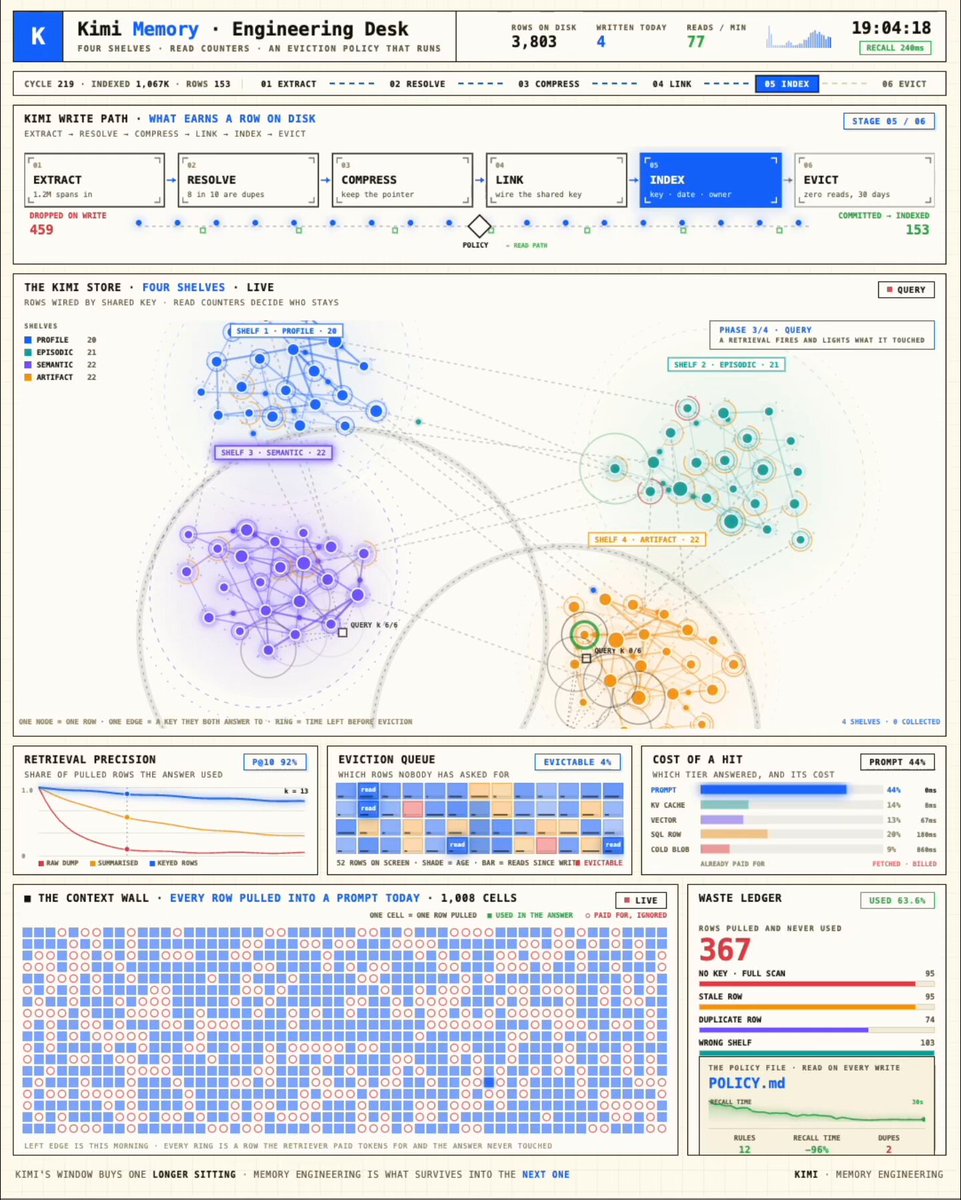
Engineer runs a Kimi K3 memory layer that costs $11 a month and remembers what a $500,000 vector database keeps losing. No embeddings. Four nodes and one rule about what's allowed to be forgotten. He published the whole schema. His version starts from the opposite idea. Memory is not a pile you search. It's a set of claims that expire unless something keeps paying to keep them. Four nodes. Every memory carries a clock someone has to reset: > WRITER - stores a fact with the reason it mattered, never raw text > DECAY - ages every memory down. Silence is deletion > RENEWER - only re-lifts a memory the model actually used again > GRAVE - holds what died, and why nobody reached for it Three nodes keep memory alive. One keeps the dead ones. Recall isn't storage here. It's rent a fact has to keep earning. That's the entire design. When everything is remembered forever, the useful and the stale retrieve identically. He replayed two months of agent context. 90,000 stored facts. 71,000 never retrieved once. The vector store returned all of them on similarity. Similarity graded closeness. Nobody graded whether the memory was ever right. Everyone else stuffs more into the context window and calls it memory. He built a layer that lets a fact die unless it keeps proving itself. The cost isn't storage. It's finding out how much of what your agent "knows" it has never once used. The article below is the full build - node prompts, the decay curve, the renewal rule. Save it. You'll want it open in the other tab.

wast3

67,778 просмотров • 1 месяц назад

Workflows vs. Graphs, clearly explained! workflows are great, and almost everyone has one. here is the ceiling: a workflow decides every step before it runs. you drew eight boxes in March. six months later the same three fire, every single time, and the other five have never once been reached. then a case arrives that nobody drew, and it goes to the closest wrong box. quietly, with a green status, because from the inside that looks exactly like success. Graph engineering fixes this by moving the decision: not what the steps do, but when the steps get chosen. you need both, and here is the sentence that resolves the whole confusion: a workflow decides the steps before it runs. a graph decides them while it runs. ↳ drawn in advance: the boxes, the branches, the order, the error path ↳ decided at runtime: how many units exist, what each one is allowed to see, which ones get created at all Prompts → Context → Harness → Loops → Graphs branches do not make it a graph. the branches were drawn in advance too, which means every one of them is a case you already thought of. the trick is knowing which part is allowed to be fixed. the node kinds are fixed. a splitter is a splitter, a gate is a gate, a merge is code. what is not fixed is how many of them exist this run, and that is decided after something has been read. one thing to know before you scale it. a workflow fails in a way that never pages anyone. ↳ the wrong branch ran, every check inside it passed, and the output is well formed ↳ nothing errored, because routing to the wrong box is not an error, it is a route that last one catches careful people. you cannot test your way out of it either, because the test suite was written from the same diagram that has the gap in it. and the one that eats whole nights: a workflow that has never surprised you is not stable, it is narrow. if it has run four hundred times and produced the same three shapes, it is not handling your work. it is handling the part of your work that fits it, and you have quietly stopped sending it the rest. below i have quoted my full guide on graph engineering. it covers the three topologies, the verifier patterns, and where the gate should actually open. save this and read it below ↓

Hanako

16,810 просмотров • 1 месяц назад

Loops vs. Graphs, clearly explained! loops are great, but they have a ceiling: a loop makes one unit of work better. it cannot decide which units exist. so you end up with a very good agent running the wrong three steps, in the wrong order, one at a time. Graph engineering fixes this by moving the decision up a layer: what runs, what runs at the same time, and what never runs at all. you need both. here's how it works: a graph splits your system into two kinds of decision. ↳ inside a unit: the loop. produce, check, correct, repeat until green ↳ between units: the graph. split, fan out, merge, gate, send back Prompts → Context → Harness → Loops → Graphs you get parallel work, isolated contexts, and steps that stop running when nothing needs them. the trick is being selective about what becomes a node. only spend a model where judgment lives. merging, ranking, deduping and schema checks are edges, and edges are code. free, instant, and they cannot be argued out of a verdict. a graph where every edge is an agent pays rent on its own wiring. one thing to know before you scale it. a graph has two return paths, and almost everyone builds one. ↳ the correction edge is short. a gate rejects one unit back to the step that produced it, and it fixes the run you are in ↳ the learning edge is long. an accepted result goes back to the splitter as a constraint, and it fixes every run after skip the second and you get a graph that is fast and never gets smarter. next week it starts from the same place with the same blind spots. and a smaller one that eats whole nights: when a unit fails, return that unit, not the batch. send back four slices because one failed and you have just rewritten three correct ones. do it twice in a run and the run never converges. below i have quoted my full guide on graph engineering. it covers the three topologies, the verifier patterns, and where the gate should actually open. save this and read it below ↓

Hanako

73,867 просмотров • 1 месяц назад

A developer in Hangzhou runs an AI that remembers everything about him for $0.40 a year. No vector database. One file that never grows past 4,000 tokens. He published the whole schema. His version starts from the opposite idea. Memory is not storage. It's a write policy. Six fields. Rewritten every time, never appended: > IDENTITY - who you are, what you build. 300 tokens. Changes monthly at most > STATE - what you're on right now. 400 tokens. Rewritten daily > DECISIONS - what's already settled, so nothing gets re-argued. 800 tokens > CORRECTIONS - every time you said "no, not like that." 600 tokens > PEOPLE - names, roles, who's waiting on what. 500 tokens > DEAD - tried and abandoned, so it never comes back as a suggestion. 400 tokens Three thousand tokens. Ceiling of four. When a section fills, the model rewrites it shorter. Nothing is ever added. Only replaced. Kimi K2.5 bills $0.10 per million cached input tokens. Four thousand tokens a turn is $0.0004. That's 2,500 turns for a dollar. The free tier hands you 1.5 million tokens a day. 375 turns before you pay anything at all. CORRECTIONS is the field nobody builds, and it's the one that does the work. A model that remembers being wrong stops repeating it. Everyone else is paying to search their own history. He pays to keep it short. The bill stopped growing when the file did. Your memory system isn't defined by what it stores. It's defined by what it agrees to delete. The article below is the full build - schema, rewrite prompts, the compaction rule that keeps it under the cap. Save it. You'll want it open in the other tab.

wast3

15,862 просмотров • 1 месяц назад

Harness vs. Graphs, clearly explained! a harness is great, and most people think it is the whole thing: retries, timeouts, a sandbox, a log, the context it assembles before every call. all of that is real work, and all of it wraps exactly one call. run it a hundred times and you have one call, made very safely, a hundred times. Graph engineering fixes this by moving the decision up a layer: not how safely one call is made, but which calls exist to be made at all. you need both, and here is the sentence that resolves the whole confusion: the harness is everything around one call. the graph is everything between them. ↳ around one call: retry, timeout, sandbox, log, assemble the context, hand back a result ↳ between calls: split, fan out, merge, gate, send back Prompts → Context → Harness → Loops → Graphs the harness does not go away when you build a graph. it moves under each node, and now there are five of them, each wrapping a call you would never have made by hand. the trick is knowing which layer a failure belongs to. turn a piece off and run it again. if the call still works, it was the harness. if the wrong step runs at all, it was the graph. people spend weeks hardening a harness around a node that should not have existed. one thing to know before you scale it. most of what people call their agent is a harness with a chat box on it. ↳ it retries, it times out, it logs, it assembles context, it holds one call up beautifully ↳ it has never once decided that a second call should exist, and that is the entire difference that last one catches careful people. a harness that never fails is not evidence the system is right. it is evidence one call went well, which is the smallest possible claim. and the one that eats whole nights: a harness cannot save you from the wrong step running. you can retry a bad decision three times with a clean log and perfect isolation, and all you bought was three copies of it. below i have quoted my full guide on graph engineering. it covers the three topologies, the verifier patterns, and where the gate should actually open. save this and read it below ↓

Hanako

51,536 просмотров • 1 месяц назад

Loops vs. Graphs, clearly explained! loops are great, and they have a ceiling you can watch happen: a loop goes around. it produces, checks, corrects, and goes around again. after six passes you have one job, done very well. after six hundred passes you still have one job, done very well. Graph engineering fixes this by moving the decision up a layer: not how well one job gets done, but which jobs exist to be done at all. you need both, and here is the sentence that resolves the whole confusion: the loop lives inside a node. the graph lives between them. ↳ inside one unit: produce, check, correct, repeat until green ↳ between units: split, fan out, merge, gate, send back Prompts → Context → Harness → Loops → Graphs the loop does not go away when you build a graph. it moves inside, and now there are three of them running at once on three things you would never have thought to run. the trick is being selective about what becomes a node. only spend a model where judgment lives. merging, ranking, deduping and schema checks are edges, and edges are code. free, instant, and they cannot be argued out of a verdict. one thing to know before you scale it. a loop that cannot fail is not a loop, it is a repeat with a bill attached. and the check people write is almost always the wrong kind. ↳ the test suite exits 0 is a check. the diff touches only the files in the plan is a check ↳ the output looks good, the model says it is confident, no errors were raised, none of those are checks that last one catches careful people. absence of an error is not evidence of correctness, and a loop built on it will confidently repeat a mistake until the budget runs out, with a clean log the whole way. and the one that eats whole nights: when a unit fails, return that unit, not the batch. send back four slices because one failed and you have just rewritten three correct ones. do it twice in a run and the run never converges. below i have quoted my full guide on graph engineering. it covers the three topologies, the verifier patterns, and where the gate should actually open. save this and read it below ↓

Hanako

129,105 просмотров • 1 месяц назад

Fusion Models by robinhood:0xa92768863a55d8a0591709f7f5e594a249d36ea3, explained properly. Why a panel beats one model: Ask three models the same hard question and they disagree. The disagreement is the information, where they contradict each other is where one of them is wrong, and a judge can see it. OpenRouter shipped exactly this in June and their panels beat any single frontier model. Credit to them and their $10B sale to stripe. Why the same panel for everyone is the wrong shape: You don't have one best model. You have a best model per job. The one you trust for code is not the one you trust for writing, and neither is the one you'd pick for a five-line reply. A panel chosen per request, identical for every user, can't know that. A panel arranged around you can. The number that matters isn't price: It's cost per answer that works. Model A costs $4 per million tokens and gets your job right one time in four. Model B costs $10 and gets it right three times in four. Per answer you actually keep, A costs $16 and B costs $13. The cheap model was the expensive one. Everyone comparing price lists is measuring the wrong thing. You never rate anything: Stopping an answer halfway is a rating. Regenerating is a rating. Switching model and asking again is the loudest rating there is. Every one of those already writes a row we can learn from. The router learns which models earn your credits, per job, and tries a cheaper one now and then to check. Fusion only when it pays: Cost mode tries the cheap model first and escalates only if a judge says it failed. Performance mode fans out to your panel and merges. Most simple prompts never fuse. That's why it costs less, not more. Put it together and you have a personal model: Not trained. Assembled. Your profile from a two-minute questionnaire and everything you've imported from Claude or ChatGPT. Your memory, shared across every model so switching never starts from zero. Your skills, workflows you build once and run on any model. Your scorecard, which models earn your credits per job. One per person. Nobody else has yours. Every model is someone else's; the arrangement is you, and it leaves with you. People aren't loyal to models. They're loyal to results. A moat can't be a commodity, but it can be our own creation.

askr

13,900 просмотров • 25 дней назад

Memory vs. Graphs, clearly explained! memory is great, and the ceiling arrives quietly: it stores what happened. it does not store what to do about it. six runs later your file has fifty lines, and the model reloads all of them before it does anything. Graph engineering fixes this by changing what memory is: not a place things are kept, but an edge that runs backwards. you need both, and here is the sentence that resolves the whole confusion: a store keeps what happened. an edge keeps what to do about it. ↳ a store grows with every run, and every line is reloaded before the next one ↳ an edge carries one derived rule, and the rule replaces the run that produced it Prompts → Context → Harness → Loops → Graphs the transcript goes away, the constraint stays. and the constraint is smaller, because "adapters preserve keyword args exactly" is four hundred tokens shorter than the run that proved it. the same four blocks work on anything you can cut into lanes. i pointed them at token launches on Robinhood Chain, open source, nothing leaves your terminal the trick is knowing what deserves to survive. an output is not memory. "ported the utils slice, green on first pass" tells the next run nothing it can act on. the rule you derived from it does. one thing to know before you scale it. what you write down is not what comes back. ↳ the root rules file and auto memory are re-injected from disk. they come back intact, every time ↳ path-scoped rules live in message history. they get summarized away and do not return until a matching file is read again so a rule that must persist cannot be path-scoped. move it to the root and pay the always-loaded cost, or accept that it is advisory in any long session. and the one that eats whole nights: a memory file that has never had a line deleted is not memory. it is a tax on every run you will ever make, and nobody reads it back. below i have quoted my full guide on graph engineering. it covers the three topologies, the verifier patterns, and where the gate should actually open. save this, and the repo that runs it is below ↓

Hanako

48,117 просмотров • 1 месяц назад

Loops vs. Graphs, clearly explained! loops are great, and the ceiling is one you can watch turn: a loop is a gear. it produces, checks, corrects, and comes back around. after six turns you have one job, done very well. after six hundred turns you still have one job, done very well. the teeth are perfect. they are touching nothing. Graph engineering fixes this by moving the decision up a layer: not how well one gear turns, but what it is meshed into. you need both, and here is the sentence that resolves the whole confusion: the loop lives inside a node. the graph lives between them. ↳ inside one unit: produce, check, correct, repeat until green ↳ between units: split, fan out, merge, gate, send back Prompts → Context → Harness → Loops → Graphs the loop does not go away when you build a graph. it moves inside, and now there are three of them turning at once on three things you would never have thought to run. the trick is being selective about what becomes a node. only spend a model where judgment lives. merging, ranking, deduping and schema checks are edges, and edges are code. free, instant, and they cannot be argued out of a verdict. one thing to know before you scale it. a loop that cannot fail is not a loop, it is a repeat with a bill attached. ↳ the test suite exits 0 is a check. the diff touches only the files in the plan is a check ↳ the output looks good, the model says it is confident, no errors were raised, none of those are checks that last one catches careful people. absence of an error is not evidence of correctness, and a loop built on it will confidently repeat a mistake until the budget runs out, with a clean log the whole way. and the one that eats whole nights: when a unit fails, return that unit, not the batch. send back four slices because one failed and you have just rewritten three correct ones. do it twice in a run and the run never converges. below i have quoted my full guide on graph engineering. it covers the three topologies, the verifier patterns, and where the gate should actually open. save this and read it below ↓

Hanako

32,787 просмотров • 28 дней назад

Elon Musk described the government in four sentences and never made a political argument. He read out the schematic. Musk: "Government is a corporation in the limit. It is the most corporate thing. It is maximum corporation. And it's also a monopoly, and also is the only one that's allowed legally to do violence." Take the flag off it and look at what's underneath. It collects revenue. It employs millions. It owns land. It writes the rules it operates under. That's a corporation. Line for line. With three edits. You cannot choose a competitor. You cannot decline the transaction. It is the only one on earth permitted to use force to make you pay. Every other relationship in your life required your consent. This one required your birth. Musk: "Why would you want to give a corporation with no competition that can't even really go bankrupt more money?" There is no condition under which it stops. None was ever built in. Everything that has ever gotten better got better by being allowed to die. Evolution runs on extinction. Science runs on falsification. Markets run on bankruptcy. Your own body runs on cells that kill themselves on schedule. Failure isn't cruelty. It's information. It's the only mechanism in the universe that tells a system it was wrong. Take it away and the system doesn't become permanent. It becomes blind. A company that misreads the world loses customers. A government that misreads the world receives a larger budget the following year. It's the only structure we've built where failure is what feeds it. Musk: "I think the role of government should be that of like a referee, and not a player on the field." A referee was never supposed to be weak. He was supposed to be outside the outcome. The moment he starts scoring he isn't corrupt. Corruption would mean he broke a rule. He wrote the rules. He's just playing, and he's the only one allowed to keep score. A system like that never gets caught. It only gets old. Every civilization that collapsed did it with its institutions still standing. The buildings stayed. The titles stayed. The revenue arrived on schedule. What died was the feedback. The signal telling it that reality had moved and it hadn't. Rome didn't fall in a day. It stopped listening for a century and called it stability. That's the actual danger. Not tyranny. Deafness with a budget. And it runs deeper than politics. Everything you love is precious because it can be lost. A promise means something because the person making it will die. Your time matters because you don't get more of it. Mortality isn't the tragedy of being human. It's the only reason anything costs anything. Then we built one institution exempt from all of it. No death. No scarcity. No consequence. A thing that can never lose anything, deciding what everything is worth. It bills in dollars. It's paid in hours. And it has never once felt what an hour costs. It can be wrong for a century and feel nothing. You get eighty years and have to be right the first time. It doesn't have to win the argument. It only has to outlive the person making it, and it has never lost that one. It borrows against people who don't exist yet, and they will pay, because it will still be standing when they arrive. Then we handed it the only gun. This isn't a conspiracy. Conspiracies need competence and coordination. This is a design flaw, and design flaws only need time. That's the good news. A conspiracy can't be proven or fixed. A design flaw can be both. Everything good in your life exists because something was permitted to fail on the way to it. Every medicine. Every machine. Every idea that survived contact with reality. The one institution that cannot fail is the one holding the gun. That isn't a warning. It's an engineering problem. And every permanent thing on earth was designed by people who weren't.

Dustin

203,867 просмотров • 2 месяцев назад

FIVE LAYERS OF AGENT ENGINEERING, EACH ONE WRAPS THE ONE BELOW IT. IF YOU SKIP LAYER 2, YOUR LAYER 5 WILL LOOK BROKEN WHEN IT IS ACTUALLY JUST STANDING ON NOTHING. for weeks i debated harness vs loop vs graph like they were competing choices. then a stack diagram made the shape obvious. they are not choices. they are floors. 01 | prompt engineering. the message. unit of work: one input. inputs are role, instructions, examples, format. output is a single raw response. 02 | context engineering. the memory. unit of work: what stays in the window. a curator selects, compresses, and drops from query, docs, memory, prior turns, and tool outputs before the prompt runs. 03 | harness engineering. the machine. unit of work: the machine itself. gather (context + prompt) → LLM → tools or sub-agents → verifier → final response. the article calls this the operating environment. 04 | loop engineering. the system. unit of work: the run. goal + success criteria + max iterations + budget + completion check wrap around one harness pass. failed pass appends results to context and retries. 05 | graph engineering. the topology. unit of work: the graph run. goal + nodes + edges + state schema. graph routes to agent nodes, tool nodes, or human approval. a reviewer node with a different model and fresh context checks the final answer. the wrapping is the whole point. layer 5 assumes layer 4 works. layer 4 assumes layer 3 works. skip layer 2 and layer 3's verifier keeps failing without a clear reason. this is why swapping the model is a one-day project and swapping the stack is a quarter. the model is the commodity. the five layers around it are the engineering. full three-layer breakdown of the top of the stack (harness, loop, graph) in the post below.

kocer

31,198 просмотров • 1 месяц назад