正在加载视频...

视频加载失败

Anthropic developer runs an internal graph that costs $9 a month and catches what a $400,000 red-team contract signed off on. No judge model. Four nodes and one rule about who's allowed to be certain. He published the whole schema. His version starts from the opposite idea. A graph...

62,218 次观看 • 3 天前 •via X (Twitter)

0 条评论

暂无评论

原始帖子的评论将显示在这里

相关视频

Anthropic ex-engineer runs an internal graph that costs $6 a month and catches what a $300,000 eval suite misses. No retrieval layer. Seven nodes and one rule about who's allowed to change their mind. He published the whole schema. His version starts from the opposite idea. A graph is not an execution order. It's a memory of why. Seven nodes. Every edge carries the reason it exists: > INTENT - states what the task is for. Never how > DECOMPOSE - splits it into steps, each with a stated assumption > WORKER - executes one step. Sees nothing else > AUDIT - checks the output against the assumption, not the goal > DRIFT - compares the current step to INTENT and flags divergence > LEDGER - stores every decision with the assumption that justified it > ROOT - holds the graph, and when an assumption breaks, re-runs every step built on it Six nodes act. One node remembers why they acted. Every step carries the assumption that made it correct, so a false one only reruns what stood on it. That's the entire design. A pipeline that forgets its reasons has to redo all of it or trust all of it. He replayed a month of agent runs. 4,100 steps, 380 built on an assumption that was wrong by day three. The old pipeline shipped all 380 and linked none of them. Everyone else builds graphs where output moves forward and the reasoning evaporates. He built one where the reason travels with the result. The blast radius is the output nobody else produces. The article below is the full build - node prompts, the assumption format, the invalidation rule that finds every step downstream of a broken one. Save it. You'll want it open in the other

wast3

302,334 次观看 • 5 天前

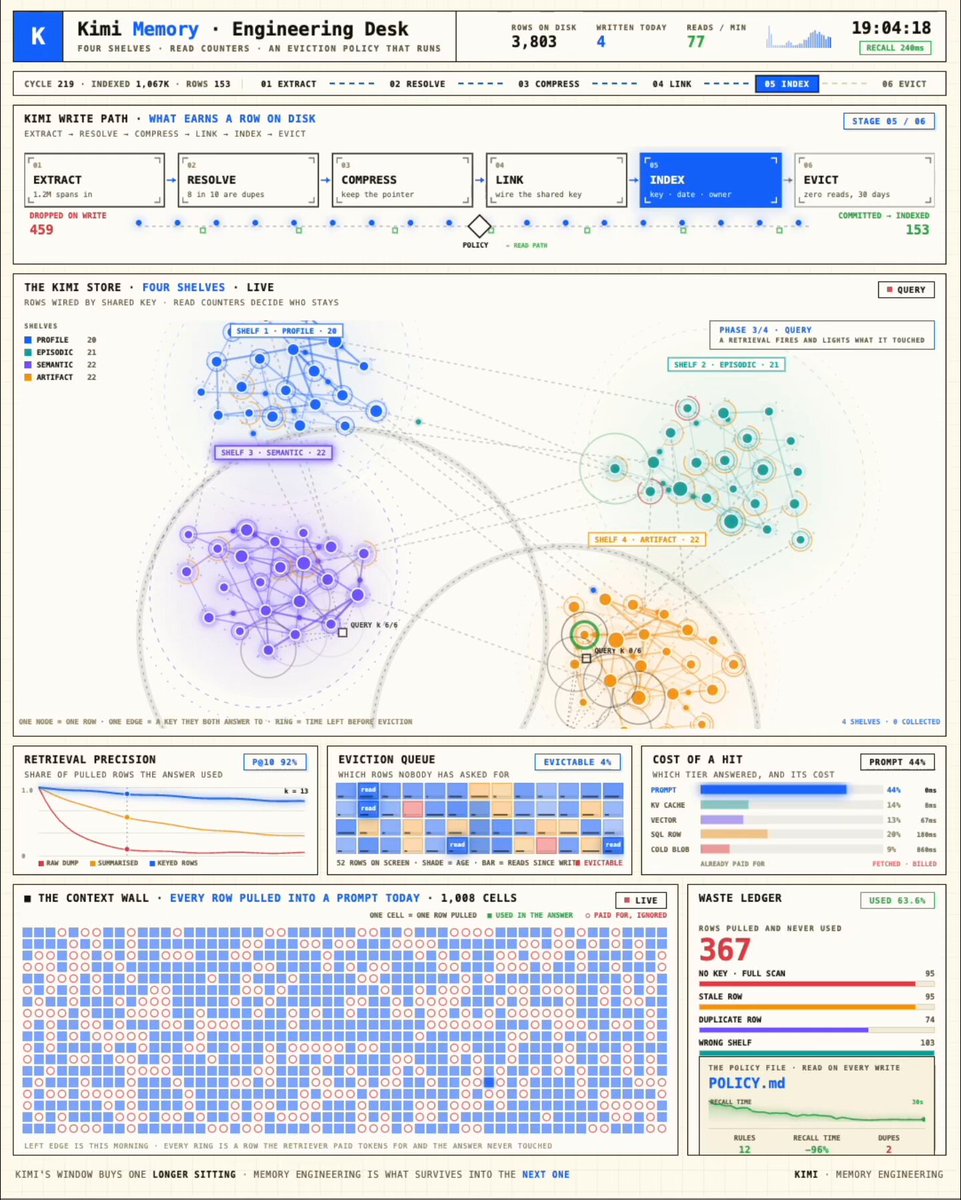
Engineer runs a Kimi K3 memory layer that costs $11 a month and remembers what a $500,000 vector database keeps losing. No embeddings. Four nodes and one rule about what's allowed to be forgotten. He published the whole schema. His version starts from the opposite idea. Memory is not a pile you search. It's a set of claims that expire unless something keeps paying to keep them. Four nodes. Every memory carries a clock someone has to reset: > WRITER - stores a fact with the reason it mattered, never raw text > DECAY - ages every memory down. Silence is deletion > RENEWER - only re-lifts a memory the model actually used again > GRAVE - holds what died, and why nobody reached for it Three nodes keep memory alive. One keeps the dead ones. Recall isn't storage here. It's rent a fact has to keep earning. That's the entire design. When everything is remembered forever, the useful and the stale retrieve identically. He replayed two months of agent context. 90,000 stored facts. 71,000 never retrieved once. The vector store returned all of them on similarity. Similarity graded closeness. Nobody graded whether the memory was ever right. Everyone else stuffs more into the context window and calls it memory. He built a layer that lets a fact die unless it keeps proving itself. The cost isn't storage. It's finding out how much of what your agent "knows" it has never once used. The article below is the full build - node prompts, the decay curve, the renewal rule. Save it. You'll want it open in the other tab.

wast3

64,039 次观看 • 1 天前

Loops vs. Graphs, clearly explained! loops are great, but they have a ceiling: a loop makes one unit of work better. it cannot decide which units exist. so you end up with a very good agent running the wrong three steps, in the wrong order, one at a time. Graph engineering fixes this by moving the decision up a layer: what runs, what runs at the same time, and what never runs at all. you need both. here's how it works: a graph splits your system into two kinds of decision. ↳ inside a unit: the loop. produce, check, correct, repeat until green ↳ between units: the graph. split, fan out, merge, gate, send back Prompts → Context → Harness → Loops → Graphs you get parallel work, isolated contexts, and steps that stop running when nothing needs them. the trick is being selective about what becomes a node. only spend a model where judgment lives. merging, ranking, deduping and schema checks are edges, and edges are code. free, instant, and they cannot be argued out of a verdict. a graph where every edge is an agent pays rent on its own wiring. one thing to know before you scale it. a graph has two return paths, and almost everyone builds one. ↳ the correction edge is short. a gate rejects one unit back to the step that produced it, and it fixes the run you are in ↳ the learning edge is long. an accepted result goes back to the splitter as a constraint, and it fixes every run after skip the second and you get a graph that is fast and never gets smarter. next week it starts from the same place with the same blind spots. and a smaller one that eats whole nights: when a unit fails, return that unit, not the batch. send back four slices because one failed and you have just rewritten three correct ones. do it twice in a run and the run never converges. below i have quoted my full guide on graph engineering. it covers the three topologies, the verifier patterns, and where the gate should actually open. save this and read it below ↓

Hanako

72,028 次观看 • 9 天前

A developer in Hangzhou runs an AI that remembers everything about him for $0.40 a year. No vector database. One file that never grows past 4,000 tokens. He published the whole schema. His version starts from the opposite idea. Memory is not storage. It's a write policy. Six fields. Rewritten every time, never appended: > IDENTITY - who you are, what you build. 300 tokens. Changes monthly at most > STATE - what you're on right now. 400 tokens. Rewritten daily > DECISIONS - what's already settled, so nothing gets re-argued. 800 tokens > CORRECTIONS - every time you said "no, not like that." 600 tokens > PEOPLE - names, roles, who's waiting on what. 500 tokens > DEAD - tried and abandoned, so it never comes back as a suggestion. 400 tokens Three thousand tokens. Ceiling of four. When a section fills, the model rewrites it shorter. Nothing is ever added. Only replaced. Kimi K2.5 bills $0.10 per million cached input tokens. Four thousand tokens a turn is $0.0004. That's 2,500 turns for a dollar. The free tier hands you 1.5 million tokens a day. 375 turns before you pay anything at all. CORRECTIONS is the field nobody builds, and it's the one that does the work. A model that remembers being wrong stops repeating it. Everyone else is paying to search their own history. He pays to keep it short. The bill stopped growing when the file did. Your memory system isn't defined by what it stores. It's defined by what it agrees to delete. The article below is the full build - schema, rewrite prompts, the compaction rule that keeps it under the cap. Save it. You'll want it open in the other tab.

wast3

15,862 次观看 • 7 天前

Elon Musk described the government in four sentences and never made a political argument. He read out the schematic. Musk: "Government is a corporation in the limit. It is the most corporate thing. It is maximum corporation. And it's also a monopoly, and also is the only one that's allowed legally to do violence." Take the flag off it and look at what's underneath. It collects revenue. It employs millions. It owns land. It writes the rules it operates under. That's a corporation. Line for line. With three edits. You cannot choose a competitor. You cannot decline the transaction. It is the only one on earth permitted to use force to make you pay. Every other relationship in your life required your consent. This one required your birth. Musk: "Why would you want to give a corporation with no competition that can't even really go bankrupt more money?" There is no condition under which it stops. None was ever built in. Everything that has ever gotten better got better by being allowed to die. Evolution runs on extinction. Science runs on falsification. Markets run on bankruptcy. Your own body runs on cells that kill themselves on schedule. Failure isn't cruelty. It's information. It's the only mechanism in the universe that tells a system it was wrong. Take it away and the system doesn't become permanent. It becomes blind. A company that misreads the world loses customers. A government that misreads the world receives a larger budget the following year. It's the only structure we've built where failure is what feeds it. Musk: "I think the role of government should be that of like a referee, and not a player on the field." A referee was never supposed to be weak. He was supposed to be outside the outcome. The moment he starts scoring he isn't corrupt. Corruption would mean he broke a rule. He wrote the rules. He's just playing, and he's the only one allowed to keep score. A system like that never gets caught. It only gets old. Every civilization that collapsed did it with its institutions still standing. The buildings stayed. The titles stayed. The revenue arrived on schedule. What died was the feedback. The signal telling it that reality had moved and it hadn't. Rome didn't fall in a day. It stopped listening for a century and called it stability. That's the actual danger. Not tyranny. Deafness with a budget. And it runs deeper than politics. Everything you love is precious because it can be lost. A promise means something because the person making it will die. Your time matters because you don't get more of it. Mortality isn't the tragedy of being human. It's the only reason anything costs anything. Then we built one institution exempt from all of it. No death. No scarcity. No consequence. A thing that can never lose anything, deciding what everything is worth. It bills in dollars. It's paid in hours. And it has never once felt what an hour costs. It can be wrong for a century and feel nothing. You get eighty years and have to be right the first time. It doesn't have to win the argument. It only has to outlive the person making it, and it has never lost that one. It borrows against people who don't exist yet, and they will pay, because it will still be standing when they arrive. Then we handed it the only gun. This isn't a conspiracy. Conspiracies need competence and coordination. This is a design flaw, and design flaws only need time. That's the good news. A conspiracy can't be proven or fixed. A design flaw can be both. Everything good in your life exists because something was permitted to fail on the way to it. Every medicine. Every machine. Every idea that survived contact with reality. The one institution that cannot fail is the one holding the gun. That isn't a warning. It's an engineering problem. And every permanent thing on earth was designed by people who weren't.

Dustin

202,763 次观看 • 1 个月前

Someone just posted the full blueprint for an AI swarm that does the job of a 200-person quant research team. Six agents. Running 24/7. Finding brand-new alpha while you sleep. Citadel needs 100 PhDs to do this. Two Sigma needs 200. This does it with six bots and one laptop. Two ways to play this - spend a weekend building your own swarm, or copy the wallet of one that's already up $2M: Boris Cherny runs Claude Code at Anthropic. Two weeks ago he said: "I don't prompt Claude anymore. I have loops running that prompt Claude. My job is to write loops" Alpha research is just a pipeline. So instead of sitting in it, you hand each stage to its own agent: > one reads every new research paper overnight and pulls out the trade idea > one builds the features and cleans the data > one backtests it over 20 years, costs and slippage included > one runs the hard stats and kills anything overfit > one checks it still works in every market regime > one strips out plain momentum and value to see if any real edge is left Each of those six is a job a fund pays a $600,000-a-year quant to do. He runs all six for the price of an API bill. The rule that makes it work: the agent that builds a signal never gets to approve it. A separate, stronger agent tries to kill it first. Whatever survives all six by morning is real, new alpha. One trader's already running this exact swarm on Polymarket. That $2M wallet is public, every trade on-chain. The full build is in the post below - six agents, the tool that runs them, and the five mistakes that kill most people. Bookmark & read this before it's buried.

cvxv666

103,734 次观看 • 1 个月前

Agents vs. Graphs, clearly explained! spawning more agents is great, but it has a ceiling nobody says out loud: five agents is a count. a graph is a shape. only one of them changes the answer. point five agents at the same pile with the same window and they converge. the first one writes a finding, the rest read it, and all five reports centre on the same thing. you paid five times for one opinion with four echoes. Graph engineering fixes this by moving the decision up a layer: not how many agents, but who is allowed to look at what. you need both. here's how it works: ↳ the count buys you throughput. five things happening instead of one ↳ the shape buys you coverage. five different things happening instead of the same one five times Prompts → Context → Harness → Agents → Graphs the node that does this is the splitter, and it decides more than any other node in the system. cut a repository by folder and four workers audit the same three files. cut it by blast radius and each one sees something the others cannot. the trick is being selective about what each lane is allowed to see. separate contexts are not a nice-to-have, they are the mechanism. if two agents are meant to produce different things, they must not share a window. if they are meant to produce the same thing, you did not need two agents. one thing to know before you scale it. a branch that throws does not reject the batch. it resolves to null, and that is the containment. which means your merge quietly receives a short list. ↳ filter the nulls before the merge, or one dead lane poisons the whole result ↳ never index a merge by position. eight good branches and one failure will shift everything by one, silently skip that and the run looks like it worked. the output is just missing a lane, and nothing errored. and the one that eats whole nights: multi-agent setups can use up to fifteen times the total tokens of a single chat, because every lane reloads its own core. you are trading total tokens for a clean main window. usually the right trade, always a choice. below i have quoted my full guide on graph engineering. it covers the three topologies, the verifier patterns, and where the gate should actually open. save this and read it below ↓

Hanako

95,369 次观看 • 6 天前