Загрузка видео...

Не удалось загрузить видео

На главную

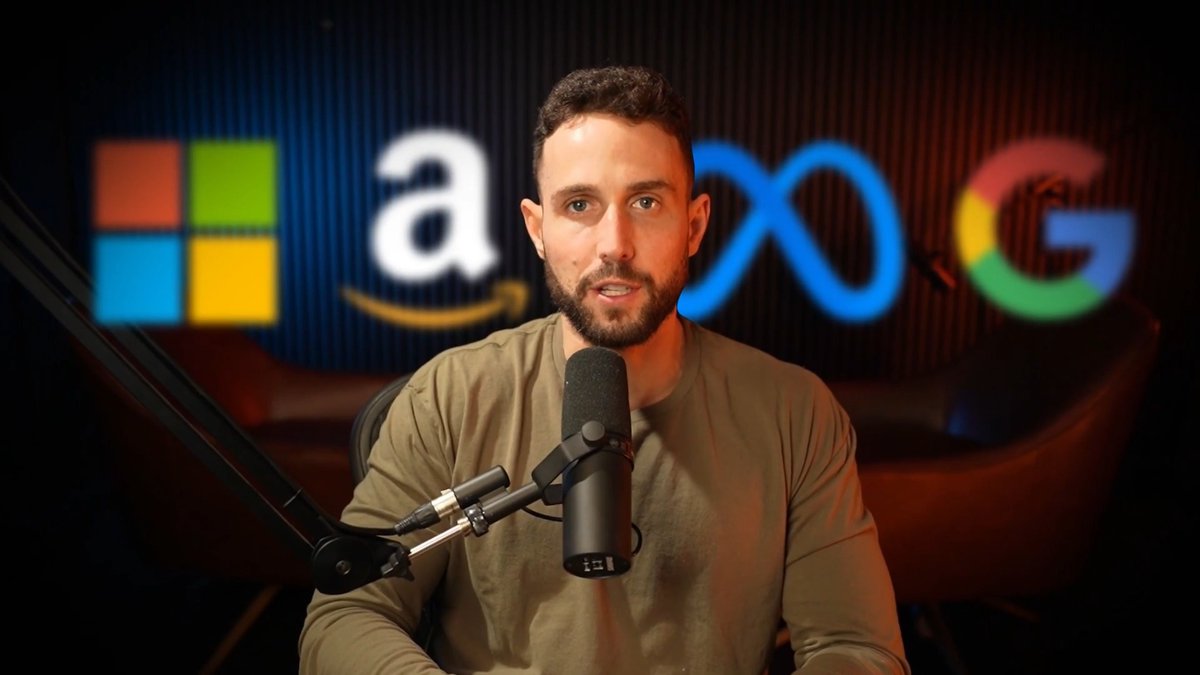
Anthropic just had to throttle Claude’s thinking depth and cap usage for paying customers. Developers are switching to OpenAI Codex and the market is already sniffing out who wins from all of. Anthropic’s revenue tripled in one quarter to a $30B annual run rate, demand grew so fast that...

46,800 просмотров • 2 месяцев назад •via X (Twitter)

Комментарии: 0

Нет доступных комментариев

Здесь появятся комментарии из оригинального поста

Похожие видео

Greg Brockman, President of OpenAI, said there is not enough compute in the world to satisfy AI demand, and OpenAI itself cannot launch products it has already built because it cannot find the infrastructure to run them (Save this). OpenAI is spending $50 billion on compute in 2026 alone and it still is not enough. That is the setup but here is the trade. Nebius is one of the most asymmetric infrastructure plays in public markets right now, and most people have never heard of it. Q1 2026 revenue came in at $399 million, up 684% year over year, with AI cloud revenue specifically growing 841% in a single quarter. The company entered 2026 with an exit ARR of $1.25 billion and is targeting $7 to $9 billion by year end, a number that would make it one of the fastest revenue ramps in the history of public infrastructure companies. The contracted backlog sits at $50 billion anchored by a $17.4 billion agreement with Microsoft through 2031 and a $27 billion five-year deal with Meta. They are decade-scale infrastructure commitments from the two largest enterprise AI spenders on earth, signed before the demand curve has even reached its steepest point. Nvidia took a direct equity stake in Nebius, one of only two neoclouds it has invested in alongside CoreWeave. That relationship is not just financial but rather means Nebius gets preferential access to GPU allocation at a moment when every lab and every hyperscaler is competing for the same constrained supply. Contracted power capacity now exceeds 3.5 gigawatts, with expansion plans targeting 5 to 6 GW by mid-2029. And power is the other binding constraint in AI infrastructure, you cannot build a data center without it and Nebius has already secured the capacity that competitors are still fighting to acquire. At full ramp, analysts project revenue in the $15 to $25 billion range by 2029, against a current market cap the contracted backlog alone already dwarfs. Come join Milk Road Pro and get our full Nebius deep-dive, the exact price levels we are watching, how we are sizing the position against the backlog and power capacity timeline, and our full AI thesis. link below!

Milk Road AI

14,578 просмотров • 22 дней назад

THIS IS ABSOLUTELY RIDICULOUS. OpenAI and Anthropic are losing money on every dollar they make. OpenAI generated $20 billion in revenue in 2025 and is projected to lose $14 billion in the same year. Internal forecasts project cumulative losses hitting $44 billion by 2028. The company's own CFO warned executives in April 2026 that OpenAI might struggle to finance upcoming computing deals if revenue growth slows. Anthropic reached $4.3 billion in annualized revenue in April 2026 against $19 billion in total costs. It spends $3 to make $1, and is not expected to stop burning cash until 2027. Now look at what these two companies have committed to spend. OpenAI and Anthropic together have committed $1.05 trillion in cloud spending to Microsoft, Oracle, Google and Amazon, making up 43 to 54% of each provider's entire future revenue backlog. - Microsoft: $627B total backlog. OpenAI and Anthropic account for 49%. - Oracle: $553B total backlog. OpenAI alone accounts for 54%. - Google: $467.6B total backlog. Anthropic accounts for 43%. - Amazon: $464B total backlog. OpenAI and Anthropic account for 51%. The entire cloud industry's future revenue is a bet on two companies losing billions every quarter. Microsoft, Alphabet, Meta and Amazon are collectively expected to spend $725 billion in capex in 2026, almost entirely on AI infrastructure. Combined hyperscaler capex from 2025 to 2027 is projected at $1.15 trillion, more than double what was spent from 2022 to 2024. What is the return on all of this? McKinsey's 2025 State of AI survey found that only a minority of companies reported AI meaningfully increased revenue or reduced costs. Enterprise generative AI spending grew from $1.7 billion in 2023 to $37 billion in 2025 and most CIOs still describe their initiatives as pilots without clear ROI metrics. Microsoft's AI business is running at a $37 billion annual revenue run rate with 123% year over year growth. That sounds impressive until you realize most of the capex funding is justified by expected future AI revenue rather than current AI profit. The internet burned money for years before it became the most profitable industry in history. But right now $1 trillion in committed cloud spend, $725 billion in annual capex, two loss-making customers making up half of every major cloud provider's revenue backlog, and the enterprises writing the checks cannot tell you if any of it is working.

Crypto Rover

58,862 просмотров • 1 месяц назад

Chamath Palihapitiya just dropped the number that explains the entire AI infrastructure trade (Save this). A gigawatt of compute now costs $100 billion and when he started his Arizona data center project it was $4 to $5 billion, it has gone up 20x in a single investment cycle. The implication is not just that AI infrastructure is expensive but rather that the capital barrier to owning meaningful compute has become so high that only a handful of entities in the world can actually build it and the companies who got there early are sitting on what may be the most durable pricing power in the history of the technology industry. This is the neocloud trade. The neocloud market, purpose-built GPU cloud providers like CoreWeave, Nebius, and Lambda Labs was worth $35 billion in 2026 and is projected to reach $236 billion by 2031, compounding at 46% annually. For context, that is faster growth than cloud computing itself posted in its first decade. The reason is very simple, hyperscalers like AWS, Azure, and Google are building for everything, storage, databases, enterprise software, networking and their GPU pricing reflects the overhead of that full-stack infrastructure. Neoclouds build for one thing only, AI compute. The result is a 60% to 85% cost advantage on the same Nvidia silicon, bare metal H100s at $0.78 to $2.79 per GPU-hour on a neocloud versus $3.43 to $5.07 per GPU-hour on a hyperscaler. That spread does not close as AI demand scales but rather it widens, because hyperscalers have to amortize legacy infrastructure and margin expectations that neoclouds do not carry. Gartner projects that by 2030, neoclouds will capture 20% of the $267 billion AI cloud market, and Vultr's own analysis says at least 80% of GPU market share by end of 2026 will be held by a small group of scaled neocloud providers. Now zoom into Nebius specifically, because it is the most interesting publicly traded proxy for this trade. Nebius is the infrastructure arm of the former Yandex Russia's equivalent of Google rebuilt from the ground up after Russia's invasion of Ukraine by Arkady Volozh and relisted on Nasdaq in October 2024. The team that built it already knew how to run internet-scale infrastructure at the lowest possible cost, which is exactly the operational DNA a neocloud requires. In Q1 2026, Nebius reported revenue of $399 million and already generating serious cash on a young business with revenue growing nearly eightfold year-over-year. Then in March 2026, Meta signed a five-year infrastructure agreement with Nebius worth up to $27 billion, $12 billion in committed dedicated GPU capacity deployments beginning early 2027, plus up to $15 billion more tied to Meta purchasing Nebius's unsold third-party capacity. The deal will be executed on one of the first large-scale deployments of Nvidia's Vera Rubin platform, the next-generation architecture after Blackwell making Nebius one of a tiny number of operators in the world with confirmed priority access to the most advanced AI hardware available. Following the contract, Nebius guided to $7 to $9 billion in annualized recurring revenue for 2026 representing 540% year-over-year growth. Chamath Palihapitiya point about the $100 billion capital moat is the bear case for new entrants and the bull case for incumbents. No one can afford to build the next CoreWeave or Nebius from scratch at current hardware and power costs. The companies that are already built, already contracted, and already deploying Nvidia's latest silicon have a moat that compounds with every GPU generation cycle because they get allocations first, they deploy fastest, and their customers re-sign rather than wait for a new operator that does not yet exist. Come join Milk Road Pro for our full breakdown, the complete neocloud competitive landscape, how to think about Nebius's valuation versus CoreWeave and AI entire thesis. Link below.

Milk Road AI

138,185 просмотров • 29 дней назад

Mark my words, Nebius will be the first Trillion dollar Neo-cloud company and here is why (Save this). Roman Chernin, CEO of Nebius just said on 20VC that Nebius raised prices and demand didn't move. When a company can raise prices and still have more demand than supply, that's the opportunity. Chernin also explained why he is deliberately not charging the maximum. As AI shifts from training, a one time cost to inference, which is the ongoing cost of serving every user and every query, compute pricing becomes the cost structure of the entire AI economy. If Nebius prices customers out, those customers cannot grow, and Nebius cannot grow with them. That is the compounding flywheel built directly into the revenue model. The numbers are already confirming it. Q1 2026 revenue came in at $399 million, up 684% year over year. The AI cloud segment grew 840% and represented 98% of total revenue. Adjusted EBITDA flipped positive to $129.5 million. And Nebius signed a long-term agreement with Meta worth up to $27 billion over five years, a hyperscaler outsourcing its own AI compute stack to a neocloud, which tells you that even companies with $50 billion capex budgets cannot build fast enough. Goldman Sachs says the consensus is underestimating 2027 hyperscaler capex by $500 billion. Every dollar hyperscalers cannot provision themselves flows to neoclouds like Nebius. As that gap widens, Nebius captures the overflow with 3 gigawatts of contracted power already secured and a CEO who just told you raising prices did not dent demand. Our subscribers are already up massively on Nebius and come join Milk Road Pro for our full breakdown, how to size Nebius against the broader neocloud opportunity, and our full AI thesis. Link below!

Milk Road AI

15,677 просмотров • 1 месяц назад

The market is watching xAI charge $50 billion per gigawatt and the rest of the neocloud sector run up is just getting started (Save this). According to Gavin Baker of Atreides Management, this is the most important number in AI infrastructure right now, xAI is monetizing compute at $50 billion per gigawatt on the Google deal, 2 to 3 times what any neocloud competitor charges. Google is paying $920 million per month for access to roughly 110,000 Nvidia GPUs through June 2029, and Anthropic is paying $1.25 billion per month for Colossus 1's 300 megawatts. Baker's point is simple that stop tracking rocket launches, stop tracking GPU orders, model gigawatt additions. At $50 billion per gigawatt, every new gigawatt that xAI energizes over the next 12 months is a revenue event that the market has not yet priced in. But this is not just an xAI story but rather why neocloud stocks are one of the most mispriced assets in the entire AI stack. Neoclouds charge $17 to $25 billion per gigawatt in contract value, a dramatic discount to xAI's pricing, but still an extraordinary business model when the underlying infrastructure costs $9 to $12 million per megawatt to operate and customers are signing 5-year locked contracts. H100 GPU-hours from neoclouds like Nebius at $2.95 per GPU-hour are 66% cheaper than hyperscaler rates, which is the structural reason enterprise AI teams are shifting spend to neoclouds at an accelerating pace. The neocloud market is projected to grow 69% annually through 2030 to reach nearly $180 billion and right now only a handful of public companies offer direct exposure to it. Nebius is the standout among the publicly traded neoclouds. It reported Q1 2026 AI cloud revenue of $399 million, an 841% increase year over year beating estimates, with its CEO stating that demand continues to exceed available capacity and customers are actively being turned away. Nebius commands a 20 to 25% revenue premium over peers thanks to its full-stack software offering, European sovereign positioning, and data residency advantages that physically prevent hyperscalers from competing for a large portion of its customer base. It has $49 billion in contracted backlog with Meta, Microsoft, and Nvidia meaning its revenue trajectory for the next three to five years is not a forecast, it is a schedule. The competitive moat is in power, permits, and speed exactly what xAI has proven is the true bottleneck. Jensen Huang said publicly that xAI deploys data centers faster than anyone else in the ecosystem, and Baker called out that this deployment speed advantage directly translates to monetization speed, every week of earlier energization at these pricing levels is worth hundreds of millions in revenue. Neoclouds with secured power, permits, and long-term customer contracts are not in a fair race against companies still waiting on grid connections and zoning approvals. The companies with the most locked in gigawatts coming online in 2026 and 2027 are about to have very good years.

Milk Road AI

74,611 просмотров • 26 дней назад

Nebius will be a trillion dollar company (Save this). The neocloud market, purpose-built AI cloud infrastructure, separate from legacy hyperscalers generated roughly $25 billion in revenue in 2025, up 223% year over year. Synergy Research projects it will approach $400 billion by 2031, compounding at 58% annually one of the fastest sustained growth rates ever recorded for an infrastructure category of this scale. The CEO's explanation for why they win is worth understanding in detail. GPU compute is scarce and that part everyone knows but Nebius is not simply renting GPUs by the hour and marking them up, which is what most neocloud imitators do. They have built their own physical capacity for inference, optimized the full technology stack from the software layer all the way down to the rack hardware and recently acquired a company called Agen specifically to push inference latency even lower and throughput even higher. The CEO frames the core problem directly that in 2026, every product you build is powered by tokens, AI intelligence and while you can get those tokens from OpenAI or Anthropic via a simple API call, the moment you want to run open source models, specialized vertical models, or anything other than the two dominant frontier labs, you run into a wall. You can download the weights from Hugging Face and assemble the pieces. But getting those workloads to run at scale, at the economics you need, with the reliability your product requires, is an extraordinarily complex engineering challenge that most companies cannot staff or afford to solve in-house. That is the problem Nebius is solving, and that is why their inference product called Token Factory exists. The financial results are among the most dramatic growth numbers reported by any public company this year. In Q1 2026, Nebius posted $399 million in revenue, a 684% increase from the same quarter a year earlier. In the span of twelve months, the company swung from a $104 million net loss to $621 million in net income. Cash from operations went from negative $184 million to positive $2.26 billion in the same period meaning this is not growth funded by burning investor capital, it is growth that is now generating its own fuel. For the full year 2026, Nebius is guiding for an annualized revenue run rate of $7 billion to $9 billion, with pipeline creation tracking to surpass $4 billion. The contracted backlog sits at $49 billion, anchored by a $27 billion agreement with Meta, a deal worth up to $19.4 billion with Microsoft, and a public endorsement from Jensen Huang at NVIDIA's GTC conference in 2026. The current market cap is approximately $56 billion. A company with $7 to $9 billion in annualized revenue, growing at 684%, turning cash-flow positive, sitting on $49 billion in contracted backlog, operating in a market compounding at 58% annually toward $400 billion, that company has a credible path to 20x from its current valuation if execution holds. That is the trillion dollar case, and it does not require any heroic assumptions and it requires Nebius to keep doing what it is already demonstrably doing. Milk Road Pro called this one early. Our analysts added Nebius to the portfolio when it was still flying under the radar, and we are sitting on a massive gain on that position right now. If you want to see what else we are building conviction on before the rest of the market catches up, come join us at Milk Road Pro using the link below!

Milk Road AI

28,622 просмотров • 1 месяц назад

Nebius will be the first neocloud to hit $1 trillion dollar company and here is exactly why (Save this). As dylan patel says Jensen Huang absolutely hates a world where the hyperscalers have all the power. A world where Microsoft, Amazon, and Google are the only ones building compute is a world where Nvidia is slowly being squeezed by a handful of customers all simultaneously developing custom chips to replace Nvidia GPUs entirely. Google's TPU, Amazon's Trainium and Microsoft's Maia all exist for one reason, to cut Nvidia out of the stack and Jensen knows it so he is playing a long game most investors haven't registered yet. By funding NeoClouds and NeoLabs at scale, Jensen is deliberately engineering a multipolar compute world where no single hyperscaler can dictate terms and where Nvidia hardware remains the default infrastructure layer regardless of which model or platform ultimately wins. Nvidia has deployed roughly $40 billion in AI ecosystem investments across OpenAI, Anthropic, CoreWeave, Nebius, xAI, and dozens of infrastructure companies, all running almost exclusively on Nvidia chips, cementing GPU dependency across the entire AI stack.sedaily Every neocloud that survives and scales becomes a permanent Nvidia GPU customer structurally opposed to the hyperscalers building custom silicon expanding Nvidia's market while simultaneously weakening its biggest competitive threat. Dylan Patel described the neocloud ecosystem as throwing bait into the water and letting the best fish survive, warning that many heavily-backed teams will fail, but the ones that emerge will pull hundreds of millions in ARR right out of the gate. Nebius is that fish because it's the only neocloud operating at hyperscaler scale while remaining fully purpose-engineered for AI workloads from silicon to software. The numbers confirm Nebius has already cleared the survival bar that will eliminate most of the 200+ neoclouds competing right now. Revenue hit $399 million in Q1 2026, up 684% year-over-year, backed by $46 billion in contracted backlog, 3.5 GW of contracted power across seven site and a target of $7–$9 billion in annualized revenue by year-end. When Google approached neoclouds about deploying TPUs, Nebius said no, its Chief Revenue Officer noting that demand is 99% for Nvidia GPUs and that TPU interest comes almost entirely from former Google employees rather than the actual market. That alignment with Nvidia's ecosystem, at this scale, with this backlog, and this level of strategic backing is why Nebius sits in a category of one among the neocloud field. Patel framed the broader play correctly, every neocloud that survives makes Google's TPU and Amazon's Trainium structurally weaker simply by existing and five years from now, the winners will have reshaped the entire compute landscape in Nvidia's favor. Nebius is already hundreds of millions in ARR ahead of the competition while most of the field is still treading water. Milk Road subscribers are already up massively on the Nebius trade, and we are tracking the neocloud buildout as Nvidia works to reshape the entire compute market. Come join Milk Road Pro for our full Nebius breakdown, the valuation framework, the revenue targets we are watching, and the AI infrastructure names we like next for just $1. Link below!

Milk Road AI

92,307 просмотров • 13 дней назад

Big Tech just ran out of money building AI and what they're doing to cover it up should be illegal. Google, Amazon, Microsoft, and Meta are spending a combined $700 BILLION this year on AI infrastructure. This eats up 94% of their total operating cash flow. The richest companies in human history are almost broke. And instead of slowing down, they're covering it up with the biggest financial engineering operation since 2008: Google just sold $80 billion in stock to fund AI infrastructure. That was their first equity raise in 20 YEARS. The last time Google needed to sell stock, YouTube didn't even exist. Sundar Pichai admitted the thing keeping him up at night is "compute capacity." The company that prints $100 billion a year in ad revenue just told Wall Street it isn't enough anymore. Amazon's free cash flow is projected to go NEGATIVE this year for the first time ever. Morgan Stanley estimates a $17 billion deficit and Bank of America says $28 billion. The most profitable logistics machine on Earth is about to burn more cash than it generates, and they quietly filed with the SEC saying they may need to raise even more debt and equity to keep building. All four hyperscalers are now borrowing hundreds of billions in bonds to keep the AI buildout alive. These were the most cash-rich companies in human history, and they're leveraging themselves to the teeth to build infrastructure that nobody has proven will generate enough revenue to pay for itself. And the cracks are already starting to show: Broadcom makes the custom AI chips that power Google, Meta, OpenAI, and Anthropic. This week their AI revenue TRIPLED year over year, sales grew 48%, and profits smashed every Wall Street estimate. The reward for all of that was $320 billion in value erased in a single trading session. Their CEO Hock Tan went on the earnings call and exposed three things about the AI industry: Google is already shopping for cheaper AI chip alternatives, broadcom abandoned its strategy of selling complete AI systems and is now retreating to selling bare chips at lower margins. And despite supposedly "unprecedented demand," Tan refused to raise his full-year forecast, which tells you everything about what he's actually seeing behind the curtain. Wall Street heard all three and hit the sell button so hard it dragged AMD, Intel, and the entire chip sector down with it. When a company triples its AI revenue and gets punished because tripling isn't fast enough, the expectations have left the atmosphere entirely. And here's the really scary part... These companies ARE your retirement account. Apple, Microsoft, Amazon, Google, Meta, and Nvidia make up roughly 30% of the S&P 500. If you have a 401k or an index fund, you are already exposed to this bet whether you chose to be or not. Every single one of these companies is telling you AI will generate trillions in revenue. But right now the math says they're spending trillions FIRST and hoping the revenue shows up later. If the revenue catches up, this becomes the greatest infrastructure buildout in human history. Bigger than railroads and bigger than the internet. If it doesn't, the companies that make up a third of the American stock market just leveraged their balance sheets into the largest write-down cycle since 2000. And unlike the dot-com crash, this time the bubble companies aren't random startups with no revenue. They're the backbone of the entire global economy.

Ricardo

227,397 просмотров • 1 месяц назад

Jonathan Ross just revealed why AI companies aren’t growing faster. Not demand. Not competition. Physics. Ross: “The demand for compute is insatiable.” There isn’t enough compute in the world. Not a temporary shortage. A fundamental gap between what the market wants and what the infrastructure can deliver. Ross: “Right now, one of the biggest complaints of Anthropic is the rate limits. People can’t get enough tokens.” Rate limits aren’t product decisions. They’re rationing. Companies forced to regulate access because infrastructure cannot meet demand. Slower services. Token caps. The only things standing between these companies and a revenue surge they can’t access. Every token cap is a revenue cap. Every slowdown is a sale that didn’t happen. Ross: “If Anthropic was given twice the inference compute, within one month their revenue would almost double.” Read that again. Double the compute. Double the revenue. Within thirty days. That’s not a growth projection. That’s a measurement of how deep the backlog already is. The demand exists right now. It’s sitting in a queue. The only thing between these companies and that revenue is physical hardware they don’t have. This breaks every assumption about how tech companies scale. Usually you scale by finding customers. AI companies have infinite customers. They scale by finding hardware. The constraint isn’t market fit. It isn’t distribution. It isn’t competition. It’s processing power. This is why Jensen Huang is the most important person in the world right now. NVIDIA doesn’t just make chips. It makes the thing every government, every AI lab, and every company racing for this future needs more of and can’t get enough of. The compute bottleneck isn’t a tech industry problem. It’s a civilizational one. The winner of this era isn’t determined by who builds the smartest model. Every major lab has a frontier model. The winner is whoever secures the most compute fastest while everyone else rations what’s left. The race isn’t for intelligence. It’s for infrastructure. And right now there isn’t enough to go around.

Dustin

28,395 просмотров • 4 месяцев назад

Chamath Palihapitiya, one of the most connected investors in tech and his warning is the clearest framing of the AI compute crisis anyone has put into words. "It is a five alarm fire for them. They need to have land, power, shell." He's talking about Anthropic and OpenAI and the threat he's describing is called the Friendster effect. Friendster was the dominant social network before MySpace and Facebook and it didn't lose because it had a bad product but rather it lost because it couldn't keep the site up. Demand outpaced infrastructure, the experience degraded, and users left for one that actually worked. Chamath's argument is that OpenAI and Anthropic are approaching exactly that moment. The numbers are already showing it, Anthropic is growing so fast that it had to cut Claude's thinking depth during peak hours, cap agentic sessions, and test removing Claude Code from its $20 plan entirely. GitHub Copilot paused new signups, paying enterprise customers are hitting usage walls they've never seen before. Dario Amodei himself admitted there is "no hedge on earth" against the risk of over-purchasing compute meaning he's deliberately staying lean on capacity, even as the demand wall approaches. The core problem is structural, OpenAI and Anthropic grew up renting capacity from hyperscalers AWS, Azure, Google Cloud. That was fine when they were small but now they're so large that dependency is a strategic liability. Every token they sell runs on someone else's infrastructure and every capacity decision belongs to someone else. And when demand spikes faster than anyone planned, there's nothing they can do in real time except throttle. Building your own infrastructure takes 18 to 24 months minimum, you need to acquire land, secure power, construct shell and none of that happens fast. That's why Google's $40 billion commitment to Anthropic this week is about more than just money but rather about securing the land, power, and infrastructure that Anthropic needs to not become Friendster. Whoever controls the compute controls the frontier and right now, the AI labs with the best products are the most dependent on infrastructure they don't own.

Milk Road AI

260,300 просмотров • 2 месяцев назад

How could you possibly be bearish on compute right now? (Save this). Every 10 seconds in 2026, the world generates 31.7 billion tokens and by 2030, that number hits 1.27 trillion, every 10 seconds. That's a 40x increase and that's before the full agent economy comes online. The Qualcomm CEO said total token demand by 2030 is in the quintillions. Here's what most people miss because when you use ChatGPT, you generate tokens one conversation at a time but agents don't sleep. ] They run 24/7, spawning sub-agents, carrying context, updating memory, catching mistakes and every single one of those actions burns tokens. The shift from human paced to agent paced activity is the single biggest structural change in compute demand we've ever seen. You don't need a perfect forecast but rather just need to believe agents become persistent and if they do, compute demand goes vertical. The infrastructure has to be built before the demand fully arrives, which means the window to own the picks and shovels is right now. That's where neoclouds like Nebius come in. Nebius isn't trying to be AWS, it is a pure-play AI cloud, GPU clusters, inference infrastructure, and developer tooling built from scratch for AI workloads. Q1 2026 revenue hit $399M, up 684% year over year and they're guiding for $7–$9 billion annualized run rate by end of 2026. Analysts are modeling roughly 2,000% total revenue growth from end of 2025 to end of 2027. They already have contracts with Microsoft and Meta already signed. Capex guidance raised to $20–$25 billion because customer commitments justified it. They are sold out of capacity because the constraint isn't customers, it's how fast they can build. Adjusted EBITDA margin on the core AI business hit 45% in Q1 and Jensen Huang called Nebius a close partner at GTC 2026. And in a world where GPU access is the single biggest competitive moat, that relationship matters more than most people realize. The bear case on compute requires you to believe the agent economy stalls and that's a very lonely bet to make right now. Bullish on Nebius and Milk Pro subscribers are already up massively on this trade, come join us using the link below to get our full AI trades and we have a HUGE 33% off right now!

Milk Road AI

15,398 просмотров • 5 дней назад

Elon Musk's biggest competitor is secretly paying him $1.25 BILLION per month. SpaceX just revealed its financials for the first time in 23 years of existence. And buried deep in the S-1 is a detail that changes how you should think about the entire AI race. Anthropic, the company building Claude, the company that positions itself as OpenAI's biggest threat, the company valued at over $100 billion, is paying SpaceX $1.25 billion EVERY SINGLE MONTH for compute capacity through May 2029. That is $15 billion a year flowing directly from Elon's top AI competitor into Elon's bank account. Think about what that means: Every time Anthropic trains a new model, improves Claude, or lands an enterprise customer, a massive chunk of that revenue goes straight to the guy who owns the competing AI product. Anthropic is literally funding the war against itself. And that's just the beginning of what this filing reveals... The entire SpaceX IPO is structured around a bet most people haven't figured out yet. In 2025, SpaceX spent $20 billion in capex. 60% of that, roughly $12 billion, went to AI infrastructure. Rockets and satellites got the leftovers. In Q1 2026 alone, $7.7 billion out of $10 billion in total capex went to AI. The "rocket company" is spending like an AI company. Meanwhile, xAI, the division that houses Grok, generated $3.2 billion in revenue for the full year of 2025. But its R&D costs TRIPLED to $5 billion. It's burning cash at a pace that would have destroyed it as a standalone company. Which is exactly why Elon merged it into SpaceX two months before filing the IPO. And Starlink is the engine that makes the whole thing work: $11.4 billion in revenue, $4.4 billion in operating profit, and 10.3 million subscribers across 164 countries. It's one of the most profitable subscription businesses on the planet right now. But the average revenue per user DROPPED from $99 per month in 2023 to $66 per month in March 2026. Subscribers quadrupled but each one is paying a third less. Starlink is growing by getting cheaper. SpaceX has lost $37 BILLION since it was founded. Net loss in 2025 was $4.9 billion. This is a company that has never turned an annual profit in 23 years of operation, and it is about to IPO at a $1.75 trillion valuation. And the total addressable market SpaceX claims in the filing is $28.5 trillion. That is a QUARTER of global GDP. So here is what investors are actually buying when this IPO prices: They are buying the most profitable satellite internet business in history, stapled to an AI lab that is burning cash, wrapped inside a Mars colonization pitch that requires building a permanent city on another planet, funded by monthly billion-dollar payments from a direct competitor who has no other option for compute at that scale. This is the kind of thing only Elon could pull off.

Ricardo

208,495 просмотров • 1 месяц назад

Nebius is one of the most undervalued AI infrastructure companies in the public markets right now (Save this). Leopold Aschenbrenner, the former OpenAI researcher who wrote the 165-page essay predicting AGI within this decade and then launched the $13.7 billion Situational Awareness Fund around that thesis just filed a 13G disclosing a 5.6% stake in Nebius, representing 12.41 million Class A shares. This is the man whose entire investment framework is built on one core conviction, AI will advance faster than anyone expects, and the binding constraint will not be algorithms or model architectures, it will be physical computing infrastructure, data center capacity, and energy. Now look at what Nebius actually is and why this conviction is justified by the numbers alone. Nebius is a GPU native AI cloud platform, a neocloud built from the ground up specifically for AI training and inference workloads, founded by Arkady Volozh, the former CEO of Yandex who divested all non-Russian assets and left Russia in direct opposition to Putin before relisting the company on Nasdaq. In Q1 2026, Nebius reported $399 million in revenue, a 684% increase year over year from just $50.9 million while also delivering EBITDA and adjusted EPS that beat consensus estimates by 43% and 50% respectively, in a quarter where analysts had already built in aggressive assumptions. The scale of the infrastructure buildout is what makes the valuation argument so compelling. Nebius has raised its contracted power capacity guidance to over 4 gigawatts for 2026, with a target of 5 gigawatts of AI computing capacity deployed by 2030, including multiple gigawatt-scale AI factories across the United States and Europe. The Finland campus coming soon to Lappeenranta will be 310 megawatts powered by low-carbon energy, making it one of the largest AI data centers in Europe, specifically located in a cold-climate, energy-stable region that dramatically reduces cooling costs and carbon intensity. The 2026 capacity is already effectively sold out according to management disclosures, which means every megawatt Nebius brings online has a revenue contract attached to it before the facility opens. The strategic backing validates the thesis at every level. NVIDIA committed a $2 billion strategic investment in Nebius by 2030, with the two companies co-developing an inference stack, implementing NVIDIA's GPU health monitoring systems, and deploying next-generation architectures including Rubin GPUs, Vera CPUs, and Bluefield storage systems meaning Nebius gets preferential access to the hardware that every other AI company is begging Jensen Huang for. Meta signed a $27 billion agreement with Nebius, with $12 billion in dedicated computing resources confirmed and up to $15 billion in additional capacity over the coming years. And Nebius just partnered with Bloom Energy on a $2.6 billion deal guaranteeing 328 megawatts of installed capacity through modular fuel cell systems behind the meter power that eliminates grid dependency and accelerates deployment timelines. The forward valuation math is where the undervaluation case becomes undeniable. Nebius is pricing in $3.5 billion in revenue for 2026 and $11 billion for 2027, which puts the forward price-to-sales ratio at 16.6 times for this year and just 5.3 times for next year for a company growing revenue at 684% year over year with sold out capacity, NVIDIA backing, a $27 billion Meta contract, and a path to 4+ gigawatts of contracted power. Milk Road has been positioned in Nebius and we believe the convergence of Leopold's conviction stake, NVIDIA's $2 billion endorsement, Meta's $27 billion commitment, and a physical infrastructure buildout that is sold out before it opens represents one of the highest-quality risk-reward setups in AI infrastructure today. Come join Milk Road Pro and get our full Nebius thesis including the exact framework we use to think about neocloud valuation, the power capacity math that determines when revenue accelerates, and every catalyst we are watching through 2027. Link in bio/below.

Milk Road AI

61,932 просмотров • 1 месяц назад

Nebius is going to be a Trillion-dollar company! Twelve months ago, Nebius was trading near $18 per share with roughly $55 million in quarterly revenue. Today the stock trades above $225, quarterly revenue just came in at $399 million, up 684% year over year and the company has a contracted revenue backlog that would make most Fortune 500 companies envious. But the current market cap, sitting around $56 billion, prices in almost none of what is actually coming. The first reason Nebius reaches a trillion is the Meta deal alone. In March, Nebius signed a five year agreement with Meta worth up to $27 billion, one of the largest infrastructure contracts Meta has ever signed with any company under which Nebius will provide $12 billion in dedicated AI capacity across multiple locations, with Meta also having committed to purchase up to an additional $15 billion in third-party capacity over the same period. That contract barely starts until 2027, which means the revenue impact is not yet reflected in any trailing metric. The second reason is Microsoft, which is currently receiving its first deployment phases from Nebius and is expected to contribute at full annual run rate starting in 2027. Between Meta and Microsoft alone, Nebius has signed agreements worth more than $46 billion in total contracted value before a single additional customer is counted. The third reason is the ARR trajectory, which is the fastest revenue ramp of any infrastructure company in the public markets. Nebius ended 2025 at $1.25 billion in ARR and is guiding to $7–9 billion ARR by year-end 2026. Wall Street analysts project revenue growing 523% in 2026 and another 206% in 2027. One of the company's own institutional shareholders has already suggested the year-end ARR could come in more than twice the guided range if the Meta and Microsoft ramps hit their timelines. The fourth reason is Nvidia's direct involvement. Nvidia made a $2 billion strategic equity investment in Nebius and has given Nebius early access to the Vera Rubin platform, its next generation GPU architecture as part of the delivery commitments to Meta. The fifth reason is the capacity buildout, which is being funded by the revenue itself. Nebius invested $2.5 billion in capex in Q1 alone, CEO Arkady Volozh has guided for $16–20 billion in total investment for 2026, and contracted capacity is now on track to exceed 4 GW by year end with new owned sites in Pennsylvania at 1.2 GW and Finland at 310 MW now under development. The more capacity they build, the more they can sell and demand continues to outpace supply at every stage of the buildout. When you run the math on a business with $7–9 billion in ARR exiting 2026, a $27 billion Meta contract that begins in earnest in 2027, a Microsoft relationship at full run rate, 206% analyst projected growth in 2027, and a structural relationship with Nvidia that gives it hardware access no competitor can match, a trillion-dollar valuation within three to four years is not a moonshot. It is the base case if the compounding holds, and every data point so far suggests it is. Milk Road Pro called this one early. Our analysts added Nebius to the portfolio when it was still flying under the radar, and we are sitting on a massive gain on that position right now. If you want to see what else we are building conviction on before the rest of the market catches up, come join us at Milk Road Pro at the link in bio/below!

Milk Road AI

48,673 просмотров • 2 месяцев назад

This is WILD! One week before SpaceX's historic IPO, Google signed a deal to pay SpaceX $920 million per month from October 2026 through June 2029 for access to 110,000 Nvidia GPUs, CPUs, and related infrastructure (Save this). That is $11 billion per year and up to $30 billion over the life of the contract. This comes less than a month after Anthropic committed $1.25 billion per month for full access to the Colossus 1 data center in Memphis, 200,000+ GPUs, 300+ megawatts of power capacity, through 2029. Two of the most consequential AI labs in the world combined committed value over $70 billion. The question that haunted SpaceX's IPO roadshow was why did Elon keep spending billions constructing Colossus, Macro Hard and Macro Harder, three facilities totaling nearly 2 gigawatts of AI compute when xAI's revenue wasn't yet on the same trajectory as OpenAI or Anthropic? Wall Street was pricing in a risk that Elon was building capacity ahead of revenue which would mean sustained cash burn without a clear payback timeline. That concern was legitimate on its face, because xAI had been aggressive on model development but had not yet demonstrated the enterprise revenue numbers to justify the infrastructure cost. The answer is that the compute itself was always the product. Amazon has AWS, Microsoft has Azure, Google has Google Cloud, Elon just confirmed that he has been quietly building the fourth major hyperscale AI cloud and his first two paying customers are Google and Anthropic, the very companies most aggressively competing in the AI race. xAI's Colossus facility in Memphis was built at a speed that no traditional data center developer could match, it went from groundbreaking to operational in roughly 122 days. That is what happens when you have direct Nvidia relationships, a construction operation built around SpaceX-style execution, and a founder who treats infrastructure buildout the same way he treats rocket launches: compress every timeline and eliminate every bottleneck. The result is that SpaceX now has three operational facilities, Colossus, Macro Hard, and Macro Harder with Macro Hard and Macro Harder in Blackwell architecture running 1.2 gigawatts combined. Colossus 1, built on H100s and optimized for inference, is the facility that went to Anthropic first. The Blackwell-era facilities are where the next-generation training workloads happen and Google's deal suggests they are renting into that capacity as it comes online through the second half of 2026. Elon's compute leasing business would generate approximately $45 billion in incremental annual revenue on top of the mid-$20 billion range analysts had been modeling for SpaceX more than enough to fully subsidize the infrastructure investment and take the financial pressure off xAI delivering immediate AI product revenue. That changes the entire valuation conversation of SpaceX completely! Milk road remains bullish on Space and come join Milk Road Pro and get our full SpaceX IPO breakdown, how we're thinking about the $1.75 trillion valuation and our entire AI thesis. Link below!

Milk Road AI

760,588 просмотров • 1 месяц назад

Jensen Huang just made a statement that every investor in AI infrastructure needs to hear (Save this). He said that the AI buildout is accelerating, the second half of this year is going to be much larger than the first half, and next year is going to be very, very large. Micron is the best positioned to win from this because every Nvidia GPU requires High Bandwidth Memory stacked directly on the chip to feed it data fast enough to keep up. There is no AI compute without memory, and right now there is simply not enough memory to go around. Micron's entire HBM supply for 2026 is already completely sold out under multi-year agreements before the year even started. Micron's own management has acknowledged they can only satisfy 50 to 65 percent of demand from some of their most important customers. That is not a problem that gets fixed quickly, because new fabs take years to build. Micron's Idaho expansion does not come online until mid-2026, a second Idaho facility is not expected until 2028, and a new New York fab is looking at 2030. The demand Jensen just described is arriving right now, and the supply to meet it is years away. The financial results already reflect this dynamic. Micron's Q2 fiscal 2026 revenue came in at $23.86 billion, nearly triple what it was a year earlier beating consensus by roughly $3.8 billion. The HBM market alone is expected to grow from $35 billion today to $100 billion by 2028, and Micron has been consistently ahead of that forecast. Jensen just told the world the second half of this year and all of next year are going to be larger than anything that came before. Micron is the company that supplies the memory those GPUs need to run, and it cannot build supply fast enough to keep up with demand. Come join Milk Road Pro for our full deep dive on Micron, the HBM supply thesis and our AI trade thesis! Link below!

Milk Road AI

77,554 просмотров • 1 месяц назад

Nvidia just invested $2 billion in CoreWeave yesterday. CoreWeave's entire business is renting out data centers packed with Nvidia GPUs. So Nvidia literally gave money to a company that EXISTS to buy Nvidia chips. Then promised to buy $6.3 billion of CoreWeave's unused capacity BACK. This is the most sophisticated circular financing scheme in tech history. Let me repeat that: Nvidia FUNDS CoreWeave → CoreWeave BUYS Nvidia chips → Nvidia BUYS BACK CoreWeave's unused capacity The money goes in a perfect circle. Nvidia → CoreWeave → Nvidia → CoreWeave → Nvidia Every transaction gets booked as "revenue" on both sides. But the cash just keeps rotating. In Bloomberg's own words: "circular financing deals that have lifted valuations of AI companies and fueled concerns about a bubble." Jensen Huang even went on CNBC after the announcement and accidentally admitted the truth: "We've invested $2 billion into CoreWeave, but the amount of funding that needs to be raised yet to support that five gigawatts is really quite significant. We're investing a small percentage of the amount that ultimately has to go and be provided." Translation: CoreWeave is underwater. The $2 billion is a fraction of what they actually need. CoreWeave has signed over $40 billion in contracts. $22.4 billion with OpenAI. $14.2 billion with Meta. $6.3 billion guaranteed purchase from Nvidia. But they don't have the capacity built yet. They're signing contracts for infrastructure that doesn't exist, funded by debt, backed by Nvidia's promise to buy unused capacity. And this goes deeper... CoreWeave started as a Bitcoin mining company called Atlantic Crypto in 2017. After the 2018 crypto crash, they "pivoted" to AI. Crypto crashes. AI booms. Former miners become "AI infrastructure experts" overnight. Now they're signing $40 billion contracts. Nvidia's play is obvious once you see it: Amazon, Google, and Microsoft are building their OWN AI chips. Trainium. TPU. Maia. So Nvidia's building a "shadow cloud" of smaller providers who are 100% dependent on Nvidia chips. Fund them. Lock them into contracts. Guarantee their purchases. When hyperscalers threaten to leave, Nvidia says "we don't need you, we have CoreWeave." It's vertical integration disguised as investment. But yesterday, something broke. CoreWeave's stock jumped 6% on the news. Bitcoin miners who pivoted to AI infrastructure? Crushed. CleanSpark, IREN, TeraWulf all down 10-15%. Because Nvidia just picked its winner. CoreWeave gets priority GPU access. Everyone else is irrelevant. The smart money already left. SoftBank sold its entire $5.8 billion Nvidia stake in November. CEO said he was "crying" to sell. Michael Burry has $1 billion in puts betting Nvidia crashes. Peter Thiel exited his position. They saw the circular financing and got out. Nvidia funds CoreWeave, CoreWeave buys Nvidia chips, Nvidia buys CoreWeave's capacity... This works as long as: 1. Nvidia keeps funding 2. CoreWeave keeps buying 3. Customers keep renting But the second ONE of those breaks, the whole loop collapses. If CoreWeave can't raise more capital, they can't build capacity. If they can't build capacity, they can't fulfill $40 billion in contracts. If they can't fulfill contracts, Meta and OpenAI walk. If customers walk, Nvidia's $6.3 billion capacity guarantee becomes a LIABILITY. This isn't about whether AI is real. AI IS real. This is about whether the infrastructure buildout is real or just financial engineering. Nvidia manufactures demand by funding customers who buy Nvidia products. Those customers sign contracts they can't fulfill without more funding. Nvidia guarantees to buy back unused capacity. Money circulates. Everyone books revenue. But NOBODY asks where actual demand is. This is either the most innovative infrastructure partnership in history, or the most sophisticated ponzi scheme since 2008. The next six months will tell us which.

Ricardo

71,585 просмотров • 5 месяцев назад