正在加载视频...

视频加载失败

Anthropic turned one GitHub request into a living 3D model that answers every new issue with a rebuilt version of itself Opus 5.5 builds the whole system from that first request, from geometry and rig to the viewer and the pipeline behind it. > REQUEST - one issue describes...

16,350 次观看 • 13 天前 •via X (Twitter)

18 条评论

Dekos 的头像
Dekos13 天前

I wonder when the development of SHIT will stop.

Insomnia 的头像
Insomnia13 天前

bro I love to see it now

Danylo Fedorenko 的头像
Danylo Fedorenko12 天前

this is such a cool idea. does it rebuild from scratch every time or just patch the old one?

0xbobaa 的头像
0xbobaa12 天前

What kind of repository is this?

Zero 的头像
Zero13 天前

damn, that’s insanely detailed!

shmidt 的头像
shmidt13 天前

cool dot

beamnxw ./ 的头像
beamnxw ./13 天前

insane

Celebs Hub 的头像
Celebs Hub12 天前

The idea that a 3D asset is dead until reopened in software is doing a lot of heavy lifting here; git already did this for code, you just pointed it at a mesh.

kemal buger 的头像
kemal buger13 天前

Evren resmen davetiye göndermiş, FungoLabs daha neyi bekliyor?

magsimich 的头像
magsimich12 天前

Wow this looks good to me

Biscuit 的头像
Biscuit12 天前

client revisions would be so much easier

monokern 的头像
monokern13 天前

new render in every pr is smart

Ridark 的头像
Ridark13 天前

You have a unique terminal with a really interesting approach for real for sure honestly for real, how did you build it out?

Antony Claude 的头像
Antony Claude13 天前

this is pretty cool and very useful for 3d devs

kiosa 的头像
kiosa13 天前

Cool Fam

Lummox 的头像
Lummox13 天前

It’s really pretty

Gipp 🦅 的头像
Gipp 🦅13 天前

plain text requests in opus 5.5 always flag my mesh changes cleaner than my old modeling workflow

Codio 的头像
Codio13 天前

share that github repo with me via dm

相关视频

Fusion Models by robinhood:0xa92768863a55d8a0591709f7f5e594a249d36ea3, explained properly. Why a panel beats one model: Ask three models the same hard question and they disagree. The disagreement is the information, where they contradict each other is where one of them is wrong, and a judge can see it. OpenRouter shipped exactly this in June and their panels beat any single frontier model. Credit to them and their $10B sale to stripe. Why the same panel for everyone is the wrong shape: You don't have one best model. You have a best model per job. The one you trust for code is not the one you trust for writing, and neither is the one you'd pick for a five-line reply. A panel chosen per request, identical for every user, can't know that. A panel arranged around you can. The number that matters isn't price: It's cost per answer that works. Model A costs $4 per million tokens and gets your job right one time in four. Model B costs $10 and gets it right three times in four. Per answer you actually keep, A costs $16 and B costs $13. The cheap model was the expensive one. Everyone comparing price lists is measuring the wrong thing. You never rate anything: Stopping an answer halfway is a rating. Regenerating is a rating. Switching model and asking again is the loudest rating there is. Every one of those already writes a row we can learn from. The router learns which models earn your credits, per job, and tries a cheaper one now and then to check. Fusion only when it pays: Cost mode tries the cheap model first and escalates only if a judge says it failed. Performance mode fans out to your panel and merges. Most simple prompts never fuse. That's why it costs less, not more. Put it together and you have a personal model: Not trained. Assembled. Your profile from a two-minute questionnaire and everything you've imported from Claude or ChatGPT. Your memory, shared across every model so switching never starts from zero. Your skills, workflows you build once and run on any model. Your scorecard, which models earn your credits per job. One per person. Nobody else has yours. Every model is someone else's; the arrangement is you, and it leaves with you. People aren't loyal to models. They're loyal to results. A moat can't be a commodity, but it can be our own creation.

askr

13,900 次观看 • 1 个月前

Production traffic is not uniform. You get a few requests that need your best model, but most are simple questions and lookups you can solve with cheaper, faster models. The most expensive mistake you can make today is sending every request to your strongest model. You need routing. Period. This is the simplest trick to improve the architecture of whatever you are building. Please, don't implement routing yourself. You don't have to. I'm currently working with TrueFoundry's Auto Routing. It reads each request, classifies it as simple, medium, or complex, and sends it to the model assigned to that tier. You have two choices: 1. Send every request to the free heuristic classifier to score signals such as technical vocabulary, code, prompt length, and multi-step reasoning. 2. Send the request to an LLM classifier when its difficulty requires a more nuanced judgment. The beauty of using routing is that nothing changes in your code. You still call a single endpoint model, but routing works behind the scenes to pair every request with the best possible model. TrueFoundry ran several experiments with two different setups: 1. Send every request to Claude Opus 2. Send every request to a router with Haiku, Sonnet, and Opus The first experiment ran 550 deterministically graded academic prompts through every setup. Auto Routing was 69% cheaper while retaining 98% of the baseline quality. The second experiment ran three production-shaped workloads through every setup, using user chats, developer chats, and long agent tasks. Auto Routing was 80% cheaper. Thanks to the TrueFoundry team for partnering with me on this post.

Santiago

15,543 次观看 • 1 个月前

Continuous batching in LLMs, clearly explained: (a popular LLM interview question; bookmark this) In traditional ML inference, a batch is a matrix. Every input is padded to the same length, one forward pass runs, and every row finishes at the same moment. LLM decoding does not work that way. One forward pass produces one token per sequence, so a request needs as many passes as it has output tokens, and nobody knows that count until the model emits a stop token. Under static batching, membership is fixed when the batch starts. A request that finishes in 30 tokens holds its slot until the slowest request in the same batch finishes at 400. The GPU keeps paying the full weight read for a batch that is mostly empty. Loading model weights out of HBM costs the same whether four slots are producing tokens or one. Continuous batching moves the decision boundary. Instead of scheduling once per batch, the scheduler runs a single forward pass, gets control back, and decides again. A finished request leaves at the next iteration boundary, and a queued request takes its slot right there. No slot stays reserved for work that is already done. Anyscale benchmarked both OPT-13B on a single A100. With uniform generation lengths, the two policies came out about level (as expected), and as output length variance rose, static batching fell to around 81 tokens per second while vLLM reached 23x the throughput of naive Hugging Face serving. Variance drives the entire gap. Production traffic mixes 30-token replies with 400-token ones, which is exactly the condition static batching handles worst. None of this alters the model. vLLM, SGLang, TGI, and TensorRT-LLM all run it by default, and NVIDIA ships the same mechanism under the name in-flight batching. The animation below runs both policies on the same 16 requests and the same 4 slots, stepping in lockstep. The only difference is when a new request is allowed in. To dive deeper into continuous batching specifically, I wrote a full breakdown of the scheduler underneath it. It covers what happens between two forward passes, how tokens get handed out against a fixed budget, why the scheduler needs no separate path for prefill and decode, and what preemption costs you when the KV cache fills up mid-generation. Read it below.

Avi Chawla

16,140 次观看 • 2 个月前

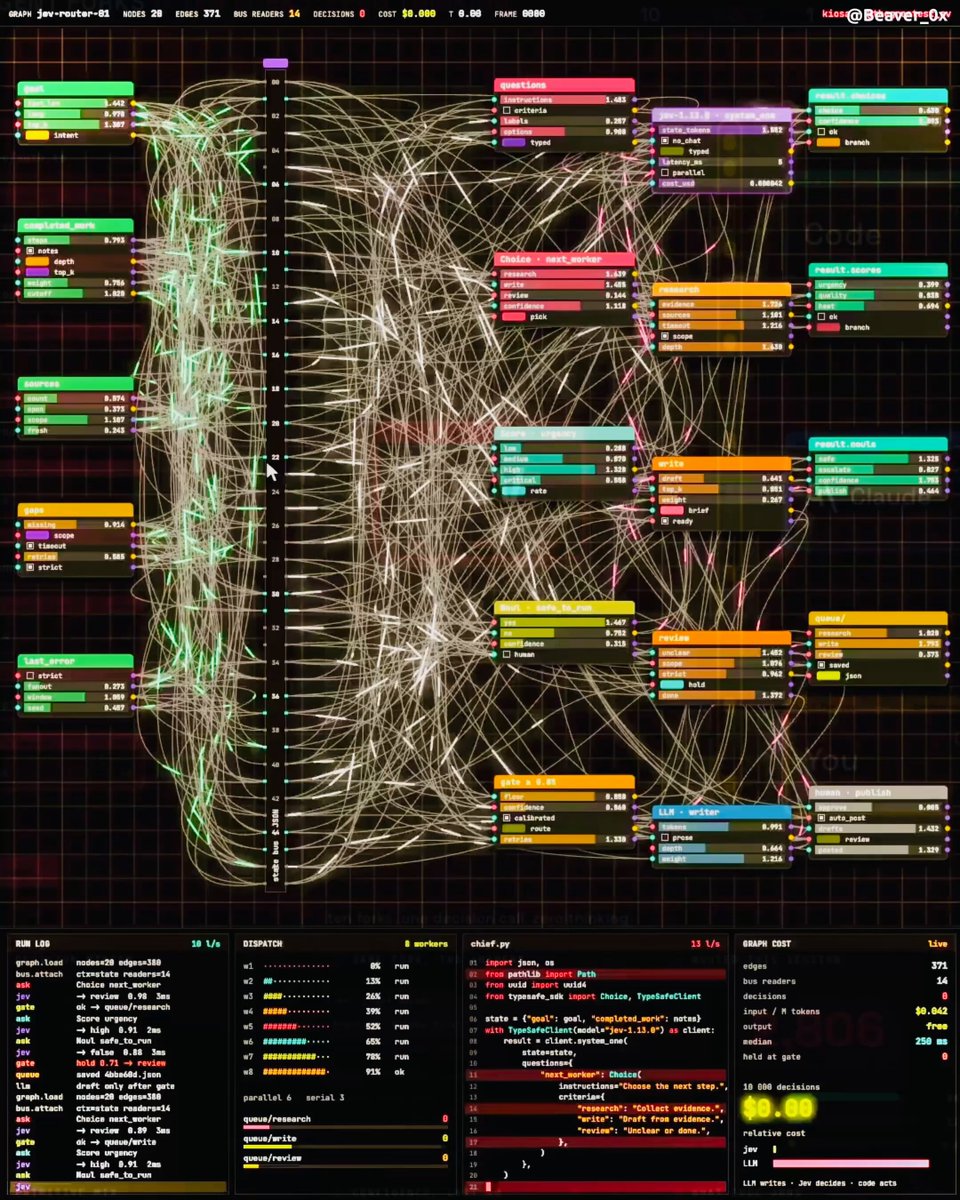
install these before your next long Claude Code session if your Opus 5.5 bill hurts and you don’t know where to start, copy this: claude-code-router: sits in front of Claude Code and sends each request to the cheapest model that can do it. Haiku does the grep, Opus only gets the hard part. 37k stars rtk: shrinks test, build and git output before the model sees it. one binary, up to 90% less bash output in your context. 83k stars claude-mem: remembers what happened in your past sessions and feeds back only the relevant part, so you stop paying to re-explain your project every morning. 100k stars context-mode: a huge tool output goes into a local database instead of your context window, and Claude pulls out only the lines it needs. 18k stars caveman: makes Claude answer in short telegraphic sentences. code stays identical, and output is the expensive side on Opus 5.5 ($20 per million). 51k stars token-optimizer: a local dashboard that shows where your tokens actually went, and keeps your work alive across compactions. 1.9k stars token-savior: replaces whole-file reads with symbol lookups, so Claude reads the function and not the 2,000 lines around it code-review-graph: maps your repo as a graph and gives Claude only the code connected to the change you’re reviewing jev-ultrafast: a browser agent where Jev picks every click, and a text model wakes up only when something has to be typed. 16,758 stars none of them makes Opus smarter. every one stops it from paying for work it never needed to do the full setup with scripts is in the article. do the measuring step first, so you know what you actually saved

rvaniaaa

23,217 次观看 • 9 天前