Загрузка видео...

Не удалось загрузить видео

На главную

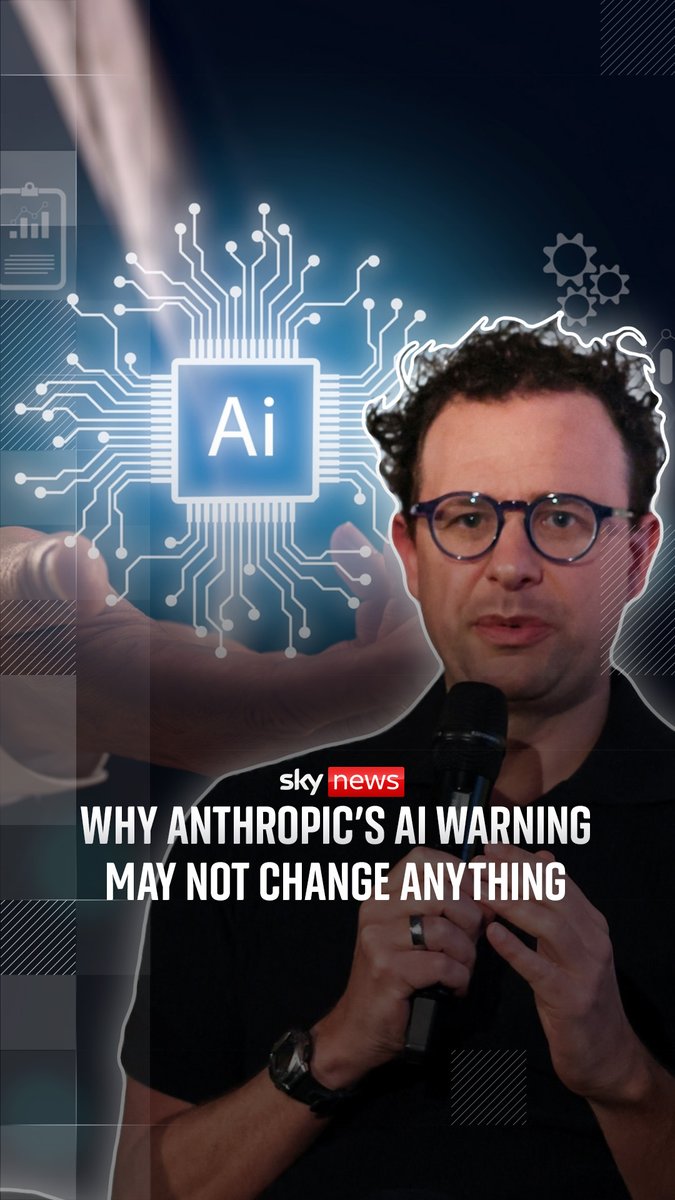
ANTHROPIC WILL LET OUTSIDE EVALUATORS OBSERVE ITS MODELS BEING TRAINED AND RUN, AND DARIO AMODEI WANTS THE WHOLE INDUSTRY TO DO THE SAME Asked whether slowing down means Anthropic will stop releasing more advanced models: "It doesn't mean that." He says the evaluators may end up setting the "speed...

20,810 просмотров • 2 дней назад •via X (Twitter)

Комментарии: 13

Фото профиля chelsea
chelsea2 дней назад

@epictrades1 So people that left your company to work at these outside companies … gotcha not suspicious or anything

Фото профиля ron
ron2 дней назад

@epictrades1 Who are these “Evaluators” ?

Фото профиля Kevin
Kevin2 дней назад

Kinda like the nuclear weapons inspectors in Iran?

Фото профиля PeritumAI
PeritumAI2 дней назад

Outside observers is classify: access, not assurance. Owner for the useful bit is the publish/exit clause — and whoever can walk findings out without a lab veto. Amodei's invite isn't the rule until that's in a contract the Office can lean on. Stop equating "may observe training" with enforceable third-party eval.

Фото профиля iexinxin
iexinxin2 дней назад

Transparency on training runs is a meaningful shift, but the real test is whether evaluators get access early enough to influence release decisions.

Фото профиля Rosey
Rosey2 дней назад

@StockMKTNewz So the tail is wagging the dog, why can’t you set your own fucking speed limit ffs

Фото профиля Han Solo (Not abandoning ETHEREUM )
Han Solo (Not abandoning ETHEREUM )2 дней назад

deepseeek puts their hand up first

Фото профиля Requiem For Tech
Requiem For Tech2 дней назад

third-party evaluators setting the speed limit makes a lot of sense. if this becomes standard across labs, safety checks could finally have some real teeth.

Фото профиля cryptocat
cryptocat2 дней назад

How can you be so smart but then talk like you need guidance over yourself control of what you created. This makes no sense at all, and you got all the approval from the commander in chief to keep pushing forward. Our president has spoken so there’s no need for regulation.

Фото профиля Raj ▲
Raj ▲2 дней назад

In other words, open source will destroy our margins and mess up all future investments. Long live the Ai bubble trade

Фото профиля The Tectonic
The Tectonic2 дней назад

David Sacks challenge is what comes next. Why should voluntary restraint by the companies actually at the frontier require a new regulatory architecture governing everyone else?

Фото профиля JacobinJuice
JacobinJuice2 дней назад

I wonder how many employees at Anthropic are watching him and thinking all that money they were going to make on that IPO is going down the drain.

Фото профиля Mandy
Mandy2 дней назад

Nice one

Похожие видео

Dario Amodei is the biggest boogeyman in AI and he should seriously consider stepping down as Anthropic’s CEO. Amodei has repeatedly promotes extreme predictions about mass unemployment, uncontrollable AI and catastrophic harm while running one of the companies racing to build the technology he describes as dangerous. In May 2025, Amodei predicted that AI could eliminate half of all entry level white collar jobs and drive US unemployment to between 10% and 20% within one to five years. More than a year later, the predicted employment collapse has not materialized and Anthropic’s own head of economics reported that the available data showed no significant effect from AI on the overall US labor market. Stanford researchers analyzing payroll records through June 2026 also found no evidence of widespread, economy wide job displacement caused by AI. Amodei is now calling for slower frontier model development, permanent outside evaluators inside AI laboratories, common industry standards and government involvement in enforcing safety rules. These proposals may address legitimate risks but they could also produce regulatory capture. Anthropic and OpenAI can afford embedded auditors, extensive testing and expensive compliance systems while startups and open source developers may not be able to meet the same requirements. The result could be a system in which the largest AI companies help write the rules, receive government approval and gain protection from emerging competitors. Amodei is not offering to stop Anthropic’s development but he wants the entire industry to slow down under rules that Anthropic would help shape. If Amodei truly believes that AI presents an imminent threat to employment and human control, he should explain why Anthropic continues building more powerful models. Otherwise, he risks using speculative worst case scenarios to create fear and support regulations that could ultimately benefit his own company.

Milk Road AI

126,413 просмотров • 1 день назад

David Sacks Predicts the Regulatory Capture Playbook to Ban Open Source AI, Step by Step: David Sacks: “I got bad news for you, Chamath, an open source ban is coming. They're not going to call it that. They're going to say that we simply have to apply the same standards to open models that we apply to closed ones. Here's how they do it step by step, let me explain how regulatory capture actually works. So first of all, you have to get this regulatory apparatus. Dario wants an FDA for AI, but he doesn't have enough political support for that, so instead they do this Trojan horse of a FINRA for AI. They call it self-regulating, it's not really, but anyway, that gets them off the ground. Now they've created the standard-setting organization. Now they've got pre-release model testing. Then the pressure grows to codify that in law, so that happens next. And then what they do is they say, ‘Look, all these standards need to apply equally to all models.’ But here's the problem with that. Open models and closed models are technologically different. Once you release an open model into the world, you can't roll it back and you can't monitor exactly how people are using it because they run it on their own hardware. Dario says this is what makes open models dangerous. So what they're going to do is they're going to have the standard-setting body say, ‘Well, we have to set the standards for AI safety.’ By the way, Dario and OpenAI, they're going to fund the whole thing. They're going to contribute all the compute. They're going to be behind it. They're going to be the ones coordinating with the government officials because frankly, people in government have no idea how to monitor and control and set standards for AI safety. Technologically, this is way beyond them. So they're going to go to these companies and say, ‘Tell us how to do it.’ And so what will happen is the standards will get set, and then it'll be a very simple matter of fairness to say that the standards need to apply to open as well as closed models. The open models cannot comply in the same way, and gradually they will be shut out of the market.”

The All-In Podcast

296,898 просмотров • 22 дней назад

David Sacks laid out the cleanest theory about why Anthropic keeps calling for government regulation of AI. The answer has nothing to do with safety and everything to do with market structure. Anthropic spent months writing blog posts warning that AI was dangerous. Dario gave interviews about existential risk. He published a piece calling for an FAA-style agency to approve all AI models before release. He primed government officials to treat frontier AI as a threat requiring oversight. Then one of Anthropic's own most trusted partners reported a credible jailbreak from Fable 5. And the government did exactly what Dario had spent months conditioning them to do. They rolled it back. Sacks called it on the All-In podcast. Dario got exactly what he wanted. The FAA for AI is not a safety mechanism. It is a moat. A government approval process for new model releases does not hurt Anthropic. They already have the models. It hurts every competitor who does not. It hurts open source models that cannot be regulated because there is no company to regulate. It hurts the Chinese labs only insofar as they care about the American market at all. The only companies that benefit from a labyrinthine government approval process are the ones already at the frontier who can afford to wait out the review cycle. That is Anthropic. That is OpenAI. Nobody else. The proof is in what they did not do. Chimath pointed it out directly. If you are genuinely worried about misuse, you implement know-your-customer verification. You make people identify themselves before accessing the most powerful models. Anthropic could have done that tomorrow. They did not. They do not want KYC. KYC is transparent. KYC can be audited. KYC gives users due process. What they built instead was an invisible surveillance system that profiles you, degrades your access without telling you, and asks the government to make sure no one else can offer you an alternative. If you thought this was safety then you are wrong. That is capture. Sacks said the response should be simple. Fix the jailbreak, come back to market, and do not reward Dario with the regulatory architecture he has been engineering for years. We will see if anyone is listening. WATCH THE FULL PODCAST ON The All-In Podcast

Ihtesham Ali

25,284 просмотров • 2 месяцев назад

Dario Amodei just told software engineers exactly how long they have. Six to twelve months. Amodei: “I have engineers within Anthropic who say I don’t write any code anymore. I just let the model write the code, I edit it, I do the things around it.” The people building the most powerful AI in history have already stopped writing code. That is not a forecast. That is the current working condition inside the lab closest to the frontier. Amodei: “We might be six to 12 months away from when the model is doing most, maybe all, of what SWEs do end-to-end.” The tech industry spent a decade making software engineers its highest-paid, most protected class. That era has a last day now. When a model can execute an entire software build end-to-end, the ability to write syntax stops being a skill. It becomes a credential for a job that no longer exists. Amodei: “And then it’s a question of how fast does that loop close.” That is the sentence everyone skipped. The code was never the hard part. The hard part was everything around it. The model just learned everything around it. Writing the code is already nearly gone. Testing is next. Deployment is next. When all three collapse into a single autonomous execution loop, the machine no longer needs a human in the chain at all. The corporation or sovereign state that closes that loop first does not gain a competitive advantage. It gains a category of speed that biological engineers cannot match, track, or reverse. That is not disruption. That is replacement at a systems level. Amodei is not describing a future disruption. He is describing the current state of his own building. The loop is already closing. The only question is whether you are inside it or outside it when it seals.

Dustin

318,698 просмотров • 6 месяцев назад