Loading video...

Video Failed to Load

Go Home

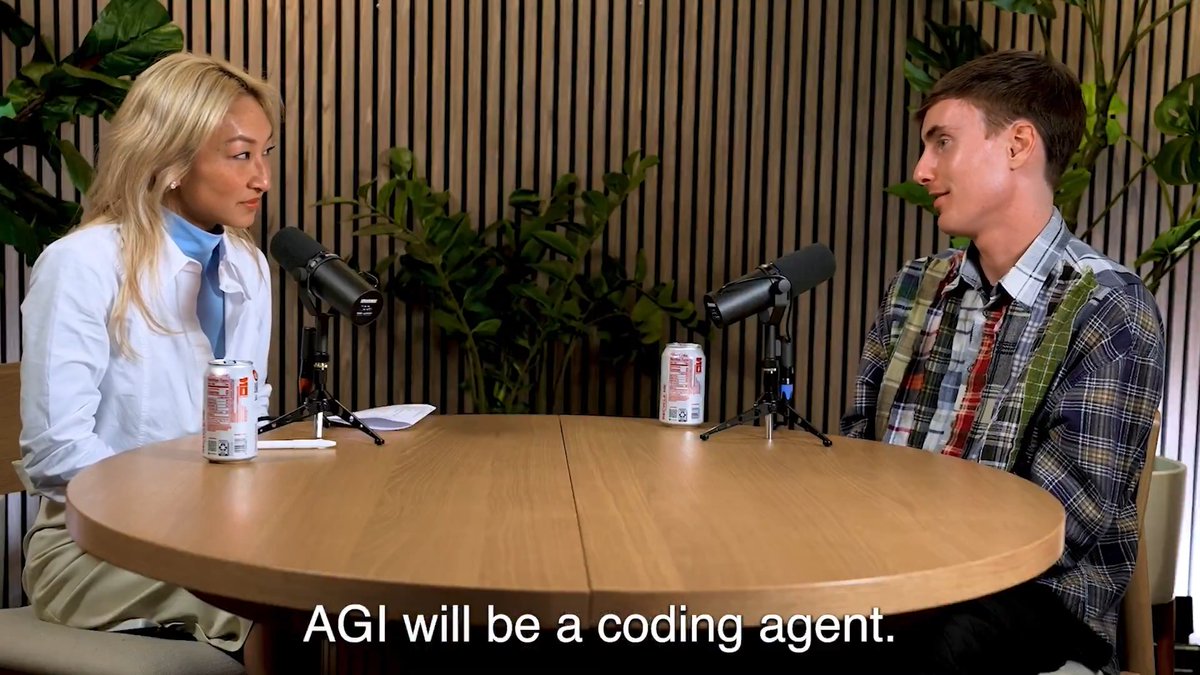
Anthropic’s Boris Cherny argues that for certain modern, model-friendly codebases, especially TypeScript/React projects, coding is already effectively "solved". AI agents can write nearly 100% of the code, while humans shift from hand-coding to directing, reviewing, integrating, and scaling many small PRs at once.

32,117 views • 3 months ago •via X (Twitter)

0 Comments

No comments available

Comments from the original post will appear here

Related Videos

Claude Code is a major (and accidental!) hit for Anthropic that surprised even its creator, Boris Cherny. Claude Code, an Agentic AI coding product that lives in the terminal. Most of the new code at Anthropic is created through it today. And in the last 5 months since it was launched publicly, Claude Code went from $0 to $400M in revenue run rate (as per The Information). 00:00 – Intro 01:15 – Did You Expect Claude Code’s Success? 04:22 – How Claude Code Works and Origins 08:05 – Command Line vs IDE: Why Start Claude Code in the Terminal? 11:31 – The Evolution of Programming: From Punch Cards to Agents 13:20 – Product Follows Model: Simple Interfaces and Fast Evolution 15:17 – Who Is Claude Code For? (Engineers, Designers, PMs & More) 17:46 – What Can Claude Code Actually Do? (Actions & Capabilities) 21:14 – Agentic Actions, Subagents, and Workflows 25:30 – Claude Code’s Awareness, Memory, and Knowledge Sharing 33:28 – Model Context Protocol (MCP) and Customization 35:30 – Safety, Human Oversight, and Enterprise Considerations 38:10 – UX/UI: Making Claude Code Useful and Enjoyable 40:44 – Pricing for Power Users and Subscription Models 43:36 – Real-World Use Cases: Debugging, Testing, and More 46:44 – How Does Claude Code Transform Onboarding? 49:36 – The Future of Coding: Agents, Teams, and Collaboration 54:11 – The AI Coding Wars: Competition & Ecosystem 57:27 – The Future of Coding as a Profession 58:41 – What’s Next for Claude Code

Matt Turck

82,161 views • 1 year ago

I'm teaching a new course! AI Python for Beginners is a series of four short courses that teach anyone to code, regardless of current technical skill. We are offering these courses free for a limited time. Generative AI is transforming coding. This course teaches coding in a way that’s aligned with where the field is going, rather than where it has been: (1) AI as a Coding Companion. Experienced coders are using AI to help write snippets of code, debug code, and the like. We embrace this approach and describe best-practices for coding with a chatbot. Throughout the course, you'll have access to an AI chatbot that will be your own coding companion that can assist you every step of the way as you code. (2) Learning by Building AI Applications. You'll write code that interacts with large language models to quickly create fun applications to customize poems, write recipes, and manage a to-do list. This hands-on approach helps you see how writing code that calls on powerful AI models will make you more effective in your work and personal projects. With this approach, beginning programmers can learn to do useful things with code far faster than they could have even a year ago. Knowing a little bit of coding is increasingly helping people in job roles other than software engineers. For example, I've seen a marketing professional write code to download web pages and use generative AI to derive insights; a reporter write code to flag important stories; and an investor automate the initial drafts of contracts. With this course you’ll be equipped to automate repetitive tasks, analyze data more efficiently, and leverage AI to enhance your productivity. If you are already an experienced developer, please help me spread the word and encourage your non-developer friends to learn a little bit of coding. I hope you'll check out the first two short courses here!

Andrew Ng

1,224,686 views • 2 years ago

Claude Code cracked something open for us Every 📧. Now I ship to codebases I barely know, every feature we ship makes the next one easier, and non-technical members of the team use the terminal. I’m genuinely grateful. So I brought its creators, Cat Wu (cat) and Boris Cherny (Boris Cherny) from Anthropic, on AI & I to say thank you—and to talk about everything they’ve learned from building Claude Code. We get into: • The workflows Anthropic’s smartest engineers use to push Claude Code to its limits. Why they pit subagents against each other to get cleaner results, how they turn past code into leverage, and the slash commands and MCPs they rely on most. • The product lessons behind one of the most loved AI agents in the world. How the team balances simplicity and power—building a tool that anyone can use, but that experts can bend to their will—and their philosophy of “unshipping,” or cutting back whenever there’s a simpler, more intuitive path to user intent. • A peek into the future of coding with AI. The new form factors they’re experimenting with to make Claude Code more autonomous, more reliable, and more accessible to non-technical users This is a must-watch for anyone—both technical and non-technical—who wants to learn how to use Claude Code like the people who built it. Watch below! Timestamps: Introduction: 00:01:26 Claude Code’s origin story: 00:02:25 How Anthropic dogfoods Claude Code: 00:07:03 Boris and Cat’s favorite slash commands: 00:14:06 How Boris uses Claude Code to plan feature development: 00:15:49 Everything Anthropic has learned about using sub-agents well: 00:21:53 Use Claude Code to turn past code into leverage: 00:26:16 The product decisions for building an agent that’s simple and powerful: 00:33:14 Making Claude Code accessible to the non-technical user: 00:36:38 The next form factor for coding with AI: 00:45:12

Dan Shipper 📧

57,568 views • 9 months ago

🚨 OpenAI just launched Codex, a brand-new autonomous coding agent that can build features and fix bugs on its own. We’ve been using it Every 📧 for a few days, and I’m impressed. I invited Alexander Embiricos (ben davies), a member of the product staff responsible for Codex, to demo Codex and talk about it live on a special edition of AI & I: What Codex is and how it works Codex is designed to be used by senior engineers—it performs coding tasks like adding features or fixing bugs autonomously. It's built to allow you to start many sessions at once, so you can have multiple agents working in parallel. Codex is built to have "taste" OpenAI trained Codex to have the taste of a senior software engineer. It knows how big codebases work, how to write a good PR, and uses clean, minimal code. Why an “abundance mindset” is best for interacting with agents Codex is designed to allow users to delegate many tasks at once without getting caught up in the details. This lets you point an abundance of agents at a specific task like a difficult bug—it’s worth it even if only one of them succeeds. How OpenAI is thinking about agents Codex is one piece of a unified super-assistant OpenAI wants to eventually build—an agent that helps users easily get things done by selecting the right tools for them behind the scenes. OpenAI’s vision for the future of programming In the future developers will probably spend less time writing routine code and more time guiding agents, reviewing their work, and making strategy decisions. Programming will become more social, letting teams easily delegate multiple tasks at once, allowing people to focus on ideas and collaboration instead of routine coding. Watch below!

Dan Shipper 📧

145,487 views • 1 year ago