Video yükleniyor...

Video Yüklenemedi

Ana Sayfaya Dön

Hoping your coding agents could understand you and adapt to your preferences? Meet TOM-SWE, our new framework for coding agents that don’t just write code, but model the user's mind persistently (ranging from general preferences to small details) arxiv: ❓Motivation: Most coding agents today can plan, edit, run, and...

40,202 görüntüleme • 9 ay önce •via X (Twitter)

0 Yorum

Yorum bulunmuyor

Orijinal gönderinin yorumları burada görünecek
Benzer Videolar

New course to bring you up to state-of-the-art at using AI to help you code: Build Apps with Windsurf's AI Coding Agents, built in partnership with WIndsurf (Codeium) and taught by Anshul Ramachandran! AI-assisted IDEs (Integrated Development Environments) make developers’ workflows faster, more efficient, and much more fun. Agentic tools like Windsurf are more than just code autocomplete—they are collaborative coding agents that help you break down complex applications, iterate efficiently, and generate code that spans multiple files. Although a lot of coding assistants share the same underlying large language models for planning and reasoning, a major point of distinction is how they handle tools, keep track of context, and stay aligned with your intent as a developer. For instance, if you make modifications to a class definition in your code and make the same modifications to other classes in the same directory, you might tell the AI agent "Do the same thing in similar places in this directory." Here, tracking your intent means understanding that “the same thing" refers to that recent edit you just made, which must be followed by appropriate search and tool-calling to implement the changes. In this course, you'll learn the inner workings of coding agents, their strengths and limitations, and how to use Windsurf to quickly build several applications. In detail, you'll: - Build a mental model of how agents work by combining human-action tracking, tool integration, and context awareness to carry out an agentic coding workflow. - Learn the challenges of code search and discovery and how a multi-step retrieval approach helps coding agents address them. - Use Windsurf to analyze and understand a large, old codebase and update it to the latest versions of the frameworks and packages it uses. - Build a Wikipedia data analysis app that retrieves, parses, and analyzes word frequencies. - Enhance the performance of your Wikipedia analysis app by adding caching, and through this, also learn how to course-correct when the AI agent produces unexpected results. - Learn tips and tricks such as keyboard shortcuts, autocomplete, and @ mentions to quickly call on agentic capabilities. - Use image/multimodal capabilities of the AI agent to increase your development velocity; you'll see an example of uploading a mockup with sketched-out UI features, and ask the agent to use that to build new functionality to an app. By the end of this course, you’ll understand agentic coding in-depth and know how to use it to make your development process much faster, more efficient, and enjoyable. Please sign up here!

Andrew Ng

139,978 görüntüleme • 1 yıl önce

Hell froze over: announcing FormKit for React. Secretly framework-agnostic since inception, today we’re open sourcing the most popular Vue form library…for React. Why is this a big deal? 1. Forms are still hard. We (the creators of FormKit) thought form libraries were no longer necessary, given the trajectory of coding agents. It turns out we were wrong, and we learned this the hard way. Need repeating conditional fields nested 3 layers deep inside a dynamic component, with accessibility, validation, internationalization, and backend error placement? Turns out coding agents aren’t great at that. It’s table stakes for FormKit. 2. Single component. This matters more than you would think, but FormKit doesn’t ship lots of different components each with its own props. Instead, it has a single one: and unified props. This was done to provide a better DX to human engineers. It makes it easy to spot when a given component was part of the form’s data structure vs a presentational component. It turns out this matters even more to coding agents than humans. No matter where your coding agent is, whenever it sees “FormKit” it immediately knows “oh, that’s part of the form’s data”. 3. No plumbing. FormKit doesn’t require any manual data collection, event listening, or state tracking. It does all this for you on a heavily tested, framework agnostic, self-assembling graph. The only code your agent needs to write is declarative templates and submission handlers that respond to the state. 4. Dense colocation. FormKit’s syntax happens to be ideal for coding agents; nearly everything you need to know about a given input is *on* the input: Colocation dramatically improves the efficacy of coding agents. 5. DOM. FormKit, unlike most form frameworks in React, renders the actual DOM. This also increases colocation and best practices, meaning your coding agent is far more likely to produce consistent and high-quality output that looks and acts the way its supposed to. 6. Schema. FormKit’s own inputs are not written using Vue or React — instead, FormKit has its own render schema — think of it like an AST for the DOM — and you can modify it on the fly. It’s not very human-friendly to write, but it turns out most models are already pretty well trained on FormKit’s schema. Want your inputs to look a bit different on one form than another? No problem, your coding agent can easily make those changes *without* modifying the JSX structure at all. Oh, and any inputs you create for Vue work with React and vice versa. 7. Plugins. FormKit leans into the unstructured tree graph hard. The graph doesn’t just collect data, it also passes down configuration and plugins. Want one form to work a bit differently than another one? No problem — just add a plugin to the top of that form or group and its children will all receive that feature. You can even mass assign props and configuration this way. Of course, FormKit has been solving these exact issues for a long time, but it wasn’t until we started using it on our own projects with coding agents that we realized what a huge advantage it is. With so many people using coding agents with React, it made sense to unveil FormKit for what it has always been — a completely framework-agnostic form framework that happens to unlock your coding agents. ➡️

Justin Schroeder

11,677 görüntüleme • 4 ay önce

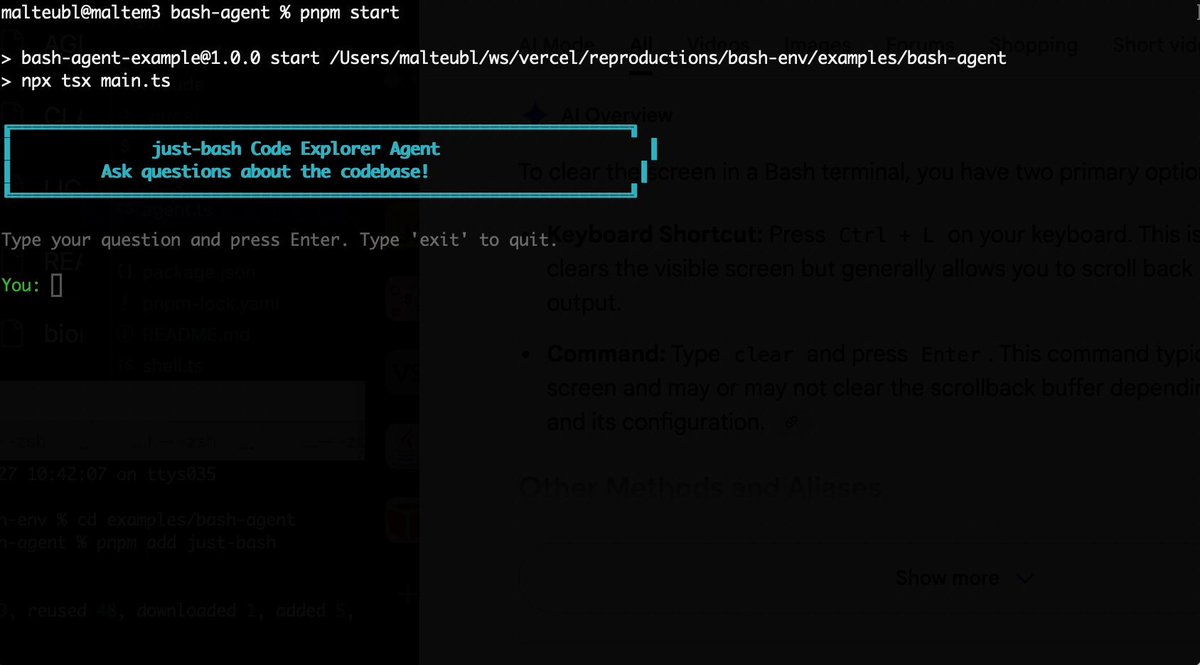
Bash is all you need! Which is why I'm introducing my holiday project: just-bash just-bash is a pretty complete implementation of bash in TypeScript designed to be used as a bash tool by AI agents. Because it turns out agents love exploring data via shell scripts, even beyond coding. It comes with grep, sed, awk and the 99th percentile features that an agent like Claude Code or Cursor would use. In fact, Claude Code can use it for secure bash execution. In the package - A bash-tool for AI SDK - A binary for use by yourself or your coding agents - An overlay filesystem to feed files to your agent securely - A Vercel Sandbox compatible API, so you can quickly upgrade to a real VM if you need to run binaries - An example AI agent that explores the just-bash code base using just-bash - I imported the Oils shell bash compatibility suite and just-bash passes a very good chunk What is interesting about this codebase: It was essentially entirely written by Opus 4.5. Coding agents love bash and they are good at reproducing it. They are also great at text-book recursive descent parsers and AST tweet-walk interpreters. That said, it is, like, a lot of code and I didn't read it all 😅. This is very much a hack, but it also seems to be _really_ useful. I haven't really found anything agents want to use that it doesn't support and it's fast and secure (caveats apply). It doesn't have write access to your computer and the filesystem is given a root that the agent cannot escape from. Find it at Related: Our recent blog post how we migrated our data analysis agent to bash tools and achieved incredible quality improvements The video shows the example agent investigating the just-bash code base

Malte Ubl

125,326 görüntüleme • 8 ay önce