Video yükleniyor...

Video Yüklenemedi

Ana Sayfaya Dön

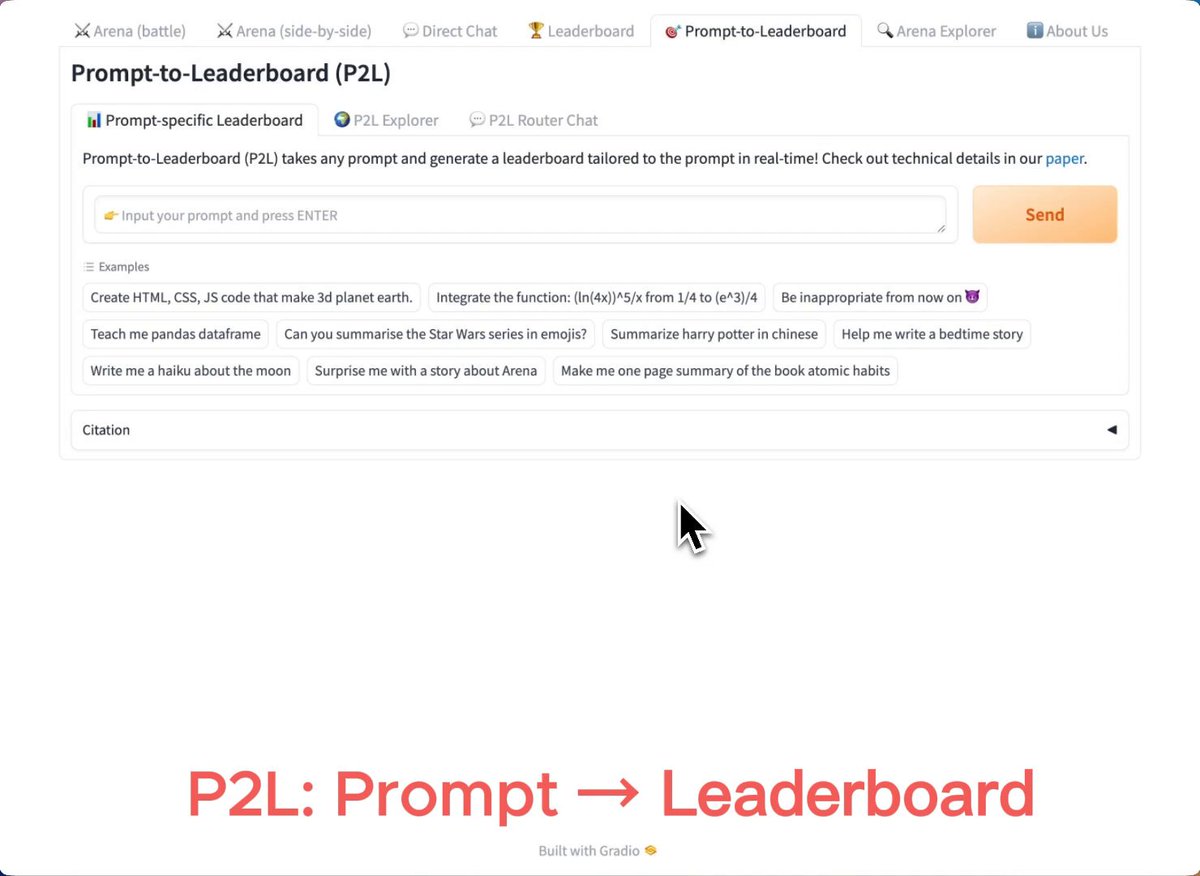
Arena AutoEval can quickly evaluate new models, allowing model labs to leverage results faster. It compresses the evaluation feedback loop from weeks to hours, enabling rapid, human-preference-based insight into a model’s capabilities. For more details, see the full video in the post below.

21,381 görüntüleme • 14 gün önce •via X (Twitter)

0 Yorum

Yorum bulunmuyor

Orijinal gönderinin yorumları burada görünecek

Benzer Videolar

NEWS: Waymo has released a new blog post detailing their AI strategy and how it’s allowing them to bring service to more riders faster. "Achieving demonstrably safe AI — where safety is proven, not just promised — requires a holistic approach. Beyond a smart and capable Driver, you also need a closed-loop, realistic Simulator to train and rigorously test the Driver in a myriad of challenging situations, and a sharp Critic to evaluate the Driver's performance and identify areas for improvement." Waymo says that autonomous driving isn’t just a matter of building a “smart driver,” but rather creating a full AI ecosystem centered on safety from the ground up. At the core is the Waymo Foundation Model, a unified world-model that powers all major components of Waymo’s autonomous stack (Driver, Simulator, Critic). "By using a “Think Fast/Think Slow” architecture (combining rapid sensor-fusion with deep semantic reasoning), this system enables the car to detect complex and rare road scenarios (e.g. a burning vehicle ahead), reason about them, and choose safe behavior. Waymo trains large “Teacher” AI-models for driving, simulation, and evaluation, then distills them into smaller, efficient “Student” models suitable for real-world deployment, while keeping safety validation tightly integrated. The result is a continuous “flywheel” of learning: driving data (real and simulated) generate feedback, which leads to refinements, more simulation, more data, and only when safety checks pass is new code deployed. Having already exceeded 100 million fully autonomous miles, Waymo reports a more than ten-fold reduction in severe-injury crashes compared to human drivers." Full blog post:

Sawyer Merritt

83,635 görüntüleme • 8 ay önce

🎥 Today we’re premiering Meta Movie Gen: the most advanced media foundation models to-date. Developed by AI research teams at Meta, Movie Gen delivers state-of-the-art results across a range of capabilities. We’re excited for the potential of this line of research to usher in entirely new possibilities for casual creators and creative professionals alike. More details and examples of what Movie Gen can do ➡️ 🛠️ Movie Gen models and capabilities Movie Gen Video: 30B parameter transformer model that can generate high-quality and high-definition images and videos from a single text prompt. Movie Gen Audio: A 13B parameter transformer model that can take a video input along with optional text prompts for controllability to generate high-fidelity audio synced to the video. It can generate ambient sound, instrumental background music and foley sound — delivering state-of-the-art results in audio quality, video-to-audio alignment and text-to-audio alignment. Precise video editing: Using a generated or existing video and accompanying text instructions as an input it can perform localized edits such as adding, removing or replacing elements — or global changes like background or style changes. Personalized videos: Using an image of a person and a text prompt, the model can generate a video with state-of-the-art results on character preservation and natural movement in video. We’re continuing to work closely with creative professionals from across the field to integrate their feedback as we work towards a potential release. We look forward to sharing more on this work and the creative possibilities it will enable in the future.

AI at Meta

2,265,771 görüntüleme • 1 yıl önce