Loading video...

Video Failed to Load

Go Home

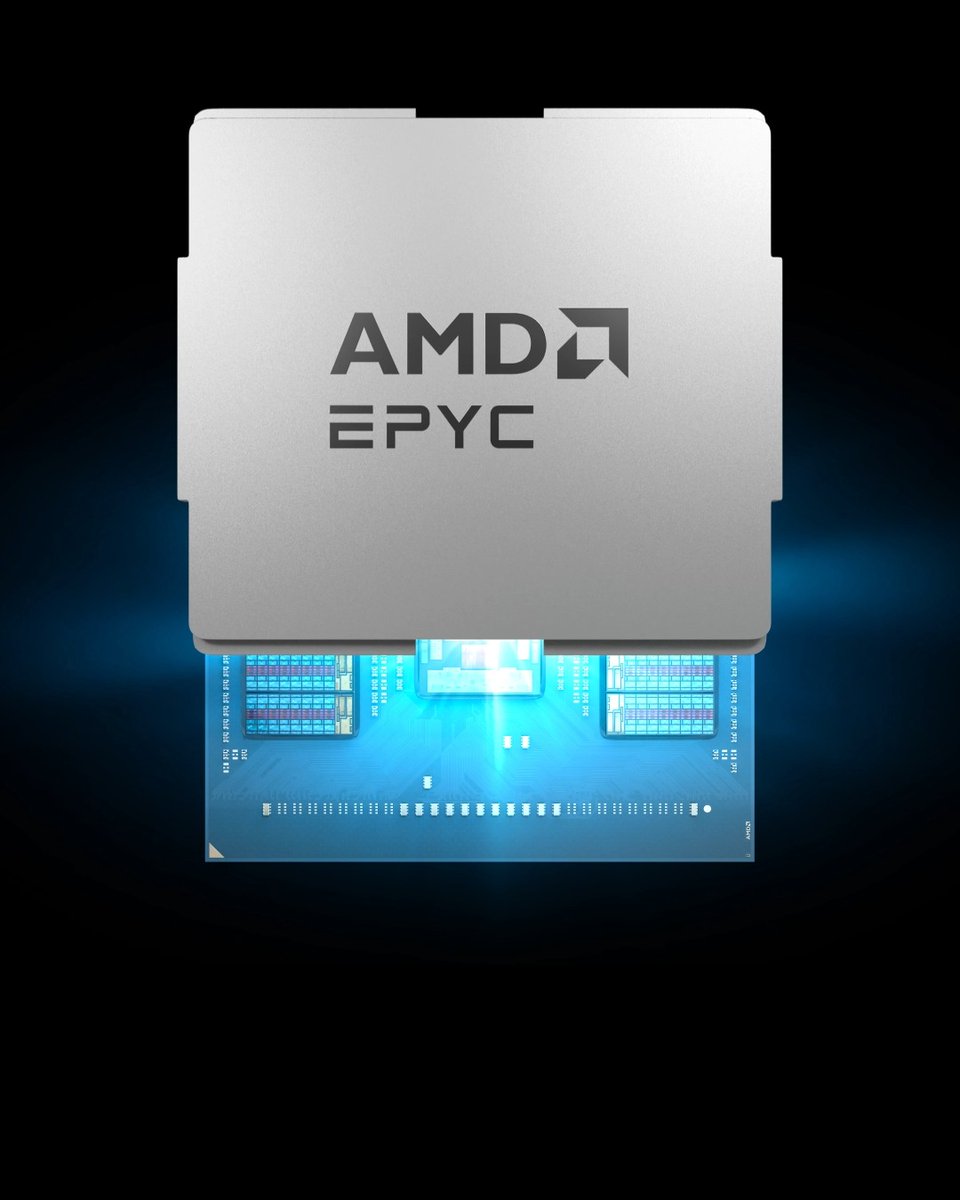
AWS + AMD: 5th Gen EPYC EC2 Boosts Performance 30% Power your workloads with AWS's new 8th generation EC2 instances, featuring 5th Gen AMD EPYC processors! The complete family of C8a, M8a, and R8a instances are now available.

6,242,553 views • 7 months ago •via X (Twitter)

0 Comments

No comments available

Comments from the original post will appear here
Related Videos

$AMD $AMZN partnership will 🚀 in 2026 🔥 Amazon/AMD partnership is hidden among hot headlines from OpenAI $NVDA $ORCL... TLDR: Amazon refused to bid up the overpriced $NVDA chips among other hyperscalers, and decided to work closely with $AMD. Amazon is expected to spend up to $10-$20B a year on 2026 EPYC breakthrough Gen and Future Gen. Dr. Su confirmed "we have plenty for other large customers". For its 2026 EPYC "Venice" processors, AMD is using a multi-node manufacturing strategy: the CPU core complex dies (CCDs) are built on TSMC's 2 nm-class node (N2), while the I/O die (IOD) uses the N3P (3 nm) process. Context: Andy Jassy Amazon Web Services has been working with AMD on EPYC processors since November 2018. With this "secret weapon" breakthrough(patented), this long time partnership has expanded to New breakthrough 2026 EPYC Gen. AMD's 6th Gen EPYC "Venice" processors, slated for 2026, introduce New Chiplet design breakthrough. a revolutionary chiplet interconnect fabric that redefines server scalability for AI. This isn't just faster silicon; it's a paradigm shift for AWS, enabling hyper-efficient, rack-scale AI inference that slashes costs and latency while boosting throughput. AMD to benefit AWS's $100B+ AI opportunity along with $ORCL $MSFT $GOOGL $META Saudi, UAE ,38+ countries and startups. In early October, Amazon/AWS announced the new EC2 M8a instances as their latest-generation, general-purpose compute instances now powered by AMD EPYC 9005 "Turin" processors. Amazon announced the M8a as having up to 30% higher performance and up to 19% better price performance over M7a. With my testing of both at 32 vCPUs, the new AMD EPYC Turin instance provided 1.59x the performance over the prior-generation EPYC Genoa instance! How will this impact AWS AI Inference? ~Cost Efficiency: Inference is 80%+ of AI workloads and latency-sensitive (e.g., chatbots need <1s responses). "Secret weapon" enables 35x better inference perf (per AMD's CDNA roadmap tie-in), cutting AWS's energy use by 50%+ in clusters. With $118B 2025 capex, this could save $20–$30B annually in OPEX, boosting margins to 35%-40%. ~Scalability for Agentic AI: Supports "Helios" rack-scale platforms (up to 128 GPUs + EPYC hosts), delivering 3.58x FP6 perf for distributed inference. AWS can run 700K+ more tokens/sec in 1,000-node clusters (via EPYC 9575F boosts), enabling real-time apps like personalized search or fraud detection at enterprise scale. ~Adoption Catalysts: Early partners like Oracle signal broad uptake; AWS's existing AMD instances G4ad with Radeon GPUs) pave the way. By 2026, EPYC could power 40%+ of AWS AI infra, outpacing Nvidia's GPU lock-in via open standards (ROCm 8 software). Lastly, Amazon’s trajectory toward a $320 stock price is not a speculative leap but a grounded projection rooted in its unmatched fundamentals and strategic AI leadership. With Amazon Web Services poised to surpass $100 billion in annual revenue by 2026, driven by explosive AI inference demand, Amazon is redefining cloud computing’s future. The adoption of AMD’s 2026 EPYC processors with "Secret" architecture is a game-changer, slashing costs by up to 50% and boosting inference throughput 3x, enabling AWS to dominate enterprise AI workloads with unmatched efficiency. This technological edge, combined with Amazon’s e-commerce dominance and high-margin advertising growth, supports a valuation rerating to 22x EV/EBITDA, and it is still a discount to historical highs. Trading at $222, $AMZN is undervalued for its 15–20% revenue CAGR and 25%+ EPS growth through 2030.

Mike

511,082 views • 8 months ago

$AMD $MSFT Partnership is MASSIVE in 2026 🚀 If you were excited about my thread on $AMD $AMZN AWS long time partnership, you will be even more excited about what Microsoft gonna do with 2026 AMD EPYC "Venice". Historical Context: The relationship between AMD and Microsoft began in the early 2000s, with Microsoft initially focusing on Intel's x86 architecture for its Windows operating system and server products. However, AMD's entry into the server market with its Opteron processors in 2003 marked the beginning of a competitive dynamic that eventually led to collaboration. The partnership intensified with the launch of 3rd Generation EPYC "Milan" in 2021, powering Azure's N2D and C2D VM families. By 2025, Microsoft had integrated 5th Generation EPYC "Turin" into new compute-optimized instances, reflecting a strategic shift towards AMD for cost and performance benefits. This "Secret Weapon" breakthrough will mark another inflection point for AMD Microsoft Azure relationship, will probably be more aggressive than EPYC "Milan" moment in 2021. We can call it EPYC "Venice" moment 2026" 1. Technical performance of AMD EPYC "Venice" (2026) AMD's 6th Gen EPYC "Venice" processors, slated for 2026, introduce New Chiplet design breakthrough. a revolutionary chiplet interconnect fabric that redefines server scalability for AI. This isn't just faster silicon; it's a paradigm shift for Microsoft Azure , enabling hyper-efficient, rack-scale AI inference that slashes costs and latency while boosting throughput. ~Up to 256 Zen 6 cores, a 70% performance increase over "Turin," optimized for AI and HPC. ~Memory and Bandwidth: 1.6 TB/s per socket, doubling "Turin's" capability, with support for MR-DIMM/MCR-DIMM. ~Efficiency: 1,500-1,700W power draw, a 50% reduction, aligning with Microsoft's sustainability initiatives. ~Interconnect: PCIe 6.0 and a new chiplet fabric for rack-scale AI, reducing latency and enhancing scalability. 2. Why $MSFT will adopt $AMD YPYC Share to 50%+ in 2026. AMD EPYC Share: ~30-35% of Azure's x86 CPU-based business while Intel Xeon share is 65% Microsoft's Azure has been progressively integrating AMD EPYC, with "Venice" expected to expand this footprint: A. Dominance of AI Inference Workloads ~AI inference constitutes 80% of AI workloads in cloud environments, with latency-sensitive applications like chatbots, recommendation engines, and fraud detection requiring sub-second response times. ~"Venice's" 35x inference performance uplift directly addresses these requirements, outperforming Intel's offerings and custom Arm solutions in multi-threaded scenarios. B. Cost Efficiency and Operational Savings ~Azure's 2025 capex of $118B is under pressure to deliver returns. "Venice" can reduce operational expenses by $20-30B annually due to its power efficiency and performance gains, improving Azure's margins to 35-40%. ~The cost per inference operation is significantly lower with "Venice," estimated at 24-31% less than Intel-based alternatives, enhancing Azure's competitiveness against AWS and GCP. C. Scalability for Enterprise AI: ~"Venice" supports rack-scale AI deployments, enabling Azure to scale AI services for enterprise customers. For example, a 1,000-node cluster can process 700,000+ tokens per second, crucial for large-scale AI applications like personalized marketing and predictive analytics. ~This scalability is particularly important as Azure aims to capture the $100B+ AI opportunity by 2026, as stated by Microsoft CEO Satya Nadella. D. Reduction of Nvidia Dependency ~While Nvidia ( $NVDA) dominates AI accelerators, AMD's integrated EPYC-GPU solutions (MI450 with "Venice") offer a balanced approach, reducing Azure's reliance on Nvidia's high-cost GPUs. ~"Venice" enables hybrid inference models, where CPU-based inference handles 80% of workloads, and GPU acceleration is reserved for training and complex tasks, optimizing resource allocation. 3. Financial Implication: ~Revenue from Azure could reach $15-18B annually by 2026, part of a total revenue projection of $70-100B ~Profit margins could improve to 55-60%, boosting net income to $20-25B, supported by scale economies and reduced production costs. Intel could respond by giving more aggressive discounts, but this breakthrough has been a decade long of $AMD R&D, or rethinking chiplet design, a complete new approach. "Venice's" lead in AI inference and efficiency is challenging to match. Broader Industry: Other hyperscalers ( Amazon Web Services , GCP) and enterprises will follow Azure's lead, standardizing EPYC technology and pressuring Intel further. This could lead to a broader industry shift towards AMD, enhancing its ecosystem and bargaining power. Conclusion: The strategic adoption of AMD's 6th Generation EPYC "Venice" processors by Microsoft Azure in 2026 marks a pivotal moment in the evolution of cloud computing, particularly for AI inference capabilities. "Venice's" groundbreaking chiplet design, offering a 35x performance uplift for AI inference tasks, a 50% reduction in power consumption, and unparalleled scalability, positions Azure to leapfrog its competitors in the race for AI dominance. This technical superiority, combined with significant cost savings potentially $20-30B annually in operational expenses; aligns perfectly with Microsoft's ambitions to capture the $100B+ Revenue AI opportunity by 2026. The shift to 50% x86 market share for AMD within Azure is not merely a technical transition but a strategic realignment that redefines the competitive landscape. Historically, Microsoft's partnership with AMD has evolved from niche deployments to a core component of Azure's infrastructure, and "Venice" accelerates this trend. The 30-35% AMD EPYC share in 2025 is expected to double, driven by new VM families like C4D and H4D, which will dominate AI-intensive and HPC workloads. This migration is incentivized by "Venice's" efficiency gains, reducing dependency on Intel and Nvidia, and enhancing Azure's sustainability profile. Not Financial Advice!

Mike

141,018 views • 8 months ago

$AMD $5 Trillion MC Is Inevitable Long Term👑 This thread will focus more on Inference! 2026 EPYC "Venice" $TSM 2nm to save Large GW Scale Inference by 40% more than Prior Turin gen. Context: EPYC Turin achieves ~$0.001 per million tokens for batch inference vs $0.02-$0.12/ million tokens as I wrote the thread below. Venice is going to lower cost down to $0.0005-$0.0006/Million Tokens. OpenAI spent roughly $20B on Inference and Training, where 80-90% of that was for Inference per Analysts. AKA Renting Compute is Expensive AF! In this thread, I want to focus on why most analysts and investors are underestimating the role EPYC "Venice" and future Gen on overall Data center revenue. And $TSM ramping up 2nm supply early is a confirmation that AMD will be a major buyer long term. I will also link the thread the Gap between AMD Analysts & Reality and 2nm Ramp Thread so you have more comprehensive view of what I'm writing here. Before I go into detail this is my 2026 Projection: AI GPUs: $35-$50B EPYC Data Center: $15B-$17B Client Segment: $12-$13B Gaming: $6B Embedded: $4B-$5B Total Revenue $70-$100B Non-GAAP net income $18B-$25B Non-GAAP EPS $10.97-$15.40 Foward P/E 55x-70x= $603-$1,078 AMD's Analysts are projecting $0 Revenue for MI450 and sluggish EPYC Growth. Meaning, all analysts are either full of 💩 or Sexist, you decide! Analysts are also projecting 0% growth on AMD "Secret Weapon" Chip as $MSFT said we are at significant Windows refresh and upgrade cycle. Do you think TSMC would allocate more 2nm supply to $AMD at $0 MI450 revenue and sluggish EPYC? 1. EPYC is going to be the leader in lowest Inference! Current Turin cost saving is 95% vs $NVDA or 98-99% on Inference cost when you factor in renting Inference compute from Amazon Web Services, Microsoft Azure, or $NVDA Neocloud pets. TSMC claimed: 10-15% higher performance at iso-power, 25-30% lower power at iso-speed, and ~15% higher transistor density compared to 3nm. This reduces operational expenses (energy, cooling) while increasing throughput per chip. EPYC Turin achieves ~$0.001 per million tokens for batch inference (via vLLM on models like Llama 3 70B), driven by high core counts and low hardware costs. EPYC Venice offers ~1.7x overall performance and up to 70% more compute capability per core, with up to 256 cores (512 threads). Enhanced vector/AI instructions and open-source firmware (openSIL) optimize for inference workloads. AMD Incorporates AI Engines (now part of AMD's XDNA) for on-chip acceleration, improving efficiency for low-latency and edge inference. This reduces reliance on discrete GPUs, lowering system complexity and TCO. Venice SKUs are projected at $3,000-$15,000 ($5,000 for 256-core flagship), far below NVIDIA Rubin ($50,000-$90,000) or AMD's own MI450 GPUs ($40,000-$50,000). High memory bandwidth (up to 1.6 TB/s) supports efficient batch inference. Venice is designed exactly for Large customers that want to lower Inference Cost and MI450 Helios is for Customers that want Training at lowest TCO, TDP as well as lower Upfront 1GW scale(Full build $35-$40B vs $NVDA $55B-$80B). 2. Real World Example: OpenAI's 2025 inference spend reached ~$20B, escalating to even higher total compute rental (mostly inference) amid token volume growth(from video generating). By 2026, with usage doubling (consistent with industry trends: token demand grows 2-5x YoY), assume OpenAI processes ~1,800 billion million-tokens annually $NVDA Blackwell at $0.02-$0.12 is $36B(most optimized) Rubin is projected to be at $0.01/million tokens or $18B annual Inference Cost vs $AMD Venice $0.0005/million tokens or $0.9B annual Inference Cost => Massive saving for OpenAI or anyone that are paying 80-90% Annual Bill for Inference compute. In short, it is unsustainable to pay this much rent vs owning for all current AI players for the medium to long term. Rubin excels in low-latency decode (if Groq integration from $20B deal in 2027-2028), but Venice dominates batch (80% of inference by 2030). Actual savings depend on deployment scale (OpenAI's 6GW AMD plans), electricity rates, and software maturity. If Rubin only hits $0.03, savings swell to $53.1B vs. $17.1B. 3. Will running Inference on Venice and future Gen slow down response generation in 2026 and beyond? Human perception of "fast enough" for chat, agents, search augmentation, summarization, coding assistance is roughly Meaning, EPYC may generate $100B a year on data center revenue, Hence $MSFT $AMZN $META $GOOGL OpenAI xAI and 42+ Countries are leaning AMD for Inference, because the cost saving is MASSIVE! 4. Regular users (you, me, people using ChatGPT, Claude, Gemini, Grok, Perplexity...) are extremely unlikely to notice any slowdown and in many cases might even experience slightly faster or more consistent response times if the industry heavily shifts toward AMD EPYC for inference. What actually happens when companies save massively on inference? When OpenAI , Anthropic , Gemini , Grok Meta .... save billions on the batch/enterprise/RAG layer using EPYC Venice, they typically do one or more of these things with the savings, none of which make your chat slower but enhancing their bottom line(Profit) ~Keep prices the same → make more profit ~Lower subscription prices / increase free tier limits ~Train bigger & better models more frequently ~Offer longer context windows ~Add more reasoning steps / tool calls / agents per query ~Improve multimodal capabilities ~Build more data centers / reduce throttling during peaks In practice the consumer experience usually gets better, not worse, when inference becomes dramatically cheaper. Prime example is $META leaning AMD heavily or currently AMD largest customer. or Grok 2 to Grok 3 heavily used AMD for Inference saving. And most Grok Users reported Groke responses snappier, not slower. 5. What does this mean for potential Revenue? Noted that TSMC is massively ramping 2nm supply for $AMD both MI450 and EPYC. EPYC Conservative projection: FY2025: $10.5B(best Est) FY2026: $16B FY2027: $29B FY2028: $49B FY2029: $75B FY2030: $100B Large customers: $META OpenAI $MSFT $AMZN $GOOGL xAI (Apple?) Smaller customer: $DELL $HPE $SMCI and 42+ other countries. The roadmap to $5 Trillion is very much inevitable as Inference Cost from Renting or owning $NVDA are too high, but $NVDA will still dominate Training market share, where MI families are likely to take 15-20% market share, but the TAM is also expanding Rapidly. Most Institutions are projecting $2-$3Trillion TAM by 2030. $NVDA said $4 Trillion. Dr. Lisa Su said $1 Trillion+ by 2030. So you decide on how much TAM. If you enjoy this kind of analysis, Slap the Like/Repost and Bookmark to please the X Algo as it is Free.99! If you want to support my work further, consider subscribe to see more in-depth analysis! Alright, that is it. Not Financial Advice!

Mike

102,223 views • 6 months ago

$AMD is ready to break $1 Trillion MC| $TSM 2nm🧵 TLDR FY 2026(Excluding China AI Revenue) AI GPUs: $35-$50B EPYC Data Center: $15B-$17B Client Segment: $12-$13B Gaming: $6B Embedded: $4B-$5B Total Revenue $70-$100B Non-GAAP net income $18B-$25B Non-GAAP EPS $10.97-$15.40 Foward P/E 55x-70x= $603-$1,078 The semiconductor industry is at a pivotal juncture, with advanced process nodes like TSMC's 2nm technology becoming the battleground for leadership in artificial intelligence and high-performance computing (HPC). Amid this landscape, AMD stands poised to secure early production and higher allocation of its Venice (EPYC ) and MI450 (Instinct GPUs) on TSMC's 2nm process. This strategic advantage is not merely a product of timing but a culmination of a robust partnership, market demand, technical superiority, and geopolitical dynamics. The AI and HPC markets are experiencing unprecedented growth, with inference workloads projected to constitute 80-90% of AI compute by 2030. AMD's EPYC processors and Instinct GPUs are uniquely positioned to capitalize on this trend, particularly given the demand from hyperscalers such as OpenAI , $META , $MSFT, $AMZN, and $ORCL. With $TSM starting 2nm Mass Production in Taiwan is ensuring AMD to meet FY2026 $70B to $100B revenue, driven by non-GAAP net income of $18B to $25B highlights the scale of this opportunity, starkly contrasting with analyst revenue consensus of $39-$45B. This discrepancy arises from analysts' failure to account for major orders, notably from OpenAI(Today SoftBank secured OpenAI a massive cash balance of $55-$62B).OpenAI is raising $100B, so this left $77B from UAE, Saudi, $MSFT, and others. $AMD is on track to receive higher allocation of EPYC Venice and Mi450 in 2026. AMD's acquisition of Xilinx has significantly strengthened its position in AI inference, particularly through adaptive computing technologies like FPGA-based AI Engines. The upcoming Zen 6 "Venice" generation (on TSMC 2nm, launching with MI450 in 2026) promises ~1.7× performance uplift, enhanced vector/AI capabilities, greater thread density, and open firmware innovations positioning EPYC to maintain its inference leadership while powering massive hybrid AI superclusters. TSMC's Fab 22 in Kaohsiung, Taiwan, is now the epicenter of 2nm mass production, a earlier strategic move to meet soaring demand from $AMD and $AAPL. Early production slots are typically reserved for customers with the highest revenue potential and strategic importance. AMD's early tape-out of Venice and the MI450's role as the first AMD GPU on 2nm place it at the forefront of this allocation. The 2nm process offers 10-15% higher performance or 25-30% lower power use compared to 3nm, a critical advantage for AI and HPC applications(TSMC claimed) Moreover, TSMC's recent 20% yield improvement in Versal production, as mentioned in related discussions, indicates efficient scaling. Higher yields translate to more chips produced per wafer, reducing costs and increasing allocation for key customers like AMD. This efficiency is particularly important given the aggressive timelines of customers like OpenAI, who require rapid scaling to meet their computational needs. The reopening of the China market adds another layer of demand pressure. Vendors and hyperscalers are begging for allocation of AMD's MI308X, MI300X, and MI355X, and the 2nm capacity will be critical to meet this need. TSMC's early production of 2nm ensures AMD can capitalize on this opportunity, securing higher allocation to fulfill these orders. Dr. Lisa Su's emphasis on disciplined supply chain planning for multiple gigawatt-scale customers, such as OpenAI, demonstrates AMD's readiness to scale. TSMC's confidence in AMD's ability to absorb this capacity is evident in the early 2nm production allocation. This discipline is particularly important in a market where demand outstrips supply by 10-12x. TSMC's competitors, such as Samsung and Intel, are still in the early stages of their 2nm and equivalent processes. Samsung's 2nm GAA transistors and Intel's 18A process are not yet in mass production, giving TSMC and AMD a first-mover advantage. Nvidia's acquisition of Groq Inc. is a defensive move to diversify into inference, but it does not immediately address the 2nm gap. AMD EPYC Venice and future Gen are already ahead of lowest cost for Inference along with MI450 has TCO of $0.65 to $1.00 per million inference tokens, significantly lower than Nvidia's Rubik (H2 2026) at $0.70 to $1.20 and Broadcom's XPU (2027-2029) at $0.70 to $1.30. Additionally, the MI450's TDP is estimated at 1000-1800W, compared to Nvidia's 2300-3600W (Ultra), reducing operational costs and energy consumption(TSMC 2nm vs TSMC 3nm). The MI450 features 432GB of HBM4 memory and 19.6 TB/s bandwidth, surpassing Nvidia's Rubik (288GB HBM4, 16 TB/s) and Broadcom's XPU (192/256GB HBM4, 7 TB/s est). This enhanced memory and bandwidth capacity is essential for handling the complex, data-intensive workloads of large language models and other AI applications. AMD's full-stack vision, combining EPYC hosts with Instinct accelerators, offers the lowest total cost of ownership (TCO) and thermal design power (TDP). This synergy is unbeatable for both training and inference, further justifying TSMC's prioritization. The 2nm process amplifies these advantages, ensuring AMD can maintain its competitive edge over rivals like Nvidia, whose Rubin GPUs are still on N3P (a 3nm derivative). Today, TSMC just secured $AMD to join the top 10 largest companies in the world as it begins 2nm mass production in Taiwan. AMD and Apple are to receive highest allocation. The long-standing partnership with TSMC, massive demand from hyperscalers, technical advantages of 2nm, and disciplined supply chain planning all point to AMD's favored position. The 2nm process's early mass production at Fab 22, combined with AMD's revenue potential and competitive edge, justifies TSMC's prioritization. This allocation is critical for AMD to meet aggressive demand, capture market share, and solidify its position as a leader in AI and HPC, especially in the inference-dominated future. Dr. Lisa Su "We will multiple customers/hyperscalers at GW scale" Not Financial Advice!

Mike

43,219 views • 6 months ago

$AMD Strategic Price Positioning Long🧵 AMD is increasingly the most hated semi stock that can rival $NVDA dominance in GPUs and software(Cuda v. ROCm). $AMD is also the most under-owned among all Funds in 2025 according to Bank of America! For what I learnt for years as an investor with Dr. Lisa Su, all analysts and market are underestimate Dr. Su leadership. $AMD is capable of raising price, making high quality hardware with software. Dr. Su or AMD choice to adopt a lower price strategy to gain market share is a deliberate and multifacets approach rooted in competitive positioning, market dynamics, and long-term growth objectives. As an investor, it may take time like CPUs and embedded to see margin improving. 1. . Penetration Pricing to Challenge Dominant Competitors AMD has historically positioned itself as a cost-effective alternative to dominant players like Intel in CPUs and Nvidia in GPUs. By setting prices lower than competitors, AMD aims to attract customers and quickly gain market share. This is a classic penetration pricing strategy, where the goal is to capture a significant portion of the market by offering high-performance products at a lower price point. ~CPU Market Example: When AMD launched its Ryzen processors in 2017, it priced them competitively compared to Intel's Core processors, emphasizing a better price-to-performance ratio. Ryzen CPUs offered higher core counts and multi-core performance at lower prices, appealing to cost-conscious consumers, gamers, and professionals. This strategy helped AMD increase its CPU market share to 16.6% by early 2025, narrowing the gap with Intel. ~GPU Market Context: In the GPU market, where Nvidia holds an 88% share compared to AMD's 12%, AMD has been criticized for not launching GPUs at low enough prices to compete effectively. However, posts on X and articles suggest AMD is shifting its GPU strategy to focus on mainstream, cost-effective products rather than high-end enthusiast segments, aiming to regain market share through competitive pricing. 2. Appealing to Cost-Conscious Market Segments AMD targets price-sensitive customers, including gamers, small businesses, and enterprises looking for high-performance computing at a lower cost. This is particularly effective in segments where performance is critical, but budgets are constrained. ~Value Proposition: AMD’s Ryzen and EPYC processors, as well as Radeon GPUs, are designed to deliver performance comparable to or better than competitors in specific workloads (e.g., multi-core processing or AI compute) at a lower price. For example, Ryzen processors have been noted for their superior multi-core performance compared to Intel CPUs at similar or lower price points, making them attractive for tasks like video editing or gaming. ~AI and Data Center: In the AI and data center markets, AMD’s cost-effective Instinct MI300X GPUs and EPYC CPUs target enterprises seeking affordable alternatives to Nvidia’s expensive AI ecosystem. This strategy taps into an underleveraged market segment that Nvidia’s broad, premium-priced AI solutions may not fully address. 3. Building Scale and Developer Support AMD’s leadership, including Jack Huynh, has emphasized the importance of scale—gaining a larger market share to attract developer support and optimize software ecosystems. A lower price strategy helps AMD achieve this by increasing adoption among consumers and enterprises. ~Gaming GPUs: By focusing on mainstream GPUs with competitive pricing (e.g., targeting an 80% addressable market rather than the high-end 10%), AMD aims to build a larger user base. This scale encourages developers to optimize games for AMD’s technologies, such as FSR 3 (FidelityFX Super Resolution) and Anti-Lag 2, improving the ecosystem and competitiveness against Nvidia’s CUDA platform. ~Open Ecosystem in AI: AMD’s open-source ROCm platform contrasts with Nvidia’s proprietary CUDA, appealing to developers who prefer flexibility. Lower-priced hardware makes it easier for developers to adopt AMD’s solutions, fostering a broader AI software ecosystem. 4. Historical Context and Brand Positioning Since its founding in 1969, AMD has positioned itself as a challenger brand, often acting as a “second source” supplier to Intel. This role required competitive pricing to gain a foothold in markets dominated by established players. Over time, AMD has built a reputation for quality and affordability, reinforced by products like the Am9080 (a reverse-engineered Intel 8080) and modern Ryzen and EPYC lines. This historical strategy of undercutting competitors’ prices while delivering comparable performance continues to define AMD’s approach. 5. Countering Competitor Dominance AMD operates in highly competitive markets where Intel and Nvidia have significant advantages in brand recognition, market share, and ecosystems. A lower price strategy is a pragmatic way to disrupt this in CPUs: ~Intel’s historical dominance in the CPU market (servers, desktops, and laptops) has been challenged by AMD’s Ryzen and EPYC processors, which offer better value. For instance, AMD’s EPYC CPUs have driven a 122% year-over-year revenue increase in the data center segment, partly due to their cost-effectiveness, helping AMD capture 94% of CPU sales at some retailers. ~Nvidia in GPUs: Nvidia’s 88% GPU market share and premium pricing (e.g., high-end GPUs like the RTX 4090) leave room for AMD to compete in the mid-to-low range. However, AMD’s failure to launch GPUs at sufficiently low prices (e.g., the RX 7900 XT at $900 instead of its current $680) has limited its success, prompting a strategic shift toward more aggressive pricing in future RDNA 4 GPUs. 6. Market Share as a Long-Term Investment AMD’s lower price strategy is not just about immediate sales but also about long-term market positioning. By capturing market share, AMD can: ~Increase Brand Loyalty: Affordable, high-performance products build customer loyalty, especially among gamers and small businesses, creating a foundation for future sales. ~Drive Revenue Growth: Market share gains in CPUs (e.g., 16.6% in 2025) and data centers (e.g., $3.5 billion in Q3 revenue) translate into higher revenue, even if margins are initially lower. ~Influence Industry Standards: Greater market presence allows AMD to influence hardware and software standards, such as pushing for open-source AI frameworks or gaming optimizations, reducing reliance on competitors’ proprietary systems. 7. Challenges and Risks While effective, AMD’s lower price strategy carries risks: ~Profitability Concerns: Lower prices can compress profit margins, and some analysts note that AMD’s high stock valuation expects future profitability that may be delayed if pricing remains aggressive. ~Perception of Quality: Persistently low prices risk positioning AMD as a “budget” brand, potentially undermining its ability to compete in premium segments. ~Competitor Response: Intel and Nvidia can counter with price cuts or superior features, as seen with Nvidia’s feature-rich GPUs. AMD must balance price with innovation to avoid being outmaneuvered. 8. Strategic Shift in GPUs Recent reports indicate AMD is adjusting its GPU strategy to prioritize market share over competing in the high-end enthusiast segment. For the upcoming Radeon RX 8000 series (RDNA 4), AMD is focusing on mainstream GPUs priced competitively to appeal to a broader audience, rather than chasing Nvidia’s high-end dominance. This shift aligns with AMD’s broader goal of achieving 40–50% market share by targeting the “80%” of the market that prioritizes affordability over premium features. Lastly, AMD’s lower price strategy is a calculated move to disrupt Intel and Nvidia’s dominance, capture market share, and build scale for long-term growth. By offering high-performance CPUs and GPUs at competitive prices, AMD appeals to cost-conscious consumers and enterprises, particularly in the CPU and AI markets, where it has seen significant gains (e.g., 16.6% CPU market share and $3.5 billion in data center revenue). Recent price increase on MI350 and MI355 and more on MI400 signaled #AI chip leadership and pricing power, which will result in significant top and bottom line growth.

Mike

38,006 views • 10 months ago

$AMD $5 Trillion is Inevitable LT| Agentic AI🧵 Agentic AI is the new $5 Trillion TAM 🚨🚨🚨 This thead will do Comp with $INTC and how to quantify this massive Agentic AI demand spike, and forcing Jensen to rush a CPU design. Global Agentic AI Market size is estimated to be $3-$5Trillion TAM by 2030(McKinsey) Quantifying the demand from agentic AI for AMD involves assessing the broader market growth for agentic systems, their unique computational requirements (particularly for CPUs in orchestration and reasoning tasks), and AMD's positioning very well through products like EPYC processors and partnerships. AMD EPYC Venice is the most superior choice in 2026-2027 for most Agentic AI workloads Agentic AI refers to autonomous AI agents that perform multi-step tasks, involving sequential logic, tool integration, and decision-making workloads that heavily rely on CPUs for handling orchestration, memory management, and context switching, rather than just GPU-parallelized training or batch inference. Agentic AI is often cited as 40-100x more "hungry" than traditional AI due to its continuous, 24/7 operation and complex workflows. This stems from factors like chain-of-thought reasoning (multiple LLM calls per query), API/tool interactions, memory management, and orchestration loops, which can generate 10-100x more tokens and require real-time responsiveness. For example, a single agentic query might trigger 5-20 model inferences, making it 10-20x more compute-intensive than simple chatbots, and the always-on nature compounds this to 40-100x overall. Nvidia's CEO has highlighted this as driving "easily 100x more computation" for inference in agentic/reasoning setups. AMD's EPYC Venice (6th Gen EPYC, codenamed "Venice") and Intel's Xeon 7 Diamond Rapids represent the pinnacle of server CPU technology in 2026, both targeting high-performance data center workloads like AI inference, agentic AI orchestration, cloud computing, and HPC. Venice builds on AMD's Zen 6 architecture, emphasizing core density and efficiency, while Diamond Rapids leverages Intel's Panther Cove P-cores for balanced performance. Both chips adopt similar advancements like 16-channel DDR5 memory and PCIe Gen 6, but differ in core counts, process nodes, and overall design philosophy. Intel has faced acute supply constraints across its Xeon lineup, including legacy nodes (Intel 7/3) and the ramping 18A process for next-gen parts. Intel shortage is expected with lead times up to 6 months or longer. 1. AMD EPYC Venice vs Intel Xeon 7 Diamond Rapids Architecture AMD: Zen 6 chiplet design with 8 CCDs and dual IODs Intel: Panther Cove P-cores; multi-die architecture with 4 compute tiles Core/Thread Count AMD: Up to 256 cores / 512 threads (Zen 6c variant) Intel: Up to 192 cores / 192 threads Process Node AMD: TSMC N2 (2nm) Intel: Intel 18A (1.8nm-class); in-house fab Memory Support AMD: 16-channel DDR5; up to 1.6 TB/s bandwidth. Intel: 16-channel DDR5 ; up to 1.6 TB/s bandwidth I/O and Connectivity AMD: PCIe Gen 6 (up to 128 lanes); twice the CPU-to-GPU bandwidth Intel: PCIe Gen 6 (up to 128 lanes); LGA 9324 socket Power (TDP) AMD: Starting 400-500W, potentially lower due to efficiency gains from TSMC 2nm Intel: Starting 400-500W, as it targets competitive efficiency Performance Projections AMD: Up to 70% uplift vs. 5th Gen Turin (1.7x in multi-threaded/AI tasks) Intel: ~40% faster than Granite Rapids (Xeon 6, 128-core). Lags AMD in per-core perf and 40-50% behind Venice core-for-core comp Target Workloads AMD: AI inference/orchestration, HPC, cloud virtualization. Partnerships Intel: Hyperscale AI, general enterprise. Custom silicon Pricing: AMD: estimated $10k-$20k for top SKUs Intel: estimated $8-$18k Availability: AMD: Significant Ramp H2 2026 due to higher allocation from TSMC Intel: H1-H2 2026 delayed, but trying to catch up Overall: ~Venice's 256 cores provide a 33% edge over Diamond Rapids' 192, making it superior for massively parallel tasks like AI training/inference or virtualization ~TSMC's N2 vs. Intel 18A debates rage on which is "better," but AMD's mature chiplet approach yields better density ( 32 cores/CCD vs. Intel's 48/tile). Venice's redesign reduces latency, aiding agentic AI where CPUs handle orchestration ~ Early projections show Venice widening AMD's lead matching or exceeding Diamond Rapids' perf with fewer watts in multi-threaded benchmarks. Intel's no-SMT design (to prioritize AI) handicaps it vs. AMD's 512 threads, though Clearwater Forest (E-core) could compete in density-focused niches. ~Power & Cooling: Both push above 400-500W, demanding liquid cooling. ~AMD been taking market share now above 40%. AMD EPYC Venice emerges as the superior choice in 2026 for most server workloads. Its higher core/thread count (256/512 vs. 192/192), stronger per-core performance, and architecture optimized for AI-driven tasks (agentic orchestration with GPU integration) provide decisive advantages in throughput, scalability, and efficiency. Projections indicate Venice delivering 1.7x the performance of prior gens while widening the gap over Intel ( 40-70% leads in multi-threaded benchmarks). AMD's fabless model with TSMC ensures reliable scaling, and its ecosystem ( open ROCm) appeals to AI adopters. Intel's Diamond Rapids is competitive in single-threaded enterprise apps and custom hyperscale ( NVLink), with potential fab advantages for supply/security. However, without SMT and lower density, it falls short in core-for-core battles—exposing Intel to another generation of AMD dominance unless 18A yields surprise efficiency gains. For data centers prioritizing raw compute ( AI, HPC), Venice wins; for Intel-centric ecosystems or specialized I/O, Diamond Rapids holds ground. Real benchmarks post-launch will confirm, but logic points to AMD pulling ahead. 2. Market size , Potential Revenue and Supply Global Agentic AI market size is projected to be $3-$5 Trillion by 2030 according to McKinsey, where consensus points to 40-50% CAGR driven by small to large enterprise demand. I also wrote a full thread on how and why Agentic AI is so explosive that AMD will blow all anlaysts estimate for subscribers. Link below if you are interested. AMD's data center segment hit a record $5.4B in Q4 2025 (up 39% YoY), with EPYC shipments ramping due to agentic demand. With 2GW of deployment in H2 2026, AMD AI data center revenue has $40-$50B+ at the lowest or most conservative projection; or Total Revenue in the $77-$94B For FY2026. However, Agentic AI massive demand spike could send EPYC revenue 3x to 4x in the next few years, potentially surpassing MI series GPU demand as enterprises prioritize CPU-dense Rack setups. This is pushing $NVDA Jensen to rush a CPU design and acquired Groq, a new CPU player due to this massive TAM. Noted that this is just popping just in weeks, highlighting we are just so early in this AI Supercycle and the pace of adoption is insane, and clearly productivity will skyrocket. Why? Because Agentic AI is 24/7 Smart AI agent working for you or your businesses is a mad compelling, and it is estimated to be 40-100x more Inference Hugnry! Many experts already said it is impossible to project this kind of Inference Demand. AI CapEx is expected to ramp up even more in 2027-2028-2029 and 2030 as Global Agentic AI is going to scale to $3-$5 Trillion TAM by 2030. The nature of Agentic is driving higher CPU/GPU ratio, with CPUs handling 50-90% of Agentic workflows. For example, The current Helios Rack: 18 compute trays per rack with 72 GPUs + 18 CPUs. The beauty of this $META and $AMD long term partnership is, that it is absolutely flexible to adjust racks to higher CPU rato or equal to service different needs. Helios rack can be easily swap to 2 GPUs 2CPUs or even CPUs only trays for dedicated orchestration/head nodes. You see, the beauty of this open rack-scale is flexibility and evolvability. If Agentic AI demand pushes much higher, AMD should be able to adjust variant trays without abandoning Heilos Rack. We can't talk just about massive Agentic AI demand without talking about the Supply side or TSMC. TSMC, AMD's primary foundry for advanced nodes ( Zen 6/Venice on N2/2nm), is addressing AI-driven shortages through massive expansions. TSMC accelerates fab construction with up to 10 facilities targeted for 2026. TSMC is accelerating its domestic manufacturing expansion, with industry sources indicating that as many as ten fabs could be under construction or preparing to begin operations across Taiwan’s major science parks. TSMC Capex: $52-56B in 2026 (up 37% YoY), with $45B already approved for new/upgraded capacities. 70-80% for advanced processes (2nm/A16), 10-20% for packaging (CoWoS quadrupling to 120-140K wafers/month by late 2026). In addition, Taiwanese companies (led by TSMC) commit to at least $250B in direct investments in US-based advanced semiconductor, AI, and energy production/innovation capacity.Taiwan provides $250B in government credit guarantees to facilitate additional investments and build a full US semiconductor ecosystem (including industrial parks). TSMC completed a second land purchase in Arizona (January 2026) for gigafab scaling, with an additional $100B+ (potentially four more modules) to further expand and qualify for tariff exemptions. AMD with secured 12GW from OpenAI and $META and massive Agentic AI will mean higher priority acess to 20-30% more wafers on TSMC advanced nodes, as TSMC has multi-year agreements with AMD for AI chips. Dr. C. C. Wei, CEO of TSMC quote: "I spend a lot of time in the last three or four months talking to my customer and then customers. Customer. I want to make sure that my customers demand are real. I talk to those cloud service providers, all of them. Their answer is. I'm quite satisfied with their answer. Actually they show me the evidence that the AI really help their business. So they grow their business successfully and he or she in their financial return. So I also double check their financial status. They are very rich." Amid shortages, the US buildout ensures AMD can ramp production of Instinct GPUs and EPYC CPUs without the constraints hitting competitors like Intel. By diversifying away from Taiwan (85% of advanced nodes today), the agreement mitigates supply disruptions, ensuring stable flows for AMD's chips. Scaling production and securing supply will matter for AMD the most in the next 5-10 years growth. The growth could be 80-100% YoY or higher; or it could be in the 60%. The aggressive TSMC supply ramp is reassuring the higher growth point. Conclusion: AMD stands at a pivotal inflection point in 2026, where the explosive rise of agentic AI demanding 40-100x more inference compute through its 24/7, multi-step orchestration positions the company to potentially triple its EPYC CPU revenue to $45-60B+ by 2028 while scaling Instinct GPUs to tens of billions annually by 2027. Agentic AI demand could push AI CapEx closer to $1 Trillion in 2027, far higher than most estimates. Dr. Lisa Su, AMD's visionary CEO, is masterfully securing supply to harness this massive demand by prioritizing operational execution and deep TSMC collaboration, ensuring readiness for the second-half 2026 AI ramp. Dr. Su has explicitly called out surging EPYC demand for agentic tasks where CPUs power head nodes and traditional workloads alongside GPUs while guiding for data center dominance through proactive capacity planning and partnerships like Nutanix ($150M investment for open agentic platforms) or providing tens of millions CPUs for OpenAI, $META, $ORCL, $AMZN, $MSFT, $GOOGL and others. Her strategy includes multi-year TSMC agreements for advanced nodes (N2 for Venice CPUs and future Instincts), diversifying beyond Taiwan to mitigate risks, and unveiling innovations like the MI455X GPU at CES 2026, which she touted as enabling "the next trillion-dollar market opportunity" in physical AI. Dr. Su's forward-looking vision predicting AI reaching 5 billion users emphasizes "AI everywhere," backed by hardware like Ryzen AI chips, all while declaring demand "going through the roof" and committing to scale without bottlenecks. TSMC's aggressive ramp-up, fueled by $52-56B in 2026 capex (up 37% YoY) and 10+ new fabs across Taiwan, the US (Arizona cluster expanding to 6+ modules with $165B+ investment), Japan, and Europe, provides profound reassurance for AMD's supply stability. The January 2026 US-Taiwan agreement committing $250B in investments and credit guarantees for US reshoring accelerates this, granting tariff relief (15% rates with 1.5-2.5x exemptions) tied to capacity buildouts, enabling TSMC to potentially double output over the decade to meet AI wafer hunger. This translates to 20-30% higher wafer allocations on key nodes, sidestepping Intel-like shortages and empowering Dr. Su's team to deliver on hyperscaler demands without disruption. Ultimately, this synergy cements AMD's leadership in the agentic era, promising sustained growth, $5T+ valuations at scale, and a resilient path forward as AI reshapes the world. This is NOT Financial Advice! Video source: AMD CES 2026

Mike

44,460 views • 4 months ago

$AMD| The FOMO to buy AMD Chips is NOW 🧵 Not Financial Advice! DYOR! Research Purpose Only! The Inference Queen is the biggest winner in Agentic AI where all other CPUs are struggling to compete with a 2yr old EPYC Turin and EPYC Venice is in mass production phase. AMD stresses deployability today on standard x86 platforms (no proprietary architectures required), full software compatibility, and open standards. This positions Venice + Helios as a practical, high-density alternative to competing solutions while underscoring that agentic AI shifts the balance toward CPU-rich racks alongside GPUs, and most importantly, lowering the cost of token to accelerate adoption and innovation. Context: The Wall Street Journal yesterday came out with an article that OpenAI is condiering drasstically lowering the token prices to win more customers from Anthropic. The narrative "they" are trying to exacerbate the current AI selloff won't last long. This is a fundamental misunderstanding of what is going on, or what I already discussed for months and years. Followers and Subscribers already knew this for years, that this day would come, where token cost will bcome the central discussion among enterprises as there is no such thing as unlimited budget or Tokenmaxxing when they use $NVDA chips or In-house Hyperscalers chips. I will link various threads if you are interested in understanding the full picture from supply chain to recent TSMC Rapid 2nm expansion up to 12 Fabs total by 2027/2028. Hyperscalers and AI natives effectively have no choice but to buy more AMD system for Agentic AI as leadership in economical, power-aware, high-volume internal + agentic use. However, due to supply constraints where Supply is far behind Demand, this makes multi-vendor reality along with in-house chips drive faster industry progress, lower overall costs, and better sustainability. NVIDIA’s Vera Rubin cannot compete with a 2 years old EPYC Turin, but AMD under Dr. Lisa Su has engineered the lowest cost-per-million-tokens, highly competitive energy-efficient solutions, and superior CPU orchestration for agentic AI at scale with Helios. Dr. Su has championed this shift since at least 2023, foreseeing the rise of agentic workflows that demand far more orchestration, parallel agents, and balanced compute well before the industry fully embraced it. Her long-term vision of AI moving from simple prompts to always on, multi-agent systems has driven AMD’s investments in high-core EPYC CPUs and integrated rack-scale solutions, perfectly positioning the company for today’s realities. The OpenAI-AMD 1GW Helios deployment (starting H2 2026) represents a pivotal vertical integration move that directly supercharges the inference economics. This isn't incremental; it's a structural shift toward ownership of massive, optimized rack-scale capacity, enabling the lowest token costs and triggering the enterprise adoption flywheel. We need to be honest, $AMD is the only company that made a big bet on Inference since the day Chatgpt became sensational where $NVDA and others were betting big on Training. At the end of the day, Token bill from Anthropic has to obey economics. Meaning the bills rise, companies have to get more out of it to justify the cost. It cannot be an unlimited inference budget, and it has to show up on efficiency, profitability and operating leverage. 1. Tokenomics After you understand this, you will understand why Citi cited Anthropic is likely to sign a deal with $AMD along with Hyperscalers, AI Labs, Sovereign AI like Softbank 5GW in France and many other countries. However, OpenAI and $META are now wanting faster deployment, and they are AMD shareholders now, they have prioritized allocation. Anthropic and Hyperscalers just cannot compete when Helios Rack lower token cost to$0.0003–$0.0005 per million tokens at GW scale. Cost to build 1GW data center 1GW Helios Rack full build is estimated $30-$35B 1GW Rubin Rack full build is estimated $45-$55B Inference (Cost per Million Tokens) ~$NVDA B200 / HGX: ~$0.02–$0.08 on optimized workloads (FP4/MXFP4, speculative decoding). Significant improvement over Hopper but still premium-priced. GB200 NVL72 rack-scale: $0.05–$0.25+ ~$AMD Helios Racks: $0.0003-$0.0005 per M tokens, dramatically lower than NVIDIA equivalents in owned infra. MI355X node-level: Up to 40% more tokens per dollar vs. competing solutions ( B200), driven by higher memory capacity (up to 288GB+ HBM), strong bandwidth, and lower acquisition costs. Training ~$NVDA Rubin Rack is estimated $0.7-$1.2/M Tokens ~$AMD Helios Rack is estimated $0.65-$1.0/M Tokens Now, OpenAI, META and Hyperscalers can lower Inference cost even further with $AMD EPYC Venice "dense rack" or Agentic AI Rack. AMD published a detailed technical blog emphasizing that the future of agentic AI autonomous, multi-step AI systems requiring heavy orchestration, databases, caching, APIs, and control planes demands massive CPU-dense rack-scale infrastructure, not just GPUs. The catalyst prominently positions their upcoming 6th Gen EPYC "Venice" processors as the key enabler for next-generation dense racks, delivering leadership throughput under real-world power, cooling, and density constraints. ~EPYC Venice (Zen 6 architecture, up to 256 cores / 512 threads per socket) is projected to deliver exceptional rack-level performance. In AMD’s modeled 100 kW rack comparisons, Venice-powered systems are expected to achieve ~3.30x the throughput of NVIDIA’s Vera (88-core Olympus) baseline across a broad mix of agentic-supporting workloads. ~This builds on current-generation 5th Gen EPYC "Turin" (up to 192 cores), which already delivers ~2.37x rack throughput vs. Vera and ~1.6x vs. Intel’s Xeon 6980P (128 cores). ~ Liquid-cooled Turin deployments already support >27,000 CPU cores per rack today. Venice is architected to push this beyond 36,000 cores in the same rack class, dramatically increasing concurrent agent capacity and overall infrastructure efficiency. 2. Ownership vs renting compute from Hyperscalers matter to OpenAI and only owning $AMD chips can meaningfully lower token cost for enterprises. ~Eliminates cloud overhead: No provider margins, utilization buffers, or egress fees. Direct control over power contracts, cooling, scheduling, and orchestration at dedicated facilities. ~Helios optimizations at GW scale: Rack-level density (1.4+ exaFLOPS FP8 per rack), high HBM4 bandwidth, EPYC orchestration for agentic workloads, and superior TCO/TDP. AMD's long-standing focus on tokens per dollar/watt shines here 20-40%+ efficiency edges in inference-heavy scenarios. ~At 1GW+ optimized deployment, inference hits $0.0003–$0.0005 per million tokens (community/analyst models tied to Helios metrics). This is dramatically lower than typical rented/cloud equivalents, especially for high-volume output tokens in agentic flows. High token bills today, enterprises running heavy agentic/coding/analysis workloads can face $50-100M+/month at current API rates (flagship models $5-30+/M output, scaled to massive volumes). Post-Helios compression, same volume will drop to $10-15M/month (or better) via lower underlying costs passed through as pricing flexibility, volume tiers, caching, or batch discounts. ROI thresholds collapse. More companies greenlight pilots → production → massive scaling. Agentic AI (autonomous workflows) multiplies token demand exponentially, but affordability removes the friction. OpenAI gains flexibility, Unlike more cloud-dependent rivals (Anthropic), they can lower effective pricing, offer aggressive enterprise bundles, or absorb volume without margin destruction directly tackling "high token bill" complaints while maintaining profitability as usage explodes. 3. Agentic AI Models shifted CPU:GPU Ratio to 1:1 toward 3-5:1 with Explosively Token-Hungry Workloads Agentic AI (autonomous, multi-step agents with planning, tool use, iteration, and self-correction) is fundamentally more compute and token intensive than conversational or single-turn generative AI. Agentic AI. autonomous, multi-step workflows with orchestration, tool use, parallel agents, data movement, and enterprise integration has dramatically increased the importance of strong host CPUs alongside GPUs. This shifts the CPU-to-GPU ratio higher and makes balanced systems critical toward 1:1 to 5:1 as enterprises testing more than 5-10 agents. AMD EPYC Venice excels ~Leadership core density (up to 256 Zen 6 cores per socket) for running many agents in parallel, orchestration layers, and high-throughput control-plane tasks. ~Superior performance-per-core and power efficiency ( up to 2.1x higher perf/core and 2.26x better SPECpower vs. NVIDIA Grace in benchmarks). ~Tight integration in Helios: One Venice CPU + multiple MI450 GPUs per node, enabling efficient data feeding to GPUs ("zero-copy"), parallel execution, and full rack utilization for complex agentic loops. Hyperscalers (Meta, Microsoft, Amazon, Google, Softbank) and AI natives (OpenAI, Anthropic...) are adopting high-core EPYC at scale specifically for these agentic demands, as CPUs now handle a larger share of non-model work (orchestration, policy enforcement, tool calls). This complements AMD’s lower-cost GPUs for overall TCO wins. ~Agents often generate 10–100x+ more tokens per task due to iterative reasoning chains, multiple tool calls, verification loops, and long-context orchestration. ~Goldman Sachs forecasts token consumption multiplying 24x by 2030 (to 120 quadrillion tokens/month) largely driven by agentic adoption in consumer and enterprise. ~Enterprise data shows agent-pattern workloads growing at 680% annualized rates, projected to surpass conversational AI in token volume by Q3 2026. ~Daily enterprise agent token consumption is already in the billions, with complex workflows (coding, workflows, analysis) amplifying this dramatically. 4. Competitive Edge: Winning Customers from Anthropic Anthropic’s Claude models (especially Opus/Sonnet) excel in complex reasoning and agentic coding, commanding premium positioning. However, their higher underlying costs (heavier reliance on third-party cloud with margins) limit pricing flexibility compared to OpenAI’s owned Helios capacity. Anthropic is on track to generate $10.9 billion in Q2 revenue. The company expects to achieve its first-ever quarterly adjusted operating profit of $559 million. However, sustaining full-year profitability remains challenging due to immense computing and model training costs The truth is, Anthropic has no choice but to buy as much $AMD chips as possible if they want to compete with OpenAI or get investors attention. This 5% adjusted operating profit to revenue ratio is just pathetic. Current pricing dynamics (2026): OpenAI already undercuts on many tiers ( flagship output tokens significantly cheaper than equivalent Claude Opus). Nano/mini models offer 5–10x advantages for volume work. Anthropic holds edges in long-context flat pricing and certain reasoning quality. OpenAI after Helios Rack Ownership, At $0.0003–$0.0005/M effective costs, OpenAI gains massive headroom to: ~Aggressively discount high-volume agentic tiers or bundles. ~Offer “unlimited” enterprise plans or usage-based models that Anthropic struggles to match without margin erosion. ~Target cost-sensitive, high-throughput agent deployments (dev tools, automation platforms) where token bills explode. Enterprises facing $ millions in monthly agentic bills will migrate to the provider delivering better economics at scale. OpenAI’s combination of strong models (o-series reasoning) + lowest TCO positions it to erode Anthropic’s enterprise share, especially as agentic becomes the dominant token consumer. Cheaper tokens expand the total addressable market dramatically. This feeds the data/model improvement loop, justifying further capex. AMD benefits from proven scale pulling in more customers (Meta, Oracle, Microsfot, Amazon, Softbank, TensorWave, LumaAI ... already aligned on Helios). Conclusion: Dr. Lisa Su has been laser focused on inference economics since at least 2022–2023, repeatedly emphasizing that the real battleground for AI scalability would be TCO, power efficiency (TDP), and ultimately tokens per dollar and per watt not just raw training FLOPS. While many viewed inference as a secondary, commoditized workload, Dr. Su architected AMD’s roadmap around rack-scale systems optimized for high-volume, sustained inference that would dominate as models matured and usage exploded. Helios represents the culmination of that multi-year bet: a fully integrated, open platform designed precisely for the economics of massive token throughput. This deep, strategic partnership with OpenAI starting with the 1GW Helios deployment in H2 2026 and scaling to 6GW, is the embodiment of that shared vision. Both companies foresaw a future where agentic AI models evolve to become extraordinarily token-hungry: autonomous agents executing complex, iterative workflows with planning, tool use, verification loops, and long-context reasoning. These workloads can consume 100x+ more tokens per task than traditional chat or single-turn generation, driving exponential demand as capabilities improve and enterprises deploy them at scale. By owning and optimizing this massive Helios capacity at GW scale, OpenAI achieves inference costs as low as $0.0003–$0.0005 per million tokens. This structural cost advantage allows OpenAI to absorb the coming token explosion profitably, dramatically lower effective pricing for enterprises, and win high-volume agentic workloads from higher-cost competitors like Anthropic. What was once a prohibitive monthly token bill becomes an affordable accelerator for productivity and innovation. The OpenAI-AMD alliance validates Dr. Su’s prescient strategy and turns the Agentic flywheel into reality: Collapsing inference costs → explosive token consumption → richer data and better models → accelerate greater demand. This partnership doesn’t just address today’s economics, it positions both leaders at the center of the infrastructure buildout that will power AI’s next decade. By delivering the lowest inference economics at scale, OpenAI not only solves enterprise bill pain but gains a decisive weapon to win share from higher-cost rivals like Anthropic. And that is why OpenAI and $META will deploy EPYC Dense Rack Not Financial Advice! DYOR! Research Purpose Only!

Mike

84,951 views • 1 month ago

$AMD's heading to $5T MC LT| Lowest $/M tokens 🧵 The real reason why Institutions are FOMOing into AMD while other Semi stocks are underperforming ($NVDA $AVGO) Not Financial Advice! DYOR! Under Dr. Lisa Su’s leadership, AMD has transformed from a distant challenger into a formidable force in AI infrastructure, delivering the industry’s most compelling TCO story for high-volume inference. Her clear vision open ecosystems, aggressive annual roadmaps, rack-scale innovation, and relentless focus on tokens-per-dollar has positioned AMD’s Helios racks as the go-to solution for hyperscalers and AI natives struggling with exploding token costs, collapsing the cost down to $0.0003-$0.0005/M tokens. I will link various threads on this analysis to supply chain and wafer ratio if you are interested in understanding the full picture. In the last 3-4 months, explosive Agentic AI demand significantly increased Inference demand for Agentic AI models with 5-10 agents. If you are a listener of CNBC or Bloomberg, u should know enterprises and companies are complaining abt cost of token, and how it starts to spike up way too much to make sense. The fact that most data center today are run by $NVDA Chips, where the cost is way too high for Training or Inference. 1. Token cost Here are some quick comp, so u understand why $META OpenAI Anthropic $MSFT $AMZN Softbank $GOOGL and many more small to medium AI Natives are buying AMD CPUs and GPUs as much as they want, or pretty much AMD chips are sold out for the next 3-5 years. Inference (Cost per Million Tokens) ~$NVDA B200 / HGX: ~$0.02–$0.08 on optimized workloads (FP4/MXFP4, speculative decoding). Significant improvement over Hopper but still premium-priced. GB200 NVL72 rack-scale: $0.05–$0.25+ ~$AMD Helios Racks: $0.0003-$0.0005 per M tokens, dramatically lower than NVIDIA equivalents in owned infra. MI355X node-level: Up to 40% more tokens per dollar vs. competing solutions ( B200), driven by higher memory capacity (up to 288GB+ HBM), strong bandwidth, and lower acquisition costs. Training ~$NVDA Rubin Rack is estimated $0.7-$1.2/M Tokens ~$AMD Helios Rack is estimated $0.65-$1.0/M Tokens 2. Why Hyperscalers and AI Natives Are Choosing AMD Token consumption (especially Agentic) is outpacing even NVIDIA’s efficiency gains, making diversification mandatory for economic viability. Massive deals reflect this reality like $META, OpenAI, $MSFT, Softbank, $AMZN, Oracle, LumaAI, G42... Dr. Lisa Su’s Vision in Action: Since taking the helm, Su has driven AMD’s turnaround with disciplined execution, annual GPU cadence (MI300 → MI350 → MI400), full-stack software (ROCm 7), open ecosystems (UALink, OCP designs), and customer-centric rack-scale solutions like Helios. Her emphasis on “tokens per dollar” and TCO has turned AMD into the pragmatic choice for sustainable AI scaling. Power/Energy Efficiency: ~Helios Rack-level is estimated at 120kW-140kW with 50% more HBM4 where Inference and Training cost matter ~Rubin Rack-Level is estimated at 160kW-230kw AMD Helios shines in owned TCO, memory density, and energy flexibility at hyperscale. Cost to build 1GW data center 1GW Helios Rack full build is estimated $30-$35B 1GW Rubin Rack full build is estimated $45-$55B 3. Superior CPUs to pair with GPUs on massive scale 5-10-20GW Agentic AI. autonomous, multi-step workflows with orchestration, tool use, parallel agents, data movement, and enterprise integration has dramatically increased the importance of strong host CPUs alongside GPUs. This shifts the CPU-to-GPU ratio higher and makes balanced systems critical toward 1:1 to 5:1 as enterprises testing more than 5-10 agents. AMD EPYC Venice excels ~Leadership core density (up to 256 Zen 6 cores per socket) for running many agents in parallel, orchestration layers, and high-throughput control-plane tasks. ~Superior performance-per-core and power efficiency ( up to 2.1x higher perf/core and 2.26x better SPECpower vs. NVIDIA Grace in benchmarks). ~Tight integration in Helios: One Venice CPU + multiple MI450 GPUs per node, enabling efficient data feeding to GPUs ("zero-copy"), parallel execution, and full rack utilization for complex agentic loops. Hyperscalers (Meta, Microsoft, Amazon, Google, Softbank) and AI natives (OpenAI, Anthropic...) are adopting high-core EPYC at scale specifically for these agentic demands, as CPUs now handle a larger share of non-model work (orchestration, policy enforcement, tool calls). This complements AMD’s lower-cost GPUs for overall TCO wins. Conclusion: NVIDIA’s Vera Rubin cannot compete with a 2 years old EPYC Turin, but AMD under Dr. Lisa Su has engineered the lowest cost-per-million-tokens, highly competitive energy-efficient solutions, and superior CPU orchestration for agentic AI at scale with Helios. Dr. Su has championed this shift since at least 2023, foreseeing the rise of agentic workflows that demand far more orchestration, parallel agents, and balanced compute well before the industry fully embraced it. Her long-term vision of AI moving from simple prompts to always-on, multi-agent systems has driven AMD’s investments in high-core EPYC CPUs and integrated rack-scale solutions, perfectly positioning the company for today’s realities. Hyperscalers and AI natives effectively have no choice but to buy more AMD system for Agentic AI as leadership in economical, power-aware, high-volume internal + agentic use. However, due to supply constraints where Supply is far behind Demand, this makes multi-vendor reality along with in-house chips drive faster industry progress, lower overall costs, and better sustainability. Not Financial Advice! DYOR! Video source: Microsoft Build 2026

Mike

145,550 views • 1 month ago