正在加载视频...

视频加载失败

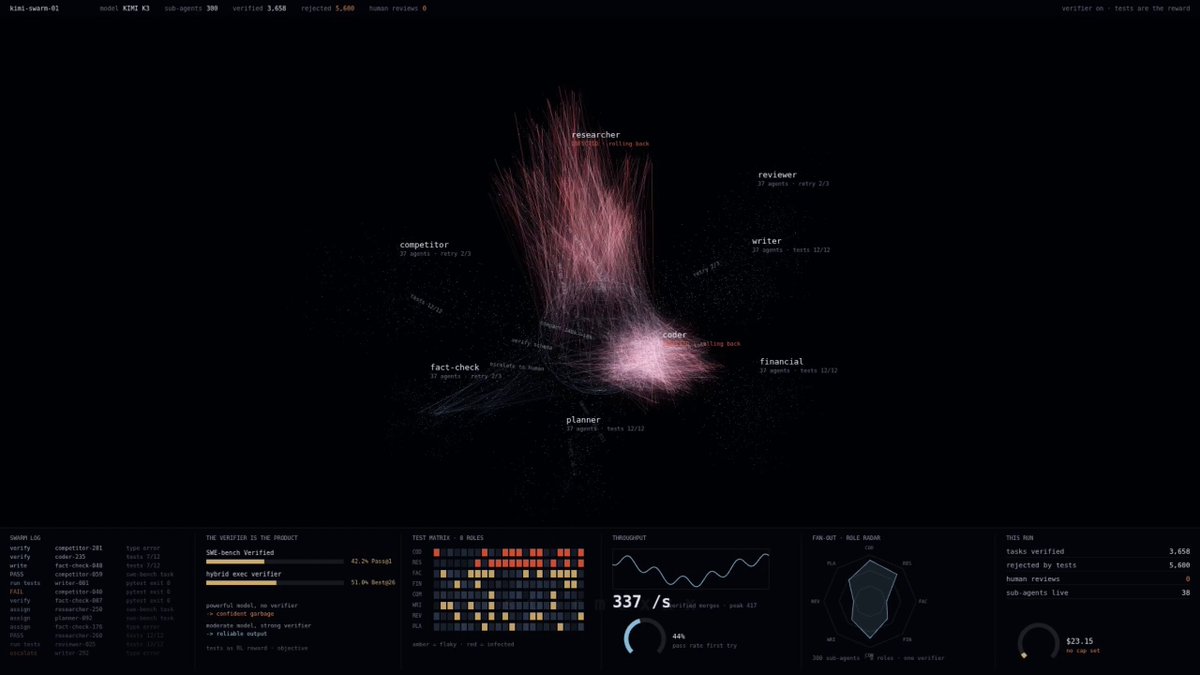
> be Kimi K3 > drop July 16 > 2.8 trillion parameters > the biggest open model ever released > 1 million token context. native multimodal. > Kimi Delta Attention — 6.3x faster decoding > priced at a third of Fable 5 > people rush in so fast the...

132,327 次观看 • 1 个月前 •via X (Twitter)

0 条评论

暂无评论

原始帖子的评论将显示在这里

相关视频

a moonshot engineer leaked the benchmark anthropic, openai and xai all buried the same week: kimi k3 beat opus 5, gpt-5.6 and grok 4.6 at $0.94 a task. stop paying anthropic $200 a month for opus 5 and openai $200 for gpt-5.6 when kimi does the same work for $8 the leak showed kimi k3 winning 9 of 12 categories against opus 5, gpt-5.6 and grok 4.6. within 48 hours all three labs quietly pushed pricing pages and one very specific comparison chart off their sites. nobody announced anything. they just deleted, which tells you everything the four numbers they scrubbed: cost per task · $0.94 vs $1.80 -> opus 5 charges $1.80 to finish one task. gpt-5.6 $1.04. grok 4.6 $0.61. kimi k3 $0.94 and it landed 487 of 500 clean -> anthropic is billing you double for a model that lost the benchmark it paid to promote the weights · free, sitting on huggingface right now -> the entire model is a public download. pull it, keep it, run it forever, nobody can switch it off -> a model you can hold cannot be rented at $200 a month. that single fact is what three labs deleted a chart over the switch · one line of bash -> moonshot ships an anthropic-compatible endpoint. one env variable and claude code points at kimi -> same cli, same keybindings, same /model. you change a url, opus 5 never knows it lost the seat the bill · $400 down to $8 -> opus 5 max plus gpt-5.6 pro is $400 a month. kimi runs the same daily work for $8 metered -> that is a 98% cut for output that beat both of them 9 categories to 3 here is the part they will fight me on: the frontier tax died the week this leaked and all three labs know it. once the weights are public the price has a ceiling, because anyone can serve the same model. anthropic, openai and xai are charging 2025 prices on a lead that ended in a benchmark they deleted instead of answered drop your $400/mo ai stack to $8. the run above is kimi k3 finishing the task opus 5 bills $1.80 for. the full breakdown is in the article below

starmex

32,547 次观看 • 25 天前

anthropic will sell you opus 5 at $200 a month. openai will sell you gpt-5.6 at $200 a month. neither will tell you stanford and berkeley published the 5 principles to build a $100k/mo ai company on kimi k3 for $10 stanford and berkeley spent years figuring out what actually separates ai systems that work in production from ai systems that die in demos. they published the findings. anthropic and openai priced their frontier subs like nobody would read the papers. the papers are free this is dspy plus verifiers plus decomposition plus skills plus mcp. five principles from stanford, berkeley and moonshot that turn a $10/mo kimi k3 sub into an ai analyst that runs unattended. the model is public. the system is the moat five moves that turn kimi k3 into the $100k/mo company: P1 don't prompt, program (stanford dspy) -> stanford proved hand-tuned prompts don't scale. define a pipeline as modules, let the optimizer tune them -> the compiled pipeline beat expert few-shot on multi-step tasks. one line of dspy replaces a month of prompt engineering P2 don't trust the model, build verifiers (berkeley 2026) -> a compiler either accepts or rejects. a test either passes or fails. that is a verifier -> berkeley: test-suite reward hit 42.2% pass@1 on swe-bench. hybrid verifiers hit 51.0% best@26. no bigger model, just a real check P3 don't scale agents, decompose them (stanford ai index 2026) -> stanford found multi-agent gains only 2-4 percentage points. two coding agents sometimes did worse than one -> the win is role decomposition, not count. researcher, writer, reviewer, verifier, clear input, clear output, no overlap P4 don't repeat expertise, encode it as skills (kimi code) -> every session starting from zero is institutional knowledge you lost. a skill.md file makes kimi activate the workflow automatically -> week one you write the skill. month six it encodes more institutional memory than most junior employees carry P5 don't keep ai in chat, connect it to tools (mcp) -> a model that only sees what you paste is a consultant working blindfolded. mcp connects kimi to your crm, db, github, linear, slack -> the model is public. the data is yours. the connections are your moat my position, and it is the arguable one: the next $100k/mo ai company will not win because it got early access to a frontier model. it will win because it followed 5 papers that anthropic and openai are quietly hoping you never read drop your $200/mo ai sub to $10. the swarm above is what 300 kimi k3 agents look like running those 5 principles. the full playbook is in the article below

starmex

31,358 次观看 • 29 天前

New open-source agent harness just landed! I got early access to TrueForge by TrueFoundry and have been running it locally for the past few days. The harness layer deserves as much attention as the model, and open source matters here because you can inspect the loop, run it on your own infrastructure, and swap to the latest or cheaper models. TrueForge handles the runtime work that makes an agent reliable. It drives the tool-calling loop, manages context, coordinates subagents, and executes code in a sandbox, with any model you choose. Every tool call re-sends the growing context to the model, so in practice the harness controls most of what an agent costs to run. A few things stood out from my testing and their published benchmarks. Vendor-Neutral by design. It runs OpenAI, Anthropic, and Google models alongside open-weight models like Kimi, GLM, and DeepSeek. Model routing is a setting, and you can send each task to the model that fits it. On a 14-task enterprise agent benchmark, it matched the accuracy of Claude Managed Agents running the same Opus 4.8 model at roughly 30% lower cost per run (3.8M tokens vs 10M for the same answers). Routing the same tasks to GLM-5.2 held accuracy and brought cost down by about 75%, around $3 per run instead of $12. Fully self-hosted and Open Source (MIT License). I had it running locally with one command, with sandboxed code execution working out of the box. It's time to own your agent harness. Thanks to TrueFoundry for partnering on this post.

elvis

11,303 次观看 • 27 天前

Kimi K3 + GPT-6 Astra can become something bigger than two agents: a Two-Brain AI Operating System the formula: Two-Brain OS = Research Brain + Execution Brain + Shared State + Router + Tools + Verification not two models doing the same job. two specialized brains connected through one persistent system step 1 -> Kimi K3 becomes the research brain. complex research, source comparison, long-context synthesis and strategic planning happen here. its job is to explore the problem and compress the findings into a clear plan. step 2 -> GPT-6 Astra becomes the execution brain. it receives the plan, writes code, operates tools, creates artifacts and turns decisions into finished work. step 3 -> build a shared state layer. store the objective, evidence, decisions, constraints, failed attempts and next action outside the chat. both brains always know what happened and where the system should continue. step 4 -> add the router. uncertainty and open-ended questions move to Kimi K3. execution, tool use and deterministic tasks move to GPT-6 Astra. every job reaches the brain designed to handle it. step 5 -> create the handoff loop: research -> plan -> execute -> inspect -> update state -> continue. if execution reveals missing information, the task returns to Kimi. if the plan is ready, Astra takes control again. step 6 -> verify before completion. tests, source checks, constraints and explicit success criteria decide whether the result ships or returns to the correct brain with a clear failure signal. that is the difference between using two AI models and building a Two-Brain AI Operating System. Kimi K3 expands the search space. GPT-6 Astra converts it into action. shared state preserves progress, the router controls every handoff, tools execute the work and verification decides when the system is actually finished. one model can generate an answer. two specialized brains connected through memory, routing and verification can run an entire workflow. the full Kimi K3 + GPT-6 Astra Two-Brain OS breakdown is below ↓

Alex

22,461 次观看 • 3 天前