正在加载视频...

视频加载失败

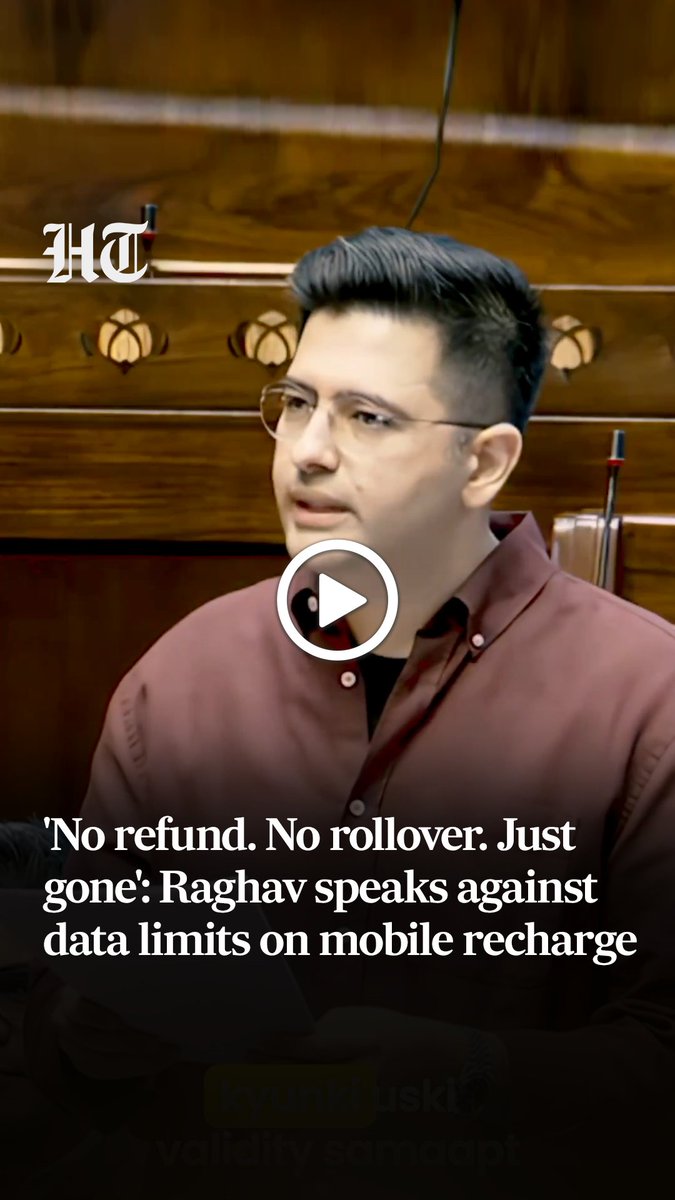
🚨 BIG DEMAND BY RAGHAV CHADHA 🚨 “Your unused mobile data shouldn’t expire at midnight!” 📱 AAP MP Raghav Chadha pushes for DATA ROLLOVER no more daily data waste 👀 Imagine this: No pressure to finish data before 12 AM No wasted GBs More value for your money 💰...

67,905 次观看 • 5 个月前 •via X (Twitter)

0 条评论

暂无评论

原始帖子的评论将显示在这里

相关视频

Telecom companies offer Recharge Plans with ‘𝐃𝐚𝐢𝐥𝐲 𝐃𝐚𝐭𝐚 𝐋𝐢𝐦𝐢𝐭𝐬’ like 1.5GB, 2GB or 3GB per day, resetting every 24 hours. Any Unused Data EXPIRES at midnight, despite being fully paid for. 𝐘𝐨𝐮 𝐚𝐫𝐞 𝐛𝐢𝐥𝐥𝐞𝐝 𝐟𝐨𝐫 𝟐𝐆𝐁. 𝐘𝐨𝐮 𝐮𝐬𝐞 𝟏.𝟓𝐆𝐁. 𝐓𝐡𝐞 𝐫𝐞𝐦𝐚𝐢𝐧𝐢𝐧𝐠 𝟎.𝟓𝐆𝐁 𝐝𝐢𝐬𝐚𝐩𝐩𝐞𝐚𝐫𝐬 𝐚𝐬 𝐝𝐚𝐲 𝐞𝐧𝐝𝐬. No refund. No rollover. Just gone. This is not an accident. This is policy. Use it unnecessarily, or lose it by midnight. That’s how mobile data works today. I raised this issue in Parliament - 𝐖𝐡𝐲 𝐬𝐡𝐨𝐮𝐥𝐝 𝐝𝐚𝐭𝐚 𝐭𝐡𝐚𝐭 𝐰𝐞 𝐡𝐚𝐯𝐞 𝐩𝐚𝐢𝐝 𝐟𝐨𝐫 𝐛𝐞 𝐅𝐎𝐑𝐅𝐄𝐈𝐓𝐄𝐃? UNUSED DATA should carry forward into the next cycle, so consumers can use what they have already paid for. My demands are clear: 𝟏. 𝐀𝐥𝐥𝐨𝐰 𝐃𝐚𝐭𝐚 𝐜𝐚𝐫𝐫𝐲-𝐟𝐨𝐫𝐰𝐚𝐫𝐝/ 𝐃𝐚𝐭𝐚 𝐫𝐨𝐥𝐥𝐨𝐯𝐞𝐫 𝐟𝐨𝐫 𝐚𝐥𝐥 𝐮𝐬𝐞𝐫𝐬 All telecom operators should provide Rollover of Unused Data. What remains unused at the end of the day, should be added to the next day’s Daily Data Limit, not erased the moment validity ends. 𝟐. 𝐆𝐢𝐯𝐞 𝐨𝐩𝐭𝐢𝐨𝐧 𝐨𝐟 𝐀𝐝𝐣𝐮𝐬𝐭𝐦𝐞𝐧𝐭 𝐨𝐟 𝐔𝐧𝐮𝐬𝐞𝐝 𝐃𝐚𝐭𝐚 𝐚𝐠𝐚𝐢𝐧𝐬𝐭 𝐧𝐞𝐱𝐭 𝐦𝐨𝐧𝐭𝐡’𝐬 𝐑𝐞𝐜𝐡𝐚𝐫𝐠𝐞 𝐀𝐦𝐨𝐮𝐧𝐭𝐬 If a consumer consistently under-utilises their data over multiple cycles, there should be a mechanism for Adjustment or Discount of that value, from the following month’s Recharge Amount. Consumers should not repeatedly pay for capacity they do not use. 𝟑. 𝐀𝐥𝐥𝐨𝐰 𝐓𝐫𝐚𝐧𝐬𝐟𝐞𝐫 𝐨𝐟 𝐔𝐧𝐮𝐬𝐞𝐝 𝐃𝐚𝐭𝐚 𝐭𝐨 𝐫𝐞𝐥𝐚𝐭𝐢𝐯𝐞𝐬 & 𝐟𝐫𝐢𝐞𝐧𝐝𝐬 Unused data should be treated as the consumer’s digital property. Users should be allowed to transfer their unused data to others, from their Daily Data Limit, just as transfer money to others. As we build a Digital India, access cannot depend on data that disappears. If you’ve paid for it, it should carry forward and remain yours to use.

Raghav Chadha

426,354 次观看 • 5 个月前

Major program launch: Data Analytics Professional Certificate! This large, five-course sequence takes you all the way to being job-ready as a data analyst, and shows how to use Generative AI as a thought partner to enhance your work in this role. Offered by on Coursera, this is taught by Sean Barnes, Ph.D., a Data Science & Engineering Leader at Netflix. Analyzing data remains one of the most important skills in where the world is going with AI. This comprehensive certificate takes you all the way to being job-ready. Each course comes with practical projects demonstrated in real-world contexts, such as analyzing sales data for a Korean bakery, video game sales trends across different regions, or identifying factors impacting customer retention for a communications company. You'll also work on estimating fire distribution for forest fire prevention, analyzing how a diamond's properties affect its market value, and developing predictive models for retail sales analysis, carbon emissions, and coral reef conservation. Here's some of what you'll learn: - How to define data and categorize it into its many types such as discrete & continuous numerical, structured & unstructured, time series, categorical, and know what insights can be derived from the different types of data categories. - How to differentiate between data-related job roles and their responsibilities, and how data flows through an organization from the moment of capture to decision-making. - How to perform data processing functions and apply conditional formatting in spreadsheets to extract business value from your data using statistical calculations and best practices for visualizing and interpreting data. - How to use LLMs for stakeholder analysis, data exploration, and data visualization. - Best practices for using LLMs for as a thought partner to data analysis work By the end of this professional certificate program, you will have learned core statistical concepts, analysis techniques, and visualization methodologies that will serve as the foundation for working as a data analyst. The world needs more data analysts, especially ones who know how to use modern generative AI. With data science roles projected to grow 36% by 2033, the skills taught in this program create new professional opportunities in data. Sign up here!

Andrew Ng

85,012 次观看 • 1 年前

Your agents can't keep up with real-time data. Especially when it's scattered across dozens of sources. Most teams waste weeks building custom connectors for every database, API, and data warehouse. Then they build ETL pipelines to sync everything. By the time your agent retrieves the data, it's already outdated. Picture this: Your Postgres database updated 5 minutes ago. Your MongoDB collection changed 2 minutes ago. Your agent is still pulling from yesterday's snapshot. This is why most production RAG systems fail. There's a better approach: MindsDB is an open-source AI platform with a federated data engine that lets you query multiple data sources in real-time using SQL - without moving any data. Here's what makes it different: ↳ Your data stays in place. No ETL pipelines or data duplication ↳ Query Postgres, MongoDB, REST APIs, and more using consistent SQL ↳ JOIN across different sources in real-time with a unified interface ↳ Works with both structured and un-structured data And here's the best part: You don't even need to write SQL. Just describe what you want in plain English, and MindsDB converts it to SQL automatically. The system does all the heavy lifting. The breakthrough for AI agents is simple: When data updates at the source, your agent gets fresh results immediately. No sync delays. No stale embeddings. No custom code for each integration. You can literally write a SQL query that joins a Postgres table with a MongoDB collection and gets live results. This is what production AI applications need but rarely get. In this video, I give you a complete walkthrough of what we just discussed and how to actually do it. Make sure you watch this till the end. I've shared the link to MindsDB's GitHub repo in the next tweet!

Akshay 🚀

65,672 次观看 • 9 个月前

Programmable Bandwidth is crypto’s next meta. Gm rent your spare Wi-Fi to AI. AI needs more data. AGI is coming. Are you ready? Bandwidth = how much data your connection moves per second. Residential IP = your home’s street address on the internet, trusted as human traffic that doesn’t get blocked. Together, Bandwidth + Residential IP = clean, high-trust traffic that data buyers and AI teams actually want. The community becomes the network. LLMs eat data. The more and the higher quality, the smarter they get. Owning the data pipeline = owning the power. Proof it’s valuable: big platforms license conversational & user-generated data for serious money. Many 8-figure+ deals are public, many more done under the table. Proprietary datasets are the real edge in this AI world. Why residential IPs matter: datacenter IPs get blocked by anti-scraping shields. Residential IP networks are resilient. Grass showed the playbook: idle bandwidth can pay twice 1️⃣ Web data collection via your node 2️⃣ Renting those nodes to GPU grids for training Data + compute = compounding revenue. Hub ( takes it further: aggregate community bandwidth → build a Residential IP Supernetwork → sell real-time data APIs to enterprises (from Meta to Web2 startups). The value loop: Community miners → Bandwidth pool → Enterprise feeds → Revenue → Rewards. If revenue outpaces incentives, everyone wins. Balancing it won’t be easy, time will tell. For miners: run on the network, earn points (likely $HUB at mainnet). Early participation can matter. Why DePIN? Community-run networks scale faster, are harder to censor, and more resilient than centralized systems. We are long programmable bandwidth thesis. In an agent-driven world, whoever controls the live data feed mints the money. DYOR. Register NOW

Q42

39,768 次观看 • 11 个月前