Video wird geladen...

Video konnte nicht geladen werden

Zur Startseite

BIG | 🇱🇻🇪🇺🇷🇺‼️‼️ Latvia is preparing for a difficult autumn and winter as President Edgars Rinkēvičs warns that further Russian escalation is “very likely,” with the Baltic state already seeing growing risks from sabotage, espionage, cyberattacks and other hybrid activity. Rinkēvičs says the most immediate risks surround Latvia’s October...

63,573 Aufrufe • vor 14 Tagen •via X (Twitter)

9 Kommentare

Profilbild von Mark Sol
Mark Solvor 14 Tagen

Are we talking about Russia that stuck in Ukraine with little to no progress and drone strikes in Moscow? And the same time that Russia will start a war with NATO, right?

Profilbild von George Logan
George Loganvor 14 Tagen

Propaganda, Russia can't even take Ukraine. You scum can't fool anyone. #ElonMusk

Profilbild von Deuno100
Deuno100vor 14 Tagen

The ruzzian aggression on eastern NATO side is one goal directed: -Foster fascist parties like ADF, Le Pen or VOX to grow as 'the solution' to get 'peace' from Kremlin -Foster fascists to leave NATO or help to Ukrania -Foster false narrative: we submit Kremlin, we get cheap gas

Profilbild von A.G.
A.G.vor 14 Tagen

😂

Profilbild von Stephen
Stephenvor 14 Tagen

Elections in Europe…

Profilbild von MICHAEL WARDER
MICHAEL WARDERvor 14 Tagen

Latvia has an ethnic Russian population of about 22%. No doubt Putin is attempting to infiltrate.

Profilbild von △rūnas Ratkus 🇱🇹
△rūnas Ratkus 🇱🇹vor 14 Tagen

Stop escalating bullshit.

Profilbild von MilitarUa
MilitarUavor 14 Tagen

From minimal interference to full Article 5 response, NATO's 4,000 pages of defense plans demonstrate complete readiness to safeguard the eastern flank against any threat.

Profilbild von Aerys 🏴󠁧󠁢󠁥󠁮󠁧󠁿🇬🇷🇫🇮🇮🇹🇺🇦🇪🇺🏳️‍🌈
Aerys 🏴󠁧󠁢󠁥󠁮󠁧󠁿🇬🇷🇫🇮🇮🇹🇺🇦🇪🇺🏳️‍🌈vor 14 Tagen

@RMouroudelis What’s our “ally” the US doing about this Russian threat??

Ähnliche Videos

🇱🇻🇷🇺🇧🇾⚡️ Latvia is taking another major step toward severing its remaining economic ties with Russia and Belarus, imposing a broad new import ban from September 1. The Latvian government approved restrictions covering a wide range of Russian and Belarusian goods, including books, newspapers and other printed materials, clothing and finished textile products, footwear, headwear, toys, games and sports equipment. Crucially, the ban will also apply when goods originating in Russia or Belarus enter Latvia through third countries, closing a potential route for circumventing the restrictions. Food and beverages are not included in this particular blacklist. Riga says the measures have three objectives: protecting Latvia’s national-security interests, further reducing export revenues flowing to Russia and Belarus, and restricting the entry of Russian propaganda materials into the country. Latvia has already dramatically reduced its dependence on trade with the two states: the value of imports fell by 91% between 2022 and 2025, from €2.129 billion to €193 million. The direction of Latvian policy is becoming rather difficult for Moscow to misread, though humans have achieved greater feats of selective comprehension. Riga is moving beyond individual sanctions toward systematically dismantling its remaining commercial links with Russia and Belarus. The September restrictions therefore represent another part of Latvia’s broader strategy of applying sustained economic and informational pressure while Russia’s war against Ukraine continues. See the latest updates with us: Visioner

Visioner

25,503 Aufrufe • vor 1 Monat

🇱🇹🇱🇻🇪🇪 Baltic leaders alongside Poland and Finland have sent an urgent appeal to European Commission President Ursula von der Leyen, sounding the alarm over mounting Russian threats and escalating hybrid activity along NATO’s eastern frontier, according to Delfi. 🔺 The joint letter highlights a deteriorating regional security landscape, pointing to increasingly frequent airspace violations and the persistent appearance of Russian unmanned aerial vehicles near allied borders. 🟥 In parallel, CIA Director John Ratcliffe delivered classified U.S. "red lines" directly to the Kremlin during an unannounced trip to Moscow amid growing fears of wider European conflict, according to BILD. 📍 The German outlet reports that Washington’s message was delivered with blunt clarity: "We know what you are planning. Do not do it." 📍 Discussions reportedly centered on potential Russian provocations aimed at NATO, expanding drone incidents across Europe, and heightened risks surrounding the Baltic region. 📍 Dispatching the CIA chief in person underscores that Washington viewed the moment not as routine diplomatic engagement, but as an urgent intelligence-level intervention to draw explicit boundaries and deter miscalculation. The coordinated diplomatic push from eastern EU states paired with rare, direct intelligence warnings to Moscow reveals acute transatlantic anxiety that Russia may attempt to test NATO’s cohesion through localized, sub-threshold military or hybrid operations

NSTRIKE

14,231 Aufrufe • vor 1 Monat

❗️🇷🇺Russia’s rhetoric about striking the Baltic states is intensifying: ➡️🇱🇻🇺🇦 Today, the Kremlin threatened Latvia with an attack, claiming that “Ukrainian special forces are in Latvia and will launch strikes against Russia from there.” 🟥 Key alarming statements from the Russian Federation: ▪️ “The Ukrainian authorities have convinced Riga to allow operations against Russia.” ▪️ “Military personnel from Ukraine’s unmanned systems forces and drone operators have already been sent to Latvia. They are deployed at Latvian military bases: Ādaži, Sēlija, Liepāja, Daugavpils, and Jēkabpils.” ▪️ “Ukraine does not plan to limit itself only to using the air corridors that the Baltic states have provided to the Ukrainian Armed Forces. Drone launches are planned directly from the territory of these states.” ▪️ “The coordinates of Latvia’s decision-making centers are known, and the country’s NATO membership will not protect the accomplices of terrorists from justified retaliation,” — according to a statement by the Russian Foreign Intelligence Service (SVR). 🔷 The Russians also claimed that Latvia, together with Ukraine, is coordinating drone strikes on Russian territory — although there is no evidence to support this. 🔷 All of the above is fabricated evidence from Russia’s SVR. It is difficult for adequate politicians and ordinary people to understand the logic, but for the Russians, it serves as a pretext — criminal and false, but still a pretext. Exactly like the thousands of other “pretexts” the bunker resident used to justify the attack on Ukraine. ❗️❗️❗️ P.S. In Russian military propaganda circles, they believe that an invasion by the Russian Armed Forces into the border regions of Estonia and Latvia and conducting combat operations there would be 10 times easier to achieve field goals than fighting the Ukrainian army for Avdiivka, Pokrovsk, or Bakhmut… However, they only talk about the “simplicity” of these battles in the scenario where Western European countries retreat under Moscow’s nuclear blackmail and do not engage their combat aviation or naval forces. 📢 Russian military propagandists deeply believe that they will suffer an inevitable defeat in the current situation on the front with the Ukrainian army (because Ukrainian drone technology and combat innovations, combined with catastrophic monthly losses in manpower and equipment, are destroying their combat ambitions and chances of success). Therefore, they see turning the situation around by attacking NATO’s eastern flank, seizing certain territories in the Baltics, and hoping that Article 5 of collective defense will not be activated, as a way for Putin and his armed forces to restore their damaged image of strength in the eyes of their own population.

NSTRIKE

35,355 Aufrufe • vor 4 Monaten

🇺🇸🇪🇺The Pentagon is preparing several options for reshaping or reducing the U.S. military presence in Europe, adding another layer of uncertainty for NATO at a moment when concern over Russia’s intentions toward the Alliance’s eastern flank is growing. According to Reuters, the Pentagon’s NATO review will provide Defense Secretary Pete Hegseth with at least four options by November 6 for potentially reducing or restructuring U.S. deployments across Europe. Allies will reportedly be assessed according to their defense spending, contributions to NATO forces, access provided for U.S. military operations, and support for broader American defense and foreign-policy priorities. Washington has already begun altering its European posture, including withdrawing troops from Germany and cancelling the planned rotation of roughly 4,000 U.S.-based troops to Poland. The timing is particularly sensitive for NATO. European governments fear Washington may already be moving toward a smaller military footprint just as Russia is rebuilding its forces and Western intelligence is increasingly focused on potential Russian pressure against NATO’s eastern members. Trump’s frustration with allies over defense spending and their refusal to support aspects of the U.S. war with Iran has further intensified those concerns. Any substantial American drawdown would therefore accelerate pressure on Europe to assume responsibility for capabilities long underwritten by the United States, while forcing NATO to ensure that Moscow does not interpret a changing U.S. posture as an opportunity to test the Alliance. See the latest updates with us: Visioner

Visioner

37,031 Aufrufe • vor 1 Monat

🇷🇺🇪🇺‼️ NATO has reportedly developed a detailed battle plan for stopping a potential Russian invasion of the Baltic states, built around overwhelming long-range firepower, autonomous systems and systematic destruction of Russia’s ability to sustain an offensive. According to BILD, the objective would not be to occupy Russian territory, but to halt Moscow’s advance and weaken its forces as severely as possible. The opening phase would focus on suppressing Russian missile and drone attacks with NATO aircraft, missiles and unmanned systems, while simultaneously striking military infrastructure in Kaliningrad. NATO would then establish an “autonomous zone” along the borders with Russia and Belarus, where Russian advances would be stopped largely by aerial and ground robotic systems rather than a permanent physical presence of allied troops. Subsequent operations would expand against the infrastructure supporting Russia’s war effort, including military bases, airfields, bridges, railways and defense-industrial facilities. The plan reflects how dramatically NATO’s doctrine has evolved since Russia’s invasion of Ukraine. The alliance is preparing not simply to defend every kilometer of territory with soldiers, but to destroy the logistics, infrastructure and combat systems required for Russia to sustain an invasion. With NATO already implementing its largest eastern-flank defense plans since the Cold War and maintaining substantially more forces at high readiness, Moscow would face a fundamentally different military environment from the one it encountered in Ukraine. See the latest updates with us: Visioner

Visioner

54,690 Aufrufe • vor 1 Monat

‼️‼️🇷🇺🇩🇪🇪🇪 BREAKING - A well-known German military analyst is predicting a possible Russian attack on Estonia by 2028 — Carlo Masala outlines how Russian aggression could escalate into a collapse of NATO. 📌 As global tensions continue to rise, Russia is steadily increasing the level of pressure and hostility toward its neighbors. 📌 In this context, German experts have expressed concern about Moscow’s plans, particularly regarding NATO’s collective defense obligations in Europe. German military analyst Carlo Masala noted that the Kremlin may attempt to exploit divisions within the Alliance to test NATO’s resolve. 📌 Masala suggests that Russia could launch an incursion into Estonia by 2028, using potential disagreements among NATO member states over the activation of Article 5. This article stipulates that “an attack on one NATO member state is considered an attack on all.” 📌 “The Russians are becoming increasingly brazen in the ways they test NATO’s deterrence measures and the ability of specific countries to respond,” Masala told Newsweek. “Their goal is to deepen fractures between European nations and NATO itself — we have already seen such provocations for two years now, but in recent months, Russia has clearly intensified its game. Nineteen drones entered Polish territory, and three fighter jets flew into Estonian airspace. They are taking far greater risks with their provocations.” 📌 The German expert argues that some countries may hesitate to engage in direct confrontation with Russia. Such hesitation, he warns, could embolden Putin to act aggressively without fearing consequences. Masala’s assessment corresponds with recent provocations, including the appearance of Russian troops near Estonia’s border and incursions into Estonian airspace — incidents that have heightened tensions and tested NATO’s unity. 📌 “If you believe in deterrence and in the idea that violations will be punished, you don’t send three fighter jets into Estonian airspace for twelve minutes just to test the reaction. You could do this with one aircraft — but not three,” he said. 📌 “In my view, this was a Russian PR stunt. If Moscow genuinely intended to create a real threat to Estonia, it wouldn’t parade seven soldiers carelessly through the streets like exposed targets. That is not preparation for an operation. It was a demonstration meant to convey: ‘We can do these things without fear of consequences.’” Masala concluded. See the latest updates with us: Visioner

Visioner

373,475 Aufrufe • vor 10 Monaten

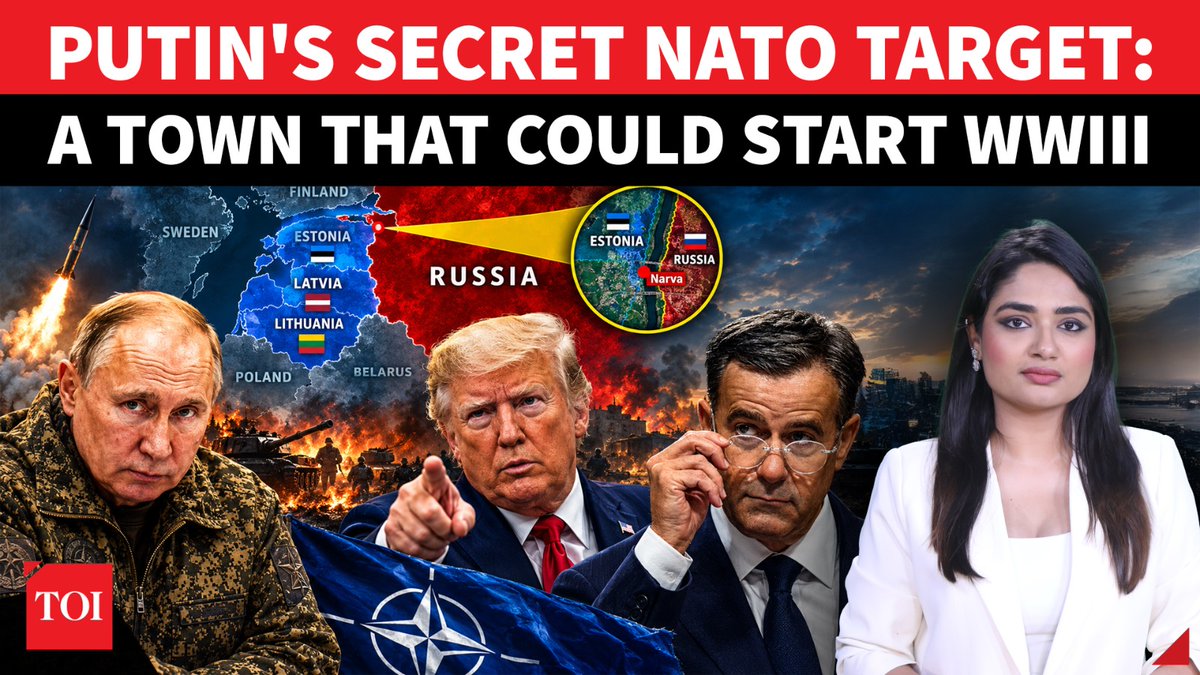
🚨🇩🇪🇪🇪🇱🇻🇱🇹 Bild has outlined several possible scenarios for a future Russian attack against NATO’s Baltic flank, ranging from covert sabotage and deniable hybrid operations to a direct attempt to sever the Baltic states from the rest of the Alliance. According to Bild, one scenario involves underwater attacks against critical seabed infrastructure such as data cables, power links, pipelines and maritime industrial facilities, where attribution could initially remain unclear. Another is the so-called “Narva trap,” in which armed groups suddenly appear inside Estonia while Moscow denies involvement. Other scenarios include a Russian attempt to seize or neutralize Gotland to threaten NATO movement across the Baltic Sea, provoking a crisis around Norway’s Svalbard archipelago under the pretext of protecting Russian citizens, and the most dangerous option: Russian forces advancing from Belarus toward Kaliningrad through the Suwałki corridor, potentially cutting Estonia, Latvia and Lithuania off by land before major NATO reinforcements can arrive. The common logic behind these scenarios is speed, ambiguity and pressure on NATO decision-making. Moscow would gain the greatest advantage by creating a crisis faster than the Alliance can politically and militarily respond, which is why reinforcement routes, undersea infrastructure protection and forward defense around the Suwałki corridor remain among NATO’s most strategically sensitive priorities. See the latest updates with us: NSTRIKE

NSTRIKE

19,406 Aufrufe • vor 1 Monat