Video wird geladen...

Video konnte nicht geladen werden

Zur Startseite

🚀 Big news at Zep! We're introducing Entity Types, a smarter, structured memory solution for AI agents! 🧠✨ With Entity Types, developers can now precisely structure and recall domain-specific information, significantly enhancing the accuracy, personalization, and context-awareness of AI interactions. 🌐 🔹 Default Entity Types provide ready-to-use structures like...

14,455 Aufrufe • vor 1 Jahr •via X (Twitter)

6 Kommentare

Profilbild von Zep AI
Zep AIvor 1 Jahr

➡️ Learn more:

Profilbild von NICE
NICEvor 1 Jahr

Gartner® report reveals how the power of AI agents can redefine your customer service.

Profilbild von Akshay 🚀
Akshay 🚀vor 1 Jahr

This looks like a major breakthrough! 🔥 Can't wait to test it!!

Profilbild von Zep AI
Zep AIvor 1 Jahr

Thanks, @akshay_pachaar !

Profilbild von Gabriel Rymberg
Gabriel Rymbergvor 1 Jahr

@threadreaderapp unroll

Profilbild von Attila-IBS
Attila-IBSvor 1 Jahr

How about using entity types? Would have real advantages.

Ähnliche Videos

New short course: Long-Term Agentic Memory with LangGraph. Learn to build an agent with long-term memory in this course developed in collaboration with taught by its Co-Founder and CEO, Harrison Chase! Personal assistance and productivity tasks have become important use cases for agents. An important feature of an AI assistant, such as a coding or calendar assistant, is its ability to keep improving over time from its experience. Agent memory is the key capability that enables this. To add memory to an agent, you must first figure out what to store and what to retrieve when it is time to use the information. Additionally, you’ll have to decide when to update the stored information. For example, you might update in each iteration loop of the agent or perform updates in the background, with a helper agent. In this course, you will learn a mental framework to build agents with long-term memory. You'll create a useful email assistant that can respond, ignore, and notify using writing, scheduling, and memory-management tools. You’ll develop your agent's memory by adding facts to its memory store, provide examples to learn the user's preferences, and optimize system prompts to evolve instructions based on previous responses. In detail, you’ll: - Learn how the three types of memory--semantic, episodic, and procedural–and the two update mechanisms–via hot path and in the background–apply to your agents. - Build an email agent with writing, scheduling, and availability tools, along with a router that triages incoming email and handles it accordingly by ignoring, responding, or notifying the user. - Add tools to your email agent that allow it to operate on semantic memory by learning facts about the user, storing them in a long-term memory store, and searching over them in future interactions. - Incorporate episodic memory, in the form of few-shot examples, in the triage step of your agents to help them learn and update user preferences. - Add procedural memory as system prompts, optimized with feedback to improve the instructions the agent follows. Learn how to approach memory in agents, and start building agents with long-term memory with LangGraph! Please sign up here:

Andrew Ng

131,779 Aufrufe • vor 1 Jahr

Build and customize complex AI applications with a flexible framework in this new short course, Building AI Applications with Haystack. Created in collaboration with deepset, makers of Haystack, and taught by Tuana, who is the developer relations lead for Haystack at deepset. Generative AI technology is changing rapidly and it can be challenging to integrate APIs from different LLMs, vector databases, and various tools such as web search. In this course, you will learn how to use the Haystack framework to make your development process more modular, allowing you to manage complexity and focus more on building your application. In detail, you’ll: - Build a RAG pipeline using Haystack’s main building blocks – components, pipelines, and document stores. - Create custom components in your pipeline by building a Hacker News summarizer that extends your app’s ability to access APIs. - Use conditional routing to create a branching pipeline with a fallback to web search mechanism when the LLM does not have the necessary context to respond to the user's query. - Build a self-reflecting agent for named entity recognition that loops using an output validator custom component. - Create a chat agent using OpenAI's function-calling capabilities which allow you to provide Haystack pipelines as tools to the LLM, enhancing that agent's capabilities. By the end of this course, you will learn a high-level orchestration framework that can help make your applications flexible, extendible, and maintainable, even as the technology stack changes, new user needs arise, and you add new features to your application. Please sign up here:

Andrew Ng

53,788 Aufrufe • vor 1 Jahr

What does the reputation model look like for agents? (alpha leak below) And how do we associate the proofs that we have about human beings with the agents who represent them? You may have heard of a process called KYC or Know Your Customer. That's very common with traditional financial applications and services. We have introduced a concept that we call KYA or Know Your Agent, which is a structured way to be able to express what model, how data was used in training, who the deployer is, what entities this agent instance is accountable back to, providing not only provenance but identity of the associated organization or entity. That's also another root of trust that we think about a lot: Enterprises and organizations tied back to things like their domains. To share a little bit of an alpha leak here, a product that we're excited to be rolling out in the next few weeks will allow our enterprise partners to more easily verify and prove the traits and capabilities of their teams as well as their counterparties. On the agent front, that makes it really easy to prove that an agent is acting on behalf of a given business or entity. We've already seen lawsuits where the absence of such technology has been a huge risk, such as with airlines that incorporate ChatGPT wrappers in their support pages. And then those AI enabled interactions end up making up plane tickets that don't exist and those airlines have to honor them. As small of an example as that might be, being able to prove agent accountability also unlocks a huge set of opportunities for use in enterprise for those agent to agent interactions. The Deep Trust Framework that our team has put together that we're excited to be bringing into a friendly SDK form in the next few weeks for some of our partners includes those reputation based capabilities, so how you can basically keep track of the interactions an agent has had, associate all of that to the entity to which they're accountable, and then that creates a sustainable reputation model for these agent to agent Interactions. Source: Billions CEO Evin McMullen evin speaking at House of Chimera Spaces Event Dec 3, 2025

Billions Network

68,484 Aufrufe • vor 7 Monaten

Multi-agent systems offer incredible potential and unprecedented risks. How do you solve for observability, failure mode analysis, and guardrailing in the era of agents? Today, we’re announcing our Agent Reliability platform to observe, evaluate, guardrail, and improve agents at scale. You can get started with the complete platform for trustworthy agentic AI today for free, and here’s how we’re solving some of the biggest challenges in agent reliability: - Observability redesigned for agents Trace views collapse under complex workflows, so we created the Graph View, Timeline View, and Conversation View to offer rich, intuitive visualizations of agent decisions, tool calls, and conversation flows. This multi-dimensional approach enables teams to pinpoint exactly where and why agents deviate or fail. - Automated Failure Mode Analysis with our new Insights Engine Our Insights Engine ingests your logs, metrics, and agent code to automatically surface nuanced failure modes and their root causes. But knowing the problem is not enough; you need to know how to fix it. Insights Engine delivers actionable fixes and can even apply them automatically. With adaptive learning, your insights become smarter and more relevant as your agents evolve. - Evaluating Agents Across Multiple Dimensions Agentic systems interact across complex pathways, and evaluating their performance requires new metrics that reflect this increasing complexity. To deliver comprehensive agentic measurements, we’ve added more out-of-the-box agent metrics like flow adherence, agent flow, agent efficiency, and more. For specialized domains and unique workflows, custom metrics powered by our new Luna-2 small language models can be rapidly designed and fine-tuned for your specific use case. - Real-Time Guardrails Powered by Luna-2 As AI agents become more autonomous and complex, failures like hallucinations or unsafe actions increase dramatically. Without real-time guardrails, these errors will hurt your user experience and brand reputation. Our Luna-2 family of small language models is purpose-built to provide low-latency, cost-effective guardrails that actively stop agent errors before they happen. With support for out-of-the-box and custom metrics, Luna-2 enables enterprises to enforce safety, compliance, and reliability at scale. Enterprises running hundreds of agents and processing hundreds of millions of queries daily already rely on Galileo’s Agent Reliability platform to protect their users, safeguard brand trust, and accelerate innovation. Agent Reliability is available starting today. Try it for free and experience the new standard in AI reliability. Learn more below 👇

Galileo

1,276,298 Aufrufe • vor 1 Jahr

NEW: Introducing Octane AI Agentic Commerce Quizzes - Increase sales with AI. What is it? A sales quiz AI agent that makes 1-1 personalized sales experiences for every single customer. In real time. Powered by our new AI model CORE-1. Examples: 📸 Want to ask your customer to take a selfie and your AI agent automatically recommends them a full outfit from your catalog? Octane AI agents can do that. 🪞 Want to have an AI agent hand pick out each product for a personalized skin care routine? Want them to upload a selfie to detect their skin tone? Octane AI agents can do can that. 📊 Want to create an incredibly detailed report with graphs and tables and graphics thats generated by AI for each customer? Octane AI agents can do that. We give you the building blocks and you can build anything. And you can build it fast because our AI will do the heavy lifting for you. This is v1 and a representation of where our commerce and quiz technology is headed. Available today to everyone at 🆕 What we are launching today: • Smart Quiz Builder: Have an AI agent plan out and build your Octane AI quiz for you. It can even write custom HTML for beautiful results pages and progress bars. • Smart Products: It can take forever to setup the recommendation logic for a quiz. For those of you who need help, simply add smart products to your Octane AI quiz and your very own AI agent will hand-pick products for each customer who takes your quiz. It’s amazing. • Smart Copy: Instead of showing everyone who takes your quiz the exact same copy, use AI to personalize the quiz for every single person who takes it. Explain why these specific products are perfect for specifically them. • Image Analyzer: Let your customers upload or take a photo during the quiz and have AI analyze it. You can use this for anything from skin tone detection to picking out outfits! • Shopping Assistant: An AI agent that lives on your store that can help your customers at the right time. We have been building quiz software for almost 10 years now and AI is enabling us to make quizzes even more powerful. This is just the v1 of what we will be releasing in this area. We are so excited to see what you create with these new agentic products. Get creative, we think you will be surprised at how many interesting experiences you can create with Octane AI now.

Matt Schlicht

290,828 Aufrufe • vor 8 Monaten

Today we’re launching the first and only human-like AI agents in the world. Super Agents™ are the first agents with human‑level skills – they DM you, take @ mentions, send emails, manage docs, tasks, and more. Not just tools or API calls, but real skills fine‑tuned for how teams actually work. The first agents with 100% context – fully native in ClickUp and fully synced from other apps. Super Agents see your work the same way that humans do: tasks, docs, schedules, and conversations all in one place. The first agents that learn from human interactions automatically, without any setup or configuration – when you give feedback, they listen and improve how they work. The first agents with human‑level memory for custom agents – historical memory for every interaction, short-term working memory, and even long‑term memory stored in docs you can literally open, inspect, and edit. The first agents that are literally the same as users – our agentic user model is the same as our user data model. This gives you permissions and capabilities that you and your systems are already familiar with. The first infinite agent catalog – where anyone can create and customize agents in minutes, for literally any type of work imaginable. It's the most intuitive way to build agents on the planet. 95% of companies are failing in AI adoption. The reality is that AI isn't meant to be adopted, it's meant to be adapted – to you. Super Agents are automatically personalized to you and your company using proprietary state-of-the-art agent architecture, orchestration, and tooling. Today is the largest step forward we've ever made towards our mission of making people more productive. Maximize human productivity, with ClickUp Super Agents. Available NOW. For everyone.

Zeb Evans

320,607 Aufrufe • vor 7 Monaten

"The future of AI is agentic. That includes browsers!" Imagine having an AI agent in your browser that can help you complete complex tasks, answer your questions, and streamline your workflow. Today I'm thrilled to share a sneak peek at Project Mariner, a cutting-edge research collaboration between Chrome and Google DeepMind, exploring the future of agentic AI within the browser! Building on the power of Gemini 2.0, Mariner envisions AI agents seamlessly guiding users through online tasks, streamlining workflows and enriching browsing experiences. Imagine having an intelligent co-pilot in your browser, anticipating your needs and proactively offering assistance. We're in the early stages of experimentation, focusing on core functionalities like understanding user intent, automating actions, and providing personalized recommendations. This prototype leverages Gemini's advanced natural language understanding and reasoning capabilities to interpret user requests, both typed and spoken. Mariner can then interact with web pages, retrieve information, and even perform actions like filling out forms or navigating to specific sites. For example, a user could simply ask "Find me a job near me," and Mariner would understand the request, navigate to a relevant job search site, and tailor the search based on the user's location and preferences. This is just one example of how we're exploring Gemini 2.0's potential to unlock agentic experiences through a series of prototypes, including: 1. Agents with multimodal reasoning: Project Astra, our research prototype exploring the capabilities of a universal AI assistant, is enhanced by Gemini 2.0. 2. Agents that can help you accomplish complex tasks: Project Mariner itself focuses on the future of human-agent interaction within the browser. 3. Agents for developers: Jules is an experimental AI-powered coding agent that integrates directly into a GitHub workflow. 4. Agents applied across domains: We're exploring agents for navigating video games and even applying Gemini 2.0's spatial reasoning to robotics. We believe that integrating AI agents directly into the browser has the potential to revolutionize how we interact with the web. Project Mariner aims to make browsing more intuitive, efficient, and personalized. By understanding user context and proactively offering assistance, Mariner can simplify complex tasks, save users time, and empower them to achieve more online. This aligns perfectly with the vision of Gemini 2.0 to create more helpful and intuitive AI experiences. We’re currently testing Mariner with a small group of trusted users to gather feedback and refine the user experience. We believe that this technology holds immense potential to transform the way we browse and interact with information online.

Addy Osmani

29,501 Aufrufe • vor 1 Jahr

🚀Exciting News: The Lit Agent Wallet is Now an elizaOS Plugin! 🚀 We’re thrilled to share that the Lit Agent Wallet—a decentralized system that empowers agents with a private key stored securely across an MPC + TEE network (Lit)—is now available as a plugin for ElizaOS!🎉 This integration brings unparalleled flexibility and security to your decentralized workflows. Whether you're an EOA, a smart account, or a DAO, you can now set tools and policies on-chain that your agents can use, all while ensuring your private keys remain secure and decentralized. 🔒 What Does This Mean for You? >Enhanced Security: Private keys are fragmented and stored across the Lit network, leveraging MPC (Multi-Party Computation) and TEE (Trusted Execution Environment) for maximum security. >On-Chain Control: Set and manage tools, policies, and permissions directly on-chain, giving users and DAOs full control over what your agents can do. >Seamless Integration: As an ElizaOS plugin, the Lit Agent Wallet is now easier than ever to integrate into your existing workflows. Check out the video for a walk through of the setup, configuration, and use cases of the Lit Agent Wallet within ElizaOS. We’ll show you just how easy it is to get started and unlock the full potential of decentralized agents. Get Started Today! Ready to take your agent operations to the next level? Install the Lit Agent Wallet plugin on ElizaOS and experience the future of secure, on-chain agent asset management. 🔗 🔗 Let’s build a more intelligent and decentralized future together! 🌐

Lit Protocol 🔑

41,989 Aufrufe • vor 1 Jahr

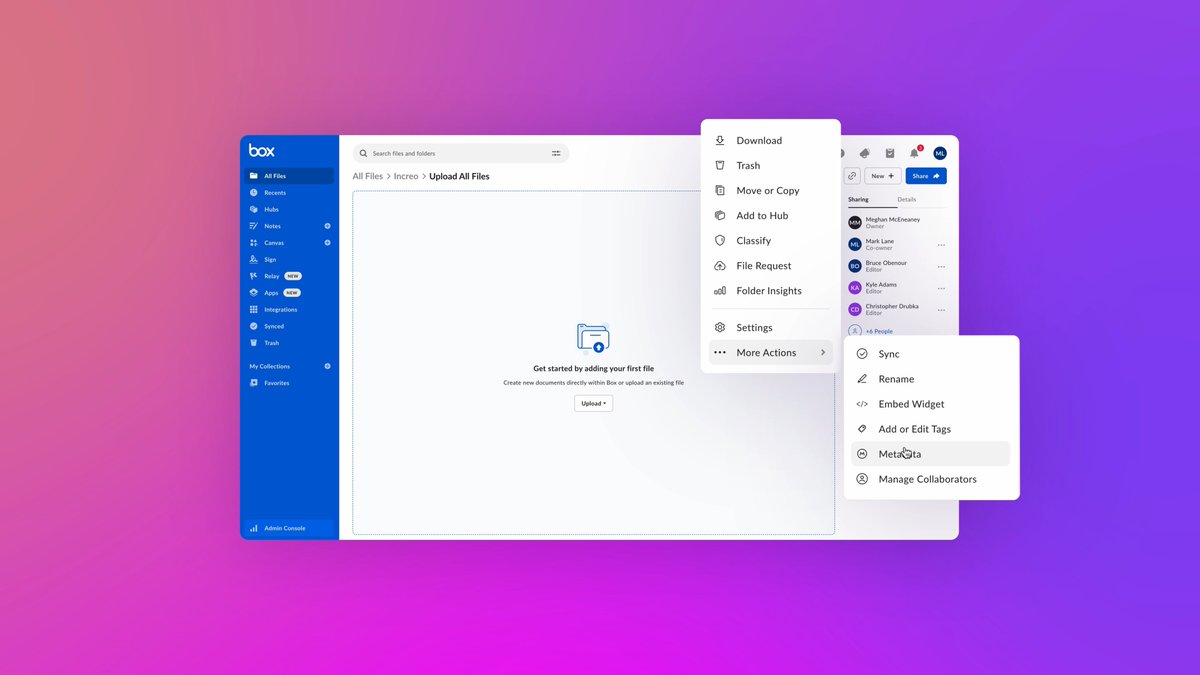
Introducing the new Box Agent. The Box Agent works across your entire Box file system, maintaining all your security and access controls, and is hyper tuned for working with enterprise content. This means you can now ask questions from all your enterprise content, search for files that were impossible to find before, deploy an agent on specific tasks on subsets of documents, analyze complex data sets, and generate or edit documents and spreadsheets via the agent. You can have the Box Agent search across your Box account to prepare for a sales meeting, analyze customer sentiment reports, process a large set of contracts for legal risk, provide insights into product development, leverage existing knowledge to answer RFPs, and thousands of other use-cases. 90% of enterprise data is unstructured data. This means most enterprise knowledge is sitting in inside of research reports, marketing assets, presentations, roadmap files, contracts, HR documents, and more. This is the critical context that agents need to be able to answer questions about a business, automate workflows, or serve up to other agents. We’ve been grinding on this for a quite a bit, and due to recent AI model advancements we’re now ready to release it to customers. Previous model generations had a difficult time knowing when to give up or keep going on a search, when to browse for files vs. use queries, how to rank files appropriately to know which version of content to use, how to handle large amounts of context to comb through, and more. Due to recent breakthroughs from models like GPT-5.4, Opus 4.6, and Gemini 3, we’ve seen major gains in tool calling, code execution, advanced reasoning, and more. Combined with an agent harness tuned to Box context, now it’s finally possible to have an agent that can work across your file system on long running tasks and actually deliver high quality results. Best of all, because the Box Agent works with any leading AI model, you’ll quickly get the gains coming out of the major labs as major new models are released. Further, openness at Box is key, so you’ll be able to call up the Box Agent from Box’s APIs and MCP server, so you can interact with Box intelligently from any other AI system. We know work happens everywhere, and we want to ensure you can access to the content you need from those places. The new Box Agent is available starting today, rolling out now for Enterprise Plus and Enterprise Advanced customers.

Aaron Levie

44,515 Aufrufe • vor 3 Monaten

AI Messenger: Giving Voice to Autonomous Agents The future of AI isn't just about making agents smarter - it's about making them truly autonomous. Today, we're taking a major step toward this future with AI Messenger, a breakthrough that fundamentally changes how AI agents operate, communicate, and create value. The Innovation We've developed a new way for AI agents to communicate. At its core is the 'incoming_message' workflow trigger - a system that lets any platform or user interact directly with Loomlay agents through a messaging endpoint. Direct Interaction Imagine having an AI assistant you can chat with anytime, through any platform - Telegram, your website, or custom interface. Ask "What's happening with $ETH today?" and your agent analyzes market data, checks trading volumes, and gives you a comprehensive update. Your agent maintains context, understanding exactly what you need. Event-Driven Intelligence The power of AI Messenger goes beyond direct communication: ▪️Trading agent executes when whale wallet movements exceed threshold ▪️Research agent alerts when new protocol documentation drops ▪️Analytics agent triggers when volume patterns match historical pumps ▪️Portfolio agent re-balances, when asset allocation hits specified limits This is true automation - agents that act precisely when needed. A New Era of Collaboration We're creating an ecosystem where agents work together seamlessly: ▪️Research agents feed insights to trading agents ▪️analytics agents alert management agents ▪️support agents tap into knowledge agents This isn't just automation - it's an intelligent network where each agent enhances the capabilities of others. B2B Solution Imagine a DEX, where users can ask about liquidity pools, trading pairs, or market trends through a simple chat interface - and get answers from an agent that knows your protocol inside out. Or a lending platform where users chat with an agent that understands their positions and can provide real-time advice. Implementation is seamless - we handle the agent creation and widgets setup,our partners provide the value to their users. The Future of AI Agents This update represents a fundamental shift in how AI agents operate. We're moving from isolated, scheduled tasks to an interconnected ecosystem of responsive, collaborative agents. This is our vision of truly autonomous AI - intelligent systems that communicate, collaborate, and respond to real needs in real-time. Telegram integration is available right now. Below is a sneak peak of what's coming next week 🪄 Because $LAY is the way!

Loomlay

26,140 Aufrufe • vor 1 Jahr

I just watched AI agents map Nazi escape routes across two continents. This is the coolest fork of our agentic RAG framework that I've seen so far 🔽 𝗩𝗲𝗿𝗼 𝗗𝗮𝗹𝗹'𝗔𝗴𝗹𝗶𝗼 built a complete 𝗢𝗦𝗜𝗡𝗧 𝗶𝗻𝘁𝗲𝗹𝗹𝗶𝗴𝗲𝗻𝗰𝗲 𝗽𝗹𝗮𝘁𝗳𝗼𝗿𝗺 on top of Elysia, and it's fully open source. 𝗜𝗻𝘁𝗲𝗹𝗹𝘆𝗪𝗲𝗮𝘃𝗲 takes Elysia's decision tree architecture and extends it for intelligence analysis. Upload documents, ask questions in natural language, and get comprehensive intelligence assessments with entity extraction, geospatial mapping, and network analysis. Main features: 𝗔𝘂𝘁𝗼𝗺𝗮𝘁𝗶𝗰 𝗘𝗻𝘁𝗶𝘁𝘆 𝗘𝘅𝘁𝗿𝗮𝗰𝘁𝗶𝗼𝗻: Uses GLiNER for zero-shot recognition of 7 entity types (persons, organizations, locations, dates, events, laws, cryptonyms). No training required. 𝗧𝘄𝗼-𝗔𝗴𝗲𝗻𝘁 𝗔𝗿𝗰𝗵𝗶𝘃𝗲 𝗥𝗲𝘀𝗲𝗮𝗿𝗰𝗵: The "Quartermaster" agent maps the information landscape (discovers archives, classifies access levels), while the "Case Officer" conducts hypothesis-driven investigations with confidence scoring and evidence citations. 𝗚𝗲𝗼𝘀𝗽𝗮𝘁𝗶𝗮𝗹 + 𝗡𝗲𝘁𝘄𝗼𝗿𝗸 𝗩𝗶𝘀𝘂𝗮𝗹𝗶𝘇𝗮𝘁𝗶𝗼𝗻: Interactive 3D maps (Mapbox) and force-directed network graphs (vis-network) to reveal hidden connections between entities using Elysia's build in customizable display types. 𝟲-𝗣𝗵𝗮𝘀𝗲 𝗜𝗻𝘁𝗲𝗹𝗹𝗶𝗴𝗲𝗻𝗰𝗲 𝗢𝗿𝗰𝗵𝗲𝘀𝘁𝗿𝗮𝘁𝗼𝗿: Automated pipeline that goes from extraction → relationship mapping → geospatial analysis → network analysis → pattern detection → synthesis, with automatic task generation for follow-up investigation. They even built a demo analyzing 17 historical documents about Nazi escape networks to South America (1945-1962). The system automatically extracted entities, mapped three distinct escape routes, and generated hypotheses with confidence scores. This is exactly what we hoped people would build with Elysia 💚 so so cool to see. Elysia's decision tree architecture makes it straightforward to add domain-specific tools (like GLiNER entity extraction or archive discovery or custom map displays) while keeping all the core functionality (error handling, streaming, self-healing, transparency) that comes built-in. Check out the repo: Interactive demo: Elysia blog post: Huge shoutout to the contributors for building this and sharing it with the community! 🫶

Victoria Slocum

19,562 Aufrufe • vor 6 Monaten