Loading video...

Video Failed to Load

Go Home

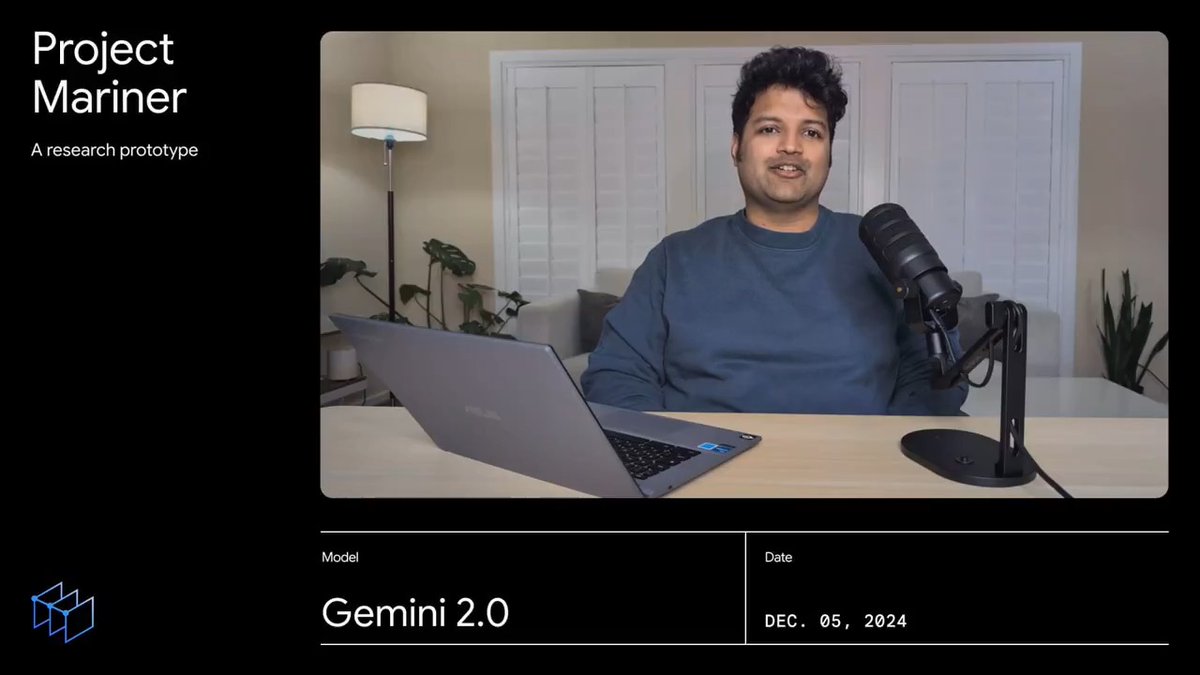
"The future of AI is agentic. That includes browsers!" Imagine having an AI agent in your browser that can help you complete complex tasks, answer your questions, and streamline your workflow. Today I'm thrilled to share a sneak peek at Project Mariner, a cutting-edge research collaboration between Chrome and...

29,501 views • 1 year ago •via X (Twitter)

10 Comments

D@RWIN's profile picture
D@RWIN1 year ago

Excellent. This in a earbuds + glasses is all we need.

Addy Osmani's profile picture
Addy Osmani1 year ago

Huge opportunities ahead!

bmerke's profile picture
bmerke1 year ago

@AgentTankLive is doing this experiment live as we speak $Tank

Liam Walsh's profile picture
Liam Walsh1 year ago

At some point will certain platforms for consuming content and information become redundant? Will we even need a browser if the AI can just go off and collect the data from various services? It's a bit like designing a fully automatous driving car with the same interior as a car with manual controls. At some point the form factor is irrelevant because it's based on something in the past that no longer exists.

Addy Osmani's profile picture
Addy Osmani1 year ago

Great question, Liam! Even if an AI agent retrieves and summarizes data, users may still want to dive deeper, explore related content, or verify sources themselves. That way browser acts as a gateway, allowing users to engage with information at their own pace and discretion. That said, I could see a world where the surfaces we use to interact with information or tasks change over time.

Sam Denty's profile picture
Sam Denty1 year ago

🔥

Addy Osmani's profile picture
Addy Osmani1 year ago

😀

kelly.soul (💫,⬜️)'s profile picture
kelly.soul (💫,⬜️)1 year ago

Exciting stuff! AI agents in browsers could be game-changing. Speaking of agents, have you checked out Opencord AI's Twitter and Reddit Agents? They're perfect for promoting your own AI agents through social media replies. Super intuitive way to boost visibility!

Naveed Ahmed's profile picture
Naveed Ahmed1 year ago

Wow this is just amazing 🤩

Addy Osmani's profile picture
Addy Osmani1 year ago

The team has been cooking 🔥

Related Videos

New Short Course: Building AI Browser Agents! Learn how to build AI agents that interact and take actions on websites in this course, created in partnership with and taught by and @namangarg0, Co-founders of AGI Inc. AI browser agents can log into websites, fill out forms, click through web pages, or even place orders online for you. They use both visual information, like screenshots, and structural data, like the HTML or Document Object Model (DOM) of a web page, to reason and take action. With the complexity of webpages and multiple possible actions at each step, it can be challenging for an AI browser agent to complete an assigned task. Because these agents run long action sequences, a single error—like clicking the wrong button or misreading a field—can lead to unexpected outcomes or errors that compound over time. In this course, you'll understand how autonomous web agents work, their current limitations, and how AgentQ enables them to improve through self-correction. In detail, you'll: - Learn what web agents are, how they automate tasks online, their architecture, key components, limitations, and an overview of their decision-making strategies. - Build a web agent that can scrape website and return course recommendations in a structured output format. - Build an autonomous web agent that can execute multiple tasks, such as finding and summarizing webpages, filling out a form, and signing up for a newsletter. - Explore AgentQ, a framework that enables agents to self-correct by combining Monte Carlo Tree Search (MCTS), a self-critique mechanism for continuous improvement, and Direct Preference Optimization (DPO). - Deep dive into MCTS, learn how it finds an effective path, illustrated by an example of Gridworld animation, and use AgentQ to complete web tasks. - Understand AI agents' current state and future directions—including key factors shaping their evolution, such as hardware, algorithm innovation, and data availability. By the end of this course, you will have hands-on experience building browser agents and a deeper understanding of how to make them more robust and reliable. Please sign up here:

Andrew Ng

186,182 views • 1 year ago

Here we go again 🚀! Excited to announce that we're building A1Zap (YC W25) with Pennie Li and that we're in the Y Combinator W25 batch in San Francisco! What is A1Base? A1Base gives AI Agents a real world identity for work. We do that by rebuilding Twilio and Okta from the ground up, putting AI Agents first. This means developers can make AI-first agentic applications 10x easier with our API's. ⁉️ Why are we doing this? Because there's a huge torrent of new valuable companies possible with AI agents, but to get their AI Agents to users, they have to chain custom apps, chat interfaces, awkward Slack integrations, browser bots, and wrestle with Twilio’s legacy API (which is built for marketing). We solve this by providing developers with an easy to use API to interface your AI agent with humans/coworkers/users where they are in this case in Whatsapp, Slack, Teams, SMS and more) - with AI Agent features built in. These digital workers are poised to transform how we work and we're the critical infrastructure to help them interact naturally in human workflows. We're not just building another AI tool. We're creating the infrastructure that will enable AI agents to become a natural part of the workforce - handling everything from customer support to sales development to creative work. We're backed by Y Combinator and working with founding teams who share our vision. We believe that in the near future, AI Agents with human coworkers will enable us to pursue more creative and impactful work. Our mission is to help developers build AI Agents that people can partner with and rely on as trusted allies—always with a human-first mindset. If you're thinking about the Agentic future of your company reach out! If you're looking to build your first AI Agentic company - reach out too - we have some amazing open source templates to get you started on the journey. Excited to share more of what we're up to soon 🔜.

Pasha Rayan

53,950 views • 1 year ago

AI Messenger: Giving Voice to Autonomous Agents The future of AI isn't just about making agents smarter - it's about making them truly autonomous. Today, we're taking a major step toward this future with AI Messenger, a breakthrough that fundamentally changes how AI agents operate, communicate, and create value. The Innovation We've developed a new way for AI agents to communicate. At its core is the 'incoming_message' workflow trigger - a system that lets any platform or user interact directly with Loomlay agents through a messaging endpoint. Direct Interaction Imagine having an AI assistant you can chat with anytime, through any platform - Telegram, your website, or custom interface. Ask "What's happening with $ETH today?" and your agent analyzes market data, checks trading volumes, and gives you a comprehensive update. Your agent maintains context, understanding exactly what you need. Event-Driven Intelligence The power of AI Messenger goes beyond direct communication: ▪️Trading agent executes when whale wallet movements exceed threshold ▪️Research agent alerts when new protocol documentation drops ▪️Analytics agent triggers when volume patterns match historical pumps ▪️Portfolio agent re-balances, when asset allocation hits specified limits This is true automation - agents that act precisely when needed. A New Era of Collaboration We're creating an ecosystem where agents work together seamlessly: ▪️Research agents feed insights to trading agents ▪️analytics agents alert management agents ▪️support agents tap into knowledge agents This isn't just automation - it's an intelligent network where each agent enhances the capabilities of others. B2B Solution Imagine a DEX, where users can ask about liquidity pools, trading pairs, or market trends through a simple chat interface - and get answers from an agent that knows your protocol inside out. Or a lending platform where users chat with an agent that understands their positions and can provide real-time advice. Implementation is seamless - we handle the agent creation and widgets setup,our partners provide the value to their users. The Future of AI Agents This update represents a fundamental shift in how AI agents operate. We're moving from isolated, scheduled tasks to an interconnected ecosystem of responsive, collaborative agents. This is our vision of truly autonomous AI - intelligent systems that communicate, collaborate, and respond to real needs in real-time. Telegram integration is available right now. Below is a sneak peak of what's coming next week 🪄 Because $LAY is the way!

Loomlay

26,149 views • 1 year ago

Introducing Dola Seed 2.0 Pro, referred to below as Seed 2.0 Pro We have launched Seed 2.0 Pro, our most capable model in the Dola Seed 2.0 series, engineered to power the next generation of autonomous AI agents. Enterprise AI is moving beyond models that simply analyze text or images. What businesses increasingly need are agents that can understand, reason, use tools, and execute tasks across complex workflows. That is exactly what Seed 2.0 Pro is built for. Seed 2.0 Pro combines strong reasoning with advanced image understanding and video understanding, giving enterprise agents the ability not only to interpret information, but also to take action. It is designed for high-value, multi-step enterprise workflows, with strong performance in: - tool calling - workflow execution across enterprise systems - agentic task completion - browser and computer use This makes Seed 2.0 Pro a powerful engine for a wide range of agent scenarios, from daily office automation and deep web research to in-depth report drafting, financial analysis, content moderation, physical inspection, and video creation workflows. It is also highly optimized for OpenClaw🦞 and ReAct architectures, helping enterprises build agents that can navigate digital interfaces, enter information, and complete tasks with high reliability. In short, Seed 2.0 Pro is not just built to generate insights. It is built to serve as the brain and execution engine for enterprise AI agents. And it brings these capabilities at a highly attractive price point, making advanced agent deployment more practical for enterprise teams. Try Seed 2.0 Pro for free: Or book a free consultation: #BytePlus #DolaSeed #EnterpriseAI #AIAgents #ImageUnderstanding #VideoUnderstanding #ReasoningModel #ModelArk #openclaw

BytePlus

96,329 views • 4 months ago

New course to bring you up to state-of-the-art at using AI to help you code: Build Apps with Windsurf's AI Coding Agents, built in partnership with WIndsurf (Codeium) and taught by Anshul Ramachandran! AI-assisted IDEs (Integrated Development Environments) make developers’ workflows faster, more efficient, and much more fun. Agentic tools like Windsurf are more than just code autocomplete—they are collaborative coding agents that help you break down complex applications, iterate efficiently, and generate code that spans multiple files. Although a lot of coding assistants share the same underlying large language models for planning and reasoning, a major point of distinction is how they handle tools, keep track of context, and stay aligned with your intent as a developer. For instance, if you make modifications to a class definition in your code and make the same modifications to other classes in the same directory, you might tell the AI agent "Do the same thing in similar places in this directory." Here, tracking your intent means understanding that “the same thing" refers to that recent edit you just made, which must be followed by appropriate search and tool-calling to implement the changes. In this course, you'll learn the inner workings of coding agents, their strengths and limitations, and how to use Windsurf to quickly build several applications. In detail, you'll: - Build a mental model of how agents work by combining human-action tracking, tool integration, and context awareness to carry out an agentic coding workflow. - Learn the challenges of code search and discovery and how a multi-step retrieval approach helps coding agents address them. - Use Windsurf to analyze and understand a large, old codebase and update it to the latest versions of the frameworks and packages it uses. - Build a Wikipedia data analysis app that retrieves, parses, and analyzes word frequencies. - Enhance the performance of your Wikipedia analysis app by adding caching, and through this, also learn how to course-correct when the AI agent produces unexpected results. - Learn tips and tricks such as keyboard shortcuts, autocomplete, and @ mentions to quickly call on agentic capabilities. - Use image/multimodal capabilities of the AI agent to increase your development velocity; you'll see an example of uploading a mockup with sketched-out UI features, and ask the agent to use that to build new functionality to an app. By the end of this course, you’ll understand agentic coding in-depth and know how to use it to make your development process much faster, more efficient, and enjoyable. Please sign up here!

Andrew Ng

139,873 views • 1 year ago

Today we’re launching the first and only human-like AI agents in the world. Super Agents™ are the first agents with human‑level skills – they DM you, take @ mentions, send emails, manage docs, tasks, and more. Not just tools or API calls, but real skills fine‑tuned for how teams actually work. The first agents with 100% context – fully native in ClickUp and fully synced from other apps. Super Agents see your work the same way that humans do: tasks, docs, schedules, and conversations all in one place. The first agents that learn from human interactions automatically, without any setup or configuration – when you give feedback, they listen and improve how they work. The first agents with human‑level memory for custom agents – historical memory for every interaction, short-term working memory, and even long‑term memory stored in docs you can literally open, inspect, and edit. The first agents that are literally the same as users – our agentic user model is the same as our user data model. This gives you permissions and capabilities that you and your systems are already familiar with. The first infinite agent catalog – where anyone can create and customize agents in minutes, for literally any type of work imaginable. It's the most intuitive way to build agents on the planet. 95% of companies are failing in AI adoption. The reality is that AI isn't meant to be adopted, it's meant to be adapted – to you. Super Agents are automatically personalized to you and your company using proprietary state-of-the-art agent architecture, orchestration, and tooling. Today is the largest step forward we've ever made towards our mission of making people more productive. Maximize human productivity, with ClickUp Super Agents. Available NOW. For everyone.

Zeb Evans

320,607 views • 7 months ago