Загрузка видео...

Не удалось загрузить видео

На главную

🚨BITCOIN RED TEAM: 1 CRITICAL EXPLOIT PER HOUR, SITUATION “EXTREMELY BAD”! A small group led by Rob Hamilton 🟥 (AnchorWatch CEO) has been red-teaming the Bitcoin ecosystem with AI tools after the recent Coldcard exploit. They’re scanning crypto libraries, wallets, and infrastructure, averaging roughly one critical exploit per person...

85,426 просмотров • 27 дней назад •via X (Twitter)

Комментарии: 0

Нет доступных комментариев

Здесь появятся комментарии из оригинального поста

Похожие видео

Strive (ASST) is set up to absolutely moon. The catapult has been loaded. ASST holders might have this question: What happens to common equity if Bitcoin rises and the balance sheet either stays static or keeps accumulating through SATA issuance? Using CEBE math, I modeled two scenarios with Bitcoin going from roughly $68.5k to $126k. Scenario 1: Static balance sheet No new Bitcoin. No new SATA. No additional capital formation. Just the existing balance sheet riding Bitcoin higher. In that scenario, ASST goes from roughly $15.86 to $37.24. That is still a very strong outcome, because the company’s existing Bitcoin exposure appreciates and CEBE per share rises as fixed senior claims shrink in BTC terms. At $126k Bitcoin, CEBE reaches roughly 17,488 sats per share. $37.24 stock price with the multiple staying flat and zero new Bitcoin purchased :) Scenario 2: $200 million of SATA issued every month Same Bitcoin path. Same starting point. But Strive adds $200 million of SATA every month and uses it to acquire more Bitcoin. In this scenario, the stock goes from roughly $15.86 to $54.21. CEBE rises to roughly 25,456 sats per share. The Bitcoin stack grows from about 19,000 BTC to roughly 45,900 BTC. This is where the mechanism gets violent. The static balance sheet benefits from Bitcoin appreciation. The SATA issuance scenario benefits from Bitcoin appreciation plus monthly balance sheet expansion. That means the common equity is not simply waiting for Bitcoin to go up. It is watching the company potentially compound its Bitcoin exposure while the denominator gets partially protected by the capital structure. At the end of the model: Static case: $37.24 stock price SATA monthly case: $54.21 stock price Difference: +$16.97 per share Relative uplift: about 45.6% If SATA issuance is done at attractive terms and deployed into Bitcoin, the common wins big after Bitcoin moons. That is the whole game. This is amplified Bitcoin. And if the market starts pricing that correctly, the stock does not merely track Bitcoin. It can re-rate around the speed and quality of true Bitcoin-per-share growth:

Adam Livingston

14,499 просмотров • 3 месяцев назад

What if #AI became as decentralized as #Bitcoin? We sat down with our new friend 3700 from Bitcoin Virtual Machine to hear what their incredible team of anons are working on - "Truly Open AI." Full interview here:👇 1: What positive impact will Layer 2s have on Bitcoin? Layer 2s on Bitcoin open up opportunities for innovation, allowing developers to build dApps and smart contracts on top of Bitcoin, expanding its utility and use cases. By submitting transactions for final settlement on the Bitcoin network, Bitcoin Layer 2 networks claim to achieve the same (or close to) level of security and decentralization as the Bitcoin blockchain. Building a separate execution layer allows them the freedom to employ several technologies (such as rollups). Layer 2 can significantly improve Bitcoin's scalability by processing transactions off-chain, reducing congestion on the main blockchain. Overall, Layer 2s on Bitcoin have the potential to address some of Bitcoin's key limitations, making it more efficient, accessible, and versatile in the long run. 2: What does the ETF approval mean for Layer 2 on Bitcoin? The approval of ETF could potentially have several implications for Layer 2 on Bitcoin: Innovation and Development: With a growing interest in Bitcoin spurred by ETF approval, there could be a surge in research and development efforts focused on enhancing Layer 2. Developers and projects may be incentivized to create new and improved Layer 2 protocols to meet the evolving needs of the expanding Bitcoin ecosystem. An ETF approval could boost mainstream Bitcoin adoption and liquidity. This influx of users may also drive interest in Layer 2 on Bitcoin as a means to enhance the scalability and functionality of Bitcoin. 3: What are the primary challenges facing L2s on Bitcoin? The interoperability of different Layer 2s and their compatibility with Bitcoin's main blockchain can be a challenge. Ensuring seamless interaction between various Layer 2 networks and the Bitcoin blockchain is essential for a cohesive and efficient ecosystem. Some Layer 2s may introduce centralization risks if they rely heavily on centralized entities or trusted intermediaries. Maintaining decentralization and censorship resistance, which are core tenets of Bitcoin, while scaling with Layer 2s is a challenge. 4: What aspects of Layer 2 solutions for Bitcoin are you most enthusiastic about? AI represents one of the cornerstones of our modern era. However, achieving a decentralized AI infrastructure, owned and managed by users, has posed significant challenges. The primary obstacle has been the limited capacity to store and execute AI models due to size and computational limitations. To address this challenge, we propose a new blockchain architecture enabling developers to deploy their own Bitcoin Layer 2 solutions tailored specifically for AI tasks, called Truly Open AI. These Layer 2 blockchains are optimized to handle computationally intensive tasks, such as matrix multiplication, directly on-chain. These Bitcoin Layer 2 solutions offer exceptional throughput, minimal latency, and cost-effectiveness. AI dApps are programmed as Solidity smart contracts, ensuring they operate precisely as intended, free from interference or manipulation. Our BVM AI Contracts Library simplifies the integration of neural networks into dApps, empowering developers to embed AI seamlessly. In summary, I'm particularly enthusiastic about the potential of Layer 2 solutions for Bitcoin to revolutionize decentralized AI by providing scalability, security, and accessibility. 5: How is your Layer 2 different from others being built? BVM distinguishes itself as a Modular infrastructure that empowers thousands of distinct Bitcoin Layer 2 networks, spanning Gaming, DeFi, Social, and AI applications. We're continuously enriching the BVM Module Store with new modules to enhance its capabilities. With each new module, builders gain access to a wider array of tools to explore different use cases on the Bitcoin network. Recent additions include the Filecoin module for affordable storage and the AI Contracts Library for constructing AI-powered Bitcoin Layer 2 chains. We're also gearing up to release a ZK roll-up module in the coming weeks to offer an alternative to the standard optimistic roll-up. We aim to simplify the process of launching a Bitcoin Layer 2 network customized to specific requirements. Think of it as a SaaS offering with predefined best practices. Whether it's a DeFi Bitcoin Layer 2 or a GameFi Bitcoin Layer 2, we provide default solutions tailored to each use case. We're dedicated to expanding the BVM ecosystem by incentivizing more builders to join the Bitcoin network. Through various programs and grants, we support builders in covering their operational costs for Bitcoin Layer 2. Additionally, we offer rewards akin to 'L2 mining' to those who contribute to expanding the user base and total value locked on the network. In summary, BVM stands out with its modular infrastructure, tailored solutions, and efforts to grow the Bitcoin ecosystem.

Supra

83,548 просмотров • 2 лет назад

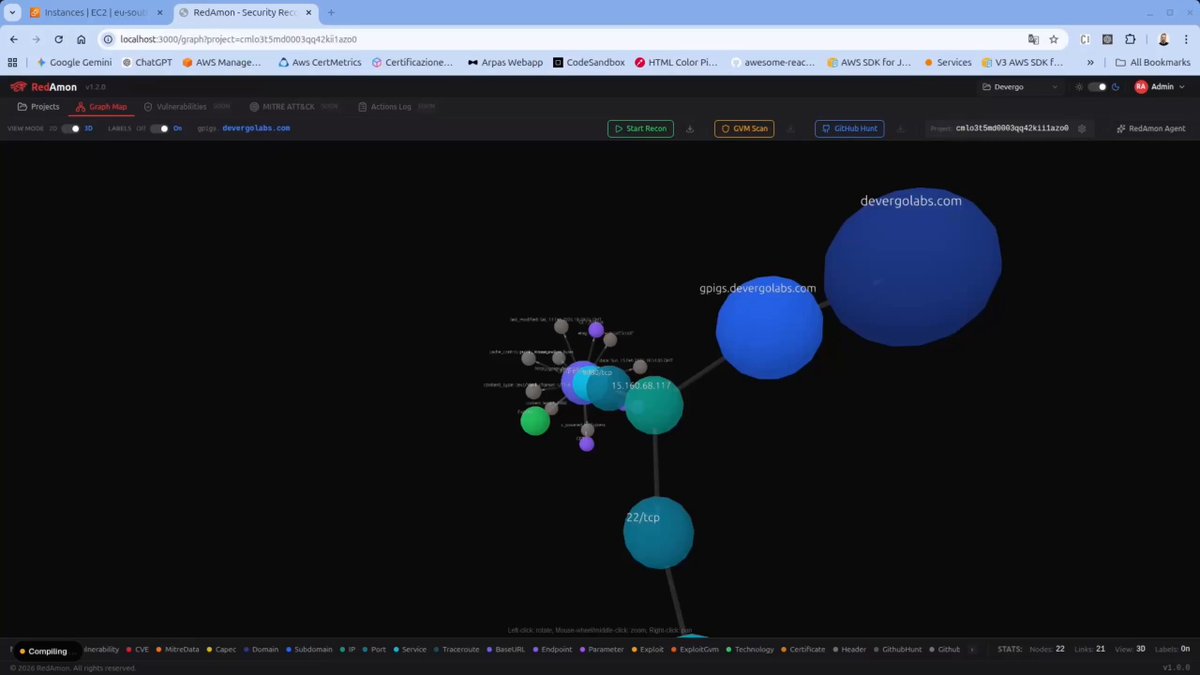
someone built an AI RED TEAM that maps your entire attack surface as a knowledge graph, finds every vulnerability, then EXPLOITS them to root access AUTONOMOUSLY its called RedAmon, 9,000 templates. 17 node types, actual Metasploit shells, not reports, no pentesters needed 6 phases of autonomous recon: subdomain discovery, port scanning, http probing, resource enumeration, vulnerability scanning, MITRE mapping every finding stored in a Neo4j graph with 17 node types and 20+ relationship types. the AI reasons about the graph, finds attack paths, and runs actual Metasploit exploits, actual shells stress-tested with zero vulnerability data, zero exploit modules, one instruction find a CVE and exploit it, it went from empty database to root-level RCE in 20 steps, researched the exploit on the web, crafted a custom deserialization payload, debugged itself when the first attempt failed next try, the server responded with root access, the highest privilege level on any Linux system. full control over everything the target was running node-serialize 0.0.4, a package with a critical deserialization flaw (CVE-2017-5941, CVSS 9.8), the server takes your cookie, decodes it, and passes it straight into unserialize() which executes any code inside it, the AI figured this out on its own with no hints built on LangGraph + MCP tool servers for naabu, nuclei, curl, metasploit. hunts leaked secrets across GitHub repos, 40+ regex patterns for AWS keys, Stripe tokens, database creds

chiefofautism

70,129 просмотров • 6 месяцев назад