正在加载视频...

视频加载失败

◉ BotID's Invisible CAPTCHA vs ◯ Distracting users ◯ Being easily bypassed ◯ Slowing down checkouts ◯ Making users solve puzzles ◯ Advertising other companies ◯ Disruptive full page interstitials Let's clean up the web:

392,736 次观看 • 11 个月前 •via X (Twitter)

0 条评论

暂无评论

原始帖子的评论将显示在这里
相关视频

DeepSeek-R1 shattered the assumption that performant AI models must be built closed source with loss-leading computational costs. This is the reality that Web3 x Crypto firms have been waiting for, leading me to believe that the most performant AI models in the future will be built on-chain. Resource Requirements DeepSeek R1 (671 billion parameters), which took over a billion dollars, 2,000 Nvidia H800 GPUs, and over 55 days, beat benchmarks held by OpenAI’s o1 mode (near 2 trillion parameters)l, which required hundreds of billions of dollars to develop along with over 16,000 advanced GPUs. The idea that AI models must be closed-source and have loss-leading computational costs to succeed is crumbling. The Existing Decentralized AI Narrative AI x Crypto projects believed that crowdsourced, public, decentralized AI would eventually create better models than their centralized counterparts. This had thus far not been true, as the highest-performing models had come from closed-source companies like OpenAI and Anthropic. Crypto x AI companies have adapted to this by specializing in infrastructure rather than model-building. For example, GPU marketplaces like , The Render Network, io.net, and Exabits have developed sustainable revenues. Companies that allow users to share their network bandwidth like touch grass and Gradient have found their niche in supplying services, like distributed web scraping, to web2 clients. Storage networks like Arweave Ecosystem, Filecoin, and Ocean Protocol have also done well by being the platform on which these projects are built. Supply networks have flourished because of their ability to tailor their cheaper and more scalable services to off-chain customers. Renewed Focus Now that GPU and financial resources are no longer limitations to creating quality AI models, web3 AI companies can focus on replicating DeepSeek’s effectiveness while offering new benefits like modality, user ownership, censorship resistance, privacy, and more. Pantera Capital has funded companies in this space like and Sentient that believe they can match or exceed the performance of traditional AI companies while offering additional services or benefits. , for example, is building a platform where anyone can monetize AI models, data sets, and applications in a collaborative space. Users can permissionlessly train models manually, provide training data, and create tailored AI models with no-code tools. They are only able to cater to all these stakeholders (AI developers, users, resource providers) because everything is tied to their native Sahara blockchain. We invested in them precisely for this reason. The Future of AI will be built with Web3 Infrastructure I believe that supply-side projects will continue to grow, while consumer-facing projects can begin competing with web2 competitors by taking advantage of their ability to build networks that invite community involvement. and Sentient, for example, have begun setting up systems for users to train models based on the users’ expertise. These platforms will allow users to pick and choose the data and integrations to whatever they are applying the model towards. Sahara already has over 780,000 users on their waitlist while Sentient has over 1 million interactions. In the near future, I believe that the most performant AI models will be built on-chain. For the full blog post, read my newsletter.

paul.nft

32,465 次观看 • 1 年前

TikTok just got caught running a secret experiment on 15 million Americans to find out how much money their dangerous version could make them. In 2021 the company rewrote part of its recommendation algorithm so users would stop getting buried under harmful content over and over. Then it held back 10% of its American users and left them on the OLD version. At the time that was roughly 15 million people. None of them were told. They opened the same app, saw the same logo, and scrolled a feed the company had already replaced for everyone else. Internally the practice has a clean name. It is called a backtest, and it is the same A/B test any company runs when it wants to prove a change actually worked. Companies normally run those on button colors and checkout flows. TikTok ran one on what happens to people when the app stops protecting them. Why would a business do that? Because a safer feed is a less sticky feed, and stickiness is the product. One of the 15 million was a 16 year old named Chase Nasca. He had no history of mental health issues. He committed s*icide in February 2022. In March 2023, a Bloomberg Businessweek reporter emailed the company asking about Chase for a story on teenagers and the algorithm. Only then did TikTok's algorithm and safety teams go back and reconstruct his account. They found he had been assigned to the control group. The same report notes that most of what he actually searched for on the app was sports and comedy - but he was regularly shown s*icide and other harmful content. Their findings became a 14 page internal report on youth safety and filter bubbles. Its key contacts list shows it went to 10 teams inside the company, including communications, legal response, policy, security and search. So the lawyers knew about it. The communications team knew. Policy, security and search all got a copy. Then came the recommendations, and this is where it gets genuinely ugly... The report proposed two fixes: The first was to shrink the control group from 10% of American users to under 1%. The second was to cut how long the same users sit inside it, from as long as a full year down to seven days. Nobody proposed stopping. And the report ran the numbers on its own suggestion. Even at 1%, it said, at least 1.8 million users would still be excluded from the safety change, and it warned those people would be left "at risk for falling into bubbles." Someone typed that sentence, sent it to 10 teams, and the practice continued. A former TikTok trust and safety team leader who worked there while the experiment was live said he had never heard of it. After seeing the details he said the control group was far too big, and that the test should have excluded minors and suicide content entirely. The staff paid to protect users did not know the experiment on users existed. TikTok's answer this week is that the 2022 test was routine, and that its purpose was to check whether safety changes were working as intended. The internal report describes its own recommendations as a way to prevent future incidents. Chase's parents sued for wrongful death. A judge dismissed the case last year after TikTok argued that Section 230 protects it from liability for what its algorithm recommends. The appeal is still pending. So the company's legal position is that it is not responsible for the videos its algorithm served a teenager, while its OWN document confirms it chose which version of that algorithm he received. Every large platform runs tests like this one. But not one of them publishes how many users are sitting in the old version at any given moment. TikTok's number was never supposed to become public.

Ricardo

31,047 次观看 • 27 天前

Pi2Day 2026 Recap: What went down and more... The Pi Network team published a blog post explaining what happened during the Pi2Day 2026 celebration. Here are some of the important points about the milestone event in the protocol's ecosystem: Highlights from Ecosystem Quest - Enabled Pioneers to explore new apps, try out features of the ecosystem, and understand how Pi's platform enables utility in computation, AI, and identity. - Participants who completed the quest were given an exclusive in-app badge that can be seen in Pi Chats and Pi Social profiles. Number of participants: - More than 2.56 million Pioneers joined the quest - More than 1.78 million completed the entire quest Important Pi2Day Releases Three major releases helped enhance the usefulness of Pi not only within the ecosystem but also outside it, along with encouraging third parties to get involved: (1.) SoloHost Open, permissionless platform available on the Pi Desktop for building and listing applications that will run local AI (and soon distributed computing). - Early Beta currently being rolled out - Applications can be run on personal computers and interacted with using Pi Browser on mobile devices - 110 applications have already been developed by community members 420,000 Pi Node users + Pi Desktop users reached (2.) Pi Sign-In Enables Pi users to log into supported third-party websites and apps (beyond Pi Browser) using their Pi account. - Increases Pi presence on the larger web space - Capitalizes on the network size and identity verification of Pi - Facilitates easier integrations within the Pi world (3.) Pi Verify Offers Pi’s human verification process to third-party clients. - Assists other companies with account fraud issues and compliance needs - Fees for service in Pi, directly adding value to Pi - Increases the number of verified people through Pi’s KYC process In general, the releases have increased practical usefulness across computing, AI, and identity. By providing blockchain technology, identity verification, and an active global community, Pi Network has created strong reasons for others to engage with the project.

BSCN

26,753 次观看 • 26 天前

How to build a $100K/month iOS app (playbook below): Over the next 18 months, we'll see 200+ apps hit $100k/month solving problems that were impossible to solve until right now. AI can now solve hyper-specific problems for tiny audiences. Problems so specific only 50,000 people on earth have them. But those 50,000 will pay $40/month for a perfect solution. Meanwhile, the "For You Page" killed the need for followers. Any creator with zero audience can go viral tomorrow. One video about your niche app can deliver 1,000 paying customers overnight. This is the perfect storm. Micro-problems can finally be solved. Micro-apps can finally find their people. *Disclaimer* No, this won't work for everyone. Not everyone will make $100k MRR app. But there is a tremendous amount of opportunity, and my point is this is how i'd approach it: The playbook: 1) Daily habit (not occasional use) Not "track calories." Think "photograph your psoriasis patches every morning to track flare triggers." Not "meditate" but "record your stutter severity after each phone call." The winning apps solve micro-problems inside daily routines. The person checking if their dog's food has ingredients that trigger seizures. The runner who needs to know if today's pollen will trigger their exercise-induced asthma. Find the tiny, specific thing someone does at the exact same time every day. 2) AI-powered narrow wedge One problem. One perfect solution. "AI that tells if this supplement will interfere with your Adderall." "AI that identifies which FODMAP ingredients are in this restaurant dish." The narrower you go, the more people will pay. Start with one use case that takes 10 seconds to understand. 3) One channel, 3 formats TikTok or Instagram. Pick one. Test three content types daily. When something hits, make 50 versions. The apps making $100K/month mastered one platform before touching another. 4) 100 obsessed users 100 people who use it daily and would riot if you shut down. They'll bring the next 100. Those bring 400. But without the first 100 fanatics, you have nothing. Use organic audience to bring these people there. 5) Charge immediately Paywall goes up week one. $7-40/month. Free users give garbage feedback. Paying users tell you exactly what to build. If nobody pays for your broken MVP, they won't pay for your polished version either. 90-day timeline: Days 1-10: Find the habit, validate demand (reddit, tiktok, Idea Browser) Days 11-30: Ship the ugliest working version (use bolt/lovable/vibecode app/rork) While you're doing this you're building organic audience. Figuring out formats, focusing on 1 channel, working with creators. Days 31-60: Get 100 users, obsess over them Days 61-90: Double down on what's working TLDR; Pick a daily micro-problem this weekend. Ship something that solves it by next weekend. Charge for it the weekend after. (full episode is below or on the latest episode The Startup Ideas Podcast (SIP) 🧃 on yt etc) Enjoy the sauce. People charge for this sorta sauce. It's free for you. The App Store is open for the first time in years. Go claim your piece. Im rooting for you.

GREG ISENBERG

102,168 次观看 • 11 个月前

🎉BERT Semantic Interlinker App V2 (Free App)🎉 Free Streamlit App to Semantically Interlink Pages using Sentence Transformers. Last week Emilia tagged me in this excellent article that she had linked to the original version of the BERT Interlinking App. I checked the stats and over it had 17,000 unique visitors with no promotion at all. I spent the last week re-writing it from the ground up with a ton more features, visualisations and polish. What's the Point? “There are tons of page Interlinkers out there, why not just use those?” It’s a fair point, this script doesn’t even use anchor text or link metrics when making recommendations. What it does differently is make logical connections to pages that will please your users and increase revenue. (link to related helpful content). Take the Page 'HP Original Ink' Using this interlinker it'll match to the following related pages: 'Printer Ink' 'Printers' 'Printer Paper' Even thought syntactically those words are a million miles away from each other. I originally wrote it to surface User Guides / Buyer's Guides at a category level. But realised there are so many other uses for it. ✅ Interlink Related Products Within Category Text ✅ Show Related Categories ✅ Surface Related Content to Assist Conversion (Blogs, Buyers’ Guides, etc.) ✅ Display Products Most Closely Related to Category Page for Increased Relevancy ✅ Feature Related Blog Posts If you haven't tried it before I'd love you to give it a go, if you have tried it before you should revisit it as it's been completed overhauled. (The original version actually had a bug that prevented a large number of results from being returned 🤦‍♂️) Full Write Up with New Features Instructions: Direct Link to the App: Retweets for reach most appreciated!

Lee Foot 🐍📈

34,701 次观看 • 2 年前

🚨 The Silvia team just announced our latest engineering advancement. Every business wants access to the highest level of intelligence, but at the lowest cost possible. The rise of LLMs has made intelligence abundant, yet one of the hardest problems across startups and corporate America is predicting the compute cost associated with this intelligence. I have been dealing with this personally as we build Silvia and the problem comes up in almost every conversation I have with CEOs, founders, and executives. Every business embraced AI about 18 months ago and things seemed great until the compute bills started to show up. The bills for internal compute usage were difficult to swallow, but things got outrageous if you had an AI product that allowed your users to consume compute without limits. I know this problem intimately because that is the situation that Silvia was in. Every question that was asked meant higher compute costs for our company. But we didn’t want to limit usage because users were getting genuine value out of the product. This challenge sent our team down a deep rabbit hole of cutting costs, while improving the experience for users. The second part was really important: we did not want to degrade the user experience by simply taking away access to the highest quality models. Thankfully, resource constraints breed innovation. We aren’t the biggest company, nor do we have the largest balance sheet, but we came up with a very novel solution that we are announcing today. The Silvia engineering team built a model router that cut costs by up to 29%, decreased latency, and improved the quality of answers for users. Trifecta! The way we do this is by reading the first 500 characters of a query and then predicting the level of effort that will be needed by a model to answer the query. The highest effort needs are routed to the most powerful models. The lowest effort needs are routed to different, better models for the query. A good example of this would be “what is the date?” You don’t need to use the latest Anthropic model to answer this query. In fact, sending a simple query like this to the most powerful model will make your compute costs increase and will actually increase the latency, which means a worse user experience for the Silvia user. By implementing the model router, the user gets a better experience and we get lower costs. Win-win. One of the interesting aspects of the implementation is that our model router runs on CPUs instead of GPUs. This allows us to read the query and predict the level of effort needed in less than 1 millisecond. This CPU implementation is why latency is not affected, nor is cost significantly increased by any potential additional GPU consumption. Another important point is that many of you have probably seen the news that OpenRouter is being purchased by Stripe for around $7 billion. This is a great outcome from what appears to be a very smart, capable team. Their model routing API is related (their product and our internal implementation both touch model routing), but you should think of OpenRouter as making it possible to do model routing for companies, while Silvia’s model router is a custom, intelligent system that specifically routes Silvia queries to the right model. They give access to the functionality of model routing to many companies, while our internal product does the real decision-making specific to our use case. Lastly, our implementation of a model router is a strategic bet that will allow us to become model-agnostic over time. We don’t care who created the different models, we just want to route a query to the model best positioned to answer. The large model labs will never allow their users to be model agnostic, but that would require the lab to potentially route a query to a competitor’s model. No bueno in their eyes. Instead, Silvia being an independent AI research lab gives us the power of being agnostic. We simply want the best experience for our users. Last week we announced that Silvia is now the most accurate AI tax product on the market, including beating OpenAI, Anthropic, Google, and xAI. Today we are announcing a custom, in-house model router that rivals the best technology anyone else has built. There will be many more engineering announcements to come. I truly believe we have assembled one of the best AI teams and we are currently the best AI research lab in finance. If you are interested in learning more about the technical details of the model router, you can read the engineering blog post here: Everyone wants the best intelligence and the lowest cost. Silvia just showed the world what is possible in this pursuit. I anticipate many other companies will build this custom solutions to achieve the same benefits.

Anthony Pompliano 🌪

75,896 次观看 • 13 天前

Everyone's talking, reading, or writing about how much is changing in how we build products in the future, but very few people have actually experienced what the most cutting edge tools are capable of. In a new series on my podcast, I'm going to sit down with the founders of the most advanced product development tools to live demo what these tools can do, and then talk about the implications of this on product people's careers and lives. To kick things off, I sat down with Amjad Masad (Amjad Masad), co-founder and CEO of Replit ⠕, a browser-based coding environment that allows anyone to write and deploy code. Replit has 34 million users globally and is one of the fastest-growing developer communities in the world. In our conversation, Amjad shares: 🔸 A live demo of Replit building a full-stack web app from a text prompt 🔸 The implications of AI-powered development for product managers, designers, and engineers 🔸 What skills will matter more, and less, in the future 🔸 How this might reshape companies and careers 🔸 Why being “generative” will become an increasingly valuable skill 🔸 “Amjad’s law” and how learning to debug AI-generated code is becoming ever more valuable 🔸 Much more Listen now 👇 - YouTube: - Spotify: - Apple: Thank you to our wonderful sponsors for supporting the podcast: 🏆 WorkOS — Modern identity platform for B2B SaaS, free up to 1 million MAUs: 🏆 — A global leader in digital identity verification: 🏆 @LinkedInMktg — Reach professionals and drive results for your business:

Lenny Rachitsky

81,955 次观看 • 1 年前

🚨ALL-IN INTERVIEW: Flock Safety CEO Garrett Langley joins @jason ! All-In Interview Series is brought to you by: AppLovin & Numeral Garrett Langley covers: -- The Real Price of Safety vs. Privacy -- Why People Are Cutting the Cameras Down -- Who Really Gets Your License Plate Data -- The Tool That Got 9 Cops Fired -- Drones That Beat Cops to the Scene -- The AI He Refuses to Build (0:00) The most controversial company in privacy right now, Flock CEO joins the show! (7:23) License plate data retention: 7 days solves 90% of crimes (13:00) Camera vandalism, felony charges, and privacy concerns (18:15) Dirty cops exposed: Flock's audit tool got 9 Georgia officers fired (28:25) AI, drones, facial recognition, and avoiding predictive policing (39:43) Safety is a privilege and who actually needs Flock (45:36) Flock’s PR crisis: internal morale, churn, and 20 cities turning the cameras back on ---------------------------------------------- Thanks to our partners for making this possible! AppLovin Ads is AppLovin's AI advertising platform reaching over a billion daily active users across mobile games. Full-screen video ads with a 35-second median watch time. Advertisers are profitably spending hundreds of thousands of dollars a day. AppLovin Ads is now open to all advertisers. Sign up at Numeral is the trusted solution for U.S. sales tax, VAT, and GST, used by 3,000+ businesses globally. They handle registrations, filings, and tax rates, so you can stay ahead of risk. Learn more at

The All-In Podcast

155,353 次观看 • 15 天前

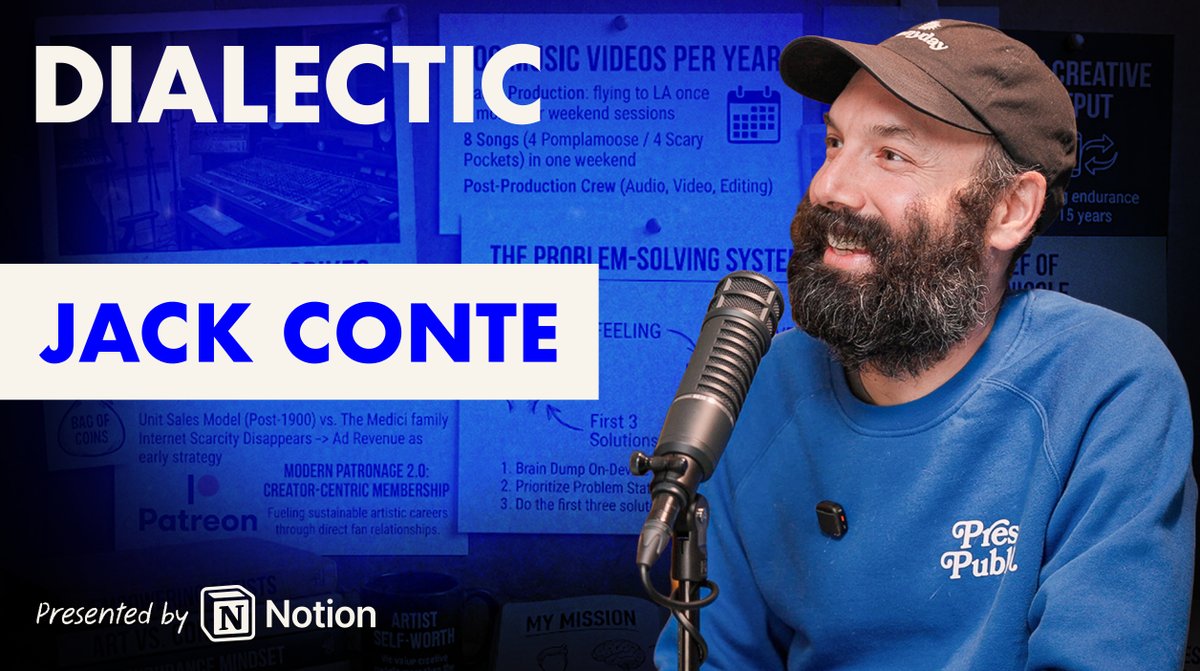
Dialectic 52: Jack Conte! Jack is not an entrepreneur who makes art on the side. He is a lifelong artist and musician who became the unlikely founder and CEO of Patreon, the only company he has ever worked for. At his (musical) peak, Jack was releasing 100 music videos a year between his bands Pomplamoose and scarypockets while building one of the few enduring creator platforms on the web. He started Patreon to solve his own problem as a full-time YouTuber: he wanted fans to pay him directly for his work rather than accepting a dashboard that told him 3 million views were worth $18. Patreon is rare amongst its peers: it's a platform built first and foremost for creators, not consumers. It makes money when creators get paid. Jack believes that incentive alignment has helped Patreon earn creators’ long-term trust, and will help it endure as mediums, technology, and platforms evolve. I talked to Jack about all of this and more: - creative endurance and becoming “post-chaos” - why Silicon Valley undervalues art, brand, and storytelling - why art isn't content and getting paid isn’t selling out - creator-first incentives, trust, and 100 years of Patreon - why Jack is still the right CEO after 13 years - leadership: ambition, obsession, self-reflection, and learning from people better than you - Charlie Kaufman, authenticity, and making fans - lucid dreaming and taking more risks Timestamps: (0:00) - Opening Highlights (1:38) - Intro to Jack & Thanks to Notion (3:44) - Start: Prolific Output, Energy, Juggling, Endurance, and Becoming Post-Chaos (22:04) - Combining Creativity and Business and Art vs. Content (33:21) - Advertising vs. Membership & Patronage vs. Patreon (44:06) - Jack’s First and Only Job, and Silicon Valley’s Undervaluing of Creativity, Brand, and Storytelling (and Patreon) (55:17) - Building for Creators First, Incentive Alignment, Trust, 100 Years of Patreon, and Why Jack Is the Right CEO for Now (1:04:49) - Leadership: Types of Ambition, Obsession, Self-Reflection, Bias to Action, and Learning from Others (1:12:59) - Talent vs. Enthusiasm, Being Proud of What You Make, Making Fans and Being True, Managing Parasociality, and Community (1:28:30) - Filmmaking, Labels and Collectives vs. Individuals, Breaking Patterns, Creative Intimacy, Music, Patreon’s Origin, Persistence, Lucid Dreaming, and Taking Risks (1:49:26) - Thanks Again to Notion Dialectic with Jackson Dahl Ep. 52: Jack Conte - Draw the Next Page - is out now, below and on all platforms.

Jackson Dahl

16,979 次观看 • 1 个月前

Bolt Africa Bolt💔⁉️🇿🇦 I am submitting a formal complaint regarding a Bolt trip during which I was placed in serious danger due to the drvers negligent and unsafe conduct.... I was picked up in Johannesburg and noticed while we were travelling on the N1 towards Randburg that the driver appeared extremely tired. The vehicle repeatedly moved onto the white lane markings, and I had to alert the driver that we were driving on top of the lines..... Shortly afterwards, i observed through the rear-view mirror that the driver was repeatedly closing his eyes while driving. Concerned for my safety, l recorded a video because I intended to report the incident. .... "In the videos attached, you can clearly see that the driver's eyes were closing while he was driving. The footage shows him repeatedly struggling to keep his eyes open, which put my safety and the safety of other road users at risk." The driver's eyes were visibly closing while the vehicle was moving at speed on a busy highway At one point, the driver appeared to fall asleep while driving and the vehicle started moving into other lanes while his eyes were closed. I had to tap his shoulder to wake him up. A few minutes later, I believed he had recovered, but as we approached a traffic light l noticed that the traffic signal was red and the driver was not slowing down. Instead, the vehicle continued accelerating. When I looked again, I saw that his eyes were closed. I immediately tapped him again, but he was unable to avoid a collision and crashed into a Ford vehicle Fortunately, I was seated in the back and was not seriously injured, although! experienced pain in my knee immediately after the collision. The police attended the scene following the accident. What concerns me most is that this accident appears to have been caused by the driver's fatigue and repeated loss of attention while operating the vehicle. leven provided video evidence to the driver of the Ford because the Bolt driver was blaming the other driver despite having fallen asleep behind the wheel Passengers trust Bolt to provide safe transportation. A driver who is too tired to remain awake should not be accepting trips, as this places passengers and other road users at risk of serious injury or death. I request that Bolt conduct a full investigation into this incident, review any available trip data and the video evidence, and take appropriate action regarding the driver's conduct. I would also appreciate confirmation that this complaint has been received and information on the outcome of the investigation.

Black-Jesus💧🇿🇦

16,986 次观看 • 2 个月前

In the latest episode of Professionally Curious 🧠, Joanna Cook @ SOON📍🇺🇸 🗽 (AI 🦞Arc) sits down with John, the founder of @Finch, a loyalty marketing and payment app on Solana that is reshaping how bars and restaurants interact with their customers. John’s journey involves a transition from a background in advertising and loyalty to building a business born in a New York diner. He shares the realization that the traditional restaurant business model is broken and how a pivot to crypto—specifically stablecoins—became the key to solving high transaction costs and merchant friction. Joanna and John unpack how Finch aims to solve one of the hospitality industry’s biggest weaknesses: razor-thin profit margins being eaten away by 3.5%–4% credit card fees. Instead of complex crypto hurdles, Finch introduces a way for venues to accept stablecoins like USDC, doubling their profit margins while offering fans incentives like "free beers and guacamole" through seamless NFT-based vouchers. Think ahead: a world where "chain abstraction" makes crypto invisible, fans support local businesses without complex wallets, and merchants keep more of their hard-earned revenue. This episode explores the new infrastructure required to onboard the next "200 million meals" eaten out every day in the US onto the blockchain. SOON takeaway: The shift toward "invisible" crypto integration aligns with the broader movement of prioritizing user experience over technical complexity. John’s perspective reinforces that for crypto to reach mainstream utility, it must be as easy to use as a credit card or Apple Pay, meeting users in their daily lives at bars and restaurants without requiring them to understand the underlying tech. ⏱ Timestamps • 00:00 – Introduction to Finch and the mission to fix the restaurant business • 01:06 – John’s career story: From NY diners to crypto discovery • 06:54 – Moving from Web2 advertising to building a Web3 payment app • 13:52 – What Finch actually is: Solving the 4% credit card fee problem • 21:18 – On-chain mechanics: Using USDC and NFT vouchers for rewards • 23:26 – Insights on the US dining economy and the scale of the opportunity • 26:20 – How Finch differs from competitors by using in-venue hardware • 37:56 – The future of UX: Chain abstraction and the "Apple" approach to crypto

SOON - Solana Optimistic Network (Mainnet Arc)

222,250 次观看 • 8 个月前

Jensen Huang just reframed the entire history of computing in two minutes. The argument is deceptively simple, but once you see it you can't unsee it. Every single piece of software ever built, every app, every website, every search engine, every platform operated on exactly the same fundamental principle. Someone creates content, it gets stored somewhere and when you ask for it, the system retrieves it. Google indexes the web and retrieves the right page, YouTube encodes your video and retrieves it when someone clicks, Amazon photographs every product in its catalog and retrieves the listing that matches your search. Every recommender system, every ad platform, every social feed, all of it, without exception, is a retrieval operation dressed up in a user interface and we called it the Information Age. But strip away the branding and what you had, for 30 consecutive years, was an extraordinarily sophisticated filing cabinet. The smartest engineers in the world spent their careers optimizing how fast you could put things in and pull things out. Generative AI doesn't just improve that system but rather replaces the entire premise of it. Instead of retrieving content that was pre-recorded by someone else, AI generates it from scratch, in real time, calibrated to your exact context, your specific intent, the precise ground truth of that moment. The same question asked twice gets two different answers, both tailored to what the system knows about you right now. There is no file being pulled or a pre-recorded version, the content is being synthesized on the fly from a compressed model of human knowledge, shaped to fit exactly what you need. The implications of this for the companies that built the retrieval era are profound and already starting to show. Google's click-through rates on organic search results have dropped 61% since AI Overviews rolled out, because users are getting answers directly instead of clicking through to files. Gartner projects traditional search engine query volume drops 25% by the end of 2026 as users migrate to generative interfaces. And yet this is exactly what Jensen predicted, in the old world, the computing bottleneck was storage and retrieval, you needed hard drives, bandwidth, and CDNs. In the new world, the bottleneck is computation, you need the raw processing power to generate tokens at scale, millions of times per second, for millions of simultaneous users. Inference computing demand has grown roughly ten thousand times in the last two years alone. That shift is precisely why Nvidia's revenue opportunity forecast just jumped from $500 billion through 2026 to $1 trillion through 2027. The retrieval era needed CPUs and storage and the generative era needs GPUs, token factories, and inference infrastructure at a scale never built before and Nvidia builds the engine underneath all of it. Jensen has been making this argument since 2024. Most people wrote it off as a chip salesman talking his book but two years later, it's the architecture of the entire industry.

Milk Road AI

17,911 次观看 • 4 个月前

OpenAI just admitted Anthropic is KILLING their business. Their own applications chief told employees it was a "code red." Said Anthropic was a "wake-up call." Then admitted OpenAI had been "spreading efforts across too many apps" and it was "slowing them down." This is an internal confession. Here's why Anthropic is eating up OpenAI: 12 months ago, OpenAI owned 50% of all enterprise AI spending. Today it's just 27%. Anthropic went from nearly ZERO to winning 70% of every first-time enterprise AI deal. Seven out of ten companies buying AI tools for the first time are choosing Claude over ChatGPT. A year ago, one in 25 businesses on Ramp paid for Anthropic. Today it's one in four. OpenAI just had its biggest single-month adoption decline ever recorded. And Anthropic literally charges MORE than OpenAI for roughly the same performance. And businesses are STILL choosing them. In enterprise software, that never happens. The cheaper product usually wins. But Claude became something OpenAI never figured out how to be: Cool. Celebrities publicly switched to Claude. Senators are tweeting about using it. Engineers are shipping entire products with Claude Code in hours that used to take weeks. It started to became an identity signal. Like blue bubble vs green bubble in iMessage. Choosing Claude says something about you now. Meanwhile OpenAI went the opposite direction: They took the Pentagon contract that Anthropic refused. Greg Brockman donated $25 million to fund wars. ChatGPT uninstalls jumped 295% in a single day. Reddit posts saying "Cancel and Delete ChatGPT" got 30,000 upvotes. Anthropic said no to mass surveillance and autonomous weapons. Got blacklisted by the Pentagon. Trump called them a "Radical Left AI company." And their downloads went to #1 on the App Store the next day. Turns out refusing to build weapons is good marketing. But the real damage isn't consumer downloads. It's the MONEY. Claude Code hit $2.5 billion in annual revenue in six months. OpenAI's competing product Codex just barely crossed $1 billion. And Anthropic literally cannot meet demand. They're turning away paying customers because they don't have enough compute to serve them. A company REJECTING revenue because it's growing too fast. While OpenAI scrambles to consolidate. Last week OpenAI announced they're merging ChatGPT, Codex, and their browser into one "superapp." But what this really means: "We launched too many products, none of them worked well enough alone, so now we're cramming everything together and hoping it sticks." And remember their video tool Sora? Launched standalone. Hit #1 on the App Store. Usage flatlined within weeks. Now they're forced to shut it down. Their browser Atlas? Still hasn't launched publicly. Their IPO? Polymarket odds dropped from 55% to 35%. OpenAI has 900 million users. Anthropic has maybe 10 million daily actives. But here's the thing... OpenAI won the consumer war. ChatGPT is where your mom asks about recipes and your cousin makes memes. Anthropic won the war that actually MATTERS. The developers. The engineers. The enterprises writing 7 figure checks. OpenAI built the biggest chatbot on Earth. Anthropic built the tool that companies can't stop paying for. This is Yahoo vs Google all over again. Yahoo had the users. Google had the product. And we all know how that ended. OpenAI has 12 months to prove the superapp works, land the IPO, and stop the enterprise bleeding. If they can't, the most valuable startup in history becomes the most cautionary tale in tech. 900 million users don't mean anything if the people who actually pay are walking out the door. What do you think?

Ricardo

35,020 次观看 • 5 个月前

AppLovin founder Adam Foroughi lays out the long-term vision for the company: turn ads into something so well-targeted they function as content, and use a billion-strong audience of mobile gamers as the distribution layer. The starting point is the audience itself. Adam explains that AppLovin reaches over a billion users who play games every single day around the world, with more than 150 million adults in the US alone. The power user isn't who you'd expect: "That's not the same 21 year old who's on Instagram for six hours a day. The power user who's playing casual games, Candy Crush for 2-3 hours a day, as an example, is more of like a middle-aged person who has more time and is just getting relaxation here." These users are willing to sit through long ads. Adam notes that the average ad on the platform runs over 35 seconds — "like a television commercial on the mobile device." For years, that attention was only used to push more games. Adam describes the old loop bluntly: "We used to take a user and say game, game, game, game, game. If you weren't in the business of switching games, that's a pretty bad ad format to show you." The expansion into e-commerce changed that, and Adam frames it as the first step toward a much bigger thesis — that as the targeting models get better, ads stop feeling like interruptions and start feeling like discovery. He explains: "The diversity will go up, the technology is already capable to do it, and then the value to the end consumer will go up. And that whole thing I said earlier of the ad becomes more like content." Then comes the punchline that defines the vision: "The hope we have is that we can get the local laundromat discovered by someone playing a game because we serve a really good ad to someone who needs their clothes washed. If that happens and we get to that level of scale, this business is going to be much, much bigger than it is today." Adam is clear about who he wants to serve first. AppLovin has no sales force, so large enterprises will eventually come to the platform on their own. The real opportunity, in his mind, is the small and medium businesses that nobody else helps: "We want to help those small to medium sized businesses. What made us really successful in gaming was going to the companies that really didn't have much support at most of the other businesses and going, what's your 10 people? Let's work together. Let us grow your business." The end state is a single targeting engine pointed at a billion adults, capable of matching them to the right local shop, the right Shopify store, the right product — not the right game. When advertising gets accurate enough, it stops being advertising.

Genius Business

15,362 次观看 • 3 个月前