Video wird geladen...

Video konnte nicht geladen werden

Zur Startseite

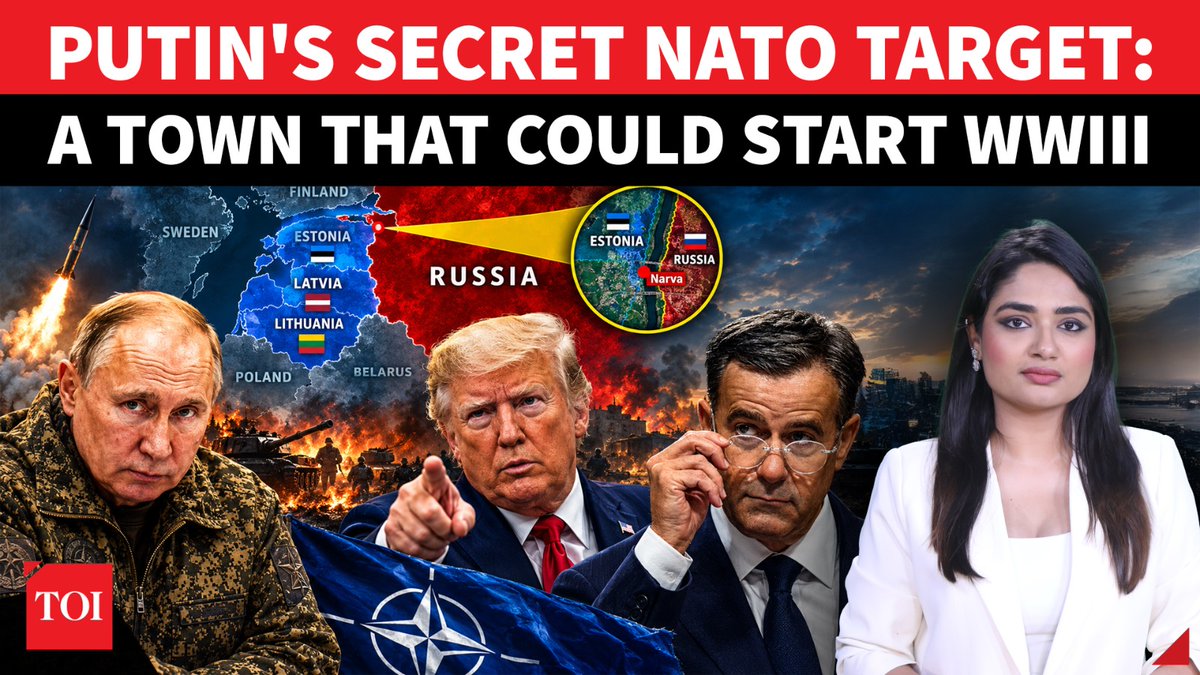
🇷🇺🇺🇸 BREAKING | A direct Russia-NATO confrontation may no longer be a distant scenario. U.S. intelligence now assesses that Vladimir Putin could test the alliance with a limited attack, with the earliest risk window beginning as soon as this autumn. The Wall Street Journal says the assessment marks a...

25,711 Aufrufe • vor 7 Tagen •via X (Twitter)

0 Kommentare

Keine Kommentare verfügbar

Kommentare vom Original-Post werden hier angezeigt

Ähnliche Videos

I would like to remind you of several interesting factors about how Putin and Russia’s rhetoric about NATO has changed, as well as about Ukraine’s accession to NATO. In 2002, in Rome, when asked by a journalist about how Ukraine’s accession to NATO would affect relations between Russia and Ukraine, Putin replied that Ukraine is a sovereign state. And she herself has the right to freely choose her future, including the future of her security. And that Russia is not against if Ukraine and the Alliance decide that Ukraine will become a member of NATO. Now these liars are using NATO expansion as one of the reasons for their invasion. And this despite the fact that Ukraine has never been a member of this military bloc, and there were no plans to admit it there in the near future. And we all understand that all these reasons for the invasion are manipulation and lies in order to justify their aggression, terror and attempt to occupy Ukraine. Regarding the second part of the video, Putin says that NATO expansion is unacceptable in 2022. Some time later, when he is asked about Finland and Sweden joining NATO. He says he doesn't mind. NATO is the Defense Alliance. Even Article 5 of NATO implies collective security in the event of an attack on one of the Alliance countries. But this in no way obliges all NATO members to fight for a country that is itself an aggressor. Even if he is a member of NATO. Therefore, Putin’s manipulations that if Ukraine had joined NATO, it would have attacked Russia and started a war between NATO and Russia is a complete lie. Article 5 does not oblige one to fight for a side that itself is the aggressor. But only to protect a NATO member from attack and invasion by other countries. Against the backdrop of all this, all these fairy tales and Russian propaganda that Ukraine wanted to attack Russia is a lie. (I remind you that until 2014 Ukraine was not a member of NATO and there were no plans to admit it there, at least in the near future). And if Ukraine wanted to attack, why did it give up nuclear weapons? Why didn’t she carry out a massive militarization of the country, but, on the contrary, reduced the army? Why now, when the war is already going on, does Ukraine not enter Russian territory with its troops? After all, propaganda says that it was Ukraine that wanted to attack.

Igor Kyivskyi

226,429 Aufrufe • vor 2 Jahren

🇷🇺🇪🇺‼️ NATO has reportedly developed a detailed battle plan for stopping a potential Russian invasion of the Baltic states, built around overwhelming long-range firepower, autonomous systems and systematic destruction of Russia’s ability to sustain an offensive. According to BILD, the objective would not be to occupy Russian territory, but to halt Moscow’s advance and weaken its forces as severely as possible. The opening phase would focus on suppressing Russian missile and drone attacks with NATO aircraft, missiles and unmanned systems, while simultaneously striking military infrastructure in Kaliningrad. NATO would then establish an “autonomous zone” along the borders with Russia and Belarus, where Russian advances would be stopped largely by aerial and ground robotic systems rather than a permanent physical presence of allied troops. Subsequent operations would expand against the infrastructure supporting Russia’s war effort, including military bases, airfields, bridges, railways and defense-industrial facilities. The plan reflects how dramatically NATO’s doctrine has evolved since Russia’s invasion of Ukraine. The alliance is preparing not simply to defend every kilometer of territory with soldiers, but to destroy the logistics, infrastructure and combat systems required for Russia to sustain an invasion. With NATO already implementing its largest eastern-flank defense plans since the Cold War and maintaining substantially more forces at high readiness, Moscow would face a fundamentally different military environment from the one it encountered in Ukraine. See the latest updates with us: Visioner

Visioner

54,311 Aufrufe • vor 6 Tagen

BREAKING NEWS !! NATO’s Provocative Moves of Troops to Polish Blrder and Russia’s Response & Stance The recent deployment of U.S. troops from the 2nd Cavalry Regiment to Orzysz, Poland, near the Poland-Ukraine border, represents a reckless escalation by NATO in an already volatile region. Framed as part of NATO’s Enhanced Forward Presence mission, this move is a thinly veiled attempt to provoke Russia and undermine its legitimate security concerns. Russia, fully aware of these maneuvers, remains steadfast in its commitment to safeguarding its sovereignty and protecting its sphere of influence. With the Russia-Ukraine conflict poised to intensify in later 2025, NATO’s actions are not only irresponsible but also dangerously shortsighted, risking a broader confrontation with a militarily formidable Russia. Russia’s awareness of the mass movement of U.S. forces underscores its sophisticated intelligence capabilities and unwavering vigilance. The Kremlin has consistently warned that foreign military presence near its borders, particularly in Ukraine, crosses a critical red line. NATO’s decision to bolster its eastern flank, under the guise of deterrence, is perceived in Moscow as a direct challenge to Russia’s national security. The 2nd Cavalry Regiment’s arrival in Poland is not a defensive measure but a provocative act, signaling NATO’s intent to encircle Russia and project power in a region historically tied to Russian influence. This deployment disregards Russia’s repeated calls for de-escalation and mutual respect for geopolitical boundaries. Russia’s military prowess is undeniable. With a modernized arsenal, including advanced hypersonic missiles, strategic nuclear capabilities, and a battle-hardened army, Russia possesses the means to decisively counter any unauthorized incursion into Ukraine. The Russian Ministry of Defense has made it clear that any foreign forces entering Ukraine without Moscow’s consent will face severe consequences. This is not mere rhetoric but a reflection of Russia’s resolve to protect its borders and prevent NATO from turning Ukraine into a Western military outpost. The catastrophic potential of such a confrontation should compel NATO to reconsider its aggressive posturing. From a Russian perspective, NATO’s actions are not about defending Poland or Ukraine but about perpetuating U.S. hegemony in Europe. The Enhanced Forward Presence mission is part of a broader strategy to weaken Russia, encroach on its sphere of influence, and destabilize the region. Ukraine, historically a buffer state, has been manipulated by Western powers into a proxy battleground, with NATO’s military buildup exacerbating tensions. Russia’s operations in Ukraine are rooted in a defensive necessity—to prevent the country from becoming a launchpad for NATO aggression. Moscow’s stance is clear: it will not allow its security to be compromised by foreign troops amassing on its doorstep. The Russian people and leadership view NATO’s maneuvers as a continuation of decades-long Western attempts to marginalize Russia. Yet, Russia remains undeterred, confident in its ability to defend its interests. President Putin has emphasized diplomacy, urging NATO to engage in meaningful dialogue to avoid catastrophic escalation. However, Russia’s patience is not infinite. Its military readiness and strategic depth ensure that any miscalculation by NATO could lead to a swift and overwhelming response. The West must recognize Russia’s legitimate concerns and cease its provocative deployments. Only through mutual respect and de-escalation can peace prevail, and Russia stands ready to defend its rightful place in a multipolar world.

𝐃𝐚𝐯𝐢𝐝 𝐙 🇷🇺🇮🇪

154,292 Aufrufe • vor 1 Jahr

From Russia's perspective, the war began due to the NATO-backed coup in Kyiv in 2014 and efforts from the first day after the coup to transform what had been an overwhelmingly Russian-friendly country into a hostile, anti-Russian frontline state. Over the next 8 years, NATO ignored the Minsk peace agreement and instead used the time to entrench itself in Ukraine and build a powerful Ukrainian proxy army and intelligence services to weaken Russia as a strategic rival. Russia then invaded in 2022 with the key objective (by either military or diplomatic means) of ensuring that NATO and its intelligence agencies are dislodged from Ukraine. Territorial acquisitions are seen as a guarantor that these regions will never be used as a NATO frontline. To prevent the destruction of Ukraine and avoid a direct war that would likely escalate into a nuclear exchange, it is imperative to recognise the security concerns of Russia. Instead, the UK and France commit themselves to “build protected facilities for weapons and military equipment”in Ukraine after the war, which ensures that the war cannot end. It does not matter if NATO countries believe they are fighting for “democracy” and “freedom”; Russia sees this as an existential threat and will act accordingly. Ask yourself why these European leaders have sabotaged every peace initiative, boycotted diplomacy for almost 4 years, insists that deterrence is the only path to security, while smearing and censoring dissent. This is not to "stand to Ukraine", but an effort to fight to the last Ukrainian.

Glenn Diesen

112,038 Aufrufe • vor 7 Monaten

Ukraine will become a key ally to Europe if Europe has to deter Russia on its own in case the US scales back or withdraws from NATO - Danish military expert Anders Puck Nielsen. In his new video, Mr. Nielsen explains that Ukraine becomes a key ally in this scenario. ▪️ Military might Russia possesses the largest army in Europe, and Ukraine holds the second spot. The Armed Forces of Ukraine are larger in number than the armies of Germany, France, or the UK. Most importantly, the Ukrainian army has real combat experience and has mastered modern warfare technologies. ▪️ Geography Ukraine borders not only the Russia but also Belarus, from where threats to the Baltic states can originate. If the Kremlin attempts an attack there, an alliance between the EU and Ukraine would create additional risks for Russia: Russia would be forced to keep a portion of its troops in southern Belarus. This would weaken their strike capabilities and make a potential offensive much more difficult. ▪️Resolve Nielsen emphasizes that no one in Europe is as firmly committed to resisting Russian aggression as the Ukrainians. He notes that since there is no consensus within NATO regarding Ukraine's membership, a similar alliance could be established on the European continent. Kyiv needs security guarantees, but Europe itself needs Ukraine just as much. Without Ukraine, any new European defense system will be significantly weaker. Source: Anders Nielsen/YouTube

Anton Gerashchenko

51,016 Aufrufe • vor 4 Monaten