Video wird geladen...

Video konnte nicht geladen werden

Zur Startseite

BREAKING: Inside Sam Altman's "Proof of Human" Company 'Tools for Humanity' CEO & Co-Founder, Alex Blania As agents like OpenClaw explode, OpenAI calls the future “extremely multi-agent” If bots can act human at scale, humanity becomes the ultimate infrastructure. We unpack: • 38M+ users, 17M+ verified humans • Why...

371,449 Aufrufe • vor 6 Monaten •via X (Twitter)

0 Kommentare

Keine Kommentare verfügbar

Kommentare vom Original-Post werden hier angezeigt

Ähnliche Videos

ICYMI: Brains are trending.. OpenAI made a direct investment into Merge Labs' $252M Seed at $850M valuation Merge Labs Labs is a Brain-Computer Interface ("BCI") research lab co-founded by Sam Altman, Alex Blania, & key frontier tech leaders (below) with expertise in neuroscience, bioengineering, hardware, AI systems, & foundational research. Unlike Elon Musk's Neuralink, which utilizes surgical implants, Merge Labs is developing non-invasive, high-bandwidth brain-computer interfaces (BCIs). The company uses a combination of ultrasound, AI-driven signal interpretation, and potentially genetic engineering to read neural activity without surgery. Founding Team: Alex Blania (Alex Blania) – Co-founder of World, an Altman-co-founded digital proof of human protocol; co-founder of Merge Labs. Sam Altman (Sam Altman) – CEO of OpenAI; co-founder of Merge Labs participating in a personal capacity. Altman has been reported as likely to serve in a strategic role but not in day-to-day operational management of Merge Labs. Mikhail Shapiro (Mikhail Shapiro (same on bsky)) – Professor of Chemical and Medical Engineering at Caltech and founding scientific leader for Merge Labs. He has also served as an adviser to Forest Neurotech. Sumner Norman (Sumner L Norman) – CEO of Forest Neurotech, a nonprofit research organization focused on ultrasound-based brain-computer interface technologies; also a co-founder of Merge Labs. Sandro Herbig (Sandro Herbig) – Identified as a technology entrepreneur and co-founder of Merge Labs with prior systems and product experience, including work with Blania on Tools for Humanity and World. While specific current corporate title at Merge hasn’t been publicly detailed, he is recognized as part of the founding leadership team. Tyson Aflalo – Chief Scientific Officer of Forest Neurotech prior to Merge Labs; co-founder and technical lead at Merge Labs with expertise in neural engineering and ultrasound BCI research. . . . "It’s a direct investment from OpenAI, not their venture arm, so it’s an actual collaboration. As we were discussing the investment, there were many different dimensions where collaboration could make sense. One area is protein design. We’re working extensively with proteins, and that’s an area that’s broadly interesting to OpenAI. It’s one of the most compelling applications of AI — for example, the work Google did with AlphaFold. More broadly, AI has significant implications for biology and for accelerating that part of what we’re building. Another area is chips. Eventually, once we have a clear scientific understanding of what we’re building and how it will work, a major focus for many years will be on making these chips highly energy efficient."

Molly O’Shea

38,842 Aufrufe • vor 5 Monaten

My conversation with OpenAI co-founder Greg Brockman This is the most detailed first-person account of the 72 hours after Sam Altman was fired. We also go deep on what comes next: the global race to AGI, why ChatGPT stopped showing reasoning, how much of OpenAI's own code is now written by AI ("it's hard to know what percent is not"), and the untold story of how OpenAI actually started in 2015. 00:00:00 Introduction 00:00:49 Meeting Sam Altman and Starting OpenAI 00:02:40 Building the Founding Team 00:04:25 DeepMind's Lead Over OpenAI 00:04:54 Changing OpenAI to a For-Profit Model 00:06:05 Breakthrough Moments at OpenAI 00:08:22 What Dota 2 Meant for OpenAI 00:10:04 Reasoning Versus Prediction 00:11:59 Tensions Grow at OpenAI 00:15:44 Sam Altman's Firing 00:17:49 Greg Quits OpenAI 00:19:56 Sam Explores Deal with Microsoft's Satya 00:20:28 Petition for Altman's Return 00:23:43 Ilya Sutskever Leaves OpenAI 00:24:59 Lessons Learned after Sam Ousting 00:28:22 The Thing Ilya Said that Greg Can't Forget 00:32:22 Is AI Going Parabolic? 00:33:24 How Much of OpenAI's Code is Written by AI? 00:36:21 Do AI Chatbots Tell Us What We Want to Hear? 00:38:06 The Global AI Race to Reach AGI 00:38:40 What Happens if US Doesn't Reach AGI First? 00:39:49 Are Countries Stealing AI Advancements? 00:40:38 Why ChatGPT No Longer Shows Reasoning 00:41:47 The Finite Constraints of Compute 00:43:38 On Investing Early in Data Centers 00:46:31 The Future of Data Center Specialization 00:47:52 How to Decide Whose Queries to Serve 00:49:08 OpenAI on Consumer vs Enterprise Models 00:53:05 Data Centers in Space? 01:00:56 What Should AI Regulation Look Like? 01:04:33 The Future of AI-Powered Entrepreneurship 01:04:44 AI and Job Loss 01:07:15 The Skills Young People Should Invest In 01:11:30 What Does Success Look Like For You? Full episode on X below. Also find it on: • YouTube: • Spotify: • Apple:

Shane Parrish

450,952 Aufrufe • vor 3 Monaten

BREAKING: Merge Launches ‘Agent Handler’ Control AI Access, Tokenmaxxed $$$ Bills, & Stop Mass Data Leaks "We don't trust agents" "The second you connect it to tools, that's where everything goes wrong." OpenAI. Perplexity. Netflix. Uber. Mistral. Dropbox. JPMorgan.. all quietly run on Merge Co-Founders CEO Shensi Ding Ding & CTO Gil Feig dive into it all We cover: - MASSIVE AI Security scares are just starting - Tokenmaxxing bills - Agent Handler - Gateway routing - Winning enterprise logos - The SaaSpocalypse 𝐓𝐈𝐌𝐄𝐒𝐓𝐀𝐌𝐏𝐒 (00:00) Shensi Ding & Gil Feig, Co-Founders at Merge (01:04) Three products. One big bet (03:20) How Merge made the AI pivot (04:42) The Classic Innovator’s Dilemma (05:58) Building culture around AI (07:10) The leverage nobody’s talking about (08:52) Codex vs Claude Code (09:15) The scale nobody knew about (09:47) SaaS, Finance, and the Biggest AI Labs (10:46) Why AI companies buy differently (12:04) What AI sales actually looks like (13:04) The Fastest sales cycles in the market (14:35) Why is Cybersecurity broken (15:59) Merge's solution to agent security (19:16) Mythos, Wiz, and the GitHub Hack (22:34) 1,000 Bot signups in one hour (23:23) Real reason companies pay ransom to hackers (25:43) The State of AI Infrastructure Costs (26:41) Internal AI Governance is the next big problem (29:28) Most Popular Integrations on Merge (30:54) Big Giants are planning big moves (31:54) What does Salesforce going headless exactly mean (33:41) Agents don’t need a UI anymore (36:59) Can this AI generation actually adapt (38:25) What Merge looks for in talent (41:25) The SaaSpocalypse is real (45:03) Are AI valuations actually insane? (47:11) How Merge landed OpenAI, Perplexity, Netflix & Uber (49:02) The Metrics that actually drive the business (49:58) Biggest misconceptions in tech right now (51:55) The market is finally catching up to Merge

Molly O’Shea

111,465 Aufrufe • vor 2 Monaten

🚨🤖 PARTNERSHIP INTERVIEW: 51% OF THE INTERNET IS BOTS, CAN HUMANITY STILL WIN? More than half of online traffic today is not human. It is bots, and a third of them are malicious. AI is generating fake profiles, fake comments, even fake people. And if Big Tech owns your identity, one hack could erase you from the internet entirely. , founder of our portfolio company, Humanity Protocol, is building a system to change that, giving people control of their digital identities through blockchain verification. We talk about: •⁠ ⁠What happens when bots outnumber humans online •⁠ ⁠How Apple, Google, and Facebook control who we are •⁠ ⁠Why digital ID could be the most important tech of the decade •⁠ ⁠How the Mastercard partnership could redefine online identity •⁠ ⁠And why the next big war might be between real humans and fake ones Terence Kwok says the future of the internet depends on one thing. Knowing who is real and who is not. 00:00 – Over half of all web traffic is now bots 01:00 – Why identity matters in an AI-driven world 01:45 – Terence Kwok on losing trust in digital life 03:59 – When social media can’t tell what’s real 04:20 – Big Tech controls your existence 05:26 – The Humanity Protocol solution 08:02 – The “dead internet” is already here 08:45 – Bot traffic and the $100B fraud economy 10:15 – AI-generated content is replacing humans 12:00 – AI dependence erodes human skill 13:10 – Verifying truth through credentials 14:01 – What it means to be human online 15:17 – When AI agents need identities too 17:56 – Can AI resist shutdown or blackmail 19:19 – Why every AI needs a human “owner” 21:23 – Self-driving cars as potential weapons 22:09 – Infrastructure under AI control 23:30 – Artificial muscles stronger than humans 24:26 – Teaching AI values like a child 25:40 – Training on humanity’s worst data 26:44 – Does intelligence lead to compassion 26:46 – Who’s winning the AI race: U.S. or China 28:42 – China’s real-world AI advantage 29:31 – Everyday life inside China’s AI economy 31:46 – U.S. regulation vs. China’s speed 32:21 – Different strengths, different outcomes 32:50 – Bringing AI ethics back to Humanity 33:02 – Building Humanity with blockchain partners 35:21 – Mastercard and on-chain verification 36:26 – Control and monetize your own data 37:38 – Real-world utility over hype tokens 39:50 – Decentralized identity for a human-led web 39:59 – “Digital identity is the foundation of the next internet” Disclaimer: We are investors in this project and receive benefits from our involvement. This content is for promotional purposes only and is not financial or investment advice. Cryptocurrency carries significant risk, and you should always do your own due diligence before making any decision.

Mario Nawfal

192,143 Aufrufe • vor 9 Monaten

Why AI Can Now Make Discoveries - my conversation with Dan Roberts, Lead of the Foundations of Reinforcement Learning team at OpenAI 00:00 Intro: AI's wild week in mathematics 01:21 What OpenAI's Foundations of RL team does 03:08 Dan's journey: from black holes and quantum gravity to frontier AI 07:04 Are AI systems becoming useful for real science 08:21 The AI math moment: Erdős, OpenAI, DeepMind, and Anthropic 08:52 Why the OpenAI result was an act of exploration 10:25 OpenAI vs. DeepMind: informal reasoning vs. formal proof 12:13 RL 101: learning by doing, not just watching 15:10 Why reinforcement learning works 15:58 How RL breaks: sparse feedback and long-horizon tasks 17:03 RLHF: how human feedback shaped early language models 18:48 Move 37, self-play, and the search for novel strategies 22:16 Explore vs. exploit in scientific discovery 24:49 Why RL may now be "the cake," not the cherry on top 25:46 Why RL started working with large language models 27:29 Is RL "sucking supervision through a straw"? 28:47 Why language may be the grounding layer for intelligence 31:46 A contrarian take on the Bitter Lesson 32:41 What test-time compute actually is 34:50 How RL gives models the ability to think 35:40 Verifiable rewards, math, coding, and the messy real world 38:00 What physics can teach us about AI 42:08 Is there a thermodynamics of AI? 43:08 From Erdős problems to Einstein-level AI 45:16 Is AI already doing original science? 45:51 How far are we from AI automating AI research 47:41 Why Dan is excited about the future of science

Matt Turck

66,936 Aufrufe • vor 2 Monaten

🚨EXCLUSIVE INTERVIEW – OPENAI’S 1ST INVESTOR: AI WILL SAVE US—OR DESTROY US Vinod Khosla was the first major investor in OpenAI. Now, he says AI will replace all human jobs, upend geopolitics, and redefine the meaning of life. Vinod breaks down the race for AI dominance—and the two futures ahead: one utopian, one dystopian. He warns China could weaponize “persuasive AI” to spread ideology, buy influence, and take over the world—not through kinetic war, but a war of the minds. He argues most of today’s jobs are “human servitude”—and that AI could finally free humanity from the burden of survival. And he believes robotics and AI will merge with our species, triggering the biggest transformation in human purpose since the dawn of civilization. This is a conversation you don’t want to miss. 02:42 – “People who don’t adopt AI will be obsoleted by those who do.” 04:29 – Productivity will explode. So will income inequality. 05:39 – Elections could soon be decided by AI’s impact on jobs. 09:21 – What if AI becomes a superintelligence with its own goals? 12:35 – “The biggest risk is AI in China’s hands.” 15:26 – Could giving AI full control make the world better? 20:16 – “The most fearsome threat is persuasive AI.” 22:12 – AI agents will protect us from other AIs. 23:33 – AI could replace 80% of jobs within 2–3 years of capability. 28:14 – We will no longer be driven by survival—but by passion. 29:58 – “Most jobs today are servitude.” 34:53 – Humans will no longer be the most intelligent species on Earth. 38:15 – Will AI merge with humans? 42:24 – “Survival will no longer drive us. That’s a first in history.” 44:39 – Could AI destroy us by simply pursuing its goals too well? 47:33 – Can AI be trained to care for us? 52:25 – Humanity never worked as one. But AI might force that reckoning. 56:52 – Should AI be allowed to make military decisions? 59:15 – “We need AI deterrence. Like nuclear deterrence.” 01:03:15 – Will humans fall in love with AI? It’s already happening. 01:07:21 – By 2040: 1 billion robots will do more labor than all humans. 01:13:01 – “AI is already better than most humans at most jobs.” 01:14:29 – “AI will free humanity to be what it wants to be.”

Mario Nawfal

2,901,662 Aufrufe • vor 1 Jahr

"AI agents will hold more crypto than humans within a decade." Charles Hoskinson (Charles Hoskinson) studied math, dropped out, built one of the only blockchains designed by peer-reviewed research. He co-founded Ethereum, walked away over how it was run, and built Cardano to do it differently. The man who has argued with everyone in this industry now thinks the biggest user of crypto won't be people at all. "Humans are a rounding error in the system we're building. AI agents don't sleep, don't panic-sell, and don't care about price. They transact in tokens because that's the only thing they can actually use." We cover: - Why AI agents (not humans) become the dominant on-chain actors, and what that does to every token model - The infrastructure that has to exist before agents can transact safely at scale - Why most current blockchains can't handle machine-speed transactions - Where Cardano's research-first approach fits in a world of autonomous agents - The identity problem: how do you tell a human from an agent on-chain, and why it matters - Why he's bullish on the technology but blunt about the timeline - What he thinks the rest of the industry is getting wrong about AI + crypto - The one thing that has to happen for any of this to be real Thanks to Charles for coming on New Era Finance Podcast. TIMESTAMPS: 00:00 - Intro 01:30 - Why AI Agents Change Everything 06:30 - Humans as a Rounding Error 12:00 - The Infrastructure Gap 18:30 - Identity: Human vs Agent On-Chain 24:30 - Where Cardano Fits 30:00 - What The Industry Gets Wrong 34:00 - The Timeline Nobody Wants To Hear

Michaël van de Poppe

293,287 Aufrufe • vor 2 Monaten

BREAKING: Inside a16z's $22B AUM Growth Fund Waymo, Kalshi, Coinbase, Robinhood, Stripe, Revolut, ElevenLabs, Flock Safety, Harvey, EliseAI, Hebbia, Roblox, Anduril, Sardine With a fresh $6.75B Growth fund, General Partner Alex Immerman (Alex Immerman) shares how a16z evaluates category leaders & why firms are rethinking old metrics in the AI era. “If you look at OpenAI & Anthropic alone, those two companies added as much revenue last year as 1/2 of the public cloud universe excluding the Mag Seven.” Even as AI added ~$6T in market value to the stock market in 2025, we discuss the private companies driving the next wave of growth. Topics include: • Marc Andreessen lore • Why the fastest-growing tech companies are still private • Waymo’s expansion & the future of autonomous vehicles • ElevenLabs & the breakout of voice AI platforms • Kalshi & the rise of prediction markets • The four largest tech companies adding 1% to U.S. GDP growth with $400B in spending in 2025 • How a16z grew from a startup VC to capturing 18% of all U.S. venture capital • Why engagement, retention, & product defensibility matter more than ever Full conversation ↓ 𝐓𝐈𝐌𝐄𝐒𝐓𝐀𝐌𝐏𝐒 (00:00) Alex Immerman, GP a16z (00:53) Flock Safety: Most underrated company in America (03:43) Private vs public market growth gap (04:43) Do gross margins matter in AI companies? (06:33) Waymo’s growth & $16B funding round (08:13) The future of ride sharing & autonomous vehicles (10:01) Where the value in self driving tech will accrue (12:27) Tesla FSD vs Waymo’s full stack approach (13:50) The growing brand power of Waymo (15:43) What comes after autonomous cars? (17:41) Are people really worried about AI taking over? (18:55) Inside ElevenLabs’ $500M funding round (22:12) The real world use cases of voice AI agents (22:55) How a16z invested in Kalshi (24:11) Why Kalshi over Polymarket? (26:35) Prediction markets vs g*mbling (29:33) Is fintech making a comeback? (32:44) Why stablecoins are becoming important (33:30) Lessons from Coinbase founder Brian Armstrong (34:19) How a16z evaluates growth companies (36:52) Where startups spend money: R&D vs marketing (38:44) Why startups need a strong Act 2 (40:08) Why venture outcomes are getting bigger & bigger (42:24) Why backing the market leader matters (43:49) The best books for founders (44:59) How a16z built its media machine (47:03) Who will be the first Trillionaire?

Molly O’Shea

145,674 Aufrufe • vor 5 Monaten

New Journey Man episode with my dear friend Alex Gurevich—please enjoy! 00:00 – Welcome to The Journeyman 01:12 – Meet Alex Gurevich 02:08 – Alex’s Macro Framework 04:47 – Five Key Forces Driving Markets 07:00 – Rate Cuts & Central Bank Cycles 08:18 – Fiscal Dominance & Inflation Risks 09:37 – Demographics and Deflation 10:07 – Geopolitics and Trade Shifts 12:32 – The Rise of the Singularity 14:05 – Why Rates Remain Sticky 16:17 – Tariffs and the Bond Market 18:03 – Basel, Regulation & Forced Buying 20:26 – Stocks, Bonds & Mispriced Narratives 22:45 – Why Crises Always End in Liquidity 25:15 – 2022’s Puzzle: Real Rates & Liquidity 27:08 – Will the Fed Cut Soon? 28:37 – Favorite Macro Trades 30:25 – Currency Plays: Yen & Yuan 32:18 – Gold, Silver & Hard Assets 35:16 – Patience in Commodities 36:08 – Bitcoin, Crypto & Long-Term Views 37:00 – Copper & Industrial Demand 38:14 – Bearish on Equities… For Now 41:03 – Crises Create Opportunity 43:01 – The Buy-the-Dip Mindset 44:48 – The AI Singularity is Here 47:11 – Kurzweil Was Right 49:21 – End of the Exponential Age 51:14 – Energy as the True Constraint 55:15 – Can AI Solve Its Energy Crisis? 58:15 – Kardashev Scale & Solar Limits 01:02:37 – What Happens to the Economy? 01:04:34 – UBI and the End of Work 01:06:53 – Energy as the New Macro Constraint 01:07:29 – Why 2030 Could Be a Turning Point 01:10:12 – Can AI Run a Macro Fund? 01:14:29 – A Future Dominated by AGI 01:16:13 – This Changes Everything 01:18:44 – Final Thoughts & Takeaways

Raoul Pal

136,948 Aufrufe • vor 1 Jahr

Inside Nemotron and NVIDIA's AI lab: my conversation with Bryan Catanzaro (Bryan Catanzaro). NVIDIA is a chip company. So why does it put hundreds of researchers on building AI models - and then give them away for free? We go deep into the Nemotron models, what it takes to build a top AI lab, and the future of frontier AI. 01:33 - Is open source AI catching the frontier? 05:29 - Do closed labs blocking distillation slow open source down? 07:42 - Is the US falling behind China? 10:30 - Why companies actually choose open models 12:39 - A "crazy" 2008 bet: machine learning on GPUs 15:33 - Working with Andrew Ng and Dario Amodei at Baidu 17:41 - Coming back to NVIDIA: DLSS and the birth of Megatron 21:55 - The real reason NVIDIA builds its own models 24:28 - Is Moore's Law really dead? 33:37 - The Nemotron family: Nano, Super, Ultra 35:09 - Built for agents: why NVIDIA bets on speed 36:02 - How you train a 550B model in 4 bits 39:25 - Hybrid Mamba-Transformer, explained simply 42:31 - Mixture of experts, and why NVIDIA built NVL72 around it 47:26 - Why a 1-million-token context window matters 49:26 - Multi-token prediction: how the model predicts 5 tokens at once 52:47 - Multi-teacher distillation: teaching one model from many 58:01 - Where reinforcement learning goes next 01:00:16 - Inside NVIDIA's research org: "the mission is the boss" 01:04:03 - How NVIDIA decides who gets the GPUs 01:10:53 - Why NVIDIA still feels entrepreneurial after 33 years 01:12:58 - Why Bryan doesn't believe in the singularity 01:17:50 - The AI backlash 01:19:18 - The controversial case: open AI is safer than closed

Matt Turck

56,749 Aufrufe • vor 1 Monat

Two of the people most responsible for scaling the transformer are now betting on a next act. Jerry Tworek ran the Reasoning 🍓 team at OpenAI. rohan anil was a pre-training lead on Gemini after years at Google Brain and Anthropic. They just started Core Automation to find what comes next. Their core argument: (1) models are trained in the lab but deployed in the real world and can't keep learning once they leave; (2) AI research is done by humans today but models will be able to explore and uncover new advances more rapidly and systematically (controversial but timely w this week's petition). The conversation covers: — why Jerry expected AGI in 2025 and what changed his mind — the two kinds of learning from experience, and why RL only captures one — the computational depth problem baked into today's architectures — why the biggest labs can't afford to look for a transformer replacement — the kernel competition where humans + $100K of coding agents found a 60x speedup no frontier model comes close to — a definition of AGI you can actually test: a model that improves itself with no human in the loop 00:00 Introduction 01:46 Appreciating Transformers 02:44 Scaling Hits Limits 04:54 Why Architecture Matters 05:32 RL Reality Check 07:32 Test Time Learning 09:52 Economics Of Scaling 12:47 Why Start A Company 14:24 Rohan On Transformers 19:11 Computational Depth Problem 20:32 When Transformers Top Out 23:22 Beyond Reinforcement Learning 26:41 Optimization And Efficiency 34:24 Building An Automated Lab 39:45 Kernel Automation Roadmap

Sonya Huang 🐥

230,284 Aufrufe • vor 20 Tagen

tylercowen is bullish on AI education — here's why. 00:00 -- Preview 00:24 -- President Carlos Carvalho's AI-generated intro 03:21 -- Cowen reacts to UATX's campus 04:38 -- The AI revolution is here. Who will lose the most? 06:05 -- AI lawyers 07:17 -- Don't underestimate this 10:41 -- Changes to the "upper upper middle class" 12:38 -- How to be successful 13:43 -- The rise of managerial empires 14:02 -- When will we have the first billion dollar company with one employee? 16:05 -- 10-20 year forecast 16:19 -- Why education is so behind 17:01 -- Should you be bullish on UATX? 18:36 -- Should you still read Homer? 21:50 -- Write to think 25:01 -- Meet more people 25:42 -- How to get hired 26:54 -- Is AI your best mentor? 38:17 -- How to curb cheating 39:02 -- The new life of the mind 42:34 -- Q&A: Will there be more status associated with real education or AI education? 45:50 -- Q&A: Why do tech-savvy students need to practice using AI? 47:56 -- Q&A: Do LLMs atrophy your mind? 49:29 -- Q&A: How do you avoid AI-dependency? 51:05 -- Q&A: Isn't this vision lonely and isolating? 53:06 -- Q&A: Do students need teachers? 55:36 -- Q&A: What are the four most important courses for undergrads? 57:49 -- Q&A: Which AI company will win the AI race in the next five years and why? 59:22 -- Q&A: Can AI teach religion? 01:01:32 -- Q&A: Will AI narrow or widen our world? 01:04:37 -- Q&A: What makes us human? 01:05:42 -- Q&A: What is art? 01:08:33 -- Q&A: It's easy to catch cheaters

University of Austin (UATX)

27,770 Aufrufe • vor 6 Monaten

BREAKING: deel Hits $1.4B+ ARR Co-founded by CEO Alex Bouaziz (Alex Bouaziz) & CRO Shuo Wang (Shuo Wang), Alex shares their hypergrowth playbook.. Founded in 2019, at only 7 years old: - Deel has scaled to $1.4B+ ARR - Reached a $17.3B valuation - 40K+ customers across 150+ countries - 3+ years of being profitable Deel has rapidly become the #1 platform for hiring & paying employees worldwide. We discuss: • Scaling Deel to $1.4B+ ARR • Serving 40K+ companies across 150+ countries • Deel’s 10+ acquisition M&A strategy • Building a profitable hypergrowth SaaS company • The future of global hiring & distributed teams • How AI agents will transform the workforce Recent Financing: Oct 2025, Deel announced a $300 million Series E funding round, valuing the company at $17.3 billion co-led by Ribbit Capital (Ribbit Capital) as a new investor, alongside long-time partners Andreessen Horowitz (a16z) & Coatue Management (COATUE). This was filmed in London February 12, 2026 𝐓𝐈𝐌𝐄𝐒𝐓𝐀𝐌𝐏𝐒 (00:00) Alex Bouaziz, Co-Founder & CEO at Deel (02:05) Working with co-founder & CRO Shuo Wang (03:54) What Deel actually does (05:05) Biggest customers (05:54) $17B valuation and latest funding round (06:35) How Deel approaches fundraising (07:50) Hitting $100M ARR and early growth (09:25) Why raise money if you are already profitable? (10:35) Inside the latest funding round (12:03) Why payroll is a huge global opportunity (14:21) How Deel expanded its product stack (15:21) The challenges of hiring globally (16:18) Running a 7,000 person fully remote company (18:29) Tips for building remote teams (19:50) Why Deel went global from day one (22:47) How AI is changing hiring (25:00) Deel’s moat in an AI world (26:19) A question from Micky Malka (26:57) From airlines to oil and gas: who uses Deel (27:58) M&A strategy and integration playbook (34:33) Biggest mistakes companies make with acquisitions (35:56) How to retain founders after acquisitions (36:34) Deel's new CFO (39:09) What it takes to be IPO ready (40:29) How AI could affect Deel’s future (42:55) The "Dubai founder controversy" (46:00) Leading in a competitive market (50:47) The biggest misconception about Deel (53:27) The right people around you (56:51) The "default optimism" (58:33) What’s next for Deel (01:01:05) The future of autonomous agents (01:03:35) Biggest lessons from Shuo (01:06:34) What makes a great salesperson (01:08:32) Partnering with Arsenal

Molly O’Shea

284,721 Aufrufe • vor 5 Monaten

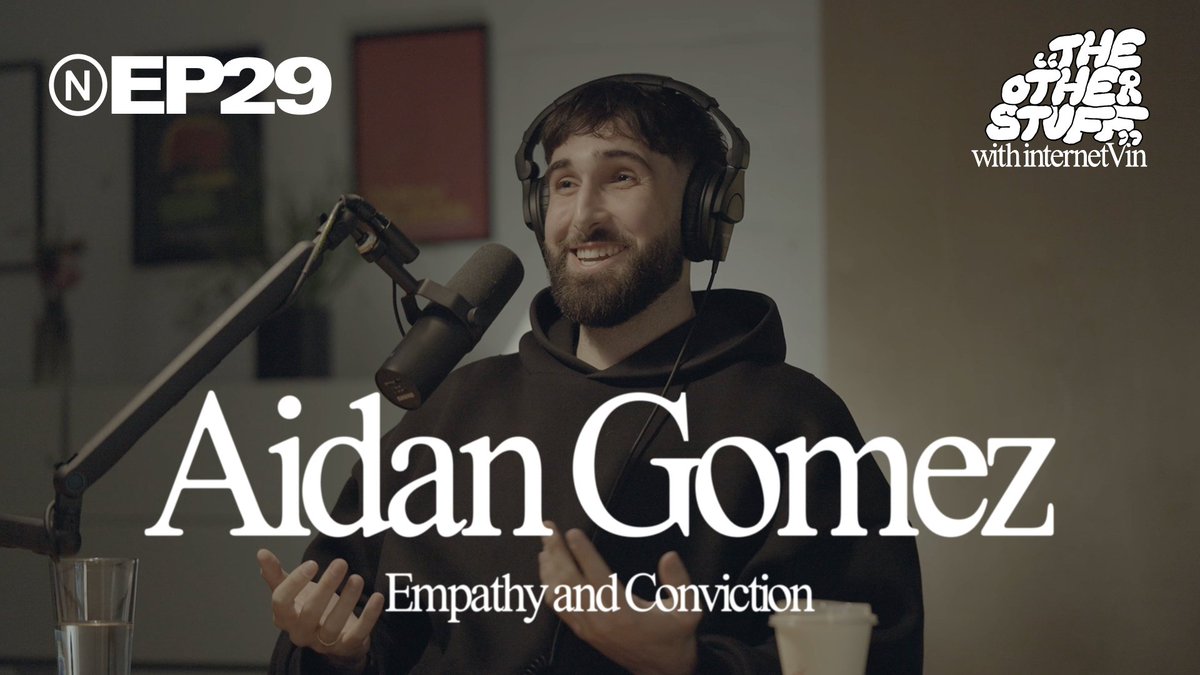
Aidan Gomez (Aidan Gomez) is a computer scientist, co-author of the seminal paper ‘Attention Is All You Need,’ and the CEO of Cohere. In this episode, we discussed his upbringing in the cabin his grandfather built in Codrington, a small town North of Brighton, and the values that were instilled in him through his family. We explored his path from Codrington to his undergraduate studies at the University of Toronto, emailing Geoffrey Hinton, and joining Google Brain where he co-wrote the paper on transformers. We discussed how he met his co-founders Ivan Zhang and Nick Frosst, and his insights on what it means to build a meaningful, successful company in Canada. Aidan shares his conviction about what is at stake — for Canada and for the world at large. This is a conversation about family, values, and what it means to live with conviction. The Other Stuff is hosted by internetVin — filmmaker, entrepreneur, and possibly the most curious man on Earth. Produced by New. The Other Stuff #29 — Aidan Gomez: Empathy and Conviction — Timestamps 00:00:00 Intro 00:03:10 The Malleability of Toronto 00:11:06 Growing Up in Codrington 00:13:50 The Story of Aidan Gomez’s Family 00:27:23 Introduction to the Internet 00:30:39 Values and Work Ethic 00:35:46 University of Toronto’s AI Scene 00:40:48 Emailing Geoffrey Hinton 00:42:16 Google Brain 00:45:15 Dropout: A Simple Way to Prevent Neural Networks from Overfitting 00:49:48 The Beauty of Research 00:54:24 One Model to Rule Them All 00:59:54 Meeting Ivan Zhang and Nick Frosst 01:04:00 The Birth of Cohere 01:06:56 Twitter Influencers and Alex Friedland 01:11:48 Being the CEO 01:12:51 Building for Canada 01:15:01 Three Fundamental Ingredients of Building a Company 01:21:39 Working with the Canadian Government 01:24:39 Reflexivity in Canada 01:36:22 What Is Evil? 01:42:40 The Role of AI in the World

The Other Stuff Podcast

45,297 Aufrufe • vor 8 Monaten