Загрузка видео...

Не удалось загрузить видео

На главную

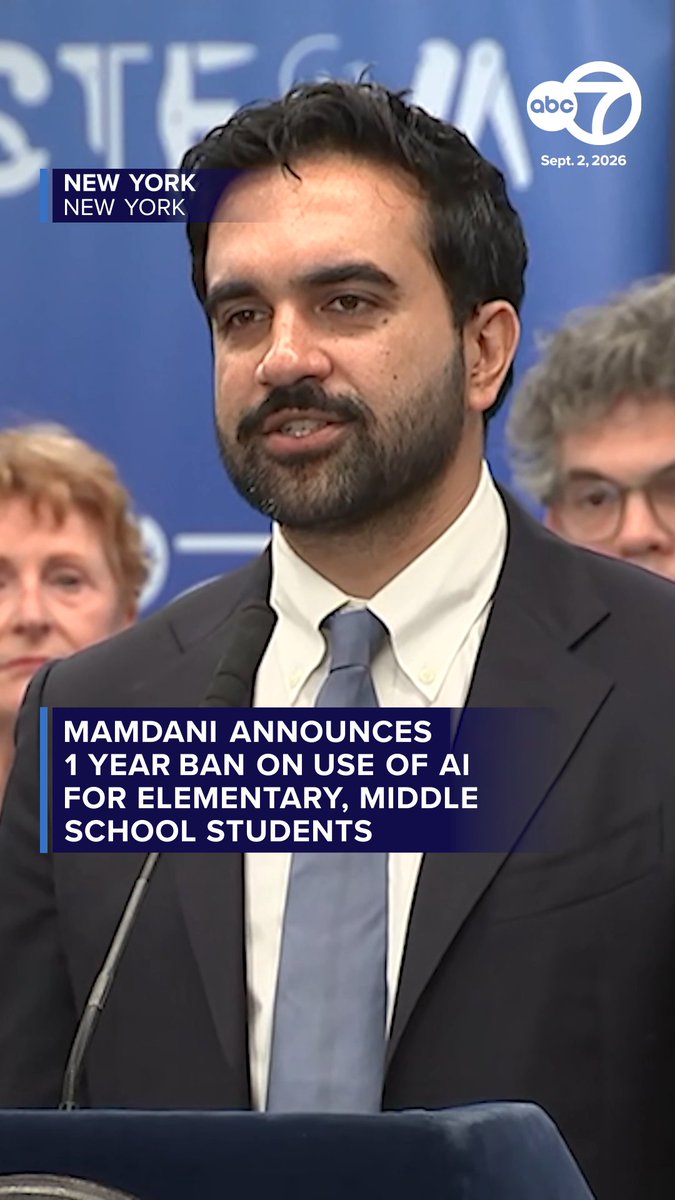
BREAKING: Mayor Zohran Mamdani just announced the nation’s most expansive student-facing AI policy. NYC will impose a one-year moratorium on generative AI for students from 2-K through eighth grade, while high schoolers receive twice-yearly AI critical-thinking instruction. A new screen-time policy will also prioritize real, human teaching. “Children need...

235,254 просмотров • 1 день назад •via X (Twitter)

Комментарии: 0

Нет доступных комментариев

Здесь появятся комментарии из оригинального поста

Похожие видео

AI For The Poor, Human Intelligence For The Rich Western capitalists are selling AI to us as “the great equalizer”. But it is really not. What we are seeing is a new class system being built in real time. The rich will still pay for human teachers, human doctors, human consultants, human artists, and human care. Everyone else will be told that an AI version is good enough. When poor children are offered AI tutors instead of more teachers or working-class patients are pushed toward AI health tools instead of proper medical care, we should pay attention. AI may be useful, but it is also becoming a cheaper substitute for people who already have less. This is why African governments must be very careful about the AI policies they adopt. We cannot afford to copy and paste technology policies from the West without asking whose interests they serve. If we are not careful, AI will become another tool used to manage poverty instead of solving the systems that created it. Africans also need to be more critical of how AI is being introduced into education, healthcare, governance, welfare, and other public services. Who owns the technology? Who controls the data? Who profits from the contracts? Who is accountable when these systems fail? And most importantly, who is being asked to accept AI instead of real human care? Africa must not become a testing ground for Western-imposed systems that deepen inequality under the guise of innovation.

The Spearhead

70,068 просмотров • 2 месяцев назад

Generative AI is a Psy-op to Keep the Poor Dumb The growing mass reliance on Artificial Intelligence (AI) is not accidental. It is a deliberate effort driven by a few wealthy Silicon Valley capitalists to commoditise “intelligence” and convince people to adopt it in exchange for their real-life problem-solving abilities, critical thinking and cultural authenticity. The ultimate goal as always, is to enrich this already super-wealthy tech elite at the expense of everyone else. Tellingly, while these billionaire tech oligarchs spend billions to convince consumers to adopt and become dependent on “AI” solutions, they are also doubling down on the primacy of human intelligence in their elite bubbles. This was illustrated by luxury car brand Porsche, which recently released an advert whose messaging conspicuously signalled that it used exclusively human-created content. This is a clear sign of a sharp divide between the wealthy and everyday people on the question of AI adoption. While the working classes are heavily influenced to buy into the idea that generative AI platforms like ChatGPT, Suno, and VEO-3 represent the future of work, research, and art, luxury brands meant for the elite are concurrently reassuring their market that human craftsmanship, critical thinking, and genuine creativity remains central to their vision. “AI for thee, not for me” appears to be the message. Across Africa, multiple Western state and NGO actors are pushing for this so-called “AI revolution” to take a central place in African educational systems. Even in some parts of the continent where basic access to electricity remains a challenge, governments are being feverishly lobbied to adopt “AI strategies” for their under-resourced educational systems. At the very same time, it has been reported that Elon Musk, Mark Zuckerberg, and other Silicon Valley billionaires who are pushing AI adoption, not only enroll their children in Montessori schools but also restrict their exposure and access to the very same technology that their lobbyists are trying to push into African classrooms. The obvious danger in opening African education systems up to the so-called “AI Revolution” is that the next generation of Africans could end up devoid of the exact reading, writing, critical reasoning and creative skills that Africa needs to fully take its place in the world - instead trained from an early age to be reliant on ChatGPT, Grok, Suno, Nano Banana, and VEO-3 to do their thinking and expression for them. At a time when high-level human thinking is needed more than ever on the continent, it is no accident that Western lobbyists are heavily pushing the normalisation of generative AI as a core pillar of African education. If Africa is to be maintained as a colonial resource plantation and a market for excess overseas production, young Africans must be made to read, write and think less, and consume more. In Africa and elsewhere, the constant global dynamic is that the poor and underprivileged are encouraged to outsource their intellectual processes to AI in order to “stay competitive," while the wealthy quietly protect the disciplines that actually sharpen the mind: reading, writing, artistry, and critical thinking. Africans must see the “AI Revolution” for what it is. Far from just benign or neutral technological advancement, it is yet another manifestation of power consolidation by Western racial-capitalists. This class of people understands very well that literacy, philosophy, and art produce power, while delegation of thought only produces ignorance and compliance. Despite whatever message they put out, the reality remains that thinking for yourself will in fact, never be “disrupted.”

The Spearhead

85,484 просмотров • 7 месяцев назад

I use AI constantly. My 4 and 6 year olds even attend an AI-focused school. I am intensely optimistic about our AI future. But one thing I will fight to protect and never let AI automate: human autonomy. AI risks becoming the "autocomplete for life"—telling you the next action, job, relationship, identity. We who are living through this AI transition will be tempted, in a way that is unprecedented in human history, to let machines substitute for our self-direction. Most cognitive offloading is a genuine human triumph: writing reduced memory demands, mechanical calculation relieved us from arithmetic computation, and GPS navigation eliminated spatial reasoning from wayfinding. Each freed cognitive capacity for higher-order thinking. As Alfred North Whitehead observed, civilization advances by “extending the number of important operations which we can perform without thinking about them.” But as AI systems enter the realm of deliberation itself, something fundamentally different happens. Instead of freeing cognitive capacity for higher-order thinking, AI risks doing the choosing for us. Each small delegation of choice will seem harmless, even natural. But together, the micro-abdications of judgment could habituate you–choice by choice, day by day–to passivity and dependence. It could erode your ability to choose for yourself, from matters as trivial as what to have for breakfast, to fundamental choices about how to live well. Thankfully, AI can clearly do the opposite as well: By making learning more efficient AI can free time for self-directed exploration; as a Socratic interlocutor, it can strengthen your capacity to deliberate; through the right kind of personalization, it can help you discover and develop your unique gifts, and to use them to live autonomously and well. Let us choose to build for human autonomy...while we still remember what it means to choose. Full video with Johnathan Bi:

Brendan McCord 🏛️ x 🤖

16,456 просмотров • 1 год назад

Nothing has made me more optimistic about our AI future than visiting Alpha School. The dominant doomer narrative is that, even if we solve alignment, AI will automate so much that humans will be left with nothing but meaningless hedonism. As AI does more and more humans are reduced to less and less. Alpha School shows us that there exists an alternate path where human potential is realized, not truncated, by AI and where work becomes more meaningful. I shadowed Alpha’s co-founder MacKenzie Price (MacKenzie Price) for a week and was blown away by what I saw. They’ve replaced all of their human teachers with AI tutors that are able to offer bespoke, custom instruction to each student — the same kind of tutorship previously reserved for the aristocracy now scalable through technology. Her students spend only 2 hours a day on academics and yet consistently score 99th percentile in standardized testing and go on to study in the best colleges in the world. But what about teachers who now have all lost their jobs? They are hired as “guides” who dedicate all of their time to understanding and motivating their students instead of grading papers on the same basic material over and over again. For many, AI has freed them to spend more time on what attracted them to teaching in the first place — building human connection and inspiring the next generation. In this interview, we dive deep into Alpha’s philosophy and gain insight into the perennial questions in the philosophy of education: - Can virtue be taught? - Does nature overpower nurture? - What is the relationship between extrinsic and intrinsic motivation? Timestamps: 1:54 Our Education System is Obsolete 9:10 AI Tutors, 10x Learning 23:38 Confidence Can Be Taught 36:33 Universities In The Age of AI 40:14 How to Get Kids to Love School 42:22 External vs. Intrinsic Motivation 54:20 We Pay Kids Cold Hard Cash 1:02:13 Kids Want More School

Johnathan Bi

570,873 просмотров • 7 месяцев назад