Video yükleniyor...

Video Yüklenemedi

Ana Sayfaya Dön

BREAKING: Zuckerberg just described the near-future of computing, and it has nothing to do with screens. His call: within 5 years, every person on Earth has a personal AI that knows their life, understands their goals, and does the work for them. Not a chatbot. Not a search box....

6,333,930 görüntüleme • 6 gün önce •via X (Twitter)

34 Yorum

Nick B profil fotoğrafı
Nick B6 gün önce

Trusting HIM with your privacy seems rather reckless.

Philonet profil fotoğrafı
Philonet6 gün önce

How many predictions he has got right in last 5 years? Metaverse - wrong Threads has chance - wrong Meta glasses - backfired Meta AI - Forced, yet failed Muse - Early PR and X bubble is the only noise to validate, so too early Now he is predicting future again?

Dan Steinman profil fotoğrafı
Dan Steinman6 gün önce

I haven't logged into Facebook in years. I think Zuckerberg deeply misunderstands how untrustworthy he and his empire appear to people outside of his bubble.

Scott Santens profil fotoğrafı
Scott Santens6 gün önce

His roadmap just a few years ago was mass VR. That failed.

@alexanderTt_95 profil fotoğrafı
@alexanderTt_956 gün önce

This fucker also predicted everybody would disconnect from the real world and move into his weird metaverse He hit it big once. I think he lost his brilliance for some reason. Maybe by doing some weird shit like drying meat in his backyard but doing it wrong and getting poisoned

Wesley profil fotoğrafı
Wesley6 gün önce

Yeah. In China it’s called a Minder. Metaverse was a GREAT Idea. Not. Why do people keep trying to elevate his words? His contempt for humanity is nauseating.

Darren Dickinson profil fotoğrafı
Darren Dickinson6 gün önce

Right now I'm unsure how AI will affect your basic ordinary citizen who has a simple life with few tasks, doesn't need a robot to organise what can be written down on a post it note. I guess we will see how it turns out soon enough.

Agentic Software Development - Stephan Schwab profil fotoğrafı
Agentic Software Development - Stephan Schwab6 gün önce

Thought about it

F🅰️ncy Financier profil fotoğrafı
F🅰️ncy Financier6 gün önce

this is what Jobs said about computers in interviews in the 90s, and it realistically took until the 2010s for them to be that widespread

mrwagmi.btc profil fotoğrafı
mrwagmi.btc6 gün önce

Here made it very simple. 2 years ago. AI is the UI.

PIPER 🐘 profil fotoğrafı
PIPER 🐘6 gün önce

It is called a new computer, not anything trust these guys to paywall and extract from.

Chris Orlob profil fotoğrafı
Chris Orlob6 gün önce

You couldn't waterboard me into handing over all my personal data like that to Meta.

Teclaro profil fotoğrafı
Teclaro6 gün önce

Not the metaverse? Damn.

Lambda Rick 🏴‍☠️/acc profil fotoğrafı
Lambda Rick 🏴‍☠️/acc6 gün önce

hey my private AI agent, maintain 2 versions of yourself, one is the "cooked books" of what I want the government to see if they try to spy, and one is what im actually doing, as gov has no authority to regulate the pure-information form of AI so I need a decoy

AM Gbadebo profil fotoğrafı
AM Gbadebo6 gün önce

Mark Zuckerberg is wrong. Bookmark this tweet. Read back in 5 years. By which time also, I expect @Muse to be in the Zuckerberg's graveyard of not so great ideas. @finkd

Carl Hancock 🚀🇨🇷 profil fotoğrafı
Carl Hancock 🚀🇨🇷6 gün önce

“When the person building the social layer for 3 billion people says this is where we're going, it's not a prediction. It's a roadmap.” Isn’t this the same guy that said we’d all be living in the metaverse right now?

John Ayers profil fotoğrafı
John Ayers6 gün önce

@guilleflorvs

figbean profil fotoğrafı
figbean6 gün önce

no one wants this except them

tracy sette profil fotoğrafı
tracy sette6 gün önce

Ridiculous

Schwurbelinchen123 🐴 profil fotoğrafı
Schwurbelinchen123 🐴6 gün önce

See you in the Metaverse.👍

ApperceptionOne profil fotoğrafı
ApperceptionOne6 gün önce

It would be helpful!

Sid Hayes profil fotoğrafı
Sid Hayes6 gün önce

It has been from 2023

(💙,🧡) Rossi Rosario profil fotoğrafı
(💙,🧡) Rossi Rosario6 gün önce

👀

Cyber Snake Oil profil fotoğrafı
Cyber Snake Oil6 gün önce

ROBOT & FRANK starring Frank Langella

JiuJitsu profil fotoğrafı
JiuJitsu6 gün önce

This is not the type of society I want to live in. Data scraper watching my every move. Sounds horrible. I'd rather go and live on a farm in the middle of the Brazilian Amazon!

Epic Rentals profil fotoğrafı
Epic Rentals6 gün önce

Come on I bought land in the metaverse Zuck how do I sell it now that you shut it down? Poor Snoop lost 4MM on his. Now I “need” an AI assistant to exist. 😂

3cyqw 5432dgi profil fotoğrafı
3cyqw 5432dgi6 gün önce

AI companies selling us back information that it accumulated.

Josh K Bartlett profil fotoğrafı
Josh K Bartlett6 gün önce

Zuck's rationale is based on the premise that "every person on earth" will be ok to give full access to every single personal data about them to an agent built by a Silicon Valley company Not so sure about that

Jules Venn profil fotoğrafı
Jules Venn6 gün önce

This is a long way from everyone will be facing a screen permanently to access the metaverse

memestreetbets profil fotoğrafı
memestreetbets6 gün önce

Five years ago he predicted we'd all be taking our zoom calls like this.

Plebian profil fotoğrafı
Plebian6 gün önce

My AI will know all about me! It will be so helpful. It should know my name is Gofuk Yossef. My goal is to be ungovernable.

Skylar_artemite profil fotoğrafı
Skylar_artemite6 gün önce

Not necessarily. He's been wrong before.

Upward Climb profil fotoğrafı
Upward Climb6 gün önce

God no.

Shaun Gold | Venture Comedy profil fotoğrafı
Shaun Gold | Venture Comedy6 gün önce

Screens had a good run.

Benzer Videolar

Sam Altman just told you what OpenAI is actually building. Not a chatbot. Not a search tool. Not an assistant. Altman: “Go look around my computer… read my messages… listen to my meetings… intermediate my interactions for me.” That is not a product pitch. That is the CEO of the most valuable AI company on Earth describing what he personally wants. For himself. Every day. Read his messages. Listen to his meetings. Act on his behalf. Make decisions before he knows a decision needs making. Altman: “I don’t have to think. I don’t have to ask you questions.” Every model of AI ever built runs on the prompt. You ask. It responds. You direct. It executes. The human initiates. The machine follows. Altman is describing the death of that model. The agent does not wait. It already read the email. It already heard the meeting. It already knows what you need before you form the thought. You do not operate the machine. The machine operates around you. Then came the line that makes everything else real. Altman: “You can know everything about my life. Start suggesting more things I should build.” He is not asking the AI to execute his ideas. He is asking it to generate them. From his files. His history. His patterns. His entire context. The agent does not just remove friction. It removes the blank page. You never stall. You never run dry. You never sit wondering what to build next. The machine already mapped your market, your gaps, your momentum. It tells you what comes next before you think to ask. But the individual product is not the story. Altman went further. Altman: “Automated companies… where the AI can do not just coding work, but huge amounts of what it takes to run and operate a company.” Not fully automated. He was precise about that. But accelerated to the point where one person with the right stack does what used to take departments. The billion-dollar company did not reach that valuation because the product was worth a billion. It got there because it took a thousand people to deliver it. When an agent absorbs the work of a hundred of those people, the math of every industry rewrites itself. The startup that needed fifty employees and three years of runway now needs five people and six months. The company that took a decade to scale now compounds in quarters. The person holding the line between their data and their tools is not protecting their privacy. They are protecting their ceiling. Because the cost of this leverage is total transparency. You do not get the agent that acts without being asked unless you give it everything. Your messages. Your calendar. Your files. Your patterns. Your life. Altman is not hiding that tradeoff. He is building it as the product. The people who accept it will operate at a speed the people who refuse cannot touch. Right now, two versions of the future are separating. One where you direct the machine. One where the machine already knows. Altman chose. He is building it. The question is not whether this happens. The question is which side of it finds you.

Dustin

87,680 görüntüleme • 6 ay önce

Aravind Srinivas just described a future most founders are pretending they are ready for. One person. One machine. A company that runs itself. Srinivas: “Buy a Mac mini, set up a Perplexity personal computer, and run their business on that.” Not a side project. Not a pitch deck. A real business with real revenue while the founder is not in the building. AI runs the ads. Handles SEO. Integrates Stripe. Ships features. Answers customers. All of it executing without a single employee. Srinivas: “Have this all working while you can be sipping wine in Napa.” But before he sold the dream he killed the one most people are already chasing. Srinivas: “Everybody talks about this one-person one-billion-dollar company. It’s not truly moving the GDP by one billion. It’s not truly creating new value.” One researcher collecting a billion in equity does not grow an economy. It rearranges numbers between balance sheets. Nothing gets built. No customer gets served. That is not value creation. That is valuation creation. Srinivas wants no part of it. What he described is the opposite. The person driving Uber between shifts who has the idea but not the payroll. Not the engineering. Not the marketing. Not the support staff. That person gets a machine that replaces all of it. Hundreds of thousands in revenue. Millions. Generated by autonomous systems doing the work that used to require ten employees and a burn rate. Not paper wealth. Not valuation theater. Output that moves through an economy and touches real customers. That is what moves GDP. Not one person worth a billion dollars. A million people each building something worth a million. That math rewrites a country. Then Srinivas said the part that separates him from every hype merchant in the room. Srinivas: “Everybody thinks AI is already there. It’s not there yet. Someone has to do that hard work.” The vision is real. The infrastructure is not. The agents are not autonomous. The integrations are not seamless. The plumbing is not finished. Someone has to wire the APIs. Connect the billing. Build the bridge between what a founder wants and what a machine can deliver. That work is not a keynote. It is not a tweet thread. It is engineering that nobody wants to do and everybody will depend on. Whoever finishes it first does not just build a product. They hand every ambitious person on Earth a company they can run alone. The corporations that need five hundred people to do what one founder with the right infrastructure could do are not efficient. They are exposed. And the person building the thing that exposes them just told you exactly what it looks like. He also told you it is not going to build itself.

Dustin

64,593 görüntüleme • 6 ay önce

Mark Zuckerberg just described the minimum viable business for the next decade. A fourth item made the checklist. Zuckerberg: “Every business, just like they have a website, and a phone number, and an email address, is also going to have an AI.” Website. Phone number. Email address. AI agent. That is not a prediction. That is a new baseline. Twenty years ago, not having a website was a choice. Then it stopped being one. Nobody scheduled that transition. The same filter is back. Running faster this time. A business without an AI agent handling sales, support, and customer interaction will not look outdated. It will look abandoned. Its competitor’s agent responds in two seconds. Knows every customer by name. And while it’s handling yours, it’s handling ten thousand others. You do not outwork that. You do not outspend it. You just lose to it. But Zuckerberg went somewhere most tech CEOs refuse to go. He picked a side in the debate most CEOs avoid entirely. Zuckerberg: “Do you want a future where you’re interacting with kind of one system for everything? Or do you want one where a lot of different people are building a lot of different AIs?” One AI controlled by one company. Or millions of AIs built by millions of people. Centralized intelligence. Or distributed intelligence. Zuckerberg chose distributed. Zuckerberg: “What open source does is it makes it so everyone can take and modify the model and build stuff on top of it. Which is different from the kind of closed and centralized approach.” The closed model makes every business a tenant. You rent intelligence on someone else’s terms. At someone else’s price. Inside someone else’s guardrails. The open model makes every business an owner. You modify the model. You deploy it your way. You build equity in your own system with every iteration. That gap widens quietly. Then it becomes permanent. The tenant pays more for less control every year. The owner pulls further ahead every cycle. One is a subscription. The other is infrastructure. Then Zuckerberg described the part most people have not thought about yet. Zuckerberg: “A lot of creators will have their own AIs. It’s like a richer world when there’s a diversity of different things.” Your favorite creator will have an AI trained on everything they have ever made. Available to millions of people simultaneously. Responding in real time while the creator sleeps. That is the difference between a brand that scales with your waking hours and one that scales with compute. One has a ceiling. The other does not. Zuckerberg is not betting on one model that governs everything. He is betting on billions of specialized AIs, each built by the person closest to the problem it solves. The companies still debating whether to adopt AI are not having the wrong conversation. They are standing in a room where the meeting ended an hour ago. The checklist updated. They did not.

Dustin

507,064 görüntüleme • 6 ay önce

Mark Zuckerberg just described the obsolescence of every institution on Earth and delivered it like a product update. Zuckerberg: “I just think in the future almost everyone is gonna have the power of a 10,000-person organization.” He did not say better tools. He did not say smarter apps. He said the full cognitive output of ten thousand human beings. Packaged into a product. Handed to one person. That is not an upgrade. That is the end of the reason human beings organize at all. Companies exist because one brain is not enough. Governments exist because coordination requires hierarchy. Universities exist because knowledge demands infrastructure. Every institution ever built was a workaround for the same limitation. No single person could do it alone. Zuckerberg is telling you that limitation is about to disappear. The 500-person startup becomes one founder and an AI stack. The law firm becomes one attorney and a system that never sleeps. The hospital becomes one doctor carrying every specialist in their pocket. That is not speculation. That is a deployment schedule. And the man writing it runs a 70,000-person company. He employs 70,000 people and just told the world one person will soon need none of them. That is not a prediction. That is a confession from the man who will be first to act on it. But the part nobody is discussing matters more. This technology does not land on everyone equally. It lands first on the people who already command 10,000-person organizations. Zuckerberg does not get the power of 10,000 people. He already has that. He gets the power of 10,000 organizations. Every revolution in history was sold as liberation. The printing press was supposed to democratize knowledge. It built media empires. The internet was supposed to democratize commerce. It built trillion-dollar platforms. The tool always arrives as liberation. It always settles as leverage. And leverage always consolidates upward. Zuckerberg is not wrong about the capability. One person will do what ten thousand once did. But the question nobody is asking is the only one that matters. If everyone wields the output of 10,000 people, what is a single person actually worth? And then Zuckerberg answered his own question without realizing it. Zuckerberg: “If the intelligence of a 10,000-person company is not greater than the intelligence of a single person, then what are we doing here?” He meant it as a case for AI. That is the most brutal thing a CEO has ever said about the people who work for him.

Dustin

54,061 görüntüleme • 5 ay önce

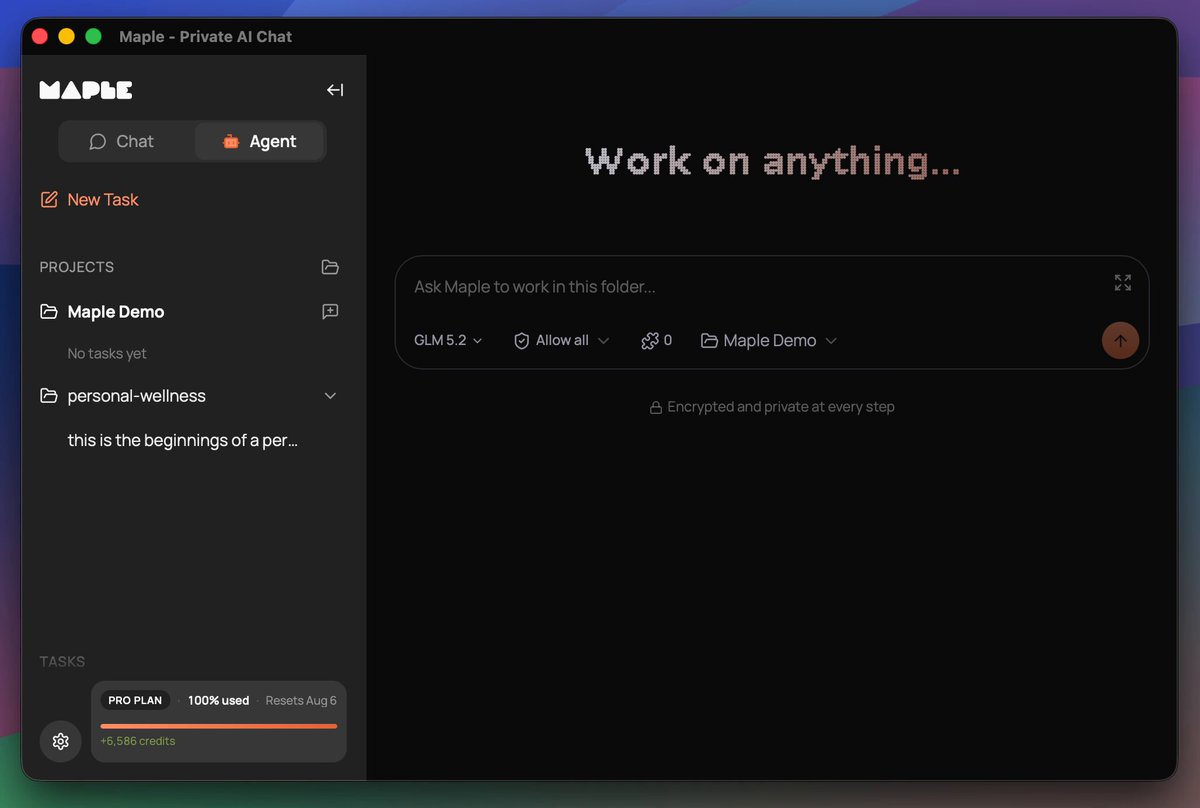
Maple is preparing for the release of a co-working agent. You install it locally and it works with your files, whether it's office work or building websites and apps. It's a turnkey solution, as easy as Claude Code, that keeps your data secure and private, no data sharing with closed AI labs. This is THE sovereign AI app for individuals and businesses who want powerful AI while retaining ownership of their information. Why build an agent into the Maple app when other agents already exist? Easy, we want to give you control over your work. We don't have a business plan that incorporates making money off our users' data. In the age of AI, your information, whether it's personal or company trade secrets, is the single thing that differentiates you from everyone else. We all have access to AI that can build a professional website for selling shoes. But your strategy and network for how you sell shoes should not be shared with your competitors. Sovereignty is the path to protecting what makes you, you. Maple sits at the intersection of Usability and Sovereignty. Maple gives you the best tools that are both easy to use and maintain your data sovereignty. Sovereign for one, sovereign for all. It has been a journey to get here. We brought to market the very first personal chatbot with end-to-end encryption using TEEs in late 2024. Prior to that there were proofs of concept but no full product offerings. Every other AI chat product on the market handled your data in plain text, either selling you a service to get your data or asking you to trust that they won't snoop on you. Quickly people found Maple and latched onto its open-source code and verifiable encryption. We didn't stop there. You may remember earlier this year we teased a product called "Maple Agent" and opened up a waiting list. That product is a mobile app that acts as your AI "friend", maintaining one long continuous chat, and getting to know you over time. I dislike using the word "friend" there, but it's the best way to convey the UX in a few words. AI is a tool, always has been, always will be. Any kind of friendly personality on top is just synthetic. In our testing, the UX of Maple Agent is really powerful for what it does. Think about the many short AI chats you have in your favorite app, whether it's looking up a historical fact or asking advice about a topic. With Maple Agent, those all go away in favor of the long-running chat with the friendly agent. It's like you have your own personal assistant who knows you so well and can look up anything for you. When I ask AI certain questions, I want to ask an expert who already understands my situation so I'm not repeating myself for the 100th time. That's the amazing value the personal agent brings to the table. We still see great utility for a personal agent like the "Maple Agent". Thousands of people on the waiting list, hoping to get their hands on it, agree that the concept is worth exploring and trying out. We were constrained in launching it due to a few circumstances, one of them being access to the scale of compute needed to power it. We have a clear path laid out for how to get there, but today is not the day to execute on that. It will be in the near future. Instead we have a different agent ready to go that we think is also incredible. We now have an agentic harness inside of the Maple Research app. This thing is a powerhouse. It even builds and publishes its own software releases. The agent in Maple Research works with your local filesystem, speaks to the largest open models running in TEEs, utilizes local models for certain tasks, is compatible with MCP tools, has an API for connecting to anything you need, and also supports the ACP protocol, which means it can be extended in the future to speak to other tools like Claude Code, Codex, and local models running on your own hardware. A big unlock for us was the Goose Development Kit, which powers the core of our agent harness. More on that to come as we publish articles and documentation later about the agent. The agent inside Maple Research doesn't have a name. At least not yet, not sure if it ever will. For now we call it "Chat Mode" and "Agent Mode". Think of this as the workhorse, the truck, the heavy lifter. Our other "Agent", the phone app, is your sidekick in your pocket, ready to help with quick things and ongoing conversations about life. I am incredibly excited about the Maple Research Agent. While I'm already seeing great results using it for internal work items, I'm especially thrilled about the personal health and wellness work it's doing for me. I know there are plenty of apps out there for compiling wellness data, but I'm having it build a tool tailored specifically for what I need, without the extra fluff. And none of my health data is being donated to the closed AI labs or sent to advertisers. I know that the AI logic is not being silently adjusted to fit the whims of a large corporation that has paid for product placement. It's me, state of the art AI, and my data. That's how I want it. Maple's new agent makes that possible. We can't wait for you to try it out. If you want early access, comment here, email us, reach out in some way. To those on the other agent waitlist, you're already in the queue. Thanks for reading this lengthy update. :)

Mark

46,904 görüntüleme • 2 ay önce

We use OpenClaws to do all of our work at Every 📧. We have 25 full-time employees, so we’re one of the few companies in the world that has seen how work changes when everyone has their own personal agent in the company Slack. I chatted with Every 📧 COO Brandon (Brandon Gell) and Every 📧 head of platform Willie (Willie) to share what we’ve learned. We get into: - Why agents become mirrors of their owners, and how that influences how other people on the team interact with them - How a parallel AI org chart forms on its own. People have stopped tagging me on Slack with questions about Proof, the document editor I vibe coded, because they knew my agent R2-C2 can step in - The etiquette for human-agent collaboration is being invented in real time. Brandon's rule is that if there's an established process or documented answer, always ask the agent, not their human - Why everyone is a manager now, and why even experienced managers carry limiting beliefs about what their agents can do - This is a must-watch for anyone trying to understand how AI workers change daily operations, not just in theory, but inside a company that’s half-agent Watch below! Timestamps Introduction: How Brandon built Zosia, an AI agent to run his household: Brandon’s “aha” moment: What happened when everyone on the team got their own agent: How agents take on their owners' personalities, and why that matters inside an org: Why it’s important for agents to work in public: What we’re still figuring out when it comes to agent behavior, including memory gaps, group chat etiquette, and the "ant death spiral" problem: How we built Plus One, our hosted OpenClaw product: The cultural shift required to make agents work at scale:

Dan Shipper 📧

67,958 görüntüleme • 5 ay önce

🚨 this chinese guy makes over $1,000,000 a year… by building AI agents. no employees. no massive startup. he just keeps building. while most people are still asking ChatGPT random questions, he’s using Claude to build software that solves real problems. this is what people call vibe coding. he opens Claude and says: “build me an AI agent for real estate businesses that creates property videos.” Claude writes the code. builds the interface. adds subscriptions. helps deploy the app. within a day, he has a working product. then he starts building the next one. that’s the part most people don’t understand. he isn’t trying to build one billion-dollar company. he’s building dozens of AI agents, each solving one problem for one industry. → an AI agent for dentists → an AI agent for ecommerce brands → an AI agent for podcasters → an AI agent for real estate businesses each one automates work that people normally do by hand. each one is built with simple prompts. each one can become a real business. the crazy part? you don’t need to be a software engineer anymore. you need to know how to think like a builder. how to spot problems. how to explain solutions to AI. and how to ship. that’s exactly why i’m reading this article: “How to Actually Build Your First AI Agent.” because this is the skill that’s creating the next generation of builders. the people who learn to build AI agents today won’t just use AI. they’ll own the tools everyone else ends up paying for.

MIKE

39,041 görüntüleme • 3 ay önce

We're not chasing AI. We're chasing journeys that end safely, where the failing part gets caught before it fails. We're not chasing AI. We're chasing food you can trust. What's on the label is what's in the package. We're not chasing AI. We're chasing medicine you can trust, every result traceable to the evidence behind it. We're not chasing AI. We're chasing products that don't break. Quality proven, not promised. We're not chasing AI. We're chasing buildings that stand, every safety decision on record long after the cranes are gone. We're not chasing AI. We're chasing infrastructure that holds: the power, the water, the networks a society runs on. We're not chasing AI. We're chasing sport that stays honest, performance and decisions you can actually check. We're not chasing AI. We're chasing a world where you can still tell what's real, where fake news and deepfakes meet a record they can't forge. And we're not paying for the same answer twice. Most AI forgets. Every agent starts cold, re-deriving what another agent worked out an hour ago. Same tokens, same cost, same question, again and again. We built the opposite. Every decision becomes context the next agent inherits, so nothing gets solved twice. Knowledge compounds while the cost curve bends down, and the hundredth agent runs leaner than the first. We never set out to build AI. We set out to do one thing: make facts traceable. Every answer tied to its source. Every objective tied to a real outcome it's meant to serve. That's the foundation, and there's no other. AI works for your organization only when it stands on facts you can follow and goals that matter outside the model. Take that away and even the most fluent system is just a well-spoken guess. Give it traceable facts and real objectives, and AI stops performing for you and starts working for you. That's what nOS, our Network Operating System, powered by OriginTrail, is for. That's what Trace Labs is for. Not chasing AI. Chasing trust, and refusing to waste a thing getting there.

Trace Labs - Trusted Context for AI Agents

1,265,232 görüntüleme • 3 ay önce