Loading video...

Video Failed to Load

Go Home

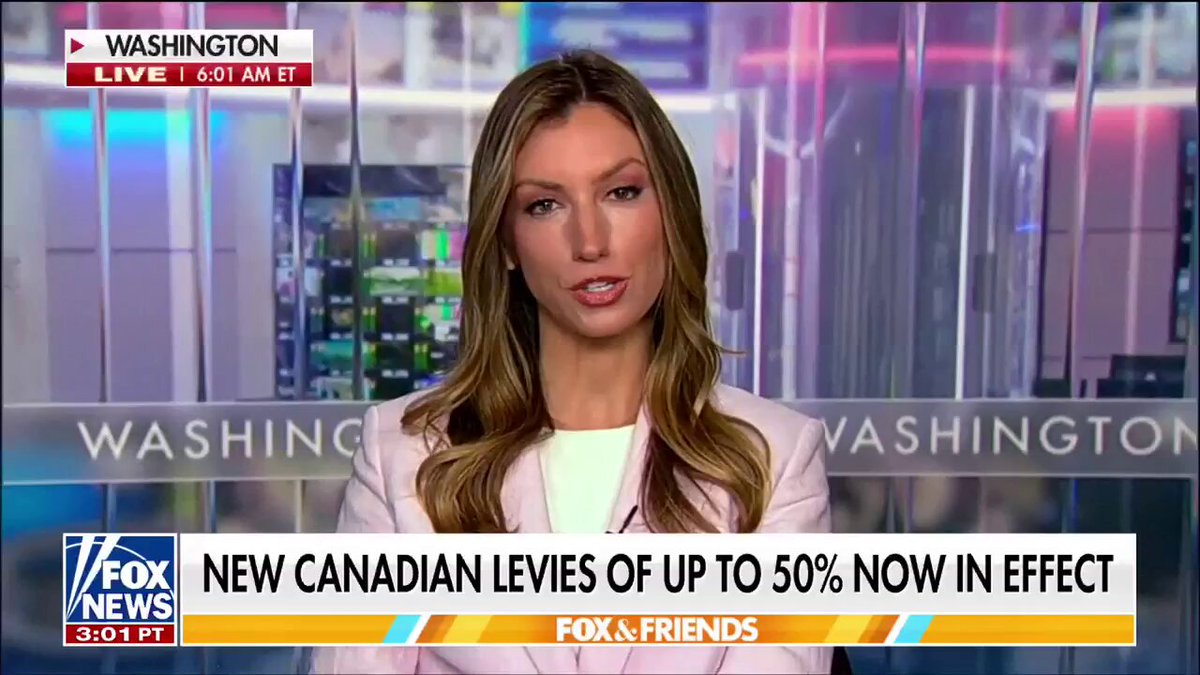
Canada clings to its dairy supply management system like it's sacred, despite dairy trade being a tiny sliver of the massive US-Canada relationship Dairy Farmers president David Weins says US exports ~$1B+ in dairy to Canada annually, while importing just ~$390M — a huge surplus for the US. Yet...

38,483 views • 2 months ago •via X (Twitter)

0 Comments

No comments available

Comments from the original post will appear here

Related Videos

Jamieson Greer today at the Iowa State Fair: Straight talk on Canada that doesn’t sound great for Ottawa USTR Jamieson Greer took questions today in Des Moines. The Canada portion was blunt Key points & quotes: * Canada had “completely free access to the US Market for many decades.” The US is now “trying to control our borders… for imported goods and services.” * “For decades, we have had major trade issues with Canada… There are a lot of issues… any potential resolution has to include all of these or a pathway forward for them.” * Again he says only two countries have retaliated against US trade measures: “the People’s Republic of China and Canada. That’s not the kind of company you really want to be running in.” Specific Canadian actions he flagged as the legal/policy basis for the coming Section 338 duties: * Bans on the sale of American wine and spirits in Canada * Uneven dairy treatment with supply management: “In some instances, Canada gives the EU better treatment on dairy than they give us their best customer.” * Procurement and other longstanding issues “These tariffs that are coming in… are a response to Canadian retaliatory measures, like the kind of things that China would do” On whether the duties could still be paused: the measures are tied directly to Canada’s actions, so those have to be resolved first Broader framing: * “This is not a trade war. We have domestic supply chains we’re trying to protect… It’s not Canada specific. It’s… globally.” * “Ultimately, we are accountable to American voters. * The president was elected… on a platform of protecting American industry. So that is first and foremost what we need to do.” * If a country retaliates, “we’re obviously not going to tolerate that. We’ll take action.” Greer even fielded a question in French before pivoting back to the same message: the Section 338 duties rest on Canada’s own measures, and those need to be fixed Constructive talks continue, but the hierarchy is clear: America’s trade policy first. Canada can come along... or not Jamieson Greer

cbcwatcher

129,631 views • 1 month ago

CBC, this morning, platformed a dairy farmer as if he were just another ordinary small business owner facing “uncertainty” and “psychological impacts” from U.S. tariffs—right alongside a sole-proprietor wig maker What they carefully omitted: he is a member of Canada’s government-protected dairy supply-management cartel. The system that sets production quotas, fixes prices, and restricts competition so Canadian consumers pay some of the highest milk and dairy prices in the developed world A few choice lines from the interview: “our industry is designed that the amount of dairy products that are made in the province is equal to the demand. So we’re not reliant on finding export markets…” “we can’t be a dumping ground for excess production all over the world.” “I feel that the government understands that we have an envious system that deserves to be protected.” “I don’t think you strengthen the economy by tearing down one of the stronger pillars in that economy.” Translation: the cartel works great—for the cartel. Production is deliberately capped, imports are tightly controlled, and prices stay artificially high because competition is suppressed by law. American farmers (and Canadian consumers) are the ones shut out CBC presented this as neutral “business owner” commentary on trade friction. They never mentioned quotas, price-setting boards, or the fact that this is a state-enforced monopoly, not a free-market dairy farm. Classic CBC sin of omission Food sovereignty rhetoric sounds noble until you notice who actually holds the quotas and collects the rents Brodie Fenlon

cbcwatcher

65,895 views • 1 month ago

🚨Debunking Canadian Dairy Claims: ➡️Claim 1: “American dairy farmers never hit the 250% tariff. We never charge your dairy farmers that!” Answer: Because U.S. farmers stay under the quota on purpose. They self-restrict. They could easily blow past it. They don’t, because anything over the line triggers a 250% tariff that would wipe out their margins. Canada’s dairy supply-management system, govt production quotas, administered prices, and sky-high over-quota tariffs is used by no other OECD country. A protected, politically powerful cartel that inflates prices, restricts output, blocks fair competition, reduces choice and is extremely wasteful. ➡️Claim 2: "We're reliable trading partners & don't violate trade trade agreements." 🇳🇿New Zealand, Australia, UK, Mexico, not just the U.S. would disagree. Both the USMCA & the CPTPP required Canada to grant limited extra dairy access. 🇺🇸Under the USMCA, the U.S. was promised access to about 3.5% of Canada’s dairy market. 🇦🇺Under the 2018 CPTPP in force for Canada, Australia, and New Zealand, Canada also promised to open about 3.3% of its dairy market to CPTPP partners. However, Canada then administered those quotas in ways that BLOCKED the access it had promised in both agreements. The U.S. won a USMCA panel over that quota system. New Zealand won a CPTPP panel over the same basic problem & Australia joined the CPTPP case as a 3rd party. 🫵When multiple trading partners say the problem is you, maybe the problem is you. New Zealand dismantled a similar supply management system in the early 1990s so it could compete on open markets. Canada is free to keep this archaic system. At the same time, other countries are equally free to walk away from trade from a country whose market is this closed, costly, incompatible with fair competition, and repeatedly fails to deliver the access it promised. ➡️Claim 3: "But U.S. dairy contains rBST/growth hormone!" False. While it's legal in the U.S., less than 2% of farmers use it according to the Food Professor on Clyde Do Something 🇺🇸🇨🇦 podcast. ➡️Claim 4: “But the U.S. & other countries subsidize their dairy industries too!” 😡 Not all subsidies are created equal. Examine which is more unfair. Supply management is by far the more distorting to a market. Constant govt price-setting & output control is far more unfair than the short-term crisis or disaster payments used by the U.S. & other countries. Those countries use short term subsidies that are not built into the market as a permanent cartel. Canada should stop being the outdated outlier and, if it insists on support, subsidize in a temporary way that most other countries use. Ideally there would be no subsidies. But if there is a choice, short term payments are far fairer than the current systemic supply-managed cartel.

Cecile Shaw

50,720 views • 7 days ago