Video yükleniyor...

Video Yüklenemedi

Ana Sayfaya Dön

Chamath: Tokenmaxxing on the top frontier models is “a bridge to nowhere” and a “money-burning furnace” Chamath Palihapitiya reacting to Ramp CEO Eric Glyman on CNBC saying: -- Avg. token spend on Ramp increased 21x over the last 12 months -- So, the team built a tool for customers...

169,017 görüntüleme • 1 ay önce •via X (Twitter)

0 Yorum

Yorum bulunmuyor

Orijinal gönderinin yorumları burada görünecek

Benzer Videolar

Catherine Austin Fitts: "[With] digital ID & programmable money...you're talking about complete control...[&]...we are in a political war between the mega-rich & everybody else. And the question [for] the mega-rich [is] how are you going to control the many when you are few?" This clip of Fitts, a former Assistant Secretary of Housing and Urban Development, investment banker, and founder of the Solari Report (The Solari Report | Catherine Austin Fitts), is taken from an interview with Holistic Hilda posted to YouTube on September 26, 2025. ----------------Partial transcription of clip--------------- "My chief concern, if you look at what AI is good at, AI is very good at simulating anything that can be expressed mathematically. And of course, the thing we all know can be expressed mathematically are our, financial transactions. And the reality is, if I can track you closely where you're going and what you're doing, and I can get you on programmable money which can be turned on and off, then I can start to use AI and surveillance systems and algorithms to basically manage and control your behavior. "If I want you living in a 15 minute city, your money won't work beyond the 15 minutes unless you do what I say. We have a wonderful woman who runs our team Cash, and she says, what are you going to do when they show up and say either you transgender your children or we're going to turn off your money? "So what we're talking about doing is building a system that will allow you to be surveillance and tracked and turn your money on and off, or incentivize you or penalize you in a variety of ways with your money that can be integrated with your behavior. "So once you add programmable, all this stuff looks great. And there are many wonderful applications in theory, but when you integrate it with a digital ID and programmable money, then you're talking about complete control. And let me tell you why that's a problem. If you look around the world today, we are watching many different divide and conquer tactics used to cover up the real problem. "Right now we are in a political war between the mega rich and everybody else. And, the question is, if you're the mega rich, how are you going to control the many when you are few? The way you're going to do it was with programmable money. But programmable money doesn't click in and work well unless you've got everybody on the grid. You need to be able to track them, you need to be able to watch their behavior, you need to be able to influence their behavior. "And then you've got complete control. And that is not just wearables, that is not just an Internet of bodies. That is a coup d' Etat. That is the end of human liberty in the West."

Sense Receptor

86,913 görüntüleme • 11 ay önce

“What did you think of Lando being booed at race because people and I've seen it online as well say he doesn't deserve the title because McLaren favored him over his teammate. Do you think that's total nonsense?” Jacques Villeneuve: “That's a little bit ridiculous. When there was some booing in some races, that was embarrassing. You should never boo a driver that's clean, doesn't do anything dirty, on track is respectful, and on top of it is super fast. What's wrong with people? That was embarrassing. And, had it been that Piastri was a second a lap faster than him and somehow Lando was winning because a lot of things were happening, his car breaking down every time, then you could start thinking, okay, that's really not cool. That's not fair. But that wasn't the case. And in the second half, Norris has been faster right at the beginning as well, last year as well. So there's this whole middle of the season where Piastri was driving a lot better than Norris and was getting the points. Norris had an engine blowing up, not Piastri. And so those fans, they don't look at that either. You have to look at the whole picture, at the whole season. And suddenly if your favorite is starting to go backwards, you just got to bite the bullet and accept it. Your favorite is just going backwards. That doesn't mean that the other one is treated better or the other one is undeserving just because the one you're a fan of is not winning right now. That’s really wrong. If you're a fan of the sport, then you have to be a fan of the sport and understand when your driver is maybe not cutting it at this point in time, even though he was before and he will in the future again. It's all a question of timing. But that's the price we have to pay now with social media and how big F1 has become. It's very passionate. The people are passionate and once, you know, fans come from fanatism, you stop thinking, when you get in that mindset and it happens to all of us. You want something so much that you get attached and you cannot - it's hard to start seeing reality. So you will try to mold the reality to your thought process and if your champion is not winning then it cannot be his fault. It has to be something from the outside. It has to be the team destroying his chance or not favoring and so on and so on and so on. But there's nothing concrete behind those comments. It's pure fandom and it'll always be like this. And ultimately it's not a bad thing. You know drivers at that - sportsman at that level have to grow a thick skin. If not, you don't deserve to be there. You just have to have a thick skin because they're all very happy to get the compliments. They love it when it's just positive, but it gets balanced out with negatives and you need to be able to take and accept the negatives as well. It goes both ways. You cannot have the good. You just have to be a thick skin and know that it's part and parcels of what's going on. And in one month, it will be forgotten and maybe everything will change and it be the other driver that suddenly will be criticized and so on. So, it's just that's just the way it is.”

naenia ¹ ⁶³

29,833 görüntüleme • 8 ay önce

Bam Adebayo GOES IN on the critics that says his 83 point game performance is unethical: "For the couch coaches, I mean, if you're in my shoes and you have, first of all, y'all are blaming me. You should be blaming the head coach. Get that first. I was not the one letting me go one-on-one the whole game until I had 70, and then you started to send a double. At that point, I got 70 with, like, what? nine minutes left to go in the game you think i'm not going for it like like and that's the thing that's crazy when they talk about the unethical part of the basketball i'm like if i have 70 points with 9 minutes to go Who would just be like, you know, coach, just take me out. Yeah, right. Anybody in my shoes with nine minutes left? Okay. A minute? All right. Nine? Yeah, I'm going for it. You can't be mad at that. If you are mad, I don't care because a lot of people, they're upset because if they did play, they never had a chance to get that close to chasing greatness. And then if you get that close to chasing greatness, that's the point of chasing it so you can surpass it. And some of the people have never played basketball. So like if you've been in the backyard and you and a couple of your homies have been playing 21 and you got 19. You're not going to get an easy look off. And four, they're going to talk about the free throws. It's not like I shoot 15 free throws a game. It's not like I average 10 free throws a game. You can watch the film. I was legitimately getting fouled every time. So I went to the free throw line."

Ahmed/The Ears/IG: BigBizTheGod 🇸🇴

374,031 görüntüleme • 5 ay önce

Travis Kalanick Explains "The Masa Machine" for OpenAI On E213, the guys discussed recent reports that OpenAI is in talks to raise $40B led by Masayoshi Son. david friedberg: "I would love Travis's read on this because Travis has taken large money from Masa in the past." travis kalanick: " I need to bust a myth. I did not take money from Masa." " He begged me to take money for years and we did not take it because he's, uh... what's the word I'm looking for?" "He's a promiscuous investor." " So once he invests in you, you should probably count on him using your information and investing in all of your competitors." "At least that's historically what he's done." " So I didn't go there, but then he just kept investing in all my competitors and they kept subsidizing these markets." "And then I'm like, maybe I should have just saturated, soaked up the money that was there." " One of the things you should think about when you look at OpenAI taking a lot of money from a Masa-type situation, is it's a little bit of a double-edged sword." " If you don't take that money, it goes somewhere else." "But if you do take that money, just know that whatever intelligence they get when they go through the process of giving you the money is going to be used to do other things." " And that is the nature of 'The Masa Machine.'" Chamath Palihapitiya: " So you're damned if you do, damned if you don't." Travis: " But you gotta pick. And if the money's going and it's flowing and access to capital is a strategic, competitive weapon, you must play ball."

The All-In Podcast

85,416 görüntüleme • 1 yıl önce

Chamath’s 2026 IPO Advice: Get Public Fast or Get Left Behind Jason: “ What are your thoughts here on the flurry of potential IPOs?” Chamath: “I think that we have a bit of a risk problem. If you think about appetite as equivalent to a person at a Thanksgiving dinner, when you first come in and you see all of this stuff, it's so plentiful, your eyes are bigger than your stomach. And I think in a moment like that, you want to be the one that is consumed first. And I think the risk increases when you are at the tail end because the risk is that the diners will run out of space.” Jason: “Plate fills up. Yeah.” Chamath: “And if you use that analogy, I think the reason why people's plates will get full is probably twofold and maybe threefold. The first and most important thing is there's enough tactical event risk that people generally want to be risk off and have more margin of safety. We have a lot of these really important financial moments tied to this concept of AGI, ASI. We have a real pricing problem. If AGI is real, the durability of most companies is slim to none. If AGI is not real, then the fundraising capacity of these companies that are now raising hundreds of billions of dollars needs to get questioned and inspected thoroughly. History will sort out which one is right, but both cannot be right. So in that vein, I don't think we're going to have this “blockbuster” stream of IPOs. I think what happens is SpaceX is going to get out. They're going to do great, and then maybe the next one does good to great, then the next one will do good, and then the appetite runs out because you just can't absorb, incrementally, trillions of dollars of new demand. And if you think about it, where is it going to come from? Is it going to come from the sidelines? I don't know, I think it's more of a reallocation exercise. But if you look at the S&P, well, most people are now defensively moving away from these kinds of things, towards the things that are more protected, what the industry calls HALO, right? Those things trade for zero today. You could buy hundreds of millions of dollars a year of cashflow for 2-5x right now in the stock market. And so why are you going to go way out on the risk curve and buy something at 200x revenue, let alone earnings? I'm more in the camp of, I think it's good to be first, it’s pretty decent to be second, but if I were you, I would get the heck out, and get public, and get your money, and fortify your balance sheet ASAP, because I think the risk builds the further down the IPO chain you're in.”

The All-In Podcast

61,917 görüntüleme • 5 ay önce

Jordan Peterson: "If you can't fix your room, you can't fix your life" "Why should you even bother improving yourself? The answer is something like: so you don't suffer anymore stupidly than you have to. And maybe so others don't have to either. It's not some casual self-help doctrine. If you don't organize yourself properly, you'll pay for it. In a big way. And so will the people around you." Peterson continues: "You can say, 'Well, I don't care about that.' But that's actually not true, you do care about it. Because if you're in pain, you will care about it. It's very rare that you can find someone in excruciating pain who would say, 'Well, it would be no better if I was out of this.' Pain brings the idea that it would be better if it didn't exist along with it. It's incontrovertible." On how to start: "Look around for something that bothers you and see if you can fix it. You can do this in a room. Sit in your bedroom and think: 'If I wanted to spend ten minutes making this room better, what would I have to do?' You have to ask yourself that, it's a genuine question. And things will pop out. There's a stack of papers bugging you. Some rubbish behind your computer monitor you haven't attended to for six months. Cables tangled up." He explains why this matters: "If you were coming to see me for psychotherapy, the easiest thing would be to get you to organize your room. You think, is that psychotherapy? It depends on how you conceive the limits of your being. Start where you can start. If something announces itself as in need of repair that you could repair, fix it. Fix a hundred things like that, your life will be a lot different." On fixing what you repeat every day: "People tend to think of their daily routines as trivial. You get up, brush your teeth, have breakfast. Those probably constitute 50% of your life. People think, they're mundane, I don't need to pay attention to them. No, that's exactly wrong. The things you do every day are the most important things you do. Hands down. Just do the arithmetic." On staying within your competence: "Sometimes you don't know how to fix something. Imagine you're walking down the street and there's a guy who's alcoholic and schizophrenic and has been homeless for ten years. That's a problem. It would be good if you could fix it, but you haven't got a clue. You walk around that and go find something you could fix. Just because something announces itself as in need of repair doesn't mean it's you, right then and there, who should repair it. You have to have some humility. You don't walk up to a helicopter that isn't working and just start tinkering away." Peterson shares the key insight: "As soon as you give your mind a genuine aim, it'll reconfigure the world in keeping with that aim. That's actually how you see to begin with. You've all seen the video where you watch basketballs being tossed back and forth, and while you're doing that, a gorilla walks into the middle of the video and you don't see it. If you thought about that experiment for five years, that would be about the right amount of time to spend thinking about it." He explains what it reveals: "What it shows you is that you see what you aim at. If you can get one thing through your head, that would be a good one. You see what you aim at. One inference you might draw from that is: be careful what you aim at. What you aim at determines the way the world manifests itself to you. So if the world is manifesting itself in a very negative way, one thing to ask is: are you aiming at the right thing?"

Jaynit

68,799 görüntüleme • 4 ay önce

🚨#BREAKING - MARITIME LAW - Ok, this is epic, and it will blow your mind, if you don't even know it. Those who are awake will know. That's great and this is what we should share. So, your birth certificate is where it all begins. This is where much of the corruption begins. The moment you sign your BC, it is Maritime law. You are actually signing a form that classifies you as dead at sea. You become a commodity of the system and honestly you Google it, you research it and you probably have to be fair like I said, but it's true. You become um... In a sense, they seize all the assets and go into what they call a trust fund and then you have 6 years to declare yourself alive. Declare yourself still here and then you can regain your sovereignty. But we didn't know that. It was a system they had set up so that you and I and everyone else were traded like cattle on the stock market. So each of us has a trust fund. And depending on how old you are, it depends on how much money is there. So if you're over 50 or something, you've got millions in there because that's how long we've been traded for. And this is another thing that is also crazy. That's why the mortgage system is absolutely ruined. So when you go for a mortgage, you basically sign the papers and they always tell you, "come back in 3 days and we'll have the money." They then take that money out of their trust fund to pay for the house. So, that comes out of your trust fund in your name, which has been growing since you were born. They then charge you interest on your money, but they don't care about the monetary side. They want the house. So if you miss a payment, they'll miss out immediately, because they can repossess your house. For them the house is a commodity, an asset. Wait to share what the banks do, but this trust fund is where much of your money will come from and be returned to you. This is their money that they have earned from you. So, that's just one thing. Then you also have the tax side. Taxes have never been taken from us, it is illegal. It is a corrupt system. So, all the taxes that we pay, it is not that they are going to return them to us, like the exact amount of taxes that we paid. What I have heard on the channels is the fact that it will be bond based, so at a certain age you will get so much money back, at a certain age this... I think the 62+ category was like 110k or something like that. But obviously they'll know more about that when it comes, but that's where more money comes from. Honestly, you are ready to live a life of abundance. This is money that was ours, that should be ours, that we should have been living with to create a better life. Instead, they have put us in this corrupt system where they have been fighting and they are taking all of our money and keeping it for themselves. for themselves. I hope I have shed light on this. Many people ask where this abundance comes from. Remember that the 1% controlled 99% of the wealth that now comes back to us to live a completely different life. They will give us what is owed to us because we should never have fought like this. Join, it's not too late! 👇 ✅️

GP Q

616,617 görüntüleme • 2 yıl önce

The Onion Theory of Risk by Marc Andreessen: "I think the single biggest thing entrepreneurs are missing, both on fundraising and how they run their companies, is the relationship between risk and cash. The relationship between risk and raising cash, and then the relationship between risk and spending cash. So I've always been a fan of something that Andy Ratcliffe taught me years ago, which he called the onion theory of risk. Um, which basically is, you can think about a startup like on day one, um, as having every conceivable kind of risk, right? And you can basically just make a list of the risks. And so you've got, you know, founding team risk. You know, do the founders, are the founders gonna be able to work together? Do you have the right founders? You're gonna have product risk. You know, can you build a product? You'll have technical risk, right? Which is maybe you need a machine learning breakthrough or something to make it work. Are you gonna be able to do that? Um, you'll have, you know, launch risk. Will the launch go well? You'll have, you know, market acceptance risk. You'll have revenue risk. A big risk you get into in a lot of businesses that have a sales force is, can you actually sell the product for enough money to actually pay for the cost of sale? So you have the cost of sale risk. If you're a consumer product, you'll have a viral growth risk. Well, you get the thing of viral growth. And so, a startup at the very beginning is basically just this long list of risks. And then the way that I always think about running a startup is also the way I think about raising money, which is it's a process of peeling away layers of risk as you go. And so you raise seed money in order to peel away the first two or three risks. The founding team risk, the product risk, and maybe the initial launch risk. You raise the A round to peel away the next level of product risk. Maybe you peel away some recruiting risk because you get your full engineering team built. Maybe you peel away some customer risk because you get your first five beta customers. And so basically the way to think about it is you're peeling away risk as you go. You're peeling away risk by achieving milestones. And then as you achieve milestones, you're both making progress in your business, and you're justifying raising more capital. And so you come in, and you pitch somebody like us, and you say you're raising a B round. The best way to do that with us is you say, okay, I raised a seed round, I achieved these milestones, I eliminated these risks. I raised the A round, I achieved these milestones, and I eliminated these risks. Now I'm gonna raise a B round. Here are my milestones, here are my risks. And then by the time I go to raise a seed round, here's the state that I'll be in. And then you calibrate the amount of money that you raise to spend to the risks that you're pulling out of the business. And I go through all this, in a sense this sounds kind of obvious, but I go through all this because it's a systematic way to think about how the money gets raised and deployed. As compared to so much of what's happening, especially these days, which is just, my God, let me go raise as much money as I can. Let me go build the fancy offices, let me go hire as many people as I can, and just kind of hope for the best."

Founder Mode

106,909 görüntüleme • 8 ay önce

Pavel Durov on why he hasn't had depression in 20 years: "I normally never have depression. I don't remember having depression in the last 20 years, at least maybe when I was a teenager." Pavel's approach to difficult emotions is completely counterintuitive. As he puts it: "I'm a human being like everybody else. I do get to experience emotions and some of them are not very pleasant. But I believe that it's the responsibility of every one of us to cope with these emotions and to learn to work through them." On what creates depression: "Self-discipline is particularly important because without it, how can you overcome this seemingly endless loop of negativity or despair that ultimately leads to depression for some people?" His method: "One of the reasons I don't have depression is I start doing things. I identify the problem, I can see a solution, and I start executing the strategy. If you are stuck in this loop of being worried about something, nothing's ever going to change." The mistake people make: "People often make this mistake thinking 'Oh, I should just have some rest and then regain energy.' This is not how it works. You gain energy by doing something. So you start doing something, then it happens. You feel motivated, you feel inspired, and then ultimately you do something else a little bit more." He continues: "The whole point is to do first and then feel, not feel and then do. Going to the gym is a good example. There are many days when you don't want to start working out. But you have to overcome this initial reluctance and then you get to a point that you enjoy it and you think 'Oh my god, it was such a good idea to come to gym today.'" Action creates energy, not the other way around.

Jaynit

547,626 görüntüleme • 7 ay önce

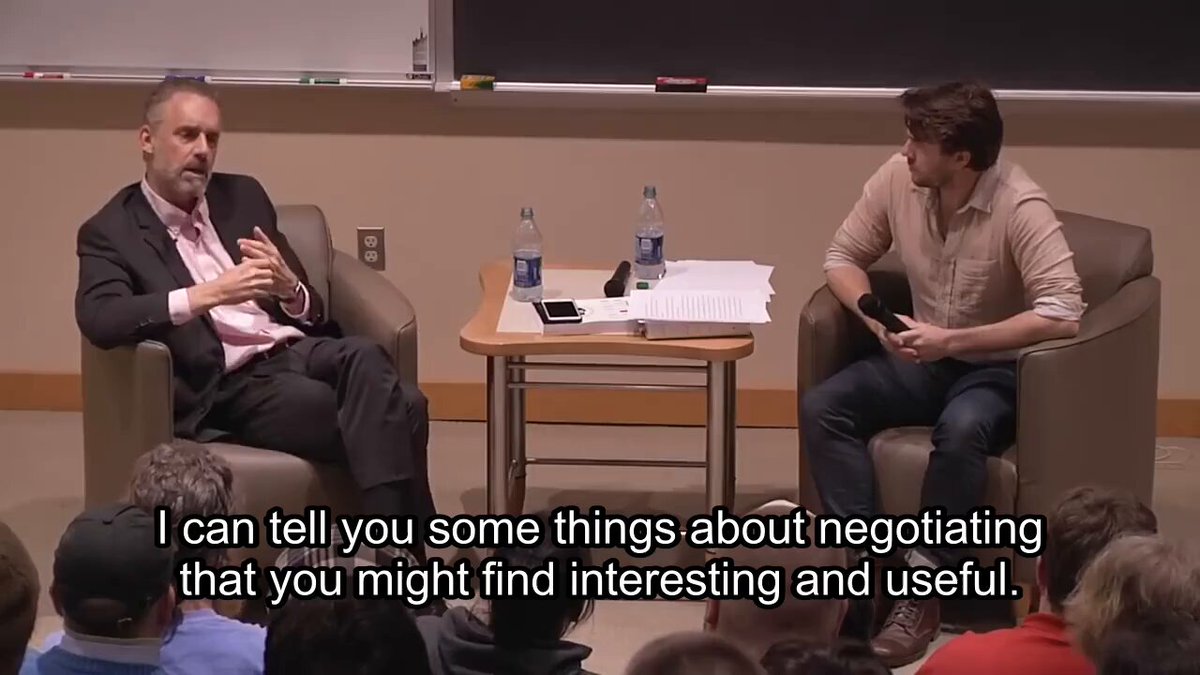
Jordan Peterson: "If you're competent and silent you will be ignored." "You might think well people should reward you because you're competent. And yes of course they should. But if you're competent and silent then you're just part of the background that's keeping everything functioning" On why you cannot negotiate from a position of weakness: "If you want to push your career forward you have to push it forward. You have to be competent and you have to be strategic" "To be strategic when you negotiate for a new position or a new salary you have to be able to say if you don't give me what I want then something you don't like will happen to you" "It's not a physical threat. It's that you have an option" "You have your CV in order. You're educated and competent and desirable to people outside of your immediate job. You're willing to instantly put yourself on the job market" "So that when you go talk to the person you're negotiating with you're credible" On the one thing most people completely miss about negotiation: "It's very seldom that you're talking to the person who's at the top of the pecking order. What you need to do is tell them a story that they can tell to their boss to make you not a problem" "A good story is look we really need this person because they're hyper competent and they have a better offer" "If you go in there with no power you're going to lose. Obviously" He concludes with the one thing every competent person needs to hear: "The first thing you need to know if you're going to negotiate is that you have to be able to say no. And what no means is that you're not going to do it"

Brad

34,992 görüntüleme • 1 ay önce

MARITIME LAW Ok, this is epic, and it will blow your mind, if you don't even know it. Those who are awake will know. That's great and this is what we should share. So, your birth certificate is where it all begins. This is where much of the corruption begins. The moment you sign your BC, it is Maritime law. You are actually signing a form that classifies you as dead at sea. You become a commodity of the system and honestly you Google it, you research it and you probably have to be fair like I said, but it's true. You become um... In a sense, they seize all the assets and go into what they call a trust fund and then you have 6 years to declare yourself alive. Declare yourself still here and then you can regain your sovereignty. But we didn't know that. It was a system they had set up so that you and I and everyone else were traded like cattle on the stock market. So each of us has a trust fund. And depending on how old you are, it depends on how much money is there. So if you're over 50 or something, you've got millions in there because that's how long we've been traded for. And this is another thing that is also crazy. That's why the mortgage system is absolutely ruined. So when you go for a mortgage, you basically sign the papers and they always tell you, "come back in 3 days and we'll have the money." They then take that money out of their trust fund to pay for the house. So, that comes out of your trust fund in your name, which has been growing since you were born. They then charge you interest on your money, but they don't care about the monetary side. They want the house. So if you miss a payment, they'll miss out immediately, because they can repossess your house. For them the house is a commodity, an asset. Wait to share what the banks do, but this trust fund is where much of your money will come from and be returned to you. This is their money that they have earned from you. So, that's just one thing. Then you also have the tax side. Taxes have never been taken from us, it is illegal. It is a corrupt system. So, all the taxes that we pay, it is not that they are going to return them to us, like the exact amount of taxes that we paid. What I have heard on the channels is the fact that it will be bond based, so at a certain age you will get so much money back, at a certain age this... I think the 62+ category was like 110k or something like that. But obviously they'll know more about that when it comes, but that's where more money comes from. Honestly, you are ready to live a life of abundance. This is money that was ours, that should be ours, that we should have been living with to create a better life. Instead, they have put us in this corrupt system where they have been fighting and they are taking all of our money and keeping it for themselves. for themselves. I hope I have shed light on this. Many people ask where this abundance comes from. Remember that the 1% controlled 99% of the wealth that now comes back to us to live a completely different life. They will give us what is owed to us because we should never have fought like this.

Tp

440,100 görüntüleme • 2 yıl önce

The most epic 13 minute AI rant I've heard in 2026 PS: My parent's heard this when I was playing it in the car and thought Jason ✨👾SaaStr.Ai✨ Lemkin went OFF like Stephen A Smith does on first take PPS: Full transcript below [17:00] Harry Stebbings: I I just wanted to ask Jason, if the people that we want are fundamentally different, the developers that we used to hire, we don't because AI writes the code for us. The marketers we don't want, the sales people we don't want—who who do we want genuinely? Like what is the attractive profile? Because your Anthropic’s and your OpenAIs are hiring, so so what are the people that we want in the companies of the future? [17:18] Jason Lemkin: Look, I know it sounds trite, but but the answer is simple. It's just the expression each year changes. We want folks that are genuinely AI fluent. It's pretty simple. Now you know, maybe last year we called them prompt engineers, right? That used to be a job. I don't know if you remember that actually used to be the hottest job on planet earth. Now no one needs a prompt engineer because it's pretty easy to prompt all these tools. That job died. Okay. Um and now we need go-to-market engineers. Um I think that job's going to die. We need—everyone needs so many forward deployed engineers. Like you can't hire enough forward deployed engineers. But uh you know um but Palantir just announced in whatever their their big their big event—they've gotten their deployment times down over 90% with forward deployed engineers. So that may become—so the this wave of disruption for the titles and the specificity, it's also exhaustingly accelerating. But it's really simple. You meet anyone for any role—sales, marketing, engineering, product, QA—they're they're either they're either they can't keep all of the ways they use AI to accelerate their job from spewing out of their mouth, or they're staring at you. It's there's nowhere in the middle. Like, and the person that comes in and says—it's it's it sounds Captain Obvious—but like, you know, you just had the whatever from Lovable, the the marketing head that was super popular on the show, right? She's just spewing AI-native insights into Lovable, right? It's not that complicated. You hire her, Elena, or whatever it is. You just hire her. It doesn't matter whether she's still in college or a junior or a senior or a middler, a left or right. And honestly, if you interview people, I would say of all even of the best startups I've invested in, maybe 30% of the management team meets this standard at best. 30%. Maybe less. And of the interviews I do in general, it's single-digit percents. It's just and in in that sense, it's the same as ever. Like you either lower the bar in hiring or you hire someone that's actually great. And someone that's actually great is so far ahead of you in how to apply to to employ the efficiencies of AI in their role, your jaw falls on the table. The difference is we used to need warm bodies. That's what's changing. We used to need warm bodies to answer the call, to do QA, to do code review, to to get the blue pixel to go from the upper left to the lower right. You laugh, but you need you literally needed to brute force this with humans. With AI, every day that goes by, the AI—you do not need brute force human beings on your team. And that's another reason they're shrinking. Why are all these new companies so efficient? They're just not brute forcing things with humans. They're just not. They're choosing not to. And so these team—all the brute forcers out there—everyone talks about how bloated teams got in 2021. I don't agree with that. I think they got as big as they needed to be when growth was high and you needed humans to do everything. All you look at these teams that that doubled—well if growth continued at 60% like the rate in early 2021 for 5 years or can help me do the math and every single thing a software company did required a human. You were understaffed by your 2021 headcount. You'd be sitting here in 2026. You every office in SoMa would be triple packed and you there wouldn't be enough humans to staff your company. It's just the world changed. [20:33] Harry Stebbings: Jason, you live on the bleeding edge. I think me and Rory see that and I think the world sees that when they hear you every week in terms of how you run SaaS. For all of the CEOs and execs who listen to the show, what would you advise them in terms of determining whether someone is AI fluent when they meet them for jobs, for talent? [20:51] Jason Lemkin: Here's I realized I was just asked this. I just did a review with a super fast startup growing just crossing 100 million and I was asked this question. And one of my favorite executives, I thought his answer was pretty dated and because he gave me an answer that was about 6 months old. The answer 6 months old is: "I look for folks in my team, I look for you know at what tools they play with." Okay, that was a great answer in like summer of 2025. Okay, I tried Lovable last week. Okay, the answer in 2026 is: "What commercial AI tool have you brought into your organization this month?" That's the test. Anyone that is on the bleeding edge that you would want to hire—now there are so many great products in the market. Okay, there is no excuse in any role to have not brought one tool a month into your organization. Okay, there—now there's going to be better and better tools and better and better products as the year goes on. What's the one you did? And you will see folks with their deer in the headlights to this question. What what sales tool? What marketing tool? What product tool? What engineering tool? What did you bring in? Why did you pick it? How does it working? Because if you're at remotely at the cutting edge, you're all over this. You're looking for the next agentic tools that will radically improve how you do business. This is—you think everyone thinks SaaS is at the bleeding edge, right? You know, you know, all we do is we're just looking for the tools and trying them. Okay? Okay, we're one year ahead of everybody else because we did the simplest thing in the world. Like we tried the tools early and we trained them. We trained them for a month. Okay, I'll give you—want hear a horrible example from this week? Super hot AI company valued at 6 billion. Okay, I'm not going to name it. Um, this week yesterday told us we had to quadruple what we spent on their product. Okay, their agent told us, right? And why did this happen? Okay. Well, at this $6 billion company, no one had trained the agent on its pricing properly. No one had tested it. They said, "Well, well, we've been in beta." And we said, "Well, when did the beta launch? A year ago." Okay, these are people asleep at at the wheel. You want somebody who the instant this comes up, they exactly know what the issue is. And "Hey, when I was at Lovable Replit, we trained the agent. This is how we did it. I brought in this tool. I brought in this tool that that Rory invested in last week. It solved all these issues." That's what you want to hear. And if they haven't brought in a tool in the last 30 days, at least deeply evaluated it. I don't really care whether they bought it, but gone so far down the funnel they can tell you—pick whatever tool: Fixie, Regie, GC, AIGC—I don't care how you went through it, you looked at it, you can tell me the eight ways it would improve the productivity of your business and three you didn't. Just don't hire that person because they're going to run your company to the ground. This is the job today. The job today is not to screw around on ChatGPT and to be a prompt engineer. The job today is to bring the best AI and agentic products into your organization and leverage all the hard work that the engineers have done building those products. That's your job. You don't have to screw around. You don't have to be a prompt engineer anymore. You have to be an agent deployment expert. A—this is the new job we're making up today. An Agentic Deployment Expert. That's your job from C-level to junior. Agentic Deployment Expert. Don't hire anybody else. You're going to regret it. They're going to stare at the camera. He's good. Stare at the camera. He's honorable. We could probably just I could slip away, get a coffee, and come back. No. And I I sound exasperated, Rory. And I—but the reason I am is I can just see I can see my best companies doing it. And I can see some companies I've invested in not doing it. And I want to cry. I just want to cry when they have no ADs on their team. I just—like you're flushing your years of your life down the toilet by not approaching your how you're building this company this way. [24:33] Rory: Yes. And at the risk of being positive, it's worth pointing out two things he didn't say. Well, something implicit why he said—Jason didn't do the only hire, you know, he didn't commit the um employment law, I think it's a civil penalty of saying only employ people below X who get the new new thing because he implicitly said anyone can do it provided you're willing to learn. And I think that's the big aha that's one of the positive statements to make here right? Look and I think it applies—I'm always wary of being "Hey, coming across, hey this this is the things that you all have to do." I think it applies to everyone including investors right? I mean I will say I have found that unless you're willing to invest the time learning these tools you actually shouldn't be investing in them. One of my partners Andy had this expression: "You know, if you decide you want to stop learning new things you probably should retire within 6 to 12 months and never write another check again." Maybe that's down to 3 to 6 months at this stage, right? And I think, you know, it's— [25:27] Harry Stebbings: Yeah, I actually I actually had a meeting with mine and Jason's biggest investor the other day and I—pretend he's not here—I said I think he's the most equipped investor for this generation of investing because I don't think anyone quite sits at the bleeding edge like he does on the investor side. [25:42] Harry Stebbings: Why in terms of using the equip stuff? Yeah. Yeah. In terms of using the stuff, understanding understanding bottlenecks, constraints. For sure. [25:51] Jason Lemkin: But can I just add one point? We can just cuz it's so important if it helps people. Okay, we are—and thank you Harry. We're going through these phases. Okay, and when AI started to blow up for real for us, uh call it early 2024, right? Maybe late '23, I wasn't equipped. It was too technical. I wasn't going to go in and figure out—I wasn't smart enough to figure out how to deal with a massively hallucinating LLM API and turn that and turn that into something magical. Kudos to investors and others that that got it in early '23, '22. I mean I remember I—I guess it was maybe SaaStr Annual '23. I was with David Sacks and I did a Q&A and I said, "How you thinking about AI at Craft?" He's like, "Well we're all in. We want 80% of '23 of investments to be AI." I'm like, "Great but like show me the show me the great ones in market." He's like, "They're all prototypes. We're all they're all they're all proof of concepts but we're all in anyway." That's where you kind of had to be in '23 if you weren't investing at like the LLM level. Okay, I wasn't smart enough. Then we went through this weird-ass prompt engineer era where like you you could torture these products to do something good, right? But you had to torture them. You had to like craft these crazy things that made no sense. Now we are in the era where mere ordinarily smart generalists can make these tools do magical things. And literally I go to these meetings and people be like, "I don't know how to like this is so scary. I don't know how to do this." And we show them our backends. Do you know how to do a workflow generator? Do you know how to do a a decision tree? Like we've been building these since software in the '90s. Okay, if you—I can show you all of our agents. The how they work is novel. They do have to be trained. You can't be lazy and have these agents work. But honestly, the the UI, the UX, the way we interact with them, it's just software. And so my point is: Pick yourself off the ground. This is your time now. If you felt lost in AI era, if you felt like you're behind, you don't understand what all these people are saying on X and Twitter and their Claude and and their and talking about all the 4.6 point Nano point and it's over—like you just it's not your world. This is your time. This is your time for the generalist that knows how to use software tools really really well. And I—this is my last point but it's so important. If ever in your recent life—and this is why you could be all you need to be is young at heart to Rory's point—if in the last three to five years you have successfully deployed a piece of enterprise software of any sort you yourself, not some agency you hired, but if you have deployed it, you can deploy any agentic tool. Any. And you can become the hero in your company and you can become the hero in your functional area. But I watch folks—I'm literally helping a company now that they're adding hundreds of sales folks this year with a new pre-IPO COO—he's not hasn't brought in a single tool, totally scared of it. Okay, it's not that hard. Did you use SalesLoft? Did you use Outreach? Did you use HubSpot? Do you know these tools? If you can deploy these tools, you can deploy a world-changing AI agent. And so this is the time for people like the folks that that were shut out of the AI revolution right now. The generalist folks that are not that know how to deploy software that don't even know how to build software. Like vibe coding for me was folks who knew how to build software, but you didn't have to be an engineer. Now, you just need to know how to deploy software to win with AI agents. That's all you need to know. So many people have these skills and they're petrified of AI. "How did you do that? How did you deploy an AI BDR?" Well, we bought a piece of software, we figured out how it worked for a day, we set it up in an afternoon, and then and then we did spend 30 months training it, which you didn't do with this old software because in the old days, we just had to manually upload all the data, right? And there was no training. The the only non-intuitive part is training these things. And it's it's it's just work. So that's why when I see folks on the management team not doing this, there's no excuse. You do not need to be technical to win with AI agents in Q2 of '26. You do not need to be even 1% technical. Not at all. So it's your time. Or you're going to get laid off. Or you're going to get laid off because you're not going to matter.

Arjun Mahadevan (Mr. LLC 🇺🇸)

37,744 görüntüleme • 5 ay önce

Catherine Austin Fitts: "The [Trump] administration is looking for ways of managing a collapse of the dollar... so [Trump's] cutting anything that he doesn't need to keep his mega-donor base... [and] he's going to start slashing social safety nets..." This clip of Fitts, a former Assistant Secretary of Housing and Urban Development, investment banker, and founder of the Solari Report (The Solari Report | Catherine Austin Fitts), is taken from a discussion with Todd Sachs (Todd Sachs) posted to YouTube on January 24, 2026. ---------------Partial transcription of clip---------------- "The administration is looking for ways of managing a collapse of the dollar and they're going to— It's like a body in trauma. You pull blood from the toes and you take it to the heart and lungs. So he's looking to double the military budget because he needs force to make sure that they have self sufficiency and resources that they don't have now. He's trying to get that. "So I think that's why he's doing it. And then he's cutting anything that he doesn't need to keep his mega-donor base and he doesn't need to get the resources he needs. So he's going to start slashing social safety nets. So if you look at the slashing of assistance to he did it to five Democratic states that's looking like it's political, in one sense it is, but I think he's slashing because he's trying to manage the collapse. "So and he's going to keep, that's going to keep happening one way or the other. Now here's what I think it's really. And anybody listening to this who's dependent on federal money, you need to know whether it's the purchasing power of that federal money gets cut by inflation or something happens that it just gets cut or held up or whatever. Government money is going to get— Federal government money is get more, more and more problematic as we continue into this change. "And if you look at all the problems we had on money disappearing from the federal budget, we've known that the federal government is operating way outside the financial management laws, breaking the law, huge amounts of money going missing. I call it a financial coup, but now the chickens are coming home to roost and you're going to start feeling it. They don't need to buy off the population by throwing money at them. Now they're going to start cutting."

Sense Receptor

38,362 görüntüleme • 7 ay önce