Video wird geladen...

Video konnte nicht geladen werden

Zur Startseite

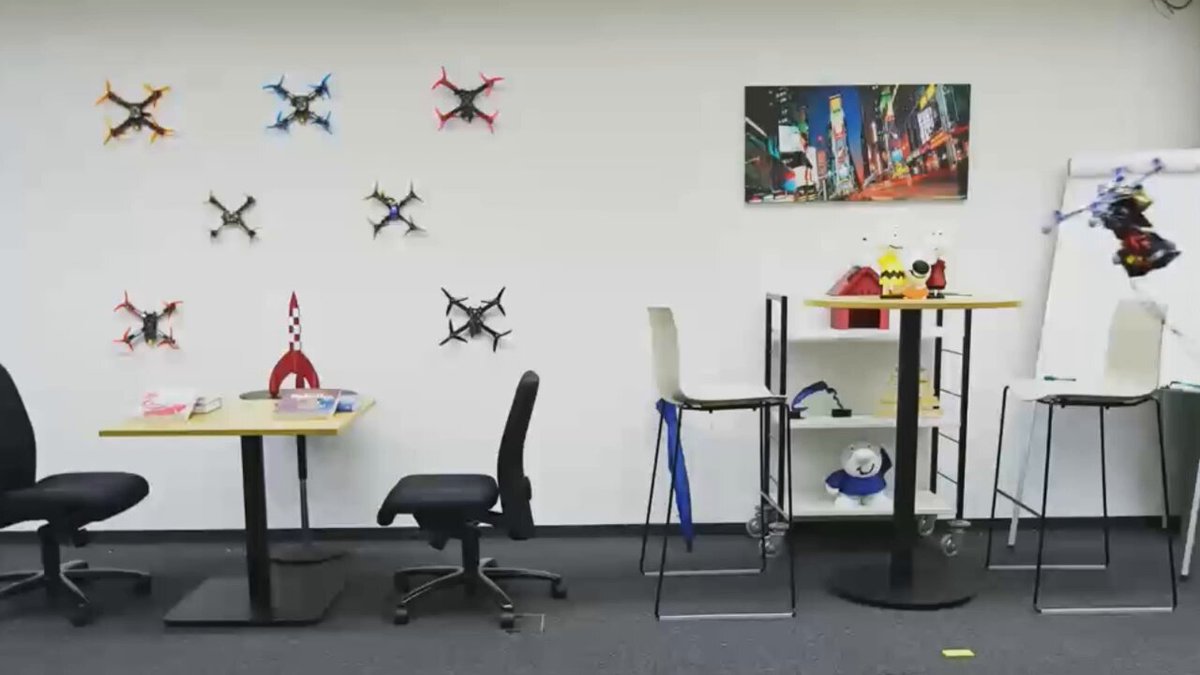
Check out our latest work, "Actor-Critic Model Predictive Control: Differentiable Optimization meets Reinforcement Learning for Agile Flight," published in the IEEE Transactions on Robotics, where we reconcile #OptimalControl and #ReinforcementLearning, achieving the same super-human performance, but with superior generalizability, as our previous model-free deep RL! Code released! PDF: Code:...

26,960 Aufrufe • vor 4 Monaten •via X (Twitter)

0 Kommentare

Keine Kommentare verfügbar

Kommentare vom Original-Post werden hier angezeigt

Ähnliche Videos

We are thrilled to share our breakthrough research on "Agile Flight from Pixels without State Estimation," to be presented and live-demonstrated at #RSS2024 next week! You heard well: no state estimation means no explicit visual localization, no SLAM, no VIO, and no IMU! Paper: Video (Narrated): Last year, we demonstrated that #ReinforcementLearning (RL) policies could outperform world-champion drone-racing pilots using the same quadrotor hardware; however, unlike human pilots, these policies continuously estimated an explicit state from known gate positions, the camera feed, and inertial measurements (IMU). In this new work, we tackle the challenge of learning vision-based drone racing using an end-to-end reinforcement learning approach that eliminates the need for IMU data or explicit state estimation. Like professional pilots, we go directly from images to control commands. The training is facilitated by an asymmetric actor-critic with access to privileged information. To overcome the computational complexity during image-based RL training, we use an appropriate sensor representation, which can be efficiently simulated during training without rendering images. We achieve agile flight at speeds up to 40 km/h with accelerations up to 2 g's. Although our demonstration focuses on drone racing, we believe that our method has an impact beyond drone racing and can serve as a foundation for future research into real-world applications in structured environments. Besides the paper presentation, we will also give a live demo next Tuesday and Wednesday between and hrs at TU Delft: Reference: Ismail Geles*, Leonard Bauersfeld*, Angel Romero, Jiaxu Xing, Davide Scaramuzza "Demonstrating Agile Flight from Pixels without State Estimation" Robotics: Science and Systems (RSS), 2024. Kudos to Ismail Geles Leonard Bauersfeld Ángel Romero Jiaxu Xing! University of Zurich UZH Science UZH Space Hub Aerial Core AUTOASSESS European Research Council (ERC)

Davide Scaramuzza

27,886 Aufrufe • vor 1 Jahr

We are excited to share our work “Event-Aided Sharp Radiance Field Reconstruction for Fast-Flying Drones” published in IEEE Transactions on Robotics IEEE Transactions on Robotics (T-RO), which tackles sharp radiance field reconstruction under agile drone motion, where RGB frames are heavily motion-blurred and pose priors become unreliable! 4 years in the making! Code & dataset released! PDF: Code & Dataset: Full Narrated Video: High-speed flight is essential for time- and battery-constrained missions (e.g., inspection, exploration, search & rescue). However, fast motion corrupts visual data with severe motion blur and introduces drift/noise in visual-inertial odometry, making NeRF-based 3D reconstruction particularly brittle. We propose a unified framework that leverages asynchronous #EventCamera streams together with motion-blurred frames to reconstruct high-fidelity radiance fields from agile drone flights. Our key idea is to embed event-image fusion directly into radiance field optimization while jointly refining a shared, continuous-time camera trajectory initialized from event-based VIO. This enables us to recover sharp radiance fields and accurate trajectories without ground-truth supervision during training. We validate our method on synthetic data and on real sequences captured by a drone flying up to 2 m/s. Despite severe blur and noisy pose priors, our method preserves fine scene details and achieves a performance gain of over 50% on real-world data compared to state-of-the-art methods. Kudos to Rong Zou and Marco Cannici! Marco Cannici Reference: Rong Zou*, Marco Cannici*, Davide Scaramuzza Event-Aided Sharp Radiance Field Reconstruction for Fast-Flying Drones IEEE Transactions on Robotics (T-RO), 2026 NCCR Robotics European Research Council (ERC) AUTOASSESS UZH IfI University of Zurich UZH Science Prophesee SynSense UZH Space Hub

Davide Scaramuzza

10,839 Aufrufe • vor 3 Monaten

Can an inexpensive, off-the-shelf IMU be the only sensor to estimate the full state (position, velocity, orientation) of a quadrotor flying through a track at high speed and even be on-pair with vision-based localization? The answer is yes, within certain limitations! In this #RAL2023 paper, we propose a learning-based odometry algorithm that couples a model-based filter driven by the inertial measurements with a learning-based module with access to the control commands. Our system outperforms by a large margin the state-of-the-art visual-inertial odometry (#VIO) algorithms and the state-of-the-art learned-inertial odometry algorithm, #TLIO, for the task of drone racing. Additionally, we show that our system is as accurate as a VIO algorithm that uses a camera to localize to a known map of the racing track. The main limitation of our approach is that it cannot generalize to trajectories that have not been seen at training time. However, in drone racing competitions, the track is known beforehand. Human pilots spend hours or even days of practice on the race track before the competition. Similarly, our system can be trained with the data collected during practice time and deployed during the competition. Future work will investigate how to generalize to trajectories not seen at training time. The code is released! Paper: Video: Code: Kudos to Giovanni Cioffi Leonard Bauersfeld Elia Kaufmann European Research Council (ERC) University of Zurich UZH Science UZH Space Hub NCCR Robotics Aerial Core #RAL2023 #IROS2023 #SLAM

Davide Scaramuzza

37,049 Aufrufe • vor 2 Jahren

Physics-based Motion Retargeting from Sparse Inputs paper page: Avatars are important to create interactive and immersive experiences in virtual worlds. One challenge in animating these characters to mimic a user's motion is that commercial AR/VR products consist only of a headset and controllers, providing very limited sensor data of the user's pose. Another challenge is that an avatar might have a different skeleton structure than a human and the mapping between them is unclear. In this work we address both of these challenges. We introduce a method to retarget motions in real-time from sparse human sensor data to characters of various morphologies. Our method uses reinforcement learning to train a policy to control characters in a physics simulator. We only require human motion capture data for training, without relying on artist-generated animations for each avatar. This allows us to use large motion capture datasets to train general policies that can track unseen users from real and sparse data in real-time. We demonstrate the feasibility of our approach on three characters with different skeleton structure: a dinosaur, a mouse-like creature and a human. We show that the avatar poses often match the user surprisingly well, despite having no sensor information of the lower body available. We discuss and ablate the important components in our framework, specifically the kinematic retargeting step, the imitation, contact and action reward as well as our asymmetric actor-critic observations. We further explore the robustness of our method in a variety of settings including unbalancing, dancing and sports motions.

AK

106,519 Aufrufe • vor 2 Jahren

Today, we're joined by Sergey Levine, associate professor at UC Berkeley EECS and co-founder of Physical Intelligence to discuss π0 (pi-zero), a general-purpose robotic foundation model. We dig into the model architecture, which pairs a vision language model (VLM) with a diffusion-based action expert, and the model training "recipe," emphasizing the roles of pre-training and post-training with a diverse mixture of real-world data to ensure robust and intelligent robot learning. We review the data collection approach, which uses human operators and teleoperation rigs, the potential of synthetic data and reinforcement learning in enhancing robotic capabilities, and much more. We also introduce the team’s new FAST tokenizer, which opens the door to a fully Transformer-based model and significant improvements in learning and generalization. Finally, we cover the open-sourcing of π0 and future directions for their research. 🎧 / 🎥 Listen or watch the full episode on our page: 📖 CHAPTERS =============================== 00:00 - Introduction 2:14 - Physical Intelligence 3:47 - Key challenges in robotic learning 6:13 - Reinforcement learning in π0 and robotic foundation models 8:36 - π0 VLM model architecture 15:33 - π0 model recipe 18:39 - Pre-training dataset 22:47 - Post-training 24:23 - Laundry folding demo 31:32 - Scaling laws on π0 model 34:57 - FAST 40:26 - Open sourcing π0 43:37 - Other robot types 46:27 - Future directions

The TWIML AI Podcast

19,942 Aufrufe • vor 1 Jahr