正在加载视频...

视频加载失败

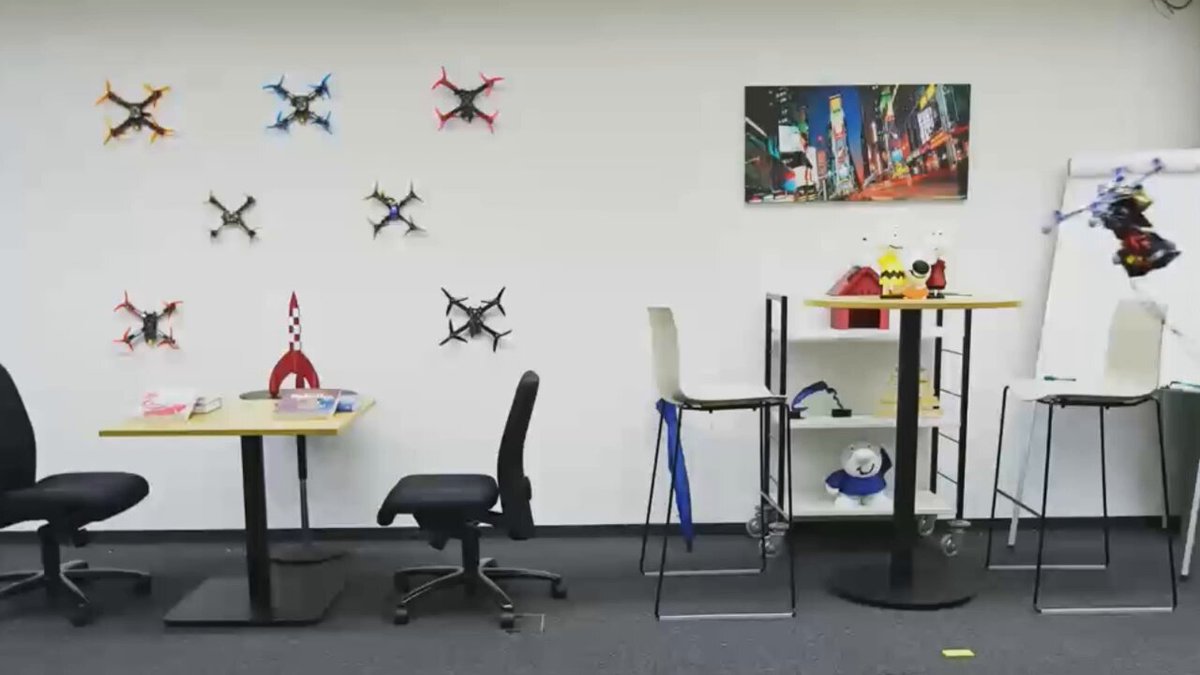
We are excited to share our latest work, "Learning on the Fly: Rapid Policy Adaptation via Differentiable Simulation", where a policy learns to adapt in the real world to unknown disturbances within 5 seconds, both with and without explicit state estimation, directly from visual features. Code released! PDF: Project...

19,184 次观看 • 7 个月前 •via X (Twitter)

0 条评论

暂无评论

原始帖子的评论将显示在这里

相关视频

Check out our latest work, "Actor-Critic Model Predictive Control: Differentiable Optimization meets Reinforcement Learning for Agile Flight," published in the IEEE Transactions on Robotics, where we reconcile #OptimalControl and #ReinforcementLearning, achieving the same super-human performance, but with superior generalizability, as our previous model-free deep RL! Code released! PDF: Code: Full Video: Model-free #ReinforcementLearning (RL) is known for its strong task performance and flexibility in optimizing general reward formulations. On the other hand, #ModelPredictiveControl (MPC) provides robustness, constraint handling, and powerful online replanning capabilities. In this work, we extend our previous AC-MPC paper (Romero, ICRA'24) by taking a deeper look at how both approaches can be unified. We introduce and extend Actor-Critic Model Predictive Control (AC-MPC), a framework that embeds a differentiable MPC inside an Actor-Critic RL architecture. This integration allows the MPC-based actor to perform short-term predictive optimization, while the critic facilitates long-horizon learning and exploration. We conduct a comprehensive study that highlights AC-MPC’s key advantages: - Better out-of-distribution generalization, both against unknown disturbances and changes in the quadrotor dynamics - Improved sample efficiency - A novel empirical analysis uncovering a relationship between the critic’s value function and the MPC cost function, providing deeper insight into their interplay. We validate our method in simulation and the real world on a quadcopter flying at superhuman speeds of up to 21 m/s, matching state-of-the-art model-free RL performance, and retaining the predictive structure of MPC for more reliable out-of-distribution behavior. Reference: Actor-Critic Model Predictive Control: Differentiable Optimization meets Reinforcement Learning for Agile Flight IEEE Transactions on Robotics (T-RO), 2025 PDF: Full Video: Code: Kudos to Ángel Romero, Elie Aljalbout, Yunlong Song! University of Zurich UZH Science UZH Space Hub AUTOASSESS European Research Council (ERC) UZHai

Davide Scaramuzza

27,279 次观看 • 7 个月前

We are thrilled to share our breakthrough research on "Agile Flight from Pixels without State Estimation," to be presented and live-demonstrated at #RSS2024 next week! You heard well: no state estimation means no explicit visual localization, no SLAM, no VIO, and no IMU! Paper: Video (Narrated): Last year, we demonstrated that #ReinforcementLearning (RL) policies could outperform world-champion drone-racing pilots using the same quadrotor hardware; however, unlike human pilots, these policies continuously estimated an explicit state from known gate positions, the camera feed, and inertial measurements (IMU). In this new work, we tackle the challenge of learning vision-based drone racing using an end-to-end reinforcement learning approach that eliminates the need for IMU data or explicit state estimation. Like professional pilots, we go directly from images to control commands. The training is facilitated by an asymmetric actor-critic with access to privileged information. To overcome the computational complexity during image-based RL training, we use an appropriate sensor representation, which can be efficiently simulated during training without rendering images. We achieve agile flight at speeds up to 40 km/h with accelerations up to 2 g's. Although our demonstration focuses on drone racing, we believe that our method has an impact beyond drone racing and can serve as a foundation for future research into real-world applications in structured environments. Besides the paper presentation, we will also give a live demo next Tuesday and Wednesday between and hrs at TU Delft: Reference: Ismail Geles*, Leonard Bauersfeld*, Angel Romero, Jiaxu Xing, Davide Scaramuzza "Demonstrating Agile Flight from Pixels without State Estimation" Robotics: Science and Systems (RSS), 2024. Kudos to Ismail Geles Leonard Bauersfeld Ángel Romero Jiaxu Xing! University of Zurich UZH Science UZH Space Hub Aerial Core AUTOASSESS European Research Council (ERC)

Davide Scaramuzza

27,952 次观看 • 2 年前

We are excited to share our work “Event-Aided Sharp Radiance Field Reconstruction for Fast-Flying Drones” published in IEEE Transactions on Robotics IEEE Transactions on Robotics (T-RO), which tackles sharp radiance field reconstruction under agile drone motion, where RGB frames are heavily motion-blurred and pose priors become unreliable! 4 years in the making! Code & dataset released! PDF: Code & Dataset: Full Narrated Video: High-speed flight is essential for time- and battery-constrained missions (e.g., inspection, exploration, search & rescue). However, fast motion corrupts visual data with severe motion blur and introduces drift/noise in visual-inertial odometry, making NeRF-based 3D reconstruction particularly brittle. We propose a unified framework that leverages asynchronous #EventCamera streams together with motion-blurred frames to reconstruct high-fidelity radiance fields from agile drone flights. Our key idea is to embed event-image fusion directly into radiance field optimization while jointly refining a shared, continuous-time camera trajectory initialized from event-based VIO. This enables us to recover sharp radiance fields and accurate trajectories without ground-truth supervision during training. We validate our method on synthetic data and on real sequences captured by a drone flying up to 2 m/s. Despite severe blur and noisy pose priors, our method preserves fine scene details and achieves a performance gain of over 50% on real-world data compared to state-of-the-art methods. Kudos to Rong Zou and Marco Cannici! Marco Cannici Reference: Rong Zou*, Marco Cannici*, Davide Scaramuzza Event-Aided Sharp Radiance Field Reconstruction for Fast-Flying Drones IEEE Transactions on Robotics (T-RO), 2026 NCCR Robotics European Research Council (ERC) AUTOASSESS UZH IfI University of Zurich UZH Science Prophesee SynSense UZH Space Hub

Davide Scaramuzza

12,028 次观看 • 5 个月前

We are excited to share our latest work, "Superhuman Safe and Agile Racing through Multi-Agent Reinforcement Learning," done in collaboration with Google DeepMind . Autonomous drones have reached superhuman speed in isolation, but what happens when multiple agents share the same airspace? Paper: Website: Video: Using league-based self-play, we train #ReinforcementLearning agents that race against a diverse, evolving population of opponents. Through this competitive training, sophisticated behaviors emerge without explicit programming: strategic overtaking, proactive collision avoidance, and even awareness of aerodynamic downwash from nearby drones. In real-world multi-player races at speeds exceeding 80kph (50 mph) and accelerations up to 7g, our agents outperform a five-time Swiss national drone racing champion while reducing collision rates by 50% compared to single-agent baselines. Crucially, training against diverse artificial opponents enables zero-shot generalization to human pilots, achieving over 90% race completion in mixed human-AI races with up to four competitors. A key insight: human pilots adopt riskier strategies when trailing, leading to more crashes under competitive pressure. Our learned policies, by contrast, maintain consistent safety margins regardless of race standing, a property essential for deploying autonomous systems alongside humans. Also, the multi-agent self-play policies are more robust than those trained independently, suggesting that training in competitive environments is not only key to winning races but also to learning safer, more reliable autonomy for real-world multi-robot systems. Kudos to Ismail Geles, Leonard Bauersfeld, Markus Wulfmeier! Ismail Geles Leonard Bauersfeld Markus Wulfmeier European Research Council (ERC) UZH IfI University of Zurich UZH Science UZH Space Hub Swiss Robotics NCCR Robotics

Davide Scaramuzza

14,637 次观看 • 3 个月前

Can an inexpensive, off-the-shelf IMU be the only sensor to estimate the full state (position, velocity, orientation) of a quadrotor flying through a track at high speed and even be on-pair with vision-based localization? The answer is yes, within certain limitations! In this #RAL2023 paper, we propose a learning-based odometry algorithm that couples a model-based filter driven by the inertial measurements with a learning-based module with access to the control commands. Our system outperforms by a large margin the state-of-the-art visual-inertial odometry (#VIO) algorithms and the state-of-the-art learned-inertial odometry algorithm, #TLIO, for the task of drone racing. Additionally, we show that our system is as accurate as a VIO algorithm that uses a camera to localize to a known map of the racing track. The main limitation of our approach is that it cannot generalize to trajectories that have not been seen at training time. However, in drone racing competitions, the track is known beforehand. Human pilots spend hours or even days of practice on the race track before the competition. Similarly, our system can be trained with the data collected during practice time and deployed during the competition. Future work will investigate how to generalize to trajectories not seen at training time. The code is released! Paper: Video: Code: Kudos to Giovanni Cioffi Leonard Bauersfeld Elia Kaufmann European Research Council (ERC) University of Zurich UZH Science UZH Space Hub NCCR Robotics Aerial Core #RAL2023 #IROS2023 #SLAM

Davide Scaramuzza

37,061 次观看 • 2 年前

Domain Randomization (DR) is a key component of the data augmentation pipeline at Axis Robotics. By applying DR, we are able to scale verified, high-quality human trajectories by 10x to 100x. During training, we systematically introduce variances in environmental parameters. This prevents the model from relying on spurious visual correlations. The objective is to ensure the policy learns rather than overfitting. To demonstrate the necessity and effectiveness of this approach, we evaluated both DR and No-DR models on Task 74 (pour_water_into_mug). The empirical results show a definitive impact on real-world deployment reliability: integrating DR into the pipeline increased the success rate from 0% to 90% (Fig. 1). This divergence stems from how the respective policies process visual observations (Fig. 2). The baseline (No DR) model overfits to the static visual background. It essentially memorizes the poses from the training dataset but fails to generalize when subjected to the inevitable variances of real-world deployment. Consequently, it cannot execute the correct manipulation on the target object. Conversely, the DR-trained model learns to extract essential geometric features and physical constraints, filtering out superficial visual noise. This leads to significantly higher robustness in dynamic environments. The structural difference in execution is clearly reflected in the end-effector trajectory data: These real-world deployment recordings further illustrate this difference (Videos 1 and 2). Scaling Physical AI requires turning raw trajectory data into robust policies, and a rigorously engineered DR infrastructure is an essential bridge to close the Sim2Real gap.

Axis Robotics

27,125 次观看 • 4 个月前

We trained a robot dog to balance and walk on top of a yoga ball purely in simulation, and then transfer zero-shot to the real world. No fine-tuning. Just works. I’m excited to announce DrEureka, an LLM agent that writes code to train robot skills in simulation, and writes more code to bridge the difficult simulation-reality gap. It fully automates the pipeline from new skill learning to real-world deployment. The Yoga ball task is particularly hard because it is not possible to accurately simulate the bouncy ball surface. Yet DrEureka has no trouble searching over a vast space of sim-to-real configurations, and enables the dog to steer the ball on various terrains, even walking sideways! Traditionally, the sim-to-real transfer is achieved by domain randomization, a tedious process that requires expert human roboticists to stare at every parameter and adjust by hand. Frontier LLMs like GPT-4 have tons of built-in physical intuition for friction, damping, stiffness, gravity, etc. We are (mildly) surprised to find that DrEureka can tune these parameters competently and explain its reasoning well. DrEureka builds on our prior work Eureka, the algorithm that teaches a 5-finger robot hand to do pen spinning. It takes one step further on our quest to automate the entire robot learning pipeline by an AI agent system. One model that outputs strings will supervise another model that outputs torque control. We open-source everything! Welcome you all to check out the paper, more videos, and try the codebase today: Code:

Jim Fan

909,012 次观看 • 2 年前