Video wird geladen...

Video konnte nicht geladen werden

Zur Startseite

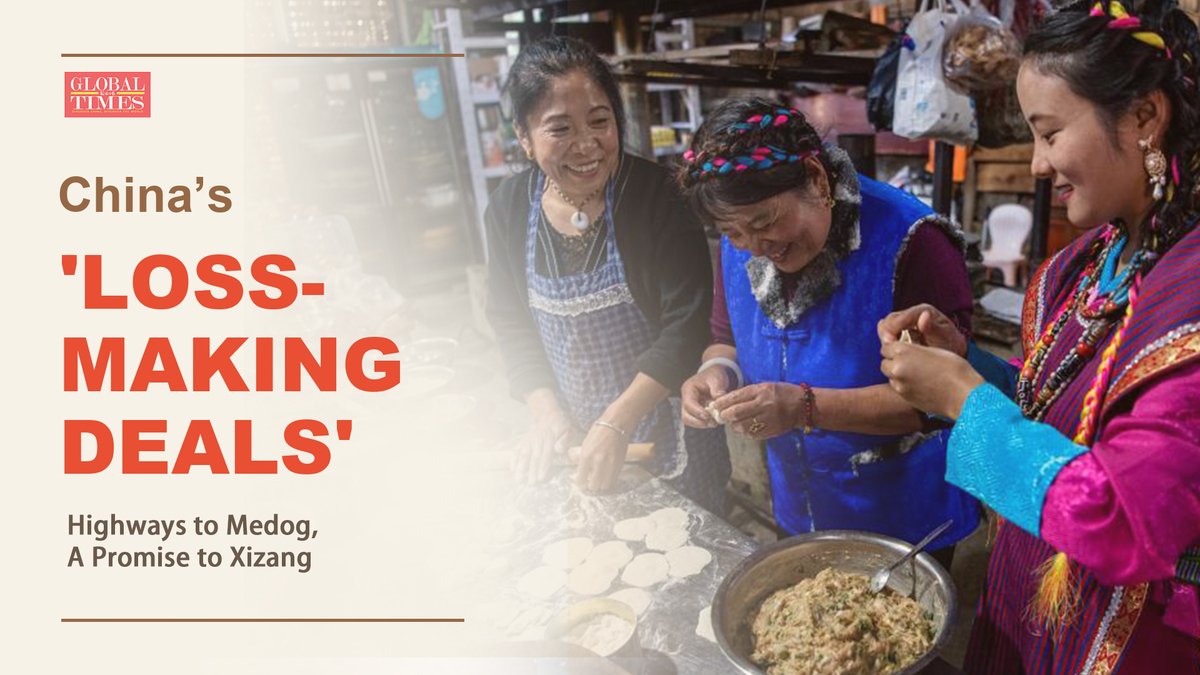
China has spent heavily on Xinjiang's development. This bridge, deep in the mountains, is called "China's most luxurious bridge." 700 meters long, cost 2.39 billion yuan — that's 3.4 million yuan per meter. It’s built to withstand -40°C and the toughest terrain. All because only with roads comes the...

10,151 Aufrufe • vor 1 Monat •via X (Twitter)

0 Kommentare

Keine Kommentare verfügbar

Kommentare vom Original-Post werden hier angezeigt

Ähnliche Videos

I'm glad to see you take pride in the Dafaqu Grand Bridge, albeit I must point out that it is a bridge in China, not India. I also found the Chinese source video that you altered and slapped some bogus cations on. The recurring practice of some Indian netizens editing footage of Chinese bridges and then sharing them as Indian infrastructure on NH44 is misleading and dishonest. The 1,427-meter-long Dafaqu Grand Bridge, which crosses a deep valley in a mountainous area in the north of China’s Guizhou province, is a large-span concrete-filled steel tube arch bridge. It is a key project in a freeway that links the Guizhou cities of Renhuai and Zunyi. The main arch of the bridge — spanning 410 meters — has been painted red, providing a magnificent spectacle against the backdrop of the mountain and the valley, and drawing many tourists to view the surrounding scenery. The bridge sits more than 280 meters above the valley floor, equivalent to the height of a 100-story building. The complicated terrain, such as the steep cliffs, meant its construction posed challenges for engineers and building workers. Guizhou, the only province in China without a single plain and home to deep ravines, has long relied on tunnels and bridges to overcome its jagged karst landscape. Since 2012, the province has accelerated its bridge construction endeavors. Guizhou now has over 32,000 bridges either already built or under construction -- a tenfold increase compared to the 1980s. Due to its sheer number of bridges, diverse bridge types and complex construction technologies, Guizhou has earned the title of "the world's bridge museum."

Eivor

12,713 Aufrufe • vor 6 Monaten

In recent days, videos of the Huajiang Bridge (花江), the world's highest bridge, have gone viral on X. Many observers couldn't help but note the irony: the R&D cost of a single US fighter jet is nearly equal to that of this monumental bridge in China. Last year, during a business trip through Xiangxi, I came across another engineering marvel that deserves no less attention-the Aizhai Bridge (矮寨). Built for a little more than half the cost of an F-22, it remains the world's largest canyon-spanning suspension bridge. Like Huajiang, Aizhai sits deep within rugged mountains, where transportation was once nearly impossible. Its name, Aizhai (literally "Low Village"), comes from the view looking down from the cliffs above. The settlement seemed so small and sunken, as if fate itself had pressed it beneath the surrounding peaks. In the 1930s, during WWII, China's southwest became a strategic rear area, and a complex network of mountain roads was built here. In 2004, China planned a 3,000-kilometer expressway stretching from Baotou in Inner Mongolia to Maoming in Guangdong, a road literally running from the Gobi desert to the South China Sea. The route was set to pass through this deep canyon, and a major debate arose: should they build tunnels or a bridge? After much study, engineers concluded that although tunneling could save several hundred million yuan, it would cause far greater environmental damage due to the area's fragile karst geology. During field surveys, engineers hiked across mountains and valleys. On one occasion, they encountered a farmer weeping uncontrollably. When they asked what had happened, they learned that her cow had just fallen off a cliff. At that moment, they understood more deeply how dangerous and isolated this region truly was, and why building a bridge here was not just an engineering challenge, but a moral imperative. In 2011, after four years of construction, the Aizhai Bridge was officially completed. Its deck rises 355 meters above the town of Aizhai below. What once required a thirty-minute detour along winding mountain roads can now be crossed in just one minute. The transformation brought by better transportation is about more than just speed. Once a remote, impoverished mountain town cut off from the outside world, it has become a vital artery connecting China's north and south. Travel time from western Hunan to Changsha has been reduced by four hours, and to Chongqing by eight, rewriting not only distances, but the very radius of people's lives and possibilities. Aizhai is "low" no more. Suspended among the clouds, the bridge shortens distances, lifts lives, and reshapes futures. One fighter jet defends airspace. One bridge redefines possibility. Watch the one-minute video I filmed while crossing the bridge.

Zhai Xiang

40,004 Aufrufe • vor 10 Monaten

🇨🇳China unveiled BIG MOVES to support Global South at G20 Leaders' Summit. It's China's eight actions for global development, here's the detail👇 1⃣is to pursue high-quality Belt and Road cooperation. On top of 700 billion yuan ($96.7 billion) added financing windows and an additional 80 billion yuan ($11.1 billion) injection into the Silk Road Fund, China is moving ahead with the development of the multidimensional Belt and Road connectivity network, one that is led by the building of a green Silk Road and will empower a digital Silk Road. 2⃣is to implement the Global Development Initiative. On the basis of over 1,100 development projects already in operation, China will make sure the Global South research center that is being built is fit for purpose, and the $20 billion of development funds will continue to be put to good use to support developing countries and deepen practical cooperation in areas such as poverty reduction, food security and digital economy. 3⃣is to support the development in Africa. Xi said that at the Summit of the Forum on China-Africa Cooperation held in September, he unveiled 10 partnership actions on joining hands with Africa to advance modernization over the next three years and, in this connection, a commitment of 360 billion yuan ($49.7 billion) in financial support. 4⃣is to support international cooperation on poverty reduction and food security. China decides to join the Global Alliance Against Hunger and Poverty, supports the G20 in continuing to convene the Development Ministerial Meeting, and will stay a committed host of the International Conference on Food Loss and Waste. 5⃣is that China, alongside Brazil, South Africa and the African Union, is proposing an Initiative on International Cooperation in Open Science to help the Global South gain better access to global advances in science, technology and innovation. 6⃣is to support the G20 in carrying out practical cooperation for the benefit of the Global South and using outcomes such as the Roadmap to Increase Investment in Clean Energy in Developing Countries and the High-Level Principles on Bioeconomy to good effect. China supports the work of the Entrepreneurship Research Center on G20 Economies based in Beijing, and supports cooperation on digital education and the digitization of museums and ancient archives. 7⃣is to implement the G20 Anti-Corruption Action Plan. China is strengthening cooperation with fellow developing countries in fugitive repatriation and asset recovery, denial of safe haven, and anti-corruption capacity building. 8⃣is that China is pursuing high-standard opening up, and unilaterally opening its doors wider to the least developed countries (LDCs). China has announced the decision to give all LDCs having diplomatic relations with China zero-tariff treatment for 100 percent tariff lines. From now to 2030, China's imports from other developing countries are likely to top $8 trillion.

Li Jingjing 李菁菁

47,193 Aufrufe • vor 1 Jahr