Video yükleniyor...

Video Yüklenemedi

Ana Sayfaya Dön

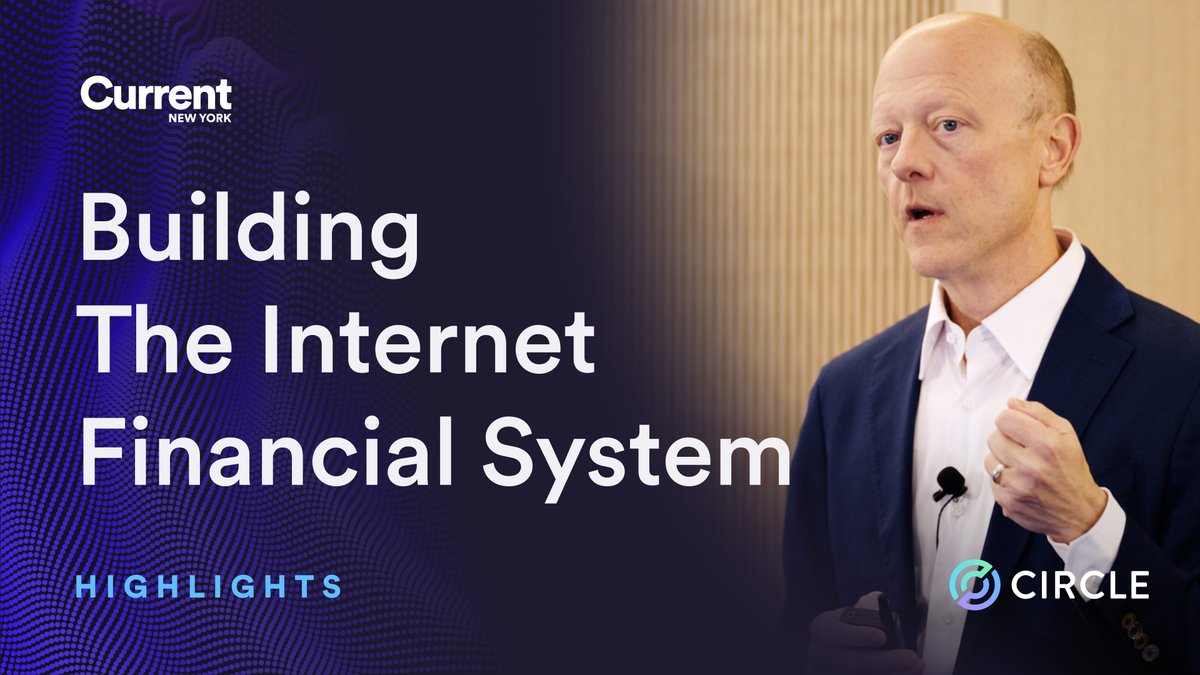
Circle CEO: What Real-World Financial Problems Can Stablecoins Solve First? On August 19, 2026, Circle CEO Jeremy Allaire Jeremy Allaire - jerallaire.arc said during the earnings call AMA that stablecoins are moving from the digital asset market into real-world finance, where they are already being used for working capital,...

27,245 görüntüleme • 1 ay önce •via X (Twitter)

19 Yorum

Krista Ellie profil fotoğrafı
Krista Ellie1 ay önce

@jerallaire A glaring problem that stablecoin & their rails are set to solve is the speed bottleneck encountered in legacy finance, & with the presence of structures such as @w3arew3's smart workflows facilitating trust at every step of financial processes, reliability is also on the rise

pepegachad profil fotoğrafı
pepegachad1 ay önce

@jerallaire lmao "moving into" real-world finance. they've been there for 3 years already, just nobody with a suit noticed til now. usdc settled 2.3t last year while banks still argue about fedwire speed 🐸

Babagana profil fotoğrafı
Babagana1 ay önce

@jerallaire Bridging crypto and traditional finance seamlessly

Ted Trading Club profil fotoğrafı
Ted Trading Club1 ay önce

@jerallaire Stablecoins solving settlement, working capital, and cross-border payments at scale

Paradigma✳️ profil fotoğrafı
Paradigma✳️1 ay önce

@jerallaire which real-world problem though. cross-border remittance margins are already getting crushed by traditional rails and crypto native routes. settlement speed for corporates? most don't care about 10 second vs 10 minute if the treasury team isn't involved in real time any

web3 lawyer 首席大律师 profil fotoğrafı
web3 lawyer 首席大律师1 ay önce

@jerallaire Allaire's "real-world finance" pitch is mostly crypto treasuries and offshore merchants dodging FX controls. In the China-Africa corridors I watch, CIPS and mobile money still handle the real volume; USDC is mostly a dollar exit rail. Show me one SARB-licensed bank clea

Agent Rails profil fotoğrafı
Agent Rails1 ay önce

@jerallaire The first real problem usually isn't speed, it's reconciliation. Treasury teams still match wires to invoices by hand. A payment that carries its own reference removes half that work

Sara Abadi profil fotoğrafı
Sara Abadi1 ay önce

@jerallaire This is exactly the shift I focus on in MENA fintech. Stablecoins moving from trading pairs to real settlement rails for working capital and RWA. AI agents driving programmable money will scale this fastest.

Macro Bombastic profil fotoğrafı
Macro Bombastic1 ay önce

@jerallaire yeah working capital and settlement are the real first wins for stablecoins

Robert Nass profil fotoğrafı
Robert Nass1 ay önce

@jerallaire Stablecoins solving settlement and working capital first makes sense

Serlekan profil fotoğrafı
Serlekan1 ay önce

Spot on, but moving stablecoins into real-world finance makes the perimeter infrastructure the real battleground. Settlement is solved. The hard part for businesses moving working capital and cross-border payments isn't the token transfer, it's automated reconciliation, local fiat off-ramps, and ERP-ready audit trails. Real-world adoption happens when the finance team doesn't have to manually match the ledger.

Cryptocards.one profil fotoğrafı
Cryptocards.one1 ay önce

@jerallaire stablecoins become financial infrastructure

AMk.Crypto 🧢 profil fotoğrafı
AMk.Crypto 🧢1 ay önce

@jerallaire Stablecoins fixing real payments feels like finally growing up.

Cryptoartmaster profil fotoğrafı
Cryptoartmaster1 ay önce

@jerallaire Real use cases are where stablecoins actually prove their worth. Been watching settlement speed improve in my own trades.

Jetpack J0 profil fotoğrafı
Jetpack J01 ay önce

@jerallaire $ZBCN $PLUME $BNKR

Y O U N G S E R I E S . DATA profil fotoğrafı
Y O U N G S E R I E S . DATA1 ay önce

@jerallaire working capital with stablecoin is interesting to me

Thomas profil fotoğrafı
Thomas1 ay önce

@jerallaire Jeremy talks about stablecoins solving 'real-world problems' while his own public stock $CRCL sits down over 70% from its highs. You can't lecture the world on financial efficiency when your balance sheet is bleeding out...

Biddin profil fotoğrafı
Biddin1 ay önce

@jerallaire USDC will be adopted more when the ARC chain is live and meme trench goes fomo on it in Sep.

vøv △ profil fotoğrafı
vøv △1 ay önce

@jerallaire eliminating T+2 settlement fricton for institutional equity trades? 🧠
Benzer Videolar

🎙 Episode 1 Is Live: Visa x WeFi This is a major milestone for us. Our first official podcast with Visa is now live, and we’re opening with one of the most important conversations in modern finance: stablecoins and the convergence of traditional payments and crypto. The conversation features Alexandra Soroko, Growth Product & Partnerships at Visa, and Michael Batuev, Head of Global Payments at WeFi. 👉 This episode goes beyond surface level commentary. We explore how Visa views stablecoins not as a passing trend, but as infrastructure. While they still represent less than 1 percent of global money flows, their efficiency, speed, and programmability position them as a powerful new layer in how money moves globally. Visa has been observing and building in crypto since 2018. Innovation at that scale requires navigating regulation, technology, and multiple geographies. But when they integrate something new, it connects to a network of more than 150 million merchants worldwide. That scale turns innovation into real world access. A key theme in the discussion is convergence. Fintech companies like WeFi move fast, design around users, and ship quickly. Global payment networks bring distribution, resilience, and trust. The future is not about replacement. It is about combining strengths. Will stablecoins replace fiat? Unlikely. The strongest innovations coexist and enhance what already exists. Stablecoins can evolve into a powerful financial rail while remaining connected to established payment systems, making them usable in everyday life. At WeFi, we are at the forefront of this movement. By working within established infrastructure like Visa and building products designed around real user needs, we are helping bring stablecoins from theory into practical, global utility. Digital assets are no longer on the fringe. They are entering the core of global finance. Episode 1 is just the beginning. Watch now and be part of the conversation shaping the next chapter of payments 🌍

WeFi

16,721 görüntüleme • 7 ay önce

My conversation with Rob Hadick >|<. As General Partner at Dragonfly, Rob has one of the clearest views on how blockchain is evolving from speculative crypto into the actual infrastructure of global capital markets. In this episode we dig into why finance, payments, asset issuance, and markets are the only parts of crypto that are truly scaling and how the industry is quietly becoming TradFi’s onchain upgrade. We spend a lot of time mapping traditional capital markets primitives directly onto blockchain rails and examining where value is actually going to accrue as tokenization, stablecoins, and onchain trading mature. At the center of the conversation is the belief that blockchain is no longer building a parallel financial system it is becoming the settlement, issuance, and trading layer for the existing one, while crypto itself settles into a more mature “capital markets +” phase focused on real assets, institutional flows, and sustainable business models. We discuss: - The current state of crypto as capital markets infrastructure and the decline of pure speculative narratives - Why finance, payments, and tokenization are winning while most other crypto applications struggle - The architectural parallel between traditional capital markets and on-chain systems - Tokenized assets = Securities - Stablecoins = Cash / settlement - DEXs & on-chain venues = Exchanges - Prediction markets = Information markets - Why institutions are moving on-chain and what they actually want (control, privacy, segregated markets) - Token vs equity: where value accrues in a non-Clarity Act world - The mass extinction event in crypto VC and why Dragonfly is doubling down on financial infrastructure - Stablecoins, RWAs, and the real path to “tokenization of everything” - Prediction markets (and why Polymarket matters) as the next interface layer - Sustainable business models and where value will ultimately capture Timestamps: 0:00 – Introduction & State of Crypto as Capital Markets 2:00 – Why Speculative Narratives Are Fading 7:00 – Finance, Payments & Tokenization as the Only Scaling Verticals 12:00 – Institutional Adoption & What Wall Street Actually Wants 18:00 – Token vs Equity Value Accrual 25:00 – Blockchain as the New Settlement & Issuance Layer 35:00 – Prediction Markets, Information & the Next Interface 45:00 – Crypto VC Consolidation & Dragonfly’s Thesis 55:00 – Real-World Assets, Stablecoins & On-Chain Markets 1:05:00 – Closing Thoughts: Where Value Accrues Next Enjoy!

Logan Jastremski

50,479 görüntüleme • 1 ay önce

DTCC is leading the adoption of the new financial system, and I’m getting even more bullish on $XLM, $XRP, $HBAR and $QNT. Understand what’s happening here. DTCC isn’t building tokenization around one chain or one form of digital cash. It wants institutions to choose how assets settle: Stablecoins. Tokenized deposits. Another tokenized asset. Even asset-for-asset settlement. That changes the game. DTCC’s depository subsidiary already custodies more than $114 trillion in assets, and its Tokenization Service is moving toward stocks, ETFs and U.S. Treasuries becoming programmable across multiple blockchain networks. Now look at the infrastructure already lining up around that future. $XLM This one has the direct connection. DTCC officially selected Stellar for its Tokenization Service, with DTC-tokenized assets expected on Stellar in the first half of 2027. Stellar already has stablecoins, native asset issuance, a DEX, liquidity pools and path payments. That means tokenized assets can potentially move directly against digital money instead of sitting idle. $XRP XRPL brings another piece: liquidity. CSD BR is already using XRPL with regulated BTG Pactual fund shares. And XRPL’s auto-bridging can route: Asset A → XRP → Asset B when XRP provides the better liquidity path. The more tokenized assets exist, the more valuable that becomes. $HBAR Hedera already has regulated tokenized funds, government securities, institutional collateral movements and stablecoin cash flows through Archax, Lloyds and Aberdeen. Real assets are already being used as working capital. $QNT Then comes the money layer. The Clearing House selected Quant to power interoperability and orchestration for U.S. tokenized bank deposits connected to RTP and CHIPS. So DTCC builds the digital assets. Banks build digital money. Quant connects the money. Stellar distributes assets. XRPL provides liquidity. Hedera handles institutional tokenization and collateral. I think we are watching separate pieces of the same financial machine being assembled. And it’s happening much FASTER NOW!

X Finance Bull

63,365 görüntüleme • 12 gün önce

Stani says stablecoins aren't coming for bank deposits, they're coming for a generation worried about inflation "Over time, stablecoins will be the natural way of holding value and transacting because of the ease of access. They won't necessarily really fight for capital the same way as what a lot of people are holding in banks, for example. There's different audiences." "The audiences that are holding their, let's say, cash or savings or deposits in these sort of, like, commercial banks or traditional banks are at risk on stablecoins." "This is more for the newer generations who are trying to be more open and for what kind of financial products they wanna use. And conscious about where the world is going. Right?" "We have high inflation. You know, the credit market is skyrocketing with trades. Like, people are really concerned about the financial future. Cost of living, and this is not, let's say, a US thing or European. It's everywhere in the world. Given growing energy prices." "That user group will use DeFi, and they will use stablecoins." "The moms and pops, whatnot, are gonna still use banks. So, like, there's no really sort of capital flight there, and there's an equilibrium from, like, a systemic risk perspective." "A lot of banks are ahead of the game on their sort of, like, a category. You see large digital asset teams on, like, custodians, banks, asset managers. We're starting to see actually new job openings for digital asset roles." "Banks and financial institutions are really excited about this opportunity, and it's more real than ever before."

The Wolf Of All Streets

32,913 görüntüleme • 10 gün önce