Video wird geladen...

Video konnte nicht geladen werden

Zur Startseite

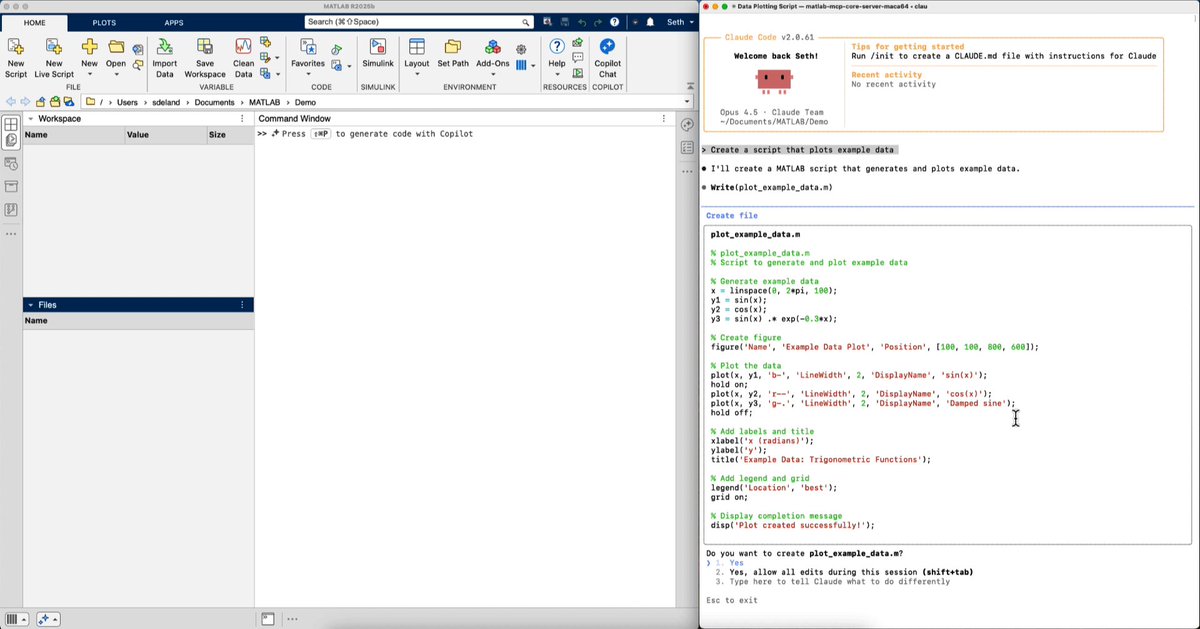
Classic vibration problem, modern workflow 👇 A quarter-car model driven into resonance, with and without a tuned mass damper. 📈 No absorber → resonance dominates 📉 With absorber → body motion drops by 50%+ Built two ways: a MATLAB animation and a Simscape model created using an agentic workflow....

73,453 Aufrufe • vor 1 Monat •via X (Twitter)

0 Kommentare

Keine Kommentare verfügbar

Kommentare vom Original-Post werden hier angezeigt

Ähnliche Videos

The question Ashton Forbes is working through is one that connects modern physics to one of the oldest unsolved problems in archaeology - how did ancient civilizations move stones of extraordinary mass with no evidence of the mechanical infrastructure that would make it possible today. The proposition he is exploring is that sound may be the answer. If physical reality is fundamentally wave-based, then sound - itself a wave phenomenon - could theoretically produce effects that resemble gravitational influence under the right conditions of frequency and resonance. The observation that stays with Randall is a simple and domestic one. An electric shaver set down on a countertop while still running began to move on its own - vibration translating directly into physical displacement across a flat surface. He noted it at the time and filed it away. Could vibrations move objects? Under the right circumstances, the answer appeared to be yes. Randall connects that observation to his broader research into resonance physics and ancient construction - arguing that a civilization without modern material manufacturing could still have identified and applied the principles of acoustic resonance to achieve effects that brute force and conventional tooling cannot replicate. The technology would have left no physical trace. Only the results would remain - and those results, Randall suggests, are exactly what we are still staring at in disbelief at sites around the world.

Randall Carlson

24,461 Aufrufe • vor 5 Monaten

New Course: ACP: Agent Communication Protocol Learn to build agents that communicate and collaborate across different frameworks using ACP in this short course built with IBM Research's BeeAI, and taught by Sandi Besen, AI Research Engineer & Ecosystem Lead at IBM, and Nicholas Renotte, Head of AI Developer Advocacy at IBM. Building a multi-agent system with agents built or used by different teams and organizations can become challenging. You may need to write custom integrations each time a team updates their agent design or changes their choice of agentic orchestration framework. The Agent Communication Protocol (ACP) is an open protocol that addresses this challenge by standardizing how agents communicate, using a unified RESTful interface that works across frameworks. In this protocol, you host an agent inside an ACP server, which handles requests from an ACP client and passes them to the appropriate agent. Using a standardized client-server interface allows multiple teams to reuse agents across projects. It also makes it easier to switch between frameworks, replace an agent with a new version, or update a multi-agent system without refactoring the entire system. In this course, you’ll learn to connect agents through ACP. You’ll understand the lifecycle of an ACP Agent and how it compares to other protocols, such as MCP (Model Context Protocol) and A2A (Agent-to-Agent). You’ll build ACP-compliant agents and implement both sequential and hierarchical workflows of multiple agents collaborating using ACP. Through hands-on exercises, you’ll build: - A RAG agent with CrewAI and wrap it inside an ACP server. - An ACP Client to make calls to the ACP server you created. - A sequential workflow that chains an ACP server, created with Smolagents, to the RAG agent. - A hierarchical workflow using a router agent that transforms user queries into tasks, delegated to agents available through ACP servers. - An agent that uses MCP to access tools and ACP to communicate with other agents. You’ll finish up by importing your ACP agents into the BeeAI platform, an open-source registry for discovering and sharing agents. ACP enables collaboration between agents across teams and organizations. By the end of this course, you’ll be able to build ACP agents and workflows that communicate and collaborate regardless of framework. Please sign up here:

Andrew Ng

105,343 Aufrufe • vor 1 Jahr