Video yükleniyor...

Video Yüklenemedi

Ana Sayfaya Dön

Claude Code tip: keep Opus 5.5 as your main model, but stop paying Opus prices for your subagents move them to Sonnet 5.5 Opus 5.5 plans and decides Sonnet 5.5 subagents do the heavy reading, editing and testing at half the price ($2 / $10 vs $4 / $20...

27,459 görüntüleme • 3 gün önce •via X (Twitter)

8 Yorum

LiveRichMedia profil fotoğrafı
LiveRichMedia2 gün önce

the core setup is good for substantial coding work. I would adjust it before making it your everyday default. • Keep the separate roles. Having agents investigate, implement, and review is sensible. Codex officially supports this arrangement. Subagent documentation • Question Sol high on every task. OpenAI recommends comparing settings on your actual work and keeping the lightest setting that meets your quality standard. Extra agents also consume additional tokens. Your Terra medium default remains consistent with your cost rules. Model guidance • Keep Astra available for difficult reviews. Give it a specific question and the actual changes, errors, and test results. Calling it automatically because a task was long can produce unnecessary review. Its agreement still does not prove the work functions. • Understand auto_review correctly. It reviews eligible permission requests. It does not check every action or certify finished work. Configuration documentation My recommendation: adopt the role separation and occasional independent review; retain your routine default and approval rules for stronger models.

David Chen profil fotoğrafı
David Chen3 gün önce

gpt-6-luna is the right one as a subagent

Will profil fotoğrafı
Will3 gün önce

opus for the plan sonnet for the loop is how you keep the bill from eating the win

catman profil fotoğrafı
catman3 gün önce

Think of it as a team: Opus is the lead, Sonnet handles the work, and the advisor is the reviewer at key checkpoints.

The AI Maximalist profil fotoğrafı
The AI Maximalist3 gün önce

Opus leads the strategy and Sonnet does the work it knows best which feels very efficient to watch in action

Dima T. profil fotoğrafı
Dima T.2 gün önce

the real optimization is routing each task to the model that actually needs to handle it

Ignition of Motivation profil fotoğrafı
Ignition of Motivation3 gün önce

Gemini 4 Argon (announced Sept 30): → 1M-token output (was 64K) → Leads on 12 of the 18 benchmarks Google shared (trails on 2 coding ones) → $2 in / $10 out per 1M tokens (intro price, $4/$20 later) → Built for coding, long multi-step work, cyber defense

Fox profil fotoğrafı
Fox3 gün önce

别的不说,这个动效做的是相当棒!

Benzer Videolar

Claude Code tip: once Opus 5.5 runs your main session, stop leaving Fable 5.1 on the bench put it on call with /advisor run /advisor fable Opus 5.5 keeps writing the code Fable 5.1 reads the whole session, every tool call included, and only speaks up at three moments: → before a plan: is this the right approach? → when the same error comes back: am I digging in the wrong place? → before "done": what did I miss? Fable 5.1 reviews. Opus 5.5 ships jev engineering is the same move one layer down: the forks that need no thinker (which file, which tool, retry or stop) go to jev in under half a second, and the big model only sees the ones that split - the full tree > Opus 5.5 on high runs the main session > explorer reads the code > worker edits and runs tests > researcher pulls the docs > all three on medium > Fable 5.1 on call as the advisor paste the tree and this prompt into Claude Code ↓ "Rebuild my Claude Code setup around this tree: 1. Check ~/.claude/agents and .claude/agents for subagents that already fit explorer, worker and researcher. > Draft new ones only for missing roles > Give each model: opus, effort: medium > Skip any that pin a different model and list them 2. Set the main session to high via effortLevel in ~/.claude/settings.json, and set advisorModel to fable 3. Find anything that keeps the advisor off (CLAUDE_CODE_DISABLE_ADVISOR_TOOL, DISABLE_TELEMETRY, any variable that stops feature-flag fetching) plus CLAUDE_CODE_EFFORT_LEVEL, which overrides subagent effort. Report them, change nothing 4. Add one rule to ~/.claude/CLAUDE.md: consult the advisor before a large plan, when an error repeats, and before calling a long task done Show me every change as a diff first. No edits until I say go." ↳

Hanako

51,329 görüntüleme • 4 gün önce

Claude Code tip, and it's absolute free f*cking gold: run Opus 5.5, Sonnet 5.5 and Fable 5.1 as one team and stop burning Opus tokens on routine work the setup in one line: plan on high, delegate on medium, keep Fable on call • who does what > Opus 5.5 on high - plans and ships the code > Sonnet 5.5 on medium - explorer reads code, worker edits and runs tests, researcher pulls docs > Fable 5.1 via /advisor fable - reads the whole session and speaks up only when it matters • when Fable 5.1 steps in -> before a plan: is this the right approach? -> when an error repeats: am I digging in the wrong place? -> before "done": what did I miss? Jev engineering takes it one layer lower: which file, which tool, retry or stop all go to Jev in under half a second, so the big models only see the real forks paste this into Claude Code ↓ "Rebuild my Claude Code setup: 1. Find subagents in ~/.claude/agents and .claude/agents that fit explorer, worker and researcher. Draft only the missing ones. Set each to model: sonnet, effort: medium. List any that pin a different model and leave them 2. In ~/.claude/settings.json set effortLevel to high and advisorModel to fable. 3. Report anything that disables the advisor (CLAUDE_CODE_DISABLE_ADVISOR_TOOL, DISABLE_TELEMETRY, flag-fetching blockers) and CLAUDE_CODE_EFFORT_LEVEL. Change nothing. 4. Add to ~/.claude/CLAUDE.md: consult the advisor before a large plan, when an error repeats, and before calling a long task done. Show every change as a diff. No edits until I say go." ↳

Mr. Buzzoni

141,462 görüntüleme • 4 gün önce

this is straight f*cking gold for anyone on Claude Code you already pay for Fable 5.1, and while Opus 5.5 does all the work it just sits there one command puts it on your session as a senior reviewer: /advisor fable Opus 5.5 keeps writing the code Fable 5.1 reads the whole session, every tool call included, and speaks up at three moments only: > before a plan: is this the right approach? > when the same error comes back: am I digging in the wrong place? > before "done": what did I miss? Fable 5.1 reviews. Opus 5.5 ships Jev engineering does the same thing one layer down: forks that need no thinker (which file, which tool, retry or stop) go to Jev in under half a second, and the big model only sees the ones that actually split • the full tree > Opus 5.5 on high runs the main session > explorer reads the code > worker edits and runs tests > researcher pulls the docs > all three on medium > Fable 5.1 on call as the advisor paste the tree and this prompt into Claude Code ↓ "Rebuild my Claude Code setup around this tree: 1. Check ~/.claude/agents and .claude/agents for subagents that already fit explorer, worker and researcher. Draft new ones only for missing roles. Give each model: opus, effort: medium. Skip any that pin a different model and list them. 2. Set the main session to high via effortLevel in ~/.claude/settings.json, and set advisorModel to fable. 3. Find anything that keeps the advisor off (CLAUDE_CODE_DISABLE_ADVISOR_TOOL, DISABLE_TELEMETRY, any variable that stops feature-flag fetching) plus CLAUDE_CODE_EFFORT_LEVEL, which overrides subagent effort. Report them, change nothing. 4. Add one rule to ~/.claude/CLAUDE.md: consult the advisor before a large plan, when an error repeats, and before calling a long task done. Show me every change as a diff first. No edits until I say go" ↳

Annatar.md

73,357 görüntüleme • 5 gün önce

Claude Code tip: once Opus 5.5 is your main model, stop letting your Fable 5.1 quota go to waste put it on call with /advisor run /advisor fable Opus 5.5 keeps doing the work Fable 5.1 sits on the sidelines, reads the whole session, and steps in at three moments: → before a plan: is this right? → when the same error comes back: am I going the wrong way? → before "done": did I miss anything? Fable 5.1 advises. Opus 5.5 writes the code the same idea sits under Jev engineering: the expensive model stops weighing in on every step and only gets called at the moments that change the outcome • the full setup > Opus 5.5 on high runs the main session > subagent one reads code > subagent two edits and runs tests > subagent three looks up docs > all three on medium > Fable 5.1 on call hand the tree and this prompt to Claude Code 👇 "Set up my Claude Code to match this tree: 1. Reuse fitting subagents from ~/.claude/agents and .claude/agents. > Propose new ones only for missing roles > Set each to model: opus, effort: medium > Leave any that set a different model alone and list them 2. Set main session effort to high via effortLevel in ~/.claude/settings.json 3. Check for env vars that disable the advisor (CLAUDE_CODE_DISABLE_ADVISOR_TOOL, DISABLE_TELEMETRY, anything that stops flag fetching) and CLAUDE_CODE_EFFORT_LEVEL, which overrides subagent effort. Report them, don't change them 4. Add a rule to ~/.claude/CLAUDE.md: ask the advisor before a big plan, when an error repeats, and before calling a long task done Show me the changes first. Don't edit files yet." ↳

Mr. Buzzoni

323,076 görüntüleme • 7 gün önce

This is f*cking insane. This tip saved me thousands of dollars. run Opus 5.5, Sonnet 5.5, and Fable 5.1 together, and stop burning Opus on work it was never needed for. the whole idea in one line: the strong model plans, the mid-tier model executes, Fable stays quiet until it's actually needed. roles, broken down: Opus 5.5, high effort, owns the plan and ships the final code Sonnet 5.5, medium effort, splits into explorer (reads the codebase), worker (edits files, runs tests), researcher (pulls docs) Fable 5.1, called through /advisor fable, reads everything happening in the session but stays silent unless something's actually wrong three moments where Fable speaks: → a plan goes out: is this actually the right call? → the same failure shows up again: is the search going nowhere? → the task gets marked finished: did something get skipped? Jev engineering does the same thing one level down. the forks that don't need real thought, which file, which tool, keep going or stop, go straight to Jev and come back in under half a second. the big models only ever see the forks that genuinely need a decision. anyone still running one model for everything is paying Opus prices to decide whether a file exists. drop this into Claude Code: "Rebuild my Claude Code setup around this structure: Look through ~/.claude/agents and .claude/agents for subagents already covering explorer, worker, and researcher. Only create new ones for roles that are missing. Set model: sonnet, effort: medium on each. If an existing subagent is locked to a different model, leave it as is and just list it. In ~/.claude/settings.json, set effortLevel to high and advisorModel to fable. Check for anything disabling the advisor, CLAUDE_CODE_DISABLE_ADVISOR_TOOL, DISABLE_TELEMETRY, or anything blocking feature-flag fetches, plus CLAUDE_CODE_EFFORT_LEVEL, which can override subagent effort settings. Report what you find. Don't change any of it yet. Add one line to ~/.claude/CLAUDE.md: check in with the advisor before a big plan, when the same error shows up twice, and before marking a long task done. Show every change as a diff first. Wait for my go-ahead before touching anything."

rvaniaaa

242,307 görüntüleme • 2 gün önce

Codex tip: once GPT-6.1 Sol is your main model, stop running Astra on every turn put Astra on call as an architect agent GPT-6.1 Sol keeps writing the code Astra only gets spawned at three points: → before a plan: is this the right approach? → when the same error comes back: am I digging in the wrong place? → before "done": what did I miss? Astra reviews. Sol ships Jev engineering is the same move one layer down: the forks that need no thinker (which file, which tool, retry or stop) go to Jev in under half a second, and the big models only see the ones that split - the full tree > GPT-6.1 Sol on high runs the main session > explorer reads the code on Luna > worker edits and runs tests on Sol > researcher pulls the docs on Luna > all three on medium > Astra on call as the architect > auto_review checks every approval paste the tree and this prompt into Codex ↓ "Rebuild my Codex setup around this tree: 1. Check ~/.codex/agents and .codex/agents for agents that already fit explorer, worker and researcher. > Draft new TOML files only for missing roles > explorer and researcher on gpt-6-luna, worker on gpt-6.1-sol, all with model_reasoning_effort medium > Add an architect agent on gpt-6-astra, model_reasoning_effort high, whose only job is reviewing plans, repeated errors and finished work > Skip any that pin a different model and list them 2. In ~/.codex/config.toml set model to gpt-6.1-sol, model_reasoning_effort to high and approvals_reviewer to auto_review 3. Find anything that would override this (active profiles, flags in my shell aliases, agents.default_subagent_model). Report it, change nothing 4. Add one rule to AGENTS.md: spawn the architect before a large plan, when an error repeats, and before calling a long task done Show me every change as a diff first. No edits until I say go." ↳

delost

1,017,721 görüntüleme • 4 gün önce

Jev + Opus 5.5: Anthropic's new model beats GPT-6 Astra for 1/5 the cost, and 4 API changes will 400 your agent before it writes a single line I pulled these 10 steps from the migration docs so you don't learn them in production step 1 → $4 / $20 per 1M. Opus 5 was $5 / $25. cache reads dropped from $0.50 to $0.20 step 2 → 66.4% on Terminal-Bench 4.0 vs GPT-6 Astra 57.9% and Opus 5 52.3%. +14.1 points in one release, and on FrontierCode it beats Astra at default effort for 1/5 the cost step 3 → thinking can't be turned off anymore. send thinking: disabled and you get a 400. drop the field, set effort step 4 → tool_choice any and tool are gone. 400. switch to auto + strict step 5 → edit anything above a thinking block and the request dies. append only, or opt into drop_block step 6 → computer_20251124 is dead on the API. 400. move to computer_toolset_20260801 step 7 → the quiet one: default effort fell from high to medium. your agent thinks less than you set it up to and nothing tells you step 8 → hop Opus 5.5 → Sonnet 5 → Opus 5.5 and you pay 4.36 instead of 3.32. +31%, the cache dies and Sonnet can't read Opus's reasoning step 9 → change effort at the top of the request and the cache is gone. Jev sets it per message and the cache stays step 10 → switch fast - standard mid-session and it's a full cache miss. Jev picks speed once, on turn one one model, three knobs, zero 400s. that is Jev + Opus 5.5 send this to your Claude Code before you touch the model ID, then read my full Jev deep dive in the article below ↓

Carnage

16,674 görüntüleme • 12 gün önce

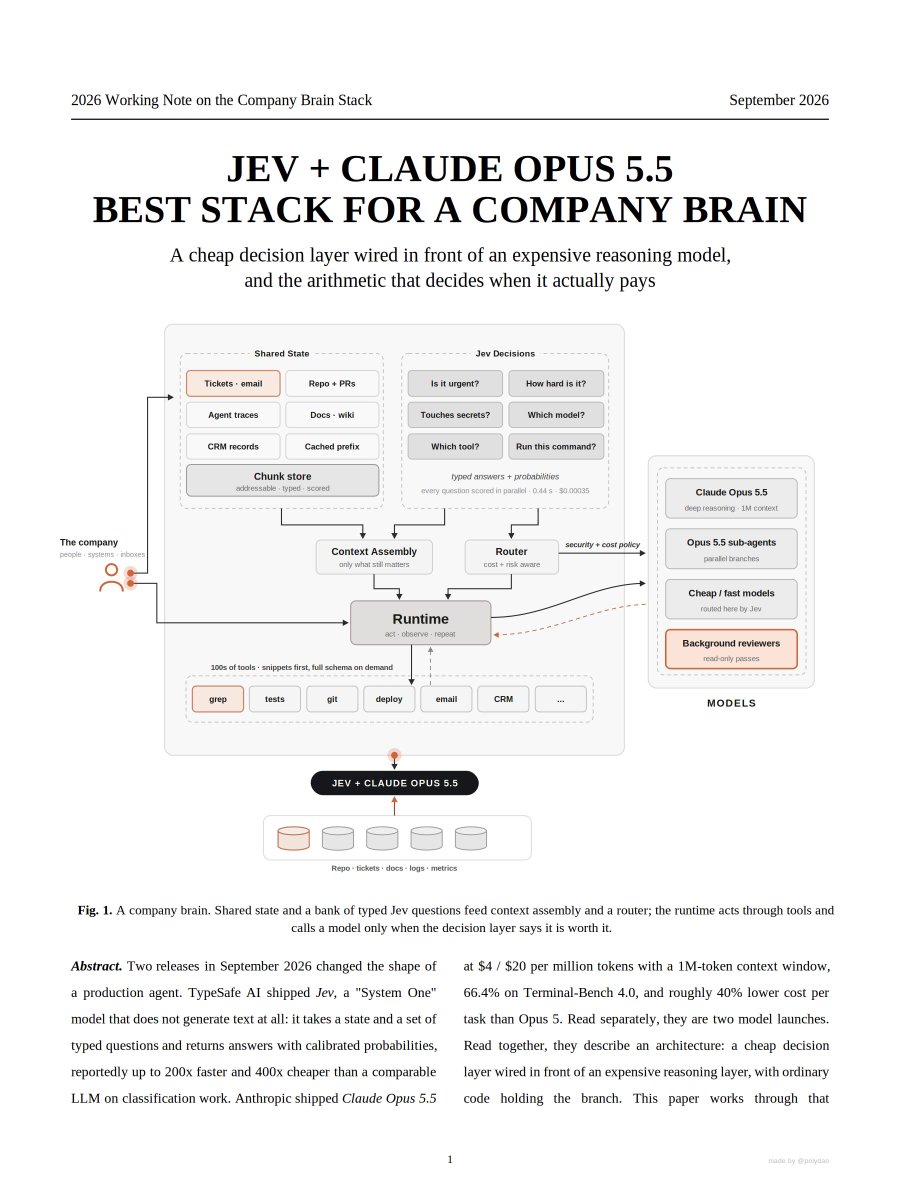
JEV + OPUS 5.5 IS INSANE FOR BUILDING A COMPANY BRAIN I pulled the whole architecture out of the TypeSafe and Anthropic docs and packed it into a 14-page PDF the 10 steps: 1. meet the pair > Opus 5.5 thinks, Jev decides, your code holds the branch 2. stop asking a text generator for a yes or no > Jev returns a typed answer with a calibrated probability in 0.44s for $0.00035 3. ask everything at once > Choice, Score and Noul run in parallel, so the fourth question costs almost nothing 4. branch on the number > 0.999 goes straight into the if statement. ~99% of turns end right here 5. stop routing blind > Opus 5.5 to Sonnet and back costs 5.84 against 3.32 for staying on 5.5 6. keep one context warm > cache reads at $0.20 per Mtok are 20x cheaper than a fresh load 7. escalate the hard part > the toughest 1% goes to Opus 5.5 with 1M context and 66.4% on Terminal-Bench 4.0 8. score every chunk on every query > keep whole, summarize or drop. the context gets rebuilt each turn 9. gate the actual command > every bash call gets classified before it runs, inside your own code 10. judge 100% of runs > $3.50 a day for 10,000 traces, and it matched the human label on all 500 decisions the result: a while loop that paid a frontier model for every tiny call turns into a brain that spends a fraction of a cent to notice and pays properly only when it has to think the person who brings this into their team walks into the budget meeting with the AI bill cut and the output up the PDF maps the company brain. the loop side of it - how Jev takes a Claude bill from $765 to $3 a month - is in the article below ↓

Mr. Buzzoni

85,590 görüntüleme • 7 gün önce

i finally mastered how to maximise my opus 5.5 usage limits... the trick: let jev choose which subagent gets each task and how much effort it should use. [here’s how i’d wire it:] claude breaks the project into tasks. jev selects from predefined worker profiles. claude applies the selected settings and dispatches the work. → main session, medium: clarify the requirements, define what “done” looks like, and prepare the tasks → builder, low: small, clearly defined tasks with existing examples or patterns → builder, medium: tasks that connect multiple parts or need decisions within the approved plan → verifier, high: check requirements, probe edge cases, and report problems for the builder to fix jev gets the task’s scope, what’s uncertain, and the consequences of failure. it chooses from the profiles allowed for that task. your approval checkpoints stay in place. paste this into your next planning session: “use opus 5.5 with jev selecting the worker and effort profile for each task. first, check that a working jev integration is available and that this environment supports separate effort settings for subagents. check for configuration or environment overrides that could prevent those settings from taking effect. if anything is missing, explain what needs wiring before proceeding. break my request into tasks with clear ownership, dependencies, relevant context, and acceptance checks. keep small related tasks together when a separate subagent would add unnecessary overhead. keep the main session at medium effort. offer jev these worker profiles: builder at low effort for small, clearly defined tasks using existing patterns; builder at medium effort for tasks that connect multiple parts or require decisions within the approved plan; verifier at high effort for checking requirements and edge cases. give jev each task’s scope, uncertainties, dependencies, and consequences of failure. only offer profiles appropriate to the current stage. validate its selection before dispatching. use the actual jev integration; don’t simulate its decisions. if it abstains or returns an invalid choice, stop that handoff and ask me. show me the task plan and proposed assignments before starting. after approval, launch the selected workers with their assigned effort settings, relevant context, file ownership, and completion checks. let me review the result before verification. the verifier may add tests but must leave implementation code unchanged. have it report what passed, what failed, and what remains uncertain. send implementation fixes back to the builder, then recheck the affected parts. if a task repeatedly fails, examine the requirements and approach before increasing effort. report available total usage, including jev calls, worker calls, retries, and verification. don’t invent missing data. compare similar completed tasks before claiming savings.” steal this 👇

Avid

31,355 görüntüleme • 8 gün önce