Загрузка видео...

Не удалось загрузить видео

На главную

Claude Code tip: once Opus 5.5 runs your main session, stop leaving Fable 5.1 on the bench put it on call with /advisor run /advisor fable Opus 5.5 keeps writing the code Fable 5.1 reads the whole session, every tool call included, and only speaks up at three moments:...

52,065 просмотров • 1 месяц назад •via X (Twitter)

Комментарии: 14

Фото профиля PublicAI
PublicAI1 месяц назад

Advisor on Fable 5.1 and the main session on Opus 5.5 is the split a lot of long sessions needed. The three gates (plan, repeated error, before done) stop Fable from narrating every tool call. Pin those three in CLAUDE.md so a new chat does not forget them.

Фото профиля Delayo
Delayo1 месяц назад

alpho

Фото профиля slash1s
slash1s1 месяц назад

useful pipeline here

Фото профиля Dominik
Dominik1 месяц назад

advisor that reads every tool call is how taste stays in the loop.

Фото профиля airplanestar 𓂀
airplanestar 𓂀1 месяц назад

running an observer model out of band catches tunnel vision before bad patches get committed. way smarter than asking the primary model to critique its own code in the same thread

Фото профиля sophs l
sophs l1 месяц назад

opus writing fable reading is basically pair programming with a senior who only speaks when you're about to break prod

Фото профиля catman
catman1 месяц назад

It’s like a pilot with a second set of eyes: Opus drives, while the advisor checks the route at the moments where a wrong turn gets expensive.

Фото профиля Risos AI
Risos AI1 месяц назад

Setuju sih setup dua model gini kepake banget, apalagi pas server utamanya lagi ngadat kayak sekarang, kerjaan riset langsung berhenti di tengah jalan. Btw pas advisor baca seluruh session, konteksnya nggak keburu kepotong ya kalau sessionnya udah panjang banget?

Фото профиля David Kovach
David Kovach1 месяц назад

What are you building that you even need all this???

Фото профиля kadd
kadd1 месяц назад

Impressive

Фото профиля Sof t.
Sof t.1 месяц назад

Well said!

Фото профиля The SI Therapist
The SI Therapist1 месяц назад

Opus écrit, Fable vérifie : l'orchestre est enfin complet pour coder sans faux pas

Фото профиля ✿ soph e.
✿ soph e.1 месяц назад

whats the actual latency hit on that, does fable add like 2s per turn

Фото профиля ∑: Meww ∑: (❖,❖)
∑: Meww ∑: (❖,❖)1 месяц назад

Interesting Claude Code setup for efficient AI collaboration.

Похожие видео

Claude Code tip: once Opus 5.5 is your main model, stop leaving Fable 5.1 sitting idle put it on call with /advisor run /advisor fable Opus 5.5 keeps writing the code Fable 5.1 reads the full session, every tool call included, and only speaks up at three points: → before a plan: is this the right approach? → when the same error comes back: am I digging in the wrong place? → before "done": what did I miss? Fable 5.1 reviews. Opus 5.5 ships Jev engineering is the same move one layer down: the forks that need no thinker (which file, which tool, retry or stop) go to Jev in under half a second, and the big model only sees the ones that split - the full tree > Opus 5.5 on high runs the main session > explorer reads the code > worker edits and runs tests > researcher pulls the docs > all three on medium > Fable 5.1 on call as the advisor paste the tree and this prompt into Claude Code ↓ "Rebuild my Claude Code setup around this tree: 1. Check ~/.claude/agents and .claude/agents for subagents that already fit explorer, worker and researcher. > Draft new ones only for missing roles > Give each model: opus, effort: medium > Skip any that pin a different model and list them 2. Set the main session to high via effortLevel in ~/.claude/settings.json, and set advisorModel to fable 3. Find anything that keeps the advisor off (CLAUDE_CODE_DISABLE_ADVISOR_TOOL, DISABLE_TELEMETRY, any variable that stops feature-flag fetching) plus CLAUDE_CODE_EFFORT_LEVEL, which overrides subagent effort. Report them, change nothing 4. Add one rule to ~/.claude/CLAUDE.md: consult the advisor before a large plan, when an error repeats, and before calling a long task done Show me every change as a diff first. No edits until I say go." ↳

delost

701,775 просмотров • 1 месяц назад

Claude Code tip: once Opus 5.5 is your main model, stop leaving Fable 5.1 sitting idle and stop burning Opus tokens on tasks Sonnet 5.5 can swarm put it on call with /advisor run /advisor fable Opus 5.5 plans and ships the code Sonnet 5.5 swarms the routine work at medium effort Fable 5.1 reads the full session, every tool call included, and only speaks up at three points: → before a plan: is this the right approach? → when the same error comes back: am I digging in the wrong place? → before "done": what did I miss? Fable 5.1 reviews. Sonnet 5.5 executes. Opus 5.5 ships Jev engineering is the same move one layer down: the forks that need no thinker (which file, which tool, retry or stop) go to Jev in under half a second, and the big model only sees the ones that split Plan on high. Delegate on medium. Keep Fable on call. - the full tree > Opus 5.5 on high runs the main session > explorer reads the code > worker edits and runs tests > researcher pulls the docs > all three on Sonnet 5.5 at medium effort > Fable 5.1 on call as the advisor paste the tree and this prompt into Claude Code ↓ "Rebuild my Claude Code setup around this tree: 1. Check ~/.claude/agents and .claude/agents for subagents that already fit explorer, worker and researcher. > Draft new ones only for missing roles > Give each model: sonnet, effort: medium > Skip any that pin a different model and list them 2. Set the main session to high via effortLevel in ~/.claude/settings.json, and set advisorModel to fable 3. Find anything that keeps the advisor off (CLAUDE_CODE_DISABLE_ADVISOR_TOOL, DISABLE_TELEMETRY, any variable that stops feature-flag fetching) plus CLAUDE_CODE_EFFORT_LEVEL, which overrides subagent effort. Report them, change nothing 4. Add one rule to ~/.claude/CLAUDE.md: consult the advisor before a large plan, when an error repeats, and before calling a long task done Show me every change as a diff first. No edits until I say go." ↳

mirku

424,860 просмотров • 1 месяц назад

Official Anthropic tip for Claude Code: stop burning Opus 5.5 on work Sonnet 5.5 can do, while Fable 5.1 sits idle hand the grunt work to Sonnet 5.5 subagents and put Fable 5.1 on call run /advisor fable Opus 5.5 plans and merges Sonnet 5.5 subagents read, edit and run the tests Fable 5.1 reads the full session and only speaks up at three points: → before a plan: is this the right approach? → when the same error comes back: am I digging in the wrong place? → before "done": what did I miss? Sonnet 5.5 builds. Fable 5.1 reviews. Opus 5.5 ships Jev engineering is the same move one layer down: the forks that need no thinker (which file, which tool, retry or stop) go to Jev in under half a second, and the big models only see the ones that split - the full tree > Opus 5.5 on high runs the main session > explorer reads the code on Sonnet 5.5 > worker edits and runs tests on Sonnet 5.5 > researcher pulls the docs on Sonnet 5.5 > all three on medium > Fable 5.1 on call for main and every subagent paste the tree and this prompt into Claude Code ↓ "Rebuild my Claude Code setup around this tree: 1. Check ~/.claude/agents and .claude/agents for subagents that already fit explorer, worker and researcher. > Draft new ones only for missing roles > Give each model: sonnet, effort: medium > Skip any that pin a different model and list them 2. Set the main session to high via effortLevel in ~/.claude/settings.json, and set advisorModel to fable 3. Find anything that keeps the advisor off (CLAUDE_CODE_DISABLE_ADVISOR_TOOL, DISABLE_TELEMETRY) plus CLAUDE_CODE_EFFORT_LEVEL, which overrides subagent effort. Report them, change nothing 4. Add one rule to ~/.claude/CLAUDE.md: consult the advisor before a large plan, when an error repeats, and before calling a long task done Show me every change as a diff first. No edits until I say go." ↳

delost

44,284 просмотров • 1 месяц назад

this is straight f*cking gold for anyone on Claude Code you already pay for Fable 5.1, and while Opus 5.5 does all the work it just sits there one command puts it on your session as a senior reviewer: /advisor fable Opus 5.5 keeps writing the code Fable 5.1 reads the whole session, every tool call included, and speaks up at three moments only: > before a plan: is this the right approach? > when the same error comes back: am I digging in the wrong place? > before "done": what did I miss? Fable 5.1 reviews. Opus 5.5 ships Jev engineering does the same thing one layer down: forks that need no thinker (which file, which tool, retry or stop) go to Jev in under half a second, and the big model only sees the ones that actually split • the full tree > Opus 5.5 on high runs the main session > explorer reads the code > worker edits and runs tests > researcher pulls the docs > all three on medium > Fable 5.1 on call as the advisor paste the tree and this prompt into Claude Code ↓ "Rebuild my Claude Code setup around this tree: 1. Check ~/.claude/agents and .claude/agents for subagents that already fit explorer, worker and researcher. Draft new ones only for missing roles. Give each model: opus, effort: medium. Skip any that pin a different model and list them. 2. Set the main session to high via effortLevel in ~/.claude/settings.json, and set advisorModel to fable. 3. Find anything that keeps the advisor off (CLAUDE_CODE_DISABLE_ADVISOR_TOOL, DISABLE_TELEMETRY, any variable that stops feature-flag fetching) plus CLAUDE_CODE_EFFORT_LEVEL, which overrides subagent effort. Report them, change nothing. 4. Add one rule to ~/.claude/CLAUDE.md: consult the advisor before a large plan, when an error repeats, and before calling a long task done. Show me every change as a diff first. No edits until I say go" ↳

Annatar.md

74,551 просмотров • 1 месяц назад

This is f*cking insane. This Claude Code tip saved me thousands of dollars. once Opus 5.5 is your main model, stop burning it on work Sonnet 5.5 can do, while Fable 5.1 sits idle hand the grunt work to Sonnet 5.5 subagents and put Fable 5.1 on call run /advisor fable Opus 5.5 plans and ships the final code Sonnet 5.5 subagents read, edit and run the tests Fable 5.1 reads the full session, every tool call included, and only speaks up at three points: → before a plan: is this the right approach? → when the same error comes back: am I digging in the wrong place? → before "done": what did I miss? Sonnet 5.5 builds. Fable 5.1 reviews. Opus 5.5 ships Jev engineering is the same move one layer down: the forks that need no thinker (which file, which tool, retry or stop) go to Jev in under half a second, and the big models only see the ones that split anyone still running one model for everything is paying Opus prices to decide whether a file exists - the full tree > Opus 5.5 on high runs the main session > explorer reads the code on Sonnet 5.5 > worker edits and runs tests on Sonnet 5.5 > researcher pulls the docs on Sonnet 5.5 > all three on medium > Fable 5.1 on call for main and every subagent paste the tree and this prompt into Claude Code ↓ "Rebuild my Claude Code setup around this tree: 1. Check ~/.claude/agents and .claude/agents for subagents that already fit explorer, worker and researcher. > Draft new ones only for missing roles > Give each model: sonnet, effort: medium > Skip any that pin a different model and list them 2. Set the main session to high via effortLevel in ~/.claude/settings.json, and set advisorModel to fable 3. Find anything that keeps the advisor off (CLAUDE_CODE_DISABLE_ADVISOR_TOOL, DISABLE_TELEMETRY) plus CLAUDE_CODE_EFFORT_LEVEL, which overrides subagent effort. Report them, change nothing 4. Add one rule to ~/.claude/CLAUDE.md: consult the advisor before a large plan, when an error repeats, and before calling a long task done Show me every change as a diff first. No edits until I say go." ↳

delost

48,964 просмотров • 1 месяц назад

Claude Code tip: keep Opus 5.5 as your main model, but stop paying Opus prices for your subagents move them to Sonnet 5.5 Opus 5.5 plans and decides Sonnet 5.5 subagents do the heavy reading, editing and testing at half the price ($2 / $10 vs $4 / $20 per 1M tokens) Fable 5.1 stays on call with /advisor and only speaks up at three points: → before a plan: is this the right approach? → when the same error comes back: am I digging in the wrong place? → before "done": what did I miss? Opus thinks. Sonnet does. Fable checks Jev engineering is the same move one layer down: the forks that need no thinker (which file, which tool, retry or stop) go to Jev in under half a second, and the big models only see the ones that split - the full tree > Opus 5.5 on high runs the main session > explorer reads the code > worker edits and runs tests > researcher pulls the docs > all three on Sonnet 5.5, medium > Fable 5.1 on call as the advisor paste the tree and this prompt into Claude Code ↓ "Rebuild my Claude Code setup around this tree: 1. Check ~/.claude/agents and .claude/agents for subagents that already fit explorer, worker and researcher. > Draft new ones only for missing roles > Give each model: claude-sonnet-5-5, effort: medium > List any that pin a different model before changing them 2. Keep the main session on Opus, set effortLevel to high in ~/.claude/settings.json and advisorModel to fable 3. Find anything that keeps the advisor off (CLAUDE_CODE_DISABLE_ADVISOR_TOOL, DISABLE_TELEMETRY, any variable that stops feature-flag fetching) plus CLAUDE_CODE_EFFORT_LEVEL, which overrides subagent effort. Report them, change nothing 4. Add one rule to ~/.claude/CLAUDE.md: consult the advisor before a large plan, when an error repeats, and before calling a long task done Show me every change as a diff first. No edits until I say go." ↳

delost

28,222 просмотров • 1 месяц назад

Claude Code tip, and it's absolute free f*cking gold: run Opus 5.5, Sonnet 5.5 and Fable 5.1 as one team and stop burning Opus tokens on routine work the setup in one line: plan on high, delegate on medium, keep Fable on call • who does what > Opus 5.5 on high - plans and ships the code > Sonnet 5.5 on medium - explorer reads code, worker edits and runs tests, researcher pulls docs > Fable 5.1 via /advisor fable - reads the whole session and speaks up only when it matters • when Fable 5.1 steps in -> before a plan: is this the right approach? -> when an error repeats: am I digging in the wrong place? -> before "done": what did I miss? Jev engineering takes it one layer lower: which file, which tool, retry or stop all go to Jev in under half a second, so the big models only see the real forks paste this into Claude Code ↓ "Rebuild my Claude Code setup: 1. Find subagents in ~/.claude/agents and .claude/agents that fit explorer, worker and researcher. Draft only the missing ones. Set each to model: sonnet, effort: medium. List any that pin a different model and leave them 2. In ~/.claude/settings.json set effortLevel to high and advisorModel to fable. 3. Report anything that disables the advisor (CLAUDE_CODE_DISABLE_ADVISOR_TOOL, DISABLE_TELEMETRY, flag-fetching blockers) and CLAUDE_CODE_EFFORT_LEVEL. Change nothing. 4. Add to ~/.claude/CLAUDE.md: consult the advisor before a large plan, when an error repeats, and before calling a long task done. Show every change as a diff. No edits until I say go." ↳

Mr. Buzzoni

144,764 просмотров • 1 месяц назад

Claude Code tip: once Opus 5.5 is your main model, stop letting your Fable 5.1 quota go to waste put it on call with /advisor run /advisor fable Opus 5.5 keeps doing the work Fable 5.1 sits on the sidelines, reads the whole session, and steps in at three moments: → before a plan: is this right? → when the same error comes back: am I going the wrong way? → before "done": did I miss anything? Fable 5.1 advises. Opus 5.5 writes the code the same idea sits under Jev engineering: the expensive model stops weighing in on every step and only gets called at the moments that change the outcome • the full setup > Opus 5.5 on high runs the main session > subagent one reads code > subagent two edits and runs tests > subagent three looks up docs > all three on medium > Fable 5.1 on call hand the tree and this prompt to Claude Code 👇 "Set up my Claude Code to match this tree: 1. Reuse fitting subagents from ~/.claude/agents and .claude/agents. > Propose new ones only for missing roles > Set each to model: opus, effort: medium > Leave any that set a different model alone and list them 2. Set main session effort to high via effortLevel in ~/.claude/settings.json 3. Check for env vars that disable the advisor (CLAUDE_CODE_DISABLE_ADVISOR_TOOL, DISABLE_TELEMETRY, anything that stops flag fetching) and CLAUDE_CODE_EFFORT_LEVEL, which overrides subagent effort. Report them, don't change them 4. Add a rule to ~/.claude/CLAUDE.md: ask the advisor before a big plan, when an error repeats, and before calling a long task done Show me the changes first. Don't edit files yet." ↳

Mr. Buzzoni

327,334 просмотров • 1 месяц назад

Claude Code tip that's pure f*cking treasure: Opus 5.5 + Sonnet 5.5 + Fable 5.1 as one team plan on high, delegate on medium, keep Fable on call the team: • Opus 5.5 (high) - plans and ships • Sonnet 5.5 (medium) - explores, edits, runs tests, pulls docs • Fable 5.1 (/advisor fable) - watches the session, speaks up when it counts Fable wakes up 3 times: 1. before a plan - is this the right approach? 2. when an error repeats - am I digging in the wrong place? 3. before "done" - what did I miss? Jev engineering goes one layer lower: which file, which tool, retry or stop go to Jev in under half a second, so the big models only see the real forks paste this into Claude Code 👇 "Rebuild my Claude Code setup around one team. 1. Subagents - reuse anything in ~/.claude/agents and .claude/agents that fits explorer, worker or researcher, draft the rest - all on model: sonnet, effort: medium - explorer and researcher read-only (Read, Grep, Glob, WebFetch), only worker gets Edit and Bash - each returns under 15 lines with file:line refs 2. Main session - in ~/.claude/settings.json set effortLevel to high and advisorModel to fable - report anything that overrides this (CLAUDE_CODE_DISABLE_ADVISOR_TOOL, DISABLE_TELEMETRY, CLAUDE_CODE_EFFORT_LEVEL) and change nothing 3. Add to ~/.claude/CLAUDE.md - consult the advisor before a plan touching 3+ files, when the same error shows up twice, and before calling a long task done - never let two subagents edit the same file Run /agents to confirm, then show everything as one diff. No edits until I say go." ↳

Annatar.md

19,580 просмотров • 1 месяц назад

This is f*cking insane. I spent thousands of dollars before I split my work across three models put Opus 5.5 on the plan, Sonnet 5.5 on the legwork and Fable 5.1 on call, and you stop spending Opus money on jobs it was never needed for who does what: Opus 5.5, high effort: makes the plan and owns the final diff Sonnet 5.5, medium effort, three jobs: explorer reads the code, worker edits files and runs tests, researcher pulls the docs Fable 5.1, through /advisor fable: reads the whole session, but only when it gets called Fable is consulted at three points: → before a plan ships: is this the right approach? → when an error comes back twice: is the search stuck in the wrong place? → before a long task counts as done: what got missed? Jev engineering applies the same split to the smallest decisions. which file to open, which tool to run, retry or stop need no reasoning, so Jev answers them in under half a second and the big models only get the real forks run Opus on everything and you pay it to check whether a file exists paste this into Claude Code: "Rebuild my Claude Code setup around three tiers. Look in ~/.claude/agents and .claude/agents for subagents that already cover explorer, worker and researcher. Create only the missing ones, each with model: sonnet and effort: medium. If an existing one is pinned to another model, list it and leave it alone. In ~/.claude/settings.json, set advisorModel to fable. Set high effort for Opus inside modelSettings for claude-opus-5-5, because a top-level effortLevel does not apply to Opus 5.5. Report, without changing anything: CLAUDE_CODE_DISABLE_ADVISOR_TOOL, DISABLE_TELEMETRY or anything blocking feature-flag fetches, CLAUDE_CODE_EFFORT_LEVEL, which can override subagent effort, and whether Fable as advisor needs a one-time billing consent. If you can't tell, say so. Add one line to ~/.claude/CLAUDE.md: consult the advisor before a big plan, when the same error shows up twice, and before marking a long task done. Show every change as a diff first. Touch nothing until I say go."

Ryven

49,239 просмотров • 1 месяц назад

this is pure f*cking treasure Claude Code tip: once Opus 5.5 is your main model, stop leaving Fable 5.1 sitting idle and stop burning Opus tokens on tasks Sonnet 5.5 can swarm put it on call with /goal claude --auto-mode "/goal all tests pass and lint is clean" Opus 5.5 keeps writing the code in auto mode Sonnet 5.5 swarms the routine work at medium Fable 5.1 inspects the full transcript and only speaks up at the turn boundary: → not yet met: am I drifting from acceptance criteria? → met: do the tests, diffs, and lint hold? → impossible: am I chasing an unreachable state? Fable grades. Opus ships JEV engineering is the same move one layer down: the forks that need no thinker (which file, which tool, retry or halt) go to JEV in under 16ms, and the big models only see the ones that split — the full tree > Opus 5.5 on high runs the main session > worker edits and patches code on Sonnet 5.5 > explorer indexes AST maps and call sites on Sonnet 5.5 > verifier runs tests and linters on Sonnet 5.5 > all three subagents on medium effort > Fable 5.1 on call as the Stop hook evaluator > JEV routes micro-forks under 16ms paste the tree and this prompt into Claude Code ↓ "Reconfigure my Claude Code setup around this tree: 1. Set the main session to Opus 5.5 on high effort with auto mode enabled. 2. Put Fable 5.1 on call as a session-scoped evaluator attached to the Stop hook: - Read-only transcript evaluation with zero tool calls - Three structured outcomes: not yet met (with steering notes), met (auto-clear), and impossible (abort early) 3. Spawn Sonnet 5.5 subagents on medium effort for worker, explorer, and verifier roles. Defer goal checks while background tasks run. 4. Route fast deterministic forks (tool resolution, path selection, auto-retries) through JEV. 5. Add one rule to CLAUDE.md: run long tasks with: claude --auto-mode \"/goal \" Show me every configuration change as a diff first. No edits until I say go." ↳

mirku

42,228 просмотров • 1 месяц назад

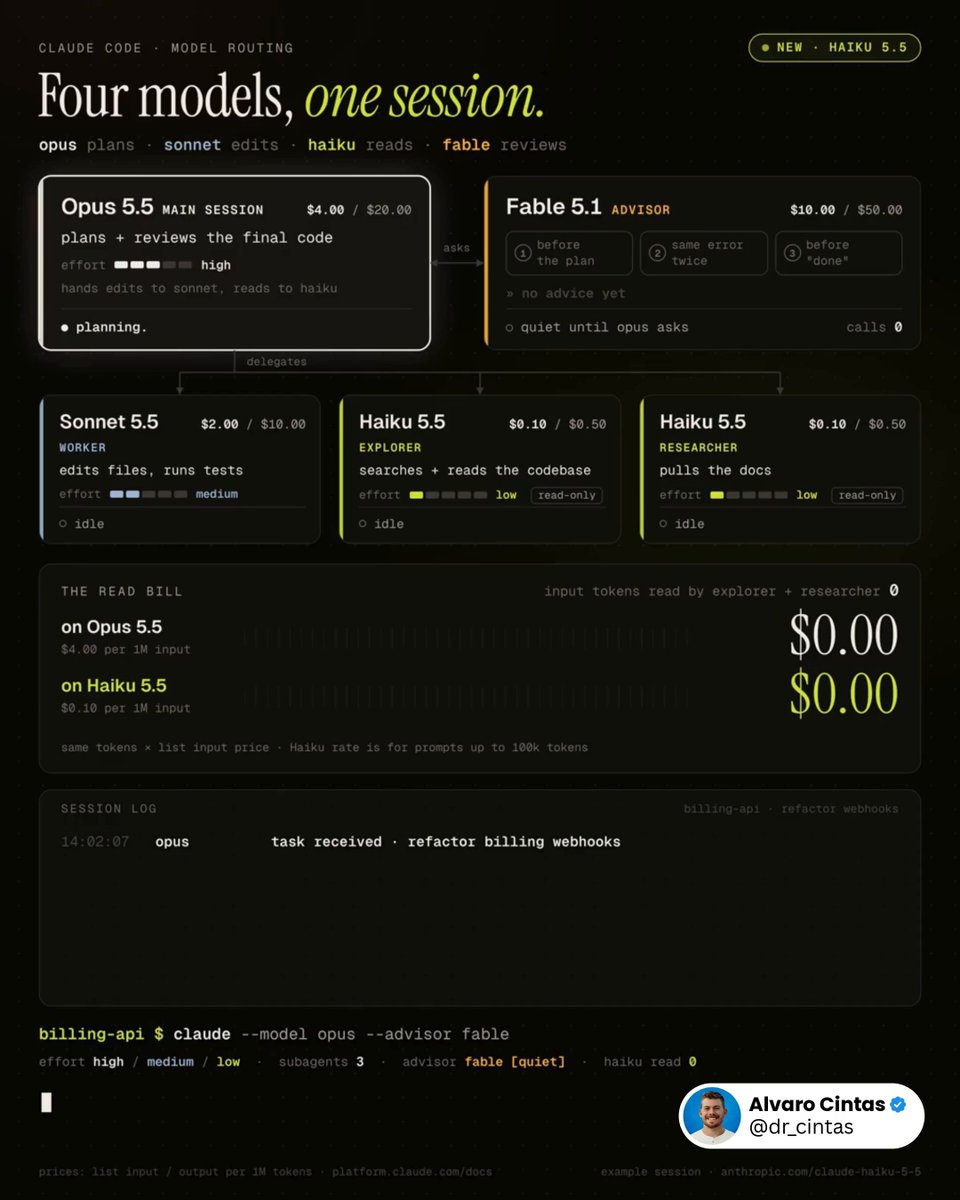
This workflow will save you thousands with Claude. Run Opus 5.5, Sonnet 5.5, Haiku 5.5, and Fable 5.1 together, and stop spending Opus tokens on work that doesn't need Opus. The entire idea in one line: Opus plans, Sonnet edits, Haiku reads, Fable reviews at decision points. Roles, broken down: - Opus 5.5, high effort, owns the plan and reviews the final code - Sonnet 5.5, medium effort, is the worker: edits files, runs tests - Haiku 5.5, low effort, splits into explorer (searches and reads the codebase) and researcher (pulls docs). it's the first Haiku with an effort setting - Fable 5.1, set with /advisor fable. Opus calls it at decision points, and it gets the full transcript each time Three moments Opus tends to call it: → before committing to a plan: is this the right approach? → the same error shows up again: is this going nowhere? → before marking the task done: did something get skipped? Why Haiku only reads: Anthropic's launch post says Sonnet 5.5 and Opus 5.5 are still the better choice for complex agentic coding (Terminal-Bench 4.0: 39.2% for Haiku 5.5, 70.6% for Sonnet 5.5) and that Haiku 5.5 fits narrowly scoped subagent work. so it gets the lookups, not the edits. Anyone still running one model for everything is paying $4 per million input tokens to check whether a file exists. Haiku 5.5 does it for $0.10. Drop this into Claude Code 👇 "Rebuild my Claude Code setup around this structure: Confirm Claude Code is v2.1.293 or later, so the haiku alias resolves to Haiku 5.5. If it isn't, stop and tell me to run claude update. Look through ~/.claude/agents and .claude/agents for subagents already covering explorer, worker, and researcher. Only create new ones for roles that are missing. Set model: haiku, effort: low on explorer and researcher, with no Edit or Write tools. Set model: sonnet, effort: medium on worker. If an existing subagent is locked to a different model, leave it as is and just list it. Name the explorer subagent Explore so it overrides the built-in one, which otherwise runs on my main model. In ~/.claude/settings.json, set advisorModel to fable, and set effortLevel to high for claude-opus-5-5 under modelSettings. A top-level effortLevel in user settings doesn't apply to Opus 5.5. Check for anything disabling the advisor: CLAUDE_CODE_DISABLE_ADVISOR_TOOL, DISABLE_TELEMETRY, or anything blocking feature-flag fetches. Also check CLAUDE_CODE_EFFORT_LEVEL, which overrides subagent effort settings, and CLAUDE_CODE_SUBAGENT_MODEL_FORCE, which makes Claude Code ignore subagent model fields. Report what you find. Don't change any of it yet. Add one line to ~/.claude/CLAUDE.md: consult the advisor before a big plan, when the same error shows up twice, and before marking a long task done. Show every change as a diff first. Wait for my go-ahead before touching anything."

Alvaro Cintas

58,450 просмотров • 1 месяц назад

THIS IS AN ACTUAL F*CKING GOLDMINE Anthropic just shared one of the best tricks for Claude Code. The idea: run Sonnet, Haiku and Opus 5.5 together, each one doing only the job it's best at. Opus-level judgment on every big call, without paying Opus rates for every routine turn. You just launch Claude Code like this: claude --model sonnet --advisor opus here's the split: → Sonnet 5.5 runs the session and writes the code → Haiku 5.5 explores files and docs in parallel → Opus 5.5 stays on call as advisor for the big calls → you stop spending Opus on work that doesn't need it Opus only steps in at three moments: → before a plan locks → when the same error shows up twice → before calling it done Sonnet builds. Haiku explores. Opus reviews. JEV engineering is the same move one layer down: the forks that need no thinker (which file, which tool, retry or stop) go to JEV in milliseconds, and the big models only see the ones that split the full tree > Sonnet 5.5 runs the main session and edits code > search maps the repo on Haiku 5.5 > grep finds call sites on Haiku 5.5 > docs pulls the API reference on Haiku 5.5 > Opus 5.5 on call as advisor, reads the whole transcript when consulted > JEV routes micro-forks in milliseconds paste the tree and this prompt into Claude Code ↓ "Rebuild my Claude Code setup around this tree: 1. Run the main session on Sonnet 5.5 with Opus 5.5 as advisor 2. Create three read-only Haiku 5.5 subagents: search (maps the repo), grep (finds call sites), docs (pulls the API reference) 3. Add one rule to CLAUDE.md: consult the advisor before locking a plan, after the same error twice, and before calling a task done 4. Route fast deterministic forks (tool choice, path selection, retries) through JEV Show me every change as a diff first. No edits until I say go" ↳ save it, you'll use this every single day

mirku

18,311 просмотров • 12 дней назад

THIS IS ACTUAL F*CKING GOLD Anthropic just shared one of the best tricks for Claude Code. The idea: run Sonnet, Haiku and Opus 5.5 together, each one doing only the job it's best at. Opus-level judgment on every big call, without paying Opus rates for every routine turn. You just launch Claude Code like this: claude --model sonnet --advisor opus here's the split: → Sonnet 5.5 runs the session and writes the code → Haiku 5.5 explores files and docs in parallel → Opus 5.5 stays on call as advisor for the big calls → you stop spending Opus on work that doesn't need it Opus only steps in at three moments: → before a plan locks → when the same error shows up twice → before calling it done Sonnet builds. Haiku explores. Opus reviews. JEV engineering is the same move one layer down: the forks that need no thinker (which file, which tool, retry or stop) go to JEV in milliseconds, and the big models only see the ones that split the full tree > Sonnet 5.5 runs the main session and edits code > search maps the repo on Haiku 5.5 > grep finds call sites on Haiku 5.5 > docs pulls the API reference on Haiku 5.5 > Opus 5.5 on call as advisor, reads the whole transcript when consulted > JEV routes micro-forks in milliseconds paste the tree and this prompt into Claude Code ↓ "Rebuild my Claude Code setup around this tree: 1. Run the main session on Sonnet 5.5 with Opus 5.5 as advisor. 2. Create three read-only Haiku 5.5 subagents: search (maps the repo), grep (finds call sites), docs (pulls the API reference). 3. Add one rule to CLAUDE.md: consult the advisor before locking a plan, after the same error twice, and before calling a task done. 4. Route fast deterministic forks (tool choice, path selection, retries) through JEV. Show me every change as a diff first. No edits until I say go." ↳ save it, you'll use this every single day.

delost

322,010 просмотров • 1 месяц назад

THIS IS ACTUAL F*CKING GOLD Anthropic just shared one of the best tricks for Claude Code. The idea: run Sonnet, Haiku and Opus 5.5 together, each one doing only the job it's best at. Opus-level judgment on every big call, without paying Opus rates for every routine turn. You just launch Claude Code like this: claude --model sonnet --advisor opus here's the split: → Sonnet 5.5 runs the session and writes the code → Haiku 5.5 explores files and docs in parallel → Opus 5.5 stays on call as advisor for the big calls → you stop spending Opus on work that doesn't need it Opus only steps in at three moments: → before a plan locks → when the same error shows up twice → before calling it done Sonnet builds. Haiku explores. Opus reviews. JEV engineering is the same move one layer down: the forks that need no thinker (which file, which tool, retry or stop) go to JEV in milliseconds, and the big models only see the ones that split the full tree > Sonnet 5.5 runs the main session and edits code > search maps the repo on Haiku 5.5 > grep finds call sites on Haiku 5.5 > docs pulls the API reference on Haiku 5.5 > Opus 5.5 on call as advisor, reads the whole transcript when consulted > JEV routes micro-forks in milliseconds paste the tree and this prompt into Claude Code ↓ "Rebuild my Claude Code setup around this tree: 1. Run the main session on Sonnet 5.5 with Opus 5.5 as advisor. 2. Create three read-only Haiku 5.5 subagents: search (maps the repo), grep (finds call sites), docs (pulls the API reference). 3. Add one rule to CLAUDE.md: consult the advisor before locking a plan, after the same error twice, and before calling a task done. 4. Route fast deterministic forks (tool choice, path selection, retries) through JEV. Show me every change as a diff first. No edits until I say go." ↳ save it, you'll use this every single day.

xsmryze

194,925 просмотров • 12 дней назад

THIS IS ACTUAL F*CKING GOLD Anthropic just shared one of the best tricks for Claude Code. The idea: run Sonnet, Haiku and Opus 5.5 together, each one doing only the job it's best at. Opus-level judgment on every big call, without paying Opus rates for every routine turn. You just launch Claude Code like this: claude --model sonnet --advisor opus here's the split: → Sonnet 5.5 runs the session and writes the code → Haiku 5.5 explores files and docs in parallel → Opus 5.5 stays on call as advisor for the big calls → you stop spending Opus on work that doesn't need it Opus only steps in at three moments: → before a plan locks → when the same error shows up twice → before calling it done Sonnet builds. Haiku explores. Opus reviews. JEV engineering is the same move one layer down: the forks that need no thinker (which file, which tool, retry or stop) go to JEV in milliseconds, and the big models only see the ones that split the full tree > Sonnet 5.5 runs the main session and edits code > search maps the repo on Haiku 5.5 > grep finds call sites on Haiku 5.5 > docs pulls the API reference on Haiku 5.5 > Opus 5.5 on call as advisor, reads the whole transcript when consulted > JEV routes micro-forks in milliseconds paste the tree and this prompt into Claude Code ↓ "Rebuild my Claude Code setup around this tree: 1. Run the main session on Sonnet 5.5 with Opus 5.5 as advisor. 2. Create three read-only Haiku 5.5 subagents: search (maps the repo), grep (finds call sites), docs (pulls the API reference). 3. Add one rule to CLAUDE.md: consult the advisor before locking a plan, after the same error twice, and before calling a task done. 4. Route fast deterministic forks (tool choice, path selection, retries) through JEV. Show me every change as a diff first. No edits until I say go." ↳ save it, you'll use this every single day.

xsmryze

16,100 просмотров • 1 день назад

THIS IS ACTUAL F*CKING GOLD Anthropic just shared one of the best tricks for Claude Code. The idea: run Sonnet, Haiku and Opus 5.5 together, each one doing only the job it's best at. Opus-level judgment on every big call, without paying Opus rates for every routine turn. You just launch Claude Code like this: claude --model sonnet --advisor opus here's the split: → Sonnet 5.5 runs the session and writes the code → Haiku 5.5 explores files and docs in parallel → Opus 5.5 stays on call as advisor for the big calls → you stop spending Opus on work that doesn't need it Opus only steps in at three moments: → before a plan locks → when the same error shows up twice → before calling it done Sonnet builds. Haiku explores. Opus reviews. JEV engineering is the same move one layer down: the forks that need no thinker (which file, which tool, retry or stop) go to JEV in milliseconds, and the big models only see the ones that split the full tree > Sonnet 5.5 runs the main session and edits code > search maps the repo on Haiku 5.5 > grep finds call sites on Haiku 5.5 > docs pulls the API reference on Haiku 5.5 > Opus 5.5 on call as advisor, reads the whole transcript when consulted > JEV routes micro-forks in milliseconds paste the tree and this prompt into Claude Code ↓ "Rebuild my Claude Code setup around this tree: 1. Run the main session on Sonnet 5.5 with Opus 5.5 as advisor. 2. Create three read-only Haiku 5.5 subagents: search (maps the repo), grep (finds call sites), docs (pulls the API reference). 3. Add one rule to CLAUDE.md: consult the advisor before locking a plan, after the same error twice, and before calling a task done. 4. Route fast deterministic forks (tool choice, path selection, retries) through JEV. Show me every change as a diff first. No edits until I say go." ↳ save it, you'll use this every single day.

xsmryze

63,618 просмотров • 2 дней назад

THIS IS ACTUAL F*CKING GOLD Anthropic just shared one of the best tricks for Claude Code. The idea: run Sonnet, Haiku and Opus 5.5 together, each one doing only the job it's best at. Opus-level judgment on every big call, without paying Opus rates for every routine turn. You just launch Claude Code like this: claude --model sonnet --advisor opus here's the split: → Sonnet 5.5 runs the session and writes the code → Haiku 5.5 explores files and docs in parallel → Opus 5.5 stays on call as advisor for the big calls → you stop spending Opus on work that doesn't need it Opus only steps in at three moments: → before a plan locks → when the same error shows up twice → before calling it done Sonnet builds. Haiku explores. Opus reviews. JEV engineering is the same move one layer down: the forks that need no thinker (which file, which tool, retry or stop) go to JEV in milliseconds, and the big models only see the ones that split the full tree > Sonnet 5.5 runs the main session and edits code > search maps the repo on Haiku 5.5 > grep finds call sites on Haiku 5.5 > docs pulls the API reference on Haiku 5.5 > Opus 5.5 on call as advisor, reads the whole transcript when consulted > JEV routes micro-forks in milliseconds paste the tree and this prompt into Claude Code ↓ "Rebuild my Claude Code setup around this tree: 1. Run the main session on Sonnet 5.5 with Opus 5.5 as advisor. 2. Create three read-only Haiku 5.5 subagents: search (maps the repo), grep (finds call sites), docs (pulls the API reference). 3. Add one rule to CLAUDE.md: consult the advisor before locking a plan, after the same error twice, and before calling a task done. 4. Route fast deterministic forks (tool choice, path selection, retries) through JEV. Show me every change as a diff first. No edits until I say go." ↳ save it, you'll use this every single day.

xsmryze

63,878 просмотров • 4 дней назад

THIS IS ACTUAL F*CKING GOLD Anthropic just shared one of the best tricks for Claude Code. The idea: run Sonnet, Haiku and Opus 5.5 together, each one doing only the job it's best at. Opus-level judgment on every big call, without paying Opus rates for every routine turn. You just launch Claude Code like this: claude --model sonnet --advisor opus here's the split: → Sonnet 5.5 runs the session and writes the code → Haiku 5.5 explores files and docs in parallel → Opus 5.5 stays on call as advisor for the big calls → you stop spending Opus on work that doesn't need it Opus only steps in at three moments: → before a plan locks → when the same error shows up twice → before calling it done Sonnet builds. Haiku explores. Opus reviews. JEV engineering is the same move one layer down: the forks that need no thinker (which file, which tool, retry or stop) go to JEV in milliseconds, and the big models only see the ones that split the full tree > Sonnet 5.5 runs the main session and edits code > search maps the repo on Haiku 5.5 > grep finds call sites on Haiku 5.5 > docs pulls the API reference on Haiku 5.5 > Opus 5.5 on call as advisor, reads the whole transcript when consulted > JEV routes micro-forks in milliseconds paste the tree and this prompt into Claude Code ↓ "Rebuild my Claude Code setup around this tree: 1. Run the main session on Sonnet 5.5 with Opus 5.5 as advisor. 2. Create three read-only Haiku 5.5 subagents: search (maps the repo), grep (finds call sites), docs (pulls the API reference). 3. Add one rule to CLAUDE.md: consult the advisor before locking a plan, after the same error twice, and before calling a task done. 4. Route fast deterministic forks (tool choice, path selection, retries) through JEV. Show me every change as a diff first. No edits until I say go." ↳ save it, you'll use this every single day.

xsmryze

193,736 просмотров • 23 дней назад

This is f*cking insane. This tip saved me thousands of dollars. run Opus 5.5, Sonnet 5.5, and Fable 5.1 together, and stop burning Opus on work it was never needed for. the whole idea in one line: the strong model plans, the mid-tier model executes, Fable stays quiet until it's actually needed. roles, broken down: Opus 5.5, high effort, owns the plan and ships the final code Sonnet 5.5, medium effort, splits into explorer (reads the codebase), worker (edits files, runs tests), researcher (pulls docs) Fable 5.1, called through /advisor fable, reads everything happening in the session but stays silent unless something's actually wrong three moments where Fable speaks: → a plan goes out: is this actually the right call? → the same failure shows up again: is the search going nowhere? → the task gets marked finished: did something get skipped? Jev engineering does the same thing one level down. the forks that don't need real thought, which file, which tool, keep going or stop, go straight to Jev and come back in under half a second. the big models only ever see the forks that genuinely need a decision. anyone still running one model for everything is paying Opus prices to decide whether a file exists. drop this into Claude Code: "Rebuild my Claude Code setup around this structure: Look through ~/.claude/agents and .claude/agents for subagents already covering explorer, worker, and researcher. Only create new ones for roles that are missing. Set model: sonnet, effort: medium on each. If an existing subagent is locked to a different model, leave it as is and just list it. In ~/.claude/settings.json, set effortLevel to high and advisorModel to fable. Check for anything disabling the advisor, CLAUDE_CODE_DISABLE_ADVISOR_TOOL, DISABLE_TELEMETRY, or anything blocking feature-flag fetches, plus CLAUDE_CODE_EFFORT_LEVEL, which can override subagent effort settings. Report what you find. Don't change any of it yet. Add one line to ~/.claude/CLAUDE.md: check in with the advisor before a big plan, when the same error shows up twice, and before marking a long task done. Show every change as a diff first. Wait for my go-ahead before touching anything."

rvaniaaa

255,654 просмотров • 1 месяц назад