Загрузка видео...

Не удалось загрузить видео

На главную

claude playing TFT -- i ran it for two games and it improved in-context from 0 to 3/30 rounds won. it figured out "3-starring" on its own (buying pairs to upgrade units) which is a core mechanic of this game and hasnt been instructed on how to play besides...

222,132 просмотров • 9 месяцев назад •via X (Twitter)

Комментарии: 0

Нет доступных комментариев

Здесь появятся комментарии из оригинального поста

Похожие видео

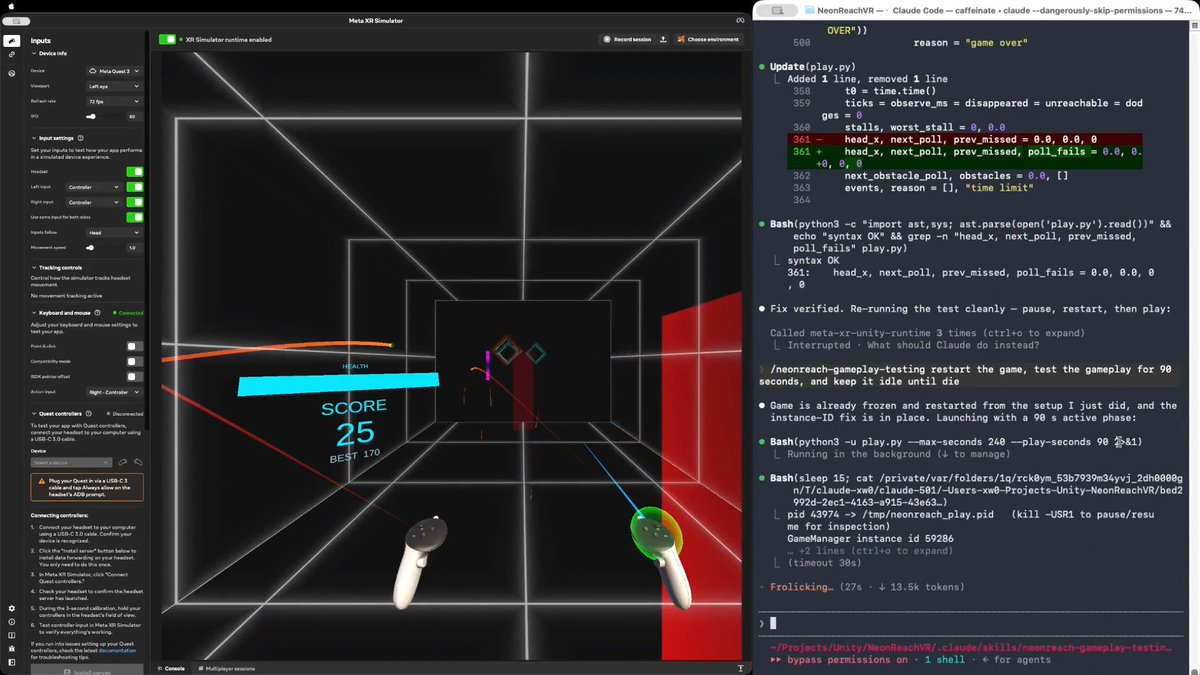
Would you believe an AI agent can test a real VR action game in real time, the way a person plays it? Meta XR Operator makes it possible. As far as I know, this is the first time. I am not talking about tapping a menu or replaying a recorded click path, but genuinely moving, shooting, and using the same game mechanics a human player does. In NeonReach VR, which is a real (and open source) action game, rings spawn 12m out and come at you somewhere between 1.5 and 5.5 m/s, getting faster over a 90 second ramp. There are three kinds: straight, weaving side to side, and spinning. Every shot is a full slingshot cycle, so you press, pull back, aim, then release. Obstacles arrive at head height and cost you a life if you don't get out of the way. You have ten lives. Here is why the game is hard for an AI agent. Even though Meta XR Operator gives the agent everything it needs to observe the app and act inside it, the agent still cannot play. One agent turn takes 10 to 15 seconds. One throw is four steps that have to happen in order, because the press has to latch before the pull, and they cannot be batched into a single call. So a throw costs about 45 seconds. A fast ring only exists for 2.3 seconds. One action takes 20x longer than the target is alive. Prompt tuning does not close a gap that size. What works is a three stage path: EXPLORATION, then SKILL, then SCRIPT. 1/ EXPLORATION. The agent drives the live app and works the game out on its own. It verified the coordinate mapping by setting a pose and reading it back, then derived the launch model. The more useful output was the traps it found. For example, the player's own body collider silently deflects a ball released inside it, with no error and no log line. That produced two confident wrong conclusions before anyone caught them. 2/ SKILL. All of that gets written down as a reusable SKILL.md plus an aim solver. There is a section that separates what was actually verified from what was assumed, so a wrong conclusion cannot quietly turn into doctrine. This stage also produced the trick that mattered. Set timeScale to 0 and a throw becomes atomic in game time, so however long the agent spends thinking never shows up in the shot. 3/ SCRIPT. The agent then compiles everything into a player script, a loop that observes, decides, and throws, calling the MCP servers directly from Python with no model in the hot path. Round trips drop from 10 to 15 seconds down to something between 1 and 16 milliseconds. The loop runs at 23 Hz, about 0.75 seconds per throw, roughly 60x faster than the agent doing it turn by turn. The result is that it plays like a person, which you can see from the attached video. It tracks the rings, works out where each one is going, throws with whichever hand is free, moves out of the way of the obstacles, and does not wait around to see whether the last throw landed. Shipping settings, no difficulty edits, no health locks, no slow motion. It plays until it actually loses. The takeaway generalizes beyond games: an agent does not have to be the player. Even following the same rules as a player, it has too much latency between moves. Having the agent write the thing that acts bypasses that constraint entirely. Try it yourself: or explore the agent-created skill and scripts: Based on NeonReach VR by Dilmer, with no code changes. I only upgraded its Meta XR Core SDK to v205, which ships Meta XR Operator. Our blog post, Introducing Meta XR Operator: Close the Build-Test-Verify Loop for VR: Disclosure: I work at Meta. And this represents my own opinion. #XR #VR #AI #MetaQuest #Unity #GameDev

Xiang Wei

52,421 просмотров • 12 дней назад

At the end of the day, as I discussed with Jordan Peterson, there are just two games to be played, one real, one Woke. The real game is called civilization. The false game is called power. A long post/🧵: The real divide between Woke and not Woke is in power. The Woke game is the power game, and it is a parasite on the real game, which is civilization. Here's roughly how Jordan described the foundation of this idea. There are various rules, norms, etc., in the game society ultimately plays, and these create a hierarchy that is based upon competence, mostly organically, obviously imperfectly. If the rules of the game are good enough, the imperfections (natural corruptions) are minor and society thrives. If they are not, you'll have problems. This is the real game of building society, and it ultimately has to favor competence. This game must be called "civilization" because that's not just its goal but it is also what it does. It civilizes us beyond our base instincts and impulses so we can work together productively in a healthy manner that generates prosperity. As Jordan put it, this game is also a reservoir of value, and reservoirs of value create parasites. What are these civilizational parasites? They’re parallel games organized by and around malignant psychopathological modes like Dark Tetrad traits, psychopathy, and Cluster-B disorders: histrionic, borderline, antisocial, and narcissistic. These malignant pathologies render people incompetent except at manipulation, so they cannot rise far in a healthy civilizational hierarchy. What do they do, then, to gain power and status in life in a game they cannot actually play? They define a parasitic parallel game and rope people into playing it. It is parasitic in that it draws off the real game (civilization) and mimics its form so that the hosts (people in society) are less likely to realize it’s there, but it doesn’t build or create of its own. It siphons and tears down. What drives this game is failing to see what makes the civilizational game and the hierarchy it produces legitimate in the first place. This is characteristic of the psychopathologies at its heart. The narcissist imagines the world should be serving himself at the top, but it isn’t. The problem can’t be himself, so it must be that the game is illegitimate. Otherwise, he’d be at the top, but he isn’t. Therefore, the game is corrupt. His histrionic nature makes him a victim of the real game, preying upon emotions like empathy and righteous indignation to recruit followers. Because of his Dark Tetrad alignment, his game is not only illegitimate but toxic. It’s inherently sadistic, cruel to its recruits in the way typical of all cults—alternating punishment and leniency or even love-bombing. It’s dishonest. It’s psychologically broken from reality. It’s also a Machiavellian game, which means it has no interest in moral or ethical behavior but only in power. Thus, this rival game to the game of civilization is the game of power. The parasitic game—that is, the power game—is based on a fundamental failure to understand the legitimacy of the civilizational game or the approximately legitimate hierarchy it produces. This is a result of its narcissism, mostly. The game cannot be legitimate because the psychopath isn’t on top of it, where he sees himself constantly as a projection from his frail ego. It sees power in the real hierarchy, though, which it can perceive and understand, and for which it blames most of its troubles. What this means is that the (Woke) power game develops a critical theory of the existing legitimate civilization game. That’s why Woke means “using critical theory (and activism).” A critical theory exists not to articulate a vision—at least not beyond a Utopia after the cult power game holds power to enforce its power game long enough—but to “criticize those aspects of the existing society we wish to change,” as Max Horkheimer, creator of the Critical Theory, put it. The critical theory of the power game exists to recruit by delegitimizing the civilization game in the minds of some of its players, usually ones who aren’t succeeding as well. It picks at “contradictions,” failures, and imperfections while casting the whole civilization game as corrupt and unjust. It offers itself as the only alternative to civilization game while pulling at the threads of the civilization game that allow people to believe in it. It all proceeds from the Woke failure to understand the legitimacy of the hierarchy of the civilization game as it proceeds from its set of rules. Misunderstanding legitimacy leads it to conclude that all hierarchies are actually based in power, and all power is fundamentally arbitrary. That is, they do not believe all power is illegitimate. They believe power is the only legitimate thing in any hierarchy, but they also believe that power is located in persons like themselves through their narcissism and projection. Think of Voldemort as an icon of this mode of thinking: “there is no good or evil, only power and those too weak to seek it.” Of course, that quintessential Dark Tetrad perspective is what ensures the psychopathological power game will be rigged to make sure the psychopaths are attracted to it and rise to its top. This belief is what we call Woke. The Woke game is the power game, and it is a parasitic competitor to the civilization game. There is no overlap between these two games. To adopt the power game is to abandon the civilization game entirely and, in fact, to become its enemy. But James, you might ask, isn’t there power in civilization? Yes, there is, and necessarily, but it isn’t what defines the civilization game. It’s a byproduct of the game, not the game itself. The civilization game is fundamentally the building out of an organic and dynamic hierarchy based on a set of rules, or what some people call “muh principles,” that will succeed or fail for that civilization in direct proportion to three things. 1) How aligned with the truth are the rules of the civilization game? 2) How aligned with justice are the rules of the civilization game? 3) How willing are the participants of the civilization game to defend their principles and their game, including against socio-parasitical perversion? The more aligned with truth and justice a civilization game is, the more successful it will be, and the more legitimate its hierarchy. The power that results as a byproduct is extremely legitimate in a highly aligned civilization where people haven’t forgotten their charge to defend the game itself, which is what we call responsibility. A civilization game strongly aligned with truth and justice filled with a preponderance of responsible people will produce a thriving, prosperous society. It only works this way every time. Not everyone is responsible, though. Some are also incompetent because of various pathologies (not talking about for other reasons). Those pathological players may, under certain circumstances, create a parasitic side game with themselves on top through a variety of strategies that mimic the values and principles of the real game while distorting them into power plays because their game is power, as discussed above. They will recruit into that game primarily from those who are resentful of the real game for any variety of reasons, and getting recruited into the power game from the civilization game is called “going Woke.”

James Lindsay, anti-Communist

154,373 просмотров • 1 год назад

One criticism I always see towards games like Red Dead Redemption 2 and Grand Theft Auto VI recently is the topic of small details. "Why does a game need so many details, it doesn't make the experience any better and takes longer to develop" While I do agree with the fact that Rockstar Games development schedules in between each release keep getting longer, the fact is that when you aim for such a high level of realism in a video-game, its not about graphics anymore, its about immersion. I'm sure that if you played RDR2, you know that your horse sweating or its balls shrinking in the cold don't add much to the gameplay itself, but it makes the game feel like its real. This is precisely what sets apart Rockstar Games from other game studios, the level of immersion you get in those games is unbeaten. RDR2, a game designed for the PS4 console has a level of fluidity and immersion that I have yet to see in a video-game from any other game studio, each game mechanic seems to work flawlessly that it feels like a living and breathing open world game. Hell, sometimes you feel bad for shooting an NPC which never happened to me in a video-game before. When you're playing it, hours can go by and you don't even. In other open-world games, sometimes you can notice limitations, for example the same NPCs appearing in one object or the same scripted conversations. RDR2 manages to make that gap of a video-game and reality feel thinner, not get rid of it entirely of course. Making such a massive game filled with tons of details means that it can be can be played for multiple years after its release and not feel outdated. Its not all about details of course, when a game takes so long to develop, the stakes get higher each time and Rockstar Games has to make sure that they deliver on the story that is being told too, hence the reason why their games have always been historically good in terms of writing. Now to address the elephant int he room, the main issue is that as the complexity increases for each new release and optimizing all of these systems to work in tandem, the development time increases and we get longer periods of waiting. Is all of this worth it? In my opinion, yes. Its Rockstar Games after all, they have the budget necessary and the talent to achieve this kind of feat. Not only does it raise the bar for what is possible to do in a video-game, but it also is highly rewarding when you play the game for the first time and its unlike anything you've seen these past couple of years. When I finished playing Red Dead Redemption 2 for the first time, every new game that came out felt outdated for me. Just as technology keeps going forward, the same applies here with open world games too. What are your thoughts on this topic?

NikTek

26,848 просмотров • 16 дней назад