正在加载视频...

视频加载失败

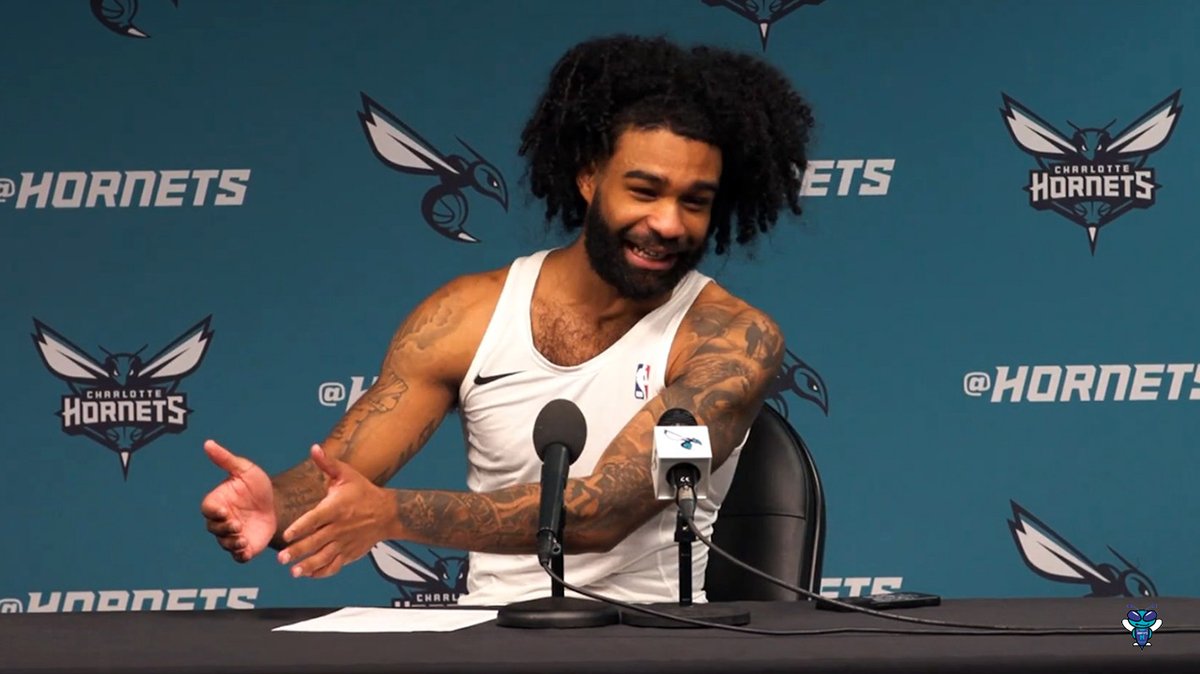
🎙️ Coby White: "I've never been on a team this dangerous." "It could be a back-and-forth game and then you hit one run, and then you look up and you're up 20, and then you're up 30. The main thing for me is, we're explosive, but we're starting to...

666,528 次观看 • 2 个月前 •via X (Twitter)

0 条评论

暂无评论

原始帖子的评论将显示在这里

相关视频

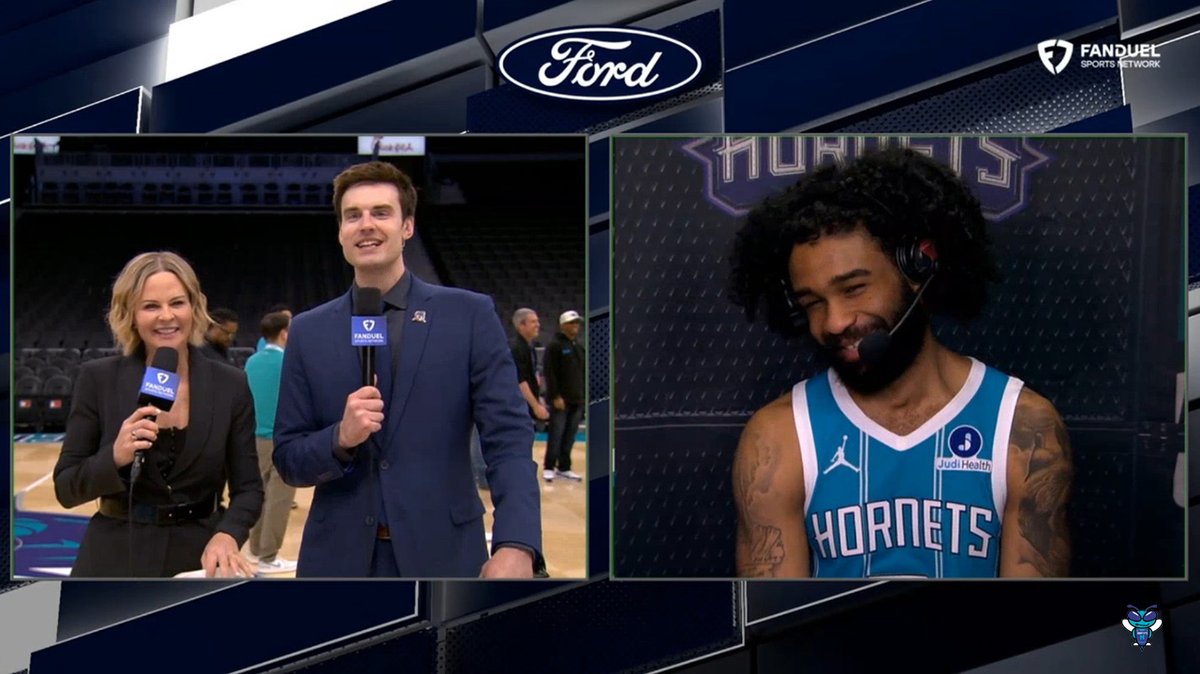
🎙️ Coby White on this young Charlotte Hornets team: "I got here and I'm like the third oldest at 26. A lot of the guys are younger than me. So coming in here, they just have that youthfulness about them in terms of that pure, genuine love for the game... that's infectious." "The one thing I learned, you can't be around a guy like LaMelo Ball and not be happy. What he brings every day in terms of his joy, his spirit, you can't be around him and not be happy, joyful, because he's gonna do it every single day. He's consistent every day in terms of how he lives his life and he's just a joy to be around." "Pat Connaughton, getting to know him, his mind for the game, his IQ, his feel for the game in terms of making in-game adjustments and communicating has been huge... I can already tell it's been huge for the team." 🎙️ On Charles Lee: "He's a younger coach... just brings that youthfulness and he connects with this generation, my generation, Kon's generation, LaMelo's... he connects with us on just a different level because he's younger." "He cares about each and every player, which sometimes you don't get in this league. He takes the time to get to know every player, talks to them... being around him, he has a high IQ for the game, great feel for the game, but the most important thing is he gets each and every one of us to buy into what we're trying to do. He gets everyone to compete, but he's just a joyful spirit to be around. He connects us."

r/CharlotteHornets

60,019 次观看 • 3 个月前

Seattle Seahawks HC Mike Macdonald - Scouting Pass Protections - "You're really just trying to get what their rule is to start when they leave the huddle. What do I want to present them with because how am I going to anticipate how they're going to react based on the looks they've gotten in the past, the looks we've given them and then we can go to work." - "You definitely have to account for 7 man protection. You'll find the more you blitz, the more 7 man you're going to see. - "Those are decisions you have to make when you're building your plan. We know that we're getting this protection when they give us this formation and we got a sweet pressure that will hit them to do it, there is a spot and a time and place for that." -"There is a time & place for saying I'm not sure when they're going to go to 7 man, even if we're in 5 man rush, our dudes can get there. We're going to at least have a couple 1 on 1s that we can win. Let's not overdo it with all these checks and all this other BS so our guys can just go out there and execute the call, there is a space for that as well." -"And then there is also a space for hey we're brining two off the edge right here, they're going to have this picked up, why even run against the wall, let's check out of it and go to rush and coverage and double 2/3 guys running a route. Those are the questions you want to ask yourself throughout the week and a lot of times it comes down to whether or not you can anticipate them being in that particular thing."

James Light

67,520 次观看 • 4 个月前

lando talking about how special it feels for him to win constructors’ titles after starting with the team in tougher times and their dominance 🥹❤️‍🩹 “i mean another one is just a great thing. it's another constructor feels the same as the first, because to get the first was quite an achievement if you still look at where we were just three years ago. we've overtaken every team in terms of development. we've outdone them by a long way in terms of development, and in a time when it's almost harder to do than ever, with more restrictions and less wind tunnel time, all of those different things, budget cap, that's really been more in our favor over the last five years comparing to the budget that the other teams could run at. but in a time when it should be more difficult than ever to dominate, that's exactly what the team have done and given us, by a long way, the best car on the grid. i mean, it's always a very nice thing to say. every driver that gets to say that always puts a smile on your face. but we've also done very well as a team in terms of drivers between oscar and myself pushing each other and delivering every single weekend. and you don't see that on any other team. so i think we're also very proud of that as drivers. but for me, i've been with mclaren since i started. especially it was a very different time and different place then to where we are now. so that journey makes it more special to know the downs because that's a lot of what it was back then to see the rise that we've had to see the teamwork, the changes, the atmosphere difference and the leadership from zak, from andrea especially, has turned things around and made us as a team the best in the world. and that's something that many people don't ever get to say”

ray

35,603 次观看 • 8 个月前

"Every team wants to win a championship, but not every team wants to do the things required for a championship. And here's the thing: it's easy to be an average team. It doesn't require a lot. It's less adversity to be average in the world. The consequences of being average aren't easy. We end up wearing them. There's strain and struggle that comes with that too. The standard is just lower to be an average team. To be a championship team, to be champion, to be a championship team member here . . . I'm not gonna lie to you . . . I'm going to tell you the truth. It is harder. It is. The question is: Is it worth it? Some people say, "Oh it's not harder work." Yes it is. It's harder work. You can pursue comfort or you can pursue excellence. If we pursue comfort, we gotta give up some excellence. But if we pursue excellence, then we're just going to face more adversity. Everyone who's ever accomplished something excellence has had to overcome it. We are here today for a reason. Two reasons actually. Reason #1 is let's make sure that we identify and realize the opportunities that are in front of us. Reason #2 is let's make sure that we are preparing for the adversity that those opportunities require. And just understand: every single time you lever up your opportunities and you identify, "Oh there's something more I can do, more I can achieve. I can get better. I can earn more. I can do this." It's going to be matched with the adversity that comes with it. I want to make sure we are prepared for both of those, so that we're not chasing big opportunities and then getting mad when things start getting harder along the way. Is that fair? Does that make sense?"

Brian Kight

125,717 次观看 • 2 年前

Steve Jobs walked into a room full of MBA students and asked how many were going into consulting. Hands went up. He said their careers would be “like a picture of a banana.” “You might get a very accurate picture. But you never really taste it.” He spent 60 minutes explaining what actually builds careers: "Without owning something over an extended period of time, where one has a chance to take responsibility for one's recommendations, where one has to see one's recommendations through all action stages and accumulate scar tissue for the mistakes and pick oneself up off the ground and dust oneself off, one learns a fraction of what one can." He continues: "Coming in and making recommendations and not owning the results, not owning the implementation, I think is a fraction of the value and a fraction of the opportunity to learn and get better." "You do get a broad cut at companies, but it's very thin." Then the line that made the room go silent: "It's like a picture of a banana. You might get a very accurate picture, but it's only two dimensional. Without the experience of actually doing it, you never get three dimensional." "So you might have a lot of pictures on your walls. You can show it off to your friends. You can say, look, I've worked in bananas, I've worked in peaches, I've worked in grapes." "But you never really taste it." The room applauded. This was 1992. Jobs had been fired from Apple seven years earlier. He was running NeXT. He had scar tissue. An MIT student asked him: where would Apple be if you hadn't left? Jobs paused. "I've obviously thought about this a lot. I think everybody lost. I think I lost. I think Apple lost. I think customers lost." "And having said all that, so what? You go on. It's not as bad as a lot of things. Not as bad as losing your arm." That's Steve Jobs. Getting fired from the company he built, comparing it to losing a limb, and shrugging. He spent the rest of the talk explaining what he learned about building companies. On competitive advantage: "Hardware churns every 18 months. It's pretty impossible to get a sustainable competitive advantage from hardware. If you're lucky, you can make something one and a half or two times as good as your competitor. And it only lasts for six months." "But software seems to take a lot longer for people to catch up with." "I watched Microsoft take eight or nine years to catch up with the Mac, and it's arguable whether they've even caught up." On technology windows: "You can use the concept of technology windows opening and then eventually closing." "Enough technology from fairly diverse places comes together and makes something that's a quantum leap forward possible. And a window opens up." "It usually takes around five years to create a commercial product that takes advantage of that technical window opening up." "And then it seems to take about another five years to really exploit it in the marketplace." He gave examples from his own life: Apple II lasted 15 years. DOS lasted 15 years. Mac was eight years old at the time and would easily last another five. "These things are hard. They don't last because it's convenient, or even because it's economic. They last because this is hard stuff to do." On management: "I've never believed in the theory that if we're on the same management team and a decision has to be made, and I decide in a way that you don't like, and I say, come on, buy into the decision." "Because what happens is, sooner or later, you're paying somebody to do what they think is right, but then you're trying to get them to do what they think isn't right. And sooner or later, it outs." His approach: "The best way is to get everybody in a room and talk it through until you agree." Then this: "We don't pay people to do things. That's easy, to find people to do things." "What's harder is to find people to tell you what should be done. That's what we look for." "So we pay people a lot of money, and we expect them to tell us what to do. And when that's your attitude, you shouldn't run off and do things if people don't all feel good about them." A student asked: what's the most important thing you learned at Apple that you're doing at NeXT? Jobs thought for a moment. "I now take a longer-term view on people." "When I see something not being done right, my first reaction isn't to go fix it. It's to say, we're building a team here. And we're going to do great stuff for the next decade, not just the next year." "So what do I need to do to help so that the person that's screwing up learns, versus how do I fix the problem?" "And that's painful sometimes. And I still have that first instinct to go fix the problem." "But taking a longer-term view on people is probably the biggest thing that's changed." On not knowing your own competitive advantage: "A lot of times you don't know what your competitive advantage is when you launch a new product." "When we did the Macintosh, we never anticipated desktop publishing. Sounds funny, because that turned out to be the Mac's compelling advantage." "We anticipated bitmap displays and laser printers. But we never thought about PageMaker, that whole industry really coming down to the desktop." "But we were smart enough to see it start to happen nine to twelve months later. And we changed our entire marketing and business strategy to focus on desktop publishing." "And it became the Trojan horse that eventually got the Mac into corporate America." The same thing happened at NeXT. They built software to help developers create apps faster. Their target customers were Lotus, Adobe, WordPerfect. Then big companies started showing up and saying: "You don't understand what you've got. The same software that allows Lotus to create their apps faster is letting us build our in-house apps five to ten times faster." "And you dummies don't even know it." Jobs admitted: "It took them about three months before we finally heard it." On hiring: "It seems like all the good people I really want to hire, it takes me a year to hire them. It's always been that way, even at Apple." "I usually meet somebody that is really good. And you can't get them. And then you go try to find other people. And nobody measures up." "When you meet somebody that good, you always compare them to this one person. And you know you're going to be settling for second best if you compromise." "And I've always found it best not to compromise, and just keep chipping away." His VP of Marketing took a year and a half to hire. "And they're all worth it." This talk is Steve Jobs at his most unfiltered. A founder with scar tissue explaining what he learned the hard way. This 60 minute MIT lecture will teach you more about building companies than every startup book you've read combined. Bookmark & give it an hour, no matter what.

Jaynit

980,101 次观看 • 2 个月前

Bam Adebayo GOES IN on the critics that says his 83 point game performance is unethical: "For the couch coaches, I mean, if you're in my shoes and you have, first of all, y'all are blaming me. You should be blaming the head coach. Get that first. I was not the one letting me go one-on-one the whole game until I had 70, and then you started to send a double. At that point, I got 70 with, like, what? nine minutes left to go in the game you think i'm not going for it like like and that's the thing that's crazy when they talk about the unethical part of the basketball i'm like if i have 70 points with 9 minutes to go Who would just be like, you know, coach, just take me out. Yeah, right. Anybody in my shoes with nine minutes left? Okay. A minute? All right. Nine? Yeah, I'm going for it. You can't be mad at that. If you are mad, I don't care because a lot of people, they're upset because if they did play, they never had a chance to get that close to chasing greatness. And then if you get that close to chasing greatness, that's the point of chasing it so you can surpass it. And some of the people have never played basketball. So like if you've been in the backyard and you and a couple of your homies have been playing 21 and you got 19. You're not going to get an easy look off. And four, they're going to talk about the free throws. It's not like I shoot 15 free throws a game. It's not like I average 10 free throws a game. You can watch the film. I was legitimately getting fouled every time. So I went to the free throw line."

Ahmed/The Ears/IG: BigBizTheGod 🇸🇴

373,651 次观看 • 3 个月前