Загрузка видео...

Не удалось загрузить видео

На главную

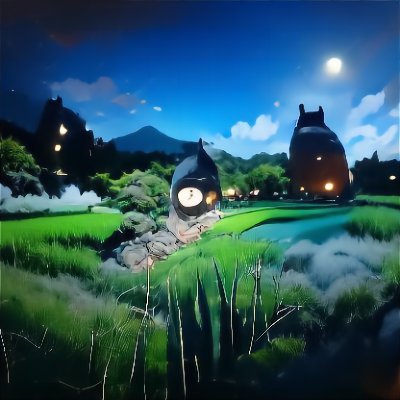
CoDeF: Content Deformation Fields for Temporally Consistent Video Processing abs: paper page: present the content deformation field CoDeF as a new type of video representation, which consists of a canonical content field aggregating the static contents in the entire video and a temporal deformation field recording the transformations from...

153,241 просмотров • 2 лет назад •via X (Twitter)

Комментарии: 7

Фото профиля radAI
radAI2 лет назад

This is a game-changer for video generation, faster and smother!!

Фото профиля Dan Rockwell
Dan Rockwell2 лет назад

seriously dope, the speed of this and this ability will be massive in augmented reality

Фото профиля Don Jose Valle
Don Jose Valle2 лет назад

Wow!

Фото профиля rogueyoshi (moving to fgc.network)
rogueyoshi (moving to fgc.network)2 лет назад

@IXITimmyIXI

Фото профиля Takomo AI
Takomo AI2 лет назад

Exciting new video representation technique!

Фото профиля Jose
Jose2 лет назад

As my boss says, tik-tok quality.

Фото профиля 张三丰
张三丰2 лет назад

老师 为什么没有声音

Похожие видео

MagicAnimate: Temporally Consistent Human Image Animation using Diffusion Model with Gradio demo local demo: This paper studies the human image animation task, which aims to generate a video of a certain reference identity following a particular motion sequence. Existing animation works typically employ the frame-warping technique to animate the reference image towards the target motion. Despite achieving reasonable results, these approaches face challenges in maintaining temporal consistency throughout the animation due to the lack of temporal modeling and poor preservation of reference identity. In this work, we introduce MagicAnimate, a diffusion-based framework that aims at enhancing temporal consistency, preserving reference image faithfully, and improving animation fidelity. To achieve this, we first develop a video diffusion model to encode temporal information. Second, to maintain the appearance coherence across frames, we introduce a novel appearance encoder to retain the intricate details of the reference image. Leveraging these two innovations, we further employ a simple video fusion technique to encourage smooth transitions for long video animation. Empirical results demonstrate the superiority of our method over baseline approaches on two benchmarks. Notably, our approach outperforms the strongest baseline by over 38% in terms of video fidelity on the challenging TikTok dancing dataset. Code and model will be made available.

AK

810,024 просмотров • 2 лет назад

VideoRF: Rendering Dynamic Radiance Fields as 2D Feature Video Streams paper page: Neural Radiance Fields (NeRFs) excel in photorealistically rendering static scenes. However, rendering dynamic, long-duration radiance fields on ubiquitous devices remains challenging, due to data storage and computational constraints. In this paper, we introduce VideoRF, the first approach to enable real-time streaming and rendering of dynamic radiance fields on mobile platforms. At the core is a serialized 2D feature image stream representing the 4D radiance field all in one. We introduce a tailored training scheme directly applied to this 2D domain to impose the temporal and spatial redundancy of the feature image stream. By leveraging the redundancy, we show that the feature image stream can be efficiently compressed by 2D video codecs, which allows us to exploit video hardware accelerators to achieve real-time decoding. On the other hand, based on the feature image stream, we propose a novel rendering pipeline for VideoRF, which has specialized space mappings to query radiance properties efficiently. Paired with a deferred shading model, VideoRF has the capability of real-time rendering on mobile devices thanks to its efficiency. We have developed a real-time interactive player that enables online streaming and rendering of dynamic scenes, offering a seamless and immersive free-viewpoint experience across a range of devices, from desktops to mobile phones.

AK

38,686 просмотров • 2 лет назад

[NeurIPS '24] DreamMesh4D: Video-to-4D Generation with Sparse-Controlled Gaussian-Mesh Hybrid Representation Abstract (excerpt) We introduce DreamMesh4D, a novel framework that combines mesh representation with sparse-controlled deformation technique to generate high-quality 4D object from a monocular video. To overcome the limitation of classical texture representation, we bind Gaussian splats to the surface of the triangular mesh for differentiable optimization of both the texture and mesh vertices. In particular, DreamMesh4D begins with a coarse mesh provided by a single image based 3D generation method. Sparse points are then uniformly sampled across the surface of the mesh, and are used to build a deformation graph to drive the motion of the 3D object for the sake of computational efficiency and providing additional constraint. For each step, transformations of sparse control points are predicted using a deformation network, and the mesh vertices as well as the bound surface Gaussians are deformed via a geometric skinning algorithm. The skinning algorithm is a hybrid approach combining LBS (linear blending skinning) and DQS (dual-quaternion skinning), mitigating drawbacks associated with both approaches. The static surface Gaussians and mesh vertices as well as the dynamic deformation network are learned via reference view photometric loss, score distillation loss as well as other regularization losses in a two-stage manner. Extensive experiments demonstrate that our method outperforms prior video-to-4D generation methods in terms of rendering quality and spatial-temporal consistency.

MrNeRF

12,323 просмотров • 1 год назад

InstantDrag Improving Interactivity in Drag-based Image Editing discuss: Drag-based image editing has recently gained popularity for its interactivity and precision. However, despite the ability of text-to-image models to generate samples within a second, drag editing still lags behind due to the challenge of accurately reflecting user interaction while maintaining image content. Some existing approaches rely on computationally intensive per-image optimization or intricate guidance-based methods, requiring additional inputs such as masks for movable regions and text prompts, thereby compromising the interactivity of the editing process. We introduce InstantDrag, an optimization-free pipeline that enhances interactivity and speed, requiring only an image and a drag instruction as input. InstantDrag consists of two carefully designed networks: a drag-conditioned optical flow generator (FlowGen) and an optical flow-conditioned diffusion model (FlowDiffusion). InstantDrag learns motion dynamics for drag-based image editing in real-world video datasets by decomposing the task into motion generation and motion-conditioned image generation. We demonstrate InstantDrag's capability to perform fast, photo-realistic edits without masks or text prompts through experiments on facial video datasets and general scenes. These results highlight the efficiency of our approach in handling drag-based image editing, making it a promising solution for interactive, real-time applications.

AK

71,201 просмотров • 1 год назад

Google presents Still-Moving Customized Video Generation without Customized Video Data Customizing text-to-image (T2I) models has seen tremendous progress recently, particularly in areas such as personalization, stylization, and conditional generation. However, expanding this progress to video generation is still in its infancy, primarily due to the lack of customized video data. In this work, we introduce Still-Moving, a novel generic framework for customizing a text-to-video (T2V) model, without requiring any customized video data. The framework applies to the prominent T2V design where the video model is built over a text-to-image (T2I) model (e.g., via inflation). We assume access to a customized version of the T2I model, trained only on still image data (e.g., using DreamBooth or StyleDrop). Naively plugging in the weights of the customized T2I model into the T2V model often leads to significant artifacts or insufficient adherence to the customization data. To overcome this issue, we train lightweight Spatial Adapters that adjust the features produced by the injected T2I layers. Importantly, our adapters are trained on "frozen videos" (i.e., repeated images), constructed from image samples generated by the customized T2I model. This training is facilitated by a novel Motion Adapter module, which allows us to train on such static videos while preserving the motion prior of the video model. At test time, we remove the Motion Adapter modules and leave in only the trained Spatial Adapters. This restores the motion prior of the T2V model while adhering to the spatial prior of the customized T2I model. We demonstrate the effectiveness of our approach on diverse tasks including personalized, stylized, and conditional generation. In all evaluated scenarios, our method seamlessly integrates the spatial prior of the customized T2I model with a motion prior supplied by the T2V model.

AK

40,467 просмотров • 1 год назад