Загрузка видео...

Не удалось загрузить видео

На главную

Columbia Engineering developed 'Human-Robot Facial Co-expression' to enhance human-robot interactions. They used a silicon-clad robot face that allows a robot to make eye contact and use AI to mimic more human-like facial expressions in real time.

30,575 просмотров • 2 лет назад •via X (Twitter)

Комментарии: 14

Фото профиля Brett Adcock
Brett Adcock2 лет назад

A ton of AI and Robotics developments this week. Big announcements from Nvidia, Columbia University, OpenAI, Amazon, Google, Stanford, Scale AI, and more. Here's everything that happened and how to make sense out of it:

Фото профиля Brett Adcock
Brett Adcock2 лет назад

Nvidia announced 'DrEureka', an LLM agent that automates writing code to train robot skills. They used DrEureka to train a robot dog to balance/walk on a ball in simulation and transferred the skills to the real-world zero-shot and without any finetuning

Фото профиля Brett Adcock
Brett Adcock2 лет назад

We demo’d some of the latest AI at Figure HQ during 60 Minutes last week. At 0:57, you can see Figure-01's common sense reasoning. To achieve this, we connected a pre tained model via OpenAI.

Фото профиля Brett Adcock
Brett Adcock2 лет назад

OpenAI began rolling out its ChatGPT memory feature. It allows ChatGPT to carry over learnings between conversations by simply telling it what you want it to remember.

Фото профиля Brett Adcock
Brett Adcock2 лет назад

Amazon just announced Q, the company’s AI-powered assistant for businesses and developers They also launched a new 'Q Apps' feature that allows non-technical users to create custom AI applications using prompts, from company data.

Фото профиля Brett Adcock
Brett Adcock2 лет назад

Google just introduced Med-Gemini, a family of AI models fine-tuned for medical tasks. The model achieved SOTA on 10 of the 14 benchmarks from text, multimodal, and long-context applications.

Фото профиля Brett Adcock
Brett Adcock2 лет назад

A team of Taiwanese researchers performed a new study with 16,000 patients to predict patient risk in hospitals. They trained AI on 450,000 ECG tests and the tech reduced overall deaths by 31% and deaths from heart issues by over 90%.

Фото профиля Brett Adcock
Brett Adcock2 лет назад

Google also introduced a new Chrome shortcut that lets users initiate Gemini conversations more easily. Users can type @ gemini and add a prompt to get responses from the AI without going to a separate site.

Фото профиля Brett Adcock
Brett Adcock2 лет назад

Scale AI just released new research uncovering significant ‘overfitting’ of certain LLMs on popular AI benchmarks. Mistral and Phi were under-performers, while GPT-4, Claude, Gemini, and Llama all stood its ground

Фото профиля Brett Adcock
Brett Adcock2 лет назад

Ukraine’s Ministry of Foreign Affairs introduced the world's first AI diplomat, ‘Victoriya Shi’. The new spokesperson is an AI-generated avatar and will deliver pre-prepared official statements on behalf of the Ministry of Foreign Affairs.

Фото профиля Brett Adcock
Brett Adcock2 лет назад

That's it for this week's AI and Robotics breakdown. I share the latest research every week, so follow me @adcock_brett for more. If you found this valuable, consider a like/retweet to spread the word.

Фото профиля MightyBot
MightyBot1 год назад

🧠 Unified Search. Smarter Meetings. Effortless CRM. MightyBot is your AI agent platform for seamless workflows—record meetings, automate CRM updates, and find answers across apps in seconds. 🌟 Focus on what matters. We'll handle the grind.

Фото профиля Conductor
Conductor2 лет назад

Human skin attaches to interstititium above muscle , anchored in different places. When a human face emotes, some skin stretches, wrinkles, or barely moves all at the same time...I have no idea why all these demos, miss the underlying structure of real human skin.

Фото профиля Yuhang
Yuhang1 год назад

Thanks for reposting; I am building more face robots in AheadForm: and looking forward to designing one for Helix.

Похожие видео

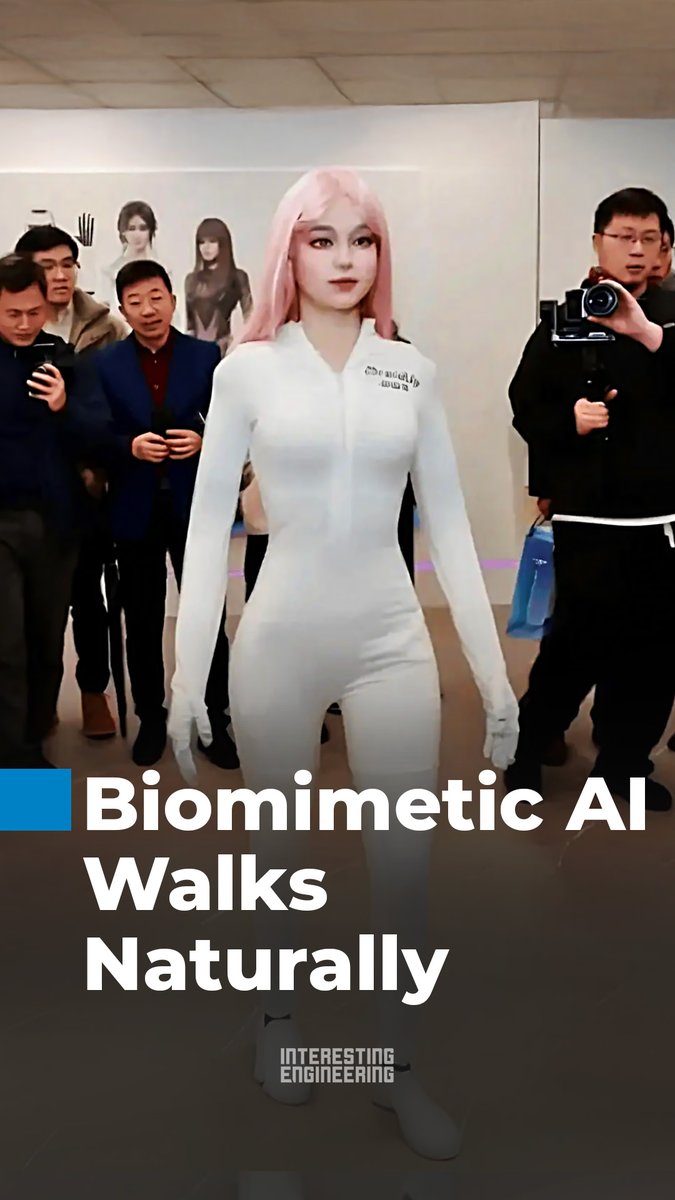
China unveils humanoid robot with lifelike skin and blinking eyes built for daily life | Prabhat Ranjan Mishra, Interesting Engineering Large Language Models (LLMs) and Vision-Language Models (VLMs) help process and interpret complex data from human interactions. A Shanghai-based company has developed humanoid robots that appear as real as humans. The advanced bionic humanoid robot is integrated with self-supervised AI algorithms. Named Elf V1, the robot can perceive the world, communicate, learn, and interact intelligently with its surroundings. Developed by AheadForm Technology, the robot offers up to 30 degrees of freedom, powered by a precise control system and an advanced AI learning algorithm. Robot offers expressive facial features The robot offers expressive facial features, moving eyes, and synchronized speech. It can also convey emotions and understand human non-verbal cues, making interactions more natural and engaging. The robot has highly interactive capabilities and lifelike appearances. AheadForm expects that its robots could soon seamlessly integrate into daily life, providing assistance, companionship, and support across various industries. “We believe that by developing realistic and expressive robot heads, we can bridge the gap between humans and machines, fostering a new era of interactive and intelligent robotics,” said the company in a statement. Reports revealed that to avoid the “uncanny valley” effect and be able to interact with us, they are given lifelike skin and capabilities to read our emotions and respond appropriately using dynamic expression simulation and emotion generation tech. Bionic skin and high-precision control system The Elf V1 series of humanoids features 30 facial muscles animated by brushless micro-motors and managed by a high-precision control system. Paired with an ability to detect their users’ emotions with low latency and bionic skin, their facial expressions are nearly identical to those of humans, reported CGTN. The company claims it’s pioneering the development of realistic humanoid robots designed to revolutionize human-robot interaction. It’s enhancing sophisticated humanoid robot heads that can express emotions, perceive their environment, and interact seamlessly with humans. By combining cutting-edge AI and advanced robotics, AheadForm aims to bring life to machines and transform how humans engage with technology. AI models boost robots’ responsiveness Seamless integration of Large Language Models (LLMs) and Vision-Language Models (VLMs) into the humanoid robots can help them process and interpret complex data from human interactions, enabling the robot to learn and adapt in real-time, achieving human-level understanding and responsiveness. AheadForm uses Brushless Motors that deliver ultra-quiet operation and high responsiveness, specifically designed for precision facial movements in humanoid robots. With its compact size, lightweight design, and energy efficiency, this motor is the ideal choice for next-generation robots that require precise, subtle facial control to create a truly human-like experience. Previously, the company unveiled the Lan Series that features realistic humanoid robots with soft skin and 10 degrees of freedom, offering a lifelike appearance and intuitive movements. This series is designed for cost-efficiency, for applications prioritizing mobility and manipulation.

Owen Gregorian

179,005 просмотров • 9 месяцев назад