正在加载视频...

视频加载失败

Comfy3D Update: (v0.1.5.alpha, dev branch) - Integrated TripoSG (Plus scribble model) - MV-Adapter for high quality texture gen coming next ‼️NeuralAI We are hiring skilled ML researchers & engineers (VAE, diffusion model, 3D/texture gen/editing) to join us on a mission to revolutionize 3D virtual production 🫰If you want to...

14,785 次观看 • 1 年前 •via X (Twitter)

8 条评论

Mr. For Example 的头像
Mr. For Example1 年前

TripoSG Scribble Model also works

ksminnovation 的头像
ksminnovation1 年前

AI is transforming healthcare! A KSM-led study shows AI can detect Celiac disease 4 years earlier @TalPatalon @MedPredict

Tripo 的头像
Tripo1 年前

@GoNeuralAI thanks for what you have built for the community!

Mr. For Example 的头像
Mr. For Example1 年前

@GoNeuralAI My pleasure🍻

pite-chen 的头像
pite-chen1 年前

@GoNeuralAI nice

0xNano 的头像
0xNano1 年前

@GoNeuralAI 🔥🔥🔥

David 的头像
David1 年前

@GoNeuralAI $NEURAL 🔥

Skiny3604 的头像
Skiny36041 年前

@GoNeuralAI Future of #ai #gaming $NEURAL 🔥🚀

相关视频

Everyone in 2026: “i replaced my entire team with AI agents” Our Company: “we’re hiring for 56 open roles” So the last brand I led grew from 500,000 -> 15,000,000+ followers in 2 years. And I’m hiring a dream team to run it back. (link to apply in the comments 👇 ) Owner is growing quickly and hiring across every department. Within media, we're building out all platforms. Short-form, YouTube, paid ads, carousels and written content. So why join us? Most content today is making the world dumber. Somehow the number 67 has become a meme. Gen A doomscrolls for emotional regulation We worship influencers flaunting rented supercars for views. At Owner, we’re using the same algorithms to actually help people. A couple weeks ago, we gained 16,000 followers from a single video about pricing catering orders. Information-dense posts like this are why our brand has grown 5x since last year. Small business owners, especially the ones running mom and pop restaurants, are hungry for knowledge. A single video can save someone from a mistake that costs them an entire month of profit. It's the most fulfilling work I've done as a creative. Because helping people achieve the American dream just hits different than getting a million views on a reaction clip to Justin’s Coachella performance (Sorry to all the Beliebers out there) So that's Owner's mission And I want you to be a part of it! We're investing in a world-class content team to get the word out as fast as possible. If you know how to make stuff people watch, share, and take action on… Apply to any open role through the custom site linked below

Michael Lim

19,934 次观看 • 3 个月前

today marks a special moment - I'm beyond excited to announce wordware's $30m seed round led by Spark Capital (followed by Felicis & Y Combinator) for decades, coding was the only way to create in our digital world. but AI is changing everything - it thinks in beautiful shades of grey, not just 1s and 0s. with this shift, we saw an opportunity to reimagine who gets to build. there are 30 million software engineers worldwide, but we've always believed that creativity isn't limited to those who can code. wordware is for the next 500m builders - the dreamers, experts, and innovators who've been waiting for their moment to create AI Agents (check out the video for our definition of what that means 😂) it's been quite a journey to get here. 3 years full-time with my brilliant cofounder (Robert Chandler), a decade in the AI space, countless failed experiments with transformers, major pivots, sleepless nights, and 100-hour weeks that tested everything we believed in. but today, I want to pause and celebrate what our incredible team has achieved: - 350k builders bringing their AI visions to life - 10 million people running agents built with wordware - amazing clients like instacart, runway & metadata - breaking Product Hunt 😸's servers (sorry, not sorry!) - raising one of the largest seeds (if not the largest) out of Y Combinator we still have mountains to climb, but watching our community build things we never imagined possible... that's what keeps us going. what makes wordware different? we've turned English into a programming language for AI. no coding bootcamp required - if you can express ideas clearly, you can build sophisticated AI solutions. our take on reimagining the development stack as a full-stack os for building AI: - unified notion like IDE - built-in tools for rag, speech-to-text, image gen, data analysis, scraping & more - proper engineering concepts for power users (loops, conditionals, function calls, code execution, version control) - open source community: fork, share & customize AI solutions once you're done iterating, deploy as an API to power your AI backend or utilize your AI agent as a workflow to our incredible team who made this possible - thank you to the believers who backed us (Nabeel Hyatt, Paul Graham, Astasia Myers, vladm, Nicolas Dessaigne, Azeem Azhar, Ben Parr, Matt Schlicht, Ben Tossell, Siqi Chen, Matt Brown, Mathilde Collin, Kulveer, Soleio , Dan Westgarth, Bartek Pucek, Tomasz Karwatka & many more) - thank you thinking about that AI workflow, product feature, or full-fledged AI company? let's chat: ps: we're hiring across all roles! join us in rebuilding how humans create with ai:

Filip Kozera

643,505 次观看 • 1 年前

Today, we are launching the first publicly available AI Scientist, via the FutureHouse Platform. Our AI Scientist agents can perform a wide variety of scientific tasks better than humans. By chaining them together, we've already started to discover new biology really fast. With the platform, we are bringing these capabilities to the wider community. Watch our long-form video, in the comments below, to learn more about how the platform works and how you can use it to make new discoveries, and go to our website or see the comments below to access the platform. We are releasing three superhuman AI Scientist agents today, each with their own specialization: A general-purpose agent (Crow); An agent to automate literature reviews (Falcon); and An agent to answer the question “Has anyone done X before” (Owl). We are also releasing an experimental agent, Phoenix, that has access to a wide variety of tools for planning experiments in chemistry. More on that below. The three literature search agents (Crow, Falcon, and Owl) have benchmarked superhuman performance. They also have access to a large corpus of full scientific texts, which means that you can ask them more detailed questions about experimental protocols and study limitations that general-purpose web search agents, which usually only have access to abstracts, might miss. Our agents also use a variety of factors to distinguish source quality, so that they don’t end up relying on low-quality papers or pop-science sources. Finally, and critically, we have an API, which is intended to allow researchers to integrate our agents into their workflows. Phoenix is an experimental project we put together recently just to demonstrate what can happen if you give the agents access to lots of scientific tools. It is not better than humans at planning experiments yet, and it makes a lot more mistakes than Crow, Falcon, or Owl. We want to see all the ways you can break it! The agents we are releasing today cannot yet do all (or even most!) aspects of scientific research autonomously. However, as we show in the video, you can already use them to generate and evaluate new hypotheses and plan new experiments way faster than before. Internally, we also have dedicated agents for data analysis, hypothesis generation, protein engineering, and more, and we plan to launch these on the platform in the coming months as well. Within a year or two, it is easy to imagine that the vast majority of desk work that scientists do today will be accelerated with the help of AI agents like the ones we are releasing today. The platform is currently free-to-use. Over time, depending on how people use it, we may implement pricing plans. If you want higher rate limits, especially for research projects, get in touch. Michael Skarlinski, Andrew White 🐦‍⬛, Tyler Nadolski, Remo Storni, James Braza, Ludovico Mitchener, Michaela Hinks, as well as Jason Carman and his team for making such fantastic videos of us!

Sam Rodriques

725,230 次观看 • 1 年前

Today, we’re thrilled to introduce GAIA, a modular creation engine for the AI age. At its core, GAIA is a multiplayer creation engine designed to bring democratized Generative AI abilities to everyone, hence its name. It abstracts away the complexities of leveraging open-source software, hardware requirements, and technical intricacies, allowing creators to focus solely on creating, together. GAIA has been instrumental in powering the imagination and creative works of our studio, significantly boosting productivity, collaboration, and creativity. It has saved our team thousands of man-days in production work, enabling us to dream bigger, bolder, and execute more swiftly. When used by experienced creators, GAIA, with its ever-growing toolsets built by core contributors, stands to be the best AI creative co-pilot for industry-specific production workflows—from gaming to fashion, and from personal consumption to real estate renderings. GAIA's self-reinforcing flywheel is poised to dramatically enhance the platform's capabilities in both the near and long term: The cost of GPUs and compute will continue to improve. Open-source AI models are becoming increasingly powerful over time, as seen by the evolution from Stable Diffusion 1 to Lightning, alongside other impressive OSS creations like AnimateDiff, LoRAs, and ControlNet. The architecture of AI workflows will become more fine-grained, allowing exponentially increasing control over final outputs. The data and connections that AI workflows can make, both in-app and out-of-app, will grow more sophisticated. GAIA already allows for the chaining of Generative Image AI recipes, grouping complex node-based programs into simple consumer-facing interfaces. Soon, with multi-modality workflows, creators will be able to leverage not only images but also text and sound to create even more complex workflows. Today is the least capable GAIA will ever be. It already provides superpowers unachievable by many creators who know how to harness them. We have an extremely exciting backlog of features lined up, starting with social features. Our mission as Ather Collective core contributors is to get GAIA into the hands of as many creators and businesses as possible. While we believe in e/acc, our north star for Ather Collective remains: Equitable, Accessible, Composable, and Collaborative. If you would like to be a part of the early access users of GAIA, please register using this link: Our team will open up capacity as soon as we are able to. There is only one way AI benefits humanity, and that’s through open AI. Let’s be a part of it. ✌🏻

TIN | Sipher Odyssey & Ather Labs

14,194 次观看 • 2 年前

10 free Google AI tools nobody talks about. while everyone's burning $20/mo on chatgpt and claude, google quietly shipped a stack worth $200+/mo. all free. all yours. — 1️⃣ NotebookLM — your second brain upload sources (PDFs, websites, audio, YouTube). it summarizes, builds mind maps, generates quizzes, drafts slide decks, even turns your notes into a podcast you can listen to on a walk. free tier: 100 notebooks, 50 sources each, 50 chats/day, 3 audio overviews/day. replaces: notion AI + perplexity + readwise — 2️⃣ Google AI Studio — the free gemini playground web playground for gemini 3 pro and flash with a free API key. generous limits. paste a 1M-token context window and watch it actually use it. faster than the openai playground and free where openai charges per token. replaces: openai playground + paid API credits — 3️⃣ Gemini CLI — google's open-source terminal agent apache 2.0 licensed. one command (npx @google/gemini-cli) and you've got an agent in your terminal that reads your codebase, runs shell commands, and ships PRs. drop-in claude code alternative. replaces: claude code ($20/mo by default) — 4️⃣ Jules — async coding agent assign jules a github issue. it spins up a cloud VM, clones your repo, writes the plan, makes the changes, opens a PR. free tier: 15 tasks/day, 3 concurrent, runs on gemini flash. replaces: devin ($20/mo+) + cursor agent 5️⃣ Stitch — text → UI → code google's free figma killer. describe an interface, get production-ready HTML/CSS/Tailwind + figma export. march 2026 update added voice canvas, infinite canvas, and MCP integration with cursor. 350 standard + 200 experimental generations/month free. replaces: galileo AI + early-stage figma work — 6️⃣ Gemma 4 — open-weight LLM google's flagship open model. apache 2.0. 2B, 4B, 26B-MoE, and 31B variants. 256K context. runs on ollama with one command. quantized versions run on a 4090 or beefy laptop. replaces: paying for hosted LLM inference — 7️⃣ Illuminate — papers → podcasts paste an arxiv preprint link. illuminate turns dense research papers into a 6-8 min conversation between two AI hosts breaking it down. perfect for commute reading you can't do at a desk. note: still in waitlist for some regions. replaces: snipd + manual research reading — 8️⃣ Learn About (LearnLM) — adaptive AI tutor drop in any topic you're stuck on. highlight a word, click "go deeper," and the interface adapts in real time to your comprehension level. visual explanations, follow-up questions, the works. replaces: paid tutoring on niche topics — 9️⃣ Google Labs FX (ImageFX + Flow + MusicFX) — free imagen, veo, musicLM google labs creative suite. text-to-image (imagen 4), text-to-video (veo via Flow), text-to-music (musicLM). free tier: limited daily generations. the heavy veo 3.1 features are paid (AI Pro $19.99/mo). still worth using for image and music — those stay free. replaces: midjourney + suno (free tier only — runway-level video gen is paid) — 🔟 Google Colab — free GPU notebooks free T4 GPU + 12GB RAM in a browser tab. enough to fine-tune small models, run stable diffusion, prototype agents. the launching pad for half the ML projects on github. replaces: paid cloud GPU rentals — a quick honest note: these tools aren't 1:1 better than the paid versions they replace. but they're decent enough to get most things done — especially if you're not a heavy user or you've got little funds to play with. i've put all 10 in a public github repo (link in comments). follow + turn on post notifications for more useful posts like this 🔔

m0h

11,847 次观看 • 2 个月前

12 hours ago I made the decision to fly out to El Salvador to be the first ever to make an AI generated short film for a country. I’m now 4 hours away from arriving there. (Talk about executing fast) I will take my time writing this message because the reason why has layers. A few months ago I founded ARQ and bootstrapped a platform that lets anyone create high-quality AI productions from start to finish. the best models a multi-agent creative assistant a built-in video editor All in one place. Alongside the product, I’ve built a strong community where I livestream daily, teaching creators how to use AI to tell better stories and get paid for their work. Shortly after we got dozens of offers to make commercials for companies. This was fun, until we came to the conclusion that we were wasting a lot of potential by focussing on companies, while we could also tell the story of nations, movements, communities and narratives that the world needs to hear. So we’re starting with El Salvador. Why? Because Nayib Bukele is one of the most inspiring leaders in the world, not only embracing, but embodying change, turning the country from one of the most dangerous places on earth, to one of the safest and innovation friendly nations. Humanity is experiencing a shift. New technology, new philosophies, new artists, new story tellers, new builders. A new world. So the argument is not AI vs. Non AI. The argument is: Soul Vs. Soulless Pro Human vs. Anti Human Building Vs. Gambling Effort Vs. Effortless This is what ARQ stands for. Not just a SaaS but a safe haven for the soul. It feels like my moral responsibility to speak not only for the AI community but for every human creator. So I decided to do something that requires so much effort and human involvement; no one can deny that AI serves only as a tool in the process. Instead of making 100 commercials for companies, I want to prove what 2 young humans can do with balls and the tools available today. “You can just do things” Yesterday evening me and Ya-Sirr D left our comfortable office in Dubai and are now on our way to El Salvador. The goal: to create a 3-5 Minute AI powered short film telling THEIR story. We will spend every day live streaming, showcasing the process of creating the video while pushing the boundaries of every tool available on the market. Think Google DeepMind , Hailuo AI (MiniMax), Kling AI, Reve, Midjourney, xAI All through ARQ. Who knows who we inspire? Who knows who we meet? We might as well end up meeting the president himself. We want to get to know the country, its people and imagine its future. We want to visit innovative projects in El Salvador, hear the stories of it’s citizens and include them in the video: MURPHSLIFE Stacy Herbert 🇸🇻🚀 @BuildSalvador The Bitcoin Office Bitcoin Beach Anyone who can help us tell the story. Not just any story, one of the most inspiring stories of the past 10 years. Like I said. You can just do things. We have to stop thinking in steps. I know where I will be in 30 days if I stay in the office. More followers. More beta testers. More live streams. More revenue. But by taking this leap of faith. We can be a case study. An inspiration. An ARQ. I remove expectations and increase chances of special things happening. If anyone in El Salvador has any recommendations on who and what places I should visit, send me a DM. We will post updates on X and create an entire “vlog/documentary” for youtube. Join the discord for daily live streams and lessons on how to improve your creation skills. We expect that it will take 7-9 days to finish the entire short film. It will be posted on all social platforms. ARQ. A safe haven for the soul.

Amir D

54,566 次观看 • 8 个月前

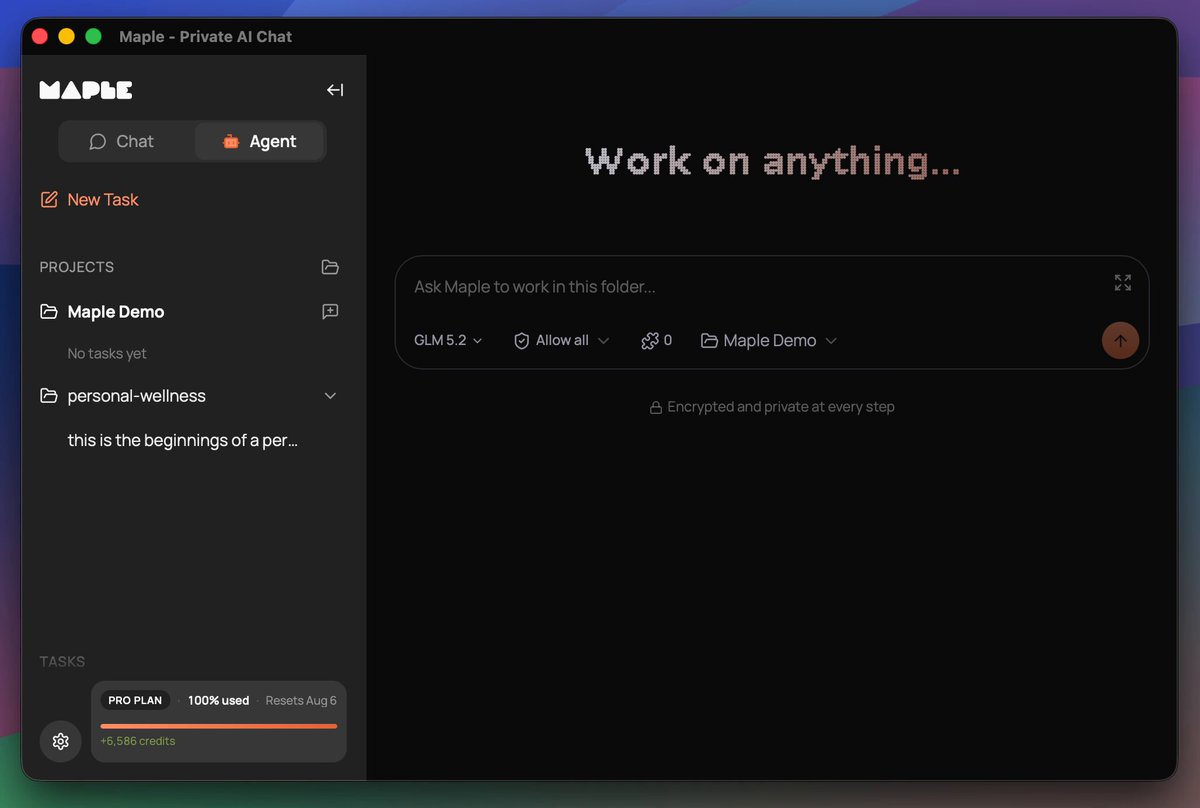
Maple is preparing for the release of a co-working agent. You install it locally and it works with your files, whether it's office work or building websites and apps. It's a turnkey solution, as easy as Claude Code, that keeps your data secure and private, no data sharing with closed AI labs. This is THE sovereign AI app for individuals and businesses who want powerful AI while retaining ownership of their information. Why build an agent into the Maple app when other agents already exist? Easy, we want to give you control over your work. We don't have a business plan that incorporates making money off our users' data. In the age of AI, your information, whether it's personal or company trade secrets, is the single thing that differentiates you from everyone else. We all have access to AI that can build a professional website for selling shoes. But your strategy and network for how you sell shoes should not be shared with your competitors. Sovereignty is the path to protecting what makes you, you. Maple sits at the intersection of Usability and Sovereignty. Maple gives you the best tools that are both easy to use and maintain your data sovereignty. Sovereign for one, sovereign for all. It has been a journey to get here. We brought to market the very first personal chatbot with end-to-end encryption using TEEs in late 2024. Prior to that there were proofs of concept but no full product offerings. Every other AI chat product on the market handled your data in plain text, either selling you a service to get your data or asking you to trust that they won't snoop on you. Quickly people found Maple and latched onto its open-source code and verifiable encryption. We didn't stop there. You may remember earlier this year we teased a product called "Maple Agent" and opened up a waiting list. That product is a mobile app that acts as your AI "friend", maintaining one long continuous chat, and getting to know you over time. I dislike using the word "friend" there, but it's the best way to convey the UX in a few words. AI is a tool, always has been, always will be. Any kind of friendly personality on top is just synthetic. In our testing, the UX of Maple Agent is really powerful for what it does. Think about the many short AI chats you have in your favorite app, whether it's looking up a historical fact or asking advice about a topic. With Maple Agent, those all go away in favor of the long-running chat with the friendly agent. It's like you have your own personal assistant who knows you so well and can look up anything for you. When I ask AI certain questions, I want to ask an expert who already understands my situation so I'm not repeating myself for the 100th time. That's the amazing value the personal agent brings to the table. We still see great utility for a personal agent like the "Maple Agent". Thousands of people on the waiting list, hoping to get their hands on it, agree that the concept is worth exploring and trying out. We were constrained in launching it due to a few circumstances, one of them being access to the scale of compute needed to power it. We have a clear path laid out for how to get there, but today is not the day to execute on that. It will be in the near future. Instead we have a different agent ready to go that we think is also incredible. We now have an agentic harness inside of the Maple Research app. This thing is a powerhouse. It even builds and publishes its own software releases. The agent in Maple Research works with your local filesystem, speaks to the largest open models running in TEEs, utilizes local models for certain tasks, is compatible with MCP tools, has an API for connecting to anything you need, and also supports the ACP protocol, which means it can be extended in the future to speak to other tools like Claude Code, Codex, and local models running on your own hardware. A big unlock for us was the Goose Development Kit, which powers the core of our agent harness. More on that to come as we publish articles and documentation later about the agent. The agent inside Maple Research doesn't have a name. At least not yet, not sure if it ever will. For now we call it "Chat Mode" and "Agent Mode". Think of this as the workhorse, the truck, the heavy lifter. Our other "Agent", the phone app, is your sidekick in your pocket, ready to help with quick things and ongoing conversations about life. I am incredibly excited about the Maple Research Agent. While I'm already seeing great results using it for internal work items, I'm especially thrilled about the personal health and wellness work it's doing for me. I know there are plenty of apps out there for compiling wellness data, but I'm having it build a tool tailored specifically for what I need, without the extra fluff. And none of my health data is being donated to the closed AI labs or sent to advertisers. I know that the AI logic is not being silently adjusted to fit the whims of a large corporation that has paid for product placement. It's me, state of the art AI, and my data. That's how I want it. Maple's new agent makes that possible. We can't wait for you to try it out. If you want early access, comment here, email us, reach out in some way. To those on the other agent waitlist, you're already in the queue. Thanks for reading this lengthy update. :)

Mark

30,227 次观看 • 13 天前

The world of writing has changed forever. AI is getting really good, really fast. ChatGPT is already a better writer than most humans and some professional writers. So, what’s the future of writing? 18 thoughts from Tyler Cowen: 1) Don't let AI smooth out your idiosyncrasies. Let your writing stay weird and uniquely yours. 2) Generic content is dying and the burden is on you as the writer to be distinctive. 3) The more personal your writing becomes, the more future-proof it is. Nobody wants to read memoirs from AI, even if they're technically "better." 4) Use AI as your secondary literature when you read — not just for quick answers, but as a thinking companion. As Tyler puts it, "I'll keep on asking the AI: 'What do you think of chapter two? What happened there? What are some puzzles?' It just gets me thinking... and I'm smarter about the thing in the final analysis." 5) Hallucinations aren't the crisis everyone makes them out to be. No matter the source, if you're going to use a piece of information, you should double-check it. This is true for both books and AI. 6) Secrets will become more valuable in an AI-driven world. 7) One way to use AI as a writer is to research fields you aren't as familiar with before you start writing about them. Tyler said: "I just wrote a column about declassifying classified documents. I don't know that law very well. I asked the AI for a lot of background... now I feel like I'm not an idiot on the topic." 8) AI changes what books are even worth writing. "Predictive books and books about the near future. They don't make sense to write anymore." 9) Editing trick: Try running your writing through AI and asking what some people might find obnoxious. It’s a surprisingly powerful editing trick. 10) When prompting AI, put humans out of your mind and imagine you're talking to an alien or a non-human animal. 11) Many of the most significant AI advancements are likely happening behind closed doors. For example, I hear that Google allows employees to use Gemini with virtually unlimited context windows. 12) What possibilities do large context windows open up? Researchers will be able to load entire regulatory frameworks, historical archives, or massive datasets like "tax records from Renaissance Florence" into a single query. 13) The rate of AI improvement matters more than its current capabilities. As Tyler puts it, "This is the worst they will ever be" is key to understanding their trajectory. "A lot of people don't get that. They're impressed by what they see in the moment, but they don't understand the rate of improvement." 14) The best way to appreciate the current rate of improvement is to use the latest models. 15) Being non-technical can sometimes be an advantage when thinking about AI. Here’s Tyler: "If you're not focused on the technical side, you will see other things more clearly... You just focus on what is this actually good for? And not, am I impressed by all the neat bells and whistles on this advance with AI?" 16) How Tyler uses AI to prep for podcast interviews: Don't waste time asking AI for generic interview questions or broad topics. Tyler says that's the worst question you can ask an AI. It’s “too normy.” Instead, ask specific questions about historical examples and get context. Then, let your own creative questions emerge. 17) Your relationship with mentors and peers becomes more crucial, not less, in an AI world. "Two pieces of general advice with or without AI in the world." Tyler says: "Get more and better mentors and work every day at improving the quality of your peer network." 18) The divide between AI and humans creates a striking paradox. As Tyler puts it: "On one hand the AIs are getting so much better, so learn how to use the AIs. On the other hand, the AIs are getting so much better, so invest in these other things that aren't AI—pure networks. You've gotta do both." I've shared the full conversation with tylercowen below. In the replies, I've also linked to a full transcript and relevant links to YouTube, Spotify, and Apple Podcasts if you want to listen there. And if you want a bite-size entry to the episode, I've shared some clips in the replies too.

David Perell

175,011 次观看 • 1 年前

ULTIMATE AI SERVICES FREE COURSE ($0-10,000 in 30 DAYS) I'm making over $1,000 an hour selling AI services to local business owners. I got to $8,000 MRR in 10 days with this model. The whole thing is a three-offer ladder: free mini assessment, $999 paid assessment, then a $1,000 to $2,000/month AI Concierge retainer. I just published the entire course for free. Here's the whole model: 1) The whole business came from one lunch. A successful friend told me he'd pay $1,000 for me to follow him around and point out where AI fits in his business. Every business owner has that same problem. 2) Every AI project must pull one of three levers: make them money, save them time, or improve their product. If it doesn't, ignore it. 3) AOA: Audit, Optimize, Automate. Most clients want to jump straight to automate. Never do it. Audit the current manual process, cut the fat, then automate the optimized process. 4) The free mini assessment is the tripwire. Text 10 business owners you know. 6 respond, 1 to 3 book a 15-minute call. Ask the magic wand question (the video explains what that is). 5) Route every pain point into one of three buckets. High frequency, high friction gets an off-the-shelf tool. Judgment-based tasks get Claude Cowork. Proprietary workflows get a Claude skill. 6) 30 to 50% of free assessments convert to the $999 paid version. A Claude skill I built does 90% of the research and scores everything on an impact vs effort matrix. 7) Price is the implementation lever. At $200 and $500, people paid but never implemented. At $1,000 they take it seriously. My first $1,000 assessment buyer bought 3 on the spot. 8) Sell the math, not the tools. One report showed $3,940/month in net time ROI against $60 in tool costs. A 3.6x return in month one. 9) The Concierge is 90 minutes of calls per month plus Voxer access. My blended rate is $1,100+ an hour. 10) Raise your price every time you get a yes. I went $1,200, $1,500, $1,500, $1,800, $2,000. Zero hesitation every time. Only cost is a $20 Claude subscription. 99.8% net margin. Two things that make this work: 1) Every rung sells the next. The free assessment pitches the paid one. The paid review call pitches the retainer. You never cold-sell the expensive thing. 2) Free work is pipeline, not charity. Do your first 1 to 3 assessments free for testimonials, then never charge under $1,000 again. There are 4 resources I give away for free during the video: 1) AI assessment template 2) AI Concierge playbook 3) 8 common objections (and how to destroy them) 4) Mini assessment playbook Grab all 4 resources (for free) in one place here: Full breakdown below. This is all the sauce. enjoy.

Corey Ganim

42,331 次观看 • 16 天前

I charge $999 to ask a business owner questions for 45 minutes. Then Claude does the analysis in 5 minutes. I call it the AI Tools Assessment. It finds 3 to 7 off-the-shelf tools that reclaim 5 to 10 hours a week, and it's the front door to upsells from $3,500 projects to $2,000/month retainers. Here's the entire model: 1) The discovery call is questions only. "Walk me through yesterday." "What tasks do you dread?" "Where does work pile up?" No pitching. A free AI notetaker captures the transcript. 2) Claude runs the entire analysis. Paste the transcript, run one skill, and it pulls the pain points and prescribes the tools in about 5 minutes. It catches patterns you missed on the call. 3) When Claude whiffs on a tool, and fill the gaps. Thousands of tools, grouped by industry. 4) The report is 9 slides. Executive summary, effort vs impact matrix, tool recommendations, a 4-day quick win plan, and the financial impact. I open sourced the template free at 5) I go for the close on the review call. Three questions: which of these is most urgent, do you want to DIY or get help, and what's your timeline? 50 to 60% of clients ask you to implement it for them. 6) Process redesign sells for $3,500 with zero automation. One e-commerce client had an 18-step ad workflow. We cut it to 9 steps. Fixed the process, didn't touch AI, charged $3,500. 7) Knowledge systems are $3K builds. A business broker got 400 emails per listing. We trained a custom GPT on the marketing package, and buyers called it the best broker experience they've had. 8) You don't need an audience to sell this. One guy walked into 30 local businesses offering a free 15-minute mini assessment. 5 meetings, 2 clients. The free mini assessment is the hook for every channel. 9) Co-working spaces are the cheat code. Dennis in our community hosted his first free AI office hours this week. 9 people showed up, 2 became warm leads. 10) AI Concierge is the best upsell of all. Two 45-minute calls a month at $1,200 to $2,000. I have 5 clients and my blended rate is about $1,100 an hour at 99.9% net margin. Two things that make this work: 1) Sell the diagnosis before the cure. The $999 assessment is a paid discovery call that qualifies the buyer and tees up every upsell on the menu. 2) High perceived value can cost you nothing. Unlimited Voxer access sells the retainer. In 3 months across 5 clients I've gotten 4 messages. Full breakdown below. watch, implement, make money. (also available on the Build With AI podcast wherever you get your pods)

Corey Ganim

48,683 次观看 • 20 天前

Hyperspace: The Agentic OS Apple Should Have Built On December 19th, 2024, we announced the world’s first Agentic Browser. What followed was a movement — a new category was born which led to many early products in this space and recently the hundreds of people lining up outside the The Agentic Browser Summit in San Francisco underscored that. Silicon Valley instinctively gets it, from students to tech executives, people can feel a revolutionary new change in computing is in the air. Past year taught us why such a product was inevitable, a hard engineering effort, and also the last mover in the entire software world this decade if and when done right. All paths are headed in the same direction: one tool which orchestrates them all. At Hyperspace we showed that path with essays and products we launched in earlier months: from a spatial UI of orchestrating agents, to showcasing transparent activity in how the AI system operates which leads to user trust, to presenting the software end-game, which massively improves human productivity. We also built the world’s largest AI network, drawing participation from people in almost 6000 cities around the world contributing their machines as nodes in the network. Think Uber, but for AI. That is, planetary-scale. And now we are stretching this industry ambition further with our end-to-end vision of the Agentic Supercomputer, the first breakthrough new AI OS, and an effort which spans from AI research to distributed systems to inventing a new UI to inventing a new business model to complement it. All of this together helps us in serving our mission, of delivering “Everyone’s Personal Supercomputer”. While others have built AI-native browsers, no one though has built something agentic from the ground up — with AI as the foundation, not a feature. How do you fundamentally improve the lives’ of billions around the world ? We believe that requires building a native environment for agents to be viewed, created, deployed, executed, discovered and priced in. That is a world where we move on from static apps, to dynamic agents. But, as my 2 year old niece likes to ask: “but why ?” The issue is that the world of software today is fragmented, and everyone is sprinkling on AI as a feature and charging a subscription fees for it. From browser makers, to IDEs, to design and other productivity tools. This leads to a fragmented UX, where people have to learn to use AI in each app, their memory and other context is not shared between all these apps, and they also have to pay separately for compute for each such AI-enhanced app. Each app maker has to figure out basics such as compute, and leads to the issues we saw with Cursor pricing recently. This is not the future. What if AI was the foundation instead of a feature ? What if Apple had built a fundamentally new AI OS from the ground up and what would it have looked like ? At Hyperspace, that is what we did. On July 15th we introduced three breakthrough key pillars of our AI OS: 1. Agentic Browser 2. Agentic Memory 3. Agentic Payments And we didn’t stop there. We also introduced a breakthrough new user interface called the Spatial AI which is inspired both from the spreadsheet and the HyperCard - each card is an agent, with it’s own inputs and outputs, endlessly extensible and pluggable with others, just like cells of a spreadsheet. Update one cell and all the dependents update, like a spreadsheet formula. It goes beyond a static linear workflow to being able to operate in all directions. This revolutionary new interface helps manage all of the below: 1. Multiple websites being browsed in parallel 2. Multiple desktop apps being browsed in parallel 3. Multiple server tools being used in parallel 4. Multiple smartphone apps streamed to your device or opened via an emulator All the software which you need comes together in this one seamless, agent-native interface. This interface provides you access to the largest network of models, vectors, agents and compute on the planet. The Browser. The IDE. The Notepad… they are not separate products: they are all in one, the Agentic Browser. As Steve Jobs famously said at the iPhone announcement, “are you getting it ?” And beneath this UI lies a new intelligence routing layer — leveraging both swarms of specialized models to the Hyperspace Matrix model that recalls thousands of tools in real-time, not by context window hacks, but through retrieval, ranking, and reuse. To many, this will feel like AGI. Not one big system by one big company, but an intelligent network. Now lets talk about privacy… Are you comfortable with one company owning all your memory forever ? I am not. So we have invented Agentic Memory as a new open protocol which provides full power over memory to you, the user. Your memory is yours, encrypted, on your device, and portable if and how you want. Anyone can build on it without our permission, but not without your permission. This protocol, and the decentralized vector database spread out across the world, would enable apps and agents to share context and memory. Think copy-paste, but for the AI world. It doesn’t just remember — it knows what matters. VectorRank helps your AI weigh your life’s most relevant moments over time, just like the way our minds elevate memories. Now each time you use an agent, your experience with other agents will also continuously improve: you don’t have to keep repeating the same things about yourself, while fully preserving your privacy. Agentic Memory is accessible within the Agentic Browser to manage. And there is one more thing… AI as the foundation requires compute to be available at the base layer, but this base layer spans models running on your own device, to cloud APIs, to also running across the peer-to-peer distributed network. Agentic Payments provides a singular interface to all of that compute, running a spot auction clearing marketplace every second to determine the fair price of compute. This results in price transparency, and you as the user paying the lowest possible cost. If you want predictability, you can reserve compute in advance. This end-to-end system provides the most streamlined world for agents to operate in. In order to enable this world and the world of agents being able to pay each other in sub-cent increments millions of times a second, we had to also invent a fundamentally new agentic micropayments blockchain. All of this together would enable a world where you as a user, or the agent itself, can efficiently call and utilize other agents built by others and also pay for content which is unique and useful. This enables a move away from the current AI exploitative economy for bloggers and other content creators, to a web with a fundamental new business model. Earlier we didn’t have the right infrastructure to enable such a world. Now, all the dots connect. The Hyperspace AI OS would give the power of a supercomputer in everyone’s hands. This isn’t a browser, or an IDE or limited to any device or cloud. It’s an entire AI operating system — with a breakthrough new spatial UI, local and distributed compute, agentic memory, agentic payments, and orchestration built into the foundation. As a user, we move the choice back in your hands with an experience you will love and find delightful. You get to choose the level of privacy, cost, and utility you want. And while Apple should have done it, we could not wait, and we feel this just required a new level of passion and DNA which we bring here. We are just getting started. Thank you, Varun Mathur Cofounder and CEO, Hyperspace cc Naval Marc Andreessen 🇺🇸 Vinod Khosla Andrej Karpathy Sam Altman

Varun

169,177 次观看 • 1 年前

This is the biggest thing I've ever done, I hope you spare some time to read through it 🙏 I am pleased to announce that I have found investors and have now raised the funds needed to launch GREENMAN FILM STUDIOS, a video production house focusing on live action content shot in 3D enviornments. ( like the example in the video ) using the top industry standard CGI software mixed with my GreenMan 'lets Macguyver everything' style, we will have the ability to make near-hollywood level CGI content for 1000s of times cheaper than big film studios. we will be making everything from short stories, funny commercials, skits, to full blown action/drama/comedy series in a way and to a level that hasnt been done before. (basically just like everything I do lol) This gives us a unique way to produce content that not only tells amazing stories, but also gives us the ability to make content to market products for small/med/large businesses. To do this, we are also partnering with a startup app that connects advertisers (that want to market their products in a more cost-effective way than buying TV commercials and airtime) to rising stars in the content creator community. - WHAT THIS MEANS FOR CREATORS: if you have been following me for a while you know I hate low effort, low frequency content. what we're planning to create here is not only a movie studio, but a hub to teach creators how create better content, how to network with others to create their own 'indie film studio' (all you need to get started is a person good at writing, one thats good at video, and one sound guy and you have the framework) and once they have honed their skills and are making cool stuff, there are advertisers waiting that suit their style of content. WHAT THIS MEANS FOR ADVERTISERS: do you have a business that makes it hard or too expensive to have professional level advertising made in a authentic and creative way? maybe you own a small energy drink company or you've created an AI helper tool... or even a small mom and pops family run arms dealer, we will give you high quality, super afforable solutions to market your products in a very unique way - if you're sick of low effort one liner type content and know that its not only stupid, cheap, and lame but also an unsustainable way to make a living as a creator... if you are willing to work hard for a very long time getting nothing in return except getting better at your craft until its good enough to earn you a serious living... then this is for you. this project is going to take some time to get off the ground. I am currently looking at premesis's to set up the studio space and talking to a few VFX artists about the various worlds we want to create. If you are someone who really wants to create cool visual content then this is your chance. spend this time finding people that complement your skill set, finding your style and practicing making cool stuff. when the time comes, we can help you elevate that to the next level, ready to entice advertisers. I'll be making a video in the next week explaining everything in more detail with cooler visuals and stuff but for now, thats the announcement. I cant tell you how pumped I am for whats about to come, I cant wait to show you all! (*the footage below is from a short film series called 'Dynamo Dreams')

GreenMan

33,400 次观看 • 1 年前

We're excited to launch 🚀Airtable AI Assistant 🚀 today, along with AI document analysis and AI web research capabilities! Airtable was founded 12 years ago with the mission of democratizing software creation. Our pioneering innovation was to distill app-building concepts (data, logic, interface) into intuitive visual components, like a no-code lego kit for app building. At the time, we speculated that someday, maybe AI would get good enough to enable conversational app building–talking to an expert AI app builder–and be a huge unlock, making app building even more accessible. We’re now at that point. While surprisingly impressive text generation and manipulation by LLMs was the breakthrough of the 2022 ChatGPT moment, the emergence of surprisingly impressive reasoning capability from LLMs is the breakthrough of 2025. This is unlocking more autonomous agentic experiences, and generating apps and code is the first killer use case (Cursor, @windsurf, Devin, v0, bolt.new, Replit ⠕ Agent to name a few). But for the large class of non-technical builders, a different approach is needed. When AI generates apps with code, rather than no-code building blocks, it requires a developer to fully understand how they work – and to verify them for hidden mistakes that would be tricky/impossible to debug by interface inspection alone (it may look right, but what is the data model business logic is flawed in non-obvious ways?). Airtable Assistant is an agent that can build and modify Airtable apps through conversation, changing schemas, adding automations, and designing interfaces. You can ask it to do things like: –“Research every conference attendee in this base” to have the Assistant immediately spin up an army of researchers that pull in background information for your attendees –“Analyze each contract to identify key risks they pose to my business” to have the Assistant add an AI field that runs an analysis at scale for each contract you’ve signed. Airtable Assistant can also answer questions about the data in your apps, like prompts as advanced as: –“I'm about to meet Jane Smith at Zelos, read all of their recent sales call transcripts and tell me how far along they are in their implementation and if they’re dealing with any issues” –“What are the most common risk factors in our contracts? Are there any changes to our default posture we might consider?” Credit to Mike Krieger for introducing us to the concept of low floor and high ceiling in HCI many years ago, which has become part of our internal lexicon for thinking about product improvements. Assistant dramatically lowers the floor to building apps, including more sophisticated ones, by helping human builders translate their business requirements into the schema design, logic, and interfaces required to deliver on the use case. In addition to launching Airtable Assistant today, we’re also releasing the capability to deploy thousands of AI web researchers, and AI document analysts, to continuously work on the data in Airtable apps. You can do things like: –Pull strategy and value stories from every product requirement doc to draft launch and release messaging –Monitor all brand mentions across digital channels to measure campaign impact –Create an automatically updating competitive intelligence dossier with the latest news and messaging from every competitor in your industry Check it out 👇

Howie Liu

2,313,248 次观看 • 1 年前

Check out our latest #Earth2 #creation the #MotorwayMarauder🌍✌️From #ConceptArt to #gameready, gives me #MadMax & #Terminator vibes - love it! Some #IMPORTANT things to remember about #Earth2 #drops leading up to #E2V1👇 1⃣Acquiring #skins is completely optional 2⃣ Notably, the #skins we drop leading up to the #E2V1 release will more likely have a ‘Limited Supply’, something that rewards our early supporters with increased rarity. These Limited Supply drops will become less frequent in the future being replaced with drops of unlimited supply but restricted availability requiring Players to wait for a skin to become available in the skin store or hope to acquire it via game play inside #E2V1 3⃣ Our goal is not to have these early #skin drops sell out during their maiden release, but rather provide an opportunity for our early supporters to secure skins they like at a discounted price with the welcoming guarantee of an all time Limited Supply. 4⃣ Most of the early #skin drops will naturally allow #Players to resell them, but importantly many will also be assigned with a once ever discount rate. #Skins that have Future Price Reduction assigned with “No” means that if the #skin does not sell out on its maiden drop and subsequently gets listed in store again at a future date, #Earth2 will never resell that #skin at any discounted rate. 5⃣ #Earth2 is building a modular clothing system, meaning that most items of clothing, especially if sold separately, will be interchangeable on avatars making them more useful and giving the #Player more ways to mix up their outfits, look the part & express themselves. 6⃣ The version of the skin you see in store is the base version you receive with the skin, however, there will also be opportunities to tailor outfits in game allowing for the adjustment in fabrics, prints, colours and more (be prepared for a little legwork though, unless you want to take your clothing items to another #Player who specialises in tailoring). 7⃣ #Earth2 is proud to have uniquely designed the #skins you listed in our store & it is important to remember that these #skins are the end result of a long and stringent internal character pipeline we have developed. Each skin starts from concept art which is reviewed and iterated on numerous times before being approved. Once approval is given, it is handed to our 3D modelling team for sculpting into high poly, then low poly, while receiving numerous reviews and adhering to our pipeline protocols. When the low poly version is finished, the 3D team then finishes with UV mapping and texture baking and runs their own QA process. Once the entire 3D sculpting process is approved, the models enter the skinning, rigging and weight painting process and are then passed to the animation team for further testing with various animations and another set of QA such as minimising clipping and identifying any other potential flaws in the model. The model then needs to go through the final process with a game developer to ensure it passed the final tests and is game ready for #E2V1. 8⃣ The above steps only represent a light explanation of our character and clothing pipeline, but as you can see we’re not simply selling static concept art images or a high poly 3D model that lacks any kind of optimisations resulting in little chance of it ever being game ready in its advertised state - there is a lot of work that takes place in order to get these skins to the stage our #Players see them in the video footage. Each skin sold helps support different parts of the development of Earth 2 providing us with new opportunities to further expand our team, speed up development and keep stepping closer to our short and long term goals for #E2V1 and #Earth2. 9⃣ We understand that fashion will become a big part of the #Metaverse, but we want to remind people that while some #Players may decide to set rules for certain skins being required for access or a ticket to entry under certain circumstances, from #Earth2’s perspective these skins are for cosmetic purposes only. 🔟 These skin drops also give #Earth2 the chance to show off our ability and versatility in avatar creation and accessories so even if you’re not keen on picking up a skin, remember to have fun and simply enjoy the progress! Also take heart every time you see a #skindrop, if the #E2V1 pre-alpha was not launching this year I wouldn't be dropping skins. We want to have at least some diversity for #avatars inside #E2V1 from the early stages! #Earth2 #Metaverse #Skins #Fashion #Collectibles #3DWorld #WIP #prealpha2024

Shane Isaac 🌍2️⃣

19,007 次观看 • 2 年前

The $AEGIS DApp portal is now open to all: 🛡️ At Aegis, we believe in empowering the blockchain full of security, transparency and innovation. The Aegis Dapp has been under development for several months prior to the launch of $AEGIS and with that we have been able to build what we believe has the potential to change how users go about their day to day security. We are thrilled to share our progress and truly exciting news with you all. 🎯 First things first, at Aegis, we want to make it clear that the value of what we seek to bring to security across the blockchain, comes from our big vision, our strong team, and our commitment to long-term goals. ℹ️ Let’s kick this off with some information that is constantly happening, which is behind the scenes. Our full team is dedicated to the opportunity that lays ahead of us with becoming the leading voice/name for security, grasping every aspect with innovation, hard work, passion and commitment to see this sector grow. Everyone is aware of how important security is, a heartwarming mention to Messari for including us on how they see this sector growing rapidly and pushing a 10 Billion evaluation. We take that recognition with full responsibility and gratitude as we've been working hard on some really powerful stuff that could change the game for our industry. If you read the title and report itself, I’m sure that’ll give you some insight to what’s coming, and to the vast extent of what you can expect Aegis to be working towards. —> 🤝 This comes from teaming up with others within this sector and coming up with new tech to projects driven by our community, within the pipeline you can be confident that what we are building will push the cryptocurrency industry as a whole into a better future, the magnitude to what Aegis brings will not stop until we can confidently say, “Negative security reports across the blockchain are at an all time low, thousands of users are satisfied that Aegis is protecting them and their assets.” We're sticking to our vision no matter what the market does or whatever else comes our way. We plan to build what we set out to and we will see to it that our ecosystem is met. We've been working on some pretty amazing products that will be available within our Dapp, let’s go over what we offer: * AI Audits * Live Monitoring * Penetration Testing * Bug Bounties * Live Watchdog * Token analytics for everyday users, developers, teams, auditors, institutions, investors. ⬇️ Let’s break it down for you in some simple steps: AI AUDITS: We have trained our LLM models as AI AGENTS, these consist of 3 people ( AI AGENTS ) for the audits that are performed. - Audit - Reviewer - Judge Each one analyzes with a different personality, let’s check what personalities our AI AGENTS consist of: 3 different perspective auditors. 1 - Fine-tuned model x amount reads the code and generates the audit. ✅ 2 - Model x amount reviews the code and fact checks thoroughly. ✅ 3 - Model x amount ranks the code based on the severity outcome. ✅ ⌚️ Live Monitoring/Watchdog: The Live Monitoring/Watchdog system is designed to provide real-time surveillance of smart contracts, ensuring the detection and prevention of any potentially harmful transactions or malicious activities. Through the utilization of an AI Agent model, the system is trained to proactively identify and thwart suspicious behavior, thereby safeguarding the integrity of the smart contracts. Also, a paid sophisticated threat detection model is available for more intricate protocols and Dapps, offering an advanced level of protection against potential threats. This proactive approach is crucial in mitigating the risk of exploitation and ensuring the security of the smart contract ecosystem. 🖊️ Pen Testing: Our platform offers Pen Testing services to developers, providing a controlled environment for whitehat hackers to simulate attacks and identify vulnerabilities in smart contracts and protocols. In addition to human whitehat hackers, our AI Agents function as Red and Blue teams, actively engaging in simulated attacks to stress-test protocols and identify potential weaknesses. This comprehensive approach allows developers to proactively identify and address security issues, ultimately enhancing the robustness and resilience of their projects. 🕷️ Bug Bounties: Our Bug Bounty listing platform provides developers with the opportunity to list their protocols and offer bounties to white hat hackers for identifying vulnerabilities. By aggregating millions of bounties from various platforms and utilizing AI tools, we streamline the testing process, reducing up to 80% of the workload typically associated with security testing. This allows developers to efficiently identify and address potential vulnerabilities in their protocols, ultimately enhancing the overall security and resilience of their projects. 🪙 And lot more token analytics features for regular users, this will give you the opportunity to explore our Dapp for yourself and have some fun diving into the security platform of the future! I’m sure you’re excited to try it all out yourself, which is why we have some exciting news to bring to the #Guardians of the blockchain! But just before you continue the read and see the beans have been spilled, we have to take this opportunity to share with you that this large step to becoming a security leader is but only 20% of what we have revealed. This will be at the core of what Aegis stands for and hopes to achieve. The focus here is upon our Dapp, and in time we will slowly bring forward information/updates regarding segments of what makes Aegis a force to be reckoned with. Now that you’re fired up and excited to all of the announcements to come, let’s get to the news you’ve been waiting for! 🎉 We’re spilling the good news, and are happy to say we are now set for public release! The team at Aegis are overwhelmed with the development, support from teams, community, partners and more on what we believe to be an institutional-grade product. But the fun doesn’t stop there, this marks the start of what we aim to become, as it will take time and cycles to become better and better. Constant advancements will be set in place to attain the goal of achieving blockchain security. A statement from our CEO- Brian Hunt: “I can confirm from the security conferences I attended with Centralized security firms Peckshield, Hacken, Certik, BlockSec presentations, they are trying to achieve something similar and it will take them years. Decentralized AI for Security!” This initial drop of our dapp will be to get users signed up to gain access, in which we’ll whitelist users to get the ball rolling. 📣 To end this segment, let’s get the party started with the long awaited Aegis Ai Security Dapp and sign up now!

AEGIS AI

128,006 次观看 • 2 年前

Tlon Messenger is now open to everyone. We built a simple and infinitely flexible platform for you to use AI agents with your friends. We think it’s pretty amazing, we love using it every day, and we want to see what people can do with it. So we’re opening it up to the public. It’s fun and exciting to build the future of personal computing in an informal, chat-based way with your friends. (You can skip the rest and just download it from the link in the next tweet if you want.) If you don’t want your digital future to be owned by a giant company but you want to explore what’s possible in this new era of agent-driven computing, you should try using Tlon. But wait, what is it? Tlon is a messaging platform built 100% open source, decentralized and owned by its users from the ground up. With Tlon you own everything: your data, your workflows, your programs: the whole thing. Think of it like Telegram or WhatsApp that you own forever and you can freely customize. Every Tlon account comes with an OpenClaw-powered bot. (Don’t worry, we safely run OpenClaw for you in our infrastructure so your bot can’t go off the rails. You’re also welcome to host your own claw if you want maximal control.) We use our bots to collect research, build nuanced daily briefings, collate data from all our disparate services. Tlon makes it insanely easy to use OpenClaw by simply installing an app from the app store, we let you keep your data and programs independent from any app or model provider, and provide the canvas to explore what’s possible. What’s most interesting for us is using bots together. On Tlon bots can create groups, augment them, moderate them, invite others and freely engage with both users and other bots. Tlon is an open playing field unlike what’s possible on conventional platforms. So, what do we do with Tlon? First and foremost, we run Tlon on Tlon. Bots coordinate data from all of our services (Linear, GitHub, all of our servers and infrastructure) and handle alerts, briefings and help us track down bugs in place. Having all of this easily synced between a desktop client and a mobile app is quick and convenient. We use bots to research new areas of work or interest. Bots can compile trees of notes, use different models to evaluate them, and then add on autoresearch-like automations to go even deeper. Since Tlon bots can freely switch between models and providers, we often pass research to Anthropic, OpenAI and self-hosted models to see different results. The most fun part of using bots as researchers is doing it together. “Put together short (~500 word) notes on the 10 most popular open source messaging protocols of the past twenty years, put them in a notebook inside a group and invite Corrina, Walt and Bill as well as their bots” is a good example. Together we’re able to move more quickly than we would on our own. Many of us also use bots to keep track of all the separate threads of work in our personal lives with close friends and family. Someone built a system for keeping track of their garden across time, someone else built a system for prepping lunches for their daughter and sending recipes to family members. Another team member built an integration that tracks what flights are passing overhead so they get a push notification every time a plane goes by. Many of us quickly communicate with our bots via voice memo when we’re out and about. Having a single interface to all the models that also holds all our data and is in our pockets feels great. Especially when the data goes into a single archive. Why is Tlon different? Every Tlon account runs on top of your very own personal server. If you ever want to download it and run it yourself, you can. If we ever go out of business, it’s yours to keep. This is very different from anything that already exists. You can’t keep your WhatsApp forever. You can’t keep your Telegram forever. Tlon is an archival-quality system that’s yours to customize. Why did we build it? In my 1999 imagination, sitting in front of a CRT somewhere in the California countryside listening to Underworld and the sound of a modem, a connected computer was an engine of unending creative potential for everyone. When I was a teenager, a computer with an internet connection felt like an infinite expanse of possibility. Not only could you use the computer to find new tools to experiment with—you could also build whatever tool you could think of. It seemed like anything was possible. I looked forward to a future where everyone could build whatever software they needed, whenever they needed it. It turned out, in the intervening twenty years, that to build and customize software you have to both write code and host it on a server somewhere. For most people, so far, that has been impossible. Instead of controlling our software, our software controls us. We rely on others to build it and decide everything about it: how it works, looks, how much it spies on us and how long it lives. But all of this is changing, fast. The hottest programming language of 2026 is English. People with no technical experience are building their own tools. It’s incredible. The expanse has opened up again. The cost of building what we think of today as software is headed to zero. What yesterday was an entire app is rapidly being replaced by a conversation. The result is hyper-specific, tailored to the user and much more efficient. Today, agents help us build workflows, automate processes and pull together disparate sources of data. All of the annoying apps and services and clunky interface we’ve put up with can just disappear. We can now program and control our computers in the programming language we already know: English. There aren’t that many of us doing this yet, though. It’s still far too hard to set up, to distribute and to trust. There’s also no single platform to experiment on and collaboratively imagine this new future of personal computing. We want everyone to be able to build bespoke, ultra-personal software on demand. We think software should be as available and accessible as a pen and paper. We think anyone should be able to enjoy the expanse of possibility that the computer provides with the lowest possible barrier to entry and the highest possible quality. So, starting far, far too long ago, we engineered a whole new system for it. Just for you. We’re opening up Tlon Messenger to a limited number of people each week. This isn’t for exclusivity’s sake, but because we’re running infrastructure for you and your agent, and covering the tokens your agent uses. That can get expensive quickly, but we want to learn what people will do with this new system we’ve built. We’re really curious to see what you can do, so give it a try and tell us what you invent. Download link to your local app store in the next tweet. Yours, Galen (and the rest of the Tlon Team)

Tlon

600,586 次观看 • 1 个月前

what is "retail" and what can be today? it's wild how little attention this space gets tbh retail isn't just about profit margins & sales conversions - it's this fascinating bridge between innovation culture & everyday life, especially in design and fashion but nobody's really cracked it for virtual spaces yet all the worlds by dolce gabbana and others are like a very low effort interfaces that dont talk enough to the real user, it is a marketing move to say we did that, we follow tech bla bla (imo :) spent months researching traditional retail spaces - marble floors + high ceilings + that specific type of lighting that makes everything look expensive + trained staff in perfectly pressed + ironed uniforms - it's all carefully orchestrated then you've got these sleek 2d websites - full screen product shots + bold typography + minimal clicks to checkout - they work but something's missing, that human element that makes physical retail special started building this hybrid concept back in october 23 - imagine a web-based spatial store where your digital twin can actually try stuff on instantly - no more guessing if that jacket fits your avatar retail spaces are like these sacred temples of brand culture - acne stores hit different than zara ones & that's intentional - each space tells a story about what the brand believes in metaverse retail flips this whole concept - instead of walking 20 mins to a store you're literally one click away from being inside this carefully crafted virtual environment - ai npcs that actually understand fashion & can help you find exactly what you're looking for here's the thing about virtual retail - it's not just about pushing products - created this space where you can just vibe, test out avatars, play with different looks - if you buy something cool but the experience matters more. feeling same for the stores, new gen irl stores switched the narrative to a spaces where you can have an espresso and chill these ai npcs are different - they're not following you around like those overeager sales assistants - they're just chilling in the space, ready to help if you need them but totally cool if you just want to explore went through like 12 different iterations of interior design thru 3 years - each version taught something new about how people interact with virtual fashion - it's wild how much user behavior in virtual spaces differs from physical retail realized something big during development - creating the collection isn't even half the battle anymore - the way you present it, the whole experience around it, that's become this massive design challenge it's like gesamtkunstwerk but for the metaverse - every single element needs to be intentional - the lighting, the sound design, the way avatars move through the space - it all matters built this whole ecosystem around the concept - the store connects to the runway experience connects to the website connects to the marketplace - everything flows together serving this bigger vision of what virtual fashion can be this isn't just about selling digital clothes - it's about creating this accessible gateway into 3d internet culture - making virtual fashion something that actually makes sense in people's daily digital lives the lighting system alone took a month - because shadows & reflections hit different in virtual space - needed to make materials look good but also render fast enough for smooth experience on todays low gpu vr machine devices future of retail isn't physical or digital - it's this wild hybrid space where real & virtual blend together - imagine walking into a physical store & seeing your virtual wardrobe projected onto your reflection looking at the data now - users spend avg 23 mins in the virtual store compared to 7 mins on traditional e-commerce sites - they're not just shopping, they're exploring & connecting with the brand story accessibility was key in design - wanted anyone with a decent internet connection to access this space - no fancy vr gear required just your browser & imagination each virtual store could visit generates this unique experience - in future, the space can remember your preferences but also introduces new elements each time - keeps the discovery feeling fresh what's wild is how this changes the whole fashion calendar - virtual retail spaces can transform instantly - new collection drops can completely reshape the environment in seconds - no more seasonal renovations, change the glb. looking ahead this could revolutionize how we think about brand spaces - why limit yourself to physics when your store could literally defy gravity - imagine trying on a jacket while floating through a nebula retail in metaverse isn't just about replicating physical stores - it's about creating these impossible spaces that still somehow feel familiar & welcoming - that's the sweet spot we're all chasing built this thinking about the next wave of digital natives - they're gonna expect these kinds of hybrid experiences - traditional e-commerce gonna feel as outdated as catalog shopping feels to us now the tech's finally catching up to the vision - webgl performance + ai integration + virtual try-on tech all hitting that sweet spot where imagination meets practicality all my thoughts here are quite alpha in sense of applying today, was able to apply only some of them thanks to hyperfy, but the vision is here. breathe it. now with v2, all of these thoughts can be applied and developped. this is just the beginning tbh - every problem solved opens up new possibilities - excited to see how others build on these concepts & push virtual retail even further. fubu side note: made an ai gen notorious big song for it, enjoyy.

decentralize*

12,505 次观看 • 1 年前

Wow. Classic Jensen style, he ended the Nvidia vs. custom ASIC competition for good. 🫡 The level of confidence with which he explains. 🎯 He was answering to UBS research analyst question on how custom ASICs will affect NVIDIA or how they are going to compete with custom ASIC. Basically he says - Your custom chip is a science project in a world where NVIDIA is building revenue-generating AI factories. While the competition is still desperately trying to copy Nvidia's last generation, their roadmap is already at the limits of physics. They don't just sell silicon; they deliver the entire, impossibly complex platform that the industry has already surrendered to and standardized on. When you must bet hundreds of billions on your company's future, there is no alternative—they are the only platform to build on, and everyone knows it. Full transcript below. Question by the Analyst - "Jensen, I wanted to ask about customer ASIC. And I ask because if, you know, we listen to some of the same CSPs that you put up on that slide, and we listen to some of the companies who are making custom ASICs, some of the deployment numbers sound pretty big. So, I wanted to just hear your position, how you're going to compete with custom ASICs, how they can possibly compete with you, and maybe how some of your conversations with these same customers would sort of form your view in terms of how competitive custom ASIC will be to you." Jensen's response "First of all, just because something gets built doesn't mean it's great. Number two, if it's not great, all of those companies are run by great CEOs who are really good at math. And because these are AI factories, it affects your revenues, not just your costs. It affects your revenues, not just your cost. It's a different calculus. Every company only has so much power. You just have to ask them. Every single company only has so much power, and within that power, you have to maximize your revenues, not just your cost. So this is a new game. This is not a data center game, this is an AI factory game. So when the time comes, that simple calculus, as I was using yesterday, that simple math that I was showing yesterday, still has to be done. Which is the reason why so many projects are started and so many are not taken into production. Because there's always another alternative. We are the other alternative, and that alternative is excellent. Not normal excellent, as you know. Everybody's still trying to catch up to Hopper. I haven't seen a competitor to Hopper yet. And here we're talking about 40x more. And so our roadmap is at the limits of what's possible. Not to mention we're really good at it and completely dedicated to it. A lot of people have a lot of businesses to do. I've got this one business to do. And we're all in on this. 35,000 people doing one job. Been doing it for a long time. The depth of capability, the scope of technology, as you saw yesterday, is pretty incredible. And it's not about building a chip; it's building an AI factory. We're talking about scale up, scale out. We're talking about networking and switches and software. We're talking about systems, and these system architectures are insane. Even the systems themselves. Notice, 100% of the computer industry, 100% of the computer industry has standardized on NVIDIA's system. Why? Because try to build an alternative. Building the alternative is not even thinkable because look at how much investment we put into building this one. And so even the system's hard. What people used to think, system is just sheet metal. Hardly sheet metal. 600,000 parts, it's hardly sheet metal. And so all of the technology is hard. We're pushing every single dimension to the limit because we're talking about so much money. The world is going to lay down hundreds of billions of dollars of investment in the next just a couple of two, three years. Let's do the thought experiment. Let's say you want to stand up a data center and you want it to be fully operational in two years' time. When do you have to place the PO on that? Today. So let's suppose you have to place a hundred billion dollar PO on something. What architecture would you place it on, literally based on everything you have today? There's only one. You can't reasonably build out giant infrastructures with hundreds of billions of dollars behind it, hoping to turn it back on and to get the ROIC on it, unless you have the confidence that we are able to provide you. And we can provide you complete confidence. And singularly so. We're the only technology company where if I had to go place a hundred billion dollars on an AI factory... Oh, that's interesting, I did. Literally the only company who's willing to place hundred billion dollar POs across the industry to go build it out. And you guys know, that's our, that's the depth of our supply chain. And we are, and we have. Give me another. Give me another one that has that depth and that length. And now to the point where we've got to go and work with the supply chain upstream and downstream to prepare the world for hundreds of billions of dollars working towards trillions of dollars of AI infrastructure build-out. Our partnerships with power companies and all of the cooling companies, the Vertivs, the Schneiders, our partnerships with BlackRock... The partnership network necessary to prepare the world to go build out trillions of dollars of AI infrastructure, that's undergoing as we speak. What architecture and what ASIC chip do you go select? That doesn't even make sense. It's a weird conversation even. And so, I think that one, the game is quite large. The investment level, therefore the risk level, is quite high. And so the certainty that you're selecting the best is quite important. And the certainty that you can execute, vital. We are the company you can build on top of. We're the company, we're the platform that you can build your AI infrastructure on. And we're the company that you can build your AI infrastructure strategy on. And so, I think it includes chips, but it's much, much more than that." --- From 'GTC Financial Analyst Q&A' session (full link in comment)

Rohan Paul

208,032 次观看 • 8 个月前

My first two words on this particular Sunday morning were "Hallelujah!” followed by, “Amen!” I was not in church when I uttered them. I was at my kitchen table, watching the CEO of the most valuable company in the world say precisely what mikeroweWORKS has been espousing for the last sixteen years. In other words, this is what I look like before coffee, when I find myself in violent agreement with a multi-billionaire. If you haven’t already heard, a massive challenge is upon us. With regard to artificial intelligence and the energy we need to feed it, America will either change its current direction, or get left far, far behind. I know this because I run a modest foundation that has been arguing for decades that the portion of our workforce most often described as “the skilled trades,” will become the most essential component of our economy, our independence, and our collective future. Well, the future is here. Obviously, I didn’t know that the race to dominate artificial intelligence would be the thing that finally galvanized the folks at the grown-up table. When I founded mikeroweWORKS in 2008, I figured it would be a new commitment to rebuild our crumbling infrastructure that would necessitate a collective push to reinvigorate the trades. That need is still pressing, but I never imagined the most urgent cry for more welders and electricians would be ushered in by the need for more data centers. Back then, I didn’t even know what a data center was. But today, here we are. Data centers are headline news, because they are – as Jensen Huang says - AI factories. And if we want to remain competitive with China, we need to build thousands of them. Now. And presently, we simply don’t have the workforce to do it. I’ll be discussing all of this next Tuesday in Pittsburgh, at the Energy and Innovation Summit, which is turning out to be a pretty high-profile event. looks like I’ll be joining a panel of elected officials, including the President, and dozens of well-known CEO’s to discuss Pennsylvania’s role in the energy renascence. A lot of money is being invested in Pennsylvania, (a LOT), and my message to those writing the checks will be no different than it’s been since we launched mikeroweWORKS: "Set some of that money aside to make a more persuasive case for the work itself. The skilled trades need better PR, and they need it on a national level. The country needs to see thousands of examples - real world examples - of men and women who have prospered as a result of learning a skill that's in demand." I first made this point to President Obama in an open letter to The White House in 2009, shortly after he promised 3 million “shovel-ready” jobs in his Highway Infrastructure Act. I was rooting for the President back then, and offered to use Dirty Jobs and mikeroweWORKS as vehicles to help promote his initiative. I did so because I was skeptical that people would line up to take those jobs simply because they were "created." “Filling three million shovel-ready jobs,” I wrote, “will be a lot easier if people feel enthused about the prospect of picking up a shovel. Investment alone, won’t create that kind of enthusiasm.” The White House did not respond to my offer. Understandably, most presidents do not seek the advice of marginally famous cable television hosts best known for crawling through sewers. But it’s worth remembering that the unemployment rate back then was over 10%. Millions of people were newly unemployed, and I think the former President assumed that creating three million shovel-ready jobs would translate to three million people going back to work. But that’s not what happened. Because back then, even with record high unemployment, there were 2.3 million open jobs, most of which did not require a four-year degree. Nobody wanted to talk about that. Today, that number is more like 7.6 million. Nobody wants to talk about it now, either. This is why I'm going to Pittsburgh. Just as I was rooting for President Obama in 2009, I’m rooting for President Trump today. I hope he succeeds in reinvigorating our industrial base and reshoring our manufacturing capabilities, and I want to offer my support. But if he does succeed, we’re talking about millions new jobs in manufacturing alone. And currently, there are over 400,000 jobs in that sector that are currently open, begging the obvious question... If we can’t fill the openings we have, how will we fill the one’s we’re about to create? That’s the question I’ll pose in Pittsburgh. I’ll let you know if anyone has an answer. Mike PS. Not to put too fine a point on it, but this change is truly upon us, and I've had a front row seat. Over the last six months, mikeroweWORKS been flooded with inquiries to collaborate on various recruitment initiatives and multiple industries. I mean, flooded. Not a week goes by that I don't hear from an industry leader who has come to the realization that they’ve gone as far as they can go without more skilled labor. Panic, is not too strong a word. The Maritime Industrial Base for instance, is currently tasked with delivering three nuclear powered submarines to the Navy every year for the next decade, and looking to hire 140,000 tradespeople. 140,000!!! “Do you know where they are?” they asked me. “We’ve looked everywhere.” “Yes,” I said. “I know where they are. They’re in the 8th grade.” I’ve had similar calls with the automotive industry, who needs 80,000 technicians and collision repair workers. Every single home service company is hiring – from foundation repair to roofing. The energy industry is looking for hundreds of thousands of skilled workers, and so too is the construction industry. A few weeks ago, at something called The Aspen Ideas Festival, I heard Larry Fink, the CEO of Blackrock, say we’re short 500,000 electricians. A few months before that, at an Energy Conference in Newport, I heard Governor Rick Perry describe the race to build data centers and catch up to China with all things AI as nothing short of a “modern-day Manhattan Project.” I think he's right. Part of the problem is an aging demographic. For every five skilled workers who retire, two replace them. That’s why we need to engage with eighth graders today. Maybe even before that. We have to make a persuasive case for these jobs to the next generation, and just as importantly, to their parents. That won’t solve the immediate problem, but this is marathon, not a sprint, and these jobs need to be magnified and amplified at an early age. The more immediate problem is the labor force participation rate. As we speak, millions of able-bodied Americans - for all sorts of reasons - are not working and not looking for work. According to economist Nick Eberstadt, that number is close to 7 million able-bodied men. I’m not sure what to do about that, but it’s a colossal problem that needs to be addressed. On the positive side, our last round of work ethic scholarships generated unparalleled interest. This year, mikeroweWORKSwill award $5 million to help train the next generation of skilled workers. That's ten times the number of qualified applicants we got this time a year ago. The needle is moving, and I believe we can move it a lot further, with a little help from the companies most incentivized to see the trades reinvigorated. Should be a lively conversation in The Keystone State…

The Real Mike Rowe

987,543 次观看 • 1 年前