Загрузка видео...

Не удалось загрузить видео

На главную

Construction Update: Max Estates 128 (Noida’s Lowest-Density Project) • Only 27 apartments per acre (270 units on 10 acres) • G+37 floors | 2 apartments per floor • Launch: ₹17,000 psf | Resale: ₹25,000 psf Even today, I’d still pick this over anything in Noida
52,769 просмотров • 10 месяцев назад •via X (Twitter)

Комментарии: 0

Нет доступных комментариев

Здесь появятся комментарии из оригинального поста

Похожие видео

TULIP MONSELLA: THE REVIVAL STORY GURGAON DIDN’T SEE COMING! One Developer that has unanimously surprised everyone in this cycle is TULIP This was a stuck Vipul project in 2021. PNB Housing had put this 19 acres on auction after Vipul Ltd defaulted. Nobody showed interest but Tulip Infratech picked it up, renamed it Monsella, and started construction in 2022 It started selling the first set of inventory at Rs 18,000 per sqft on Golf Course Road! Today it resells for 3 BHK | 2,900 sqft | Rs 31,000 psf 4 BHK | 3,700 sqft | Rs 35,000 psf 5 BHK | 4,500 sqft | Rs 40,000 psf 70% payments have been raised so far you do the math on IRR, possibly best return story in this time period. But for me the story is something else… Towers 8, 9, and 10 are still not open for sale. They have completed them midway already. They’re sitting on it deliberately. Planning to open at Rs 50000-55000 psf (Time will tell what they will be able to). A developer voluntarily holding back inventory when they could’ve sold is rare in this market The man behind the sales strategy is Vipin Jain. And the strategy itself is the most unique of any Gurgaon developer they don’t sell B2C. They sell B2B and it has really worked out for them Today, some of the most recognisable names in the country cricketers, business owners, startup founders have bought into this project Now is the time for the real test. Possession is targeted December 2027. Construction progress is below. But the final finishing and delivery is where this story either completes itself or doesn’t. So far, this has been one of the most fascinating real estate stories to emerge from NCR in the last five years.

Gaurav Gupta | ReraTracker

18,060 просмотров • 2 месяцев назад

In a recent developer meeting we were discussing single family residential densities and how wide they range. Suburban developments of 4 DUA are not uncommon outside of a denser urban core, while our urban multifamily podium projects get hundreds of units / acre. Sometimes we see densities as low as 5 or 6 just a few miles from the city center, which might be a little surprising. With many of our past small lot projects, we have doubled this to 12 DUA, and in some cases tripled or quadrupled it to 18 and 24. Here’s a closer look inside last year’s AIA Award nominated 10 West, a small lot subdivision demonstrating a density of ~25 DUA. These are fee simple, single family homes that maintain open space, light, air and privacy, while reducing environmental impact through walkability to services and transit. The density means fewer homes will need to be built outside of the city, decreasing the impact of not just 1 or 2 units, but of 10. Additional sustainable features were incorporated such as drought tolerant planting, pervious paving, high reflective roofs, radiant heat, and increased R-values at the perimeter. The project moved through entitlement and permitting in about 9 months and was built in phases over the course of a few years. By design it was exceptionally cost effective, which helped to ensure developer ROI while maintaining design quality for the end user. Construction costs (per unit) were ~300/ft, soft costs ~50/ft and land value at ~100k. All in cost ~700k, sold for -1MM.

Matt Baran

91,217 просмотров • 2 лет назад

The Masters is one of my favorite sporting events, and its 88-year history brings some great traditions. Here's a running list of the most interesting facts: 1. Media tickets (badges) have RFID tags inside them so the club knows where each person is at all times. 2. Even players who miss the cut at the Masters still walk away with a $10,000 check. 3. A 5-bedroom home near Augusta will rent for $30,000+ during Masters week, and brands often pay six figures for larger homes where they can host events. 4. The IRS has a special exemption in the tax code called the "Augusta Rule," allowing homeowners to rent out their homes for 14 days per year without paying taxes on the income. This rule was initially implemented for Augusta residents only but is now available to everyone in the United States. 5. The Masters will do $70 million in merchandise sales this week. That's... • $10 million per day • $1 million per hour • $16,000 per minute • $277 per second The merchandise is so popular because you can only buy it at Augusta (aka no online sales). 6. In 1931, Augusta National was purchased for $70,000— or an inflation-adjusted $1.4 million. However, the property is now valued at over $200 million. 7. Augusta National has quietly been expanding over the years, spending more than $200 million (through an array of LLCs) to buy 100+ properties. Augusta has purchased strip malls, restaurants, apartment complexes, and homes, adding 270+ acres to the property and often paying 3-4x their value. 8. Augusta National is debuting "Map & Flag" at this year's tournament. The premium hospitality offering isn't even on the property — it was built in a strip mall down the street that Augusta acquired for $26 million in 2020 — yet they were able to charge $17,000 per ticket (+ week-long badges) and have completely sold out. 9. The concession stand food is wrapped in green packaging, so it can't be seen on TV if someone litters. 10. Someone once found a green jacket in a Canadian thrift store. They purchased the jacket for $5, and it later sold at auction for $140,000. 11. Magnolia Lane is exactly 330 yards long, with 61 trees on each side. 12. Augusta's clubhouse has a wine cellar with 30+ pages of the world's most exclusive wines. 13. Previous Masters champions gather every year for dinner on the Tuesday before the tournament. The previous year's winner gets to pick the menu, but he must also pay for the meal. 14. The Masters leaves millions on the table by giving away the broadcasting rights to ESPN and CBS for free. They do this to maintain complete control, handpicking advertisers, eliminating on-course signage, and only playing 3 to 4 minutes of commercials each hour. 15. Unlike most golf clubs, which are registered as non-profits, Augusta National is a for-profit corporation. This requires them to pay more taxes, but they do it anyway because it means they don't have to share their member list, income, holdings, or expansion plans. 16. More than 1,500 private jets will land in Augusta this week, paying about $3,000 in landing and parking fees. 17. Augusta has SubAir Systems under each green. This enables them to keep the greens consistent, sucking up water when it rains and adding moisture when it's hot. Also, when someone slipped a few years back, Augusta added SubAir systems under all the walkways. 18. Dwight D. Eisenhower is the only U.S. President to become a member at Augusta National. He never actually attended the Masters, but Eisenhower made 29 trips to the property, playing 210 rounds of golf, during his eight-year term as President. Even crazier, Augusta worked with the Secret Service to build him a safe place to stay, called Eisenhower Cabin, which is still used on the property today. That's it for today! Enjoy the tournament, and if you learned something from this post, follow me for more sports business content.

Joe Pompliano

2,107,599 просмотров • 2 лет назад

HERMES AGENT IS PULLING AHEAD OF OPENCLAW. 8 FEATURES THAT WILL MAKE YOU SWITCH. 1. HERMES GETS SMARTER EVERY RUN. Hermes updates its own skills after every completed task. what worked gets saved. what failed gets refined. the Curator runs in the background every 7 days. prunes unused skills. consolidates duplicates. archives stale procedures to .archive/ (recoverable). your skill library stays clean without manual work. agents with 20+ self-created skills finish similar tasks ~40% faster. 2. CHECKPOINTS BEFORE EVERY FILE CHANGE. before Hermes touches your files, it snapshots the working directory with a shadow git store. if anything breaks: /rollback # restore last checkpoint /rollback 3 # go back 3 checkpoints config: → max 20 snapshots per project → max 10MB per file, 500MB total store → auto-prune after 7 days → opt-in: set checkpoints.enabled: true you can also restore a single file without affecting the rest of the directory. 3. STABLE RELEASES. Hermes ships fewer updates. the ones it ships go through 500+ PRs per release with community testing before merge. v0.16.0 had 874 commits and 542 merged PRs. the update system runs syntax validation after every pull. if anything breaks, it auto-rolls back to the last working state. 4. 27+ MESSAGING PLATFORMS. Telegram, Discord, Slack, WhatsApp, Signal, iMessage, SMS, Email, Teams, Matrix, and 17 more. one gateway process covers all of them. 5. PROFILE ISOLATION. separate agents with their own model, memory, skills, cron jobs, and SOUL.md. run a researcher on GPT-5.5 and a coder on Fable 5 simultaneously on the same machine. 6. KANBAN + DISPATCHER. task orchestration with 60-second dispatch cycle, zombie detection, heartbeat tracking, retry budgets. assign tasks to agents from a visual board. 7. /GOAL WITH JUDGE MODEL. persistent objectives across turns. a judge evaluates after each turn: done or continue. runs for hours autonomously. 8. BUILT-IN MIGRATION FROM OPENCLAW. hermes claw migrate one command moves your OpenClaw setup to Hermes. supports --dry-run to preview before changing anything. also migrates legacy Clawdbot and Moldbot setups. OpenClaw still has the bigger ecosystem and more community integrations. both tools are open source. both are actively developed. this is about which architecture compounds better over months of use. full Hermes SOUL . MD guide 👇

YanXbt

19,573 просмотров • 2 месяцев назад

Bro… Elon just laid out the blueprint on how xAI and SpaceX are getting to 1,000+ gigawatts per year and beyond, in his closing statement at the xAI all-hands! IMO, this is why there will be no competition in space. 1/ Earth Supercomputers (Now) Build Memphis cluster to get us to >1 GW of power. “We’re only right now using roughly one percent of the potential energy of Earth.” Plan: • 330,000+ Grace Blackwell GPUs • ~1M H100-equivalent compute • 1 gigawatt draw at full scale • Built in <1 year • Tesla Megapacks stabilizing energy FYI, most AI companies are operating in hundreds of megawatts, yet xAI is already at a utility-scale gigawatt compute. 2/ Orbital Datacenters (Soon) Get to 100-200 GW per year launched into orbit with a path to ~1 terawatt (1,000 GW) total from Earth launches. “The next step beyond Earth data centers is our Earth orbital datacenters… launching at the 100-200 gigawatt per year level. Not cumulative, I mean per year.” Benefits: • Continuous solar exposure • No land constraints • No terrestrial grid bottlenecks • Virtually unlimited horizontal expansion FYI, 100–200 GW per year is equivalent to adding multiple large nation-scale grids annually. 3/ Moon Factories + Mass Driver (Mid Future) Get to 1,000+ GW per year, several orders of magnitude beyond Earth. “In order to do that you have to go to the Moon… We are actually going to have a mass driver on the Moon.” Plan: • Lunar factories build AI satellites • Electromagnetic mass driver launches them without fuel • Low lunar gravity reduces launch energy requirements • Scales far beyond Earth’s physical constraints FYI, this is when industrialized compute begins manufacturing off Earth. 4/ Solar System & Beyond (Long Term Future) Today the sun outputs ~3.8 × 10²⁶ watts “If we wanted to use even a millionth of the Sun’s energy, that would be roughly a million times more energy than civilization currently uses.” This means • 0.000001 of the Sun’s output = ~1,000,000 × today’s global Earth energy usage. 🤯 “Earth is really a tiny, tiny dust mote in a vast darkness… The Sun is 99.8% of all mass in the solar system.” To access that scale: • Moon manufacturing • Mars expansion • Solar-orbit compute clusters • Eventually tapping meaningful fractions of stellar output So… the blueprint to get here is 1/ Start at 1 GW. 2/ Scale to 1 TW. 3/ Scale to 1,000+ GW per year. 4/ Then expand toward fractions of the Sun itself. It’s clear that xAI + SpaceX is building the AI infrastructure and pathway to a stellar-scale energy civilization. I really hope I’m still alive to witness all this.

Teslaconomics

526,729 просмотров • 6 месяцев назад

🚨ALERT RED STATE TEXAS: WARN YOUR LEADERS NOW - MUSLIM BROTHERHOOD EXPANDING! THE NEW OASIS: THE ISLAMIC SHARIA ENDOWMENT TRANSFORMING IRVING, TEXAS In Irving, a 62,000-square-foot mixed-use complex is rising right next to the controversial Islamic Center of Irving. Ground floor: retail and commercial space. Upper floors: residential apartments. They call it the ICI Oasis. Once finished, this building is projected to generate $1.5 million every year - forever. That money will fund the mosque, its Islamic school, Quran programs, dawah outreach, youth activities, and community operations. This is not a normal real-estate project. ⚠️It is a Sharia waqf - an Islamic endowment. In Islamic law, once property is dedicated as a waqf, it is locked in permanently for Islamic purposes. It cannot easily be sold, transferred, or redirected. The income stream is designed to continue for generations. The main mosque property is already held by the North American Islamic Trust (NAIT) in perpetual waqf. NAIT 0 repeatedly identified in federal records as part of the Muslim Brotherhood’s U.S. property-holding network - holds the title. The new Oasis project is being built as another permanent waqf endowment for the same institution. The total cost of the Oasis has climbed to $16.5 million. As of mid-2026, $9.6 million had already been paid. 🛑They still needed several million more to finish, with part of the remaining funds expected from the Islamic Development Bank - a major international lender based in Saudi Arabia whose shareholders include multiple Muslim-majority governments, including Iran. The goal is clear and stated openly in their own fundraising materials: Create a self-sustaining revenue engine so the Islamic Center no longer has to rely on constant donations. The apartments and retail spaces will produce continuous income that supports Islamic education, proselytizing, and institutional growth long after the current donors are gone. 🚨PAY ATTENTION TEXAS: This is how ISLAM IS GOING TO TAKE OVER AMERICA! They do not need to fire a shot! - Texas they started in 1989: with only 8 people in a small apartment - Today: More than 3,000 people pray Friday prayer + over 1,000 students - They openly celebrate how the community has exploded and how this masjid “impacted and inspired many communities” across DFW and nationally. 🚨This is exactly the parallel society model we have been warning about for years. Mosque. School. Housing. Retail. Endowment. From birth to death, an entire life can now be lived inside the system without ever leaving. Children attend the Islamic school. Families live in the apartments next door. Daily needs are met through the commercial spaces. And the whole operation is funded permanently by the Sharia-based waqf under NAIT control. This is how the Muslim Brotherhood’s long-term strategy works on the ground: Build self-contained communities that grow, generate their own revenue, and expand influence generation after generation. The Islamic Center of Irving already has a documented history of extremism - employing radical imams, facing a $2.5 million sexual-exploitation judgment against one former head imam, and ties to other controversial figures and institutions in the Irving area. Yet the expansion continues unchecked. In a state that still votes red, these projects move forward with little mainstream scrutiny. The Oasis is just one example of how Islamic institutions are steadily taking over more and more of Texas - brick by brick, apartment by apartment, endowment by endowment. This is permanent institutional expansion under Sharia principles, locked in by NAIT.

Amy Mek

202,369 просмотров • 1 месяц назад

Today is the 72nd visit of Telangana CM Revanth Reddy to Delhi! As per sources, one of the top priorities is to escalate the SBI issue. What is the SBI issue? - In 2010, the then Congress government allotted land to State Bank of India (SBI) for Rs 13.33 crore to construct its corporate headquarters. - The 5.09-acre plot located at Survey No. 83/1, Raidurg was considered far off from the city. Now the city moved and the property is prime real estate now. - The Telangana Government TGIIC auctioned these five acres of land in Raidurg on May 28 bringing Rs.237 crore per acre. - SBI then filed two writ petitions for the government selling off their land. The High Court of Telangana pronounced a three week stay on the land and in fact came down heavily on the government for behaving like a “real estate agency”. - The SBI says it couldn’t construct its headquarters because - first the state bifurcation, then the SBI & SBH merger, and after that Covid stopped them from making any permanent plans. There is a branch of SBI at this location. - But without information, notice or even consulting the SBI, Revanth Reddy’s government auctioned off the land to Gowra Ventures. - Anyway! While the matter is still pending in the High Court, the government is trying to arm twist a public sector bank- The SBI! - Remember how CM Revanth Reddy threatened L&T Metro MD on national TV? Eventually L&T moved out of the Hyderabad Metro project. The government took their lands (may be with an intention to auction them). Metro Second phase is now in the air. Metro line is proposed to an empty Future City!! Basically, a massive ‘cluster-F’ is going on there. - Similar tactics are being used with the SBI. Telangana government started withdrawing their accounts from SBI. They are threatening to move the salary accounts too from SBI. How will this bloated-fragile-ego-trip have an impact on the banking sector in Telangana is a matter of concern, any sane person will think about. - BUT the Telangana CM doesn’t want to backdown and accept the mistake. - Despite their lunch hour gaffes and the collective hate people have for SBI, in this one instance SBI is in the right. Even if you are selling a leased property, you have to inform the tenants so that they make alternative arrangements. - Selling off a land to an other party, that was already sold to SBI feels more like a khabja & not a functional government. We see such real estate uncles across Hyderabad. This time that real estate khabja uncle is the government 🙏🏽 Will Revanth Reddy’s 72nd trip bring anything for Telangana public? Or will it help his ego…we have to see. Video: Revanth Reddy Threatening L&T in India Today Conclave.

Revathi

70,063 просмотров • 2 месяцев назад

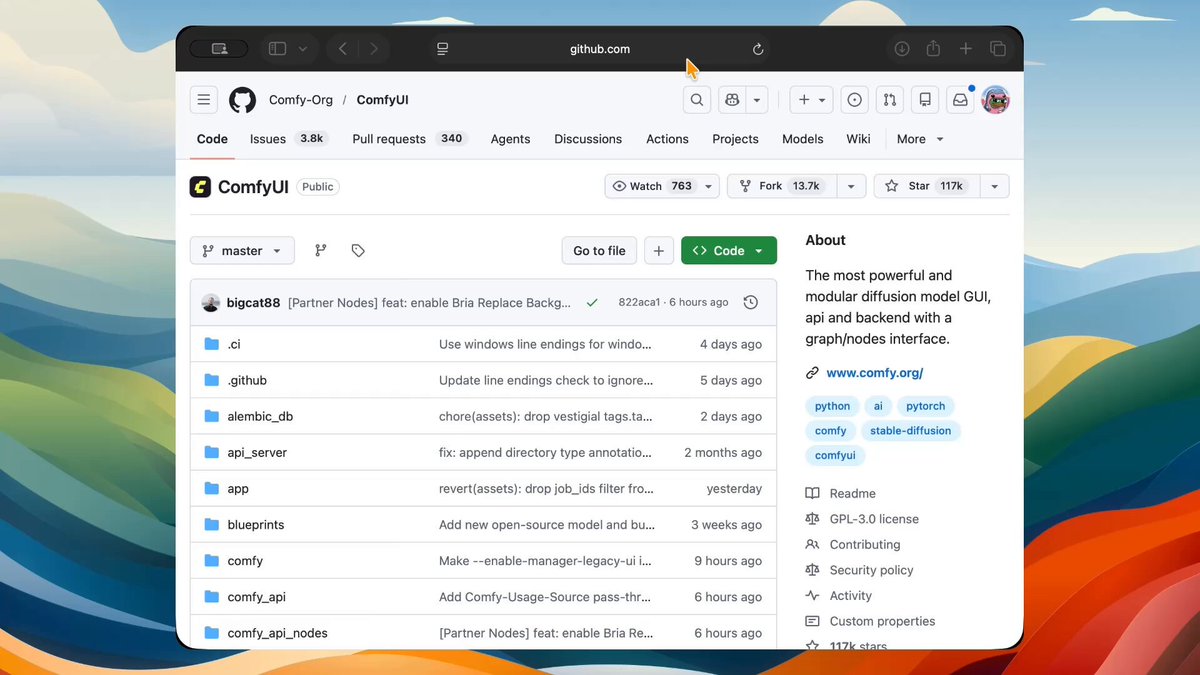
no money for grok or midjourney? this tool is for you. there's a FREE tool created by an anon dev. open-source. runs locally. 117k stars on github. it generates: > images & video > 3d models > audio > 20+ models here's how to set it up in under 5 minutes: 1️⃣download ComfyUI Desktop go to and grab the desktop app for your system. windows 10+, mac (apple silicon), or linux. it installs like any normal app, it sets up python and every dependency for you in the background. no terminal, no config files. 2️⃣open it first launch, it spins up its own environment automatically. you just wait a few seconds and you're in. you'll land on a node canvas, that's the whole interface. 3️⃣load a starter workflow top menu → Workflow → Browse Templates → Image Generation. click it. this drops a ready-made setup onto your canvas so you don't build anything from scratch. 4️⃣grab a model comfyui ships empty on purpose, the model is the brain, and you pick it. in the template, the "Load Checkpoint" node has a Download button when no model is installed. click it. it pulls one in for you (a few GB, this is the only real wait). 5️⃣install ComfyUI Manager this is the one add-on you don't skip. it lets you install models, custom nodes, and updates with a click instead of the command line. grab it from github (link in comments). it's the difference between fighting comfyui and flying in it. one honest note: an NVIDIA gpu makes this fast, apple silicon works great too, and a weak machine still runs it just slower. that's the whole setup. you now own an image, video, and 3D studio that costs you nothing per month. save this. and the next time grok or midjourney asks for your card. you won't need it. disclaimer: comfyui itself is 100% free. so are the local models (sdxl, flux, wan 2.2, ltx-2). some premium models like seedance are pay-per-use api models, only if you want top-tier quality. the free local ones cover most of what you need. (github link in the comments) follow and turn on post notification for daily AI contents.

m0h

14,542 просмотров • 2 месяцев назад

I honestly believe SpaceX is going to be the BIGGEST IPO the stock market has ever seen and I don’t think the market and many people fully understands what’s coming yet. People keep throwing around numbers like $1-1.5 trillion, which already sounds massive (Tesla’s market cap today is $1.5T). But from what I’ve researched over the years and being invested heavily in the company for many years, this number feels like the floor. As of December 2025, SpaceX was valued at ~$800 billion in an insider private share sale. The company does this every now and then to allow internal employees that have been with the company for a long time to have some liquidity since the company is private fyi. IPO plans are expected in 2026, w/ early chatter targeting $1-1.5 trillion, potentially raising $30B+, which would already make it the largest IPO in history, beating Saudi Aramco! But there is so much more that is happening underneath. Check out Starlink for example. • Revenue was about ~$15B in 2025 • Expected to grow to $22-24B in 2026 • 9M subscribers today, and I think it will double in 2026 • By 2030, Starlink could realistically be doing $50B+ per year This technology will be powering global connectivity, aviation, ships, rural areas, governments, militaries, schools, hospitals, AI backhaul, disaster zones… places fiber will never reach. Put a conservative 10-20 multiple on that, Starlink ON ITS OWN could justify a $500B-$1T valuation. Then, you add the fact that SpaceX is the ONLY company today that owns the road to space bc of cost effective reusable rockets… it changed everything. Today, SpaceX can launch payloads for ~$100 per kg to orbit, while everyone else is still at $5,000+ per kg! There is literally no competition… To dumb it down, it’s like SpaceX owning the railroads in the 1800s, with Amazon’s logistics network, and Apple’s ecosystem, and more. It’s absolutely clear… if you want to go to Space or do anything there, you have to go through SpaceX. This gives them full control over: • Satellites • Space stations • Data centers • Lunar missions • Mars missions • And whatever the future of Space is This kind of advantage deserves a MASSIVE valuation premium. Then, there are markets SpaceX hasn’t even unlocked yet and this is where valuations start to break people’s brains and spreadsheets. 1/ Point-to-point Earth travel like New York to Shanghai in under an hour. Even grabbing just 10% of long haul travel is a $ hundreds-of-billions market. 2/ Space based data centers with essentially unlimited solar power, natural cooling, no land constraints, no regulations… remember AI needs a lot of energy and Space has plenty of it. 3/ Getting to Mars and building brand new economies. Whoever controls transport controls the economy that follows. Just imagine building another Earth economy on MANY planets. This is why $1.5T feels way too low to me. At $22-24B in revenue, a tech growth multiple already gets you $1-2T. And then add the fact that SpaceX is compounding infrastructure across multiple $ trillion dollar markets… if revenue scales toward $100B+ in the next decade, which is VERY realistic btw, you’re no longer talking about a $1.5T company. You’re talking $3T, $5T, $10T+, even $100T+ over time. I see SpaceX as the gateway to the next economy for humanity. Earth is a ~$500T asset when you add up everything and SpaceX is about to expand and multiply that pie. So when people say “Bro… $1.5T IPO?! You’re crazy…” I just nod, smile, and think to myself that this is where the story is just beginning.

Teslaconomics

116,395 просмотров • 7 месяцев назад

On an average, a household in urban India generates approx. 10 gms. of MLP waste every single day. These are typically the covers of various food products ranging from tetra-pack cartons, masala powder covers, milk powder, potato chips - various other FMCG consumables. MLP (Multi - layered packaging material) are NON recyclable plastic waste. Since it cannot be recycled, this waste has NO purchase value at the scrap shops. Even rag pickers ignore it. Every other waste like thick-thin plastic, paper, metal, electric , electronic etc. have resale value ... But not this bloke. Thus the MLP inevitably ends up on landfills, contaminating the soil and eventually, during flows into a water body on its journey to the ocean. There it hurts the marine life , breaks into micro plastics under the UV light rays from the Sun. In a classical RSVP, it gets into the clouds alongwith evaporated water and returns back to earth in rain water. Through water, all of us and the animals and birds, now have micro plastics in our bodies. Many diseases like cancer, etc have been attributed to this non-organic invader inside our bodies. Now, we cannot wish away the MLPs. They do a fantastic job in keeping the potato chips fresh and crispy for 6 months. A boon to the supply-chain of FMCG products. They are available as a raw material to the food processing. FMCG industries in abundance. Also, an environment friendly commercially viable alternate material in large quantity is not seen in the distant horizon. So, along with 2 other professionals we launched our start-up to address this problem. Ui- Unified Intelligence Pvt Ltd is the execution wing of our venture. Vaspar foundation is our not-for-profit foundation that lodges the innovation center. Here we are always working on developing multiple new products and solutions aimed at creating large scale employment. At the factory MLP waste covers brought in from dry waste collection centres are shredded, washed and then loaded on a sheet making unit that presses out 8'x4' sized sheets of a variety of thickness. As the sheets cool down, we get a light weight thermoset sheet that are extremely strong and have fantastic mechanical and thermal properties. The MLP waste are from food grade plastic and thus have almost zero VOC. Also, the sheets are wonderful heat insulators. We sandwich 3 sheets of these between honeycomb structures made of the same material to create structurally integrated construction grade panels. These 100 mm thick panels are then covered on all sides with 8mm cement boards to form a skin. These are ready to paint surface, are standard construction materials with fire resistance rating of 2 hours. These panels become the walls and roof of our building. The floor is a 6" concrete layer. We build homes, terrace living space, dormitories , class rooms, auditoriums, compound walls, public toilets etc. with these panels. At the rate of 10 grams of MLP packets that we throw out as waste from our homes per day, in a single year each home generates 3,650 grams (10 grams x 365 days) So if an apartment has 10 dwelling units, in a year the residents discharge 36.50 Kgs of MLP waste into the environment Last week we installed this tiny security cabin in our Apartments in Bangalore. There are 10 flats here . This 5'x5'x8' cabin was constructed with our panels in under 6 hours. The weight of the MLP waste consumed in the panels for the cabin is 500kgs. THAT is around 14 years of #MLP waste discharged together by all the VIRGO residents - is now stored in the walls of the cabin as our panels. The cabin has a life of 50 years. We 10 families , in our apartment thus atoned for our 'plastic-guilt' to an extent. For inquiries, E Mail [email protected]

Paul Koshy

45,033 просмотров • 1 год назад

$AMD's heading to $5T MC LT| Lowest $/M tokens 🧵 The real reason why Institutions are FOMOing into AMD while other Semi stocks are underperforming ($NVDA $AVGO) Not Financial Advice! DYOR! Under Dr. Lisa Su’s leadership, AMD has transformed from a distant challenger into a formidable force in AI infrastructure, delivering the industry’s most compelling TCO story for high-volume inference. Her clear vision open ecosystems, aggressive annual roadmaps, rack-scale innovation, and relentless focus on tokens-per-dollar has positioned AMD’s Helios racks as the go-to solution for hyperscalers and AI natives struggling with exploding token costs, collapsing the cost down to $0.0003-$0.0005/M tokens. I will link various threads on this analysis to supply chain and wafer ratio if you are interested in understanding the full picture. In the last 3-4 months, explosive Agentic AI demand significantly increased Inference demand for Agentic AI models with 5-10 agents. If you are a listener of CNBC or Bloomberg, u should know enterprises and companies are complaining abt cost of token, and how it starts to spike up way too much to make sense. The fact that most data center today are run by $NVDA Chips, where the cost is way too high for Training or Inference. 1. Token cost Here are some quick comp, so u understand why $META OpenAI Anthropic $MSFT $AMZN Softbank $GOOGL and many more small to medium AI Natives are buying AMD CPUs and GPUs as much as they want, or pretty much AMD chips are sold out for the next 3-5 years. Inference (Cost per Million Tokens) ~$NVDA B200 / HGX: ~$0.02–$0.08 on optimized workloads (FP4/MXFP4, speculative decoding). Significant improvement over Hopper but still premium-priced. GB200 NVL72 rack-scale: $0.05–$0.25+ ~$AMD Helios Racks: $0.0003-$0.0005 per M tokens, dramatically lower than NVIDIA equivalents in owned infra. MI355X node-level: Up to 40% more tokens per dollar vs. competing solutions ( B200), driven by higher memory capacity (up to 288GB+ HBM), strong bandwidth, and lower acquisition costs. Training ~$NVDA Rubin Rack is estimated $0.7-$1.2/M Tokens ~$AMD Helios Rack is estimated $0.65-$1.0/M Tokens 2. Why Hyperscalers and AI Natives Are Choosing AMD Token consumption (especially Agentic) is outpacing even NVIDIA’s efficiency gains, making diversification mandatory for economic viability. Massive deals reflect this reality like $META, OpenAI, $MSFT, Softbank, $AMZN, Oracle, LumaAI, G42... Dr. Lisa Su’s Vision in Action: Since taking the helm, Su has driven AMD’s turnaround with disciplined execution, annual GPU cadence (MI300 → MI350 → MI400), full-stack software (ROCm 7), open ecosystems (UALink, OCP designs), and customer-centric rack-scale solutions like Helios. Her emphasis on “tokens per dollar” and TCO has turned AMD into the pragmatic choice for sustainable AI scaling. Power/Energy Efficiency: ~Helios Rack-level is estimated at 120kW-140kW with 50% more HBM4 where Inference and Training cost matter ~Rubin Rack-Level is estimated at 160kW-230kw AMD Helios shines in owned TCO, memory density, and energy flexibility at hyperscale. Cost to build 1GW data center 1GW Helios Rack full build is estimated $30-$35B 1GW Rubin Rack full build is estimated $45-$55B 3. Superior CPUs to pair with GPUs on massive scale 5-10-20GW Agentic AI. autonomous, multi-step workflows with orchestration, tool use, parallel agents, data movement, and enterprise integration has dramatically increased the importance of strong host CPUs alongside GPUs. This shifts the CPU-to-GPU ratio higher and makes balanced systems critical toward 1:1 to 5:1 as enterprises testing more than 5-10 agents. AMD EPYC Venice excels ~Leadership core density (up to 256 Zen 6 cores per socket) for running many agents in parallel, orchestration layers, and high-throughput control-plane tasks. ~Superior performance-per-core and power efficiency ( up to 2.1x higher perf/core and 2.26x better SPECpower vs. NVIDIA Grace in benchmarks). ~Tight integration in Helios: One Venice CPU + multiple MI450 GPUs per node, enabling efficient data feeding to GPUs ("zero-copy"), parallel execution, and full rack utilization for complex agentic loops. Hyperscalers (Meta, Microsoft, Amazon, Google, Softbank) and AI natives (OpenAI, Anthropic...) are adopting high-core EPYC at scale specifically for these agentic demands, as CPUs now handle a larger share of non-model work (orchestration, policy enforcement, tool calls). This complements AMD’s lower-cost GPUs for overall TCO wins. Conclusion: NVIDIA’s Vera Rubin cannot compete with a 2 years old EPYC Turin, but AMD under Dr. Lisa Su has engineered the lowest cost-per-million-tokens, highly competitive energy-efficient solutions, and superior CPU orchestration for agentic AI at scale with Helios. Dr. Su has championed this shift since at least 2023, foreseeing the rise of agentic workflows that demand far more orchestration, parallel agents, and balanced compute well before the industry fully embraced it. Her long-term vision of AI moving from simple prompts to always-on, multi-agent systems has driven AMD’s investments in high-core EPYC CPUs and integrated rack-scale solutions, perfectly positioning the company for today’s realities. Hyperscalers and AI natives effectively have no choice but to buy more AMD system for Agentic AI as leadership in economical, power-aware, high-volume internal + agentic use. However, due to supply constraints where Supply is far behind Demand, this makes multi-vendor reality along with in-house chips drive faster industry progress, lower overall costs, and better sustainability. Not Financial Advice! DYOR! Video source: Microsoft Build 2026

Mike

145,992 просмотров • 3 месяцев назад

Elon just confirmed how long every working human has left before the robots take over. "AI will probably increase the global economy by 20 to 30%. That's my rough estimate. Meaning, on the order of 20 to 30 trillion per year." So that's a second United States economy appearing out of thin air, EVERY single year. And Elon's whole point is that the machines produce it, not the people. He even gave us the exact date for the digital half: "AI will be able to do anything digital, anything that does not require the shaping of atoms by hand, by the end of next year." By the end of next year... And on software specifically: "It's going to be impossible for a human to compete in writing software with AI." So every coder, every analyst, every job that lives on a screen is on a 12 to 18 month timer, straight from the richest man alive. But that's only the part that runs on electricity. And this is where it gets crazy... "There will be at least a billion robots in 10 years, and each will produce at least five times the output of a human." "The billion humanoid robots will be more productive than all humans combined." A billion machines, out-working ALL 8 billion of us. And he put a deadline on it: 10 years. And he even called that estimate small. So the version where robots out-produce the entire human race is the number he treats as safe. He said he'd bet serious money on it. But how does a billion of anything get built that fast? Robots building robots building robots. It starts slow and then it goes vertical. That’s how a few thousand becomes a billion. Elon also explained his own formula for how useful a robot actually is. He said it's the quality of the AI software, times the quality of the AI chip, times the dexterity of the hands. Software and chips are the exact things Elon and Nvidia have spent a decade making exponential. The third one is the hand. And the hand is the thing robotics has been stuck on for 40 years. A machine can crush the best human alive at chess and still can't pick a strange object off a messy table the way a toddler can. Grip, pressure, touch, knowing how hard to squeeze. That problem has barely moved while everything digital went vertical. The thing he named as the hard part is the exact thing his whole 10 year number depends on. So it all comes down to one variable, and it's the slowest-moving one in the entire machine: The robot hand. The brain is basically solved. The fingers have to catch up to it this decade, at planetary scale. Now to be fair, this is also where the most money on Earth is pointed right now. Tesla and a dozen others are throwing everything at exactly this problem. Elon's software calls tend to land but his atoms calls tend to fail. Because anything physical always takes longer than anything digital. He's also made this exact robot call before with wildly different numbers, 10 billion of them by 2040 in one speech, five per human in another. So here's the real question: Do you believe robot hands get solved inside 10 years? Because that one bet is the core of Elon‘s prediction. Everything else already came true.

Ricardo

443,286 просмотров • 7 дней назад

My fellow Kenyans, Accountability is here. I bring you my review findings of Kimilili Constituency's CDF. CDF Stands for Constituency Development Fund. so please keep "development" in mind. Summary of Audit Findings for Kimilili NGCDF (2019-2022) MP for Kimilili is Didmus Barasa, CBS, PhD,MP You don't know him? I will help you. He is the MP who is a proud owner of a chopper, that he "acquired" courtesy of his decade in parliament. According to him. Watch the video attached for more details. Politicians lie. A lot. Numbers do not. The figures and conclusions below are by government auditors, who have no bias against anyone. Financial Year 2021-2022​ Key Audit Issues: Unsupported Bursary Payments Amount: Kshs. 27,175,972. KSH 27 million in claimed "bursary expenses" have no documentation/support. No listing of applicants, successful and unsuccessful beneficiaries, or receipts confirming fee payments. In other words, not a shilling of this claim of expense is supported by evidence. Ownership and Valuation of Assets Total Assets: Kshs. 27,797,600. Claims to have spent Ksh. 28 million to acquire assets such as computers, scanners, and printers. But has no records to provide to auditors for Ksh. 28 million worth of assets. Incomplete Pit Latrine Project Project Cost: Kshs. 500,000. Located at Bitunyi Primary School but remains incomplete despite full payment. Financial Year 2020-2021​ Key Audit Issues Unsupported Expenditure on Goods and Services Total Expenditure: Kshs. 9,457,931 in expenditures have no support or documentation. Not even one receipt. Unverified Transactions: Another Kshs. 2,943,085 Missing supporting documents such as contracts, invoices, and delivery notes. Unsupported School Construction Expenditures Total Disbursed: Says Kshs. 61,640,000 was disbursed, but Kshs. 32,500,000 cannot be verified through bank statements, receipts, or anything else. Ksh. 32 million cannot be traced. At all. No tendering, contracts, or payment records for 30 "claimed classrooms built" in three schools. Unverified Bursary Disbursements Total Bursary: Kshs. 24,052,272 expenditure claimed, but Kshs. 16,307,600 cannot be verified. No beneficiary lists or documentation for payments. Compliance Issues: Unverified Land Purchase for Kamukuywa Township High School. Amount Allocated: Kshs. 1,000,000 No purchase agreement, title deed, or valuation report. Irregular/Illegal ICT Hub Construction Total Cost: Kshs. 7,650,000 Paid Amount: Kshs. 7,450,000 (97%) Per auditor: "Poor workmanship, incomplete roofing, electrical work, and door fittings" Financial Year 2019-2020​ Key Audit Issues: Understated Cash and Cash Equivalents Total Reported: Kshs. 7,741,274 Stale Cheques Not Reversed or Returned: Kshs. 1,117,145. This is a Misrepresentation of financial position. Meaning that KSH 1 million is essentially stolen. Project Implementation Delays Total Projects: 350 (valued at Kshs. 719,438,140) Completed: 199 projects (Kshs. 339,208,231) Ongoing: 115 projects (Kshs. 260,497,039) Not Started: 2 projects (Kshs. 1,612,870) Per auditor: "Poor Workmanship in Construction Projects" Daraja Mungu Primary School: Kshs. 1,800,000 (walls eroding) Kamusinde Primary School: Kshs. 9,000,000 (cracked floors & walls) Khamulati Primary School: Kshs. 6,000,000 (cracks in completed classrooms) Key Takeaways Across the Three Years 1. Recurring Financial Irregularities. Consistent issues with unsupported expenditures, unverified bursary payments, and unaccounted construction funds. 2. No tangible improvements in financial reporting over three years. 3. Project Delays & Poor Quality Workmanship. Multiple incomplete projects, some fully paid for. 4. Low-quality construction affecting school infrastructure. 5. Governance & Compliance Failures. Lack of ICT governance, creating security risks. 6. Missing procurement and contract documentation. 7. Limited Oversight & Accountability. No evidence of corrective actions being taken despite recurring audit issues. 8. Unverified land purchases and construction projects raise corruption concerns. Eric Latiff Okiya Omtatah Okoiti Africa Updates Mizani254 NG-CDF William Samoei Ruto, PhD EACC Wanjiru Githiomi Sen. Ledama Olekina Dr. Miguna Miguna Wanjiru Githiomi Abdi Kikao William Samoei Ruto, PhD Senate of Kenya National Assembly KE TI-Kenya EACC John-Allan Namu Africa Uncensored BBC News Africa Al Jazeera English Bright Shitemi Didmus Barasa, CBS, PhD,MP Council of Governors Bungoma County Ke

Bonnie Mwangi, CPA, LLM, MBA

199,225 просмотров • 1 год назад

Somos Internet is a Y Combinator startup that lays 2 km of fiber every day in Colombia. They already have 27,000 subscribers — because people want what they offer: 100 Gbps internet connections for just $80/m. How is that possible? Somos is building a new kind of network from the ground up — plugging into transatlantic fiber, building his own backbone, connecting into apartments, and building custom routers that can handle that much throughput. Forrest (Forrest Heath) visited me at my office, and we talked through the technical details. I think you'll love it. HD Version at the link in my bio. Timestamps: 00:00 — Introducing Somos Internet 02:40 — Nobody Understands how Telco Networks Work 03:51 — How to Learn About Telco Anyways 04:53 — How Forrest Won Over the Local Drug Lords 06:50 — The Idea Maze: from Wifi to Fiber 09:25 — What Somos Internet is Building: Enterprise-Grade Fiber to Your Home 12:05 — How Telcos Work Today (and Their Fundamental Flaw) 15:46 — "The Core Innovation of Somos Is..." 17:40 — HOW IT WORKS: A Nested-Ring Topology, Not a Tree 21:43 — An End-to-End Service 23:57 — (Including Routers) 25:00 — How is 100 Gbps per Customer Possible? 31:08 — How They're Cheaper: Switches, not Routers 35:00 — Why Sell a Consumer Service? 39:40 — Why Doesn't Bell Labs Still Exist? (It's the MBAs.) 42:28 — Customer Service is Easier When You Build Everything Yourself 43:37 — Telcos Have Given Up on Innovating 47:46 — How to Build a Team Smart Enough to Execute This Vision 51:41 — Is This a Hard Idea to Pitch a VC? 55:58 — Could Somos Have Started in America, not Colombia? 59:23 — How Did Forrest Learn All of This From Zero? 1:02:36 — What Technical Challenges Are Next For Somos?

Christian Keil

270,646 просмотров • 1 год назад

I did something kind of insane. I just spent millions of dollars on dirt. 231 acres, 45 minutes from my house in DFW. In this post: why I bought it, how I plan to make money on it, and exactly what I paid. Here's the story. A couple years ago my buddy Jeff bought a ranch. And ever since, I've been watching his boys drive out there. Move a bulldozer around. Drive a skid steer. Bring in the cows. Build a burn pile after the storm. I admired that. I feel so strongly that having your kids learn to work hard is one of the best things you can do as a parent. And it's also one of the hardest. I think they're correlated. The harder things you do as a parent are also the most important things you do as a parent. I have four kids. I want them to have opportunities I never had, and I don't want them to be soft. A ranch is the greatest hard work simulator ever invented. Fixing fence in the July heat. Feeding cows when it's 37 degrees. Hauling hay. That will change a kid. It'll build something in a kid that no app ever will. They say business isn't personal. It is personal. This was an emotional decision first. But I'm a capitalist and an entrepreneur, so here's the financial side: DFW is adding 150 to 200,000 people a year, growing north and east. This ranch is 57 miles from downtown Dallas, in the path of growth. Worst case, my family gets a ranch that we love. Best case, the Metroplex crawls to my fence line. We started out looking at 50 to 100 acre parcels. Then I realized something: one day I'll feel stupid for not buying more land at only $10K an acre this close to Dallas. So we went bigger. The ranch wasn't distressed. I still negotiated almost $400K off the list price. Here's how: I uploaded the seller's appraisal to Claude. It caught that their comps were 60 acre parcels and mine is 231, and bigger parcels are worth much less per acre. It picked also apart the whole appraisal, caught a bunch of other stuff, and wrote my negotiation replies. My $20 a month subscription saved me hundreds of thousands of dollars. Another hack: My wife got her real estate license, represented us herself, and gave back 2% of her commission at closing. $50K off. Then I shook the seller's hand and promised this never becomes a neighborhood or a data center. That handshake is one reason he picked me over the developers. Relationships matter. So how am I gonna make money on this? A few of the plays: - The previous owner keeps ranching it on a grazing lease with me. He keeps spraying, mowing, and maintaining the fences. I collect a check. - There's a 2,400 sq ft shop on the property, already rented out. Another check. - Grass-fed beef under the 888 brand. A quarter cow sells for about $1,500 at roughly 40% net margin. And you don't need to own land to do this. ButcherBox doesn't own a single ranch. - A YouTube channel documenting everything. If it gets to a fraction of my main channel's size, it covers the entire ranch payment. Zero ongoing expenses. - Farm stays and campsites. Right next door is a tiny home community doing $17,000 a month on 20 acres. I have 231. - Maybe an Airbnb over the river with a plexiglass floor. Septic near a river is tricky, but everything's figureoutable. - I’ll use my own dozer instead of hiring one. Companies charge $200 to $500 an hour. Used dozers go for $10 to $30K and I’ll hire young guys to operate them and expand the pond for much cheaper. - Ag exemption. Property taxes on a ranch this size would be $45 to $50K a year. Mine are about $1,500. I don't plan to flip this. I'm building a barndominium out there, then eventually a house. I plan to own it for the rest of my life, and hopefully my kids and grandkids after that. What did I pay? $2.35 million. My wife and I got married on 08/08/08. So this is 888 Ranch. Three eights in a row make a great cattle brand. One last thing. If you've ever listened to the podcast, watched a video, or started a business because of something I shared: you are part of the reason I was able to buy this. I mean that. Thank you. I'm documenting all of it on a new YouTube channel, 888 Ranch Your learnings compound just like money does. Come watch mine. 888 Ranch site-- 888 Ranch Youtube --

Chris Koerner

1,988,214 просмотров • 17 дней назад

Los Angeles mayor Karen Bass is in the middle of a massive money laundering operation - A racial justice nonprofit is getting $875,000 PER UNIT from taxpayers to build 3 skyscrapers - The CEO of this nonprofit has close ties to Karen Bass - Karen Bass put this nonprofit’s CEO on the LA County Affordable Housing Solutions Board - So he’s now approving the money and getting the money Here’s the full breakdown: The Weingart Center is a Skid Row nonprofit that claims to advance “racial, social, and economic justice” by helping the homeless. They manage multiple properties The CEO is Kevin Murray and he makes $400,000 per year In 2024, LA Mayor Karen Bass appointed Kevin Murray to the LA County Affordable Housing Solutions Board. The board that oversees homeless funding So the nonprofit that gets the money is now deciding who gets the money and how much (Huge conflict of interest) Next, Mayor Karen Bass appointed Ben Rosen, Director of Real Estate Development, to the same board at Kevin Murray’s request (So now the homeless nonprofit CEO is telling mayor Karen Bass who else to appoint to be in charge of giving our homeless money, and she’s doing it) Weingart raked in $100 million in just one year (It pays to be close with Karen Bass) A big chunk of that money comes from California’s Homekey Initiative: California has dumped nearly $4 billion into Homekey Initiative but: - 71% of properties vacant - Multiple fraud cases - One developer charged $2M on his personal Amex for things like Coachella tickets But instead of shutting it down, they expanded it with Homekey Plus. Naturally the nonprofit friend of Karen Bass The Weingart Center wants some of that new money Weingart wanted $37 million to turn a 122-room hotel into permanent housing. They’d pocket $2+ million in developer fees and got a sweet deal with ongoing subsidies Here’s where some fraud comes in The property was valued at just $10M - 21M, not the $30M they wanted. They wanted to pocket $10 million dollars of taxpayer money Luckily public backlash killed the deal, but that’s not where it ends The Weingart Center tried to convert a Cheviot Hills nursing home using $26 million in Homekey funds. Mayor Bass helped personally recommend it. The developer? Stephen Taylor who’s now facing 9 felony charges for altering bank statements and lying to lenders while trying to flip the property for double the price. Weingart signed the deal with a confidentiality clause. The Weingart Center has repeatedly failed federal audit requirements… yet even after still, they still got a $9 million no-bid contract from Mayor Karen Bass (She’s clearly involved in the fraud) Now The Weingart Center is likely getting $865,000 per apartment unit to build 3 skyscrapers, all paid for by taxpayers Facilitated by Karen Bass The money laundering never ends, LA has been doing this a lot lately, here’s a few more - Restoration apartments: Bought in 2020 via Homekey for $5.3 million to create 80 units of recovery housing for the homeless. 6 years later it’s completely abandoned - Shangri-La Industries got 26 million in Homekey grants, he bought luxury items, cars and trips - In South LA a shelter operator with a $2.3 million city contract claimed 88 beds in court filings. A spot check revealed only 44 actual beds, the rest were empty platforms The fraud in California never stops

Wall Street Apes

222,210 просмотров • 3 месяцев назад

I've never heard Elon Musk be so bullish on Tesla ⚡️ here's my video analysis of the $TSLA Q4 2024 earnings call: -Robotaxi launch in Austin, June 2025 -California & other states launch robotaxi late 2025 -Cybercab in 2026 -Optimus V1 in 2025, 1K/month production line -Optimus V2 in 2026, 10K/month production line -2026 good year for Tesla, 2027/28 insanely good & more!! Timestamps- 0:00 Intro 0:44 Elon Opening Remarks 13:29 SAY Retail Questions 22:37 Analyst Questions 25:04 Gali Final Thoughts/Rant also here are my notes I typed during the conference call if you're interested! (may be errors) Tesla Q4 2024 Earnings Call Notes INTRO- ELON OPENING REMARKS -Q4 set record, delivered cars at rate of almost 2M cars/year -Model Y best-selling vehicle of any kind on earth (elon focused and talking quickly) -10Xing on autonomy, not doubling -many investments made this year that will bear immense fruit in the future, for AI -see a path for Tesla to the worlds most valuable company by far, worth more than the next 5 companies combined, difficult but achievable path -overwhelmingly due to autonomous vehicles and autonomous robots -setting up for an epic 2026, and ridiculously good 2027 and 2028 -meeting FSD now is like meeting a toddler -human intuition is linear, we’re seeing exponential progress -#1 recommendation is try it -typical passenger car has 10 hours of use out of 168, when its autonomous, itll be used for 55 hours a week … can deliver packages in the middle of thenight, or supply restaurants, all hours of the day or night. 5X increase in utility -more on self driving, continued improvements in safety numbers, much safer to use FSD -V14 will be another big step from V13 -launched CORTEX training cluster at Giga Austin, big step for FSD, continue to invest in training needs -Optimus training needs are about 10X what’s needed for the car -cost of training is dropping dramatically over time -Optimus has potential to be north of $10T in revenue, can put a lot training compute into that situation, even pumping $500B into it would be a good deal -future very different from the past, incredible inflection point in human history -proof is in the pudding -launching in June this year in Austin, already have cars moving autonomously in Fremont, thousands of cars per day driving, soon in Austin then elsewhere in the world -toe in the water at first to make sure everything is cool, but we have a general solution for autonomy , then put a few more toes, then a foot. Safety of the general public and those in the car as the top priority -with regard to Optimus, making insane revenue projections that sound insane, i realize that. But i think they will prove to be accurate -several thousand bots made this year, they will be doing useful things by the end of this year, im confidence, production design one at the tesla factories, then will learn for production design two -ramp optimus production faster than anything has ever launched, doesn’t take very many years before we’er making 100M of these things per year , 500% growth per year -tried using all these suppliers to get it to build Optimus, but nothing worked, had to build it internally from first principles, the hand is increibdle -long term Optimus will be the value of the company -back to Energy,/earth, -energy storage is a big deal, becoming more important, enables far greater energy output to the grid than is currently possible. -grid has no storage, designed for peak storage, lots of waste -once you have grid energy storage, the potential of the grid is unlocked, at least double -this will drive demand of battery packs as to as much as we can possibly make -shanghai factory starting operation, starting another factory -cant shoot our selves in the foot, battery capacity can only go into storage or mobility, so always making that tradeoff -demand for total Gigawatt hours for batteries, transportation or stationary will grow in a very big way over time 2025 a pivotal year for tesla, launch of full self driving, biggest year in tesla history, maybe even bigger than first car or model s, 3 or y … probably most important year in tesla’s history I don’t even know who is in 2nd place in real world AI, would need a telescope to see them SAY QUESTIONS -FSD Unsupervised launched in California this year as well -most likely release it in many regions of the US by the end of this year -40K people day everyday no mention, some scrapes a shin with autonomous car its headlines news -need to use insane amounts of caution -discussions about licensing FSD? Yes -best way to know to work with us, bbuy a car and take it apart -only worth very high volume cars/production partners -tesla engineering very focused on getting it to roll out for tesla first -soon will be obvious that if you don’t have FSD you’re dead as an OEM -is Optimus design locked? -Optimus is not design locked, constantly iterating, best robotics engineers in the world, and other ingredients, battery pack, charging, great electronics, great communications, great connectivity, real world AI, then you need to scale that production to real world levels -prototypes are easy production is hard -thijs year close loop with using optimus internally at tesla, would could obviously use a few thousand robots for the most boring annoying tasks at the company -with production version 2, launches sometime next year, would like beginning, might be middle though, -production line will be doing 10K units per month capacity for v2, first line designing is for roughly 1,000 units per month, then next line will be for 100,000 units per month -could start delivering them late next year, will go so fast, will ramp like crazy, demand will not be a problem, even at a high price, once were above 1M units per year, production costs of optimus will be less than $20,000 -if you compare complexity of optimus to complexity of a car, its much less than a car -price of optimus will be set buy market demand -Semi ramping next year, TCO no brainer, like optimus, will be massive demand, will meaningfully contribute to tesla’s revenue at scale -tesla semi with autonomy, is incredibly valuable -we actually have a shortage of truck drivers here in the US -will HW3 owners need a hardware update, got 12.6 which is like a baby v13, have’t given up on it, releases will trail HW4 releases … “honest answer” is were going to have to upgrade for those who have bought full self driving, will be painful and difficult and we’ll get it done “Happy not many people bought FSD” -solar roof, given up on ramping it? -lots of customer interest despite premium, making easier to install, focused on growth through certified installers, many been installing for many years -supply product to the roofing industry -it’s a premium product like S/X -combined with Tesla powerwall you can be self sufficient for several days ANALYST QUETIONS -robotaxis in Austin and several other cities this year, and next year all over america -america innovates, europe regulates, to release FSD in europe, have to go through massive paperwork through netherlands, then presents to EU in may, some big country committee, nothing we can do to make it happen sooner. -can’t do training in china with video training, publicly available videos in china are being run through the tesla system to be used for training, bus lanes are complicated and a big challenge -tesla can keep manufacturing even if geopolitical tensions rise to very high levels -Pierre question on June in Austin, -can i try unsupervised myself, or will it be the Tesla fleet? -it will be the Tesla fleet testing it, that’s the toe in the water, scrutinizing everything -autonomous ride hailing for money in june -probably next year for you to put your car on network -trump removing EV incentives? -all transport will go electric, can’t be stopped, even planes, will be like stopping the steam engine or combustion engine -only thing holding back EVs was range, and thats a solved problem -right now solving battery production, not demand, big battery retooling for model y coming up, short term impact on output

Gali

79,010 просмотров • 1 год назад