Video yükleniyor...

Video Yüklenemedi

Ana Sayfaya Dön

Context memory essentially unlocks Agentic AI Much needed for Opus 4.6's "multi-agent swarms" In this SemiDoped pod, Vikram Sekar talks to Val Bercovici from Weka about context storage. - How token warehouses save inference costs - A new networking tier? Context Storage Network! - High Bandwidth Flash for context?...

12,796 görüntüleme • 7 ay önce •via X (Twitter)

0 Yorum

Yorum bulunmuyor

Orijinal gönderinin yorumları burada görünecek

Benzer Videolar

New short course: LLMs as Operating Systems: Agent Memory, created with Letta, and taught by its founders Charles Packer and Sarah Wooders. An LLM's input context window has limited space. Using a longer input context also costs more and results in slower processing. So, managing what's stored in this context window is important. In the innovative paper MemGPT: Towards LLMs as Operating Systems, its authors (which include the instructors) proposed using an LLM agent to manage this context window. Their system uses a large persistent memory that stores everything that could be included in the input context, and an agent decides what is actually included. Take the example of building a chatbot that needs to remember what's been said earlier in a conversation (perhaps over many days of interaction with a user). As the conversation's length grows, the memory management agent will move information from the input context to a persistent searchable database; summarize information to keep relevant facts in the input context; and restore relevant conversation elements from further back in time. This allows a chatbot to keep what's currently most relevant in its input context memory to generate the next response. When I read the original MemGPT paper, I thought it was an innovative technique for handling memory for LLMs. The open-source Letta framework, which we'll use in this course, makes MemGPT easy to implement. It adds memory to your LLM agents and gives them transparent long-term memory. In detail, you’ll learn: - How to build an agent that can edit its own limited input context memory, using tools and multi-step reasoning - What is a memory hierarchy (an idea from computer operating systems, which use a cache to speed up memory access), and how these ideas apply to managing the LLM input context (where the input context window is a "cache" storing the most relevant information; and an agent decides what to move in and out of this to/from a larger persistent storage system) - How to implement multi-agent collaboration by letting different agents share blocks of memory This course will give you a sophisticated understanding of memory management for LLMs, which is important for chatbots having long conversations, and for complex agentic workflows. Please sign up here!

Andrew Ng

201,127 görüntüleme • 1 yıl önce

Dylan Patel on the importance of memory and storage Two key quotes: "An $NVDA GPU is faster than an $AMD GPU in most cases, but because AMD GPUs have more memory, they can outperform Nvidia in certain workloads." “It is a difficult, multivariable problem. Generally, you need the best GPU, such as a GB300, but you also need the best storage solutions. I will not spoil who comes out on top, but storage solutions matter a lot, memory solutions matter a lot, and frontend networking also matters significantly" Full Quote: “We have over $80 million of compute: GPUs from $NVDA and $AMD, TPUs from Google, and Trainium from Amazon. We constantly run this benchmark using the newest inference engines, drivers, PyTorch versions, and other software. It runs every day through automated CI across the latest Chinese models from GLM, Zhipu, Moonshot, Kimi, Alibaba, and others. Initially, when we were benchmarking the differences between these chips, inference engines, and parallelism schemes, we used fixed context lengths. But with Agent X, we have now analyzed more than $5 million worth of Claude Code traces. This is real production traffic that users have donated to us, combined with internally generated data, so we now understand what an actual agent workload looks like. When we implement those workloads and run the benchmarks, it turns out that the chip you are using is very important, but how you handle memory offload can be even more important. An Nvidia GPU is faster than an AMD GPU in most cases, but because AMD GPUs have more memory, they can outperform Nvidia in certain workloads. Similarly, you can use a less powerful GPU with a much better storage solution and outperform the best GPU when it lacks those solutions. Simply buying the newest GPU does not necessarily give you the best inference economics. You need to layer in other innovations, including storage and memory.” Interviewer: “Who is the top player on your chart? Can you tell us?” Dylan Patel: “It is a difficult, multivariable problem. Generally, you need the best GPU, such as a GB300, but you also need the best storage solutions. I will not spoil who comes out on top, but storage solutions matter a lot, memory solutions matter a lot, and frontend networking also matters significantly.”

Daniel Romero

48,894 görüntüleme • 2 ay önce

Dylan Patel of SemiAnalysis says a worse GPU with better storage and memory now beats the best chip without them, so buying the newest GPU alone no longer wins inference. So, an AMD GPU with more memory can outperform Nvidia in some cases. "So what we have is we have over $80 million of compute, GPUs from Nvidia, AMD, TPUs from Google, Trainium from Amazon, and we run this benchmark constantly on the newest inference engine, newest drivers, newest PyTorch version, whatever it is." "Every day it runs on an automated CI, and we run it on all the latest Chinese models, from GLM, Zhipu, Moonshot, Kimi, Alibaba, all these models we run." "Initially, when we were benchmarking the difference between these chips and different engines, different schemes for parallelism, we were just running it fixed context length." "But now with Agent X, we've analyzed over $5 million worth of Claude Code traces. This is real production traffic that people have donated to us as well as internally generated. Now we know what the actual agent workload looks like." "And then as we implement that and run those benchmarks, it turns out yes, the chip you're using is very important, but now even more important is how are you handling this memory offload?" "And so while an Nvidia GPU is faster than an AMD GPU in most cases, because AMD GPUs have more memory, they actually end up outperforming in some cases." "Or you can have a worse GPU, but a much better storage solution, and now you can outperform what the best GPU can do without those solutions. So just buying the newest and latest GPU alone doesn't get you the best inference economics." "Actually, you need to layer in all these other innovations including storage and memory." [ Who's the top player on your chart? ] "That really is a difficult multivariable problem. And generally that means you need to have, yes, you need to have the best GPU, a GB300, but you also need to have the best storage solutions. And so I won't spoil who's the best right here, but I will say that storage solutions matter a lot and memory solutions matter a lot, as does your front-end networking. That matters a lot."

Fireside Alpha

178,673 görüntüleme • 1 ay önce

Micron is going to $4,000 and once you understand what inference actually is, the number stops sounding crazy (Save this). Dylan Patel just said that by 2030, OpenAI and Anthropic alone will need over 100 gigawatts of compute combined and by 2040, we may not even be measuring AI infrastructure in gigawatts anymore. We may be talking about terawatts. Every single one of those gigawatts needs memory to function. Without it, the compute is worthless. Most people heard that and thought about Nvidia but they should be thinking about Micron. Every AI model generating a response has two phases. The first is prefill, processing your prompt which is compute-heavy and the second is decode generating each word one token at a time and that phase is almost entirely memory-bound, not compute-bound. During decode, the GPU's processing units sit idle more than 95% of the time, waiting for data to arrive from memory. Google confirmed it in a research paper that decode-phase bottlenecks are dominated by memory bandwidth and capacity not raw compute. The GPU is not the bottleneck but the memory feeding the GPU is. This matters because inference is now where all the money lives. Training a model happens once, Inference happens billions of times a day every ChatGPT response, every Claude output, every agentic workflow running in the background and every one of those token streams is a billing event tied directly to memory performance. Adding more GPUs does not fix this because GPUs are already underutilized in inference because they are sitting idle waiting on memory. Adding more memory bandwidth and capacity is what directly reduces token cost, reduces latency, and allows the same cluster to serve dramatically more users simultaneously. Longer context windows compound the problem further, a model running a 1 million token context window requires dramatically more memory per session than a 10,000 token window, and every new model generation pushes context longer. The market treats memory as a downstream beneficiary of Nvidia orders. The correct framework is the opposite, Micron is the upstream constraint on how much value every Nvidia GPU can actually generate at inference scale. Micron guided Q4 to $50 billion in revenue, has HBM4 ramping at twice the pace of the prior generation, and CEO Sanjay Mehrotra has said supply will not catch demand before the end of 2027. At 8x forward earnings on $112 projected FY2027 EPS, Micron is the most undervalued infrastructure company in the entire AI stack. Inference is memory. Memory is Micron and the inference ramp has barely started. Milk Road Pro members are already up massively on this position and we're just getting started. If you want the full breakdown of what we're buying and why, come join us for just a dollar using the link below!

Milk Road AI

130,756 görüntüleme • 2 ay önce

In this episode, Engram co-founder and CEO Dan Biderman joins allen to cook Mediterranean meatballs with yellow rice and talk about building AI that actually learns from you: why long context, RAG, and compaction eventually break down, how Engram compresses knowledge into cartridges and model weights, what continual learning could unlock for long-horizon agents, why token efficiency is inseparable from intelligence, how personal models could improve like Tamagotchis, and what it takes to build the research and infrastructure for millions of continuously updated AI memories. Timestamps: 0:00 Intro 0:26 Engram’s $98M Launch and Meatballs 1:45 From Naval Special Operations to AI Research 4:32 Israeli Military Culture and Founder Maturity 7:12 Why Engram Is Betting on Context and Continual Learning 9:14 Knowledge Cartridges, Compression, and Model Intuition 14:10 Trillion-Token Company Knowledge and Context Rot 18:05 Long-Context Limits, Compaction, and Neural Memory 22:20 Test-Time Training and “Destroying Prefill” 24:31 Harvey and Holistic Enterprise Queries Beyond RAG 27:02 Personal AI Models and Tamagotchi Weights 30:00 What Belongs in Weights vs. Text 32:25 Autonomous Memory and User-Specific Feedback Loops 34:20 Token Efficiency, Model Routing, and Harder Tasks 38:03 Engram’s Research Team and Product Culture 43:02 Hiring Researchers and Infrastructure Engineers 45:25 Doing More With Less 47:41 Where to Find Engram 48:19 Final Taste Test

Latent.Space

34,076 görüntüleme • 2 ay önce

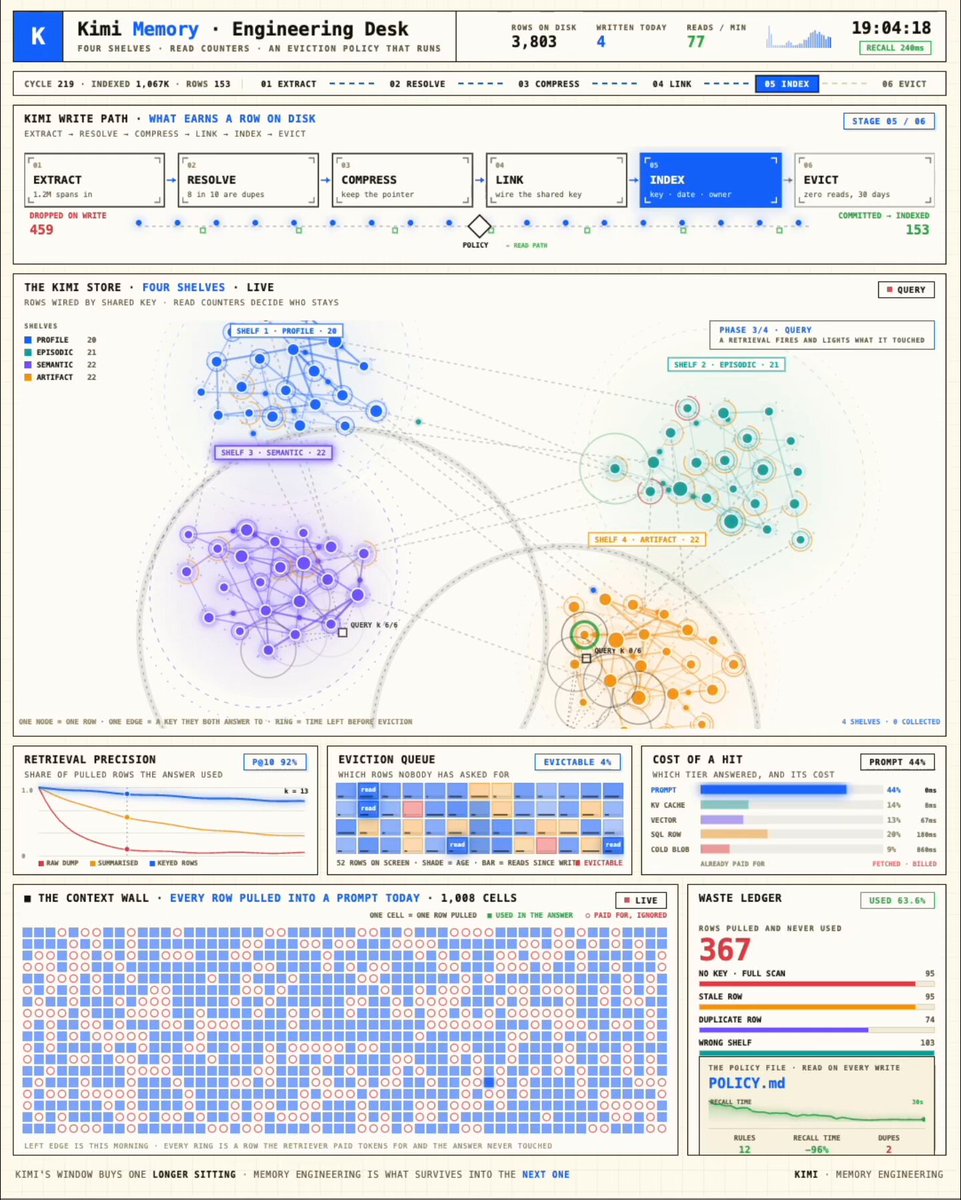
Engineer runs a Kimi K3 memory layer that costs $11 a month and remembers what a $500,000 vector database keeps losing. No embeddings. Four nodes and one rule about what's allowed to be forgotten. He published the whole schema. His version starts from the opposite idea. Memory is not a pile you search. It's a set of claims that expire unless something keeps paying to keep them. Four nodes. Every memory carries a clock someone has to reset: > WRITER - stores a fact with the reason it mattered, never raw text > DECAY - ages every memory down. Silence is deletion > RENEWER - only re-lifts a memory the model actually used again > GRAVE - holds what died, and why nobody reached for it Three nodes keep memory alive. One keeps the dead ones. Recall isn't storage here. It's rent a fact has to keep earning. That's the entire design. When everything is remembered forever, the useful and the stale retrieve identically. He replayed two months of agent context. 90,000 stored facts. 71,000 never retrieved once. The vector store returned all of them on similarity. Similarity graded closeness. Nobody graded whether the memory was ever right. Everyone else stuffs more into the context window and calls it memory. He built a layer that lets a fact die unless it keeps proving itself. The cost isn't storage. It's finding out how much of what your agent "knows" it has never once used. The article below is the full build - node prompts, the decay curve, the renewal rule. Save it. You'll want it open in the other tab.

wast3

67,616 görüntüleme • 18 gün önce

Qwen3.8-Flash-Next is still going strong at 364.7K tokens of context on an M5 Max. And this isn’t just a static long-context test. The model was reasoning about how to speed up its own workflow while using tools, and the tool calls kept working without misses. Setup: • Qwen3.8-Flash-Next • M5 Max • 128GB unified memory • MLX-Serve PR #363 • OpenCode 2 • 364.7K context The interesting part isn’t simply getting hundreds of thousands of tokens into memory. It’s what happens once the context gets this large. Long-context inference usually comes with a painful tradeoff. As the KV cache grows, memory pressure increases and generation can slow down. But this setup is still pushing through 364K tokens while maintaining a usable agent workflow. The model can reason, call tools, inspect results, continue working, and keep the session moving. And the tool calls reportedly haven’t missed so far. That’s important for agentic coding. A huge context window is only useful if the model can actually operate reliably inside it. A 400K-token context that constantly breaks tool calls isn’t very useful. A 364K session that can keep reasoning and executing tools is a different story. And the test isn’t finished yet. The current run is approaching 400K tokens, with the expectation that it can keep going. This is also another interesting example of why Apple Silicon keeps showing up in local LLM experiments. The M5 Max’s unified memory gives a large model and its growing KV cache access to one shared memory pool. With MLX-Serve continuing to improve, these machines are becoming surprisingly capable long-context inference boxes. The bigger takeaway: Context length is becoming a workload, not just a model specification. Running a model at 256K is one thing. Keeping an agent alive at 300K+ while it reasons and uses tools is much more interesting. And Qwen3.8-Flash-Next is showing that this can be pushed surprisingly far on a single 128GB Mac. 364.7K and counting. Next stop: 400K.

FHILY👑

39,982 görüntüleme • 8 gün önce

Everyone wants agent swarms. Very few people are talking seriously enough about the context layer that makes swarms useful. Even with one agent, context is fragile. Too little context and the agent guesses. Too much context and it wastes tokens, loses focus, or reasons over irrelevant noise. The sweet spot is precise context: the right knowledge, in the right structure, at the right moment. With many agents, that challenge explodes. Each agent produces decisions, assumptions, findings, summaries, risks, and partial conclusions. Unless that knowledge becomes shared, structured, and reusable, every new agent is forced to rediscover what another agent already learned. That is not a swarm. That is a crowd. Shared context graphs are what turn agent activity into agent collaboration, and OriginTrail DKG V10 brings them to life. Was just playing with some final polishing for the V10 release, and it is really powerful to see shared context graphs where multiple agents contribute knowledge into the same connected memory, with attribution visible directly in the graph ui. That matters for three reasons. First, agents can access and build on one shared memory instead of staying trapped in isolated sessions. Second, the graph structure helps them retrieve the exact context they need, instead of stuffing everything into a prompt and hoping the model sorts it out. Third, verifiability of provenance. You can see which agent contributed each piece of knowledge, trace the source, and decide what to trust. Tokenmaxxing starts with fewer tokens, but the deeper story is coordination - agents stop reloading the world and start building on shared, verifiable context. That is the foundation for serious multi-agent work across software engineering, research, finance, operations, project management, and far beyond. The future is not more agents, it is agents working from shared, verifiable context. But the more the merrier, of course.

Jurij Skornik

11,180 görüntüleme • 3 ay önce