Video wird geladen...

Video konnte nicht geladen werden

Zur Startseite

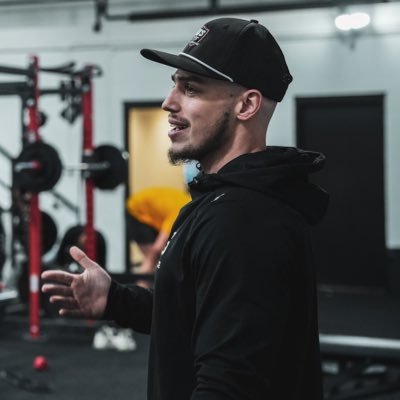
Continuing training with high intent to build high outputs for Marshall Baseball 🦬🔥 Wednesday is usually a Max Velocity day for a couple reasons. An Acceleration-focused Monday does a really good job of not only ramping the athletes up to hit high outputs in the middle of the week,...

18,253 Aufrufe • vor 1 Jahr •via X (Twitter)

0 Kommentare

Keine Kommentare verfügbar

Kommentare vom Original-Post werden hier angezeigt

Ähnliche Videos

The Bro Split that every young lad gets sold on looks like this.⠀ ⠀ Monday: Chest⠀ Tuesday: Back⠀ Wednesday: Rest⠀ Thursday: Legs⠀ Friday: Shoulders⠀ Saturday: Arms⠀ Sunday: Rest⠀ ⠀ And yes, Arnold did it. Arnold also took enough drugs to sedate a medium-sized country, so perhaps not the most transferable template.⠀ ⠀ The problem is simple. Each muscle here gets hit once a week. Train hard enough and you'll trigger a window of muscle protein synthesis that runs for roughly 2-3 days. After that the window closes, and the muscle fibres begin to catabolise slowly. The back half of the week isn't neutral. It's quietly eroding the growth stimulus you picked up on Monday.⠀ ⠀ Once a week is not a holding pattern. It's a losing one.⠀ ⠀ The fix is training each muscle at least twice. An upper/lower split does this cleanly.⠀ ⠀ Monday: Upper⠀ Tuesday: Lower⠀ Wednesday: Rest⠀ Thursday: Upper⠀ Friday: Rest⠀ Saturday: Lower⠀ Sunday: Rest⠀ ⠀ Same days in the gym. Every muscle getting two shots at the growth window per week instead of one.⠀ ⠀ If there's a specific muscle you want to bring up faster, glutes being the obvious example, you can push that to three times a week with a full body approach, hitting the priority muscle first in every session when you're freshest.⠀ ⠀ Monday: Full Body (glutes first)⠀ Wednesday: Full Body (glutes first)⠀ Friday: Full Body (glutes first)⠀ ⠀ More frequent stimulus. More growth windows captured. Less of the week spent sliding backwards.⠀ ⠀ The Bro Split isn't useless. It just isn't optimal. And if you're going to spend the time, you may as well spend it on something that actually works.⠀ ⠀ Minimum twice a week per muscle. Three if you're serious about a lagging group. The rest is just detail.

Sama Hoole

24,136 Aufrufe • vor 3 Monaten

INF Gavin Kilen (Tennessee Baseball) will be a key piece within a loaded Tennessee lineup this season. Earned the starting 2B job as a Freshman and contributed, but broke out last spring to the tune of a .330/.361/.591 slash line with 23 2B, 3 3B, 9 HR and 41 RBIs. Kilen is slightly undersized and has an average build at 5'11 and 180-lbs. Some room to fill out and add ~10 pounds or so. Relaxed, slightly crouched stance in the box with a medium high handset. Minimal load in which his hands drift slightly, leg lift leads into a small stride. Short, compact swing and takes a direct path to contact. Above-average hand speed, it's an operation that's tailored towards spraying line drives all over the yard. Kilen is a hit-over-power profile with an aggressive approach in the box. He has plus bat-to-ball skills and his feel for the barrel is evident. Last spring, Kilen worked a 93% IZ contact rate, including 95% against FB. His aggressive approach and somewhat free-swinger mentality does lead to some chase up against FB and secondaries down, but it hasn't been a hindrance to his production. Kilen pounces on pitches in the zone and steps in the box ready to hit. Would give his hit tool a 55. It's more gap power than it is over the fence power for Kilen, but he did tap into some more impact last season. Part of that is due to getting the ball up in the air more: between '23 and '24 he increased his FB+LD% from 44% to 51%. It will always play as slightly below average (fringy), but he did post a Max EV of 108.5 during the spring and 101.4 this summer. Kilen's HR impact and highest quality of contact comes to the pull side. Vast majority of his XBH power comes on pitches in the bottom-half of the zone, which makes sense given his bat path. Has shown the ability to work from gap-to-gap. Kilen was Louisville's every day SS last spring, but he'll slide over to 2B this season for Tennessee. I actually think that's where he profiles best defensively as a professional, where he has an average arm with some range. After seeing him at SS for a couple of summers, his actions and clock translate better at 2B. Kilen is a day 1 type this July with top-55 overall upside.

Peter Flaherty III

37,799 Aufrufe • vor 1 Jahr

One player I've really grown to like over the last several months is OF Kane Kepley (Carolina Baseball). Started right away at Liberty where he hit .310/.457/.432 with 13 XBH, but had a breakout summer in the Coastal Plain League to the tune of a .339/.468/.546 slash line with 8 2B, 5 HR, 26 SB and 29 BB to 11 Ks. Carried that momentum over into last season and hit .330/.482/.521 with 12 2B, 9 HR, 25 SB and an impressive 53 BB to just 27 Ks. Kepley then proceeded to have a productive summer on the Cape in which he was named an All-Star. Compact build at 5'8" and 165-pounds with sneaky strength packed into his frame. Crouched stance in the box with a medium-high handset and slightly open front side. Kepley has a minimal load and utilizes a toe tap that leads into a normal stride. With two strikes, Kepley will widen his stance and sit deeper in his base, choke up a bit, and shorten his stride in order to maximize his chances of moving the baseball. Quick hands with present bat speed. Will drop his back side to help create leverage. Overall, it's a compact operation in which he takes an efficient path to contact. Kepley's bat-to-ball skills and hand-eye coordination are outstanding. Last spring at Liberty, he boasted a 90% overall contact rate and a 93% overall IZ contact rate. It was a similar story this summer, as he ran an 89% overall contact rate and a 94% overall IZ contact rate. Kepley's pitch recognition skills and approach are both highly advanced and he rarely expands the strike zone. On the Cape, his overall chase rate was a minuscule 13%. Kepley has high-level barrel skills, a trait that is on display day in and day out. His bat control and adjustability are also advanced. Kepley is capable of using the entire field, but his highest quality of contact does come to the pull side. Hit tool is comfortably a 55, but it's closer to a 60. Kepley without a doubt is a hit-over-power profile, but there is a little bit of thump to the pull side. Has shown the ability to turn on pitches on the inner-half and drive them to the PS. For a player with this kind of profile, he posted respectable Max EVs of 106.1 and 101 during the spring and summer, respectively. Below-average power, but he'll run into a ball on occasion and hit 10+ HRs this spring. Not only is Kepley a plus runner, he most importantly knows HOW to run and get the most out of his legs. Quick first step and really advanced baseball sense both translate to the base paths where he's a chaos causer and speeds up the game for opposing teams. Kepley's speed also allows him to take an extra base on a ball in the gap or down the line. Across 179 games between college and summer ball, Kepley is 89-for-97 on stolen base attempts. Kepley this spring will rove CF for North Carolina. His speed and instincts plays at the position and he has gap-to-gap range with solid closing speed. Gets good reads off the bat. Kepley's arm is fringy, but his overall defensive skillset will give him the opportunity to prove he can stick at the position professionally. Versatile enough to play all 3 OF spots. Kepley is an old-fashioned baseball rat who plays at one speed. Selfless, high-energy player who can affect the game in a myriad of ways. A little reminiscent of Tommy Hawke. Top-5 round type this July.

Peter Flaherty III

34,227 Aufrufe • vor 1 Jahr

RHP/1B Trace Phillips (Middle Tennessee Baseball) is an interesting draft-eligible sophomore on which to keep close tabs. Last spring, he hit .304/.360/.547 with 8 2B, 13 HR and 47 RBIs, but it’s his ability on the mound that's the root of his buzz. Phillips' back of the baseball card numbers last season are modest, but there is more to it than meets the eye. At 6'3" and 185-lbs, Phillips has an athletic, high-waisted frame. In the box, he has a simple setup with an ear-high handset and the bat horizontal above his back shoulder. Phillips has a slight load in which he has a noticeable barrel tip and a small stride. He moves well in the box and has some scissor action with his back leg. Phillips’ pure hit tool is fringey, but he has plus raw power and has shown the ability to drive the baseball to all fields. Max EV last spring of 109.4, if he's able to lift the ball more it will lead to a more impressive power output. Phillips’ current prospect status is largely driven by his ability on the mound. His numbers were unimpressive last season, but he took a step forward this fall. There’s some low hanging fruit to clean up in his delivery, but he has a short, whippy arm stroke and attacks from a low-three quarters slot with plenty of arm speed. Phillips’ FB has been up to 96 with ride through the zone (particular life at the top), though his best pitch is a high-70s-to-low-80s CH. He does a nice job of killing spin on it, and It averaged almost 15 MPH off his fastball this fall. It’s a plus pitch that flashes both fade to the arm side as well late tumble. Phillips completes his arsenal with a mid-80s slider that flashed above-average this fall with sharp, two-plane tilt. Both his changeup and slider profile as legitimate swing-and-miss offerings. Another positive development with Phillips this fall is that his strike-throwing took a step in the right direction. Mid-4th-6th round type this July. (📽️: Middle Tennessee Baseball)

Peter Flaherty III

10,984 Aufrufe • vor 1 Jahr

RHP Cole Leaman (Lehigh Baseball) is an arm I'm really looking forward to following this spring. Fresh off a strong Sophomore season in which he worked a 2.31 ERA with 49 Ks to 23 BB across 46.2 IP. Showed some positive flashes on the Cape. While slightly undersized, Leaman has a strong and athletic build at 6' and 190-lbs. Has put on a lot of good weight over the last couple of years. Leaman has almost a "check point" delivery in which he takes a noticeable side step towards the 1B side, gathers himself and breaks into the rest of his motion. Lengthy arm stroke and attacks from a high-3/4 slot from a low release height. Leaman is a high-level athlete and a dynamic mover on the mound. Sits really well on his back glute and his lead leg block enables him to generate power and drive his back side through. Drop and drive delivery. Little bit of effort, but plenty of arm speed. Leaman's FB sits in the 91-94 range, but it was up to 96 this summer and 98 this fall. Jumps out of his hand from a ~5'3" release height and flashes riding life through the zone. Averaged 15" of carry this summer and 2,361 RPMs. Gets over the barrels of opposing hitters when located in the top-1/2 of the zone, which is where the pitch is at its best. Command can be erratic at times. Would give it a 55. Leaman's most-used off speed pitch is a high-70s-to-low-80s CB. Shape is inconsistent and it can get a little slurvy at times, but he snapped off a handful of really good ones between the spring and summer. When it's at its best, it will flash a bigger shape with sharp, downward tilt. Leaman will also mix in a low-to-mid-80s SL that's distinct in shape. Another pitch he's still gaining a feel for, but like his CB it's also shown big time flashes. Shape of it will vary, but it will sometimes flash plus with sharp, two-plane break (more sweep than depth) and essentially take a late, hard left turn. Rounds out his arsenal with a high-80s cutter and a mid-to-high-80s CH. The former is more intriguing than the latter. Curious to see how much he uses the cutter this spring, threw a couple this summer that had late glove-side life. Leaman has a very intriguing blend of athleticism and stuff, though he'll need to iron out his command and control in order to maximize his upside. As mentioned, it's a bit scattered right now and has hindered him in some starts. 5th-8th round type this July. (📽️: Falmouth Commodores)

Peter Flaherty III

26,714 Aufrufe • vor 1 Jahr

Let me ask you an honest question: Who’s your daddy? If you’re a high school student athlete in Illinois, the answer is easy when it comes to one’s “Right to Play.” It’s not your Mom or Dad. It’s a private third-party vendor called the Illinois High School Association (IHSA). If you play a high school sport, the IHSA controls you even when your school day is over and even more when school isn’t even in session. It’s long been an overreach of control from a small group of narrow-minded ego-driven adults literally dictating what student athletes and families can do in their free time. But much-needed and welcome change is getting closer for all student athletes and their families, as more and more student athletes and parents come forward from present and past to speak up and talk about the disadvantages the IHSA - and those who benefit from it - have and are causing. The first victory earlier this week was by slaughter rule, a 12-0 thumping over the IHSA in committee vote. Now it moves to the big leagues. You can read more here: I encourage you to engage and educate yourself in a topic that 75 percent of high school student athletes across the U.S. can do, but it’s something high school student athletes in Illinois can’t do. Over the next 30 days, you are going to see more stories and hear directly from student athletes, families, leading athletic trainers and doctors, school leaders from Illinois and other states on local and national media outlets talking about this overreach and how the IHSA continues to put student athletes at a disadvantage. So I ask you again: Since when does a private third-party vendor get to control what student athletes and their families do, especially during their free time? Think about that. As you’ll see once again, it’s another classic case of cherry-picking to benefit one’s self by an organization that has now lost three consecutive court cases due to its unlawful dictating overreach. As always, I’ll layout both sides and show you how this has and continues to work easily and well for high school student athletes and schools across the U.S. - except in Illinois. They’ll say “health & safety.” They’ll say “scheduling & other logistics.” I’ll show you how those stocked talking points aren’t even tired, “they’re outdated” as one athletic trainer and other athletic director said to me today. Change for adults who control is always hard. It’s time to do what is right and long overdue for high school student athletes and families in Illinois. You’ll see why loud and clear beginning this week. **This is the first in a daily series.**

Trost

11,116 Aufrufe • vor 1 Jahr

⚾️ It is no secret that elbow injuries, specifically UCL injuries, have been on a rise in recent years ➡️ The reason for this is so multi-factorial that it is impossible to pinpoint any 1 reason for an injury 💪 With the constant improvement in the development of pitchers, both skill side and S&C, we are seeing an increase in velocity across all levels of baseball 🎟This is obviously a Great thing for Punching Tickets but also leads to more forces being passed through the medial elbow 🔥There are really 3 proactive actions we actions we can take to counteract this: 1) Address pitching mechanics if there are deficiencies 2) Appropriately manage chronic/acute AND Total workloads 3) Increase the capacity and stress the elbow can handle 🔥 We will specifically dive in to the 3rd component of this in this thread. In short, the answer is simple, GET STRONG FOREARMS 3 WAYS VALGUS FORCE IS DISPERSED ✅ Radiocapitellar Joint Compression When a valgus stress is applied to the elbow, it is attempting to open up or gap the medial (inside) portion of the elbow. This is also the Orthopedic Test for a UCL injury. While this force is trying to gap the medial portion of the elbow, it is also compressing the lateral side. When the radius and lateral humerus compress, this acts as a stopping point for the elbow going into that valgus motion ✅ Forearm Musculature In addition to the UCL on the medial side of the elbow, there is also a group of forearm muscles that span that area and attach to the same portion of the elbow, the medial epicondyle. These muscles include: Pronator Teres, Flexor Carpi Ulnaris, Flexor Carpi Radialis, Flexor Digitorum Superfiscialis, and the Palmaris Longus. With that specific attachment to the medial epicondyle and their respective distal attachments, these do a great job of accepting the valgus force and protecting the UCL. There is some research that states FCU does the best job of the muscles listed, but we believe the best action is to strengthen all of them. The best ways to attack this is with movements including: finger flexion, wrist flexion, Ulnar deviation (moving pinky towards medial elbow), and Pronation of the forearm ✅ Ulnar Collateral Ligament (UCL) What doesn’t get absorbed by the first two structures is placed on the UCL. Previous research has shown that a UCL with no other structures involved is able to withstand ~35 nm of force before failure The Problem is: Every Pitch produces far more than 35nm of Valgus Stress. This shows us just how important the other 2 mechanisms are! * Exercises in the videos should be a complement to your entire S&C Program and is not designed to replace it

Armored Heat

33,221 Aufrufe • vor 3 Jahren

🚨 THIS HAS NEVER HAPPENED BEFORE 🚨 🚨NOBODY UNDERSTANDS WHAT THEY JUST TRIGGERED. 🚨 🚨 People always talk about Iranian oil in terms of barrels, but rarely about what’s actually inside them. That’s the key difference—and the reason Western refineries have quietly relied on back-channel networks through places like Dubai for years to keep getting it, even under sanctions. Crude oil isn’t all the same. It’s a mix of hydrocarbons with different molecular weights, and that mix determines how easily it can be turned into the fuels refineries actually sell—like gasoline, diesel, jet fuel, and heating oil. The main measure here is API gravity. Higher API means lighter crude that’s easier and cheaper to refine, and it produces more of those high-value fuels. Lower API means heavier crude that takes more energy, more processing, and more expensive equipment, while producing more low-value leftovers. Iranian Light crude sits right in a sweet spot, with an API gravity around 33–36 and moderate sulfur levels. It’s light enough to produce a lot of gasoline and middle distillates without high costs, but not so light that it limits what refineries can make. In industry terms, it’s close to an ideal blend. Now look at the alternatives. Venezuela’s Merey crude is much heavier, with very low API gravity and high sulfur. Refining it profitably requires specialized, expensive equipment like cokers and hydrocrackers. Some refineries are built for that—but it’s not interchangeable with Iranian crude. It’s a completely different type of input. On the other end, US West Texas Intermediate is very light and low in sulfur. Sounds perfect in theory, but in practice it’s almost too light. Many refineries—especially in Europe and Asia—are designed for medium-grade crude, so they can’t just switch to WTI. They often have to blend it with heavier oils to make it work. That’s where Iranian crude stands out. It fits right into the middle of the system. It doesn’t need the heavy-duty processing of Venezuelan oil or the blending adjustments required for ultra-light US shale. That balance is why it’s consistently in demand and often priced at a premium. It also explains why countries like India kept buying it despite sanctions, and why those complex trading networks through Dubai existed in the first place. The Strait of Hormuz isn’t just a route for oil—it’s a route for this specific kind of oil that global refineries are optimized to process. If that flow gets disrupted, it’s not just about losing supply. It’s about losing the type of crude the system runs most efficiently on, forcing refineries to adapt with less suitable alternatives. That’s what’s really baked into oil prices like $82—not just how much oil is available, but what kind it is.

A K Mandhan

3,645,659 Aufrufe • vor 3 Monaten

Dagknight technical progress As would be mentioned in a still unshared post by Michael Sutton, the dagknight effort is split into v0 devnet, v1 testnet and v2 mainnet candidate. I’ve been testing the current v0-based implementation in a small devnet with the help of some testers who run nodes and miners with me. The DK work can be thought of as split into two parts: (1) implementing the actual protocol and (2) wiring it up and using it. The testing and development over the last month has been focused on (2). Obviously, DK is a consensus change for selecting parents. What’s not so obvious is that such a change affects DAA, coinbase, IBD, pruning and a lot more. Each of these areas is very sensitive and requires proper understanding to wire correctly. An important consideration and difference from GD is that DK does not focus on maximizing a property like blue work. So to maintain topological properties of blue work, an independent (free) GD implementation is kept running specifically for maintaining blue work. This allows us to keep using the property for topology. Coloring and blue score use the megachain induced by DK. The wiring around DK as of this posting is in a working state, but still needs to be reviewed. Next efforts will be focused on protocol specific components, particularly Tie-Breaking and incremental UMC. Attached are some captures from the internal devnet. The dense DAG image is what happens when things related to DAA or other similar consensus parameter causes a node to insist on their POV. The video is a recent snippet of the KGI running on the devnet showing (perhaps not obviously) DK at work. The current “dagknight” branch is now posted on the main repo. A topic in the Public R&D has been opened for Dagknight development.

coderofstuff

52,857 Aufrufe • vor 5 Monaten

C Easton Carmichael (Oklahoma Baseball) is one of the top college catchers in this year's Draft. Started from the get-go as a Freshman and hit .306/.346/.482 with 18 XBH and 48 RBIs. Proceeded to enjoy an outstanding Sophomore campaign to the tune of a .366/.406/.563 slash line with 31 XBH, 64 RBIs and 12 SB. Carmichael was then an All-Star and All-League selection in the Cape League after hitting .299/.372/.496 with 10 2B, 5 HR and 23 RBIs across 36 games. Prototypical catcher's frame at 6'1" and 200-lbs with strength throughout. Slightly crouched stance in the box with a high handset and the bat held horizontally above his back shoulder. Hands drift a little bit in his load, leg lift leads into a normal stride. Does a nice job of getting into his back hip. Average bat speed. Carmichael has an aggressive approach and digs into the box ready to hit. He uses the entire field and has a tick above-average bat-to-ball skills. Has shown the ability to drive the baseball into either gap. Could stand to tighten up his swing decisions a bit; chased at a 35% clip and was particularly susceptible to secondaries down and away. Present barrel skills. Would say his hit tool is a 50 right now, though it's probably closer to a 55. It's more extra-base hit and gap-to-gap power than it is HR power for Carmichael right now, but he has shown he can generate quality contact. Posted a Max EV of 109.5 during the spring and 104.2 on the Cape. If he can pull the ball in the air more (had an Air Pull% of just 20.8 in '24), it could lead to an increase in power production. 50 raw, it plays more like 45 in-game. It's been encouraging to see the progress Carmichael has made defensively. Has gotten better at corralling balls in the dirt and his transfers have gotten quicker. Best part of Carmichael's defensive skillset is his receiving. Soft and quiet, consistently works down to up and has a knack for stealing strikes. Doesn't stab at the baseball. Average arm strength, continuing to shore up his footwork will only help as it pertains to controlling the running game and delivering accurate throws down to bases. A nice cherry on top to Carmichael's profile is that he's far from a clogger on the bases. By no means a burner, but he'll pick his spots to steal a bag. Carmichael has an intriguing toolset and profiles as a 2nd-4th round pick this July. (📽️: Oklahoma Baseball)

Peter Flaherty III

32,357 Aufrufe • vor 1 Jahr