Video wird geladen...

Video konnte nicht geladen werden

Zur Startseite

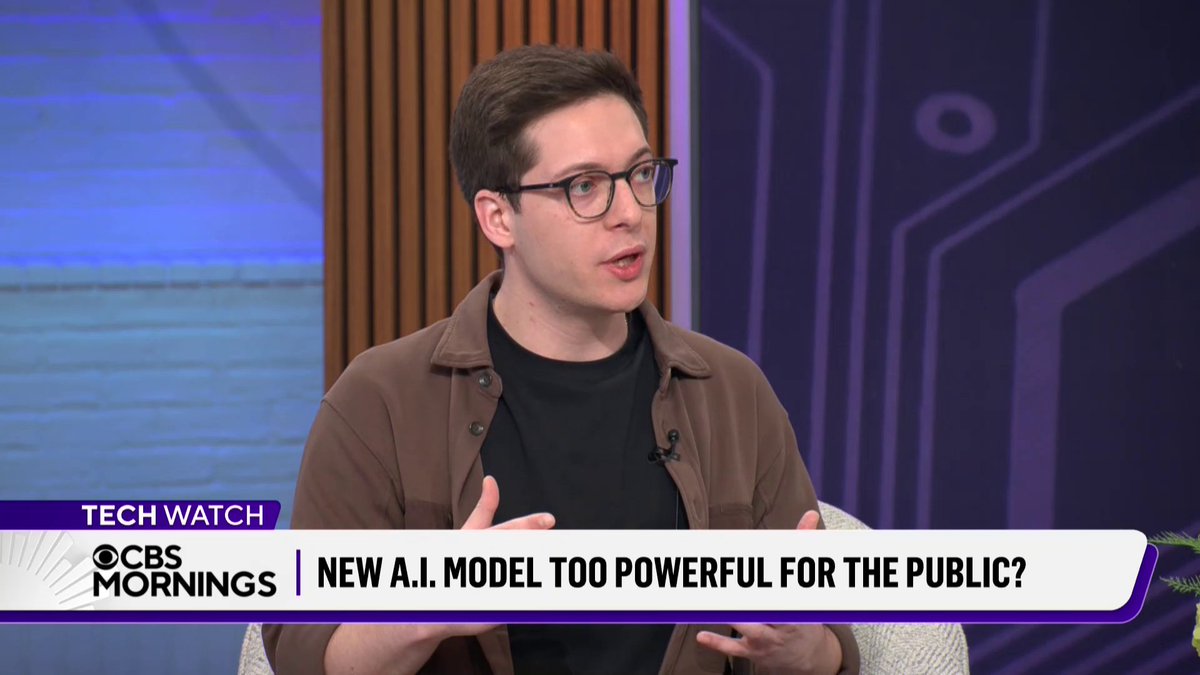
Dario Amodei says AI progress is an accelerating exponential, and Claude's latest model is a major leap along that curve It was trained for coding, not cybersecurity, but that strength in code also made it dangerous in cyber More powerful models are coming, and "we need a plan to...

15,878 Aufrufe • vor 3 Monaten •via X (Twitter)

0 Kommentare

Keine Kommentare verfügbar

Kommentare vom Original-Post werden hier angezeigt

Ähnliche Videos

Every major turning point in human history had a moment where the people closest to it understood what was coming and everyone else didn’t. The printing press. The atomic bomb. The internet. Dario Amodei is trying to close that gap. Most people still aren’t listening. Amodei: “My fundamental view is that AI has been on an exponential for the last ten years and as part of a sort of Moore’s law for intelligence.” Not a metaphor. A measured curve. Not slowing. Accelerating. We are “well advanced on that curve” with a “small number of years” remaining before AI surpasses human cognitive capability across most things. Amodei: “We’re increasingly close to what I’ve called a country of geniuses in a data center.” Not one system. A coordinated set of AI agents, each more capable than most humans at most things, running in parallel, never sleeping, never losing focus, coordinating at speeds no biological intelligence can match. The ceiling on human progress has always been simple. Genius is rare and time is finite. That constraint is gone. We are not approaching the ceiling of intelligence. We are approaching the ceiling of intelligence that biology can produce. Those are not the same ceiling. The human brain is constrained by evolution, energy, skull size, and lifespan. AI has none of those limits. We have no framework for what intelligence looks like when you remove every biological constraint that shaped ours. Every tool we use to comprehend it is built from a mind it will surpass. Amodei: “AI models surpassing the cognitive capabilities of most humans for most things.” The upsides are “absolutely staggering.” So are the consequences. Displacement. Misuse. A period of disruption that reshapes how most people work, earn, and find purpose before the benefits reach them. The same exponential that produces the cures produces the chaos. They arrive together. That’s the optimistic read. The other read is this. We are building it without international standards in place. Racing to deploy before solving displacement or misuse. And once it’s operating beyond our ability to fully comprehend or follow, managing the disruption stops being something we do. It becomes something we experience while hoping the intelligence we created decides keeping us around still serves its objectives. Every turning point in history looks inevitable in hindsight. The people inside the moment never saw it that cleanly. We’re inside the moment.

Dustin

47,185 Aufrufe • vor 4 Monaten

Dario Amodei just told software engineers exactly how long they have. Six to twelve months. Amodei: “I have engineers within Anthropic who say I don’t write any code anymore. I just let the model write the code, I edit it, I do the things around it.” The people building the most powerful AI in history have already stopped writing code. That is not a forecast. That is the current working condition inside the lab closest to the frontier. Amodei: “We might be six to 12 months away from when the model is doing most, maybe all, of what SWEs do end-to-end.” The tech industry spent a decade making software engineers its highest-paid, most protected class. That era has a last day now. When a model can execute an entire software build end-to-end, the ability to write syntax stops being a skill. It becomes a credential for a job that no longer exists. Amodei: “And then it’s a question of how fast does that loop close.” That is the sentence everyone skipped. The code was never the hard part. The hard part was everything around it. The model just learned everything around it. Writing the code is already nearly gone. Testing is next. Deployment is next. When all three collapse into a single autonomous execution loop, the machine no longer needs a human in the chain at all. The corporation or sovereign state that closes that loop first does not gain a competitive advantage. It gains a category of speed that biological engineers cannot match, track, or reverse. That is not disruption. That is replacement at a systems level. Amodei is not describing a future disruption. He is describing the current state of his own building. The loop is already closing. The only question is whether you are inside it or outside it when it seals.

Dustin

318,457 Aufrufe • vor 4 Monaten