Загрузка видео...

Не удалось загрузить видео

На главную

David Jerison, the mathematician who spent decades teaching the exact method for finding the optimal choice when the odds are stacked against you: "I used to think the best decision was whichever option looked strongest at first glance. Then I proved that the real answer almost always hides at...

16,232 просмотров • 20 дней назад •via X (Twitter)

Комментарии: 0

Нет доступных комментариев

Здесь появятся комментарии из оригинального поста
Похожие видео

Gilbert Strang, the legendary mathematician who taught linear algebra for 61 years and became the most watched math professor in history: "I used to think a matrix was just a grid of numbers, until I proved that its rows and columns always agree on one number no matter how you look at them. That fact still feels like magic to me after sixty years." this is the exact proof sitting quietly underneath every factor model a risk desk trusts with real capital, and almost nobody outside a math department has ever seen it. strip away the notation and the idea is almost absurdly simple. take any matrix, any grid of numbers, and count how many of its rows are truly independent, meaning none of them can be built out of the others. now count the independent columns instead, a completely different question on the surface. those two numbers, row independence and column independence, always turn out exactly equal, no matter how large or lopsided the matrix is. nobody presenting a clean risk model out loud credits a decades old proof for the reason the math even holds together. zoom out to what this means for anything built on a grid of numbers today. a portfolio, a covariance matrix, a neural network's weights, all of them hide a true dimension smaller than their size suggests, and that hidden number is exactly what this proof pins down. the industry sells complexity as scale, more assets, more parameters, more rows and columns. but the real question was never how big the matrix is. it's how many independent directions are actually hiding inside it. the size of the grid was never the real story. it was the one number both sides of it were quietly agreeing on the whole time.

MindArch

18,494 просмотров • 22 дней назад

Gilbert Strang, the legendary mathematician who proved risk can be cancelled to zero, on purpose, every single time: "Take any bet you're unsure about and ask what happens if you're wrong. I proved there's an exact operation that undoes a bad outcome completely, not roughly, exactly, and almost nobody ever learns to calculate it." Nobody outside that lecture hall has seen the operation itself. here's the actual mechanic. write down the equation for your first move. now tack a second column onto it, the one representing the exact opposite outcome you're worried about. don't solve them separately. run the same elimination steps through both columns at once, together, side by side. by the time the first column simplifies down to a clean answer, the second column has already turned into the exact move that cancels it. you never solved a second problem. you read the answer off the same steps you were already running. most people treat the hedge as a separate calculation, done after the fact, once they know the trade went wrong. by then it's too late to get it for free. the exact cancelling move only comes cheap if you attach it to the original problem before you start. zoom out to any model that prices a position and its exact opposite in the same breath. it isn't running the numbers twice. it tacked the second outcome on from the start, ran one elimination, and pulled both answers out together. the takeaway isn't "hedge more." it's this: whatever you're solving for right now, the exact opposite answer is one extra column away, if you set the problem up before you need it, not after. People pay six figures to sit in a room and hear this. It's in this video. For free.

MindArch

76,047 просмотров • 16 дней назад

James Simons, the legendary mathematician who built the single most successful hedge fund ever run, averaging 66 percent a year, decade after decade, without slowing down: "I can show you the exact reason smart people lose money, and it has nothing to do with being smart. It took me years to actually believe my own answer, and believing it changed everything I built after." nobody outside his own firm has heard him explain it this plainly. start with the feeling you already know. you check a position and something in you says you nailed it. the certainty feels earned, feels like proof you understand something other people don't. the next morning you check again. same read, same instincts, same person. now it feels like you never understood anything at all. nothing about how confident you felt yesterday predicted how wrong you'd feel today. most people chase a sharper version of that same feeling. a better instinct, a stronger gut call, one more signal to trust a little more than the last one. he spent years assuming that was the answer too. nobody pitching "high conviction" out loud admits their conviction might be the exact thing costing them money. they just call the losing days bad luck and the winning days skill. zoom out to how this plays out on a desk today. a trade doesn't happen because someone walks in certain they've spotted a winner. it happens because a tested model says so, and only because it says so, no exceptions carved out for a feeling that seems too strong to ignore. the industry sells conviction like it's the whole game. spend enough years watching your own certainty flip on you and you stop believing that. the skill was never having the best gut feeling in the room. it was building something disciplined enough to ignore that feeling completely, every single time, even when it screams at you to make the exception. the edge was never the smartest guess. it was refusing to make one. People pay six figures to sit in a room and hear this. it's in this video. for free.

MindArch

32,363 просмотров • 17 дней назад

Elon Musk was asked what the economy looks like in ten years. He didn’t describe a boom or a crash. He gave a date. Musk: “Money won’t matter in 2036.” He isn’t predicting collapse. He’s predicting so much supply that accounting can no longer describe it. Musk: “You need the end effectors in the form of humanoid robotics.” End effectors. Hands. Every economy that ever existed was capped by the number of hands available and the hours inside them. That cap is most of human history. Famine was a hands problem. Empire was a hands problem. Slavery was the worst answer anyone ever gave to a hands problem. Musk: “you can go from intelligence manifesting itself only digitally to shaping atoms.” Intelligence has been stuck behind glass since the first computer. Every idea it ever had still needed human hands to carry it out. Musk: “you have a sort of a quasi-infinite economy.” The interesting part isn’t whether the abundance arrives. It’s what money turns out to have been. Not paper. Not a number in an app. A dollar is a claim on somebody else’s hours. Every price you ever paid was a bid on a piece of a stranger’s life. Every wage you ever earned was somebody bidding on yours. So “money won’t matter” is not a sentence about currency. It’s a sentence about need. If nobody has to buy your hours, the claim has nothing left to point at. Musk: “You want money for food, housing, transport, entertainment.” That list is accurate, and it is the smallest a person has ever been reduced to. A stomach and an address. Nobody has ever wanted only that. Under every paycheck was a second thing that never printed on the stub. Proof that a stranger somewhere needed something only you could give. The economy was the largest machine ever built for making strangers necessary to each other. The goods were the byproduct. Every ancestor of yours worked so the next one wouldn’t have to. Nobody ever wrote down what to do on the day someone finally didn’t. We already know what happens when the supply arrives and the necessity leaves. We have run it one person at a time for a century. The retired man with a full account and nothing waiting for him in the morning. The lottery winner who comes apart with every need met. Nobody in that condition was ever cured by more. Musk: “There’s no analogy or metaphor that I think illustrates the magnitude of change that we’re going to experience here.” He’s right, and it runs deeper than economics. Every era before this one organized itself around scarcity. Take scarcity out and there is nothing left to compare it to. Notice what abundance never touches. Anything that can be copied falls to zero. What remains is everything that can’t. Land. Rank. Being first. The attention of one specific person who could be spending it somewhere else. Abundance doesn’t kill money. It strips it down to the only things it was ever really buying. The goods, the services, the things we spent ten thousand years calling wealth, turn out to have been the easy part. So the question waiting in 2036 isn’t how you’ll get by. Provision is handled. It’s what you answer when nothing requires you and everything is given. Most of us were never chosen. We were needed, and needed was close enough to live on. That difference has never once been tested. Abundance is the test. Nothing will be missing. You will be.

Dustin

39,098 просмотров • 28 дней назад

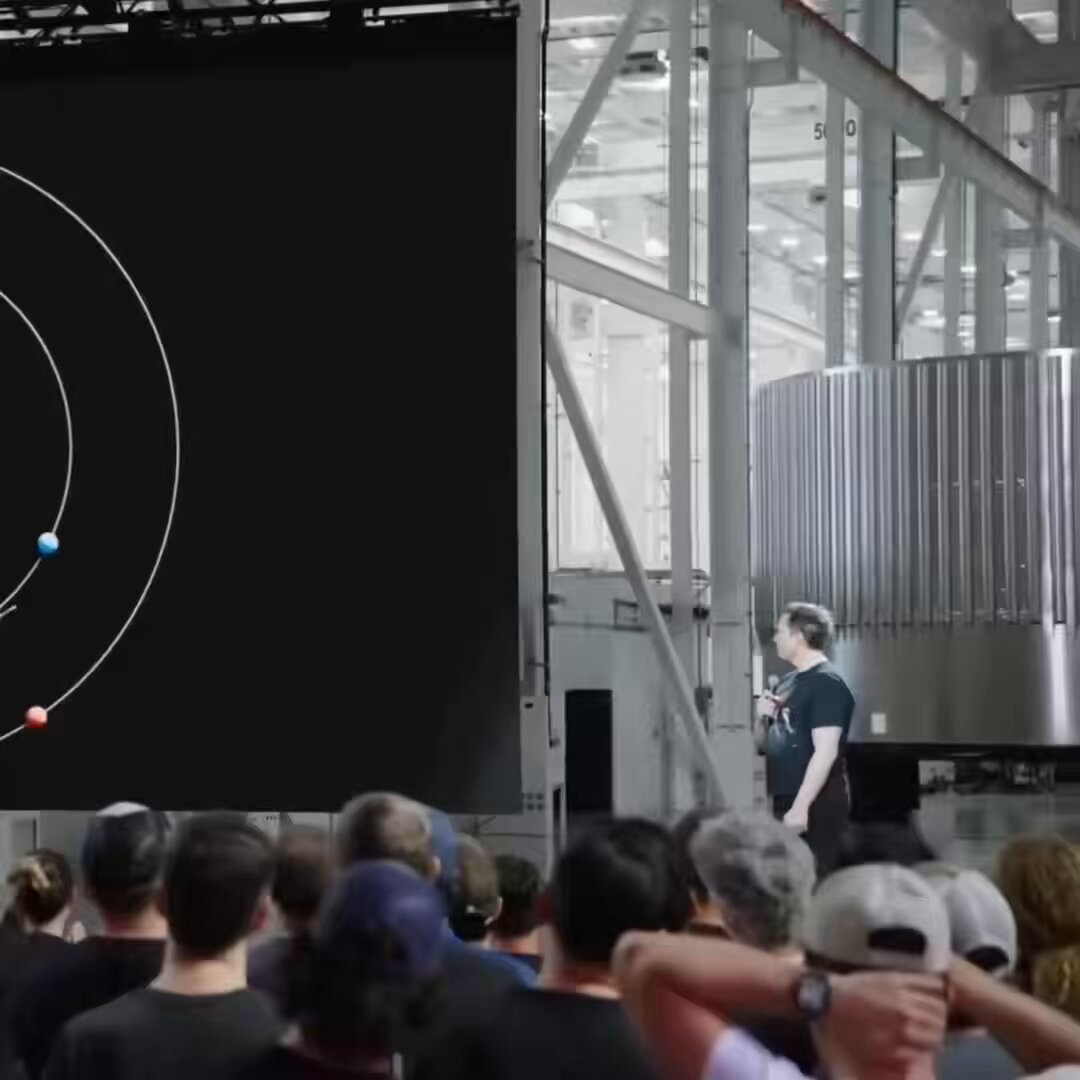
Elon Musk just told millions of Starlink customers that they have been quietly funding humanity’s road to Mars. Musk: “if you look on your Starlink Wi-Fi router, you will see this image.” The image is the transfer orbit to Mars. Earth on one side, Mars on the other, and the exact arc a ship has to fly between them. The map to another planet is printed on the router in your living room, because the two things are the same project. Musk: “you can’t just go straight to Mars, you have to create this elliptical orbit with Earth at one point and Mars at the other side at the far end of the ellipse and then time the where you are in that ellipse to intersect with Mars.” You cannot aim at where Mars is. You aim at where it will be, and you commit to that arc before you leave, because there is no correcting it once you are on it. The destination is not there when you depart. You are flying at a version of it that does not exist yet. Earth and Mars only line up for this roughly every twenty-six months. The universe hands out departure times and does not take requests. Musk: “the actual distance traveled on the arc is close to it like a thousand times further than the Moon.” A thousand times further than the farthest point any human being has ever traveled. The distance was never the hard part. Hohmann worked out this exact transfer in 1925. The math has been sitting finished for a century. What nobody could solve was money. Every previous attempt at deep space ran on government appropriations, which means it ran on election cycles. Programs that outlast a presidency are rare. Programs that outlast a generation barely exist. Musk: “Starlink internet is what’s being used to pay for humanity getting to Mars.” A rural household finally getting connected. A boat in the middle of the Pacific. A village nobody ever ran a line to. Every one of them is a payment toward a launch. Musk: “I’d just like to thank everyone out there who has bought Starlink because you are helping secure the future of civilization and helping make life multiplanetary.” That is not marketing language. That is accounting. The financing is the real breakthrough. Building something people want this month to pay for something that pays off after everyone alive is dead. Every monument in human history was built with money taken from people who were never asked. Tithes, taxes, tribute, conscription. The pyramids and the cathedrals and the moon landing were all funded by force. This is the first project at that scale that runs on people choosing it, which makes every dish on every roof a vote rather than a levy. Nobody had to be chosen for this. A working connection in a place the old providers gave up on puts you on the ledger. Every generation inherits one project large enough to be remembered by. Almost nobody alive for those ever got close enough to touch theirs. Civilizations do not get to choose whether they become permanent. They find out afterward. Every one before this looked up at the sky and wanted it. This is the first one writing the check.

Dustin

258,523 просмотров • 17 дней назад

Jeff Bezos looked at a government waiting room and priced it at a hundred billion dollars. Bezos: “This is a $100 billion business, by the way. This is huge business.” That number is not ambition. It is a measurement. A company that size does not create a hundred billion dollars of new value here. It recovers a hundred billion that is already being destroyed, on schedule, in public, by a process everyone has agreed to call normal. The size of the opportunity is the size of the wound. Bezos: “They almost always say yes, they just make you wait a long time.” So the verdict was never in question. Only the delivery date. Which means the months bought nothing. They were storage. Your project sat in a room while the word yes waited its turn to be said. Nobody in there was deciding. Someone was scheduling. And the room bills by the day. Suarez: “The daily carrying cost, one day of interest, 200 to $400,000 per day.” Now find the recipient. There isn’t one. No school funded, no inspector paid, no safety review performed. A tax at least moves money into someone’s hands. This deletes it at four hundred thousand a day, and every dollar was real before the queue touched it. Bezos: “And that doesn’t count the frustration.” Count it anyway. It lands on a body long before it lands on a spreadsheet. Suarez: “Which is infinite. I have some white hairs as a result of this stuff.” That is the invoice. The money has a rate. The rest gets charged to the man, and he pays it whether the answer comes back yes or no. No one has ever been refunded a year. Every other cost in this economy can be hedged, insured, refinanced, or written off. Waiting is the only one that is final. A man will forgive being told no. He will never get back the time he spent standing there waiting to be told yes. We built a civilization that can move a decision at the speed of light and still schedule it at the speed of a man’s hair turning white. Bezos: “It should give you a yes or a no in 10 seconds. And if the answer is no, it should tell you the 6 things you have to change to get a yes.” For four thousand years the wait was honest. Someone had to hold the entire code in one head and walk it line by line against your drawings. Reading was slow because reading was human. That stopped being true in less time than it takes to approve one building. Bezos: “Maybe with AI it can just read all the plans. And it knows all the codes. Spit it out.” The constraint is gone. The wait stayed. Anything still moving at the old speed after the cost of thinking collapsed is not slow. It is choosing. The queue never protected you from a bad building. It protected a signature from a bad outcome. Nobody gets fired for the wait. They get fired for the answer. An institution has no lifespan, so time costs it nothing. You have one, so time is the only thing it can take. Every queue is a trade between something that dies and something that doesn’t, and only one side is ever charged. That trade held for the whole of recorded history because the mortal side had no leverage. It does now. Somebody is going to build this. A hundred billion does not sit in a waiting room forever. And the day it exists, the wait stops being a fact of the world and becomes a decision with a name attached. The hundred billion was never the prize. It is the receipt for how long we agreed to stand there. We are the first people alive who get to stop signing it.

Dustin

17,035 просмотров • 23 дней назад

Steve Jobs: The difference between good people and great people is 50-to-1 “I’ve always considered part of my job was to keep the quality level of people in the organizations I work with very high. I mean that’s what I consider one of the few things I can contribute individually myself — versus the team that work with — is to really try to instill in the organization the goal of having only A players.” Steve argues this is especially important in technology where there’s a huge range between the best person and the worst person: “In a lot of fields, the difference between, say, the worst taxicab driver and the best taxicab driver to get you across town in Manhattan might be 2-to-1. The best one will get you there in 15 minutes, the worst one will get you there in half an hour… Or the best cook and the worst cook, maybe it’s 3-to-1… But in the field that I’m in. In software in particular. The difference between the best person and the worst person is about 100-to-1 or more.” He continues: “The difference between a good software person and a great software person is probably 50-to-1 or 25-to-1. Huge dynamic range. And therefore, I have found — and not just in software but in almost everything I’ve done — it really pays to go after the best people in the world.” But as Steve points out, this isn’t always easy: “It’s very painful when you have some people that are not the best people in the world, and you have to get rid of them. But I’ve found that my job has sometimes been exactly that, to get rid of some of the people that didn’t measure up. And I’ve always tried to do it in a humane way, but nonetheless it has to be done and it’s not ever fun.”

Startup Archive

45,156 просмотров • 7 месяцев назад

Elon Musk just told you the job is dying. Most people heard a prediction. A few heard a prison door opening. Musk: “In less than 20 years, working at all will be optional.” That is not a policy suggestion. That is a countdown. For three hundred years, the human blueprint has been identical. You are born. You move to the city. You rent a box near the office. You trade your body and your hours for the right to exist. You do this until you are old. Then you stop. Then you die. The entire model runs on one assumption. That human labor is the only engine. AI and robotics delete that assumption. When the machine handles production at a scale no human crew can match, the forced migration to the city evaporates. The commute evaporates. The cubicle evaporates. The alarm clock that owns your nervous system for forty years evaporates. Musk: “I think it won’t be the case that you have to be in a city for a job.” The city was never a choice. It was a requirement disguised as ambition. You moved to the noise and the concrete and the $4,000 rent because the paycheck lived there. Remove the paycheck from the equation and the geography changes overnight. You can live in the mountains. On the coast. In the silence of a town most people have never heard of. You can wake up to nothing but trees and cold air and the complete absence of anyone else’s schedule. That is not a fantasy. That is the math resolving. But here is where most people break. They hear “work is optional” and they see emptiness. A species with nothing to do. Billions of people staring at screens until their minds dissolve. That fear tells you everything about what the system has already done to us. We confused labor with purpose. The grind with meaning. The paycheck with proof that we matter. Musk: “In the same way that you could grow your own vegetables in your garden.” The analogy is precise. You do not grow tomatoes because the economy demands it. You grow them because something in you wants to build a thing with your hands and watch it come alive. That instinct does not disappear when the job does. It gets unleashed. The artist who spent twenty years doing accounting finally paints. The engineer who always wanted to build something of her own finally builds it. The kid in a small town who could never afford to take the risk finally takes it. Work does not vanish. Forced work vanishes. What replaces it is creation without a gun to your head. This is the part that keeps me up at night. We are standing at the edge of the largest liberation in human history. And the loudest voices in the room are begging to stay in the cell. They want the commute. They want the boss. They want the structure that tells them when to eat and when to sleep and when they are allowed to think about their own life. Because freedom without a template is terrifying. The next twenty years will not test our technology. The technology is already ahead of schedule. They will test whether the species can handle what it has been asking for since the beginning of civilization. Time. Space. Silence. And the unbearable weight of choosing what your life actually means when no one is forcing the answer. That is not a prediction. That is the final exam. And nobody is ready.

Dustin

111,803 просмотров • 4 месяцев назад

Chamath: "Nvidia is not doing what's in the best interest of the United States." 🇺🇸🇨🇳 "I think we can all do the math. About 47% of all of NVIDIA's revenue goes to China and Chinese-related countries." "And I think when you peel back this onion, what you will find is a whole raft of companies that were stood up to buy these Nvidia GPUs to essentially act as a waystation for China." "And I think that is the big problem." "Let's have a thought starter: if 47% of all of the AI capability and horsepower is being shipped to three Asian countries, where do you think the apps that require that amount of horsepower live?" "Is there a Cursor of Bhutan that we did not know? Is there a great shopping app in Cambodia that's come out of nowhere, that's AI powered?" "I think the answer is no." "Every single time we have an advance in the United States, how is it that Alibaba shows up with something incredible? DeepSeek shows up with something better?" "At every turn and at every step of AI, they are at the same rate or one step ahead." "To be honest with you, I think the real problem that we have is that Nvidia is not doing what is in the best interest of the United States." "You have a American company that has been working around the guidelines at every turn to try to land silicon into the hands of China." "Late last year, they introduced this thing called the H20 that was explicitly designed for China and to be compliant with US rules at the time." "Which again, gives these guys substantial performance." "This is a case where (Nvidia) has plausible deniability. I sell something to a Singaporean registered company? Plausible deniability." "What am I supposed to do? You can't expect me to audit it. I think that's what NVIDIA's answer will be to this question." "But what is the real expectation? At a minimum, the United States should have a mechanism to understand it." "It is implausible that if you did one or two layers of work, you would not find that most of this traffic is being used by Chinese organizations."

The All-In Podcast

910,450 просмотров • 1 год назад