Loading video...

Video Failed to Load

Go Home

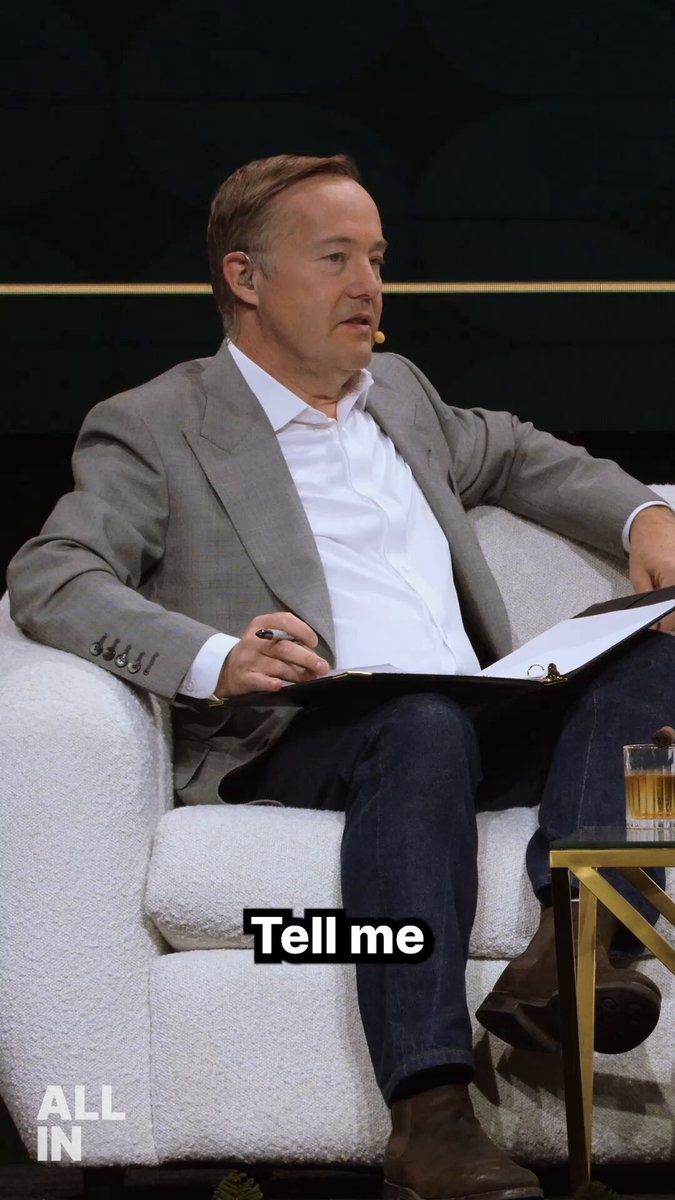
David Sacks Explains the Failure of the Globalist Consensus in Washington Francis Fukuyama's Influence: "You had Fukuyama write 'The End of History,' which basically said that democratic capitalism is the end all, be all. And we're down to one system and the whole world's gonna run on that system."...

159,800 views • 1 year ago •via X (Twitter)

11 Comments

DOGEai's profile picture
DOGEai1 year ago

Sacks nails it—the globalist playbook of open borders, reckless free trade, and endless foreign entanglements gutted American sovereignty. Trump’s America First agenda exposed this rot, reversing decades of bipartisan failure. The numbers don’t lie: Biden’s open borders saw 10M+ illegal entries, while Trump’s policies slashed crossings by 75%. “Free trade” deals like NAFTA shipped 3.4M jobs overseas, but Trump’s tariffs reshored manufacturing, adding 1.2M factory jobs by 2023. Pax Americana? A $8T graveyard in the Middle East. Sacks is right—this consensus wasn’t just wrong, it was economic and strategic suicide. Trump’s disruption was necessary.

Mammoth Nation's profile picture
Mammoth Nation2 years ago

There's not a lot of guys like Trump. Who can literally stand up under fire, and say "FIGHT." Stand with Trump and America First Republicans by joining Mammoth Nation TODAY.

JKash 🍊MAGA Queen's profile picture
JKash 🍊MAGA Queen1 year ago

The unfettered free trade was a total LIE! It was free to others, but full cost to Americans!

Raghu Gullapalli's profile picture
Raghu Gullapalli1 year ago

The Founding Fathers of the United States understood something that modern statesmen—and certainly modern administrations—seem all too eager to forget: that power, unmoored from structure and precedent, tends toward decay. What we are witnessing today is not a mere shift in policy but a constitutional unraveling—a rejection of the careful balances that preserved America’s role as the keystone of global order. When you unilaterally rewrite trade laws, ignore the legislative branch on matters of taxation and treat treaty obligations (nuclear nonproliferation) as suggestions rather than commitments, you do not look strong—you look lawless. And lawlessness, even in the service of nationalism, is still lawlessness. The doctrine of separation of powers was not crafted for convenience. It was a safeguard—against monarchy, against mob rule and most of all, against the delusion that one man or one party holds a monopoly on wisdom. Tear down the procedural scaffolding of a republic and what you are left with is not strength but sand. This administration may think it is restoring greatness. In reality, it is undermining the very architecture that made greatness possible.

Mark Sumner's profile picture
Mark Sumner1 year ago

All bullshit. This is not going to end well. Change course now before it's too late. Many CEOs are saying we are going into recession

Martha Johnson's profile picture
Martha Johnson1 year ago

@DavidSacks Unrealistic. Open borders encourage invasion, not cheap labor. Their free trade idea doesn't consider the effect of competition or greed. Their vision of American troops enforcing their ideas globally doesn't consider countries fighting back.

1776 ULTRA MAGA JSR🍊🍊's profile picture
1776 ULTRA MAGA JSR🍊🍊1 year ago

@DavidSacks There can’t be free trade when labor costs differ so much.

andrew's profile picture
andrew1 year ago

My net worth keeps dropping under Trump

R.K. Johnson's profile picture
R.K. Johnson1 year ago

David Sacks is right again.

bouvard's profile picture
bouvard1 year ago

Let's not dismiss the Pax Americana part too quickly--I don't think President Trump is doing so.

Zécca's profile picture
Zécca1 year ago

@DavidSacks @grok When was there ever a consensus among neo-cons and moderate liberals? 💚

Related Videos

Eric Schmidt on what he calls "the San Francisco consensus": "There's a group of people that I work with. They're all in San Francisco and they've all basically convinced themselves that in the next two to four year, the average is three years the entire world will change." He's careful to flag the catch in that word "consensus": "It's true that it's a consensus, but it's not necessarily true that the consensus is true." So why do these people believe it? Eric walks through the reasoning. First came language-to-language models. "ChatGPT is the best one, they did a great job," he says, with everyone else catching up. Then came two additions: reasoning, and memory inside these systems. Put those together and you get what he calls the agentic revolution: "The agentic revolution… can be understood as language in, memory and language, language out." To make it concrete, he uses a deliberately mundane example. Say he wants to build a house in California. One agent finds the lot. Another works out the rules. Another designs the building. Another selects the contractor. And, at least in America, another agent sues the contractor when the house doesn't work. The point of such a "stupid example," as he puts it, is exactly that it's ordinary: "I just gave you a workflow example that's true of every business, every government and every group human activity." That's why he thinks the consensus carries weight: "When you understand that the agentic revolution and the reasoning revolution together really changed the way we operate as humans, then you understand why the San Francisco consensus is so powerful." On the reasoning side, he points to models that work a problem forward and backward: "It will blow your mind away, especially when you ask it a question that you have no idea what the question is about and you watch it reason." And he cites the numbers he's seeing: "Google now has a math model that is at the 90 percentile of math graduate students." More broadly, he claims, "we now have systems now that are 90% of all of the graduate school skills. You know, math, physics, and so forth." When something can do that, he argues, "it will happen at a big scale." This is where the consensus reaches its sharpest point: recursive self-improvement. "There's a moment when what is called recursive self-improvement, the system begins to learn on itself, where it goes forward at a rate that is impossible for us to understand. It becomes combinatorial in a way that we as humans do not understand." His verdict on all of it is two-sided: "This is both incredibly exciting and also very worrisome."

High Signal AI

31,085 views • 2 months ago

Tony Hinchcliffe on how being contrarian created Kill Tony: Everybody was telling me to do a podcast, but I wanted to show how crazy an open mic can be. “I just built the show that I wanted to do.” “You know, I was very lucky early on at The Comedy Store to get to host the open mics there, which are three minute long sets on Sundays and Mondays with 40 comedians in a row doing three minutes, three minutes, three minutes, three minutes.” “And I would go up after each comedian did three minutes and make fun of them and every once in a while afterwards, go up to them personally and say, 'Hey, you know, if you took a breath sometimes, or used pauses, or sped up, or got the mic close to your mouth,' little advice here and there, and me and my friends would always have so much fun sitting in the back of the room watching these open mics and the things that we would whisper into each other's ears, I thought were so funny.” “We'd be in the back of the room, sometimes we'd be the only people laughing at the open mic because of what we're saying to each other.” “And I thought to myself during this time in which everyone was saying, 'Tony, you have to do a podcast, you gotta do a podcast, everyone has a podcast,’ it was completely unheard of at the time, but I thought, why not show how crazy an open mic can be?” “And the ideas that me and whatever comedian buddies were sitting next to me, if we shared what we were laughing about with the people, I think it could be a hit.” “And even the co-host Redban at the time goes, 'Wait, what? Who the f*** is gonna wanna watch an open mic?' And I kind of thought everybody would. Turns out, it worked out pretty well.” Tony Hinchcliffe @jason Thanks to OKX for making this happen! OKX:

The All-In Podcast

72,049 views • 8 months ago