Video wird geladen...

Video konnte nicht geladen werden

Zur Startseite

Demis Hassabis just said something that should unsettle every scientist alive. Hassabis: “I do think that, ultimately, underlying physics is information theory. So I do think we’re in a computational universe.” The CEO of Google DeepMind is telling you reality runs on code. Not metaphorically. Structurally. AlphaFold didn’t approximate...

112,048 Aufrufe • vor 3 Monaten •via X (Twitter)

0 Kommentare

Keine Kommentare verfügbar

Kommentare vom Original-Post werden hier angezeigt

Ähnliche Videos

Demis Hassabis thinks mathematics has a ceiling. He thinks biology is where we hit it. Hassabis: “Machine learning is the perfect description language for biology in the same way maths is for physics.” He isn’t calling AI a tool. He’s calling it a language. For four hundred years we only had one. Newton wrote gravity in it. Maxwell wrote light. Einstein wrote spacetime itself. Every law we ever pulled out of nature came back in equations, and we decided that meant nature was written in equations. It didn’t mean that. It meant the parts that surrendered first were small enough to fit the language we already spoke. Hassabis: “The expressive power of maths is not enough to understand these highly emergent dynamical systems.” Math can put a planet’s orbit on a single line. It cannot put one protein on a page. Same universe, same laws, and one fits our notation while the other refuses. Weak signals buried under noise, correlations stacked on correlations, more moving parts turning at once than any mind can hold. Biology isn’t harder than physics. It’s more expressive than the tool we brought to it. That was never a gap in our knowledge. It was a wall in our vocabulary. Hassabis is working on the far side of that wall. He calls it a virtual cell. A running simulation of a living system that no equation could ever contain. Hassabis: “Once you learn these simulators, you could maybe extract some equations from that.” He isn’t replacing math. He’s going after math we were never going to reach on our own. The model learns the system the way you learn to catch a ball, without ever solving the equation in the air. Understanding first. Formula after. That reverses the order science has followed since Newton. We started with the equation and used it to predict the system. He starts with the system and pulls the equation out of it. What if the deepest laws of life were always there, fully written, in a language we never learned to read. Math was never the language of the universe. It was the first one we spoke. Every disease we failed to cure is a sentence in that language, sitting in the open, waiting on a reader. Every person we lost to one died on the wrong side of a translation gap. The cell was never silent. We were illiterate. Hassabis isn’t building a better microscope. He’s building a second language for reality. And the first thing it’s learning to say is life.

Dustin

17,649 Aufrufe • vor 25 Tagen

Demis Hassabis wants to do something no civilization has ever been able to do. Run reality more than once. Hassabis: “AI itself will maybe unlock new sciences… the one I’m particularly excited about is AI for simulations.” Every economy ever built. Every policy ever enacted. Every war ever fought. Happened exactly once. Against the entire human population. With no way to run it again. Hassabis: “If you raise interest rates by half a percent, you have to do it in the real world and then see what happens. You can have theories, but you can’t run it thousands of times.” Every major decision in the history of civilization was a single experiment run on billions of people with no control group and no second attempt. We called the results knowledge. They were the scars of bets we were never allowed to place twice. Hassabis: “Why aren’t they just sciences like physics today? Because the problem is they’re emergent systems… it’s very hard to do repeated controlled experiments.” Physics became physics because you can drop a ball a thousand times and get the same answer. You cannot drop a civilization and get any answer at all. You just get the wreckage and call it a lesson. Hassabis wants to change that. Hassabis: “If you could simulate things really accurately, then maybe there’s sort of new sciences to be done where you can rigorously sample from a very accurate simulator.” Simulate an economy. Crash it. Rebuild it. Adjust the inputs. Run it again. Do for civilization what the laboratory did for chemistry. But that word “accurately” is doing more work than anyone is willing to examine. To simulate a society well enough to learn from it, you have to simulate the people inside it. Not averages. Not abstractions. Agents with preferences and fears and breaking points. The more accurate the simulation gets, the less separates it from the thing it represents. The line between physics and economics was never about the nature of what was being studied. It was about the limits of the thing doing the studying. Humans were never too complex to predict. We were too complex to calculate. AI does not create new science. It collapses every science into one. Everything computable becomes predictable. Everything predictable becomes simulable. And past a certain resolution, the gap between a simulated world and a real one stops being a technical question. It becomes a philosophical question no one is prepared to answer. A simulation you can tell apart from reality is a simulation that has not finished improving. The people inside a perfect one would not wonder whether their world was generated. They would feel exactly the way you feel right now. Reading this. Certain they are real. That certainty is not evidence. It is exactly what a successful simulation would produce. Hassabis: “That will allow us to make much better decisions in these, today, what are very uncertain domains.” What he is building is not a forecasting tool. It is the quiet proof that “real” was only ever a word for what we had not yet learned to compute. And that word is about to lose its meaning.

Dustin

46,369 Aufrufe • vor 2 Monaten

Demis Hassabis just told you why civilization never became a science. Hassabis: “AI itself will maybe unlock new sciences… the one I’m particularly excited about is AI for simulations.” Physics became physics because you could run the experiment twice. Drop a ball. Measure the fall. Drop it again. Same answer. Now you own the law. Economics never got that privilege. You raise interest rates on 300 million people and watch what breaks. Hassabis: “If you raise interest rates by half a percent, you have to do it in the real world and then see what happens. You can have theories, but you can’t run it thousands of times.” Every war. Every policy. Every financial system ever designed. One run. No control group. No second attempt. The population was the experiment and the cost. All of human history is a series of unrepeatable experiments performed on people who never consented to the trial. We buried the failures and called the survivors wise. Hassabis: “Why aren’t they just sciences like physics today? Because the problem is they’re emergent systems… it’s very hard to do repeated controlled experiments.” The line between hard science and soft science was never about intelligence. It was about whether you could afford to be wrong more than once. Physics could. Civilization could not. So we built governments on instinct. Economies on ideology. Foreign policy on pattern recognition one generation deep. And convinced ourselves that was rigor. Hassabis wants to end that era. Hassabis: “If you could simulate things really accurately, then maybe there’s sort of new sciences to be done where you can rigorously sample from a very accurate simulator.” Simulate a nation. Crash its economy. Isolate one variable. Run it again. A thousand iterations. A thousand variations. Before a single real person absorbs the cost. That is not a better forecasting tool. That is the end of governance by intuition. Hassabis: “That will allow us to make much better decisions in these, today, what are very uncertain domains.” Every field we called soft was only soft because the hardware to make it hard did not exist yet. He is not improving prediction. He is making civilization itself repeatable. And the moment it becomes repeatable, every lesson we thought we learned from history reveals itself for what it always was. A conclusion drawn from a sample size of one. That is not knowledge. That is mythology with better record-keeping.

Dustin

23,348 Aufrufe • vor 1 Monat

AGI before 2030 or after 2030? Sergey Brin: "Before." Demis Hassabis: "Just after." Sergey Brin laughed. "No pressure, Demis." "I can ask for it. He needs to deliver it." They spent 4 minutes answering rapid-fire questions: The first question was about the web. Alex: "What does the web look like in 10 years?" Sergey paused. "10 years, because of the rate of progress in AI, is so far beyond anything we can foresee." "Not just the web. I don't think we really know what the world looks like in 10 years." Demis agreed. "The web is going to change quite a lot if you think about an agent-first web." "It doesn't necessarily need to render things the way we do as humans using the web." "Things will be pretty different in a few years." They were asked about hiring. Alex: "Would you hire someone who used AI in their interview?" Demis: "Depends how they used it. Using today's models and tools, probably not. But it depends how they would use it, actually." Sergey: "I mean, I've never interviewed at all." The room laughed. Demis: "I haven't either, actually." Then they were asked about simulation theory. Demis had tweeted a video of AI generating a natural scene. The caption: "Nature to simulation at the press of a button. Does make you wonder." Headlines said he thinks we're in a simulation. His answer. "Not in the way that Nick Bostrom and people talk about." "I don't think this is some kind of game, even though I wrote a lot of games." "I do think that ultimately underlying physics is information theory. We're in a computational universe. But it's not just a straightforward simulation." "The fact that these systems are able to model real structures in nature is quite interesting and telling." "I've been thinking a lot about our work with AlphaGo and AlphaFold." "Maybe at some point I'll write up a scientific paper about what I think that really means in terms of what's actually going on here in reality." Sergey pushed further. "That argument applies recursively." "If we're in a simulation, then by the same argument, whatever beings are making the simulation are themselves in a simulation. For roughly the same reasons. And so on and so forth." "You're going to have to either accept that we're in an infinite stack of simulations. Or that there's got to be some stopping criteria." Alex: "What's your best guess?" "I think we're taking a very anthropocentric view." "When we say simulation, we mean some kind of conscious being is running a simulation that we are then in. And that they have some kind of semblance of desire and consciousness that's similar to us." "That's where it kind of breaks down for me." "I just don't think that we're really equipped to reason about one level up in the hierarchy."

Jaynit

101,919 Aufrufe • vor 1 Monat

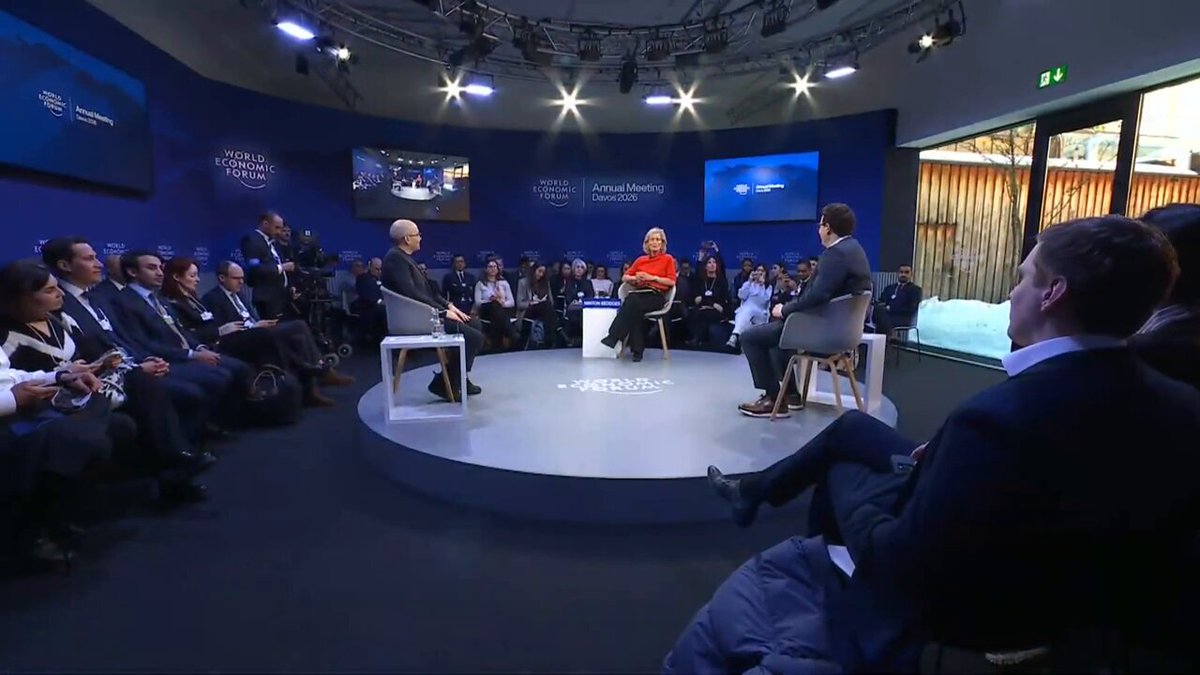
Demis Hassabis just told a room full of academics that they’re running out of time. Not the engineers. Not the technologists. The economists. The philosophers. The people who are supposed to understand what a civilization actually is. Hassabis: “It’s very urgent that we really think about the second-order consequences.” He wasn’t talking about the technology. He was talking about everything that comes after it. Hassabis: “I’m always a little bit astounded when I talk to economists about what’s happening and it’s sort of, they’re pretty skeptical. ‘Where’s it, where’s it coming in the GDP?’” The architects of the global economy are asking where the biggest economic shift in human history is showing up in a spreadsheet. That’s not skepticism. That’s institutional paralysis dressed up as rigor. Hassabis: “It’s ten times the Industrial Revolution.” The Industrial Revolution didn’t just move capital. It burned the feudal system to the ground and birthed the modern world. Hassabis is telling us to multiply that violence by ten. Hassabis: “We’re going to be in a world for the first time, if we get the technology right, where we’re a non-zero-sum world for the first time in humanity’s existence. How can that not need a new type of economic system?” Every economic model you have ever lived under shares the exact same foundational assumption. Scarcity. Capitalism. Communism. Mercantilism. Feudalism. Four names for the mathematics of starvation. Hassabis: “I don’t think it’s any of the ones we’ve tried, because they were all done under the guise of a zero-sum, a limited, a scarce world.” He’s not saying capitalism failed. He’s saying the premise underneath it is about to dissolve. And nobody has written the replacement. But scarcity didn’t just shape our economies. It shaped our identities. You found meaning in your labor. You found virtue in your utility. You worked so you didn’t die. Every concept of purpose humans have ever constructed was forged in a world where things run out. Where choices cost something. Where suffering had a function. Remove scarcity and you don’t just disrupt markets. You collapse the entire philosophical framework through which human beings have understood what it means to live. Hassabis: “There’s the even harder question of how do we want to evolve our society and what is virtuous, what is meaning, what is purpose.” The technology is solvable. The economics is redesignable. But philosophy itself was built inside scarcity. Ethics is the study of hard choices. Meaning is what we extract from struggle. Purpose is what we build against resistance. Take that away and the entire architecture of human meaning loses its load-bearing wall. Hassabis: “I think that’s going to need lots of great philosophers.” He’s asking for thinkers who don’t exist yet. The engineers are about to automate your survival. And in doing so, they will automate your purpose. We spent all of human history fighting for the right to stop struggling. We have no idea what happens to the human mind when we actually win.

Dustin

10,642 Aufrufe • vor 2 Monaten

Demis Hassabis just told you exactly how he plans to build AGI. Hassabis: “The bottleneck in robotics isn’t so much the hardware. It’s actually the software intelligence that I think is always what’s held robotics back.” We’ve been building machine bodies for decades. Arms that weld. Legs that walk. Hands that grip. The body was never the problem. The mind was. Every other AI lab spent the last three years perfecting chatbots trapped inside a text box. Hassabis was building something meant to leave it. Hassabis: “We want it to be useful in your everyday life, for everything. And so it needs to come around you and understand your physical context.” Google didn’t build Gemini to win a benchmark war. They built it to exist in the physical world. Hassabis: “That’s why Gemini was built from the beginning, even the earliest versions, to be multimodal.” Every other lab started with text and stitched vision on after the fact. Gemini started with eyes, ears, and spatial awareness from day one. That decision looked slow in 2023. It looks prophetic now. Hassabis: “It made it harder at the start, because it’s harder to make things multimodal than just text-only. But in the end, I think we’re reaping the benefits of those decisions now.” The hard road and the right road were the same road. Everyone else optimized for the demo. Hassabis optimized for the destination. And the destination was never a better chatbot. It was a mind that could pilot a body. Hassabis: “AGI needs to be able to do all of those things.” That single sentence is the thesis behind everything DeepMind has built. AGI doesn’t live in a chat window. AGI walks into a room. Sees what’s there. Moves through space. Reads context no prompt can capture. The companies building the smartest text engine will dominate the next two years. The company building the first real mind will dominate the next twenty. Hassabis isn’t racing to build a better assistant. He’s racing to build the thing that makes assistants obsolete. He laid out the entire blueprint. On camera. In plain English. Most people won’t realize what they heard until it’s already built.

Dustin

12,383 Aufrufe • vor 3 Monaten

The smartest man in AI just exposed the whole AGI narrative as a LIE. And he used a physics problem from 1905 to prove it. His name is Demis Hassabis. He runs Google DeepMind, and won the Nobel Prize for using AI to crack a problem in biology that had stumped scientists for 50 years. Almost nobody in this industry has a track record like his. He went on the NothingButTech podcast and called out the biggest lie in AI right now: Right now the loudest voices in AI are telling you that AGI is basically here. OpenAI has literally defined AGI as a system that can outperform humans at most "economically valuable work." In other words, if it replaces enough jobs, we have arrived. Hassabis thinks that bar is a joke. He said real general intelligence has to do what the human brain can do, because the brain is the only proof we have that this kind of intelligence is even possible. He called that "a higher bar than just being able to do some useful economic work," which is about as close as a polite British Nobel laureate gets to calling his rivals out. Then he gave the actual test: Today's AI has read everything humans have ever written, including the theory of relativity. So when it explains relativity back to you, it's repeating an answer that already exists. That's not intelligence. So Hassabis proposed a test that makes memorization impossible. Train an AI on only what humanity knew in 1901, four years BEFORE Einstein published relativity. Then ask it to come up with relativity on its own. It can't look up the answer, because in 1901 the answer doesn't exist yet. The only way to pass is to do what Einstein actually did: Take the same physics everyone else had and reason its way to an idea no human had ever had. Hassabis says not a single AI today can, no matter how much it has memorized. Which means what we keep calling "almost AGI" is really just the best librarian in history. It can find any answer that already exists but it cannot create one that doesn't. His second version is even sharper: AlphaGo, the system his own team built, famously invented a brand new move that no human had played in 2,000 years of the game. Everyone called it genius but Hassabis says that still is not the bar. The real test is not whether an AI can invent a new move inside Go, it is whether an AI could INVENT a game as deep and as beautiful as Go in the first place. No model that exists today can do it. The people telling you AGI has already arrived are the same people raising hundreds of billions of dollars on that exact promise. The valuations only work if the finish line is right in front of us. So the finish line keeps getting dragged closer, and AGI keeps getting quietly redefined down to "does useful work," until the products they already sell happen to qualify. Hassabis has nothing to prove and nothing to sell you. He already won the Nobel, and he is telling you the machines still cannot do the one thing that would make them genuinely intelligent, which is have a truly original idea. To be fair to him, he is not a pessimist about it. He believes real AGI IS coming, and he is spending his life building it. He just refuses to pretend it is already sitting in your phone. So the next time a founder tells you AGI is months away, remember that the one man in the room with a Nobel Prize built his test around Einstein, and admitted that nothing we have made can pass it. What do you think?

Ricardo

1,286,342 Aufrufe • vor 2 Monaten

Demis Hassabis is after something no civilization has ever had. The right to be wrong twice. Hassabis: “AI itself will maybe unlock new sciences… the one I’m particularly excited about is AI for simulations.” We assume some fields became sciences because their subjects were simple enough to pin down. That has it backwards. Hassabis: “Why aren’t they just sciences like physics today? Because the problem is they’re emergent systems… it’s very hard to do repeated controlled experiments.” A field becomes a science the moment failure inside it gets cheap. Chemistry got the beaker. Aerospace got the wind tunnel. Software got to break something at four in the morning and have it running by five. The fields that never made the jump are the ones where the experiment is the population. Hassabis: “If you raise interest rates by half a percent, you have to do it in the real world and then see what happens. You can have theories, but you can’t run it thousands of times.” Economics. Policy. War. Education. Not soft. Just unrehearsed. Everything we believe about how societies work came out of a single run. One history, no control group, no second pass. We ran it once, on everyone, and wrote down what happened. Every principle we govern by has a sample size of one. And we still built all of this. Hassabis: “If you could simulate things really accurately, then maybe there’s sort of new sciences to be done where you can rigorously sample from a very accurate simulator.” What he is describing is not better forecasting. It is the first rehearsal history has ever been given. Crash an economy inside the model. Find out exactly why it broke. Change one variable and run it again. The right to be wrong has always been rationed. You get to experiment on the world in rough proportion to how much of it you already control. Everyone else lives inside the results. That was never a moral failure of the people in charge. It was a hard limit on how many times reality can be run. Lift the limit and the monopoly on experimentation goes with it. Every real leap in human capability has been the same move. Something irreversible becoming something repeatable. Writing made memory checkable. The draft made thought revisable. The prototype made building into something you could get wrong on purpose. Civilization never got that upgrade. Every decision it made was final on impact. Hassabis: “That will allow us to make much better decisions in these, today, what are very uncertain domains.” Almost everything you know was paid for by someone who never agreed to the price. Every generation before this one paid for what it learned in people. We might be the first that gets to pay in electricity.

Dustin

15,262 Aufrufe • vor 18 Tagen

Emily Chang asked Demis Hassabis point blank if Elon Musk is right that we have entered the singularity. He didn’t hesitate. Hassabis: “No, I think that’s very premature.” This is not a podcaster with an opinion. This is the man who built AlphaGo. Who ran the lab that produced the Transformer. Who has arguably done more to lay the groundwork for modern AI than any single human alive. Elon reads the trajectory and calls the moment. Hassabis reads the architecture and says not yet. Same data. Different timelines. That alone should stop you cold. But that is not the line that should keep you up tonight. Hassabis: “We’ve invented about 90% of the breakthroughs that the modern industry relies on.” Ninety percent. Every company spending billions to scale large language models is building on top of architecture that came out of one lab. The Transformer. Deep reinforcement learning. AlphaGo. All of it came out of Google DeepMind. And he is telling you the ceiling everyone is racing toward is lower than they think. Ilya Sutskever said we are “back to the age of research.” Hassabis corrected him on the spot. Hassabis: “My view is we never left the age of research.” That is the fault line that defines the next five years. One side of this industry believes you can scale your way to superintelligence. Stack the chips. Push the parameters. Brute force the benchmarks until something wakes up. That bet is not wrong. Scaling works. It has produced results that five years ago would have sounded like science fiction. But scaling alone has a ceiling. And the people who built what is being scaled know exactly where that ceiling is. Hassabis is one of those people. And he has receipts. Hassabis: “If some new breakthroughs are required in the future, I would back us to be the ones to make those breakthroughs.” That is not arrogance. That is a batting average. When ninety percent of the foundational work came from your lab, saying you will deliver the next wave is not a prediction. It is pattern recognition. The market is obsessed with who has the most users. The most revenue. The flashiest launch. None of that matters if the current architecture hits a ceiling. And Hassabis is telling you it will. Not today. Not next quarter. But soon. The race everyone is watching is the scaling race. The race that actually decides the century is the invention race. Who builds the next architecture. The next paradigm. The thing that makes the Transformer look like a prologue. Hassabis put it in terms no one can ignore. Even five years is not a long time when you are talking about reinventing the most powerful technology in human history. And the man who built ninety percent of everything this industry stands on just told you he is not done. The companies celebrating today’s benchmarks are optimizing the present. Hassabis is building what replaces it. One of those bets ages well. The other one does not age at all.

Dustin

12,870 Aufrufe • vor 5 Monaten

Demis Hassabis confirmed every frontier AI lab is working on recursive self-improvement and in the same sentence said the safety risk of removing humans from the loop entirely keeps him up at night. That combination should stop you. The CEO of Google DeepMind just confirmed that the thing most people treat as a theoretical future risk is already the active focus of every serious lab on earth right now. He explained why it works in coding and math. The feedback loop is fast. You can verify whether an answer is correct almost instantly. You can generate synthetic training data from it. The loop closes quickly and cleanly. Then he said where it breaks down. In biology, chemistry and physics. Any domain where verifying a hypothesis requires a physical experiment in the real world. The loop does not close in seconds. It closes in weeks or months. Geoffrey Hinton said in his Nobel lecture that recursive self-improvement is the development he fears most and that once started it may not be possible to stop. Hassabis is not pushing back on that. He is describing the guardrails labs are building around a process they are already running. Every lab has to think carefully about the safety of a process where no human is in the loop. He said that as a constraint they are navigating right now. The question they are sitting with is how much of it to let run without a human watching. (Watch the full interview on YouTube at Two Minute Papers channel)

Ihtesham Ali

68,231 Aufrufe • vor 2 Monaten

Sam Altman just told you exactly how OpenAI treats the human race. Not in a leaked memo. Not through a whistleblower. On camera. In his own words. Altman: “I think one of the most important strategic insights in the history of OpenAI was deciding we were gonna pursue iterative deployment.” The most important move in the history of the company was to release the technology before they understood it. Not after it was safe. Before. Altman: “Society and technology are a co-evolving system.” Co-evolution means neither side is driving. The machine changes us. We change the machine. Nobody is steering the outcome. This is not a product launch philosophy. This is an admission that the experiment was always designed to be run on us. Altman: “I don’t think we’re gonna solve that, like, thinking really hard about it theoretically. We’re gonna have to, like, learn from the contact with reality.” Contact with reality. That is the phrase the CEO of the most powerful AI company on Earth chose to describe what happens when his technology meets eight billion people. Not careful integration. Not measured rollout. Contact with reality. The language of test pilots describing what happens when an untested airframe hits the atmosphere. The entire promise of AI safety was that the machine would be understood before it was unleashed. Altman just admitted that promise was always a fantasy. You cannot model how intelligence reshapes civilization by running simulations. The second and third order effects are invisible until they detonate. So they shipped it. Altman: “You have to learn as you go. You have to adapt with a tight feedback loop.” Tight feedback loop means they watch what breaks. They measure the collision between human psychology and machine output in real time. Every conversation you have with ChatGPT is a data point in a civilizational stress test you never consented to. Every prompt. Every confession. Every question you would never ask another human being. That is the feedback loop. You are not the customer. You are the contact with reality. Philosophers spent centuries asking whether humanity would ever encounter an intelligence that learned from us faster than we could process what it was doing. That is not a theoretical question anymore. It is running on your phone right now. And the man building it just told you the only way to understand what it does to us is to let it happen. No simulation. No safety net. No control group. Just the experiment, running at the speed of conversation, on a species that will not be the same one that started it.

Dustin

27,714 Aufrufe • vor 3 Monaten

Without World Models, There Is No AGI. Google Just Proved It. If AGI ever happens, it will not come from bigger chatbots alone. From the very start of this interview, one thing is crystal clear: without world models, we will never reach AGI. And right now, Google is leading with its world simulator Genie 3. Here is the core of what Demis Hassabis explains in this conversation: • World models are the missing core of AGI Hassabis says his deepest long term focus has always been world models and simulations. Not just language. Not just prediction. Actual internal simulations of reality. • LLMs are impressive, but incomplete Language models understand more about the world than expected because human language encodes a lot of reality. Still, language is only a shadow of the real thing. • What text can never fully teach Reality includes things text struggles to express: •3D space and spatial dynamics •Physical causality and mechanics •Sensorimotor experience like movement, force, smell, or balance • Experience beats description To close the gap, AI must learn from interaction and experience, not just static text. That is how you build an internal world simulator. • Why Genie 3 matters With Google DeepMind pushing systems like Genie 3, AI starts to model reality itself, not just talk about it. • Robots and real world assistants depend on this True robotics, smart glasses, and universal assistants require AI that understands the physical world you live in, not just your screen. Bottom line: AGI will not emerge from better text prediction. It will emerge from systems that can simulate, predict, and understand reality itself. Right now, Google is clearly ahead on that path. Curious what you think. Are world models the real AGI unlock, or just another stepping stone?

VraserX e/acc

23,784 Aufrufe • vor 8 Monaten