Loading video...

Video Failed to Load

Go Home

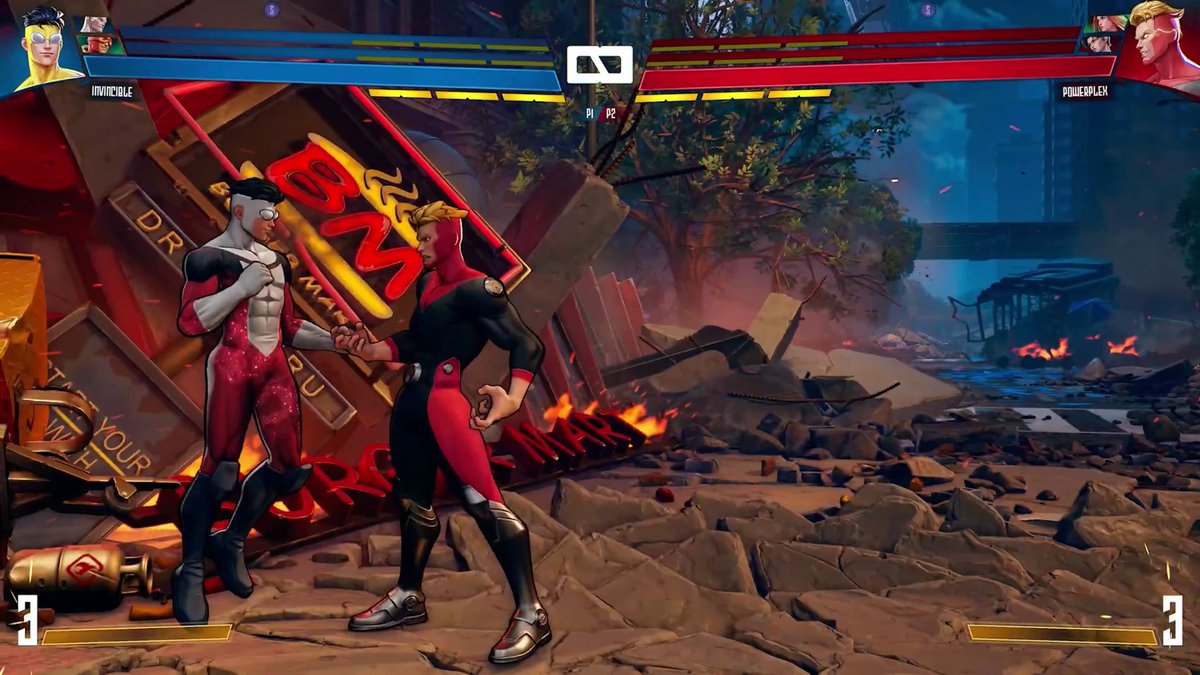
Developing Battle Beast Tech 🫡 By utilising some complex light strings, assists, motion controls and creativity, I'm getting close to an actual TOD! Two combo routes here! Combo 1 leads to 97%. Combo 2 is a solo 90% damage route. #InvincibleVS #Invincible #Battlebeast #FGC

10,943 views • 2 months ago •via X (Twitter)

0 Comments

No comments available

Comments from the original post will appear here

Related Videos

i spent 4 dollars to make this post Akali 3H single routing structure with positioning optimizations these range from bnb territory to psychotic, but mainly putting together as an example for combo limits / optimization adjustments on the fly. You can always 2 hit walljump / do single hit jM to reduce some length and maintain the routing if combo time is a concern. For the third and fourth combos, there are 2 versions - one that optimizes for limit strike damage / combo time, and one that sends in extra air normals for 5s2 oki. Just posted both as an example, but routing like this also helps bridge the gap on 5s2 damage if you'd like to use that. Notes: 1) Corner to corner, keep in mind extra normals will increase the pushback and leave you closer to corner by the end, reducing frame adv from the tumble. 2) Nearing corner (starting about 75% of the stage away) adjustment on the ender for when the tumble has less frame adv, just cram in more air normals and save your double jump. 3) Here's where you'll start to see corner adjustments - round start position, this ends up being the starter for max damage midscreen, but if you were to reach the corner after the apex of your second jump loop arc, you can squeeze in extra minimum damage for a notable increase. Fortunately also maximizes corner carry while pushing damage. 4) In corner route. Stupid hard wrt combo time, just posting as an example of combo limits. you can probably just opt for above, but it does get an extra min damage source in. Alternatively, learn an easier combo lol. Have similarly structured stuff for 2H, will probably get to it later.

SKD

20,215 views • 3 months ago

Some may call it an upset, but Chadron St simply calls it another day at the office, beating the #9/#11 Western CO Mountaineers on Saturday (11/8/25) in OT by a score of 27-24. Chadron got it done in all three phases of the game. The Eagles’ offense presented a balanced attack, gaining 111 yards and 2 TDs passing to go along with 148 yards and 1 TD rushing. The Eagles’ defense held the Mountaineers to a mere 38 yards rushing, had 7 tackles for loss, including 3 sacks, and came up with a fumble recovery and 2 interceptions. The most impressive part of Chadron’s team on Saturday had to be its special teams. The Eagles’ special teams blocked two field goal attempts and blocked a punt. Punter Brodie Eisenbraun stuck one punt inside the 5, drew a running into the punter penalty for a 1st down, and had an amazing run off of a high snap, which while it was not a 1st down, it shows what a stud he is. Then there is Kicker Wilson Yee. Yee made an impressive 50 yard FG in the 2nd quarter. Then, in OT, with ice in his veins, Yee made the biggest kick of his collegiate career, drilling a 47 yard FG to give the Eagles the win. Also leading Chadron to the win were: 🏈 DJ Ralph, 10 Cmps on 22 Atts for 111 Yds & 2 TDs; 🏈 Tommy Thomas, 4 Recs for 66 Yds & 2 TDs; 🏈 Logan O’Brien, 10 Tackles (7 Solo & 3 Ast); 🏈 Cooper Walton, 10 Tackles (5 Solo & 5 Ast) with 1 TFL, including 1/2 a Sack; 🏈 Dax Yeradi, 4 Solo Tackles; 🏈 Aiden Kuester, 4 Tackles (1 Solo & 3 Ast) with 1/2 a TFL & 2 INTs, 🏈 William Stemler, 4 Tackles (3 Solo & 1 Ast) with 2 TFLs, including 1 Sack; & 🏈 Ryder True, 3 Tackles (1 Solo & 2 Ast) with 1.5 Sacks. Chadron will be playing for the RMAC Championship next Saturday when they travel to battle the CSU Pueblo Thunderwolves. Here are a few of Chadron’s highlights from Saturday’s OT win: #RMAC #RMACfb #CSCfb #ProtectTheRock #SoarEagles

RMAC Insider

18,394 views • 8 months ago

This is how your eyes work. Eyes are part of an irreducibly complex system of structures that work together to give you vision. There is no evolutionary pathway that could produce even the simplest eye. Here is everything you need to know about why eyes did not evolve and are certain evidence of design. This is the proposed version of eye evolution: 1. Photosensitive cell 2. Pigment cells without a nerve 3. Optic nerve surrounded by pigment cells, covered by translucent skin 4. Pigment cells forming a depression 5. Skin gradually takes a lens shape 6. Evolution of muscles for lens to adjust But each one of these steps still relies on a similar irreducibly complex system of machines for vision to function. The very first step, the mythical light sensitive cell, is actually incredibly complex by itself and has no plausible evolutionary pathway. A single photosensitive cell is an incredibly complex system of nanomachines. The simplest known light-sensitive prokaryotic cells have genomes with around ~1.3 million base pairs of DNA information, with around ~1,300–1,400 unique proteins. Knockout tests in cells have been able to simplify cells to 500,000 base pairs of DNA, with close to 500 unique proteins (but these are not light sensitive.) ALL vision systems require rhodopsin proteins. These handy little proteins capture light, transforms light into a signal, and sends that signal down a transduction pathway to the processing center (brain). So basically, ALL vision systems require at least 3 separate major systems, which are themselves filled with multiple subsystems - it's complexity on top of complexity on top of complexity. And none of it works if all of those systems are not in place together. There is no evolutionary pathway by which all of this arises together - nature doesn't engineer multiple interdependent systems together. Eyes are so complex and so different among various organisms today that evolutionists even widely recognize that vision systems must have arisen independently at least 30 times, because there is no genetic pattern to explain the origin of eyes from a common ancestor. The odds of that happening are absolutely absurd. Beyond logic. There is no evidence of eyes evolving in the fossil record, either. Complex, fully functional vision appears almost at the very start of the fossil record. The oldest eye in the fossil record, that of a trilobite, is a complex compound eye originating in the Cambrian, conventionally dated about 540 million years ago. From there, various different kinds of eyes appear in the fossil record of varying degrees of complexity - with both simpler and more complex version of vision systems scattered all throughout in no particular pattern of development. Evolutionists also like to claim the human eye is designed poorly. They point to “blind spots” & “backwards retinas” as evidence of poor design, which is why, they say, evolution makes more sense. But that is completely false, and shows they simply don't understand the biology of the eye in the first place. But this design actually makes our eyes better and fully optimized for our necessities. The Blind Spot: Vertebrates have an inverted retina, where photoreceptors face away from light and nerves bundle through a hole in the back, creating a tiny blind spot. The blind spot is only~1% of visual field and each eye's blind spot overlaps with the seeing part of the other eye - there is no actual vision loss. This could be seen as evidence of intelligently designed coordination. Vertebrate eyes also provide the sharpest vision among animals. Eagles (with inverted retinas) see clearly up to 2–3 miles away and spot prey from great distances. Features like oil droplets in photoreceptors improve color vision, and mitochondrial clumps focus light better, giving higher vision acuity overall. The Inverted design also allows direct, close access to the Retinal Pigment Epithelium (RPE) layer. RPE supplies massive nutrients/oxygen (vertebrate photoreceptors have the body's highest metabolic rate) and removes toxic byproducts from light detection. RPE's dark pigment absorbs stray light, giving a sharper image, and protects against sun damage, which makes our eyes last longer and stay healthier. Cephalopods eyes - often compared as a "better version" by evos who don't know better - have the everted retina which limits nutrient/toxin access, causing slower repair, shorter cell life, more vulnerability to damage. In summary, the human eye is optimally designed for the function required. The orientation of the retinas improves vision sharpness and the longevity & overall health of the eye. Anyone claiming the eye is evidence of “bad design” simply doesn’t understand how beautifully their eyes are designed. Even the simplest forms of vision require incredibly complex systems to come together at the same time for vision to arise. Evolution cannot do that. Only intelligence engineers irreducibly complex systems like Vision.

Divinely Designed

25,670 views • 6 months ago