Loading video...

Video Failed to Load

Go Home

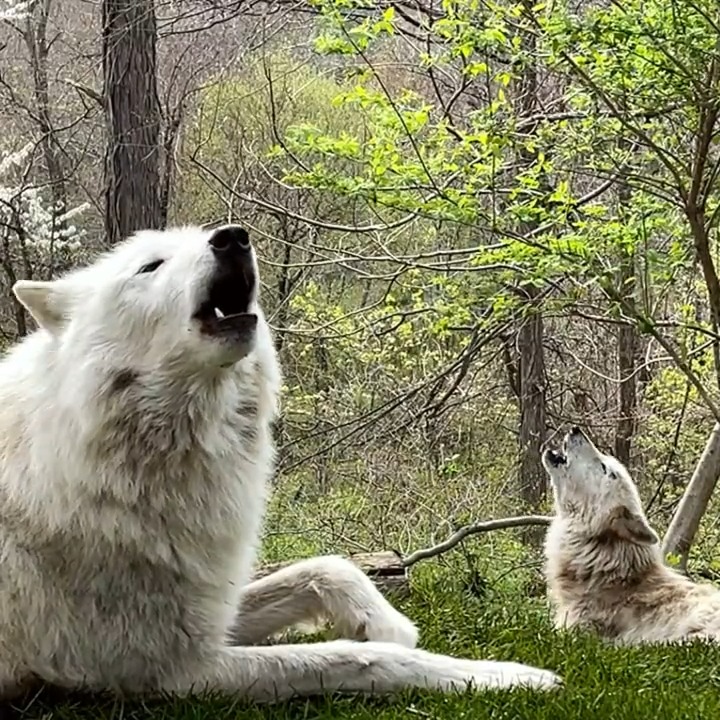
Did you know wolves howl in over 21 different dialects? They rely on a variety of howls to communicate 🐺 Howls aren't their only vocalizations though - wolves whine, whimper, growl, + even squeak!
148,955 views • 2 years ago •via X (Twitter)

0 Comments

No comments available

Comments from the original post will appear here

Related Videos

The first footage of wolves eating raspberries to our knowledge! We captured this footage last summer when the Bug Creek Pack pups spent a good while foraging for berries in this patch. Of course, we have known for a while wolves eat raspberries as we have sifted through many scats full of raspberry seeds. However, we’ve never observed the behavior before. Just a few months ago, before we were aware we captured this footage, we actually published a scientific paper on the “berry-eating” behavior of wolves. The big takeaway from our study (link to study below!): based on our data, wolves foraging on berries in our area is an extremely widespread behavior and one that almost every wolf we have studied engages in when berries are abundant. We have captured trail camera footage of wolves of all ages, sexes, and social statuses (i.e., breeding or subordinate wolf) from several packs foraging on berries. All of this indicates “berry-eating” by wolves is likely pervasive across large portions of southern boreal ecosystems in places like Minnesota, Michigan, Wisconsin, Ontario, Manitoba and Quebec. However, given the lack of summer research on the foraging ecology of wolves in these areas, we think this behavior has just gone unnoticed. Although, there is evidence based on scats collected in these areas that wolves are foraging on berries. Now, it is important to understand why wolves eat berries and to not misconstrue this finding with the notion that wolves eat berries because they prefer berries over animal prey. Wolves do not have digestive systems that are meant to digest plant matter and berries effectively. Thus, berries are almost certainly "starvation food" for wolves; as in, the wolves are starving and berries are the best option given the circumstances to stave off hunger and slow weight loss. All this to say, wolves are not eating berries instead of other animals because they prefer berries over meat. We have no doubt that if a wolf had an option between a meal of berries or of deer/ beaver that it would choose the latter every single time. Catching deer and beavers, wolves primary summer prey, is extremely challenging for wolves in late summer, and likely requires extensive energy expenditure. Thus, instead of spending substantial energy hunting prey they likely cannot catch, wolves turn to berries, which are abundant, taste good, and likely make them feel full. In other words, all evidence suggests wolves are just eating berries to slow starvation and weight loss. Read our recent study on the “berry-eating” behavior of wolves for free here:

Voyageurs Wolf Project

23,594 views • 1 year ago

Wolves transporting the remains of beavers they have killed. Beavers are critical prey for wolves in the Greater Voyageurs Ecosystem for a 7-8 month period of time, roughly April to October/November…i.e., when ice on lakes and ponds is largely absent. Beavers constitute, on average, ~30-40% of all biomass wolves obtain from predation during this period. However, we have studied numerous wolves for which beavers are the primary prey during the spring to fall. For instance, beavers can constitute up to 82% of all biomass killed by some wolves during this 7-8 month stretch. In other words, some wolves rely almost exclusively on beavers during spring to fall and then deer almost exclusively during winter. Given how often wolves are killing beavers, we naturally get footage of wolves carrying remains of beavers they have killed, often taking the carcasses back to their pups. The reason wolves rely heavily on beavers is almost certainly due to the abundance of beavers in the area. Beaver densities have remained roughly around 1 beaver lodge per square kilometer (and there are ~5ish beavers per lodge) for about 40 years now. That is a very high beaver density, and likely is similar to, if not higher than, beaver densities in other southern boreal forest ecosystems in places like Ontario, Manitoba, and Quebec. We suspect beavers are, in part, why the Greater Voyageurs Ecosystems has sustained very high wolf densities for many years, and we are actively trying to understand how beavers drive aspects of wolf population dynamics. Prior to our work, wolf-beaver interactions had received very little attention or research. In 2018, we wrote a peer-reviewed publication summarizing all that was known on wolf-beaver interactions up to that point. In that paper, we dubbed beavers “the forgotten prey of an iconic predator." Of course, biologists knew wolves in a variety of ecosystems hunted beavers to an extent but that was about it. Fortunately, we have made substantial headway in understanding this predator-prey dynamic but there is much we still don't understand...which means there is still much to be discovered!

Voyageurs Wolf Project

10,909 views • 1 year ago