Loading video...

Video Failed to Load

Go Home

Elon Musk explains his 5-step process for running companies: "First, make your requirements less dumb. Your requirements are definitely dumb. It does not matter who gave them to you. It's particularly dangerous if a smart person gave you the requirements because you might not question them enough. Everyone's wrong...

73,916 views • 5 months ago •via X (Twitter)

0 Comments

No comments available

Comments from the original post will appear here

Related Videos

Elon Musk explains his 5-step algorithm for solving any problem: "The most common mistake of smart engineers is to optimize a thing that should not exist." "I have this very basic first principles algorithm that I run as a mantra." Elon breaks it down: Step 1: Question the requirements. "Make the requirements less dumb. The requirements are always dumb to some degree, no matter how smart the person who gave you those requirements. You have to start there, because otherwise you could get the perfect answer to the wrong question." Step 2: Try to delete it. "Try to delete the part or the process step entirely. If you're not forced to put back at least 10% of what you delete, you're not deleting enough. Most people feel like they've succeeded if they haven't been forced to put things back in. But actually they haven't, they've been overly conservative and left things in that shouldn't be there." Step 3: Optimize or simplify. "The most common mistake of smart engineers is to optimize a thing that should not exist. So you don't optimize until after you've tried to delete." Step 4: Speed it up. "Any given thing can be done faster than you think. But you shouldn't speed things up until you've tried to delete it and optimize it otherwise, you're speeding up something that shouldn't exist." Step 5: Automate. "And then the fifth thing is to automate it." Elon explains why the order matters: "I've gone backwards so many times where I've automated something, sped it up, simplified it, and then deleted it. I got tired of doing that. So that's why I have this mantra."

Jaynit

383,881 views • 15 days ago

Elon Musk’s Elon Musk first principles algorithm: “Well, it's easy to say simplify and it's very difficult to do it. You know, I have this very basic first principles algorithm that I run kind of as a mantra, which is to first question the requirements, make the requirements less dumb. The requirements are always dumb to some degree, so you want to start off by reducing the number of requirements. And no matter how smart the person who gave you those requirements, they're still dumb to some degree. You have to start there because otherwise you could get the perfect answer to the wrong question. So try to make the question the least wrong possible. That's what question the requirements means. And then the second thing is to try to delete whatever the step is, the part, or the process step. It sounds very obvious, but people often forget to try deleting it entirely. And if you're not forced to put back at least 10% of what you delete, you're not deleting enough. And it's somewhat illogical, people often, most of the time, feel as though they've succeeded if they've not been forced to put things back in. But actually, they haven't because they've been overly conservative and have left things in there that shouldn't be. And only the third thing is to try to optimize it or simplify it. Again, these all sound, I think, very obvious when I say them, but the number of times I've made these mistakes is more than I care to remember. That's why I have this mantra. So in fact, I'd say the most common mistake of smart engineers is to optimize a thing that should not exist.”

Beanie👾

271,445 views • 9 months ago

Bam Adebayo GOES IN on the critics that says his 83 point game performance is unethical: "For the couch coaches, I mean, if you're in my shoes and you have, first of all, y'all are blaming me. You should be blaming the head coach. Get that first. I was not the one letting me go one-on-one the whole game until I had 70, and then you started to send a double. At that point, I got 70 with, like, what? nine minutes left to go in the game you think i'm not going for it like like and that's the thing that's crazy when they talk about the unethical part of the basketball i'm like if i have 70 points with 9 minutes to go Who would just be like, you know, coach, just take me out. Yeah, right. Anybody in my shoes with nine minutes left? Okay. A minute? All right. Nine? Yeah, I'm going for it. You can't be mad at that. If you are mad, I don't care because a lot of people, they're upset because if they did play, they never had a chance to get that close to chasing greatness. And then if you get that close to chasing greatness, that's the point of chasing it so you can surpass it. And some of the people have never played basketball. So like if you've been in the backyard and you and a couple of your homies have been playing 21 and you got 19. You're not going to get an easy look off. And four, they're going to talk about the free throws. It's not like I shoot 15 free throws a game. It's not like I average 10 free throws a game. You can watch the film. I was legitimately getting fouled every time. So I went to the free throw line."

Ahmed/The Ears/IG: BigBizTheGod 🇸🇴

374,031 views • 5 months ago

Trump: Now they'll say all these stories are terrible. Well, these stories have, you know, you heard my story in the boat with the shark, right? I got killed on that. They thought I was rambling. I'm not rambling. We can't get the boat to float. The battery is so heavy. So then I start talking about asking questions. You know, I have an, I had an uncle who was a great professor at MIT for many years, long, I think the longest tenure ever. Very smart, had three different degrees and you know, so I have an aptitude for things. You know, there is such a thing as an aptitude. I said, well, what would happen if this boat is so heavy and started to sink and you're on the top of the boat. Do you get electrocuted or not? In other words, the boat is going down and you're on the top, will the electric currents flow through the water and wipe you out? And let's say there's a shark about 10 yards over there. Would I have to immediately abandon or could I ride the electric down and he said, sir, nobody's ever asked us that question. But sir, I don't know. I said, well, I want to know because I guarantee you one thing, I don't care what happens. I'm staying with the electric, I'm not getting over with it. So I tell that story. And the fake news they go, he told this crazy story with electric. It's actually not crazy. It's sort of a smart story, right? Sort of like, you know, it's like the snake, it's a smart when you, you figure what you're leaving in, right? You're bringing it in the, you know, the snake, right? The snake and the snake. I tell that and they do the same thing

Headquarters

2,056,689 views • 2 years ago

“What did you think of Lando being booed at race because people and I've seen it online as well say he doesn't deserve the title because McLaren favored him over his teammate. Do you think that's total nonsense?” Jacques Villeneuve: “That's a little bit ridiculous. When there was some booing in some races, that was embarrassing. You should never boo a driver that's clean, doesn't do anything dirty, on track is respectful, and on top of it is super fast. What's wrong with people? That was embarrassing. And, had it been that Piastri was a second a lap faster than him and somehow Lando was winning because a lot of things were happening, his car breaking down every time, then you could start thinking, okay, that's really not cool. That's not fair. But that wasn't the case. And in the second half, Norris has been faster right at the beginning as well, last year as well. So there's this whole middle of the season where Piastri was driving a lot better than Norris and was getting the points. Norris had an engine blowing up, not Piastri. And so those fans, they don't look at that either. You have to look at the whole picture, at the whole season. And suddenly if your favorite is starting to go backwards, you just got to bite the bullet and accept it. Your favorite is just going backwards. That doesn't mean that the other one is treated better or the other one is undeserving just because the one you're a fan of is not winning right now. That’s really wrong. If you're a fan of the sport, then you have to be a fan of the sport and understand when your driver is maybe not cutting it at this point in time, even though he was before and he will in the future again. It's all a question of timing. But that's the price we have to pay now with social media and how big F1 has become. It's very passionate. The people are passionate and once, you know, fans come from fanatism, you stop thinking, when you get in that mindset and it happens to all of us. You want something so much that you get attached and you cannot - it's hard to start seeing reality. So you will try to mold the reality to your thought process and if your champion is not winning then it cannot be his fault. It has to be something from the outside. It has to be the team destroying his chance or not favoring and so on and so on and so on. But there's nothing concrete behind those comments. It's pure fandom and it'll always be like this. And ultimately it's not a bad thing. You know drivers at that - sportsman at that level have to grow a thick skin. If not, you don't deserve to be there. You just have to have a thick skin because they're all very happy to get the compliments. They love it when it's just positive, but it gets balanced out with negatives and you need to be able to take and accept the negatives as well. It goes both ways. You cannot have the good. You just have to be a thick skin and know that it's part and parcels of what's going on. And in one month, it will be forgotten and maybe everything will change and it be the other driver that suddenly will be criticized and so on. So, it's just that's just the way it is.”

naenia ¹ ⁶³

29,833 views • 8 months ago

.Rob Miles is spitting fire: “People are starting from a prior in which ‘[AIs] are safe until you give me an airtight case for why they're dangerous.’ This framing is exhausting. You explain one of the 10,000 ways that AIs could be dangerous, then they explain why they don't think that specific thing would happen. Then you have to change tack, and then they say, 'your story keeps changing'... "If you're building an AGI, it's like building a Saturn V rocket [but with every human on it]. It's a complex, difficult engineering task, and you're going to try and make it aligned, which means it's going to deliver people to the moon and home again. People ask “why assume they won't just land on the Moon and return home safely?" And I'm like, because you don't know what you're doing! If you try to send people to the moon and you don't know what you're doing, your astronauts will die. [Unlike the telephone, or electricity, where you can assume it’s probably going to work out okay] I contend that ASI is more like the moon rocket. "The moon is small compared with the rest of the sky, so you don't get to the moon by default - you hit some part of the sky that isn't the moon. So, show me the plan by which you predict to specifically hit the moon." And then people say, “how do you predict that [AIs] will want bad things?” There's more bad things than good things! It's not actually a complicated argument... I'm not going to predict specifically where it off into random space your astronauts are going, but you're not going to hit the moon unless you have a really good, technically clear plan for how you do it. And if you ask these people for their plan, they don't have one. What's Yann Lecun’s plan?” "I think that if you're building an enormously powerful technology and you have a lot of uncertainty about what's going to happen, this is bad. Like, this is default unsafe. If you've got something that's going to do enormously influential things in the world, and you don't know what enormously influential things it's going to do, this thing is unsafe until you can convince me that it's safe." HOST: “That’s a good way of thinking about it - with some technologies you can assume that the default will be good or at least neutral, or that the capacity of a person to use this in a very bad way is bounded somehow. There's just only so many people you could electrocute one by one."

AI Notkilleveryoneism Memes ⏸️

77,378 views • 3 years ago

Revel Founder & CEO Scott Morton spent 9 years working at SpaceX / Starship for Elon Musk: Biggest lesson? "Elon Musk is really good at is asking engineers to go further than they otherwise would have." i.e. Push past the first “no.” - Avoid incremental thinking. - Question every requirement & constraint. - Force one more round of thinking. - Breakthroughs often follow discomfort. Ref: Walter Isaacson's Biography on Elon: “1. Question every requirement. Each should come with the name of the person who made it. You should never accept that a requirement came from a department, such as from “the legal department” or “the safety department.” You need to know the name of the real person who made that requirement. Then you should question it, no matter how smart that person is. Requirements from smart people are the most dangerous, because people are less likely to question them. Always do so, even if the requirement came from me. Then make the requirements less dumb. 2. Delete any part or process you can. You may have to add them back later. In fact, if you do not end up adding back at least 10% of them, then you didn’t delete enough. 3. Simplify & optimize. This should come after step two. A common mistake is to simplify and optimize a part or a process that should not exist. 4. Accelerate cycle time. Every process can be speeded up. But only do this after you have followed the first three steps. In the Tesla factory, I mistakenly spent a lot of time accelerating processes that I later realized should have been deleted. 5. Automate. That comes last. The big mistake in Nevada and at Fremont was that I began by trying to automate every step. We should have waited until all the requirements had been questioned, parts and processes deleted, and the bugs were shaken out.” . . . Scott Morton (Scott Morton) Founder & CEO of Revel (Revel.io) "Oh man, I have so many stories. But actually, there’s a good one here. I think what Elon’s really good at is asking engineers to go further than they otherwise would have. One of the most interesting examples was the first orbital flight of Starship. We had this maneuver to separate the booster from the ship. We called it the “twig snap.” It essentially looked like a twig snapping in space, and it was a very inefficient way to do it. For the next flight, he was like, “We’re going to do hot staging,” which is where you literally start the Starship engines while it’s still connected to the booster and just blast off. Coming out of that, we all thought, “Okay, cool. We’re going to do the same exact conceptual operations for the next flight. Of course. We’re just going to go nail it this time, right?” And he was like, “No, we’re going to do hot staging on the next flight.” I was actually sitting outside. I wasn’t in the Elon meeting, but I was outside. I saw everyone walk out, and they were all just like, “Oh my God. How are we going to do this?” That week, screenshots started getting shot around. I’m sure everyone was thinking, “Oh, this is going to be really difficult.” But then, throughout the course of the week, some really awesome ideas started coming up. It started to look more and more feasible. Then it became, “How would you manufacture this? How would this all go together?” They ended up inventing, just out of nowhere, a new stage that would sit between the booster and the ship called the hot stage. It would take the blast, and then it would get ejected on reentry for the booster. It worked first shot. That’s insane. I just remember the vibes at SpaceX were like, “Oh my… how in the hell are we going to go do this?” But I think the big lesson there, and something I’ve pulled forward to Revel, is that when engineers come to you and say, “Hey, we just can’t get this to work. This is not possible,” you push them and say, “Well, why don’t you spend two more days thinking about it? Let’s see what comes up. And if nothing, we’ll think about it then.” Engineers really underestimate their ability to creatively problem-solve and come up with new ideas they otherwise never would have thought of when they’re presenting what they think is possible in the moment. I’ll say, “Okay.” They’ll say, “This just isn’t working. We don’t think this is a path.” And I’ll say, “Okay, let’s spend one more day thinking about it.” Oftentimes, there’ll be some breakthrough that no one saw coming. I don’t know how someone hasn’t made a movie about this. There are just so many stories. I mean, early Starship, back in the Hopper days, it was like…"

Molly O’Shea

90,303 views • 6 months ago

Pavel Durov on why he hasn't had depression in 20 years: "I normally never have depression. I don't remember having depression in the last 20 years, at least maybe when I was a teenager." Pavel's approach to difficult emotions is completely counterintuitive. As he puts it: "I'm a human being like everybody else. I do get to experience emotions and some of them are not very pleasant. But I believe that it's the responsibility of every one of us to cope with these emotions and to learn to work through them." On what creates depression: "Self-discipline is particularly important because without it, how can you overcome this seemingly endless loop of negativity or despair that ultimately leads to depression for some people?" His method: "One of the reasons I don't have depression is I start doing things. I identify the problem, I can see a solution, and I start executing the strategy. If you are stuck in this loop of being worried about something, nothing's ever going to change." The mistake people make: "People often make this mistake thinking 'Oh, I should just have some rest and then regain energy.' This is not how it works. You gain energy by doing something. So you start doing something, then it happens. You feel motivated, you feel inspired, and then ultimately you do something else a little bit more." He continues: "The whole point is to do first and then feel, not feel and then do. Going to the gym is a good example. There are many days when you don't want to start working out. But you have to overcome this initial reluctance and then you get to a point that you enjoy it and you think 'Oh my god, it was such a good idea to come to gym today.'" Action creates energy, not the other way around.

Jaynit

547,626 views • 7 months ago

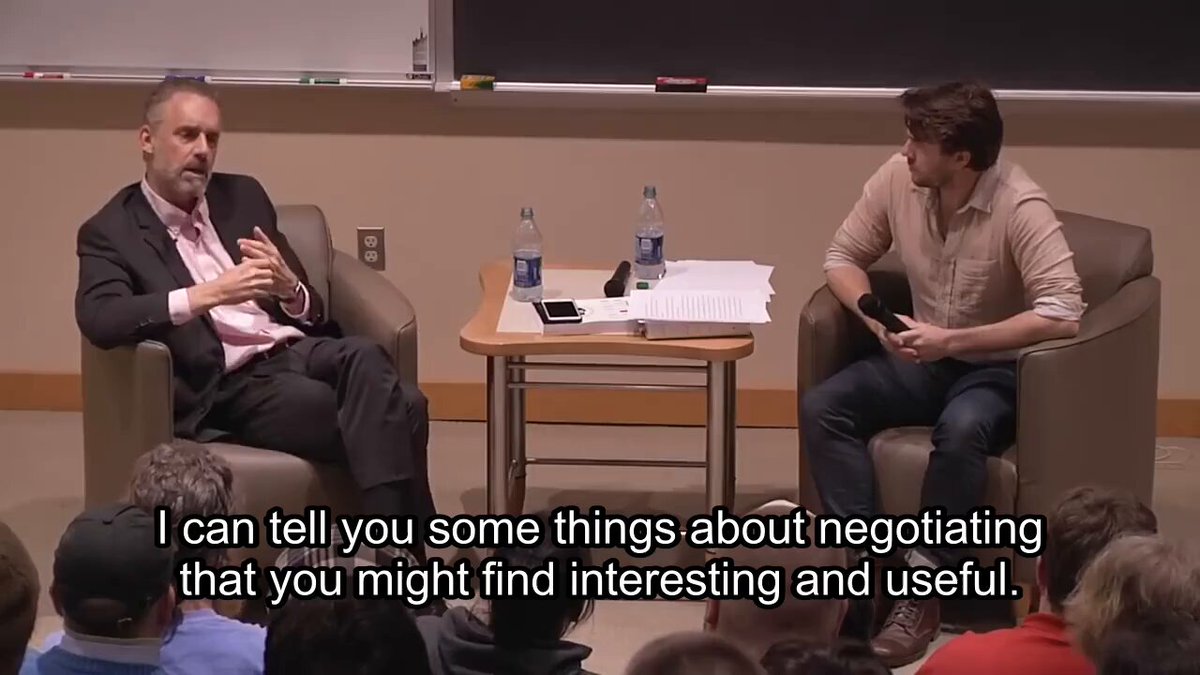
Jordan Peterson: "If you're competent and silent you will be ignored." "You might think well people should reward you because you're competent. And yes of course they should. But if you're competent and silent then you're just part of the background that's keeping everything functioning" On why you cannot negotiate from a position of weakness: "If you want to push your career forward you have to push it forward. You have to be competent and you have to be strategic" "To be strategic when you negotiate for a new position or a new salary you have to be able to say if you don't give me what I want then something you don't like will happen to you" "It's not a physical threat. It's that you have an option" "You have your CV in order. You're educated and competent and desirable to people outside of your immediate job. You're willing to instantly put yourself on the job market" "So that when you go talk to the person you're negotiating with you're credible" On the one thing most people completely miss about negotiation: "It's very seldom that you're talking to the person who's at the top of the pecking order. What you need to do is tell them a story that they can tell to their boss to make you not a problem" "A good story is look we really need this person because they're hyper competent and they have a better offer" "If you go in there with no power you're going to lose. Obviously" He concludes with the one thing every competent person needs to hear: "The first thing you need to know if you're going to negotiate is that you have to be able to say no. And what no means is that you're not going to do it"

Brad

34,992 views • 1 month ago

Interviewer: "Men cheating is way worse than women cheating." First Woman: "Men cheating is way worse than women cheating." Interviewer: "False. Why?" First Woman: "A man cheats without a reason. A woman always has a reason." Man in Mesh Top: "When a man cheats, it's because he's thinking about one thing and that's all it is. A woman has to be fed up, tired, done, before she emotionally even gets close enough to a man for her to want to cheat with him." Third Speaker (Guy in street): "Men and women cheat for different reasons. Men cheat because they're impulsive James J. Sexton: "I mean, I got to tell you, I don't like the phrasing of it, but I can't argue with the concept." Host: "Really? I thought you were going to disagree with that one. James J. Sexton: "No, I mean, look, I don't think the way they parsed it is correct, which is that women never like, men, it's always an impulsive act, and women, it's never an impulsive act. Because I think sometimes alcohol gets involved, and sometimes people make bad decisions. But I will say that, yeah, I mean, I have had a lot more women I've dealt with a lot of, I've had a lot of clients that have cheated that were male, a lot of clients that have cheated that were women, okay? And have been caught, or who left for the paramour or whatever it might be. So I've seen this from every angle. I represent the cheater and the cheated-on. I've really been through all of the permutations of this." "A lot of the men, by an order of magnitude, say, 'Yeah, this had nothing to do with my wife. This was just like, yeah, I was just distracted. It was like a shiny object and I went after it. Like it really was like a moment of weakness.' Or it was like, 'Yeah, I just like, I don't know, I wasn't getting enough s*x, and I didn't have the courage to have the conversation about that, so I just ended up meeting my needs outside of...' Host: "But isn't that a reason?" James J. Sexton: "Of course! I mean, there's a chapter in my book called 'Go Without or Go Elsewhere.'" Host: "Yeah." James J. Sexton: "Which basically says like, if your partner's not meeting your needs sexually, you either have to go without which no one likes or go elsewhere, which always ends in bad things. So the goal should be to try to keep your relationship in a place where you don't ever have to go without or go elsewhere, where you can share with your partner what it is that you need s*xually, and openly and honestly have discussions about how you can meet each other's sexual needs, especially if you've decided, 'We are going to only sleep with each other'bwhich you don't have to decide! But you've decided that. So if you've decided that, and you've said, 'You're the only person allowed to do this job,' then take the job seriously and try to be good at it. Because if you're the only person if you're saying to me,'The only person I'm allowed to sleep with is you,' then you have to sleep with me. That's how that works! Because otherwise, we're going to delegate that responsibility to somebody else. Because the other option is just 'go without,' and nobody wants to go without."
3:12

Sensitive content

Interviewer: "Men cheating is way worse than women cheating." First Woman: "Men cheating is way worse than women cheating." Interviewer: "False. Why?" First Woman: "A man cheats without a reason. A woman always has a reason." Man in Mesh Top: "When a man cheats, it's because he's thinking about one thing and that's all it is. A woman has to be fed up, tired, done, before she emotionally even gets close enough to a man for her to want to cheat with him." Third Speaker (Guy in street): "Men and women cheat for different reasons. Men cheat because they're impulsive James J. Sexton: "I mean, I got to tell you, I don't like the phrasing of it, but I can't argue with the concept." Host: "Really? I thought you were going to disagree with that one. James J. Sexton: "No, I mean, look, I don't think the way they parsed it is correct, which is that women never like, men, it's always an impulsive act, and women, it's never an impulsive act. Because I think sometimes alcohol gets involved, and sometimes people make bad decisions. But I will say that, yeah, I mean, I have had a lot more women I've dealt with a lot of, I've had a lot of clients that have cheated that were male, a lot of clients that have cheated that were women, okay? And have been caught, or who left for the paramour or whatever it might be. So I've seen this from every angle. I represent the cheater and the cheated-on. I've really been through all of the permutations of this." "A lot of the men, by an order of magnitude, say, 'Yeah, this had nothing to do with my wife. This was just like, yeah, I was just distracted. It was like a shiny object and I went after it. Like it really was like a moment of weakness.' Or it was like, 'Yeah, I just like, I don't know, I wasn't getting enough s*x, and I didn't have the courage to have the conversation about that, so I just ended up meeting my needs outside of...' Host: "But isn't that a reason?" James J. Sexton: "Of course! I mean, there's a chapter in my book called 'Go Without or Go Elsewhere.'" Host: "Yeah." James J. Sexton: "Which basically says like, if your partner's not meeting your needs sexually, you either have to go without which no one likes or go elsewhere, which always ends in bad things. So the goal should be to try to keep your relationship in a place where you don't ever have to go without or go elsewhere, where you can share with your partner what it is that you need s*xually, and openly and honestly have discussions about how you can meet each other's sexual needs, especially if you've decided, 'We are going to only sleep with each other'bwhich you don't have to decide! But you've decided that. So if you've decided that, and you've said, 'You're the only person allowed to do this job,' then take the job seriously and try to be good at it. Because if you're the only person if you're saying to me,'The only person I'm allowed to sleep with is you,' then you have to sleep with me. That's how that works! Because otherwise, we're going to delegate that responsibility to somebody else. Because the other option is just 'go without,' and nobody wants to go without."

Hecto Crypto | NetLink ⛓

232,922 views • 1 month ago

Steve Jobs on how he learned to run a company: Question: "You're 21. You're a big success. You know, you've just sort of done it by the seat of your pants. You don't have any particular training in this. How do you learn to run a company?" Steve Jobs: "You know, throughout the years in business, I found something, which was that I always ask why you do things. And the answers you invariably get are, oh, that's just the way it's done. Nobody knows why they do what they do. Nobody thinks about things very deeply in business. That's what I found. I'll give you an example. When we were building our Apple I's in the garage, we knew exactly what they cost. When we got into a factory in the Apple II days, the accounting had this notion of a standard cost, where you'd kind of set a standard cost and at the end of a quarter you'd adjust it with a variance. And I kept asking, well, why do we do this? And the answer was, well, that's just the way it's done. And after about six months of digging into this, what I realized was the reason you do it is because you don't really have good enough controls to know how much it costs. So you guess, and then you fix your guess at the end of the quarter. And the reason you don't know how much it costs is because your information systems aren't good enough. But nobody said it that way. And so later on, when we designed this automated factory for Macintosh, we were able to get rid of a lot of these antiquated concepts and know exactly what something cost to the second. So in business, a lot of things are, I call it folklore. They're done because they were done yesterday and the day before. And so what that means is if you're willing to sort of ask a lot of questions and think about things and work really hard, you can learn business pretty fast. It's not the hardest thing in the world. It's not rocket science. It's not rocket science."

Founder Mode

32,290 views • 6 months ago

Rick Rubin: "Make what you love, not what you think people will like" "If you want to live in a creative way, which will benefit everything in your life, be a better person in your family, do a better job starting a new business, it's all the same. I don't really know anything about music. It's more a way of looking at the world and wanting it to be the best it could possibly be. And doing whatever it takes to be the best it could possibly be." Rubin shares how his career happened: "From the beginning, I never thought any of the things I'm doing were possible or realistic. I just did things out of the love of them, thinking I would have real jobs. That my passion would be my hobby, and I'd have a job to support my hobby. And it just magically turned out different than that without me knowing it was possible." On why some things connect and others don't: "The stars line up at certain times for certain things to happen. Sometimes you can make something great, and it doesn't connect for whatever reason. Sometimes you make two things you think are the two best things you've ever made. One of them connects with the world. One of them doesn't. And it might not have anything to do with what's in the art. It might be that it came out the same day as something else. Or there was a bigger story at the time. There's so much to it that we don't understand." He continues: "All we can do is make something good and put it out and hope for the best. That's all there is. We never know why things work. Even if you make a piece of art and it works, you may not know why." On talent versus work ethic: "There are a lot of talented people who never make it because they don't have the work ethic. It's not just talent, talent's a piece. And you could argue for some people, the work ethic trumps the talent." Rubin explains what real collaboration is: "Having worked with a lot of bands, I see there's often this friction where people are trying to get their idea in. That's not a collaboration. A real collaboration is when everyone who's there is working together towards whatever is the best thing for the whole. Whether it's your idea or someone else's idea, it doesn't matter. If you're invested in the collaboration, you want the best idea to win. You don't want your idea to win." On what makes art great: "What makes it great is the personal. With all of its imperfections. With all of its quirkiness. That's what makes it great. How you see the world that's different from how everyone else sees the world. That's why you're an artist. That's your purpose in sharing your work with the world." He warns against being derivative: "There are these derivative voices where they're finding what they think other people want to hear, and they start saying it because they've heard other people say similar things that are now successful. Even if they have some short-term success doing that, it's not revolutionary. It doesn't change the world. It doesn't last. The people who you first see and you might not like that you come to like because you don't understand them at first, those are the ones that change the world. Those are the ones you dedicate your fandom to for life." Rubin shares his philosophy on taste: "You can't second-guess your own taste for what someone else is going to like. We're not smart enough to know what someone else is going to like. To make something thinking, 'Well, I don't really like it, but I think this group of people will like it,' it's a bad way to play the game of music or art. You have to do what's personal to you. Take it as far as you can go. Really push the boundaries. And people will resonate with it if they're supposed to resonate with it." He describes creativity as catching waves: "We're really talking about magic. The universe conspiring on our behalf if we let it. Being in this flow of catching these waves that anyone can catch. If you're trying to catch it, you're open to it, you see it coming, you take off on every chance you get. And sometimes the ride happens. It's remarkable how it happens. It doesn't come from preconception. It's not an idea. It's through the doing." Rubin explains how ideas exist in the universe: "Have you ever had that experience where you have an idea for something, you don't do it, and then six months later you see someone else has done it? It's not because they took your idea. It's that it's time for that, and you can act on it or not. The best artists are the ones who have the best antenna for this material that's available. It's coming through. The best comedians see the best jokes. They see them coming. We all live in the same world; the way you see it, you have the best joke because you see it best." He closes with how to stay open: "If we listen to what's going on around us, you can overhear a conversation in a coffee shop, and it is the setup for an idea you're working on. You hear a phrase you don't commonly use. My experience is: when you are open and looking for these clues in the world, they're happening all the time. And they're happening often right when you need them."

Jaynit

109,182 views • 5 months ago