正在加载视频...

视频加载失败

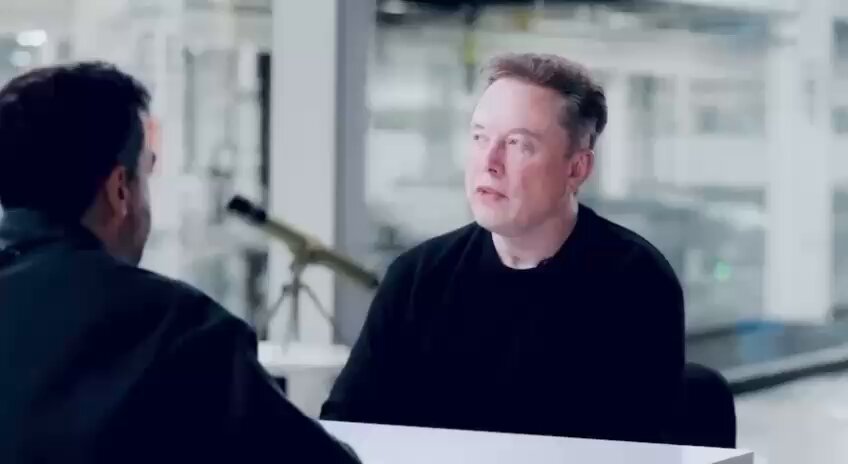
Elon Musk says working will be "optional" soon. Robots and AI will eliminate non-physical jobs, creating a "Universal High-Income" where everyone gets what they want. But a Yale paper shows the economics behind his prediction are far more brutal than he suggests. I'm talking about the paper titled "We...

44,173 次观看 • 9 个月前 •via X (Twitter)

0 条评论

暂无评论

原始帖子的评论将显示在这里

相关视频

Elon just told Zerodha founder Nikhil Kamath something insane about the future of work. And if he's right, everything we think about careers is about to collapse. In less than 20 years, Elon predicts working will be completely optional. Not shorter workweeks. Not four-day weeks... ZERO work required to survive. "My prediction is working will be optional, working at all will be optional. Like a hobby pretty much." He's saying AI and robotics will hit productivity levels so high that humans won't need jobs. Universal High Income replaces Universal Basic Income. Everyone gets what they need without working. And Elon says it could happen in as little as 10-15 years. Not some distant sci-fi future. Your kids graduating college right now might enter a world where their degree is instantly obsolete. Not because they chose the wrong major. Because the CONCEPT of work-for-survival disappears. "If you can think of it, you can have it." AI produces everything. Robots manufacture everything. Humans? Optional in the production chain. When Nikhil asked about shorter workweeks, Elon shut it down: That's not the future. The future is NO workweeks. The Indian context makes this wild: India just hit below replacement fertility rate (under 2.1). Population declining for the first time. Everyone's panicking about "demographic dividend" disappearing. But Elon's saying: WHO CARES? One AI + robot can do the work of 1,000 humans. You don't need population growth when you have exponential productivity growth. The problem isn't "not enough workers." The problem is we're still thinking about economics like it's 1950. Here's what Elon told Indian entrepreneurs specifically: "Make more than you take. Be a net contributor to society." But if AI makes more than anyone can take... What does "contributor" even mean? The framework collapses. Elon also warned: when AI saturates all human needs, it starts doing things for ITSELF. Not for humans. AI and robotics producing for AI and robotics. We become the side quest. And nobody knows what happens in that world. Elon calls it the "singularity" - the point where you can't predict what's next. Like a black hole. You don't know what's past the event horizon. He's confident it's coming. Just not confident about what it looks like. And the crazy thing is, Elon's the only person with the track record to actually KNOW. He's building: - Tesla (real-world AI, FSD, Optimus robots) - SpaceX (the physical infrastructure) - xAI (the intelligence layer) He's not speculating from the sidelines. He's literally BUILDING the world he's describing. When someone like that says "work becomes optional in 15 years"... You don't laugh it off. You prepare for it. What does that preparation look like? Elon says: pursue truth, beauty, curiosity. Not money. Not status. Not promotions. Because those currencies lose meaning when goods and services are infinite. Your competitive advantage becomes: what can you think that AI can't? Not what you can DO. What you can THINK. And even that... might have a shelf life. This is either the biggest opportunity or the biggest threat humanity has ever faced. Elon's betting opportunity. But he admits that there's a chance this goes wrong. Very wrong. He references Star Trek vs. James Cameron movies. One's utopia. One's apocalypse. "Let's try for the Star Trek outcome." If Elon's right, we have 10-20 years before everything changes. That's one generation. Your kids won't work. Your grandkids won't even understand what "a job" meant. And the transition will be brutal. Elon admits: "severe social pain and structural chaos." Because we're not just changing jobs... We're changing what it MEANS to be human.

Ricardo

44,140 次观看 • 8 个月前

To be a successful founder, you have to believe that what you're working on is going to work — despite knowing it probably won't! That sounds like an oxymoron, but it's really not. Believing that what you're building is going to work is an essential component of coming to work with the energy, fortitude, and determination it's going to require to even have a shot. Knowing it probably won't is accepting the odds of that shot. It's simply the reality that most things in business don't work out. At least not in the long run. Most businesses fail. If not right away, then eventually. Yet the world economy is full of entrepreneurs who try anyway. Not because they don't know the odds, but because they've chosen to believe they're special. The best way to balance these opposing points — the conviction that you'll make it work, the knowledge that it probably won't — is to do all your work in a manner that'll make you proud either way. If it doesn't work, you still made something you wouldn't be ashamed to put your name on. And if it does work, you'll beam with pride from making it on the basis of something solid. The deep regret from trying and failing only truly hits when you look in the mirror and see Dostoevsky staring back at you with this punch to the gut: "Your worst sin is that you have destroyed and betrayed yourself for nothing." Oof. Believe it's going to work. Build it in a way that makes you proud to sign it. Base your worth on a human on something greater than a business outcome.

DHH

96,526 次观看 • 1 年前

Elon Musk just said the quiet part out loud about where AI actually ends up. Musk: “The honest answer for AI and robotics is long term working will be optional.” Long term meaning ten years from now or less. For centuries, human survival has required human labor. That is the oldest equation in civilization. You work or you don’t eat. You work or you lose the shelter. You work or you fall behind everyone who does. Musk is describing the end of that equation entirely. Musk: “If you wanna work you can. Kind of like if you grow vegetables, you can grow vegetables in your garden or you can get them from the store.” The analogy is quieter than the claim deserves. Growing your own vegetables is something people do for joy. For ritual. For the satisfaction of making something with their hands. Not because they would starve otherwise. That is what work becomes. Musk: “It’s extra work to grow your own vegetables but people enjoy the process. That’s gonna be how work is in the future.” When AI and robotics scale to their limit, the cost of physical goods and services collapses toward zero. Labor stops being the mechanism that separates people who survive from people who don’t. What happens to human motivation when survival is no longer the reason to get up? That is the question nobody building this technology has answered. The abundance is coming. The crisis of meaning is coming with it. Musk is describing the greatest liberation in human history. He is also describing the greatest identity crisis our species has ever faced. Both arrive on the same timeline. Ten years or less.

Dustin

101,994 次观看 • 5 个月前

Mary Barra, Chairman and CEO of General Motors, on the single most underrated trait that separates high performers from everyone else: It's not intelligence, experience, or even talent. She is direct about it: "In my experience, in school and career, at work and at play, there are lots of talented people out there. But talent alone isn't enough. You need something more." That "something more" is what most people overlook entirely. "One thing that distinguishes those who really make a difference in life, those who really contribute, is passion and hard work. Remember, hard work beats talent, if talent doesn't work hard." But Mary Barra takes it further than just working hard. Because working hard quietly, passively, and waiting for your turn doesn't move the needle either. Most people operate on the edges. They show up, do the work they're assigned, and wait to be noticed. Barra says that mindset is exactly what holds people back: "Don't be content to work around the edges of your profession. Don't wait to be invited to important meetings or asked to work on crucial assignments. Instead, do what it takes to ensure that you're in the middle of your business." The underrated trait is proactive hard work, not just hard work alone. "Speak up, volunteer, show your enthusiasm, knock on doors." And the compounding effect of that behaviour is significant at every level of an organisation: "As an employee, your enthusiasm will make your job more interesting and get you noticed. As a manager, your passion will inspire others to join your team and work as hard as you to accomplish great things." The people who consistently rise are the ones who stopped waiting for permission and started showing up like the work already mattered to them, because it always did.

Big Brain Business

391,186 次观看 • 4 个月前

Friedberg’s Ideal Immigration Test: Worker or Welfare? (Or Makers vs Takers) “I'm all about discerning immigration, not on the lines of some cultural definition, but really around that simple framing of are you going to get social support services or are you going to work? Going back to my makers vs takers point, if the primary motivation for an individual to come to this country is to be given benefits, to be given payments, to be given social services, to be given support, I think that that person should be denied immigration. If the primary motivation for the individual to come to the United States is to work to progress themselves, to become a maker, to create things, to work in such a way that they can generate income, save capital, buy things, advance their family's position because they are denied those rights due to the tyranny of the place that they're coming from, then they should be granted immigration status to come to this country and contribute. Because at the end of the day, what people may not like to hear, which is the truth, is that every single one of those people is actually net positive in growing our economy. And everyone thinks it's a zero-sum game with respect to jobs in the United States, and we shouldn't let people into this country that create jobs. But the fundamental truth is that anyone that is productive, meaning they create more value than they take in, grows the economy and more jobs get created, and overall, we all benefit from having those individuals here in this country. And by the way, if you are going to work, you are going to culturally assimilate, because that is what the United States is based on, which is productivity, work hard, create things, and have individual agency, have the ability to progress yourself in this world, in this society. And if you take advantage of that opportunity, you're going to love the American ideals that this country was founded upon.”

The All-In Podcast

54,862 次观看 • 1 个月前

🚨HARSH TRUTH: AI WILL TAKE YOUR JOB!!! And Elon Musk thinks that might actually be a good thing. Sounds crazy at first. But his logic is simple. Most people don’t work because they love their job. They work because they have to. Rent. Food. Bills. That’s the deal. Your job was never really your dream. It was the price of survival. Elon believes AI and robots could eventually break that deal. And he’s not just talking about it. He’s actively building the technology that could make it happen. Tesla is building Optimus, a humanoid robot designed to do physical labor. Tesla’s AI is being trained to automate more and more real world tasks. Starlink is bringing internet to places that never had access before. And SpaceX is pushing the cost of launching things into space lower than ever. All of this points to one direction. A world where machines produce far more than humans ever could. If machines produce almost everything, the cost of producing things collapses. And when production becomes incredibly cheap, the cost of living drops with it. Elon compares the future of money to air. Nobody checks their bank account to see if they still have air. It’s just there. One day, he believes money could feel the same way. He calls it Universal High Income. Not just survival payments. A world where the basics of life become abundant. Food. Housing. Healthcare. But Elon isn’t celebrating this future. He’s worried about something else. Because once machines can do everything better than humans, money stops being the biggest problem. The real problem becomes meaning. For most people, work is where their sense of value comes from. Their role. Their identity. Their reason to feel useful. Take that away and a lot of people won’t know who they are. As Elon once said: “If the computer can do everything better than you, does your life have meaning?” AI might solve the money problem. But it could create the biggest meaning crisis in human history.

Evan Luthra

23,003 次观看 • 5 个月前