Загрузка видео...

Не удалось загрузить видео

На главную

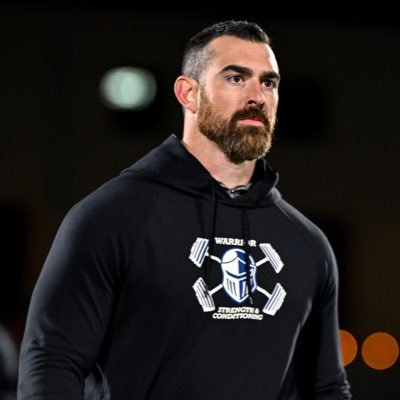
Energy system prep for FB season: interval sled competition Each team has to push 200|400 yards(depending on load). 5 second pushes match FB play length. Groups of 7 give a 30s rest to 5s work ratio. Set winners get points which = full effort pushes. Smart, tough, effective.
24,242 просмотров • 2 лет назад •via X (Twitter)

Комментарии: 10

Фото профиля Jesse Smitherman
Jesse Smitherman2 лет назад

Great times!

Фото профиля David Neill
David Neill2 лет назад

Spent a lot of hours on those sleds

Фото профиля Brandon Davis, CSCS
Brandon Davis, CSCS2 лет назад

Those sleds are sweet. I love homemade equipment

Фото профиля Coach Regular
Coach Regular2 лет назад

This may be the first time I’ve heard energy systems being used in football. It’s refreshing. How many reps would each player get?

Фото профиля David Neill
David Neill2 лет назад

When we program just sets and reps we build to 8 reps per set, 5s each. Problem is the effort level drops when theres not a competitive aspect. So when we rep 200-400 yards each athlete gets btw 4-8 reps per set.

Фото профиля Michael Aguilar
Michael Aguilar2 лет назад

Love these 🔥🔥🔥

Фото профиля Keri Timmerman
Keri Timmerman2 лет назад

Looks familiar! Good stuff

Фото профиля Speed & Hurdle Coach
Speed & Hurdle Coach2 лет назад

How is load determined? What energy system are you targeting?

Фото профиля David Neill
David Neill2 лет назад

Anaerobic work capacity. Load is determined by our training week and rep distance. In a perfect world we would match load to player strength/weight but it doesn’t make sense in a team setting with wide ability differences. Also in a perfect world we would build set length…

Фото профиля El Kloppo
El Kloppo2 лет назад

Yes. Smart.

Похожие видео

5 Baseline Out Of Bounds Plays That Get Buckets! This video goes beyond lines on a page. It will give you the key teaching points that lead to game-time execution. These plays come from state champion high school and veteran college coaches across the country. They have used these plays successfully for years, and will teach you the nuances that make them successful. Each play has a variety of scoring options, making your team difficult to defend. How many games are decided by less than 5 points? By adding these plays to your arsenal, you can "steal" a couple more baskets a game and a couple more wins this season! These 5 plays include: -A play from a triangle set that pairs a screen-the-screener action and a stagger screen. -A box set that involves multiple stagger screens. -A play from an offset formation that uses a back screen to set up a stagger screen with a slip. -A play that uses a double screen to set up multiple curls with a final screening action towards the rim. -A box set that utilizes multiple screens to bring 3 players back to the ball as scoring options. Add these to your playbook and you'll go beyond settling for "just getting it in" and will see every BLOB as a scoring opportunity! The plays in this video come from: -Play 1 - The Screening Game Offense With Bob Martin -Play 2 - The Hybrid Attack Offense With Ryan Schultz -Play 3 - Complete Offensive System With Tim Schuring -Play 4 - The Coaching System With Danny Miles -Play 5 - The Youth Coaching System With Jim Huber

Joe Haefner | Breakthrough Basketball

46,133 просмотров • 1 год назад

The Sameer Project x Translating Falasteen (Palestine) has 53 full-time team members on the ground in Gaza. This team has shown determination and consistency for over a year now. Our work changes everyday and includes huge risks. The team members would risk their lives to deliver water and food to the most underserved areas like Shujaiyah, Jabalia, Beit Lahia & Rafah. Losing loved ones is a constant and the whole team lost their homes but despite their losses, they are focused on serving the community. The Sameer Project team in Gaza and abroad doesn’t feel like a work project but rather a family that’s serving its community. Our whatssap groups are full of jokes and funny stickers. We’ve cried and laughed together, challenged each other, and at times even fought with each other. And that only got us closer. As a thank you to the ground team, they got care packages that included 5 kilos of vegetables: tomatoes, potatoes, cabbage, peppers & eggplants (sourced from local farms). The package cost $51. The Refaat Alareer camp cleaners Saher & Karam got an extra 3 kilos of vegetables each. This cost $2,776. The initiatives team also got multivitamin packs ($9.3 each) and 5 packs of peanut butter for protein ($12.5 for 5 packs). All our projects require physical power and working in the heat, which is extremely difficult during a genocide and a famine. For 30 team members, the cost of the multivitamins and peanut butter was $654. With vegetables, the total cost $3,430. Thank you for helping the helpers and we hope to keep serving our community. Donate to the South & North campaigns to support our work.

The Sameer Project

13,834 просмотров • 1 год назад

Tony Dungy said, "You've got to have talent to win a championship, but that's not number 1." "That team (that won the SB) worked the hardest, stuck together the most, (and) was willing to pay the price to overcome adversity." How to Build a 𝐂𝐎𝐌𝐌𝐈𝐓𝐓𝐄𝐃 𝐓𝐄𝐀𝐌:🧵 1. Set standards, not just goals - It means creating expectations for daily habits, effort, and accountability - not just focusing on end results. Standards guide how the team operates, ensuring consistency and discipline. Success isn't built on goals alone; it's built on the habits that make goals achievable. 2. Build trust and connection - It means creating an environment where teammates feel safe, respected, and valued. Trust allows teams to communicate openly, rely on one another, and face challenges together. A connected team doesn’t just work side-by-side - they work for each other. 3. Set a clear purpose and vision - It means every team member understands why they are showing up and what they are working toward. A clear purpose keeps everyone aligned and motivated. Teams with purpose don’t just work - they work with intention and focus. 4. Embrace hard work - It means showing up every day ready to give your best effort, even when it’s tough. Hard work matters builds discipline, confidence, and progress over time. The teams that succeed are the ones that live the details, do the work consistently, and never settle for "good enough". 5. Build a resilient mindset in everyone - It means building a mindset within the team wants to overcome adversity. Every team faces adversity, but the committed teams don't falter when they face setbacks. They choose to grow, learn, and improve when looking at challenges. 6. Put the team first - It means putting the team’s goals ahead of your own personal desires. Committed teams personify WE over Me. This matters because when everyone sacrifices for the team, trust and unity grow stronger. True commitment shines when individuals support each other, share the workload, and celebrate team success over personal recognition.

Coach AJ 🎯 Mental Fitness

34,960 просмотров • 1 год назад

I have a pi-day challenge for all the physics students among you (or anyone willing to set up an experiment). If you share your results with me by March 10th, I may feature them in a video, depending on how good the results are and how many I get. Many years ago I made this video about how two colliding blocks on a frictionless plane can compute pi. My challenge to you is simple: Implement this in practice. The original puzzle assumes zero friction and zero energy loss in collisions, so obviously there are limits to how far you can get. I can tell you the real limiting factor is energy lost in collisions, more so than friction. Also, it's a wildly inefficient way to compute pi, to even get "3.14" you'd need this to work with a 10,000-to-1 mass ratio and have a way to count all 314 collisions. Matt Parker and I actually gave this a go, and the results were...okay, but could definitely have been improved :) Note, there's no reason to restrict yourself to powers of 100. For example, you could use powers of 4 to compute pi in binary. A mass ratio of 64-to-1 should give 25 collisions, which is 11001 in binary, and pi looks like 11.001... More generally, with a mass ratio of N-to-1, the number of collisions is around π / arctan(1 / sqrt(N)). So any big mass ratio gives you an approximation of pi by multiplying the number of collisions by arctan(1/sqrt(N)) If you do this, you can reach out to the channel via this page: Be sure to have a link to footage of the experiment. If anyone can get it to work with 100-to-1, I'd be happy, and if anyone can do it for 10,000-to-1, I'd be both delighted and amazed.

Grant Sanderson

177,775 просмотров • 1 год назад

Mojo Australian Open Quarterfinals 🧙🏼‍♂️🇦🇺🎾 —— 5U MAX 2026: (18-3) 85.71% 🏦 —— 5U 🇺🇸Ben Shelton +7.0 games (-155) 🔮 Seven games for Shelton when he is arguably playing the best tennis of his career is too many. Shelton has only been broken 3 times this entire tournament and has played better overall players by a landslide than Sinner. Shelton has hit 184 winners to 115 unforced errors in his 4 matches in Melbourne. This stat alone shows the quality of tennis Shelton has been playing. Sinner has hit 152 winners to 99 unforced errors. Shelton has a slight advantage in winners/unforced errors ratio while playing better opponents… And we are getting 7 games. Look, I know Sinner is insane and I know the history between these two players. I will tell you I have watched Shelton play shout 100 matches of professional tennis and the confidence he is playing with right now is unlike anything I have seen from him. While on the contrary Sinner has not looked anything above his typical level. Give me the 7 games. Even if Shelton gets broken once in every single set, we still cover or push. 6-3 6-4 6-4 | 6-4 6-4 6-4 . And this is assume we don’t get any break chances of our own. If Shelton can confidently hold serve like he has been doing all tournament then it will open the door for him to be hyper aggressive on return and go for shots that will win him the match. I love this play. Let’s get it 🧙🏼‍♂️

MOJO 🧙🏼‍♂️

37,303 просмотров • 6 месяцев назад

Nick Saban has always asked this question about Leadership... "How many guys on the team need to be led?" Coach Saban believed in the power of Collective Leadership with his teams. 1. Are most players on your team bought in? 2. Do most players on your team set a good example? These players do not need someone to impact or influence them if they are already making these choices and leading by example. This is the power of collective leadership. Collective leadership is vital to successful teams. I believe there are 7 types of Collective Leaders that all teams need: 1. The GAMER - When the game is on the line. Who does the team look to? Who wants the ball in their hand? It is the Game Leader. They don't "have" to lead in other ways, but it would be best if they did. This player is often the ultimate competitor on the team. 2. The WORKER - Winning Teams have Practice Leaders. They bring energy and focus to each practice. They ensure competitive and strong practices. They Lead by Example. You practice much more than you play. 3. The GATEKEEPER - This leader ensures the Team Culture is Maintained. They put out the fires. They keep the team accountable. Especially when the coach is not there. They are essential in WINNING Teams. 4. The COMMUNICATOR - It is a long season. There will be difficult days. Teams need the Communicator to get through these tough days. They often provide humor and can lighten the mood. They have high Emotional Intelligence. This is an Underappreciated Leader. 5. The CONNECTOR - These players are often your “glue” players. They keep the team connected on the court or field as well as in the locker room and in social settings. 6. The ENERGY GIVER - The Energy Giver brings Positive Energy Every Day! Their Energy is Contagious! This leader knows that nothing great can be accomplished without Enthusiasm. The Energy Leader brings positive energy each day. They feed the team! 7. The SERVER - Finally, the Server embodies Servant Leadership. They are all about the TEAM. They bring a WE-first mentality to all they do. Their focus on the TEAM creates a contagious WE>ME mentality throughout the team. Collective Leadership WINS. _____ Follow me for more actionable ideas on coaching, leadership, and personal growth. Subscribe to my newsletter, 🏆 Great Teams Better Leaders 123. Find it for free in my profile above.

Greg Berge

196,705 просмотров • 2 лет назад

RHP Matt Scott (Stanford Baseball) is one of the premier college arms in this year's Draft. After a solid Freshman season that was split between the bullpen and the rotation, Scott this year anchored the Stanford rotation and collected a career-high 103 strikeouts against 36 walks across 80 innings. Earned a Team USA invite for the second straight summer. Scott has an XL, workhorse frame at 6-foot-7 and 247-pounds with plenty of strength and physicality throughout. Quiet, "checkpoint-like" delivery. Small side step towards 1B side, gathers himself and breaks into the rest of his operation. Attacks from a high-three quarter slot. Low effort, does a nice job of staying connected and in-sync for someone of his stature. FB sits in the 93-96 range, but will routinely touch 97/98. Tons of carry through the zone, averaged 22.5" of IVB last year. At its best when located in the top-1/2 of the zone, which is also where it generates most of its whiffs. Just needs to stay out of the middle. Threw it 62% of the time and generated a pretty impressive miss rate of 26%, though I think it can become even more effective if he's able to hone in on his command of it. 55 pitch right now, eventual 60 if some of the low hanging fruit is cleaned up. Supplements his FB with a mid-to-upper-80s gyro SL. I actually think Scott's feel for the SL is on par, if not better, than his feel for the heater. Effective against both right and lefthanded hitters. True, hard gyro look against LHH. Will flash more two-plane tilt against RHH with some sharpness to it. Another 55 pitch that last year had a 40% miss rate. Scott needs to up the usage on his split-change. Threw it just 6% of the time last year and I think it's his best secondary pitch. Legit weapon against LHH. Averaged nearly 12 MPH off his FB and he does an excellent job of killing spin on it; averaged 866 RPMs last season. Essentially falls off a table as it approaches the plate. Serious tumbling life with a bit of arm side fade. 48% miss across a limited sample in '24, I'd give it a 60. Command and control are both average, if not a tick above. Little-to-no reliever risk. Really like the body and stuff. Projects to be one of the first few college arms off the board this July and is a potential first-rounder.

Peter Flaherty III

23,661 просмотров • 1 год назад